Artificial Intelligence, Machine
Learning,Deep Learning
Mojammel Haque Mithu
AI Researcher & Developer @ SemanticsLab
mojammelbrur@gmail.com
May 06, 2019
Outline
 What is AI?
 What is Machine Learning?
 Types of Machine Learning
 Machine Learning Algorithms
 What is Deep learning?
 Machine Learning vs Deep learning
 Basic neural network
 Forward pass and Backward pass
 Convolution Neural Network(CNN) with example
What is Artificial intelligence (AI)?
 Artificial intelligence (AI) is the simulation of human
intelligence processes by machines, especially computer
systems.
 These processes include learning (the acquisition of
information and rules for using the information), reasoning
(using rules to reach approximate or definite conclusions) and
self-correction.
 Particular applications of AI include expert systems, speech
recognition and machine vision.
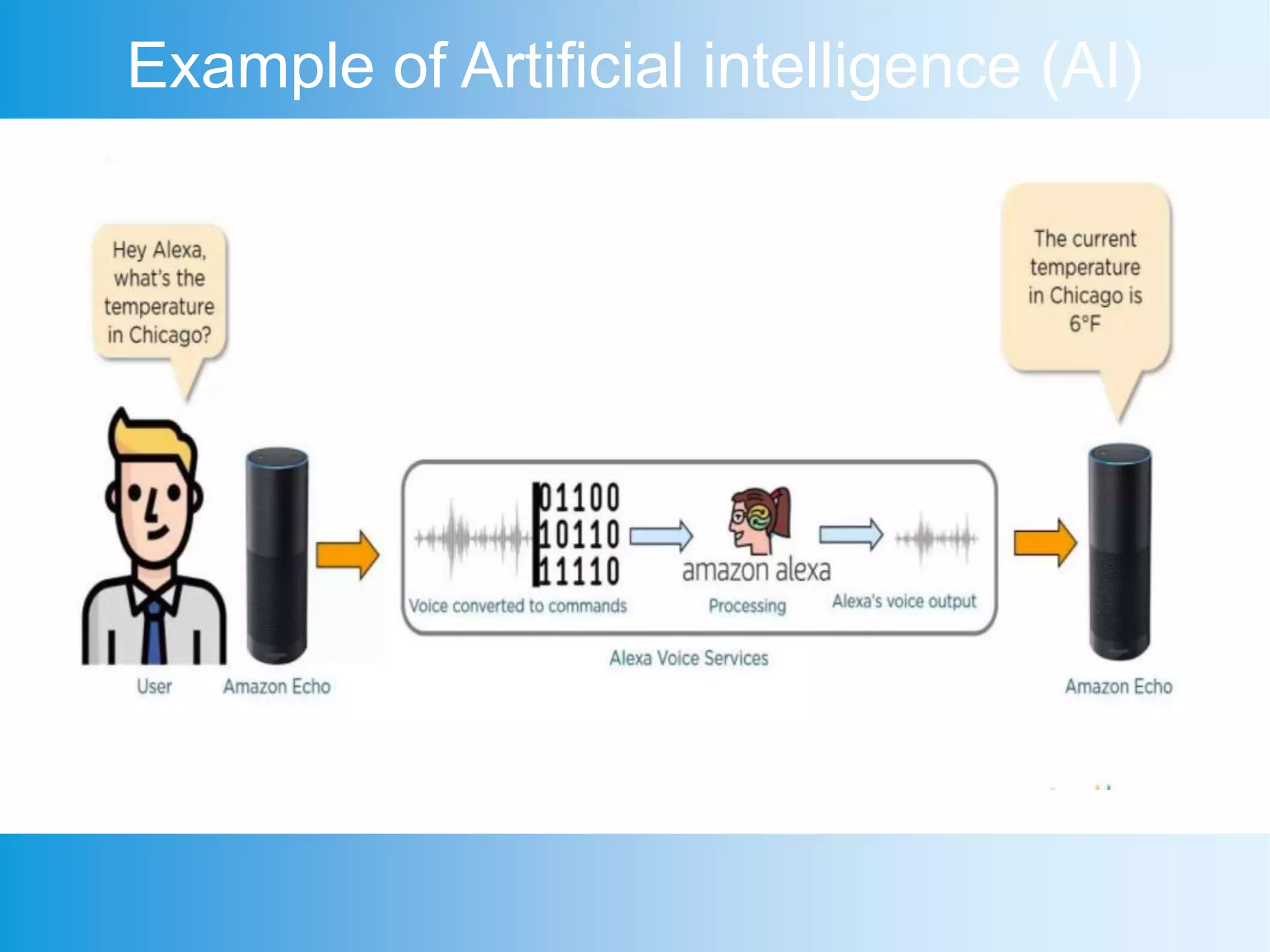
Example of Artificial intelligence (AI)
What is Machine Learning?
 Machine Learning is a field of computer science
that gives computer systems the ability to
“learn” (i.e progressively improve performance
on specific task) with data, without being
explicitly programmed.-WIKI
Example of Machine Learning
 Mars rover
Types of Machine Learning
Machine Learning Algorithms
1. Linear Regression
2.  Logistic Regression
3. Linear Discriminant Analysis
4. Classification and Regression Trees
5. Naive Bayes
6. K-Nearest Neighbors
7. Learning Vector Quantization
8. Support Vector Machines
9. Bagging and Random Forest
10. Boosting and AdaBoost
Support Vector Machine
Support Vector Machine is supervised machine learning algorithm
which is mostly used in classification problems. we perform
classification by finding the hyper-plane that differentiate the two
classes very well.
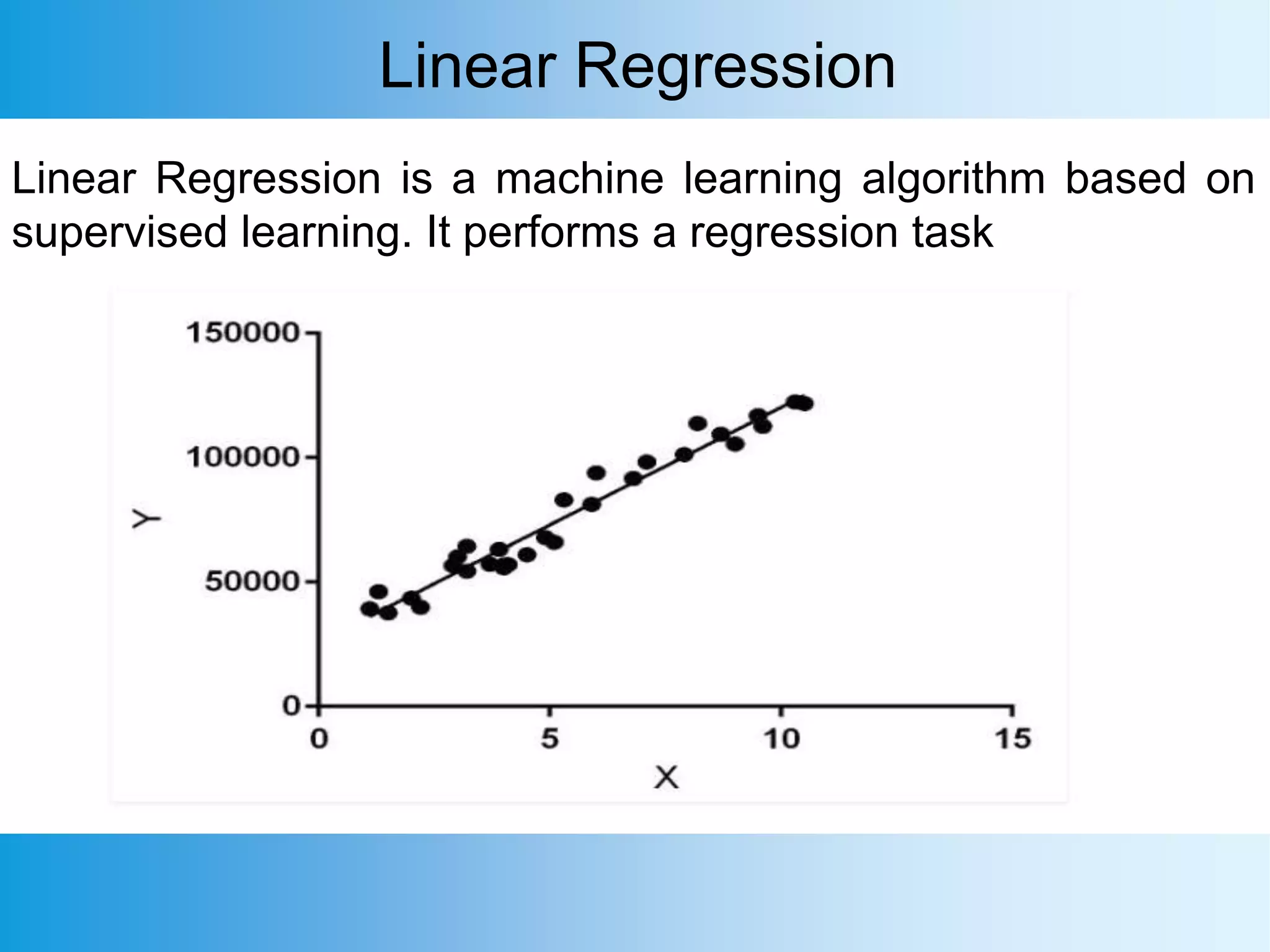
Linear Regression
Linear Regression is a machine learning algorithm based on
supervised learning. It performs a regression task
K-Nearest Neighbors
 The KNN algorithm assumes that similar things exist in
close proximity. In other words, similar things are near to
each other.
What is Deep learning?
 Deep Learning is a subfield of machine learning
concerned with algorithms inspired by the
structure and function of the brain called
artificial neural networks.
What Deep Learning can do?
1. It can also prescribe medicine used in medication.
2. Computer vision and pattern recognition
3. Robotics — Deep Learning systems have been taught to play games
and even made to taught WIN games.
4. Facial recognition
5. Precision agriculture
6. Fashion technology
7. Autonomous vehicles
8. Drone and 3D mapping
9. Post estimation in Sports analytics & Retail markets
10.Security & Surveillance
Machine Learning Vs Deep Learning
 The key difference between deep learning vs machine
learning stems from the way data is presented to the
system.
 Machine learning algorithms almost always require
structured data, whereas deep learning networks rely
on layers of the ANN (artificial neural networks).
Machine Learning Vs Deep Learning
Structure of a simple neural network
Feed-Forward Networks
• Predictions are fed forward through the network to
classify
17
Feed-Forward Networks
• Predictions are fed forward through the network to
classify
18
Feed-Forward Networks
• Predictions are fed forward through the network to
classify
19
Feed-Forward Networks
• Predictions are fed forward through the network to
classify
20
Feed-Forward Networks
• Predictions are fed forward through the network to
classify
21
Feed-Forward Networks
• Predictions are fed forward through the network to
classify
22
Error Backpropagation
• We will do gradient descent on the whole network.
• Training will proceed from the last layer to the first.
23
Error Backpropagation
• Introduce variables over the neural network
24
Error Backpropagation
• Introduce variables over the neural network
– Distinguish the input and output of each node
25
Error Backpropagation
26
Error Backpropagation
27
Training: Take the gradient of the last component and iterate backwards
Error Backpropagation
28
Empirical Risk Function
Error Backpropagation
29
Optimize last layer weights wkl
Calculus chain rule
Error Backpropagation
30
Optimize last layer weights wkl
Calculus chain rule
Error Backpropagation
31
Optimize last layer weights wkl
Calculus chain rule
Error Backpropagation
32
Optimize last layer weights wkl
Calculus chain rule
Error Backpropagation
33
Optimize last layer weights wkl
Calculus chain rule
Error Backpropagation
34
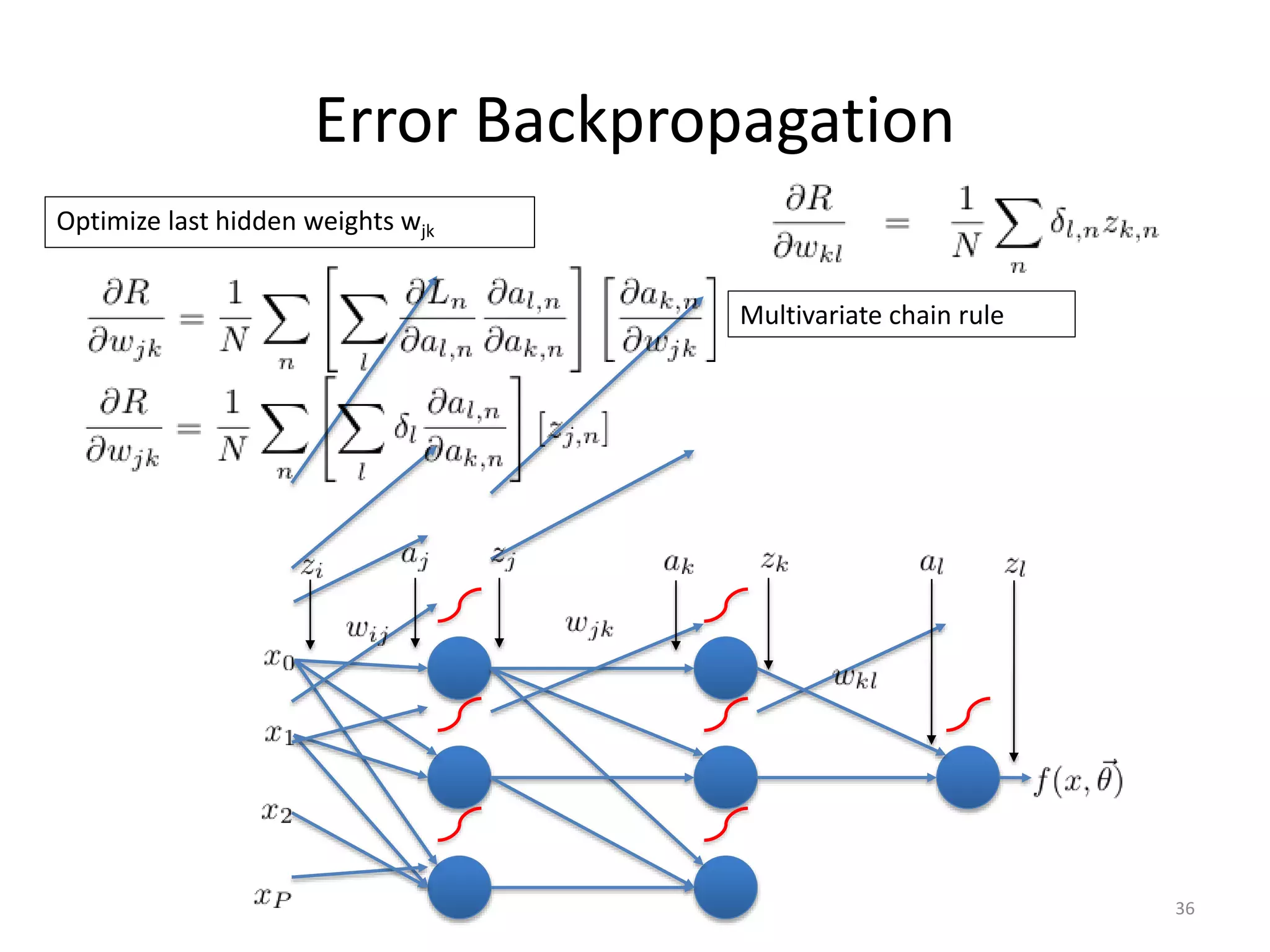
Optimize last hidden weights wjk
Error Backpropagation
35
Optimize last hidden weights wjk
Multivariate chain rule
Error Backpropagation
36
Optimize last hidden weights wjk
Multivariate chain rule
Error Backpropagation
37
Optimize last hidden weights wjk
Multivariate chain rule
Error Backpropagation
38
Optimize last hidden weights wjk
Multivariate chain rule
Error Backpropagation
39
Repeat for all previous layers
Error Backpropagation
40
Now that we have well defined gradients for each parameter, update using Gradient Descent
Error Back-propagation
• Error backprop unravels the multivariate chain rule
and solves the gradient for each partial component
separately.
• The target values for each layer come from the next
layer.
• This feeds the errors back along the network.
41
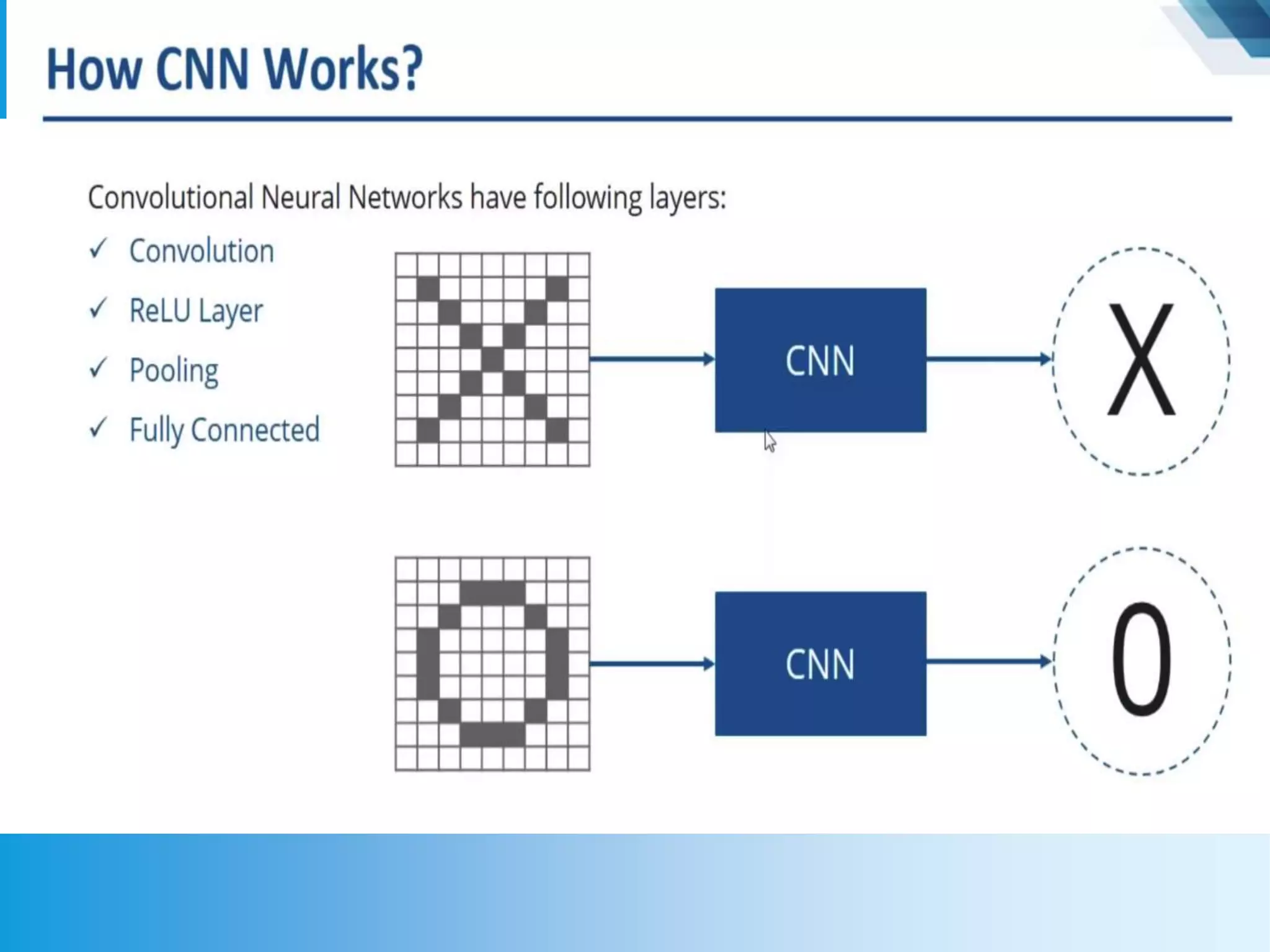
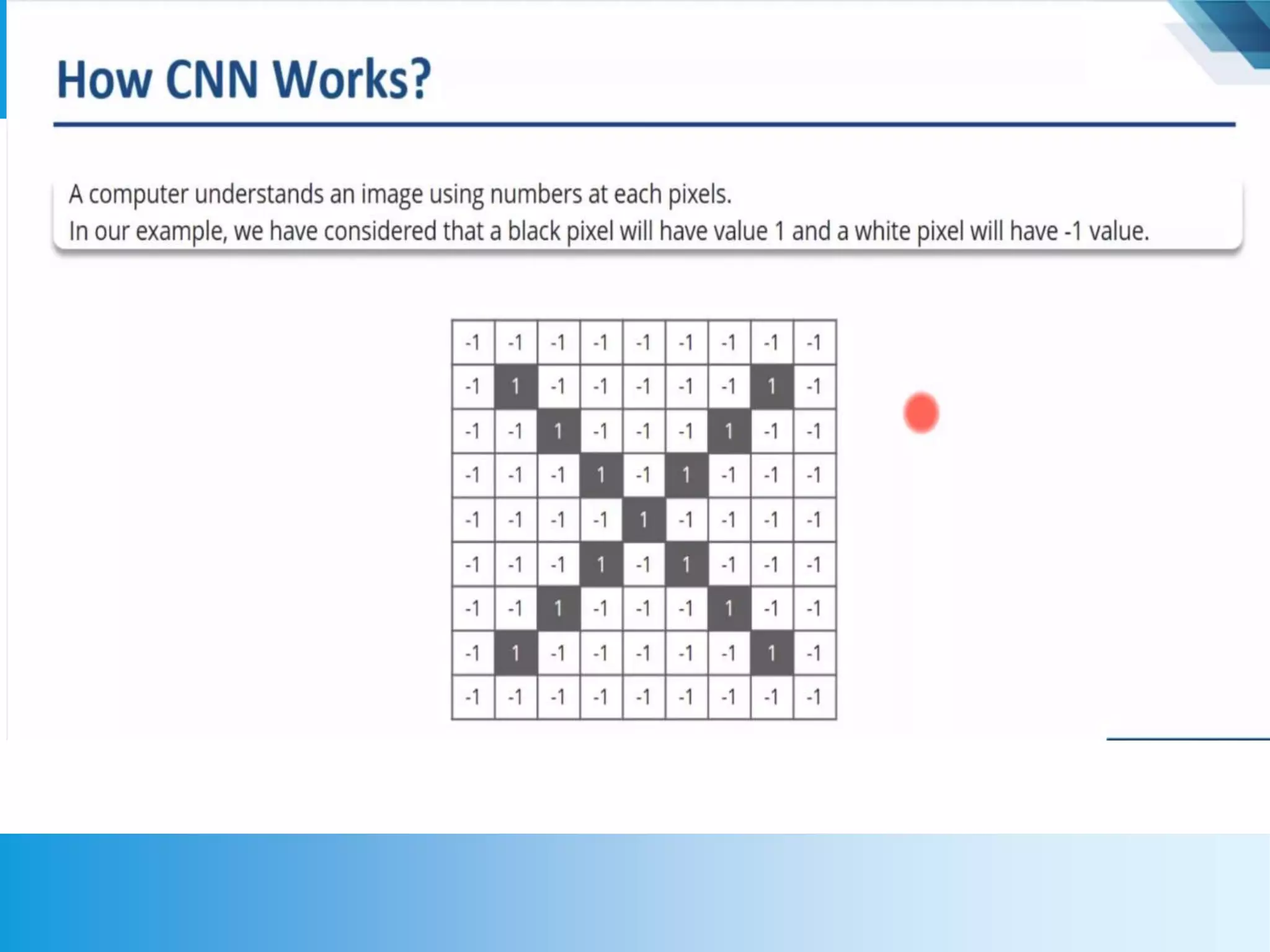
Convolutional Neural Network (CNN)
Thank you

Artificial Intelligence, Machine Learning and Deep Learning with CNN

Editor's Notes

  • #25 \vec{\theta}=\{w_{ij}, w_{jk}, w_{kl}\}
  • #26 \vec{\theta}=\{w_{ij}, w_{jk}, w_{kl}\}
  • #27 \vec{\theta}=\{w_{ij}, w_{jk}, w_{kl}\}
  • #28 \vec{\theta}=\{w_{ij}, w_{jk}, w_{kl}\}
  • #30 \frac{\partial R}{\partial w_{kl}}=\frac{1}{N}\sum_n\left[\frac{\partial L_n}{\partial a_{l,n}}\right]\left[\frac{\partial a_{l,n}}{\partial w_{kl}}\right]
  • #35 \frac{\partial R}{\partial w_{kl}}=\frac{1}{N}\sum_n\left[\frac{\partial \frac{1}{2}(y_n-g(a_{l,n}))^2}{\partial a_{l,n}}\right]\left[\frac{\partial z_{k,n}w_{kl}}{\partial w_{kl}}\right]&=&\sum_n\left[-(y_n-z_{l,n})g'(a_{l,n})\right]z_{k,n}\\&=&\sum_n\delta_nz_{k,n}
  • #36 \frac{\partial R}{\partial w_{kl}}=\frac{1}{N}\sum_n\left[\frac{\partial \frac{1}{2}(y_n-g(a_{l,n}))^2}{\partial a_{l,n}}\right]\left[\frac{\partial z_{k,n}w_{kl}}{\partial w_{kl}}\right]&=&\sum_n\left[-(y_n-z_{l,n})g'(a_{l,n})\right]z_{k,n}\\&=&\sum_n\delta_nz_{k,n}
  • #37 \frac{\partial R}{\partial w_{kl}}=\frac{1}{N}\sum_n\left[\frac{\partial \frac{1}{2}(y_n-g(a_{l,n}))^2}{\partial a_{l,n}}\right]\left[\frac{\partial z_{k,n}w_{kl}}{\partial w_{kl}}\right]&=&\sum_n\left[-(y_n-z_{l,n})g'(a_{l,n})\right]z_{k,n}\\&=&\sum_n\delta_nz_{k,n}
  • #38 \frac{\partial R}{\partial w_{kl}}=\frac{1}{N}\sum_n\left[\frac{\partial \frac{1}{2}(y_n-g(a_{l,n}))^2}{\partial a_{l,n}}\right]\left[\frac{\partial z_{k,n}w_{kl}}{\partial w_{kl}}\right]&=&\sum_n\left[-(y_n-z_{l,n})g'(a_{l,n})\right]z_{k,n}\\&=&\sum_n\delta_nz_{k,n}
  • #39 \frac{\partial R}{\partial w_{jk}}=\frac{1}{N}\sum_n\left[\sum_l\delta_l w_{kl}g'(a_{k,n})\right]\left[z_{j,n}\right]\\
  • #40 \frac{\partial R}{\partial w_{ij}}&=&\frac{1}{N}\sum_n\left[\frac{\partial L_n}{\partial a_{j,n}}\right]\left[\frac{\partial a_{j,n}}{\partial w_{ij}}\right]=\frac{1}{N}\sum_n\left[ \sum_k\delta_{k,n}w_{jk}g'(a_{j,n}) \right]z_{i,n} =\frac{1}{N} \sum_n\delta_{j,n}z_{i,n}
  • #41 \frac{\partial R}{\partial w_{jk}}=\frac{1}{N}\sum_n\left[\sum_l\delta_l w_{kl}g'(a_{k,n})\right]\left[z_{j,n}\right]\\