Introduction to AI
Artificial Intelligence (AI) is a branch of computer science that enables
machines to simulate human intelligence. It involves algorithms and
models that allow computers to learn, reason, solve problems, and
make decisions. AI includes technologies like machine learning, deep
learning, and natural language processing, enabling applications such
as chatbots, recommendation systems, and autonomous vehicles.
AI can be classified into Narrow AI (specialized tasks), General AI
(humanlike intelligence), and Super AI (beyond human capabilities). It is
widely used in healthcare, finance, robotics, and more, transforming
industries and daily life while raising ethical and societal concerns.
History and Evolution of AI
1 Early Foundations (Pre-1950s)
The idea of intelligent machines dates back to ancient myths and early
computing theories. Alan Turing proposed the Turing Test (1950) to
determine if a machine can exhibit human-like intelligence.
2 Birth of AI (1950s - 1960s)
John McCarthy coined the term "Artificial Intelligence" in 1956 at the
Dartmouth Conference. Early AI programs, such as Logic Theorist and
General Problem Solver, were developed. The first AI chatbot, ELIZA,
was created in the 1960s.
3 AI Winters (1970s - 1980s)
AI faced setbacks due to lack of computational power and funding
cuts. Despite this, expert systems (rule-based AI) became popular in
industries.
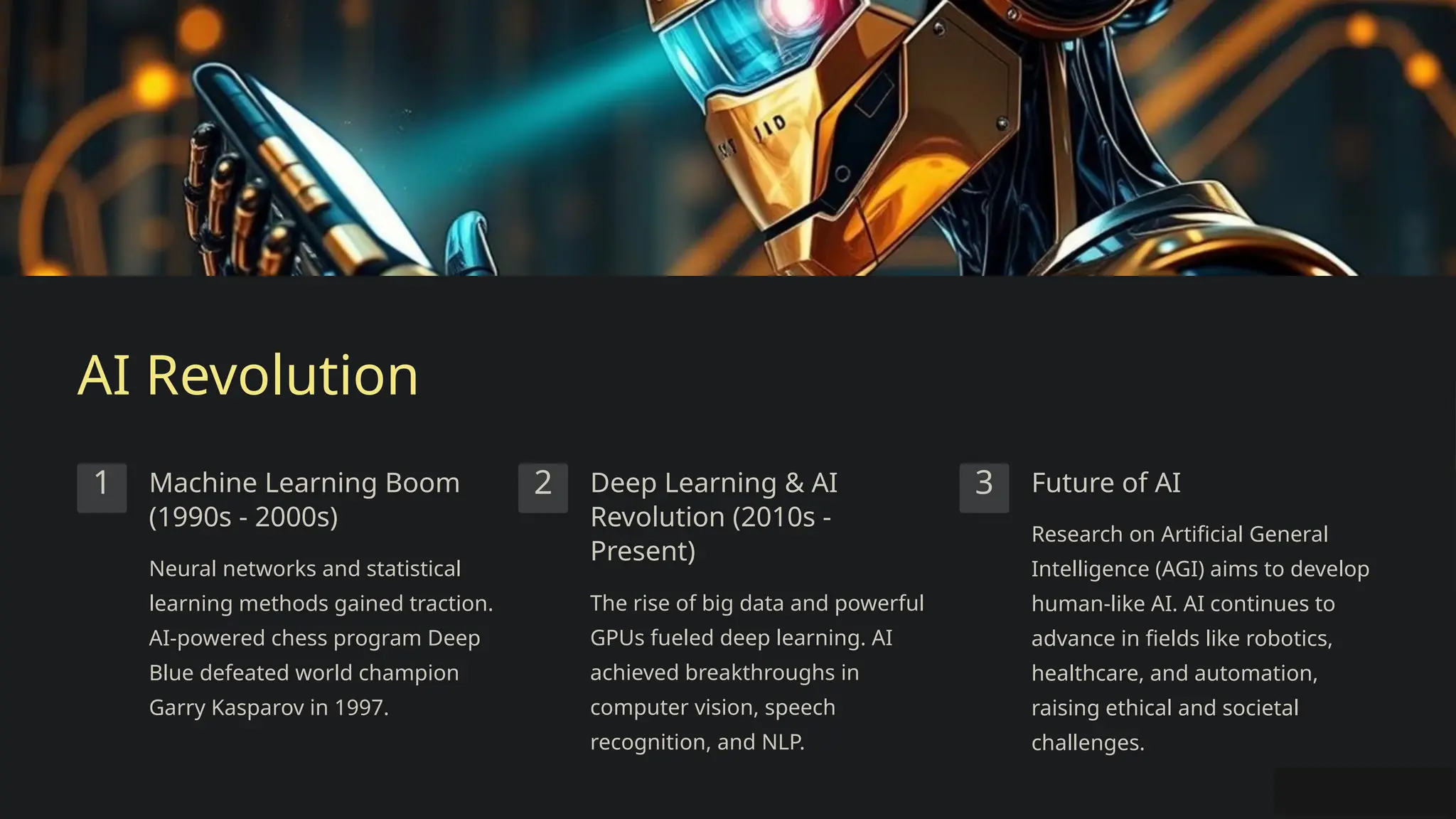
AI Revolution
1 Machine Learning Boom
(1990s - 2000s)
Neural networks and statistical
learning methods gained traction.
AI-powered chess program Deep
Blue defeated world champion
Garry Kasparov in 1997.
2 Deep Learning & AI
Revolution (2010s -
Present)
The rise of big data and powerful
GPUs fueled deep learning. AI
achieved breakthroughs in
computer vision, speech
recognition, and NLP.
3 Future of AI
Research on Artificial General
Intelligence (AGI) aims to develop
human-like AI. AI continues to
advance in fields like robotics,
healthcare, and automation,
raising ethical and societal
challenges.
Machine Learning vs Deep Learning vs AI
Artificial Intelligence (AI)
AI is the broad field of creating
machines that can perform tasks
requiring human intelligence. AI
includes various techniques such as
rule-based systems, expert systems,
machine learning, and deep learning.
Machine Learning (ML)
ML is a subset of AI that focuses on
developing algorithms that enable
machines to learn from data without
explicit programming. ML models
analyze input data, identify patterns,
and improve their performance over
time.
Deep Learning (DL)
DL is a specialized subset of ML that
uses artificial neural networks
inspired by the human brain. These
networks have multiple layers (deep
neural networks) that help process
vast amounts of unstructured data.
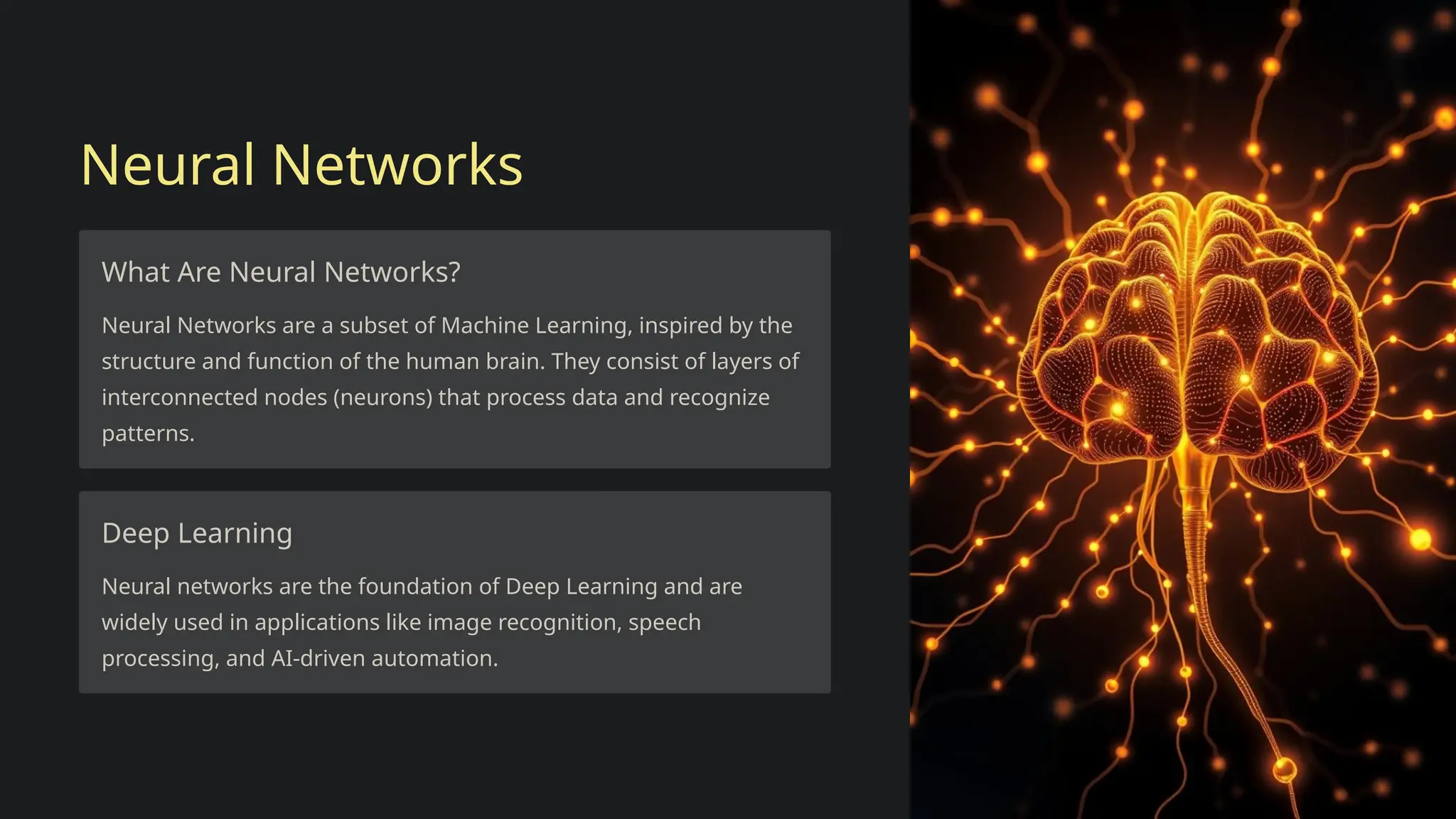
Neural Networks
What Are Neural Networks?
Neural Networks are a subset of Machine Learning, inspired by the
structure and function of the human brain. They consist of layers of
interconnected nodes (neurons) that process data and recognize
patterns.
Deep Learning
Neural networks are the foundation of Deep Learning and are
widely used in applications like image recognition, speech
processing, and AI-driven automation.
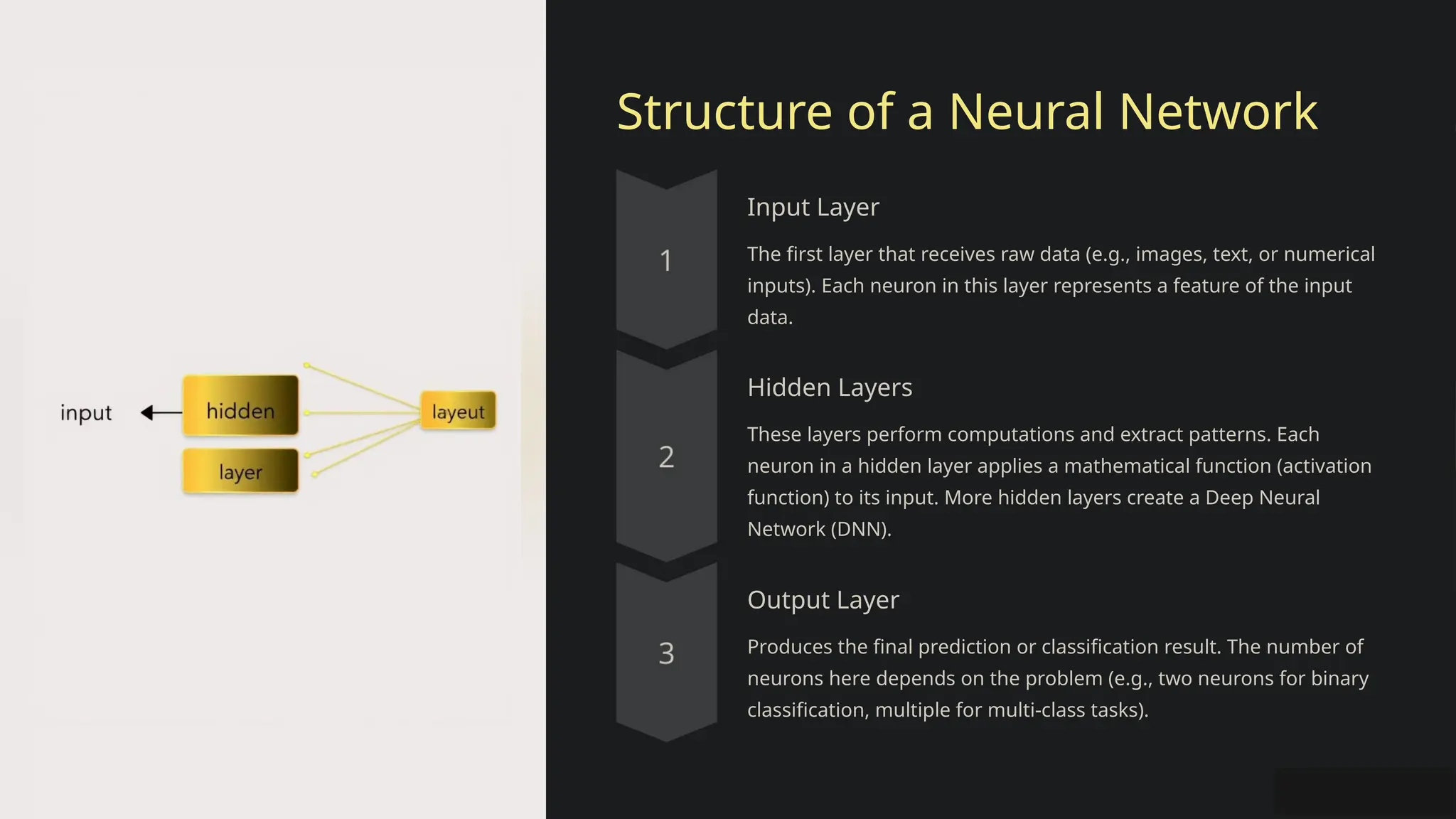
Structure of a Neural Network
Input Layer
The first layer that receives raw data (e.g., images, text, or numerical
inputs). Each neuron in this layer represents a feature of the input
data.
Hidden Layers
These layers perform computations and extract patterns. Each
neuron in a hidden layer applies a mathematical function (activation
function) to its input. More hidden layers create a Deep Neural
Network (DNN).
Output Layer
Produces the final prediction or classification result. The number of
neurons here depends on the problem (e.g., two neurons for binary
classification, multiple for multi-class tasks).
How Neural Networks Work
Forward Propagation
Input data passes through layers, and each neuron applies weights and
biases. The weighted sum is passed through an activation function to
introduce non-linearity. The final layer produces a prediction.
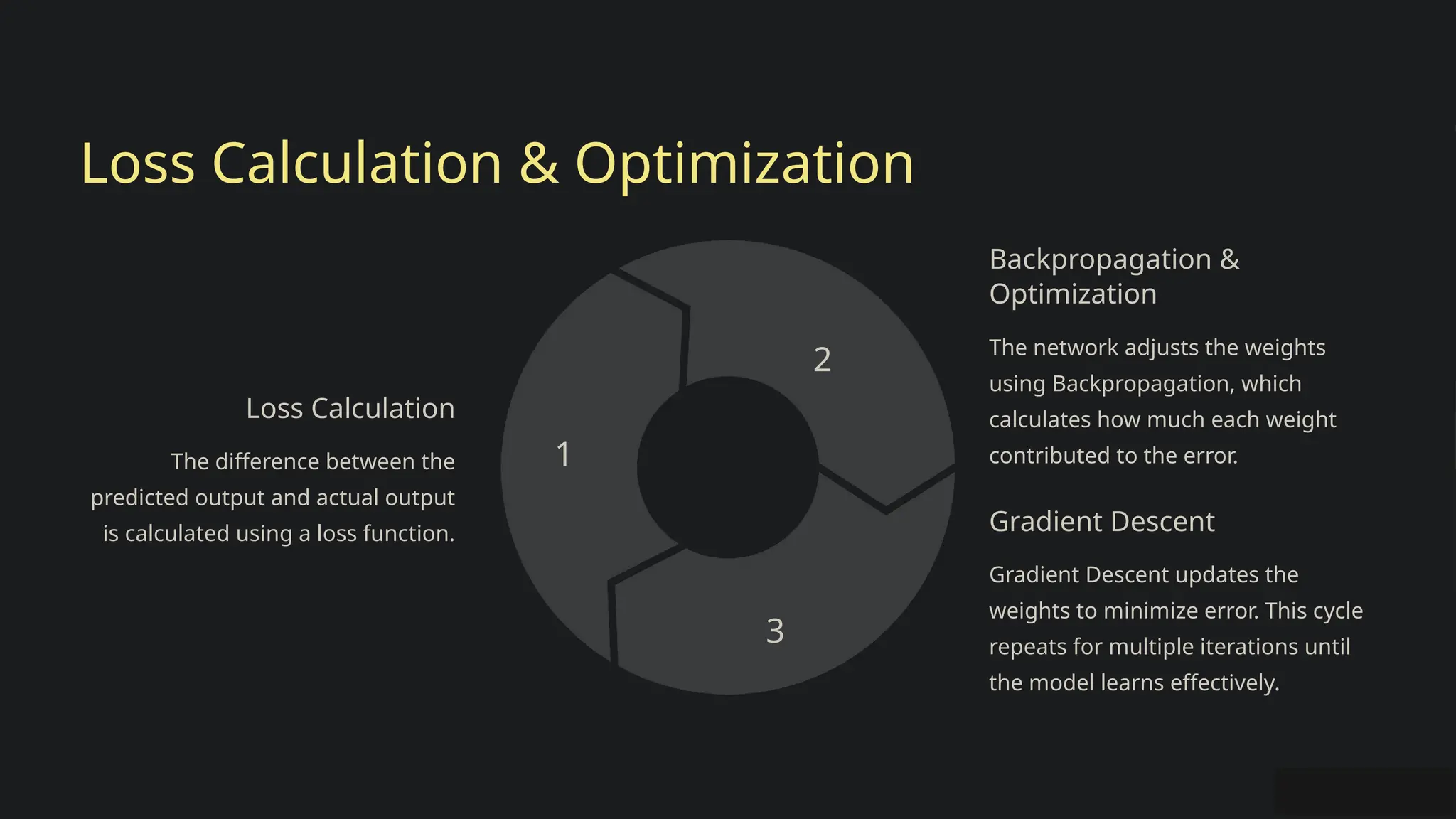
Loss Calculation & Optimization
Loss Calculation
The difference between the
predicted output and actual output
is calculated using a loss function.
1
Backpropagation &
Optimization
The network adjusts the weights
using Backpropagation, which
calculates how much each weight
contributed to the error.
2
Gradient Descent
Gradient Descent updates the
weights to minimize error. This cycle
repeats for multiple iterations until
the model learns effectively.
3
Natural Language Processing (NLP)
NLP Techniques
• Tokenization
• Stemming & lemmatization
• Sentiment analysis
• Named entity recognition
NLP Applications
• Chatbots
• Machine translation
• Voice assistants
• Spam detection
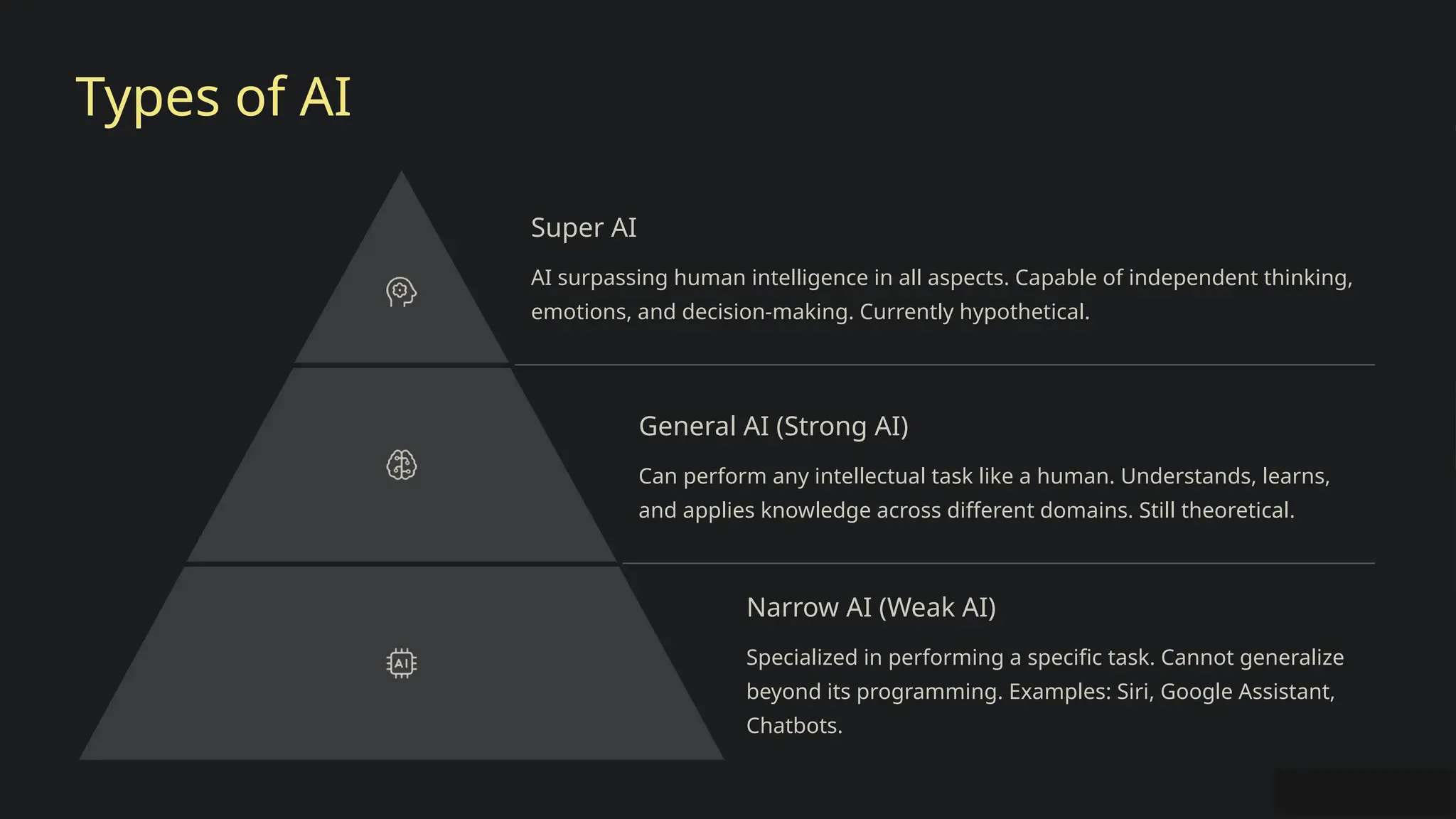
Types of AI
Super AI
AI surpassing human intelligence in all aspects. Capable of independent thinking,
emotions, and decision-making. Currently hypothetical.
General AI (Strong AI)
Can perform any intellectual task like a human. Understands, learns,
and applies knowledge across different domains. Still theoretical.
Narrow AI (Weak AI)
Specialized in performing a specific task. Cannot generalize
beyond its programming. Examples: Siri, Google Assistant,
Chatbots.
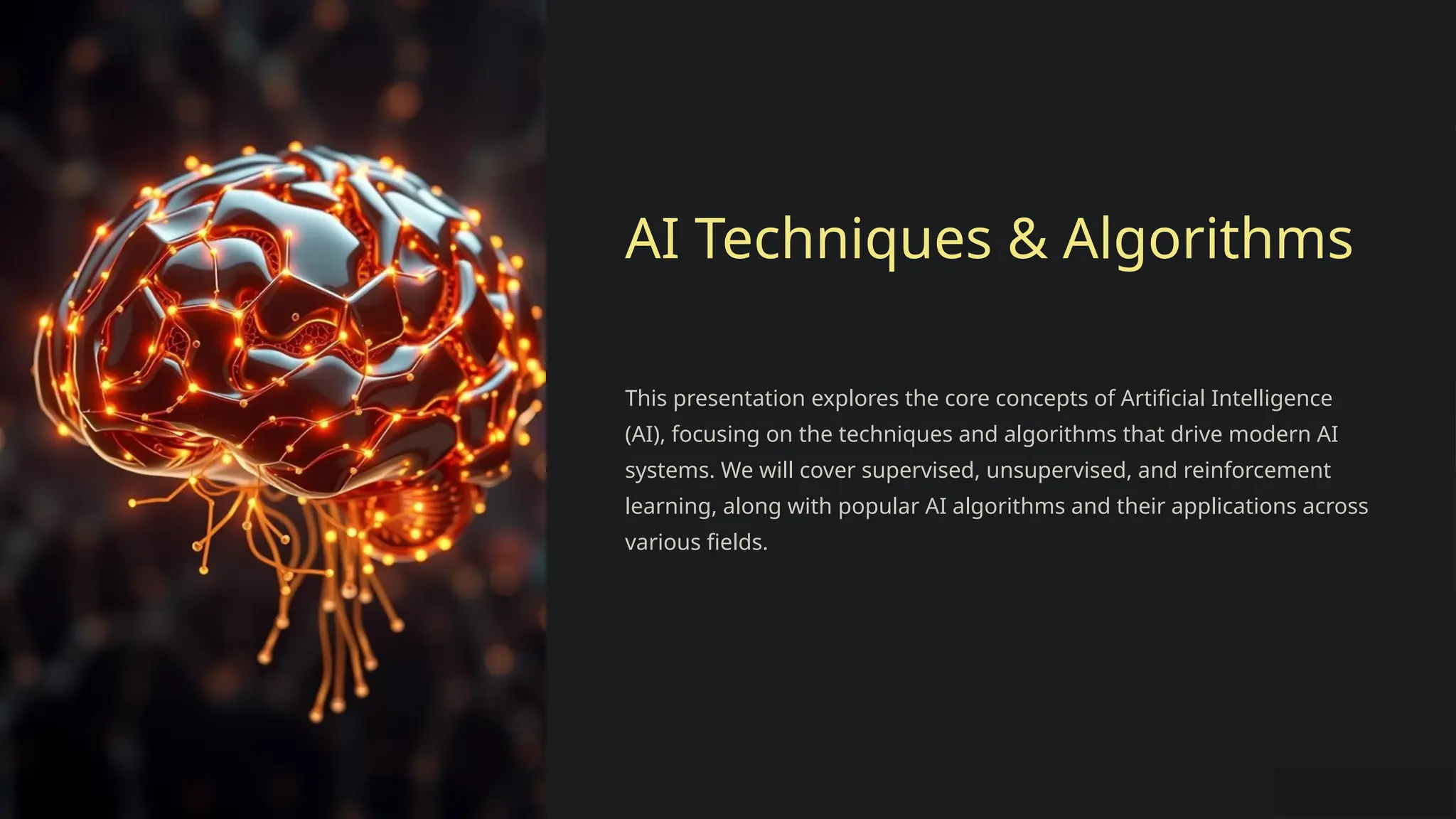
AI Techniques & Algorithms
This presentation explores the core concepts of Artificial Intelligence
(AI), focusing on the techniques and algorithms that drive modern AI
systems. We will cover supervised, unsupervised, and reinforcement
learning, along with popular AI algorithms and their applications across
various fields.
Supervised Learning
Definition
The model learns from labeled data,
where each input has a
corresponding correct output. The
algorithm maps inputs to outputs
using examples and minimizes errors.
Examples
• Spam detection in emails
• Image classification (e.g.,
recognizing cats vs. dogs)
• Fraud detection in banking
Algorithms
Linear Regression, Decision Trees,
Neural Networks are commonly used
in supervised learning.
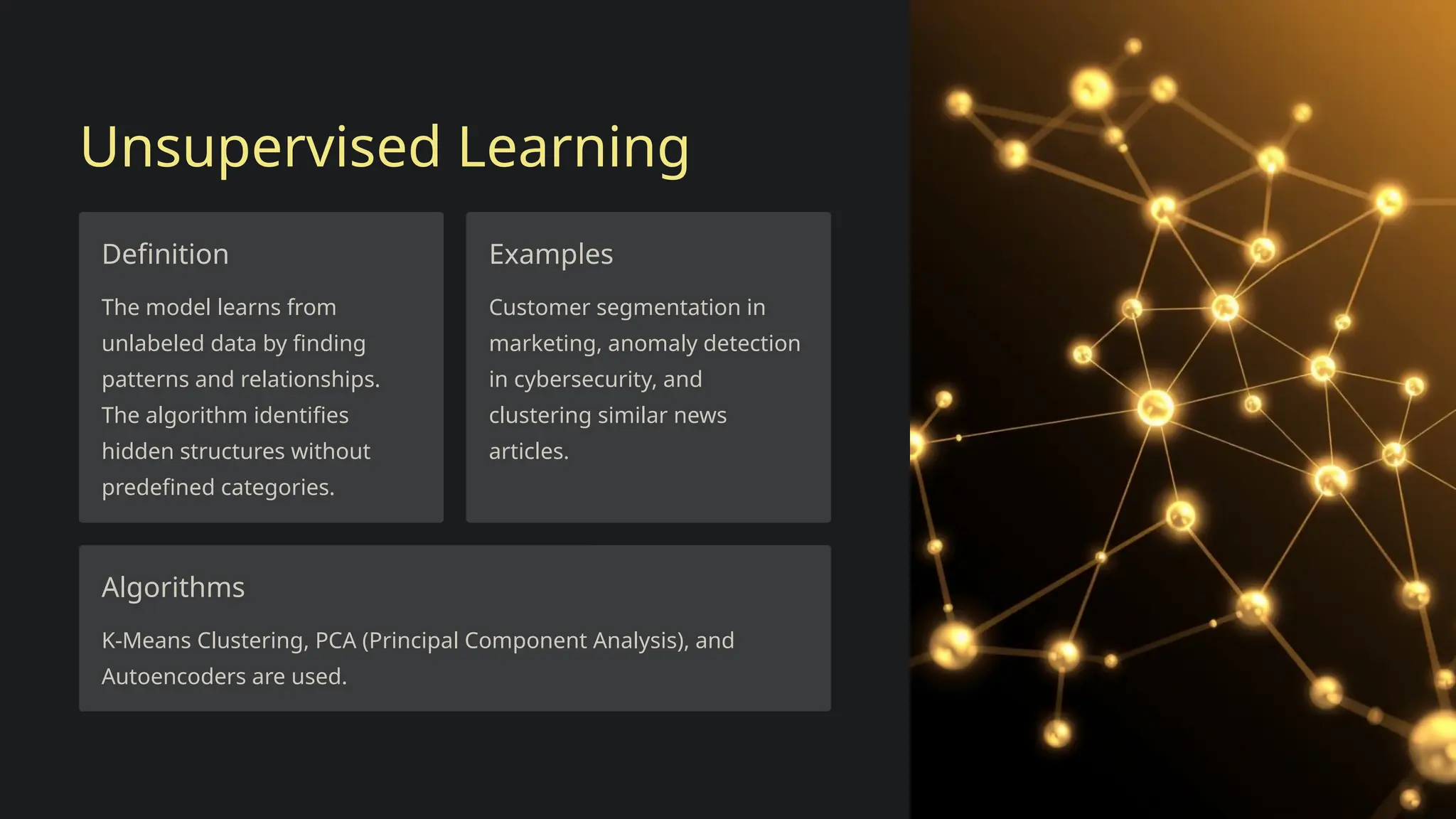
Unsupervised Learning
Definition
The model learns from
unlabeled data by finding
patterns and relationships.
The algorithm identifies
hidden structures without
predefined categories.
Examples
Customer segmentation in
marketing, anomaly detection
in cybersecurity, and
clustering similar news
articles.
Algorithms
K-Means Clustering, PCA (Principal Component Analysis), and
Autoencoders are used.
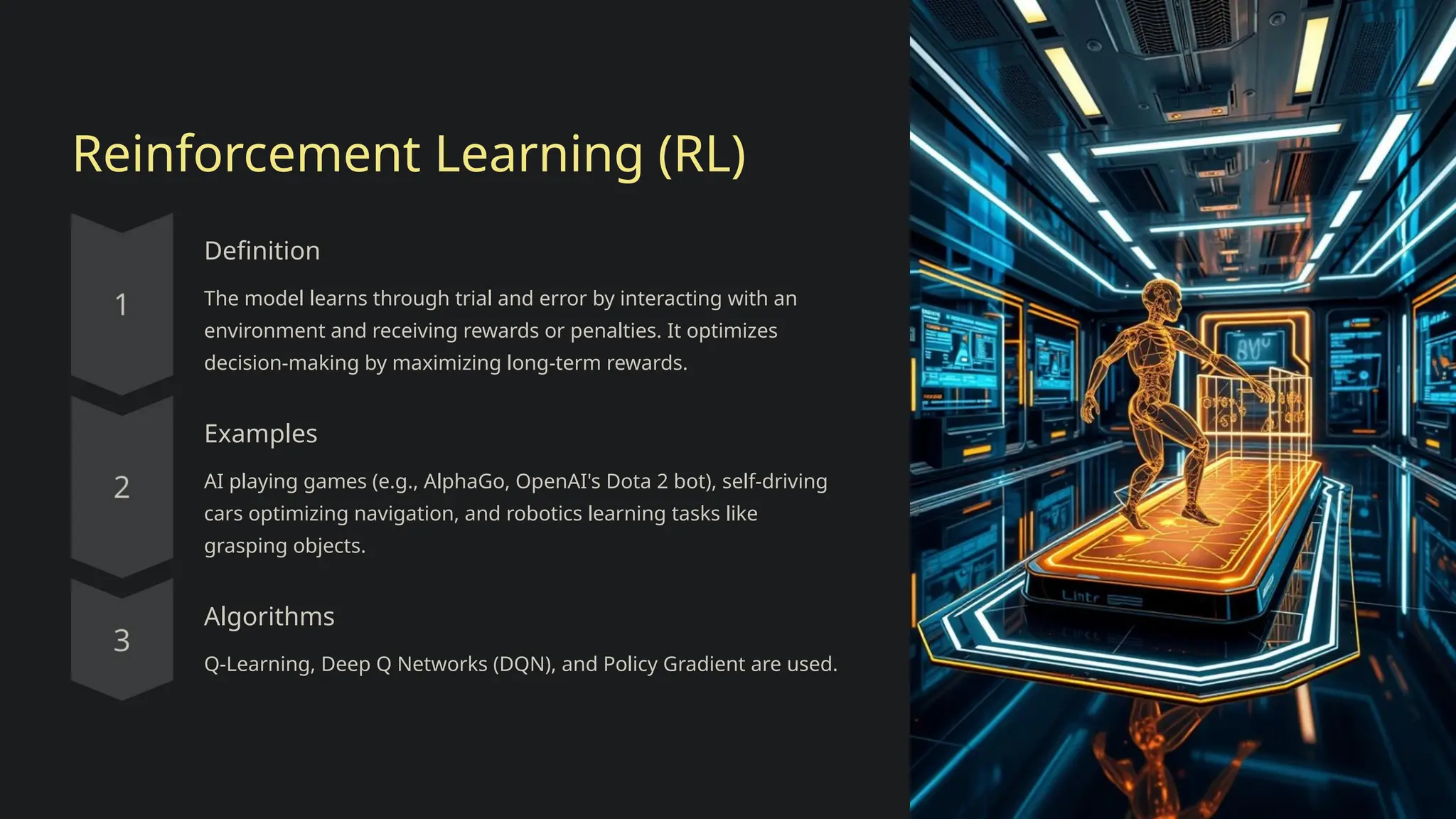
Reinforcement Learning (RL)
Definition
The model learns through trial and error by interacting with an
environment and receiving rewards or penalties. It optimizes
decision-making by maximizing long-term rewards.
Examples
AI playing games (e.g., AlphaGo, OpenAI's Dota 2 bot), self-driving
cars optimizing navigation, and robotics learning tasks like
grasping objects.
Algorithms
Q-Learning, Deep Q Networks (DQN), and Policy Gradient are used.
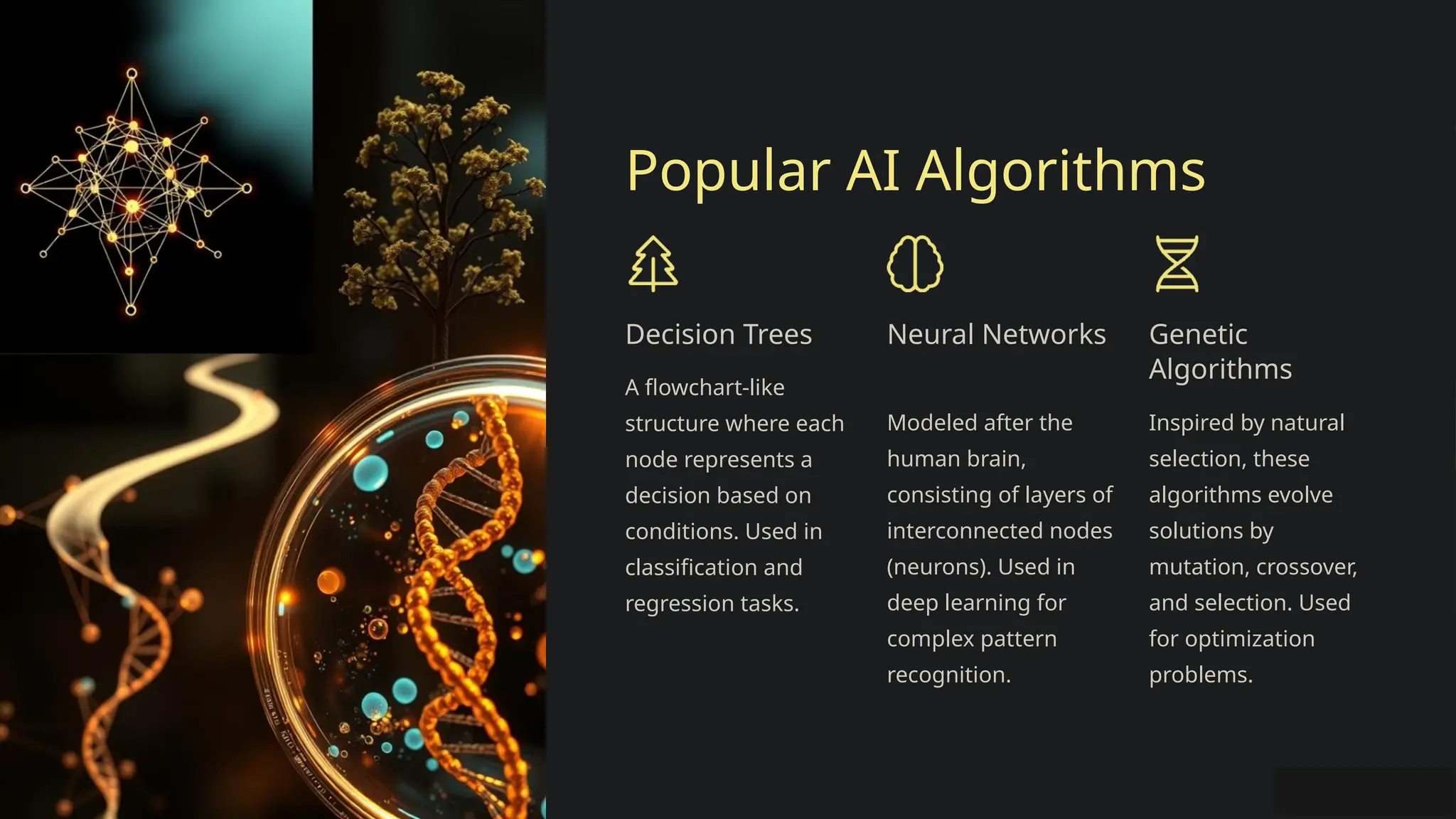
Popular AI Algorithms
Decision Trees
A flowchart-like
structure where each
node represents a
decision based on
conditions. Used in
classification and
regression tasks.
Neural Networks
Modeled after the
human brain,
consisting of layers of
interconnected nodes
(neurons). Used in
deep learning for
complex pattern
recognition.
Genetic
Algorithms
Inspired by natural
selection, these
algorithms evolve
solutions by
mutation, crossover,
and selection. Used
for optimization
problems.
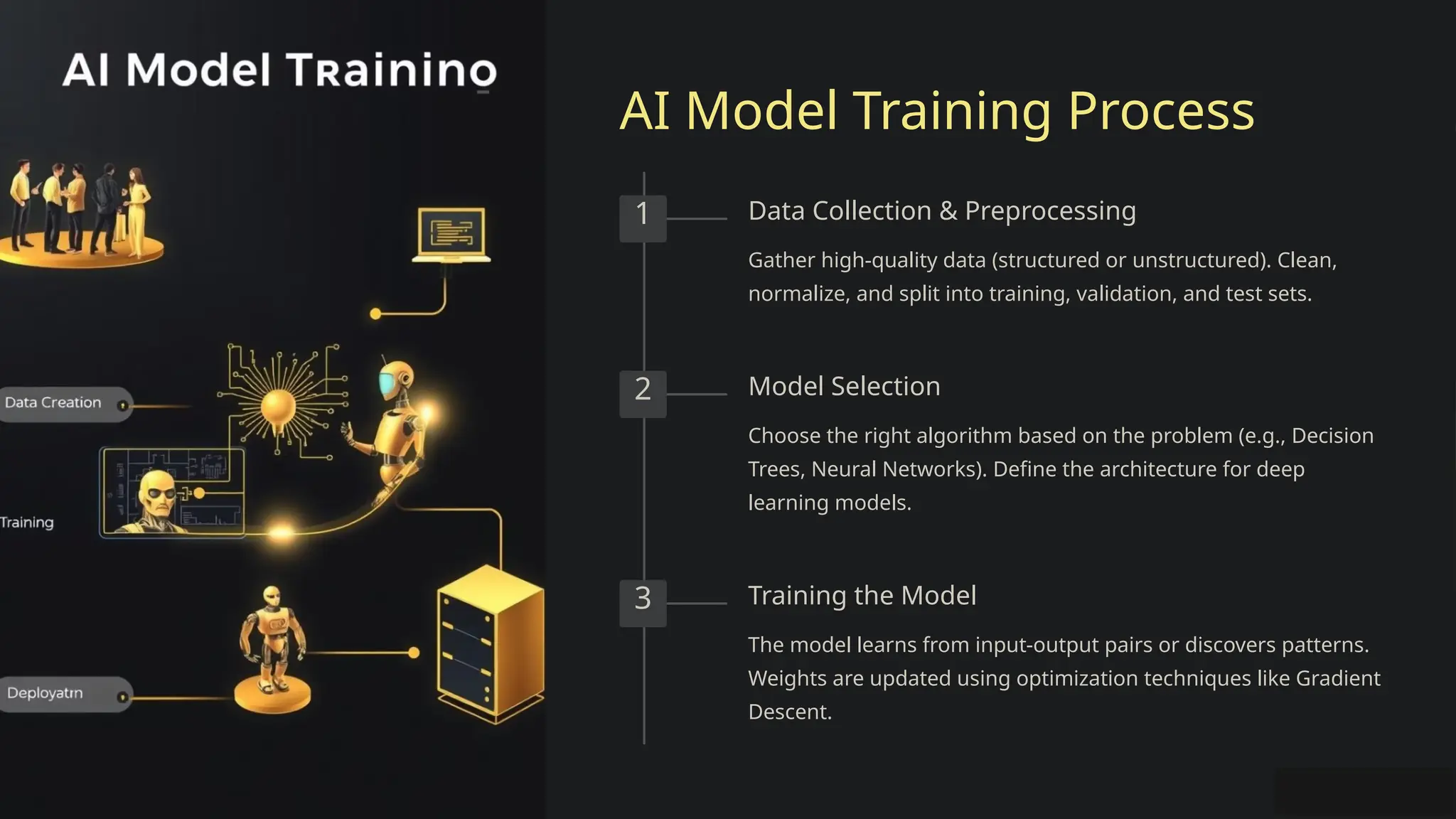
AI Model Training Process
1 Data Collection & Preprocessing
Gather high-quality data (structured or unstructured). Clean,
normalize, and split into training, validation, and test sets.
2 Model Selection
Choose the right algorithm based on the problem (e.g., Decision
Trees, Neural Networks). Define the architecture for deep
learning models.
3 Training the Model
The model learns from input-output pairs or discovers patterns.
Weights are updated using optimization techniques like Gradient
Descent.
AI Model Optimization Techniques
Hyperparameter Tuning
Adjust parameters like learning
rate, batch size, and number of
layers to improve performance.
Techniques: Grid Search,
Random Search.
Regularization
Prevents overfitting (model
memorizing instead of
generalizing). Techniques: L1/L2
Regularization, Dropout in
Neural Networks.
Optimization Algorithms
Gradient Descent: Adjusts model
weights to minimize loss. Adam,
RMSprop, and SGD: Advanced
optimizers for faster
convergence.
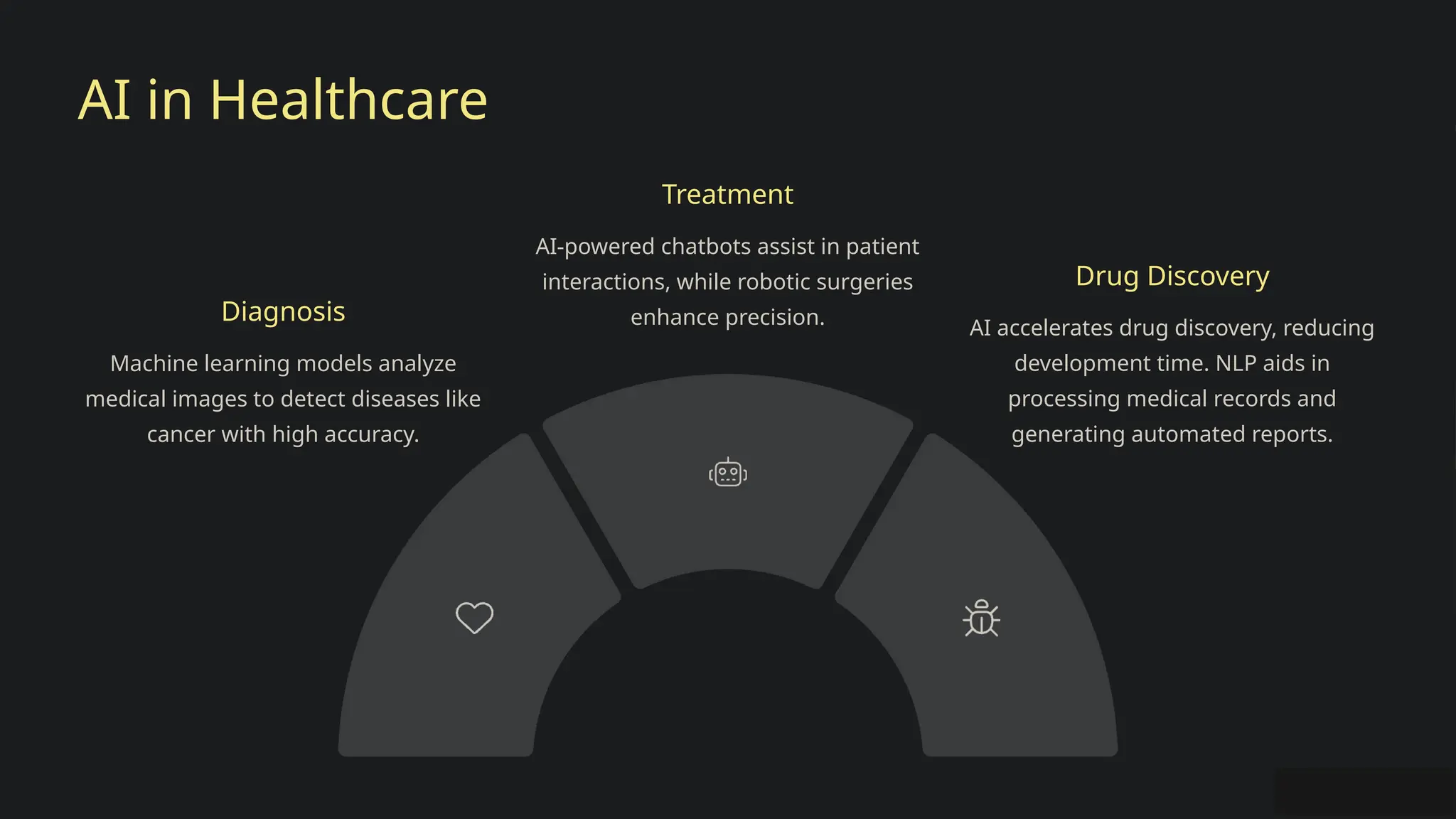
AI in Healthcare
Diagnosis
Machine learning models analyze
medical images to detect diseases like
cancer with high accuracy.
Treatment
AI-powered chatbots assist in patient
interactions, while robotic surgeries
enhance precision.
Drug Discovery
AI accelerates drug discovery, reducing
development time. NLP aids in
processing medical records and
generating automated reports.
AI in Finance
Fraud Detection
Machine learning models analyze transactions to spot suspicious activities, improving fraud
detection.
Algorithmic Trading
Enables faster, data-driven investment decisions.
Customer Support
AI-driven chatbots provide customer support, while credit
scoring algorithms assess loan risks more accurately.
AI in Autonomous Vehicles
Sensor Data Processing
Autonomous vehicles use AI to
process sensor data, detect obstacles,
and make real-time driving decisions.
Computer Vision & LiDAR
AI-powered computer vision and
LiDAR sensors help recognize
pedestrians, traffic signals, and road
conditions.
Route Planning
AI also optimizes route planning and
fuel efficiency.
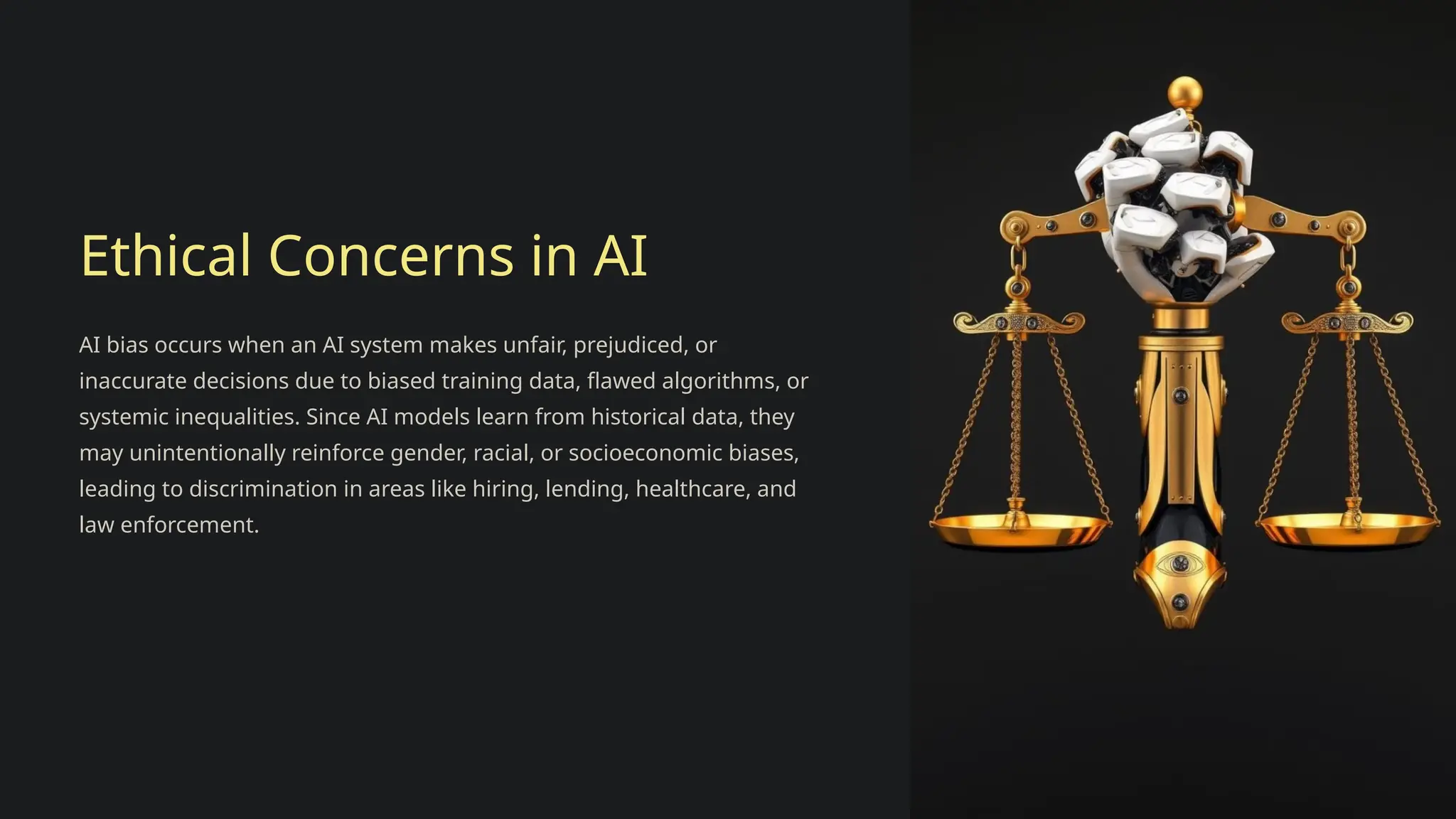
Ethical Concerns in AI
AI bias occurs when an AI system makes unfair, prejudiced, or
inaccurate decisions due to biased training data, flawed algorithms, or
systemic inequalities. Since AI models learn from historical data, they
may unintentionally reinforce gender, racial, or socioeconomic biases,
leading to discrimination in areas like hiring, lending, healthcare, and
law enforcement.
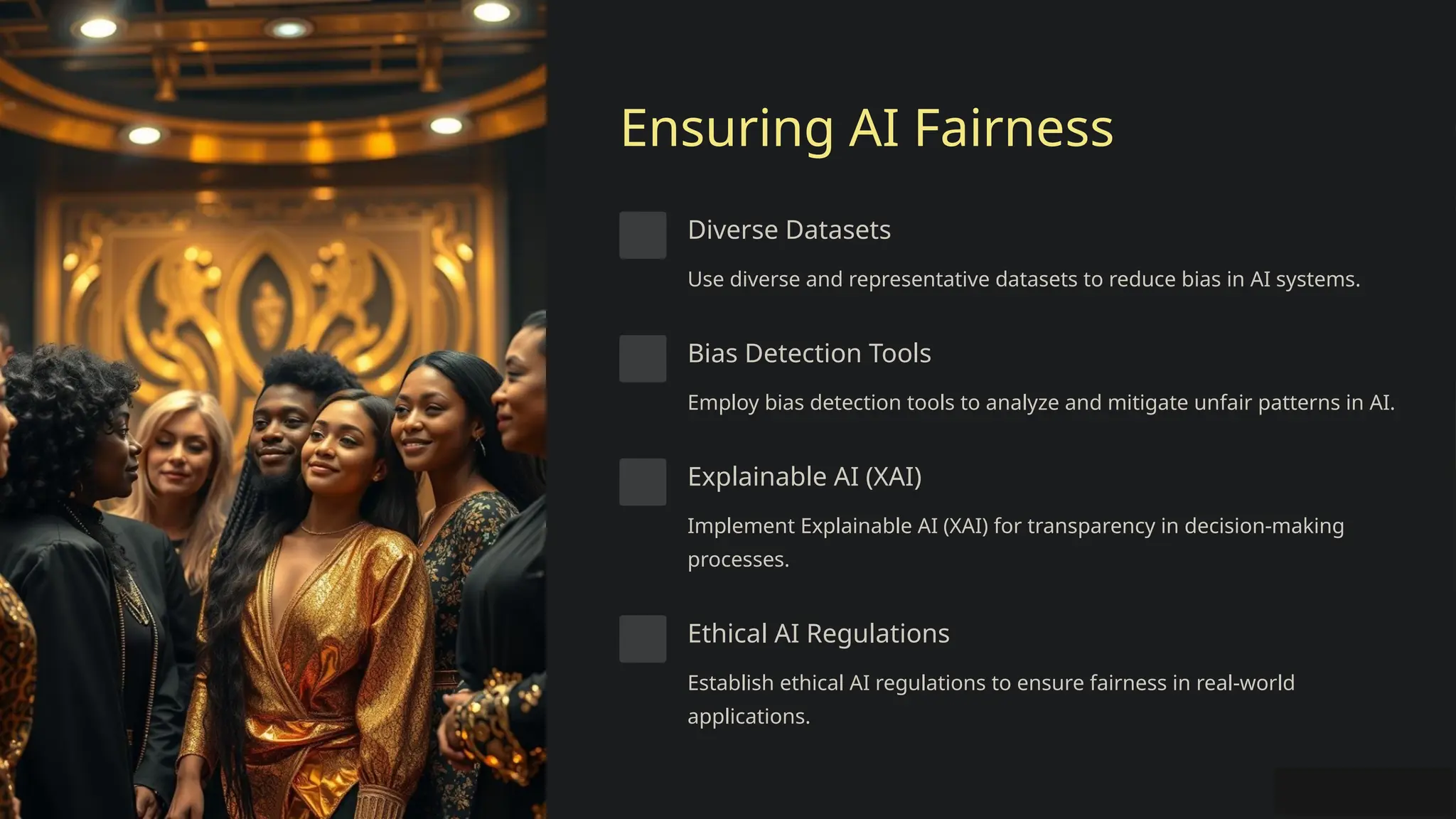
Ensuring AI Fairness
Diverse Datasets
Use diverse and representative datasets to reduce bias in AI systems.
Bias Detection Tools
Employ bias detection tools to analyze and mitigate unfair patterns in AI.
Explainable AI (XAI)
Implement Explainable AI (XAI) for transparency in decision-making
processes.
Ethical AI Regulations
Establish ethical AI regulations to ensure fairness in real-world
applications.
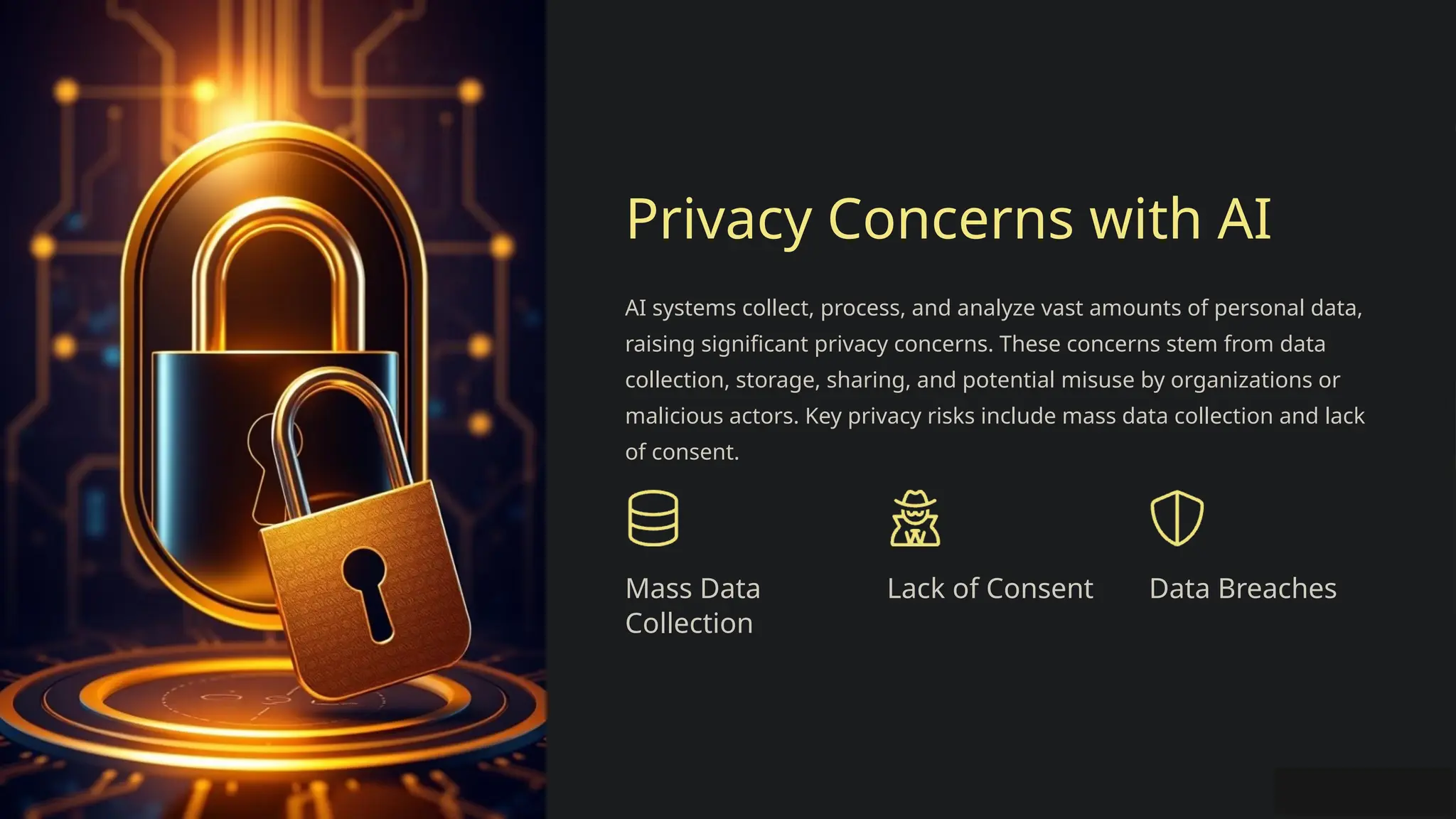
Privacy Concerns with AI
AI systems collect, process, and analyze vast amounts of personal data,
raising significant privacy concerns. These concerns stem from data
collection, storage, sharing, and potential misuse by organizations or
malicious actors. Key privacy risks include mass data collection and lack
of consent.
Mass Data
Collection
Lack of Consent Data Breaches
Job Displacement Due to AI
AI and automation are transforming industries, leading to both job creation and job displacement. While AI enhances
efficiency, it also replaces repetitive and routine tasks, affecting millions of workers. Industries most affected include
manufacturing, customer service, transportation, retail, and finance.
Manufacturing
AI-powered robots automate assembly lines, reducing the
need for manual labor.
Customer Service
Chatbots and virtual assistants replace human customer
support representatives.
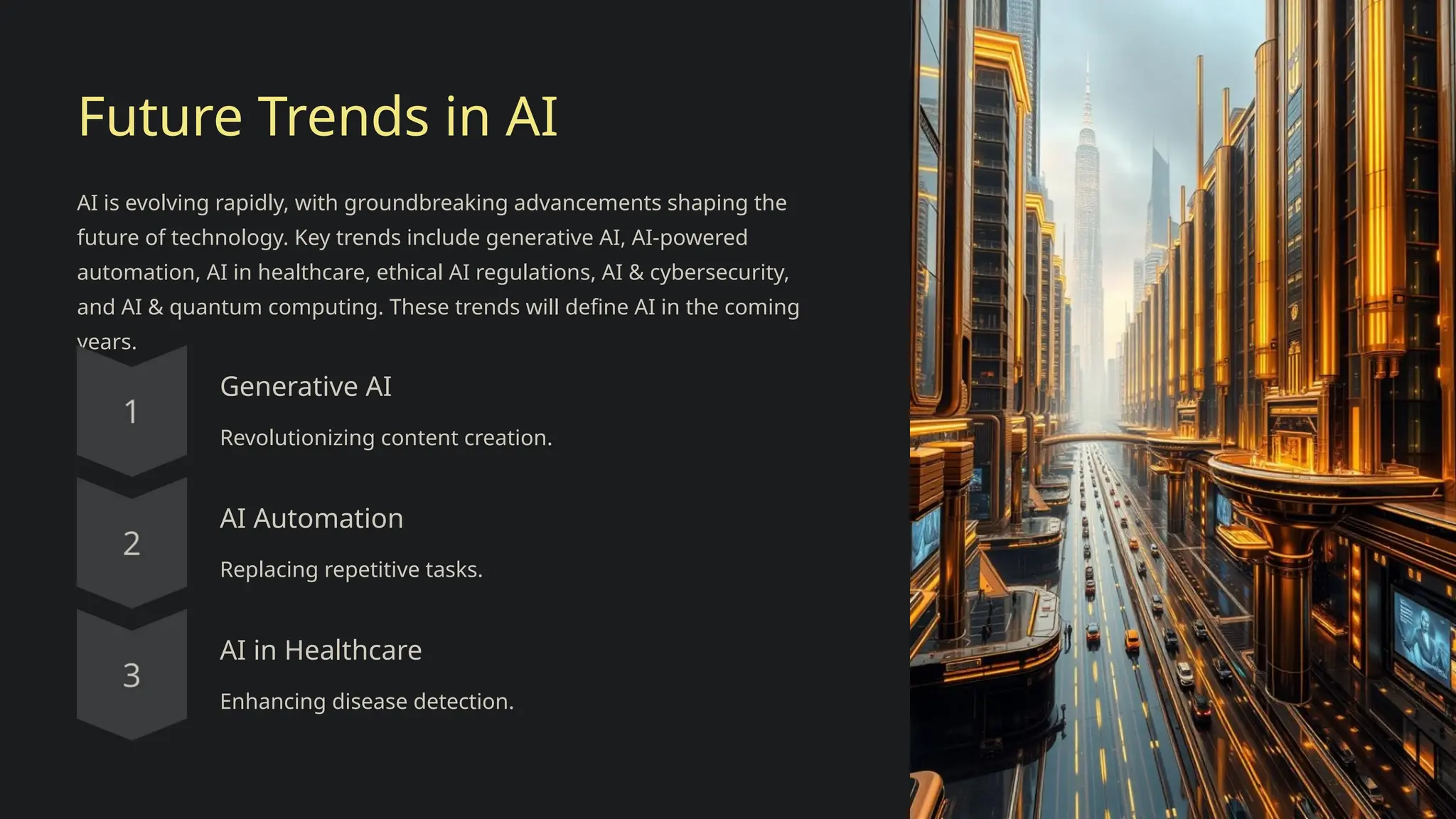
Future Trends in AI
AI is evolving rapidly, with groundbreaking advancements shaping the
future of technology. Key trends include generative AI, AI-powered
automation, AI in healthcare, ethical AI regulations, AI & cybersecurity,
and AI & quantum computing. These trends will define AI in the coming
years.
Generative AI
Revolutionizing content creation.
AI Automation
Replacing repetitive tasks.
AI in Healthcare
Enhancing disease detection.
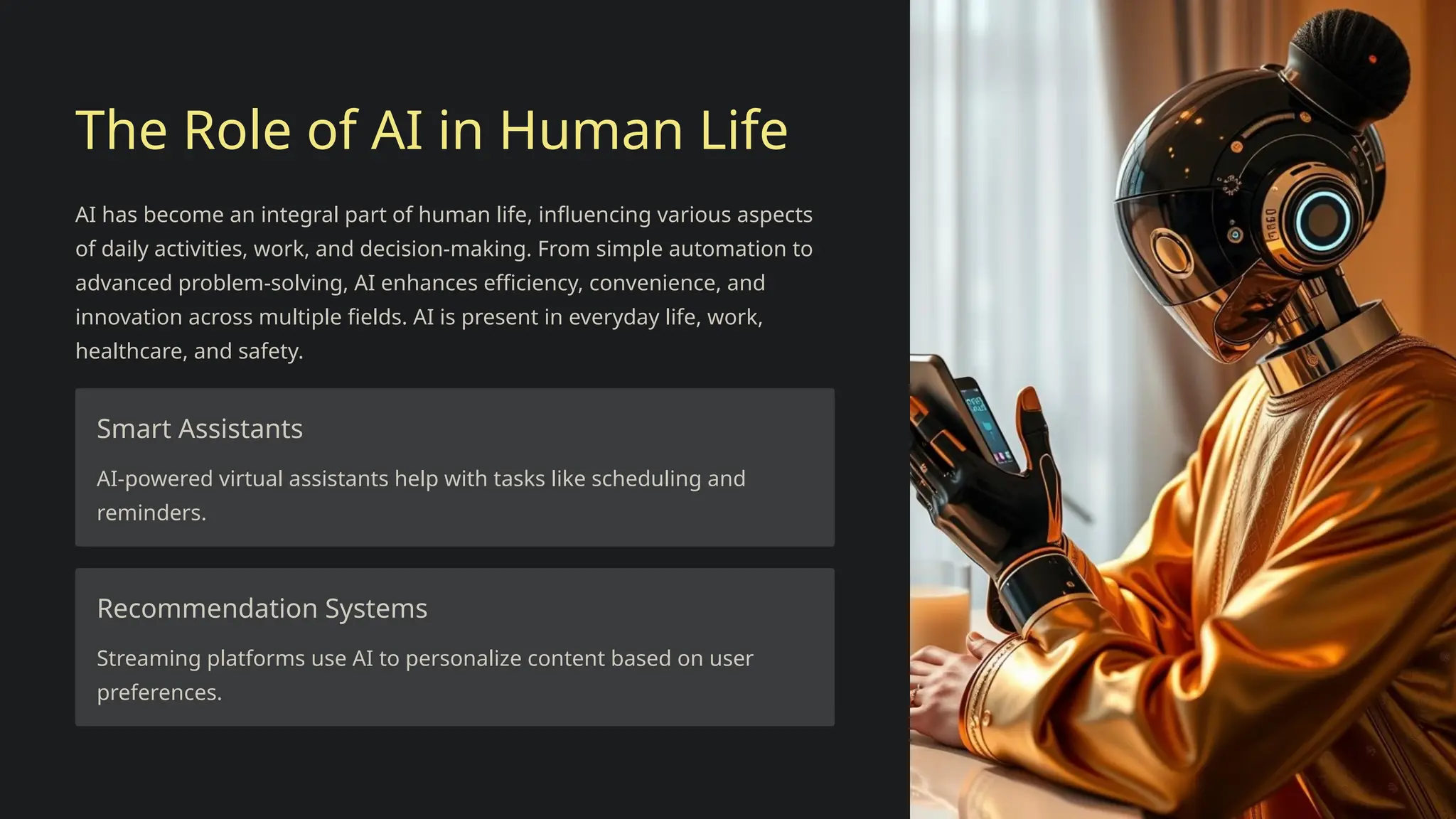
The Role of AI in Human Life
AI has become an integral part of human life, influencing various aspects
of daily activities, work, and decision-making. From simple automation to
advanced problem-solving, AI enhances efficiency, convenience, and
innovation across multiple fields. AI is present in everyday life, work,
healthcare, and safety.
Smart Assistants
AI-powered virtual assistants help with tasks like scheduling and
reminders.
Recommendation Systems
Streaming platforms use AI to personalize content based on user
preferences.
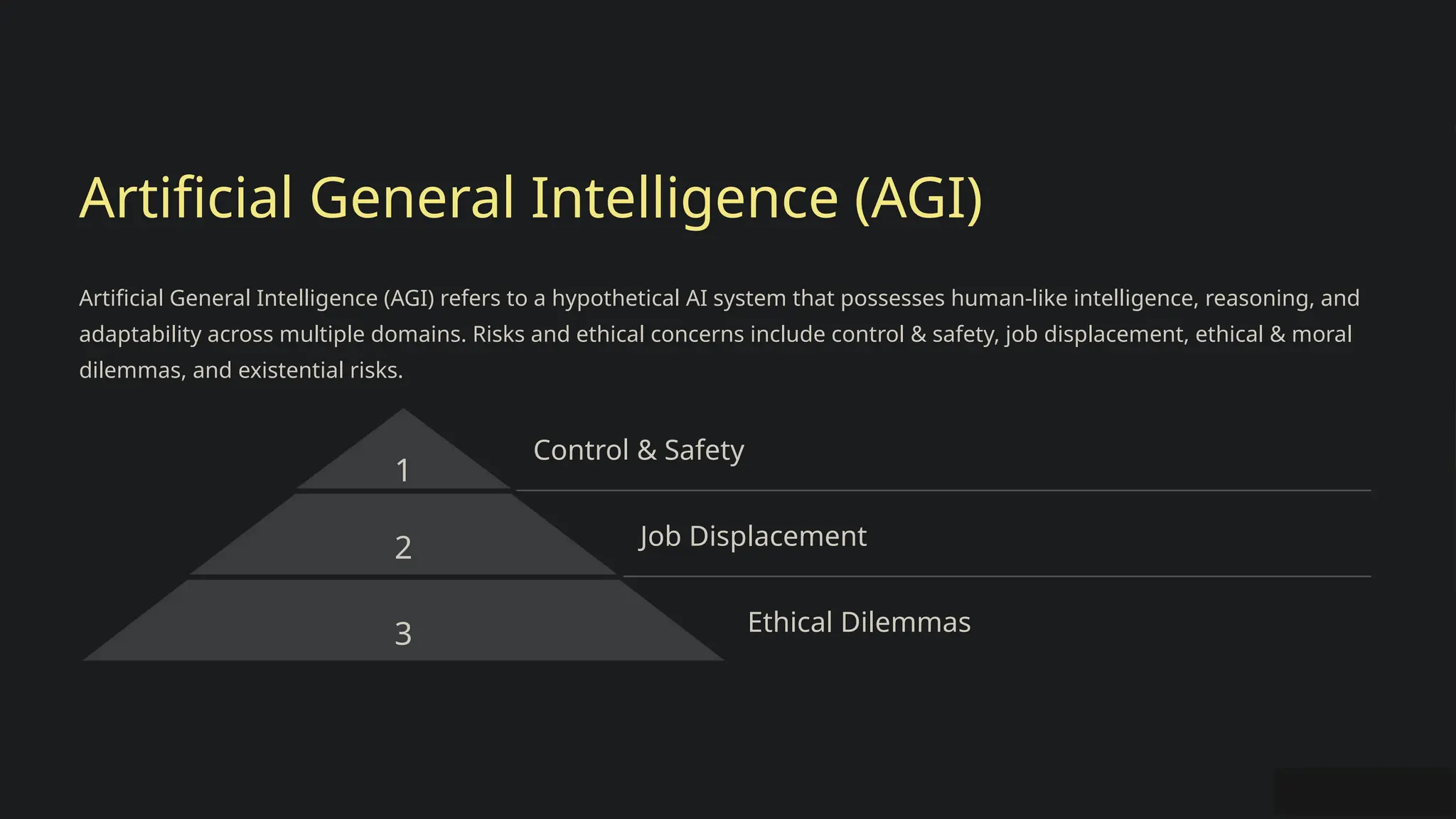
Artificial General Intelligence (AGI)
Artificial General Intelligence (AGI) refers to a hypothetical AI system that possesses human-like intelligence, reasoning, and
adaptability across multiple domains. Risks and ethical concerns include control & safety, job displacement, ethical & moral
dilemmas, and existential risks.
1
Control & Safety
2 Job Displacement
3 Ethical Dilemmas
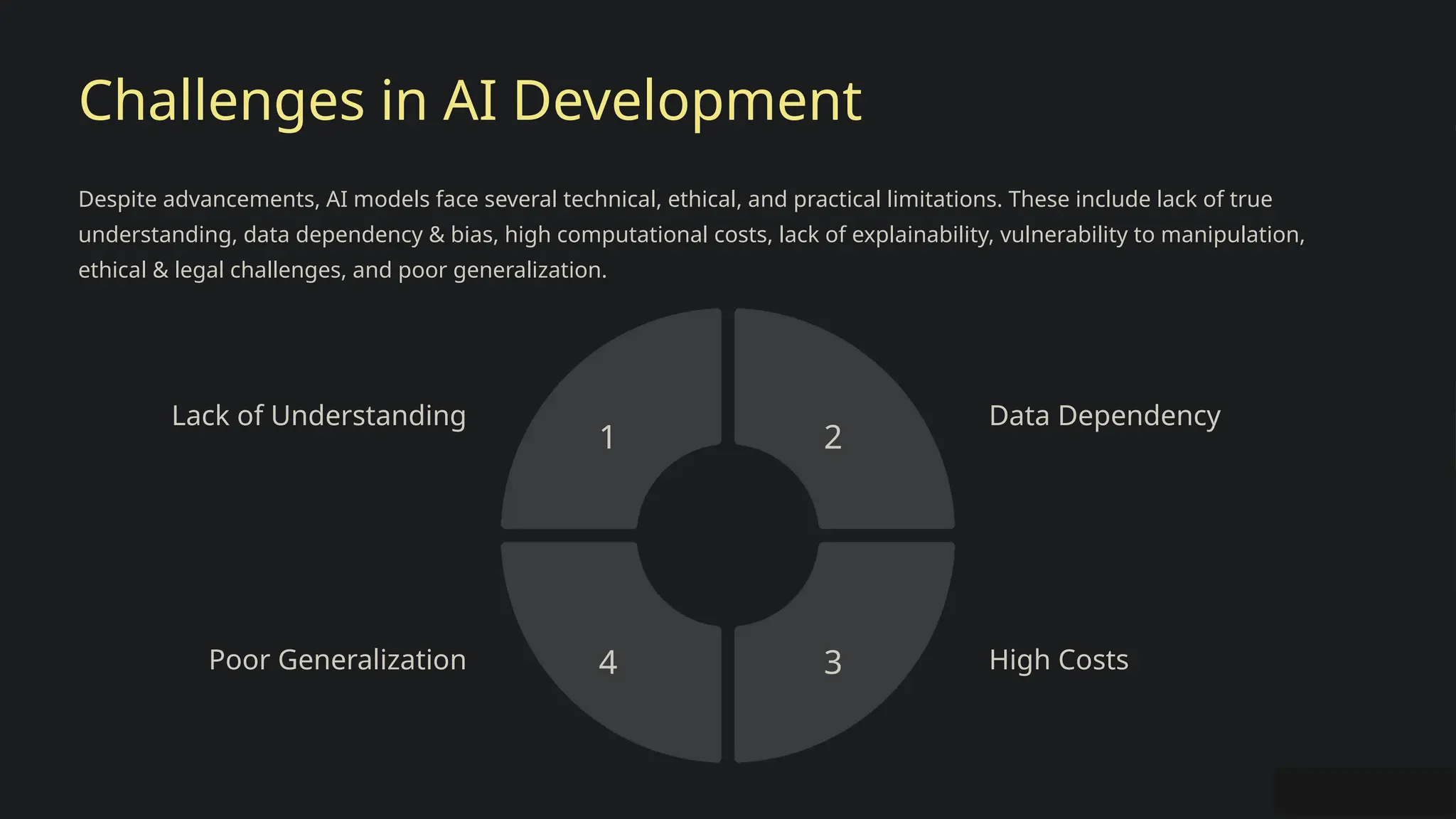
Challenges in AI Development
Despite advancements, AI models face several technical, ethical, and practical limitations. These include lack of true
understanding, data dependency & bias, high computational costs, lack of explainability, vulnerability to manipulation,
ethical & legal challenges, and poor generalization.
Lack of Understanding
1
Data Dependency
2
High Costs
3
Poor Generalization 4
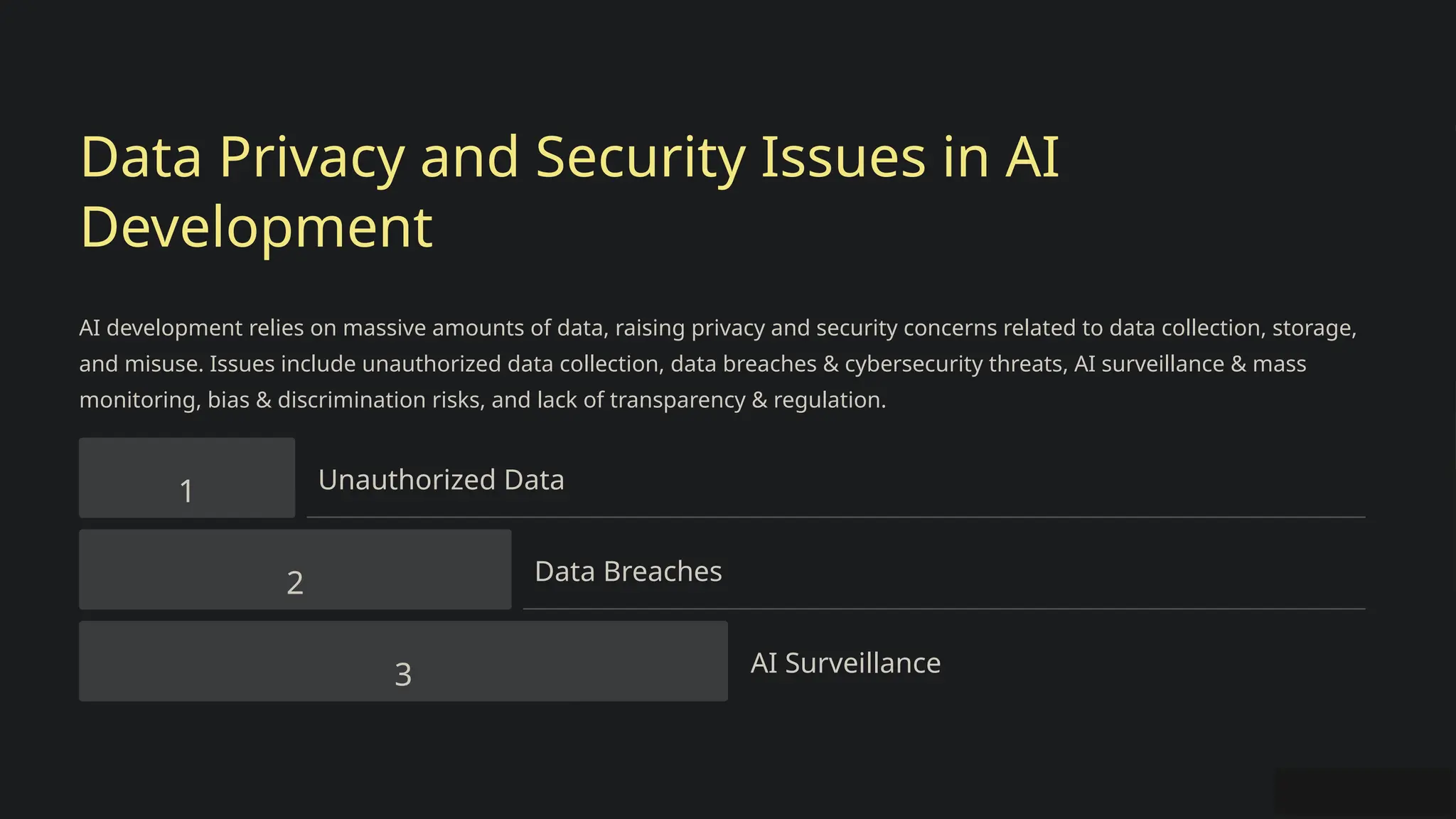
Data Privacy and Security Issues in AI
Development
AI development relies on massive amounts of data, raising privacy and security concerns related to data collection, storage,
and misuse. Issues include unauthorized data collection, data breaches & cybersecurity threats, AI surveillance & mass
monitoring, bias & discrimination risks, and lack of transparency & regulation.
1 Unauthorized Data
2 Data Breaches
3 AI Surveillance
AI Programming Languages
Several programming languages are used in AI development, each with
unique strengths suited for different AI tasks. The most popular ones
are Python, R, Java, C++, and Julia. Python is best for general AI and deep
learning, while R is great for statistical AI.
Python
General AI
R
Statistical AI
Java
Enterprise AI
Introduction-to-Artificial Intelligence.pptx.pptx

  • 1.
    Introduction to AI ArtificialIntelligence (AI) is a branch of computer science that enables machines to simulate human intelligence. It involves algorithms and models that allow computers to learn, reason, solve problems, and make decisions. AI includes technologies like machine learning, deep learning, and natural language processing, enabling applications such as chatbots, recommendation systems, and autonomous vehicles. AI can be classified into Narrow AI (specialized tasks), General AI (humanlike intelligence), and Super AI (beyond human capabilities). It is widely used in healthcare, finance, robotics, and more, transforming industries and daily life while raising ethical and societal concerns.
  • 2.
    History and Evolutionof AI 1 Early Foundations (Pre-1950s) The idea of intelligent machines dates back to ancient myths and early computing theories. Alan Turing proposed the Turing Test (1950) to determine if a machine can exhibit human-like intelligence. 2 Birth of AI (1950s - 1960s) John McCarthy coined the term "Artificial Intelligence" in 1956 at the Dartmouth Conference. Early AI programs, such as Logic Theorist and General Problem Solver, were developed. The first AI chatbot, ELIZA, was created in the 1960s. 3 AI Winters (1970s - 1980s) AI faced setbacks due to lack of computational power and funding cuts. Despite this, expert systems (rule-based AI) became popular in industries.
  • 3.
    AI Revolution 1 MachineLearning Boom (1990s - 2000s) Neural networks and statistical learning methods gained traction. AI-powered chess program Deep Blue defeated world champion Garry Kasparov in 1997. 2 Deep Learning & AI Revolution (2010s - Present) The rise of big data and powerful GPUs fueled deep learning. AI achieved breakthroughs in computer vision, speech recognition, and NLP. 3 Future of AI Research on Artificial General Intelligence (AGI) aims to develop human-like AI. AI continues to advance in fields like robotics, healthcare, and automation, raising ethical and societal challenges.
  • 4.
    Machine Learning vsDeep Learning vs AI Artificial Intelligence (AI) AI is the broad field of creating machines that can perform tasks requiring human intelligence. AI includes various techniques such as rule-based systems, expert systems, machine learning, and deep learning. Machine Learning (ML) ML is a subset of AI that focuses on developing algorithms that enable machines to learn from data without explicit programming. ML models analyze input data, identify patterns, and improve their performance over time. Deep Learning (DL) DL is a specialized subset of ML that uses artificial neural networks inspired by the human brain. These networks have multiple layers (deep neural networks) that help process vast amounts of unstructured data.
  • 5.
    Neural Networks What AreNeural Networks? Neural Networks are a subset of Machine Learning, inspired by the structure and function of the human brain. They consist of layers of interconnected nodes (neurons) that process data and recognize patterns. Deep Learning Neural networks are the foundation of Deep Learning and are widely used in applications like image recognition, speech processing, and AI-driven automation.
  • 6.
    Structure of aNeural Network Input Layer The first layer that receives raw data (e.g., images, text, or numerical inputs). Each neuron in this layer represents a feature of the input data. Hidden Layers These layers perform computations and extract patterns. Each neuron in a hidden layer applies a mathematical function (activation function) to its input. More hidden layers create a Deep Neural Network (DNN). Output Layer Produces the final prediction or classification result. The number of neurons here depends on the problem (e.g., two neurons for binary classification, multiple for multi-class tasks).
  • 7.
    How Neural NetworksWork Forward Propagation Input data passes through layers, and each neuron applies weights and biases. The weighted sum is passed through an activation function to introduce non-linearity. The final layer produces a prediction.
  • 8.
    Loss Calculation &Optimization Loss Calculation The difference between the predicted output and actual output is calculated using a loss function. 1 Backpropagation & Optimization The network adjusts the weights using Backpropagation, which calculates how much each weight contributed to the error. 2 Gradient Descent Gradient Descent updates the weights to minimize error. This cycle repeats for multiple iterations until the model learns effectively. 3
  • 9.
    Natural Language Processing(NLP) NLP Techniques • Tokenization • Stemming & lemmatization • Sentiment analysis • Named entity recognition NLP Applications • Chatbots • Machine translation • Voice assistants • Spam detection
  • 10.
    Types of AI SuperAI AI surpassing human intelligence in all aspects. Capable of independent thinking, emotions, and decision-making. Currently hypothetical. General AI (Strong AI) Can perform any intellectual task like a human. Understands, learns, and applies knowledge across different domains. Still theoretical. Narrow AI (Weak AI) Specialized in performing a specific task. Cannot generalize beyond its programming. Examples: Siri, Google Assistant, Chatbots.
  • 11.
    AI Techniques &Algorithms This presentation explores the core concepts of Artificial Intelligence (AI), focusing on the techniques and algorithms that drive modern AI systems. We will cover supervised, unsupervised, and reinforcement learning, along with popular AI algorithms and their applications across various fields.
  • 12.
    Supervised Learning Definition The modellearns from labeled data, where each input has a corresponding correct output. The algorithm maps inputs to outputs using examples and minimizes errors. Examples • Spam detection in emails • Image classification (e.g., recognizing cats vs. dogs) • Fraud detection in banking Algorithms Linear Regression, Decision Trees, Neural Networks are commonly used in supervised learning.
  • 13.
    Unsupervised Learning Definition The modellearns from unlabeled data by finding patterns and relationships. The algorithm identifies hidden structures without predefined categories. Examples Customer segmentation in marketing, anomaly detection in cybersecurity, and clustering similar news articles. Algorithms K-Means Clustering, PCA (Principal Component Analysis), and Autoencoders are used.
  • 14.
    Reinforcement Learning (RL) Definition Themodel learns through trial and error by interacting with an environment and receiving rewards or penalties. It optimizes decision-making by maximizing long-term rewards. Examples AI playing games (e.g., AlphaGo, OpenAI's Dota 2 bot), self-driving cars optimizing navigation, and robotics learning tasks like grasping objects. Algorithms Q-Learning, Deep Q Networks (DQN), and Policy Gradient are used.
  • 15.
    Popular AI Algorithms DecisionTrees A flowchart-like structure where each node represents a decision based on conditions. Used in classification and regression tasks. Neural Networks Modeled after the human brain, consisting of layers of interconnected nodes (neurons). Used in deep learning for complex pattern recognition. Genetic Algorithms Inspired by natural selection, these algorithms evolve solutions by mutation, crossover, and selection. Used for optimization problems.
  • 16.
    AI Model TrainingProcess 1 Data Collection & Preprocessing Gather high-quality data (structured or unstructured). Clean, normalize, and split into training, validation, and test sets. 2 Model Selection Choose the right algorithm based on the problem (e.g., Decision Trees, Neural Networks). Define the architecture for deep learning models. 3 Training the Model The model learns from input-output pairs or discovers patterns. Weights are updated using optimization techniques like Gradient Descent.
  • 17.
    AI Model OptimizationTechniques Hyperparameter Tuning Adjust parameters like learning rate, batch size, and number of layers to improve performance. Techniques: Grid Search, Random Search. Regularization Prevents overfitting (model memorizing instead of generalizing). Techniques: L1/L2 Regularization, Dropout in Neural Networks. Optimization Algorithms Gradient Descent: Adjusts model weights to minimize loss. Adam, RMSprop, and SGD: Advanced optimizers for faster convergence.
  • 18.
    AI in Healthcare Diagnosis Machinelearning models analyze medical images to detect diseases like cancer with high accuracy. Treatment AI-powered chatbots assist in patient interactions, while robotic surgeries enhance precision. Drug Discovery AI accelerates drug discovery, reducing development time. NLP aids in processing medical records and generating automated reports.
  • 19.
    AI in Finance FraudDetection Machine learning models analyze transactions to spot suspicious activities, improving fraud detection. Algorithmic Trading Enables faster, data-driven investment decisions. Customer Support AI-driven chatbots provide customer support, while credit scoring algorithms assess loan risks more accurately.
  • 20.
    AI in AutonomousVehicles Sensor Data Processing Autonomous vehicles use AI to process sensor data, detect obstacles, and make real-time driving decisions. Computer Vision & LiDAR AI-powered computer vision and LiDAR sensors help recognize pedestrians, traffic signals, and road conditions. Route Planning AI also optimizes route planning and fuel efficiency.
  • 21.
    Ethical Concerns inAI AI bias occurs when an AI system makes unfair, prejudiced, or inaccurate decisions due to biased training data, flawed algorithms, or systemic inequalities. Since AI models learn from historical data, they may unintentionally reinforce gender, racial, or socioeconomic biases, leading to discrimination in areas like hiring, lending, healthcare, and law enforcement.
  • 22.
    Ensuring AI Fairness DiverseDatasets Use diverse and representative datasets to reduce bias in AI systems. Bias Detection Tools Employ bias detection tools to analyze and mitigate unfair patterns in AI. Explainable AI (XAI) Implement Explainable AI (XAI) for transparency in decision-making processes. Ethical AI Regulations Establish ethical AI regulations to ensure fairness in real-world applications.
  • 23.
    Privacy Concerns withAI AI systems collect, process, and analyze vast amounts of personal data, raising significant privacy concerns. These concerns stem from data collection, storage, sharing, and potential misuse by organizations or malicious actors. Key privacy risks include mass data collection and lack of consent. Mass Data Collection Lack of Consent Data Breaches
  • 24.
    Job Displacement Dueto AI AI and automation are transforming industries, leading to both job creation and job displacement. While AI enhances efficiency, it also replaces repetitive and routine tasks, affecting millions of workers. Industries most affected include manufacturing, customer service, transportation, retail, and finance. Manufacturing AI-powered robots automate assembly lines, reducing the need for manual labor. Customer Service Chatbots and virtual assistants replace human customer support representatives.
  • 25.
    Future Trends inAI AI is evolving rapidly, with groundbreaking advancements shaping the future of technology. Key trends include generative AI, AI-powered automation, AI in healthcare, ethical AI regulations, AI & cybersecurity, and AI & quantum computing. These trends will define AI in the coming years. Generative AI Revolutionizing content creation. AI Automation Replacing repetitive tasks. AI in Healthcare Enhancing disease detection.
  • 26.
    The Role ofAI in Human Life AI has become an integral part of human life, influencing various aspects of daily activities, work, and decision-making. From simple automation to advanced problem-solving, AI enhances efficiency, convenience, and innovation across multiple fields. AI is present in everyday life, work, healthcare, and safety. Smart Assistants AI-powered virtual assistants help with tasks like scheduling and reminders. Recommendation Systems Streaming platforms use AI to personalize content based on user preferences.
  • 27.
    Artificial General Intelligence(AGI) Artificial General Intelligence (AGI) refers to a hypothetical AI system that possesses human-like intelligence, reasoning, and adaptability across multiple domains. Risks and ethical concerns include control & safety, job displacement, ethical & moral dilemmas, and existential risks. 1 Control & Safety 2 Job Displacement 3 Ethical Dilemmas
  • 28.
    Challenges in AIDevelopment Despite advancements, AI models face several technical, ethical, and practical limitations. These include lack of true understanding, data dependency & bias, high computational costs, lack of explainability, vulnerability to manipulation, ethical & legal challenges, and poor generalization. Lack of Understanding 1 Data Dependency 2 High Costs 3 Poor Generalization 4
  • 29.
    Data Privacy andSecurity Issues in AI Development AI development relies on massive amounts of data, raising privacy and security concerns related to data collection, storage, and misuse. Issues include unauthorized data collection, data breaches & cybersecurity threats, AI surveillance & mass monitoring, bias & discrimination risks, and lack of transparency & regulation. 1 Unauthorized Data 2 Data Breaches 3 AI Surveillance
  • 30.
    AI Programming Languages Severalprogramming languages are used in AI development, each with unique strengths suited for different AI tasks. The most popular ones are Python, R, Java, C++, and Julia. Python is best for general AI and deep learning, while R is great for statistical AI. Python General AI R Statistical AI Java Enterprise AI