SINUSITIS
Presented by-
DR.VARSHA DHAGE, M.S. Shalakya-ENT
Ass. Professor, Dept. Of Shalakyatantra
SNKDCT’s Nallasopara Ayurved Medical
College,dist.Palghar
PNS
 The spaces in certain skull bones which are
filled up with air, lined by pseudostratified
ciliated columner epithelium and are related
to the nose by their opening in the nasal
cavity , are called Paranasal sinuses.
Sr.n
o.
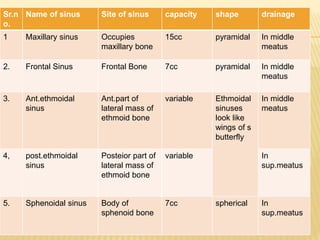
Name of sinus Site of sinus capacity shape drainage
1 Maxillary sinus Occupies
maxillary bone
15cc pyramidal In middle
meatus
2. Frontal Sinus Frontal Bone 7cc pyramidal In middle
meatus
3. Ant.ethmoidal
sinus
Ant.part of
lateral mass of
ethmoid bone
variable Ethmoidal
sinuses
look like
wings of s
butterfly
In middle
meatus
4, post.ethmoidal
sinus
Posteior part of
lateral mass of
ethmoid bone
variable In
sup.meatus
5. Sphenoidal sinus Body of
sphenoid bone
7cc spherical In
sup.meatus
TYPES OF PNS
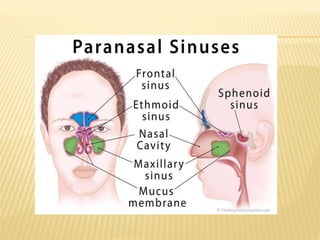
 Four pairs of paranasal sinuses –
 Frontal-above eyes in forehead bone
 Maxillary-in cheekbones, under eye
 Ethmoid-between eyes and nose
 Sphenoid-in center of skull, behind nose and
eyes
FUNCTION OF PNS
 Decreasing the relative weight of the skull
 Increasing the resonance of the voice
 Providing a buffer against facial trauma
 Insulating sensitive structures from rapid
temperature fluctuations in the nose
 Humidifying and heating inspired air
PATHOPHYSIOLOGY
 Usually follows rhinitis, which may be viral or
allergic.
 May also result from abrupt pressure changes
(air planes, diving) or dental extractions or
infections.
 Inflammation and edema of mucous
membranes lining the sinuses cause
obstruction.
 This provides for an opportunistic bacterial
invasion.
 With inflammation, the mucosal lining of the
sinuses produce mucoid drainage. Bacteria
invade and pus accumulates inside the sinus
cavities.
 Postnasal drainage causes obstruction of nasal
passages and an inflamed throat.
 If the sinus orifices are blocked by swollen
mucosal lining, the pus cannot enter the nose
and builds up pressure inside the sinus cavities.
PREDISPOSING FACTORS
• Allergies, nasal deformities, cystic fibrosis,
nasal polyps, and HIV infection.
• Cold weather
• High pollen counts
• Smoking in the home
• Reinfection from siblings
 Acute Sinusitis – respiratory symptoms last
longer than 10 days but less than 30 days.
 Sub acute sinusitis – respiratory symptoms
persist longer than 30 days without
improvement.
 Chronic sinusitis – respiratory symptoms last
longer than 120 days.
ETIOLOGY OF SINUSITIS
 70% of bacterial sinusitis is caused by:
• Streptococcus pneumoniae
• Haemophilus influenzae
• Moraxella catarrhalis
 Other causative organisms are:
• Staphylococcus aureus
• Streptococcus pyogenes,
• Gram-negative bacilli
• Respiratory viruses
COMPLICATIONS OF SINUSITIS
 Intra-orbital
 Orbital cellulitis
 Orbital abscess
 Cutaneous fistula
 Mucocele
 Intra-cranial
 Extra-dural abcess
 Sub-dural abscess
 Meningitis
 Encephalitis
 Brain abscess
 Otitic hydrocephalus
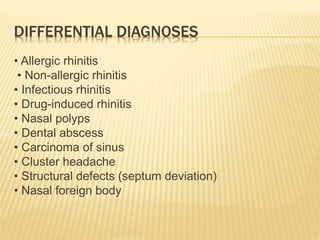
DIFFERENTIAL DIAGNOSES
• Allergic rhinitis
• Non-allergic rhinitis
• Infectious rhinitis
• Drug-induced rhinitis
• Nasal polyps
• Dental abscess
• Carcinoma of sinus
• Cluster headache
• Structural defects (septum deviation)
• Nasal foreign body
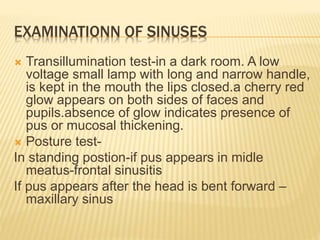
EXAMINATIONN OF SINUSES
 Transillumination test-in a dark room. A low
voltage small lamp with long and narrow handle,
is kept in the mouth the lips closed.a cherry red
glow appears on both sides of faces and
pupils.absence of glow indicates presence of
pus or mucosal thickening.
 Posture test-
In standing postion-if pus appears in midle
meatus-frontal sinusitis
If pus appears after the head is bent forward –
maxillary sinus
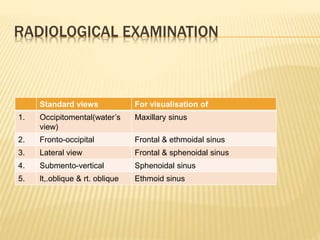
RADIOLOGICAL EXAMINATION
Standard views For visualisation of
1. Occipitomental(water’s
view)
Maxillary sinus
2. Fronto-occipital Frontal & ethmoidal sinus
3. Lateral view Frontal & sphenoidal sinus
4. Submento-vertical Sphenoidal sinus
5. lt,.oblique & rt. oblique Ethmoid sinus
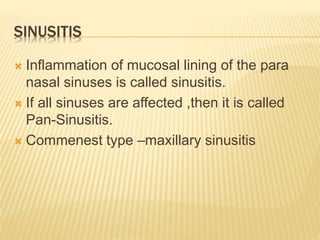
SINUSITIS
 Inflammation of mucosal lining of the para
nasal sinuses is called sinusitis.
 If all sinuses are affected ,then it is called
Pan-Sinusitis.
 Commenest type –maxillary sinusitis
ACUTE MAXILLARY SINUSITIS
 Predisposing factor-
 Spread of nasal infection
 Trauma
 Spread of dental infection-premolar and
molar teeth
 Causative organism- viral.bacterial
CLINICAL FEATURES
 Pain in maxillary region radiateing to eyes
 Tenderness over the canine fossa
 Headache,fever,malaise
 Nasal discharge-initially mucoid,later on
purulent due to secondary infection.may b
blood stained.
 Foul smelling dicharge indicates dental infection
 Dicharge may be seen trickling down from the
middle meatus.
DIAGNOSIS
 X ray PNS water’s view-hazziness or
complete opacity
 CT scan
TREATMENT
 ANTIBIOTICS
 NASAL DECONGESTANTS
 STEAM INHALATION
 ANALGESICS
 ANTIHISTAMINES
 SURGICAL TREATMENT-ANTRAL
PINCTURE/INTRANASAL ANTROSTOMY
 RADICAL ANSTROTOMY
RADICAL ANTROSTOMY
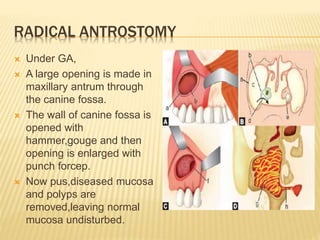
 Under GA,
 A large opening is made in
maxillary antrum through
the canine fossa.
 The wall of canine fossa is
opened with
hammer,gouge and then
opening is enlarged with
punch forcep.
 Now pus,diseased mucosa
and polyps are
removed,leaving normal
mucosa undisturbed.
ANTRAL PUNCTURE/LAVAGE
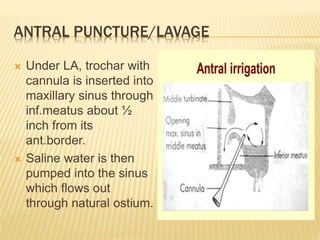
 Under LA, trochar with
cannula is inserted into
maxillary sinus through
inf.meatus about ½
inch from its
ant.border.
 Saline water is then
pumped into the sinus
which flows out
through natural ostium.
ACUTE FRONTAL SINUSITIS
 Symptoms
 Dull pain occurs in
supraorbital area.starts
in morning and
increases till midday
and tends to disappear
in late afternoon.
 Photophobia,lacrimatio
n
 Nasal discharge
 Fever,malaise
 Signs
 Tenderness over floor
of sinus
 Selling over eyelid and
eyebrow
 On rhinoscopy, local
changes are seen
TREATMENT
 Conservative treatment
 Surgical treatment-
 Frontal trephine-an opening is made in the floor
of sinus by giving a small incision just below the
medial end of eyebrow.after drainage, 2 plastic
tubes are inserted into sinus through the wond
and fixed by suturing.tubes are removed after
complete cure
 Functional endoscopic sinus surgery
ETHMOIDAL SINUSITIS-ANT. & POST.
 Pain behind the eyes
 Unilateral nasal obstruction
 Mucopurulent/purulent nasal discharge
 fever,headache,malaise
 Tenderness just below inner canthus
 Swelling of skin over nasal bone
 Treatment-
 Intranasal approach
 Frontal ethmoidal approach
 Transantral ethmoidal approach
SPHENOIDAL SINUSITIS
 Usually occurs in association with
post.ethmoidal sinusitisor may occur as a part of
generalized sinus infection(pansinusitis)
 Pain is deep in the centre of head
 Pus may seen in sup.meatus on
post.rhinoscopy
 Ant.rhinoscopy-normal
 Treatment-
 conservative
 Intranasal surgical opening of the sphenoidal
sinus in chronic stage.
THANK YOU

Sinusitis / Dr.Varsha Dhage

  • 1.
    SINUSITIS Presented by- DR.VARSHA DHAGE,M.S. Shalakya-ENT Ass. Professor, Dept. Of Shalakyatantra SNKDCT’s Nallasopara Ayurved Medical College,dist.Palghar
  • 3.
    PNS  The spacesin certain skull bones which are filled up with air, lined by pseudostratified ciliated columner epithelium and are related to the nose by their opening in the nasal cavity , are called Paranasal sinuses.
  • 4.
    Sr.n o. Name of sinusSite of sinus capacity shape drainage 1 Maxillary sinus Occupies maxillary bone 15cc pyramidal In middle meatus 2. Frontal Sinus Frontal Bone 7cc pyramidal In middle meatus 3. Ant.ethmoidal sinus Ant.part of lateral mass of ethmoid bone variable Ethmoidal sinuses look like wings of s butterfly In middle meatus 4, post.ethmoidal sinus Posteior part of lateral mass of ethmoid bone variable In sup.meatus 5. Sphenoidal sinus Body of sphenoid bone 7cc spherical In sup.meatus
  • 5.
    TYPES OF PNS Four pairs of paranasal sinuses –  Frontal-above eyes in forehead bone  Maxillary-in cheekbones, under eye  Ethmoid-between eyes and nose  Sphenoid-in center of skull, behind nose and eyes
  • 6.
    FUNCTION OF PNS Decreasing the relative weight of the skull  Increasing the resonance of the voice  Providing a buffer against facial trauma  Insulating sensitive structures from rapid temperature fluctuations in the nose  Humidifying and heating inspired air
  • 7.
    PATHOPHYSIOLOGY  Usually followsrhinitis, which may be viral or allergic.  May also result from abrupt pressure changes (air planes, diving) or dental extractions or infections.  Inflammation and edema of mucous membranes lining the sinuses cause obstruction.  This provides for an opportunistic bacterial invasion.
  • 8.
     With inflammation,the mucosal lining of the sinuses produce mucoid drainage. Bacteria invade and pus accumulates inside the sinus cavities.  Postnasal drainage causes obstruction of nasal passages and an inflamed throat.  If the sinus orifices are blocked by swollen mucosal lining, the pus cannot enter the nose and builds up pressure inside the sinus cavities.
  • 9.
    PREDISPOSING FACTORS • Allergies,nasal deformities, cystic fibrosis, nasal polyps, and HIV infection. • Cold weather • High pollen counts • Smoking in the home • Reinfection from siblings
  • 10.
     Acute Sinusitis– respiratory symptoms last longer than 10 days but less than 30 days.  Sub acute sinusitis – respiratory symptoms persist longer than 30 days without improvement.  Chronic sinusitis – respiratory symptoms last longer than 120 days.
  • 11.
    ETIOLOGY OF SINUSITIS 70% of bacterial sinusitis is caused by: • Streptococcus pneumoniae • Haemophilus influenzae • Moraxella catarrhalis  Other causative organisms are: • Staphylococcus aureus • Streptococcus pyogenes, • Gram-negative bacilli • Respiratory viruses
  • 12.
    COMPLICATIONS OF SINUSITIS Intra-orbital  Orbital cellulitis  Orbital abscess  Cutaneous fistula  Mucocele  Intra-cranial  Extra-dural abcess  Sub-dural abscess  Meningitis  Encephalitis  Brain abscess  Otitic hydrocephalus
  • 13.
    DIFFERENTIAL DIAGNOSES • Allergicrhinitis • Non-allergic rhinitis • Infectious rhinitis • Drug-induced rhinitis • Nasal polyps • Dental abscess • Carcinoma of sinus • Cluster headache • Structural defects (septum deviation) • Nasal foreign body
  • 14.
    EXAMINATIONN OF SINUSES Transillumination test-in a dark room. A low voltage small lamp with long and narrow handle, is kept in the mouth the lips closed.a cherry red glow appears on both sides of faces and pupils.absence of glow indicates presence of pus or mucosal thickening.  Posture test- In standing postion-if pus appears in midle meatus-frontal sinusitis If pus appears after the head is bent forward – maxillary sinus
  • 15.
    RADIOLOGICAL EXAMINATION Standard viewsFor visualisation of 1. Occipitomental(water’s view) Maxillary sinus 2. Fronto-occipital Frontal & ethmoidal sinus 3. Lateral view Frontal & sphenoidal sinus 4. Submento-vertical Sphenoidal sinus 5. lt,.oblique & rt. oblique Ethmoid sinus
  • 16.
    SINUSITIS  Inflammation ofmucosal lining of the para nasal sinuses is called sinusitis.  If all sinuses are affected ,then it is called Pan-Sinusitis.  Commenest type –maxillary sinusitis
  • 17.
    ACUTE MAXILLARY SINUSITIS Predisposing factor-  Spread of nasal infection  Trauma  Spread of dental infection-premolar and molar teeth  Causative organism- viral.bacterial
  • 18.
    CLINICAL FEATURES  Painin maxillary region radiateing to eyes  Tenderness over the canine fossa  Headache,fever,malaise  Nasal discharge-initially mucoid,later on purulent due to secondary infection.may b blood stained.  Foul smelling dicharge indicates dental infection  Dicharge may be seen trickling down from the middle meatus.
  • 19.
    DIAGNOSIS  X rayPNS water’s view-hazziness or complete opacity  CT scan
  • 20.
    TREATMENT  ANTIBIOTICS  NASALDECONGESTANTS  STEAM INHALATION  ANALGESICS  ANTIHISTAMINES  SURGICAL TREATMENT-ANTRAL PINCTURE/INTRANASAL ANTROSTOMY  RADICAL ANSTROTOMY
  • 21.
    RADICAL ANTROSTOMY  UnderGA,  A large opening is made in maxillary antrum through the canine fossa.  The wall of canine fossa is opened with hammer,gouge and then opening is enlarged with punch forcep.  Now pus,diseased mucosa and polyps are removed,leaving normal mucosa undisturbed.
  • 22.
    ANTRAL PUNCTURE/LAVAGE  UnderLA, trochar with cannula is inserted into maxillary sinus through inf.meatus about ½ inch from its ant.border.  Saline water is then pumped into the sinus which flows out through natural ostium.
  • 23.
    ACUTE FRONTAL SINUSITIS Symptoms  Dull pain occurs in supraorbital area.starts in morning and increases till midday and tends to disappear in late afternoon.  Photophobia,lacrimatio n  Nasal discharge  Fever,malaise  Signs  Tenderness over floor of sinus  Selling over eyelid and eyebrow  On rhinoscopy, local changes are seen
  • 24.
    TREATMENT  Conservative treatment Surgical treatment-  Frontal trephine-an opening is made in the floor of sinus by giving a small incision just below the medial end of eyebrow.after drainage, 2 plastic tubes are inserted into sinus through the wond and fixed by suturing.tubes are removed after complete cure  Functional endoscopic sinus surgery
  • 25.
    ETHMOIDAL SINUSITIS-ANT. &POST.  Pain behind the eyes  Unilateral nasal obstruction  Mucopurulent/purulent nasal discharge  fever,headache,malaise  Tenderness just below inner canthus  Swelling of skin over nasal bone  Treatment-  Intranasal approach  Frontal ethmoidal approach  Transantral ethmoidal approach
  • 26.
    SPHENOIDAL SINUSITIS  Usuallyoccurs in association with post.ethmoidal sinusitisor may occur as a part of generalized sinus infection(pansinusitis)  Pain is deep in the centre of head  Pus may seen in sup.meatus on post.rhinoscopy  Ant.rhinoscopy-normal  Treatment-  conservative  Intranasal surgical opening of the sphenoidal sinus in chronic stage.
  • 27.