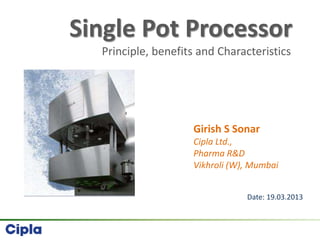
Single Pot Processor
Principle, benefits and Characteristics
Girish S Sonar
Cipla Ltd.,
Pharma R&D
Vikhroli (W), Mumbai
Date: 19.03.2013
Disclaimer
All material on this presentation, including text and
images, is of presenter's opinion only and does not
represent that of any vendor or promoting any
machine/equipment nor employee's view.
• What is ‘Single Pot Processor’?
• SPP Vs RMG
• Design features and Benefits
• Application
• Working Principle
• Case Study
• Post-approval changes
Outline
• What is ‘Single Pot Processor’?
• RMG Vs SPP
• Design features and Benefits
• Application
• Working Principle
• Case Study
• Post-approval changes
Outline
• A high-shear-mixer-granulator-dryer, combining
the steps of mixing, granulation and drying in oral
solid dosage form production
• Thus, single pot processing (SPP) is the
production of pharmaceutical granules using a
wet granulation process in which dry mixing,
liquid addition, wet granulation, drying and sizing
of the granules is done in one machine.
What is ‘Single Pot Processor’
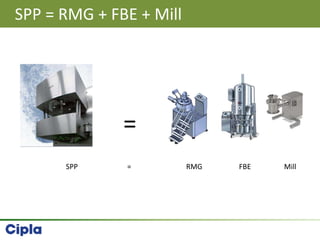
SPP = RMG + FBE + Mill
SPP = RMG FBE Mill
=
• What is ‘Single Pot Processor’?
• SPP Vs RMG
• Design features and Benefits
• Application
• Working Principle
• Case Study
• Post-approval changes
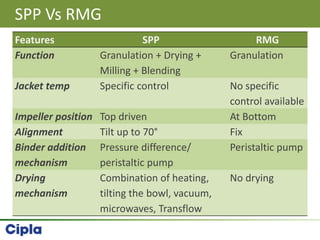
SPP Vs RMG
Features SPP RMG
Function Granulation + Drying +
Milling + Blending
Granulation
Jacket temp Specific control No specific
control available
Impeller position Top driven At Bottom
Alignment Tilt up to 70° Fix
Binder addition
mechanism
Pressure difference/
peristaltic pump
Peristaltic pump
Drying
mechanism
Combination of heating,
tilting the bowl, vacuum,
microwaves, Transflow
No drying
• What is ‘Single Pot Processor’?
• RMG Vs SPP
• Design features and Benefits
• Application
• Working Principle
• Case Study
• Post-approval changes
 Flexibility:
 Single Pot Processing: mixing, granulation and drying in
1 machine - number of material handling steps is
decreased
 Drying technique : Vacuum-drying, microwaves,
Transflow and swinging bowl – improvement of the
granule characteristics and a reduction in drying time
 Explosion proof design
 Containment:
 Perfect GMP-design, easy to clean, CIP system
 Dust-free loading
Design features and Benefits (1)
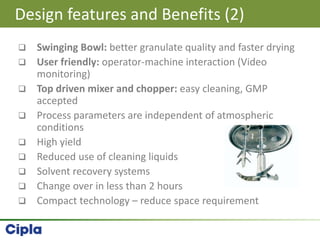
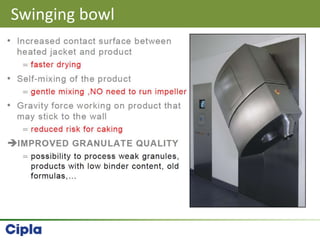
 Swinging Bowl: better granulate quality and faster drying
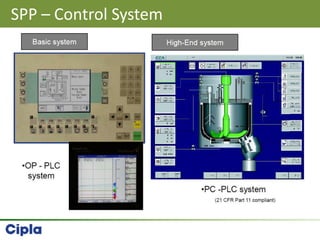
 User friendly: operator-machine interaction (Video
monitoring)
 Top driven mixer and chopper: easy cleaning, GMP
accepted
 Process parameters are independent of atmospheric
conditions
 High yield
 Reduced use of cleaning liquids
 Solvent recovery systems
 Change over in less than 2 hours
 Compact technology – reduce space requirement
Design features and Benefits (2)
• What is ‘Single Pot Processor’?
• RMG Vs SPP
• Design features and Benefits
• Application
• Working Principle
• Case Study
• Post-approval changes
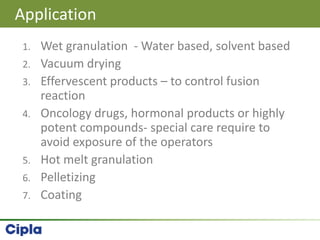
1. Wet granulation - Water based, solvent based
2. Vacuum drying
3. Effervescent products – to control fusion
reaction
4. Oncology drugs, hormonal products or highly
potent compounds- special care require to
avoid exposure of the operators
5. Hot melt granulation
6. Pelletizing
7. Coating
Application
• What is ‘Single Pot Processor’?
• RMG Vs SPP
• Design features and Benefits
• Application
• Working Principle
• Case Study
• Post-approval changes
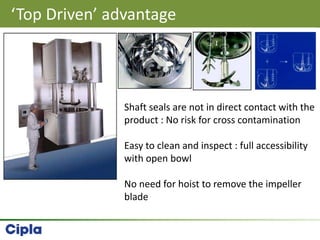
‘Top Driven’ advantage
Shaft seals are not in direct contact with the
product : No risk for cross contamination
Easy to clean and inspect : full accessibility
with open bowl
No need for hoist to remove the impeller
blade
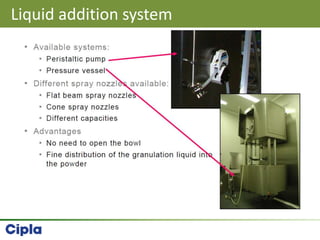
Liquid addition system
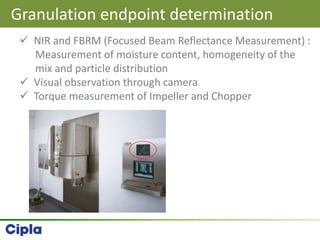
Granulation endpoint determination
 NIR and FBRM (Focused Beam Reflectance Measurement) :
Measurement of moisture content, homogeneity of the
mix and particle distribution
 Visual observation through camera
 Torque measurement of Impeller and Chopper
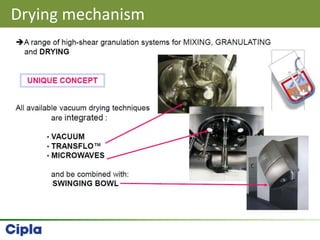
Drying mechanism
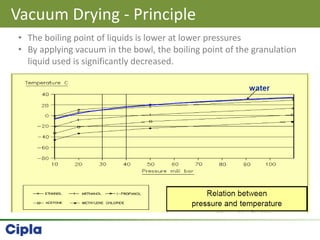
Vacuum Drying - Principle
• The boiling point of liquids is lower at lower pressures
• By applying vacuum in the bowl, the boiling point of the granulation
liquid used is significantly decreased.
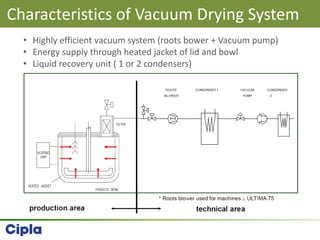
Characteristics of Vacuum Drying System
• Highly efficient vacuum system (roots bower + Vacuum pump)
• Energy supply through heated jacket of lid and bowl
• Liquid recovery unit ( 1 or 2 condensers)
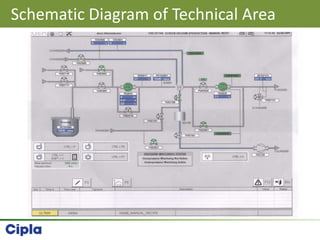
Schematic Diagram of Technical Area
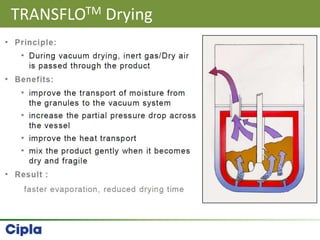
TRANSFLOTM Drying
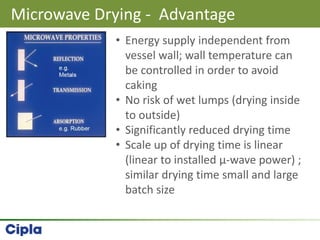
Microwave Drying - Advantage
• Energy supply independent from
vessel wall; wall temperature can
be controlled in order to avoid
caking
• No risk of wet lumps (drying inside
to outside)
• Significantly reduced drying time
• Scale up of drying time is linear
(linear to installed μ-wave power) ;
similar drying time small and large
batch size
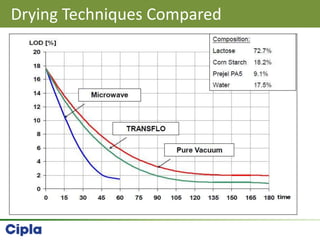
Drying Techniques Compared
Swinging bowl
SPP – Control System
SPP – Containment
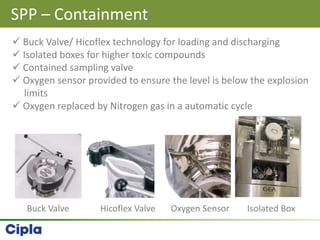
 Buck Valve/ Hicoflex technology for loading and discharging
 Isolated boxes for higher toxic compounds
 Contained sampling valve
 Oxygen sensor provided to ensure the level is below the explosion
limits
 Oxygen replaced by Nitrogen gas in a automatic cycle
Buck Valve Hicoflex Valve Oxygen Sensor Isolated Box
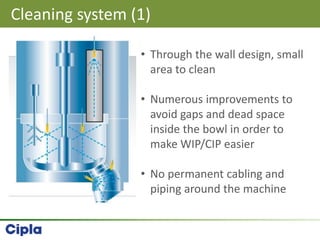
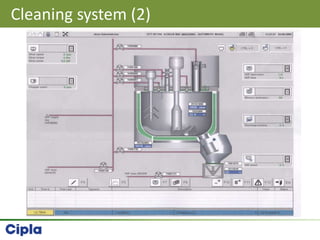
Cleaning system (1)
• Through the wall design, small
area to clean
• Numerous improvements to
avoid gaps and dead space
inside the bowl in order to
make WIP/CIP easier
• No permanent cabling and
piping around the machine
Cleaning system (2)
• What is ‘Single Pot Processor’?
• RMG Vs SPP
• Design features and Benefits
• Application
• Working Principle
• Case Study
• Post-approval changes
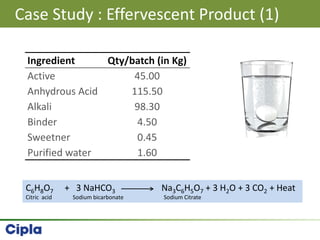
Case Study : Effervescent Product (1)
Ingredient Qty/batch (in Kg)
Active 45.00
Anhydrous Acid 115.50
Alkali 98.30
Binder 4.50
Sweetner 0.45
Purified water 1.60
C6H8O7 + 3 NaHCO3 Na3C6H5O7 + 3 H2O + 3 CO2 + Heat
Citric acid Sodium bicarbonate Sodium Citrate
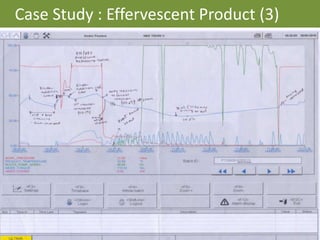
Predetermined Targets:
 Control the reaction
 Max yield
 Efficient drying
Case Study : Effervescent Product (2)
Case Study : Effervescent Product (3)
33
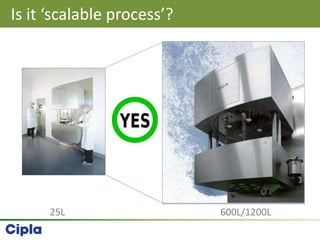
Is it ‘scalable process’?
25L 600L/1200L
• What is ‘Single Pot Processor’?
• RMG Vs SPP
• Design features and Benefits
• Application
• Working Principle
• Case Study
• Post-approval changes
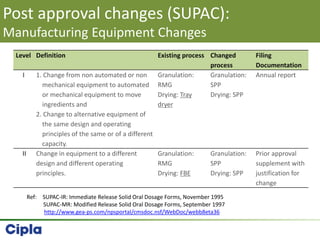
Post approval changes (SUPAC):
Manufacturing Equipment Changes
Level Definition Existing process Changed
process
Filing
Documentation
I 1. Change from non automated or non
mechanical equipment to automated
or mechanical equipment to move
ingredients and
2. Change to alternative equipment of
the same design and operating
principles of the same or of a different
capacity.
Granulation:
RMG
Drying: Tray
dryer
Granulation:
SPP
Drying: SPP
Annual report
II Change in equipment to a different
design and different operating
principles.
Granulation:
RMG
Drying: FBE
Granulation:
SPP
Drying: SPP
Prior approval
supplement with
justification for
change
Ref: SUPAC-IR: Immediate Release Solid Oral Dosage Forms, November 1995
SUPAC-MR: Modified Release Solid Oral Dosage Forms, September 1997
http://www.gea-ps.com/npsportal/cmsdoc.nsf/WebDoc/webb8eta36
Thanks for attention !
Any Question ?
Girish S Sonar
Cipla Ltd.,
Pharma R&D
Vikhroli (W), Mumbai

Single Pot Processor

  • 1.
    Single Pot Processor Principle,benefits and Characteristics Girish S Sonar Cipla Ltd., Pharma R&D Vikhroli (W), Mumbai Date: 19.03.2013
  • 2.
    Disclaimer All material onthis presentation, including text and images, is of presenter's opinion only and does not represent that of any vendor or promoting any machine/equipment nor employee's view.
  • 3.
    • What is‘Single Pot Processor’? • SPP Vs RMG • Design features and Benefits • Application • Working Principle • Case Study • Post-approval changes Outline
  • 4.
    • What is‘Single Pot Processor’? • RMG Vs SPP • Design features and Benefits • Application • Working Principle • Case Study • Post-approval changes Outline
  • 5.
    • A high-shear-mixer-granulator-dryer,combining the steps of mixing, granulation and drying in oral solid dosage form production • Thus, single pot processing (SPP) is the production of pharmaceutical granules using a wet granulation process in which dry mixing, liquid addition, wet granulation, drying and sizing of the granules is done in one machine. What is ‘Single Pot Processor’
  • 6.
    SPP = RMG+ FBE + Mill SPP = RMG FBE Mill =
  • 7.
    • What is‘Single Pot Processor’? • SPP Vs RMG • Design features and Benefits • Application • Working Principle • Case Study • Post-approval changes
  • 8.
    SPP Vs RMG FeaturesSPP RMG Function Granulation + Drying + Milling + Blending Granulation Jacket temp Specific control No specific control available Impeller position Top driven At Bottom Alignment Tilt up to 70° Fix Binder addition mechanism Pressure difference/ peristaltic pump Peristaltic pump Drying mechanism Combination of heating, tilting the bowl, vacuum, microwaves, Transflow No drying
  • 9.
    • What is‘Single Pot Processor’? • RMG Vs SPP • Design features and Benefits • Application • Working Principle • Case Study • Post-approval changes
  • 10.
     Flexibility:  SinglePot Processing: mixing, granulation and drying in 1 machine - number of material handling steps is decreased  Drying technique : Vacuum-drying, microwaves, Transflow and swinging bowl – improvement of the granule characteristics and a reduction in drying time  Explosion proof design  Containment:  Perfect GMP-design, easy to clean, CIP system  Dust-free loading Design features and Benefits (1)
  • 11.
     Swinging Bowl:better granulate quality and faster drying  User friendly: operator-machine interaction (Video monitoring)  Top driven mixer and chopper: easy cleaning, GMP accepted  Process parameters are independent of atmospheric conditions  High yield  Reduced use of cleaning liquids  Solvent recovery systems  Change over in less than 2 hours  Compact technology – reduce space requirement Design features and Benefits (2)
  • 12.
    • What is‘Single Pot Processor’? • RMG Vs SPP • Design features and Benefits • Application • Working Principle • Case Study • Post-approval changes
  • 13.
    1. Wet granulation- Water based, solvent based 2. Vacuum drying 3. Effervescent products – to control fusion reaction 4. Oncology drugs, hormonal products or highly potent compounds- special care require to avoid exposure of the operators 5. Hot melt granulation 6. Pelletizing 7. Coating Application
  • 14.
    • What is‘Single Pot Processor’? • RMG Vs SPP • Design features and Benefits • Application • Working Principle • Case Study • Post-approval changes
  • 15.
    ‘Top Driven’ advantage Shaftseals are not in direct contact with the product : No risk for cross contamination Easy to clean and inspect : full accessibility with open bowl No need for hoist to remove the impeller blade
  • 16.
  • 17.
    Granulation endpoint determination NIR and FBRM (Focused Beam Reflectance Measurement) : Measurement of moisture content, homogeneity of the mix and particle distribution  Visual observation through camera  Torque measurement of Impeller and Chopper
  • 18.
  • 19.
    Vacuum Drying -Principle • The boiling point of liquids is lower at lower pressures • By applying vacuum in the bowl, the boiling point of the granulation liquid used is significantly decreased.
  • 20.
    Characteristics of VacuumDrying System • Highly efficient vacuum system (roots bower + Vacuum pump) • Energy supply through heated jacket of lid and bowl • Liquid recovery unit ( 1 or 2 condensers)
  • 21.
    Schematic Diagram ofTechnical Area
  • 22.
  • 23.
    Microwave Drying -Advantage • Energy supply independent from vessel wall; wall temperature can be controlled in order to avoid caking • No risk of wet lumps (drying inside to outside) • Significantly reduced drying time • Scale up of drying time is linear (linear to installed μ-wave power) ; similar drying time small and large batch size
  • 24.
  • 25.
  • 26.
  • 27.
    SPP – Containment Buck Valve/ Hicoflex technology for loading and discharging  Isolated boxes for higher toxic compounds  Contained sampling valve  Oxygen sensor provided to ensure the level is below the explosion limits  Oxygen replaced by Nitrogen gas in a automatic cycle Buck Valve Hicoflex Valve Oxygen Sensor Isolated Box
  • 28.
    Cleaning system (1) •Through the wall design, small area to clean • Numerous improvements to avoid gaps and dead space inside the bowl in order to make WIP/CIP easier • No permanent cabling and piping around the machine
  • 29.
  • 30.
    • What is‘Single Pot Processor’? • RMG Vs SPP • Design features and Benefits • Application • Working Principle • Case Study • Post-approval changes
  • 31.
    Case Study :Effervescent Product (1) Ingredient Qty/batch (in Kg) Active 45.00 Anhydrous Acid 115.50 Alkali 98.30 Binder 4.50 Sweetner 0.45 Purified water 1.60 C6H8O7 + 3 NaHCO3 Na3C6H5O7 + 3 H2O + 3 CO2 + Heat Citric acid Sodium bicarbonate Sodium Citrate
  • 32.
    Predetermined Targets:  Controlthe reaction  Max yield  Efficient drying Case Study : Effervescent Product (2)
  • 33.
    Case Study :Effervescent Product (3) 33
  • 34.
    Is it ‘scalableprocess’? 25L 600L/1200L
  • 35.
    • What is‘Single Pot Processor’? • RMG Vs SPP • Design features and Benefits • Application • Working Principle • Case Study • Post-approval changes
  • 36.
    Post approval changes(SUPAC): Manufacturing Equipment Changes Level Definition Existing process Changed process Filing Documentation I 1. Change from non automated or non mechanical equipment to automated or mechanical equipment to move ingredients and 2. Change to alternative equipment of the same design and operating principles of the same or of a different capacity. Granulation: RMG Drying: Tray dryer Granulation: SPP Drying: SPP Annual report II Change in equipment to a different design and different operating principles. Granulation: RMG Drying: FBE Granulation: SPP Drying: SPP Prior approval supplement with justification for change Ref: SUPAC-IR: Immediate Release Solid Oral Dosage Forms, November 1995 SUPAC-MR: Modified Release Solid Oral Dosage Forms, September 1997 http://www.gea-ps.com/npsportal/cmsdoc.nsf/WebDoc/webb8eta36
  • 37.
    Thanks for attention! Any Question ? Girish S Sonar Cipla Ltd., Pharma R&D Vikhroli (W), Mumbai