Single Camera Calibration
using Partially Visible Calibration Objects
Based on Random Dots Marker Tracking Algorithm
*Yuji Oyamada1,2, Pascal Fallavollita2, and Nassir Navab2
1. Keio University, Japan
2. Chair for Computer Aided Medical Procedure (CAMP),
Technische Universität München, Germany
*contact: oyamada@in.tum.de
http://campar.in.tum.de/Main/YujiOyamada
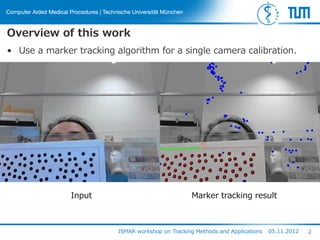
Overview of this work
• Use a marker tracking algorithm for a single camera calibration.
Input Marker tracking result
ISMAR workshop on Tracking Methods and Applications 05.11.2012 2
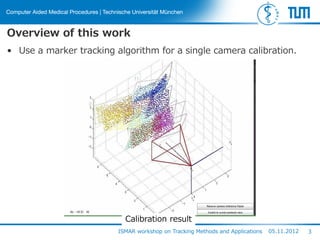
Overview of this work
• Use a marker tracking algorithm for a single camera calibration.
Calibration result
ISMAR workshop on Tracking Methods and Applications 05.11.2012 3
Introduction
ISMAR workshop on Tracking Methods and Applications 05.11.2012 4
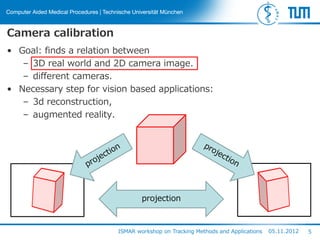
Camera calibration
• Goal: finds a relation between
– 3D real world and 2D camera image.
– different cameras.
• Necessary step for vision based applications:
– 3d reconstruction,
– augmented reality.
projection
ISMAR workshop on Tracking Methods and Applications 05.11.2012 5
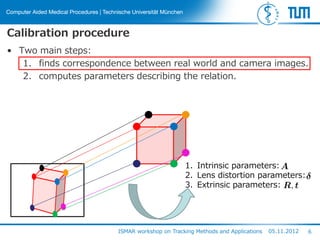
Calibration procedure
• Two main steps:
1. finds correspondence between real world and camera images.
2. computes parameters describing the relation.
1. Intrinsic parameters:
2. Lens distortion parameters:
3. Extrinsic parameters:
ISMAR workshop on Tracking Methods and Applications 05.11.2012 6
Well-known & well-used method
• Zhang's method [26]:
– uses several images of a set of known control points on a planar
objects.
– step-by-step parameters estimation.
MatLab Camera Calibration Toolbox [3]
ISMAR workshop on Tracking Methods and Applications 05.11.2012 7
[26] Z. Zhang, ICCV, 1999
[3] J. Y. Bouget, MatLab Camera Calibration Toolbox, 2008
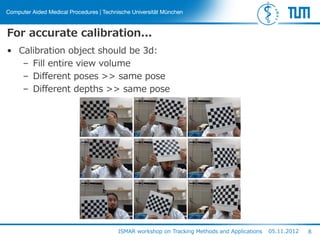
For accurate calibration...
• Calibration object should be 3d:
– Fill entire view volume
– Different poses >> same pose
– Different depths >> same pose
ISMAR workshop on Tracking Methods and Applications 05.11.2012 8
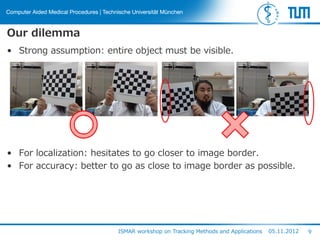
Our dilemma
• Strong assumption: entire object must be visible.
• For localization: hesitates to go closer to image border.
• For accuracy: better to go as close to image border as possible.
ISMAR workshop on Tracking Methods and Applications 05.11.2012 9
Literature: points correspondence
Circle/rings grid
[4]
AR Tag [7] Natural image
[19]
Occlusion X O O
Defocus O X O
Perspective
distortion
△ O △
[4] Datta, ICCV workshop, 2009
[7] Fiala, MVA, 2008
[19] Pilet, ISMAR, 2006 ISMAR workshop on Tracking Methods and Applications 05.11.2012 10
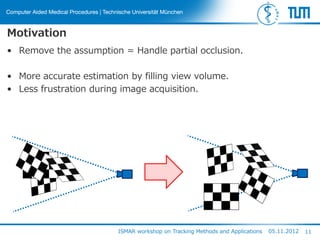
Motivation
• Remove the assumption = Handle partial occlusion.
• More accurate estimation by filling view volume.
• Less frustration during image acquisition.
ISMAR workshop on Tracking Methods and Applications 05.11.2012 11
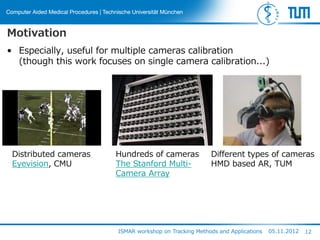
Motivation
• Especially, useful for multiple cameras calibration
(though this work focuses on single camera calibration...)
Hundreds of cameras
The Stanford Multi-
Camera Array
Distributed cameras
Eyevision, CMU
Different types of cameras
HMD based AR, TUM
ISMAR workshop on Tracking Methods and Applications 05.11.2012 12
The proposed method
ISMAR workshop on Tracking Methods and Applications 05.11.2012 13
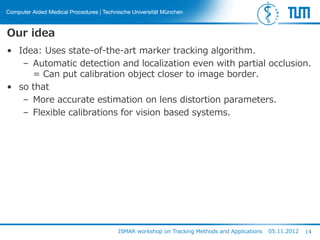
Our idea
• Idea: Uses state-of-the-art marker tracking algorithm.
– Automatic detection and localization even with partial occlusion.
= Can put calibration object closer to image border.
• so that
– More accurate estimation on lens distortion parameters.
– Flexible calibrations for vision based systems.
ISMAR workshop on Tracking Methods and Applications 05.11.2012 14
The proposed method
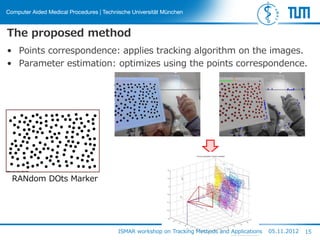
• Points correspondence: applies tracking algorithm on the images.
• Parameter estimation: optimizes using the points correspondence.
RANdom DOts Marker
ISMAR workshop on Tracking Methods and Applications 05.11.2012 15
Method 1/2: overview
• Applies RANDOM tracking algorithm [22] on the images.
– Simple circle detection.
– Fast matching using LLAH.
Circle detectionInput Points matching
[22] Uchiyama, IEEE VR, 2011 ISMAR workshop on Tracking Methods and Applications 05.11.2012 16
Method 1/2: tracking algorithm
• Tracking algorithm [22] invariant to scale & rotation.
– Use distribution of control points.
– For a point of interest, set of ratio of two triangles consists of its
neighboring points.
[22] Uchiyama, IEEE VR, 2011 ISMAR workshop on Tracking Methods and Applications 05.11.2012 17
Method 2/2: parameter estimation
• Based on Zhang's method [26].
– Non-linear optimization on reprojection error of control points.
– Consider the visibility of control points.
(11)
[26] Z. Zhang, ICCV, 1999 ISMAR workshop on Tracking Methods and Applications 05.11.2012 18
Experimental results
ISMAR workshop on Tracking Methods and Applications 05.11.2012 19
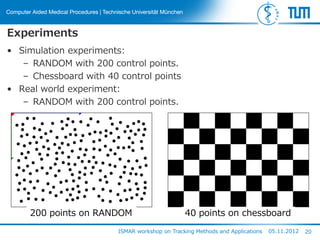
Experiments
• Simulation experiments:
– RANDOM with 200 control points.
– Chessboard with 40 control points
• Real world experiment:
– RANDOM with 200 control points.
200 points on RANDOM 40 points on chessboard
ISMAR workshop on Tracking Methods and Applications 05.11.2012 20
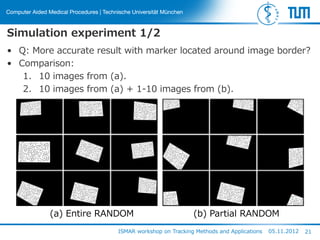
Simulation experiment 1/2
• Q: More accurate result with marker located around image border?
• Comparison:
1. 10 images from (a).
2. 10 images from (a) + 1-10 images from (b).
(a) Entire RANDOM (b) Partial RANDOM
ISMAR workshop on Tracking Methods and Applications 05.11.2012 21
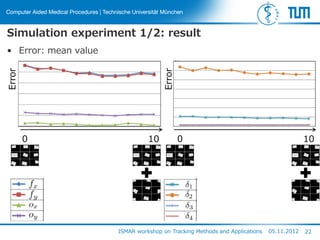
Simulation experiment 1/2: result
• Error: mean value
Error
Error
0 10 0 10
ISMAR workshop on Tracking Methods and Applications 05.11.2012 22
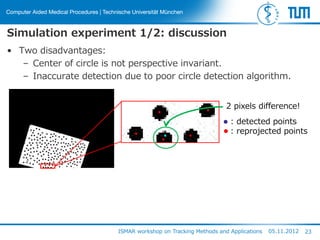
Simulation experiment 1/2: discussion
• Two disadvantages:
– Center of circle is not perspective invariant.
– Inaccurate detection due to poor circle detection algorithm.
: detected points
: reprojected points
2 pixels difference!
ISMAR workshop on Tracking Methods and Applications 05.11.2012 23
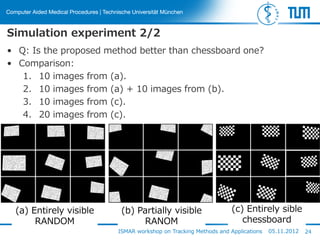
Simulation experiment 2/2
• Q: Is the proposed method better than chessboard one?
• Comparison:
1. 10 images from (a).
2. 10 images from (a) + 10 images from (b).
3. 10 images from (c).
4. 20 images from (c).
(a) Entirely visible
RANDOM
(b) Partially visible
RANOM
(c) Entirely sible
chessboard
ISMAR workshop on Tracking Methods and Applications 05.11.2012 24
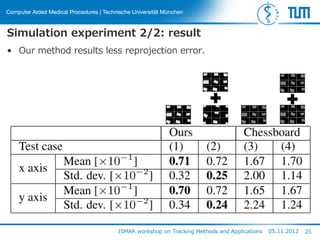
Simulation experiment 2/2: result
• Our method results less reprojection error.
ISMAR workshop on Tracking Methods and Applications 05.11.2012 25
Simulation experiment 2/2: result
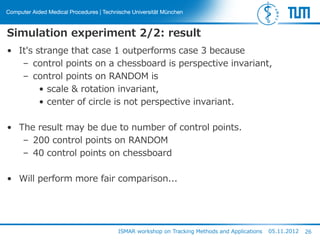
• It's strange that case 1 outperforms case 3 because
– control points on a chessboard is perspective invariant,
– control points on RANDOM is
• scale & rotation invariant,
• center of circle is not perspective invariant.
• The result may be due to number of control points.
– 200 control points on RANDOM
– 40 control points on chessboard
• Will perform more fair comparison...
ISMAR workshop on Tracking Methods and Applications 05.11.2012 26
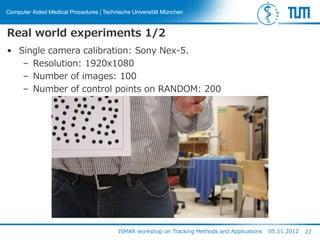
Real world experiments 1/2
• Single camera calibration: Sony Nex-5.
– Resolution: 1920x1080
– Number of images: 100
– Number of control points on RANDOM: 200
ISMAR workshop on Tracking Methods and Applications 05.11.2012 27
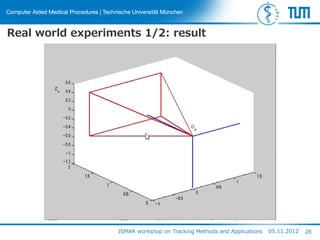
Real world experiments 1/2: result
ISMAR workshop on Tracking Methods and Applications 05.11.2012 28
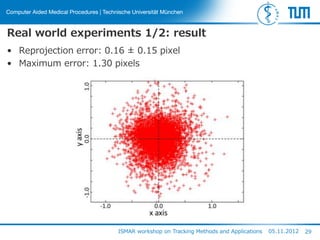
Real world experiments 1/2: result
• Reprojection error: 0.16 ± 0.15 pixel
• Maximum error: 1.30 pixels
ISMAR workshop on Tracking Methods and Applications 05.11.2012 29
Real world experiments 2/2
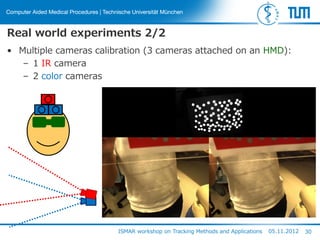
• Multiple cameras calibration (3 cameras attached on an HMD):
– 1 IR camera
– 2 color cameras
ISMAR workshop on Tracking Methods and Applications 05.11.2012 30
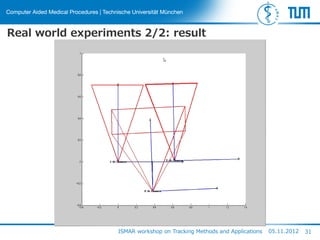
Real world experiments 2/2: result
ISMAR workshop on Tracking Methods and Applications 05.11.2012 31
Conclusion
+
future works
ISMAR workshop on Tracking Methods and Applications 05.11.2012 32
Conclusion
• Used marker tracking algorithm
• To solve points correspondence problem
• For more accurate & friendly camera calibration.
• Advantage:
– More accurate & stable calibration result.
– Many potential extensions.
• Limitation:
– The tracking algorithm is only scale & rotation invariant.
= heavy rotation along x/y axis is not supported.
– Center of circle is not perspective invariant.
ISMAR workshop on Tracking Methods and Applications 05.11.2012 33
Potential extension
• Multiple cameras calibration.
• Multiple markers for calibration [A1].
ISMAR workshop on Tracking Methods and Applications 05.11.2012 34[A1] GML Camera Calibration Toolbox, 2005
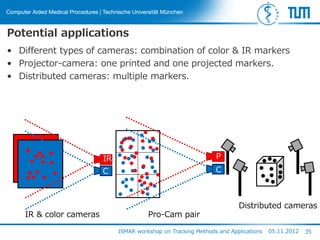
Potential applications
• Different types of cameras: combination of color & IR markers
• Projector-camera: one printed and one projected markers.
• Distributed cameras: multiple markers.
Pro-Cam pair
P
C
IR & color cameras
IR
C
Distributed cameras
ISMAR workshop on Tracking Methods and Applications 05.11.2012 35
Future works: tracking for points correspondence
• Use perspective invariant metric for points correspondence.
– line segments tracking [A2].
• Center of circle is not perspective invariant.
– Use perspective invariant mark [A3].
Line segments tracking_
for SLAM [A2]
Perspective invariant mark
[A3]
[A2] Hirose, BMVC, 2012
[A3] Beeler, Tech. rep. ETHZ, 2010 ISMAR workshop on Tracking Methods and Applications 05.11.2012 36
Future works: tracking for calibration constraints
• Uses rigidity of cameras for non-overlapping cameras calibration.
– Tracking for knowing each camera motion,
– Then align the unsynchronized cameras using their rigidity [A4].
• Selects good calibration images from long video sequences.
– Somehow evaluate calibration images
– To reduce unnecessary huge amount of images from video
sequences.
[A4] Irani, IJCV, 2002 ISMAR workshop on Tracking Methods and Applications 05.11.2012 37
Code available
• Entire package containing tracking and calibration by me.
– will publish as an open source
– current version: C++ + MatLab
– future version: C++
– If you want to use it, please contact me!
• Original RANDOM tracking algorithm by Hideaki Uchiyama [22].
– open source
– C++
• User friendly calibration code on github by Alexandru Duliu.
– open source
– C++
ISMAR workshop on Tracking Methods and Applications 05.11.2012 38
Thanks for your attention...
• I'm looking for a job opportunity.
• present-03.2013: postdoc @ Keio Univ. & visiting postdoc @ TUM
• 03.2012-??: not decided yet...
• My research interests
– camera tracking for practical application,
– image restoration
• deblurring
• focus control
– 3d modeling
• 3d reconstruction using depth camera
• photometric stereo
– AR visualization to improve perception
ISMAR workshop on Tracking Methods and Applications 05.11.2012 39
Acknowledgments
• This work was partially supported by the Strategic Young
Researcher Overseas Visits Program for Accelerating Brain
Circulation of Japan Society for the Promotion of Science, G2308
ISMAR workshop on Tracking Methods and Applications 05.11.2012 40

Single Camera Calibration Using Partially Visible Calibration Objects Based on Random Dots Marker Tracking Algorithm

  • 1.
    Single Camera Calibration usingPartially Visible Calibration Objects Based on Random Dots Marker Tracking Algorithm *Yuji Oyamada1,2, Pascal Fallavollita2, and Nassir Navab2 1. Keio University, Japan 2. Chair for Computer Aided Medical Procedure (CAMP), Technische Universität München, Germany *contact: oyamada@in.tum.de http://campar.in.tum.de/Main/YujiOyamada
  • 2.
    Overview of thiswork • Use a marker tracking algorithm for a single camera calibration. Input Marker tracking result ISMAR workshop on Tracking Methods and Applications 05.11.2012 2
  • 3.
    Overview of thiswork • Use a marker tracking algorithm for a single camera calibration. Calibration result ISMAR workshop on Tracking Methods and Applications 05.11.2012 3
  • 4.
    Introduction ISMAR workshop onTracking Methods and Applications 05.11.2012 4
  • 5.
    Camera calibration • Goal:finds a relation between – 3D real world and 2D camera image. – different cameras. • Necessary step for vision based applications: – 3d reconstruction, – augmented reality. projection ISMAR workshop on Tracking Methods and Applications 05.11.2012 5
  • 6.
    Calibration procedure • Twomain steps: 1. finds correspondence between real world and camera images. 2. computes parameters describing the relation. 1. Intrinsic parameters: 2. Lens distortion parameters: 3. Extrinsic parameters: ISMAR workshop on Tracking Methods and Applications 05.11.2012 6
  • 7.
    Well-known & well-usedmethod • Zhang's method [26]: – uses several images of a set of known control points on a planar objects. – step-by-step parameters estimation. MatLab Camera Calibration Toolbox [3] ISMAR workshop on Tracking Methods and Applications 05.11.2012 7 [26] Z. Zhang, ICCV, 1999 [3] J. Y. Bouget, MatLab Camera Calibration Toolbox, 2008
  • 8.
    For accurate calibration... •Calibration object should be 3d: – Fill entire view volume – Different poses >> same pose – Different depths >> same pose ISMAR workshop on Tracking Methods and Applications 05.11.2012 8
  • 9.
    Our dilemma • Strongassumption: entire object must be visible. • For localization: hesitates to go closer to image border. • For accuracy: better to go as close to image border as possible. ISMAR workshop on Tracking Methods and Applications 05.11.2012 9
  • 10.
    Literature: points correspondence Circle/ringsgrid [4] AR Tag [7] Natural image [19] Occlusion X O O Defocus O X O Perspective distortion △ O △ [4] Datta, ICCV workshop, 2009 [7] Fiala, MVA, 2008 [19] Pilet, ISMAR, 2006 ISMAR workshop on Tracking Methods and Applications 05.11.2012 10
  • 11.
    Motivation • Remove theassumption = Handle partial occlusion. • More accurate estimation by filling view volume. • Less frustration during image acquisition. ISMAR workshop on Tracking Methods and Applications 05.11.2012 11
  • 12.
    Motivation • Especially, usefulfor multiple cameras calibration (though this work focuses on single camera calibration...) Hundreds of cameras The Stanford Multi- Camera Array Distributed cameras Eyevision, CMU Different types of cameras HMD based AR, TUM ISMAR workshop on Tracking Methods and Applications 05.11.2012 12
  • 13.
    The proposed method ISMARworkshop on Tracking Methods and Applications 05.11.2012 13
  • 14.
    Our idea • Idea:Uses state-of-the-art marker tracking algorithm. – Automatic detection and localization even with partial occlusion. = Can put calibration object closer to image border. • so that – More accurate estimation on lens distortion parameters. – Flexible calibrations for vision based systems. ISMAR workshop on Tracking Methods and Applications 05.11.2012 14
  • 15.
    The proposed method •Points correspondence: applies tracking algorithm on the images. • Parameter estimation: optimizes using the points correspondence. RANdom DOts Marker ISMAR workshop on Tracking Methods and Applications 05.11.2012 15
  • 16.
    Method 1/2: overview •Applies RANDOM tracking algorithm [22] on the images. – Simple circle detection. – Fast matching using LLAH. Circle detectionInput Points matching [22] Uchiyama, IEEE VR, 2011 ISMAR workshop on Tracking Methods and Applications 05.11.2012 16
  • 17.
    Method 1/2: trackingalgorithm • Tracking algorithm [22] invariant to scale & rotation. – Use distribution of control points. – For a point of interest, set of ratio of two triangles consists of its neighboring points. [22] Uchiyama, IEEE VR, 2011 ISMAR workshop on Tracking Methods and Applications 05.11.2012 17
  • 18.
    Method 2/2: parameterestimation • Based on Zhang's method [26]. – Non-linear optimization on reprojection error of control points. – Consider the visibility of control points. (11) [26] Z. Zhang, ICCV, 1999 ISMAR workshop on Tracking Methods and Applications 05.11.2012 18
  • 19.
    Experimental results ISMAR workshopon Tracking Methods and Applications 05.11.2012 19
  • 20.
    Experiments • Simulation experiments: –RANDOM with 200 control points. – Chessboard with 40 control points • Real world experiment: – RANDOM with 200 control points. 200 points on RANDOM 40 points on chessboard ISMAR workshop on Tracking Methods and Applications 05.11.2012 20
  • 21.
    Simulation experiment 1/2 •Q: More accurate result with marker located around image border? • Comparison: 1. 10 images from (a). 2. 10 images from (a) + 1-10 images from (b). (a) Entire RANDOM (b) Partial RANDOM ISMAR workshop on Tracking Methods and Applications 05.11.2012 21
  • 22.
    Simulation experiment 1/2:result • Error: mean value Error Error 0 10 0 10 ISMAR workshop on Tracking Methods and Applications 05.11.2012 22
  • 23.
    Simulation experiment 1/2:discussion • Two disadvantages: – Center of circle is not perspective invariant. – Inaccurate detection due to poor circle detection algorithm. : detected points : reprojected points 2 pixels difference! ISMAR workshop on Tracking Methods and Applications 05.11.2012 23
  • 24.
    Simulation experiment 2/2 •Q: Is the proposed method better than chessboard one? • Comparison: 1. 10 images from (a). 2. 10 images from (a) + 10 images from (b). 3. 10 images from (c). 4. 20 images from (c). (a) Entirely visible RANDOM (b) Partially visible RANOM (c) Entirely sible chessboard ISMAR workshop on Tracking Methods and Applications 05.11.2012 24
  • 25.
    Simulation experiment 2/2:result • Our method results less reprojection error. ISMAR workshop on Tracking Methods and Applications 05.11.2012 25
  • 26.
    Simulation experiment 2/2:result • It's strange that case 1 outperforms case 3 because – control points on a chessboard is perspective invariant, – control points on RANDOM is • scale & rotation invariant, • center of circle is not perspective invariant. • The result may be due to number of control points. – 200 control points on RANDOM – 40 control points on chessboard • Will perform more fair comparison... ISMAR workshop on Tracking Methods and Applications 05.11.2012 26
  • 27.
    Real world experiments1/2 • Single camera calibration: Sony Nex-5. – Resolution: 1920x1080 – Number of images: 100 – Number of control points on RANDOM: 200 ISMAR workshop on Tracking Methods and Applications 05.11.2012 27
  • 28.
    Real world experiments1/2: result ISMAR workshop on Tracking Methods and Applications 05.11.2012 28
  • 29.
    Real world experiments1/2: result • Reprojection error: 0.16 ± 0.15 pixel • Maximum error: 1.30 pixels ISMAR workshop on Tracking Methods and Applications 05.11.2012 29
  • 30.
    Real world experiments2/2 • Multiple cameras calibration (3 cameras attached on an HMD): – 1 IR camera – 2 color cameras ISMAR workshop on Tracking Methods and Applications 05.11.2012 30
  • 31.
    Real world experiments2/2: result ISMAR workshop on Tracking Methods and Applications 05.11.2012 31
  • 32.
    Conclusion + future works ISMAR workshopon Tracking Methods and Applications 05.11.2012 32
  • 33.
    Conclusion • Used markertracking algorithm • To solve points correspondence problem • For more accurate & friendly camera calibration. • Advantage: – More accurate & stable calibration result. – Many potential extensions. • Limitation: – The tracking algorithm is only scale & rotation invariant. = heavy rotation along x/y axis is not supported. – Center of circle is not perspective invariant. ISMAR workshop on Tracking Methods and Applications 05.11.2012 33
  • 34.
    Potential extension • Multiplecameras calibration. • Multiple markers for calibration [A1]. ISMAR workshop on Tracking Methods and Applications 05.11.2012 34[A1] GML Camera Calibration Toolbox, 2005
  • 35.
    Potential applications • Differenttypes of cameras: combination of color & IR markers • Projector-camera: one printed and one projected markers. • Distributed cameras: multiple markers. Pro-Cam pair P C IR & color cameras IR C Distributed cameras ISMAR workshop on Tracking Methods and Applications 05.11.2012 35
  • 36.
    Future works: trackingfor points correspondence • Use perspective invariant metric for points correspondence. – line segments tracking [A2]. • Center of circle is not perspective invariant. – Use perspective invariant mark [A3]. Line segments tracking_ for SLAM [A2] Perspective invariant mark [A3] [A2] Hirose, BMVC, 2012 [A3] Beeler, Tech. rep. ETHZ, 2010 ISMAR workshop on Tracking Methods and Applications 05.11.2012 36
  • 37.
    Future works: trackingfor calibration constraints • Uses rigidity of cameras for non-overlapping cameras calibration. – Tracking for knowing each camera motion, – Then align the unsynchronized cameras using their rigidity [A4]. • Selects good calibration images from long video sequences. – Somehow evaluate calibration images – To reduce unnecessary huge amount of images from video sequences. [A4] Irani, IJCV, 2002 ISMAR workshop on Tracking Methods and Applications 05.11.2012 37
  • 38.
    Code available • Entirepackage containing tracking and calibration by me. – will publish as an open source – current version: C++ + MatLab – future version: C++ – If you want to use it, please contact me! • Original RANDOM tracking algorithm by Hideaki Uchiyama [22]. – open source – C++ • User friendly calibration code on github by Alexandru Duliu. – open source – C++ ISMAR workshop on Tracking Methods and Applications 05.11.2012 38
  • 39.
    Thanks for yourattention... • I'm looking for a job opportunity. • present-03.2013: postdoc @ Keio Univ. & visiting postdoc @ TUM • 03.2012-??: not decided yet... • My research interests – camera tracking for practical application, – image restoration • deblurring • focus control – 3d modeling • 3d reconstruction using depth camera • photometric stereo – AR visualization to improve perception ISMAR workshop on Tracking Methods and Applications 05.11.2012 39
  • 40.
    Acknowledgments • This workwas partially supported by the Strategic Young Researcher Overseas Visits Program for Accelerating Brain Circulation of Japan Society for the Promotion of Science, G2308 ISMAR workshop on Tracking Methods and Applications 05.11.2012 40