
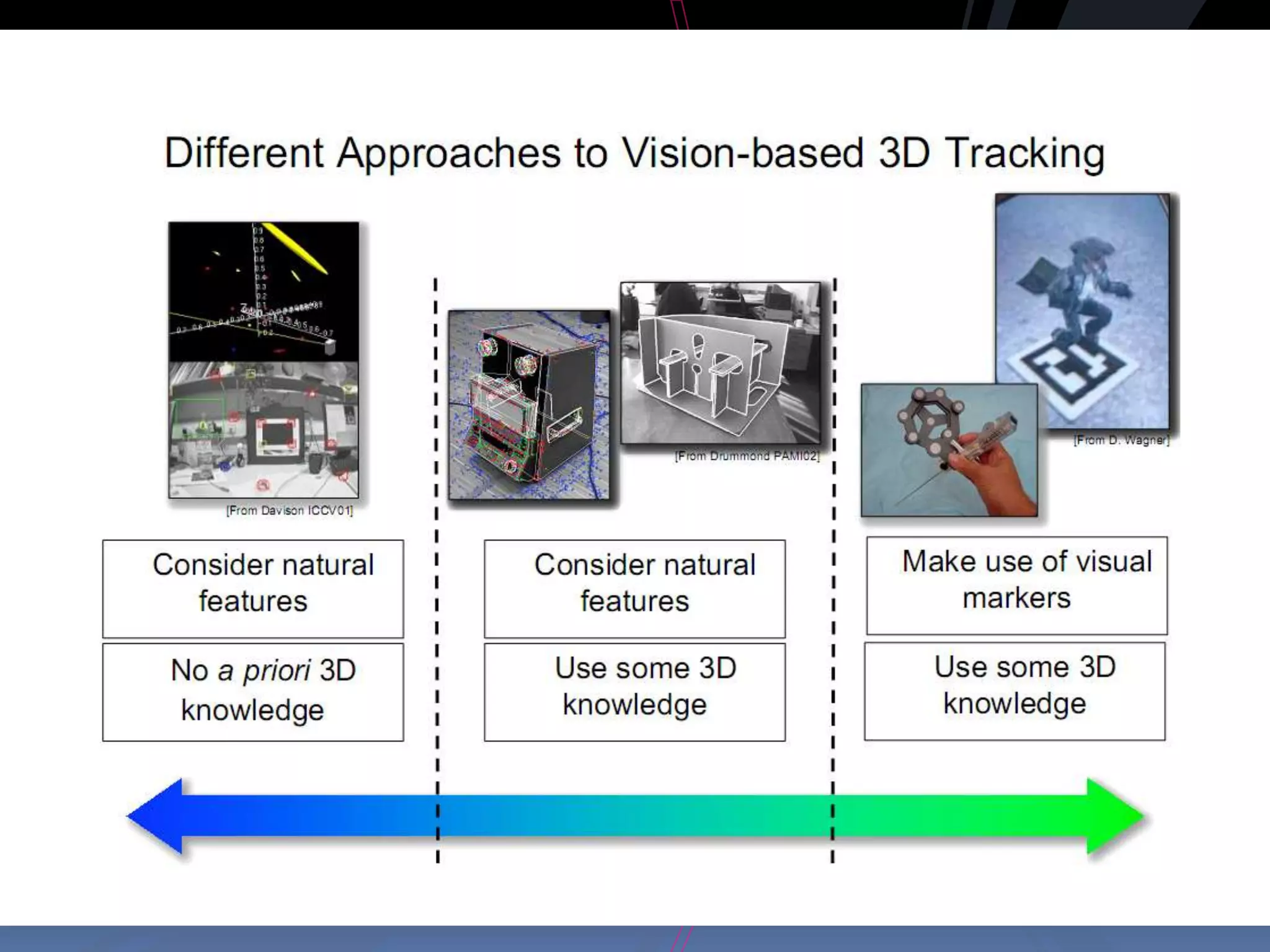




Monocular Model-Based 3D Tracking of Rigid Objects: A Survey2008. 12. 04.백운혁Chapter 2. Mathematical Tools
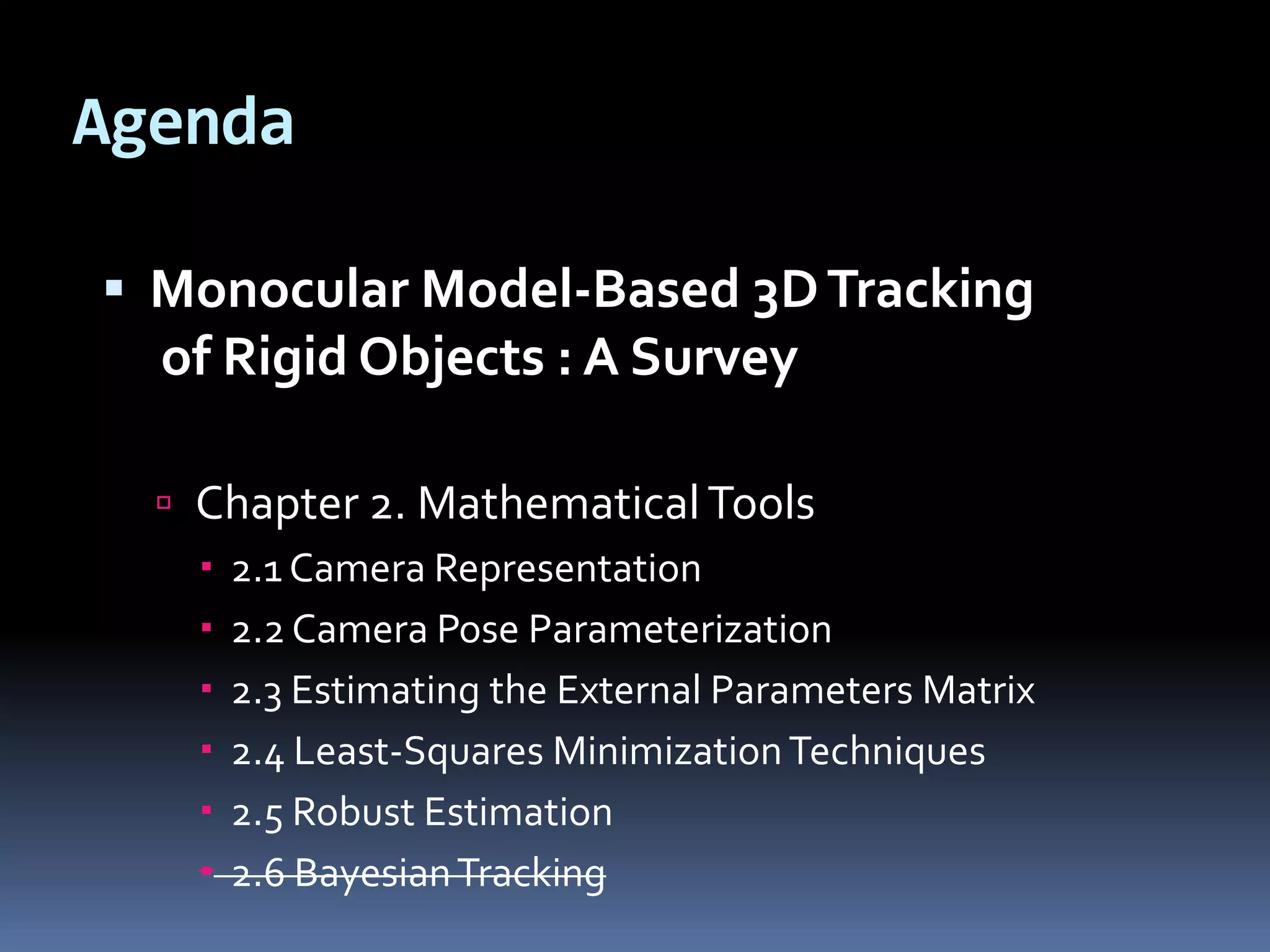
AgendaMonocular Model-Based 3D Tracking of Rigid Objects : A SurveyChapter 2. Mathematical Tools2.1 Camera Representation2.2 Camera Pose Parameterization2.3 Estimating the External Parameters Matrix2.4 Least-Squares Minimization Techniques2.5 Robust Estimation2.6 Bayesian Tracking
the standard pinhole camera model2.1 Camera Representation
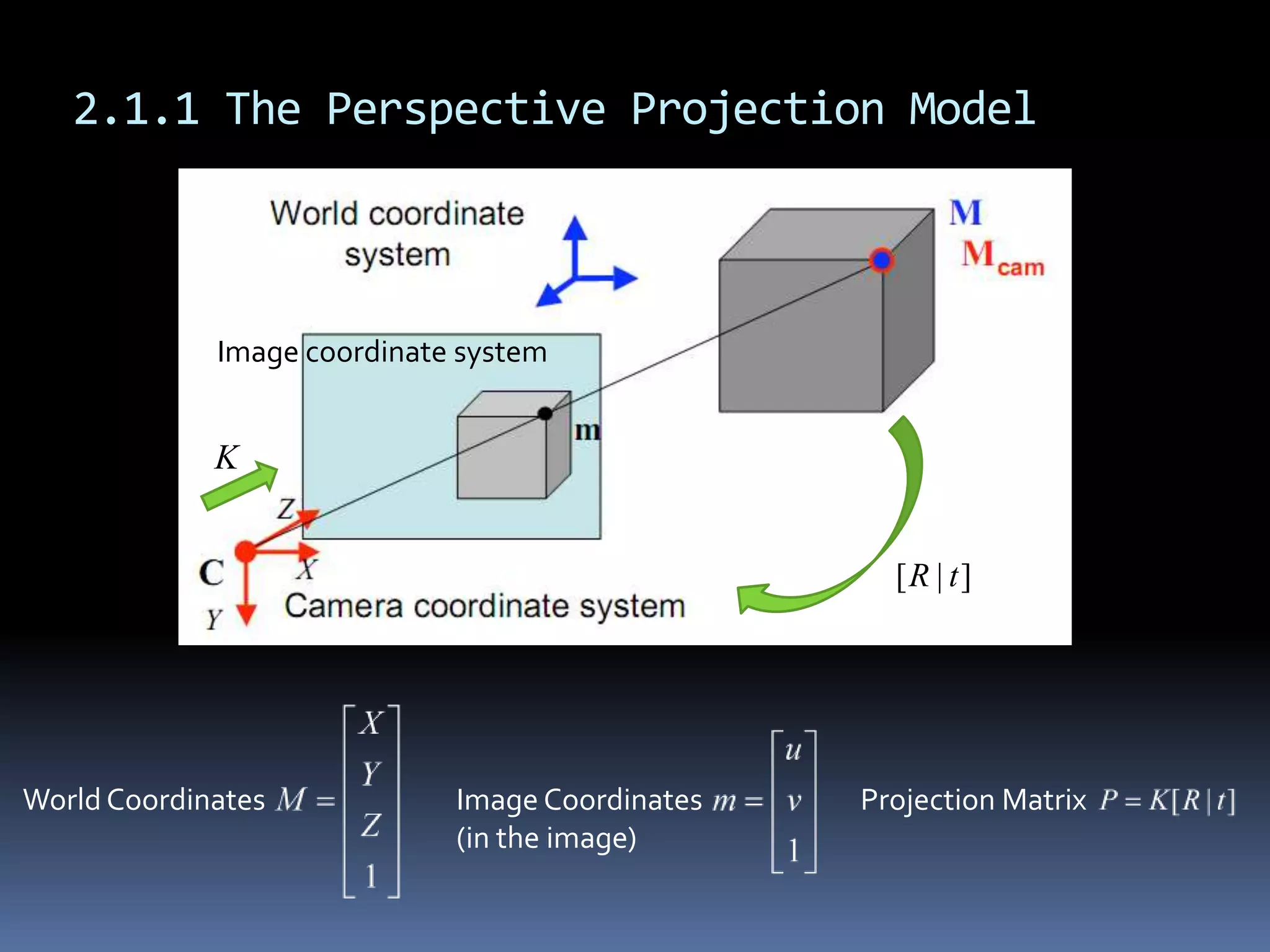
2.1.1 The Perspective Projection ModelImage coordinate systemWorld CoordinatesImage Coordinates(in the image)Projection Matrix
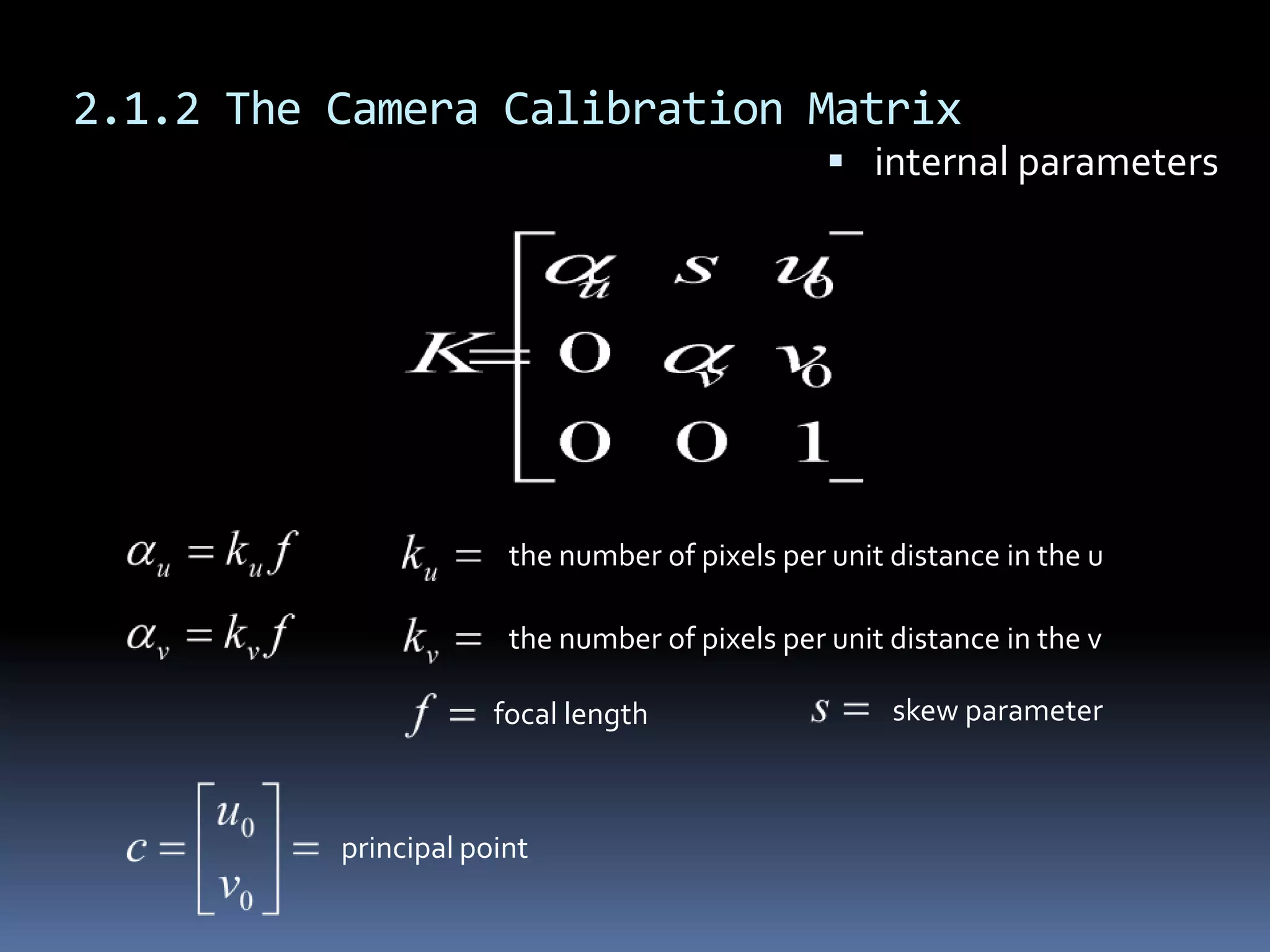
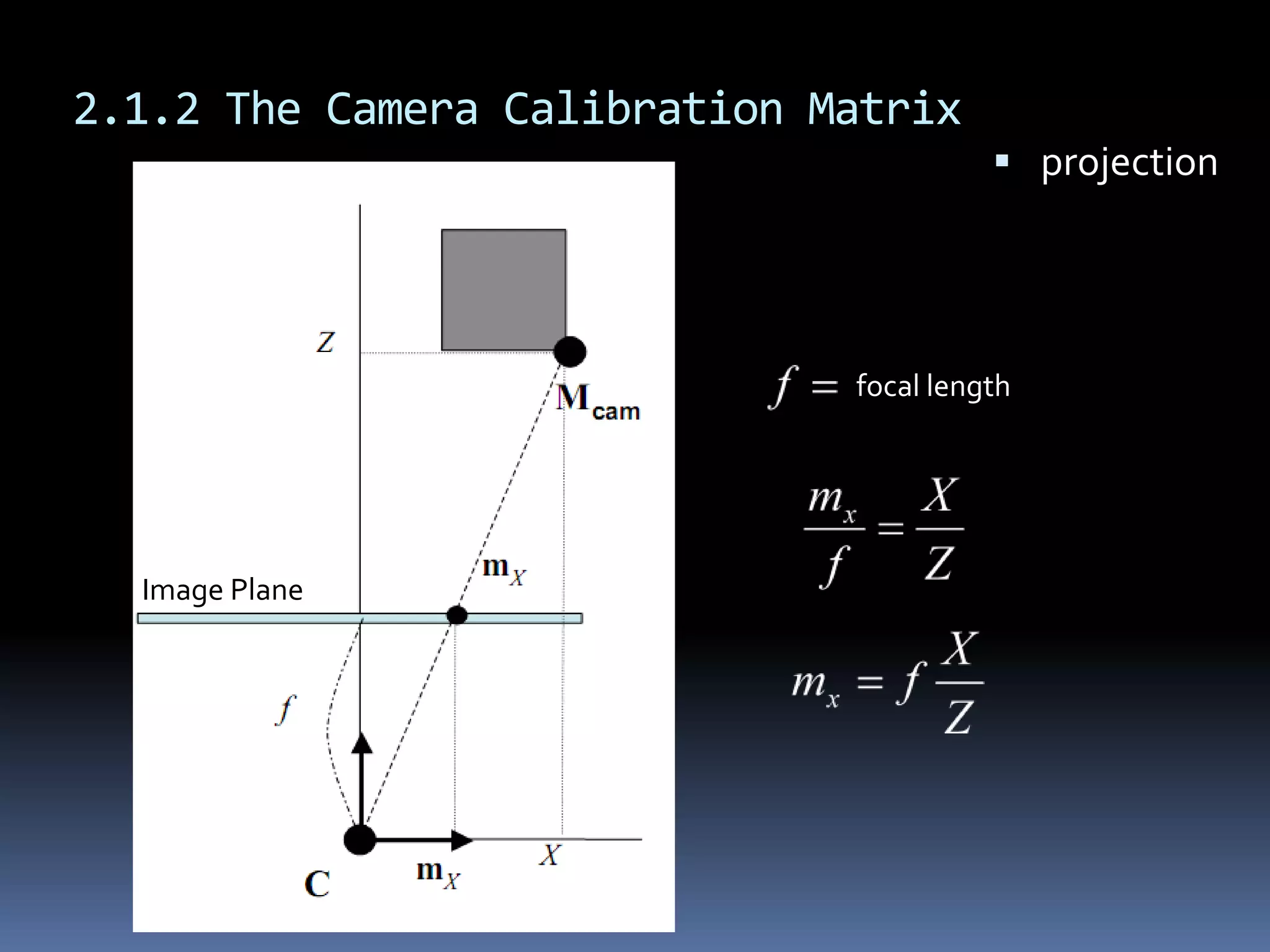
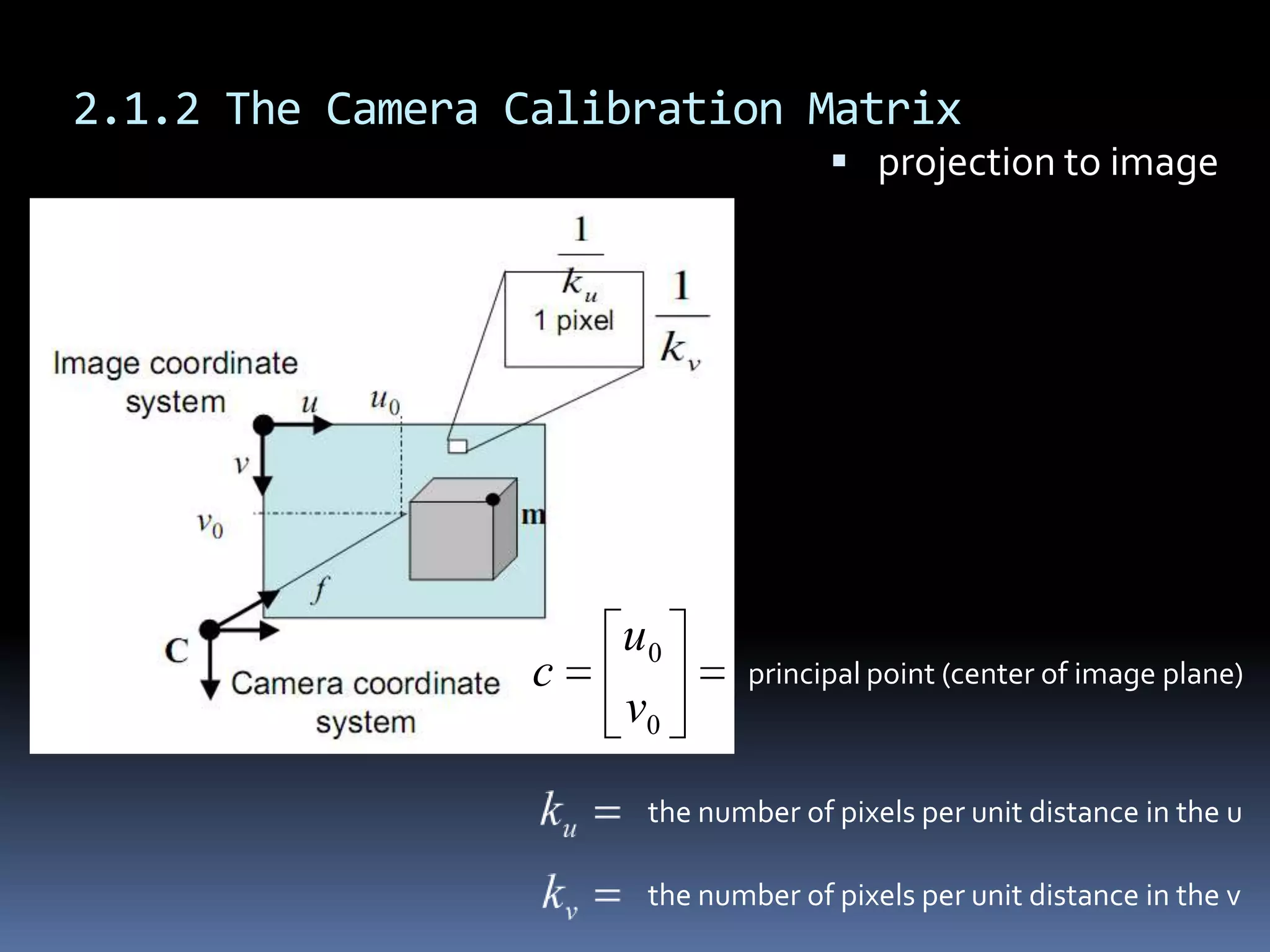
2.1.2 The Camera Calibration Matrixinternal parametersfocal lengthprincipal pointskew parameterthe number of pixels per unit distance in the uthe number of pixels per unit distance in the v
2.1.2 The Camera Calibration Matrixprojectionfocal lengthImage Plane
2.1.2 The Camera Calibration Matrixprojection to imageprincipal point (center of image plane)the number of pixels per unit distance in the uthe number of pixels per unit distance in the v
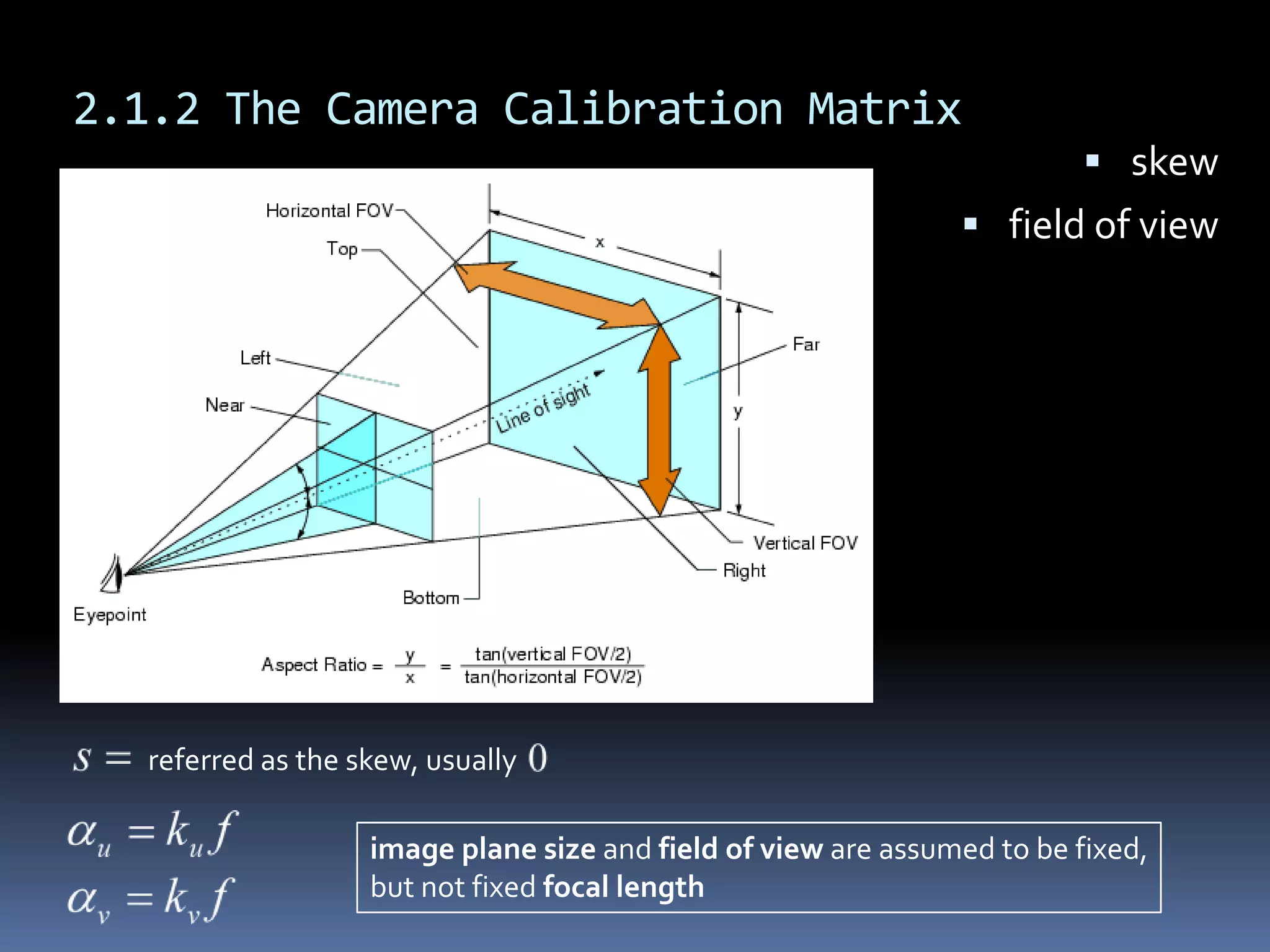
2.1.2 The Camera Calibration Matrixskewfield of viewreferred as the skew, usuallyimage plane size and field of view are assumed to be fixed,but not fixed focal length
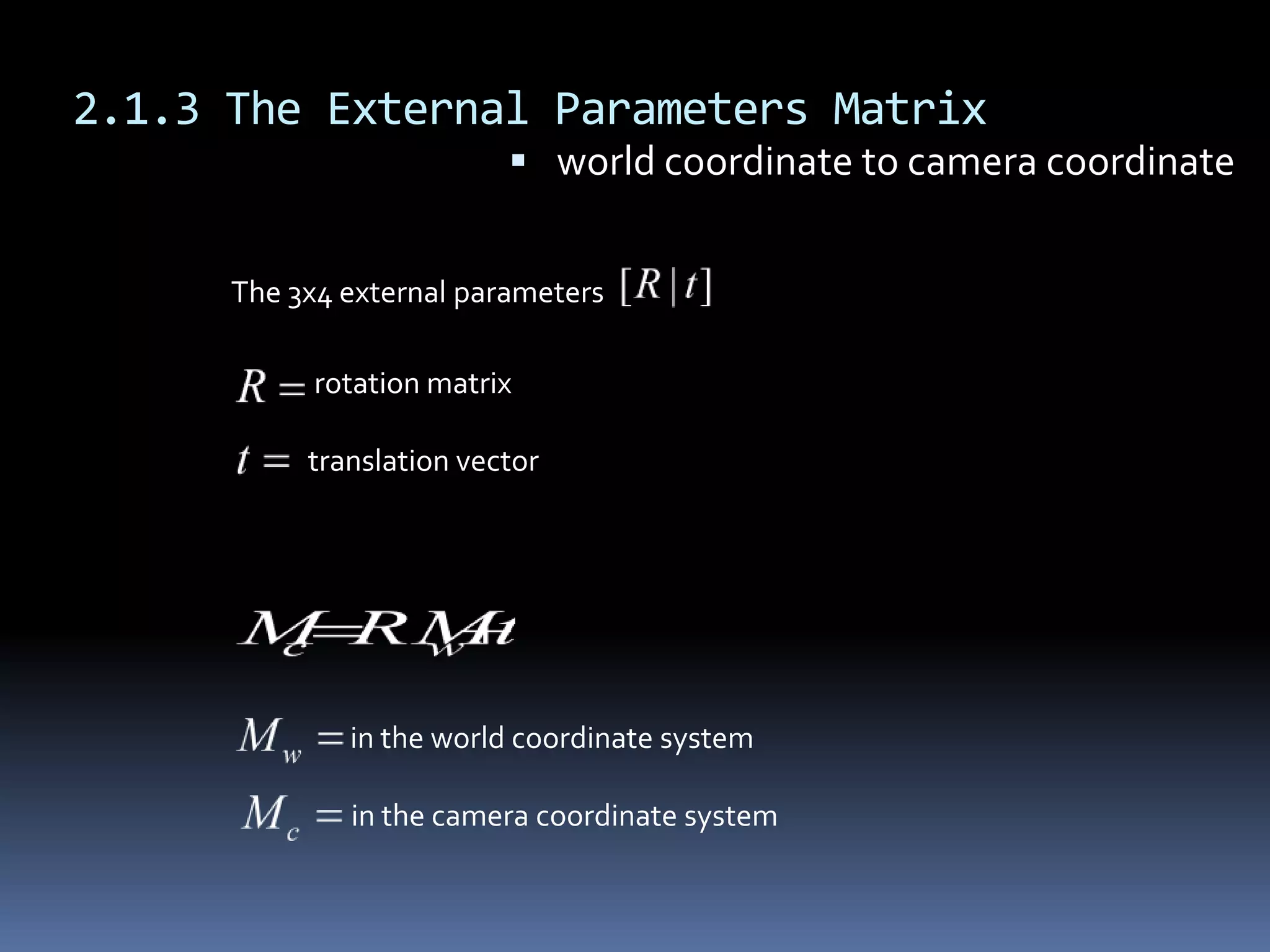
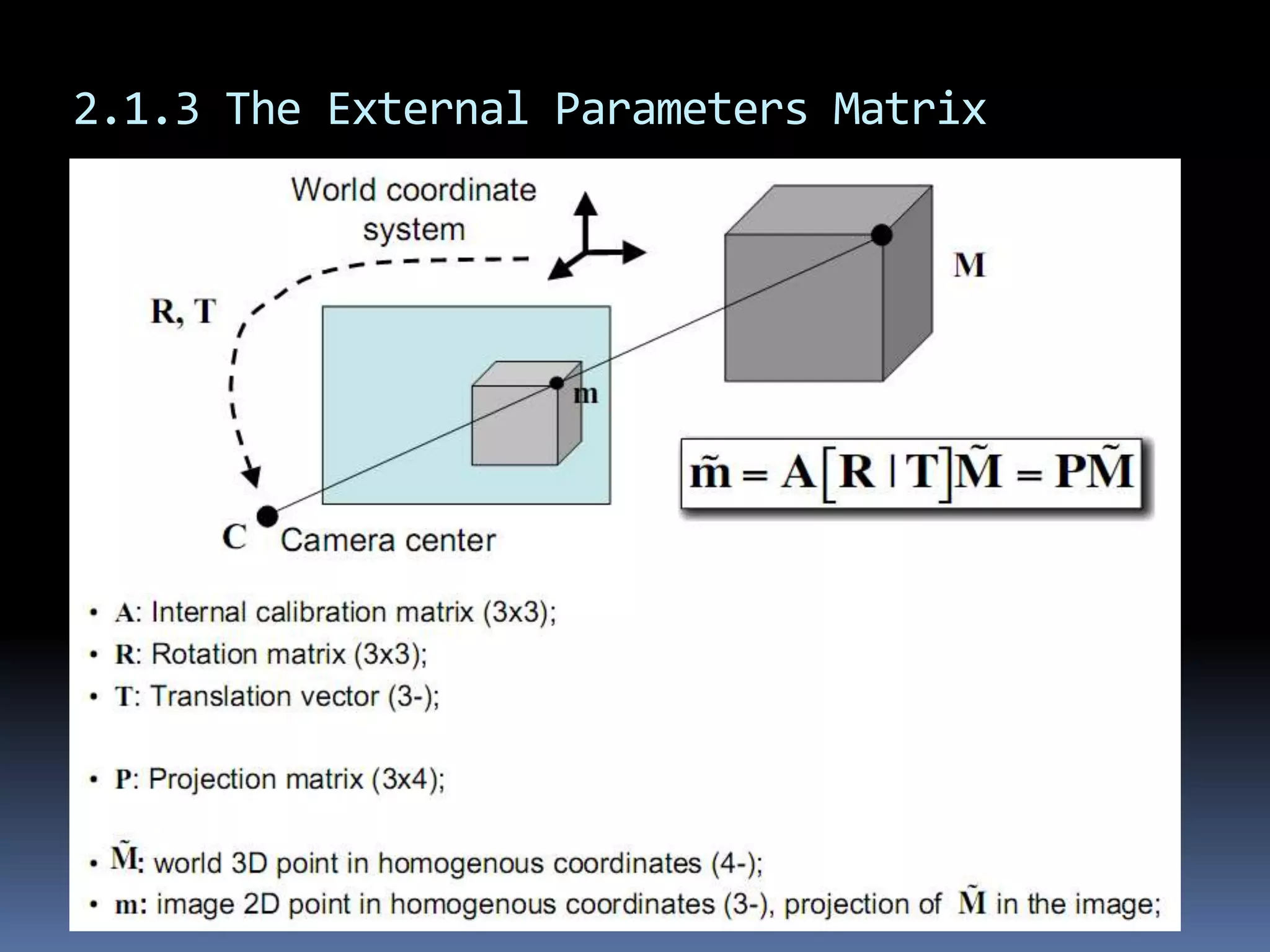
2.1.3 The External Parameters Matrixworld coordinate to camera coordinateThe 3x4 external parametersrotation matrixtranslation vectorin the world coordinate systemin the camera coordinate system
2.1.3 The External Parameters Matrix
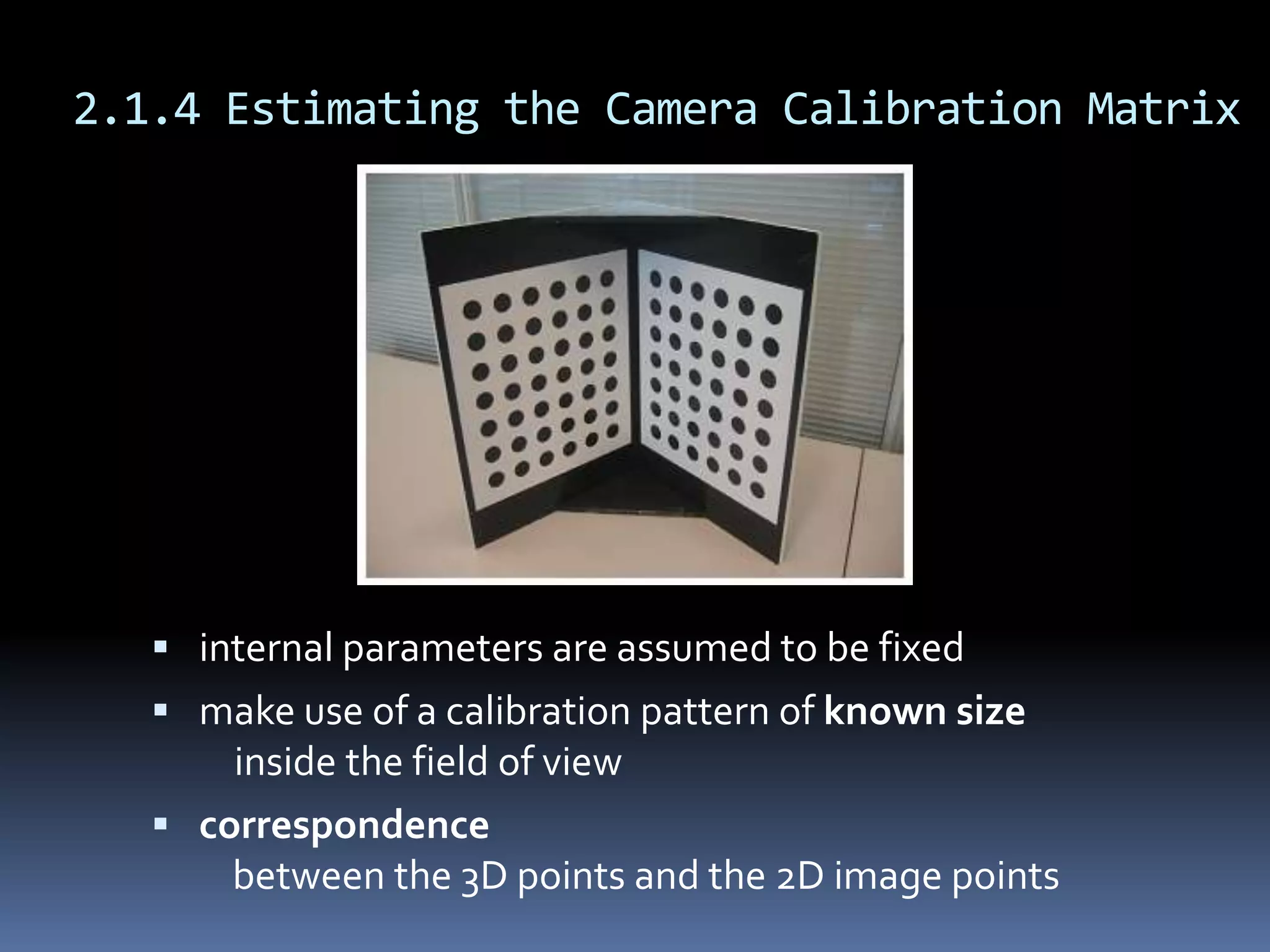
2.1.4 Estimating the Camera Calibration Matrixinternal parameters are assumed to be fixedmake use of a calibration pattern of known sizeinside the field of viewcorrespondence    between the 3D points and the 2D image points
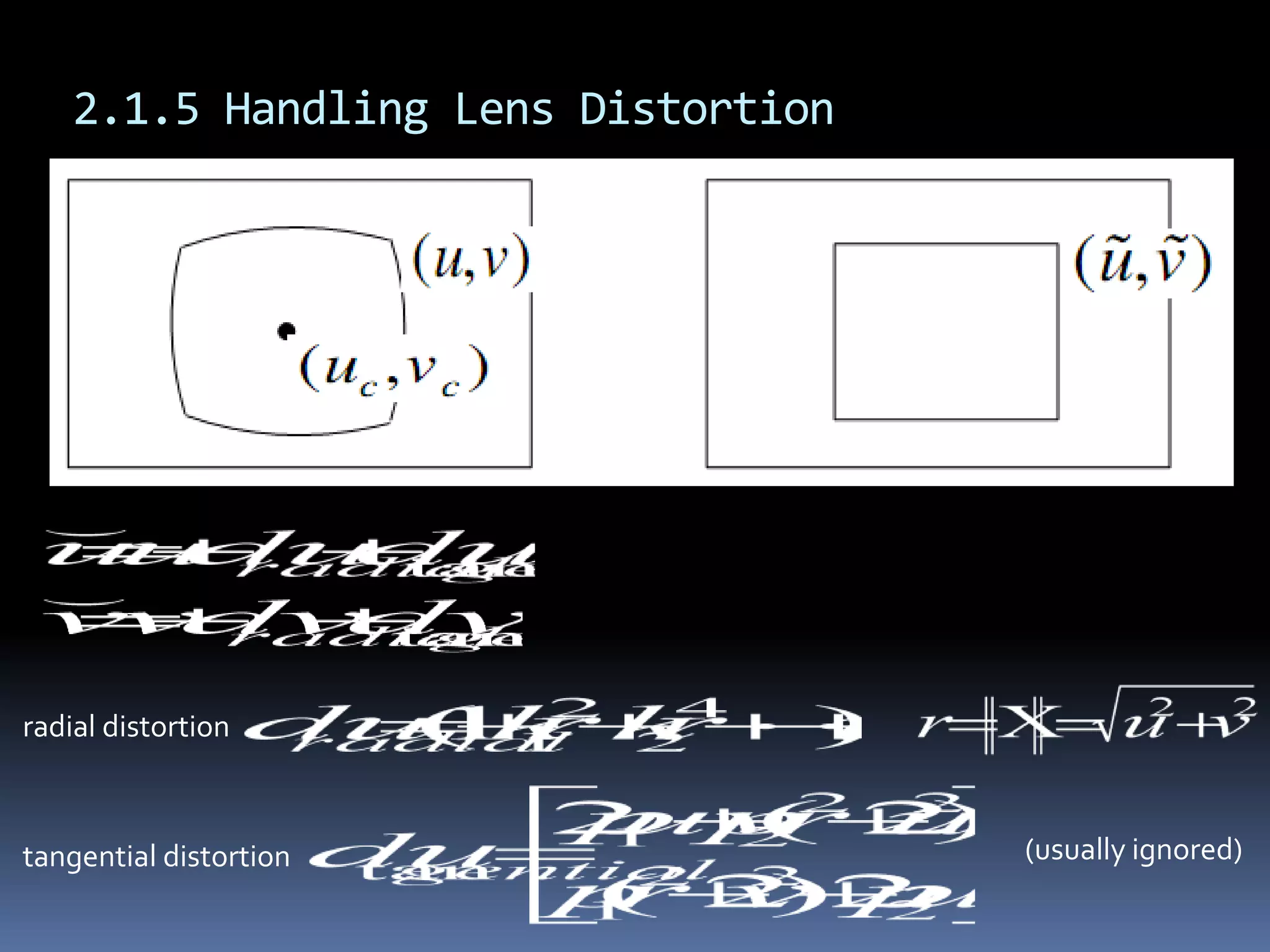
2.1.5 Handling Lens Distortion(usually ignored)radial distortiontangential distortion
can be avoided by locally re-pametrizing the rotation2.2 Camera Pose Parameterization
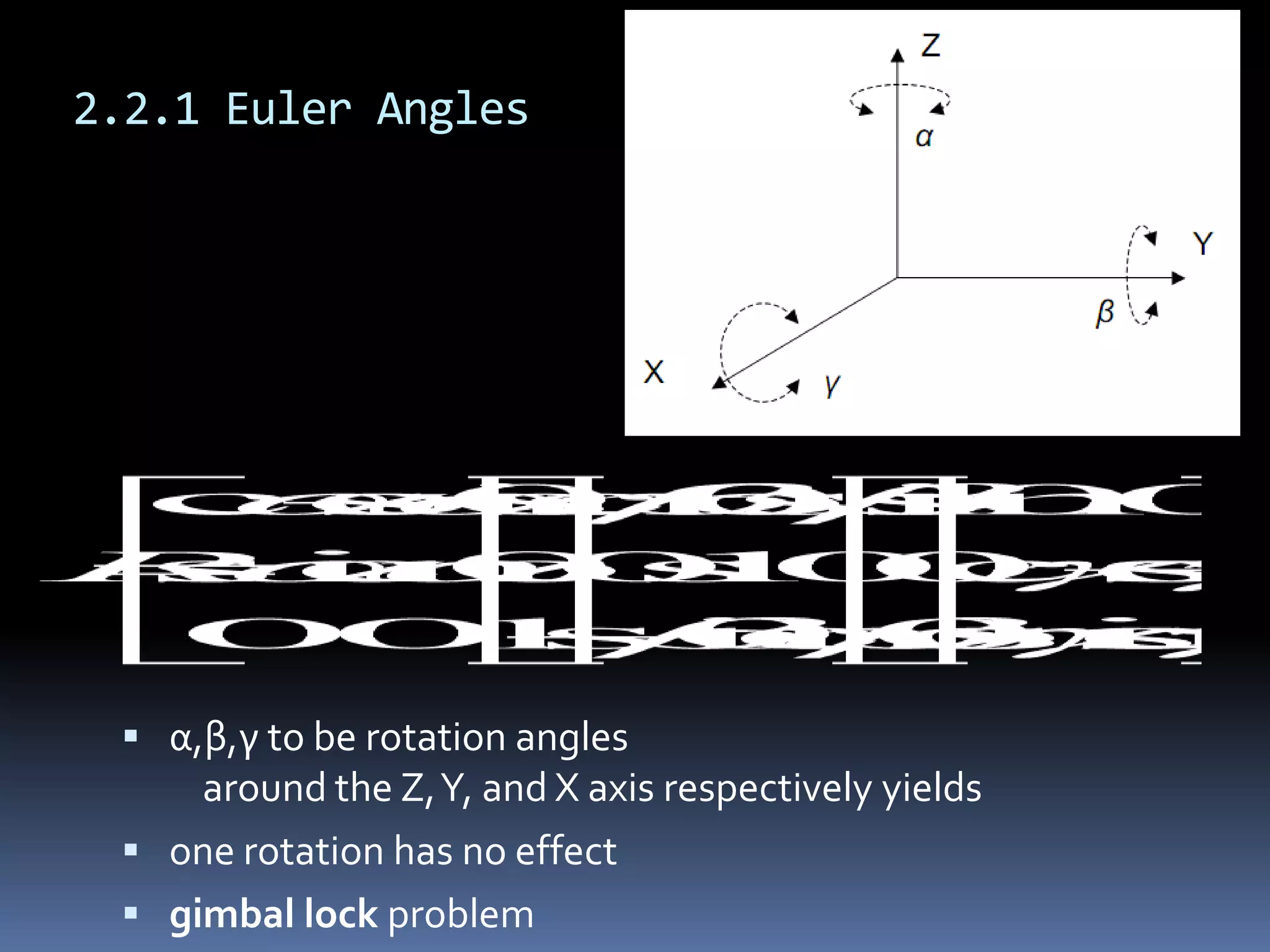
2.2.1 Euler Anglesα,β,γ to be rotation angles    around the Z, Y, and X axis respectively yields
one rotation has no effect
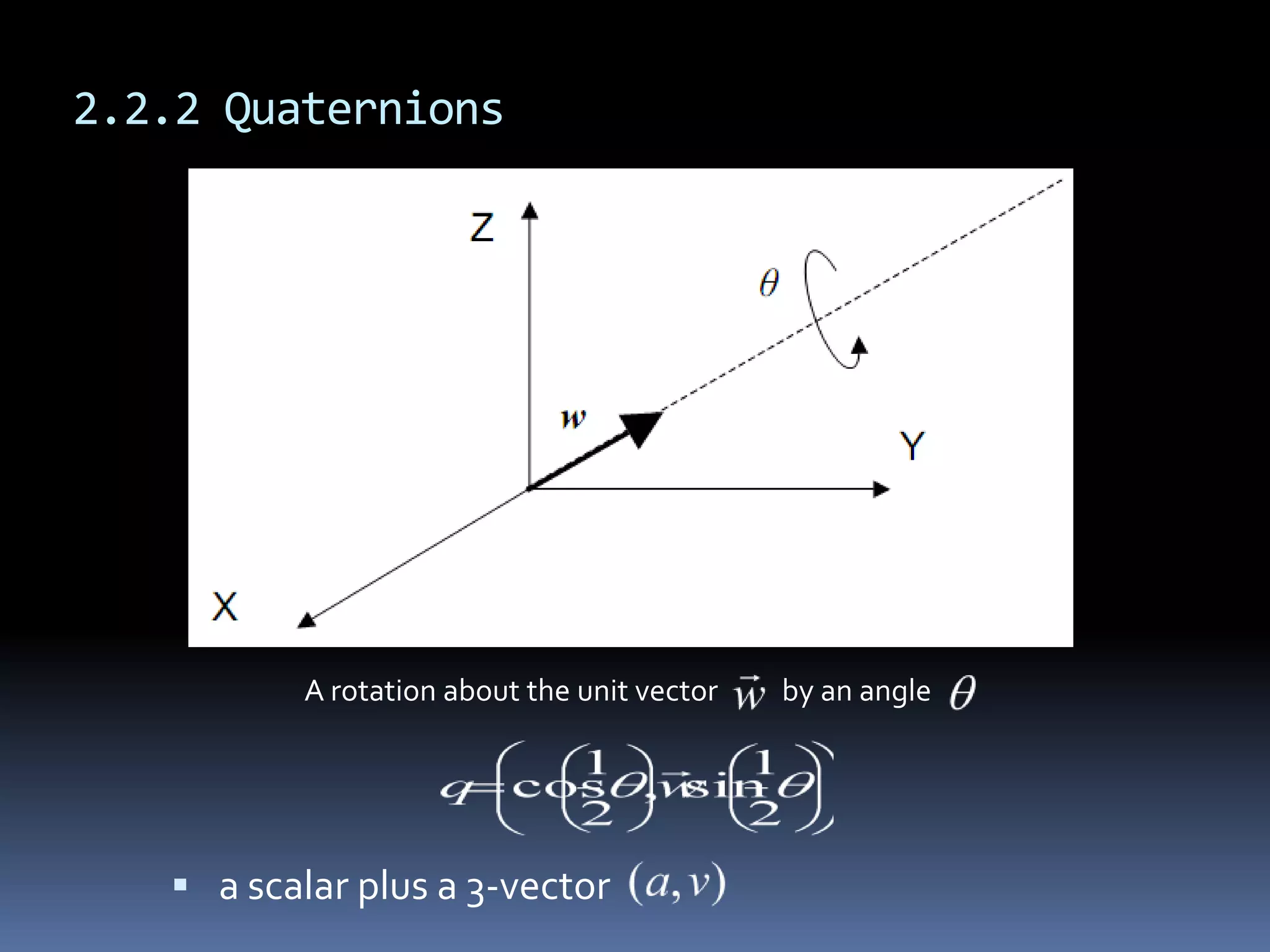
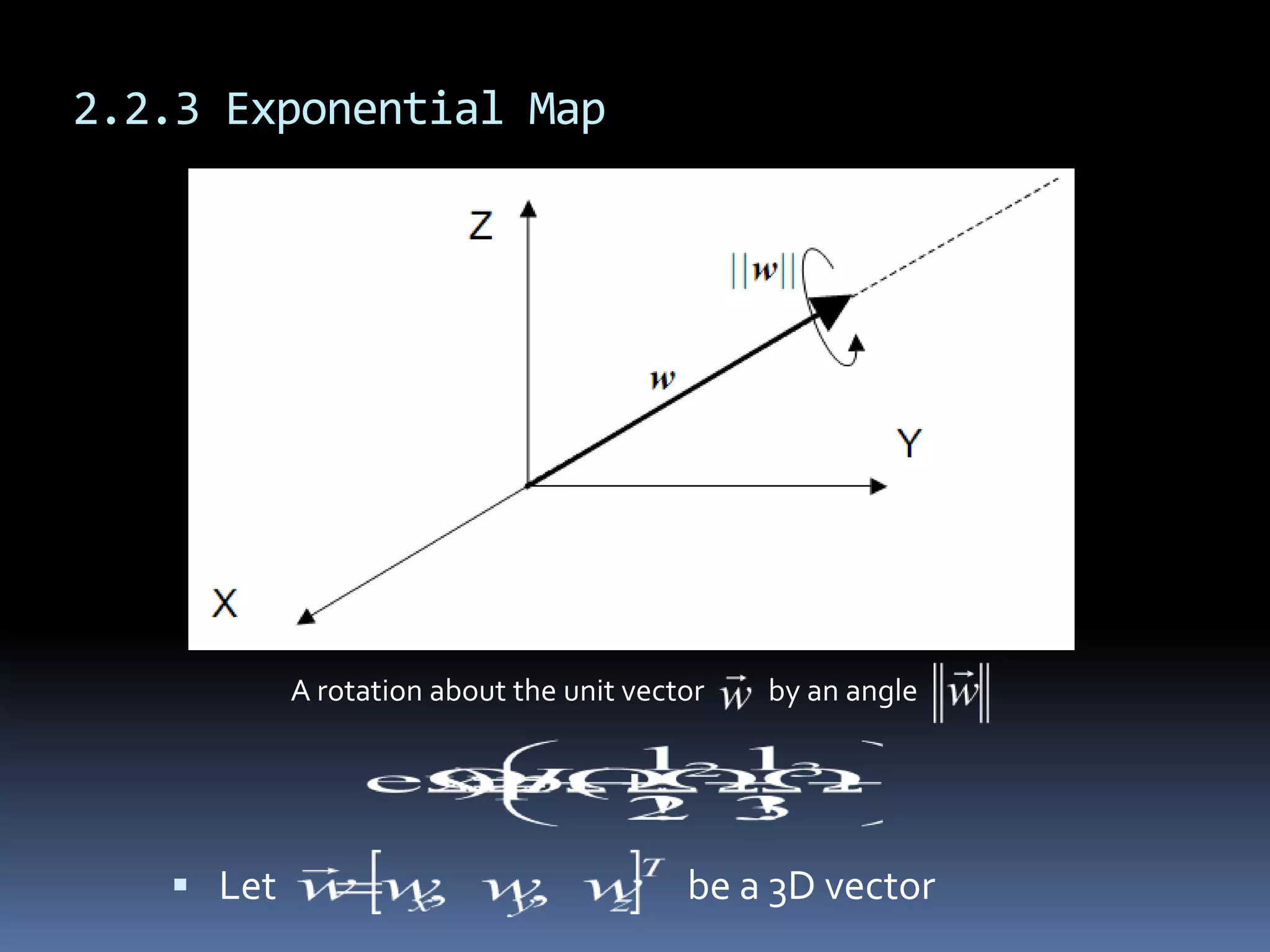
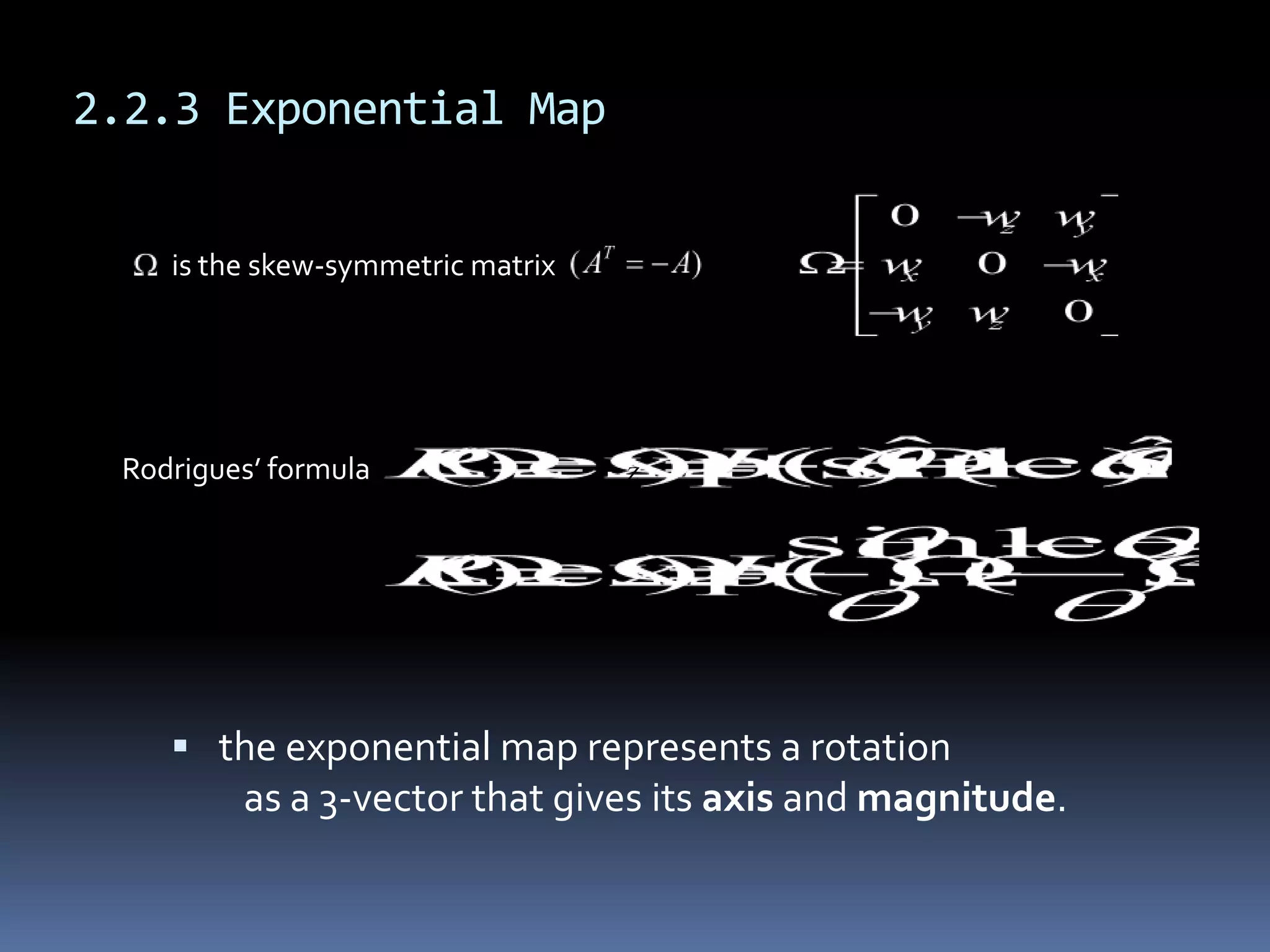
gimbal lock problem2.2.2 QuaternionsA rotation about the unit vector          by an angle a scalar plus a 3-vector2.2.3 Exponential MapA rotation about the unit vector          by an angle Let                                                 be a 3D vector2.2.3 Exponential MapRodrigues’ formulathe exponential map represents a rotation   as a 3-vector that gives its axis and magnitude.is the skew-symmetric matrix
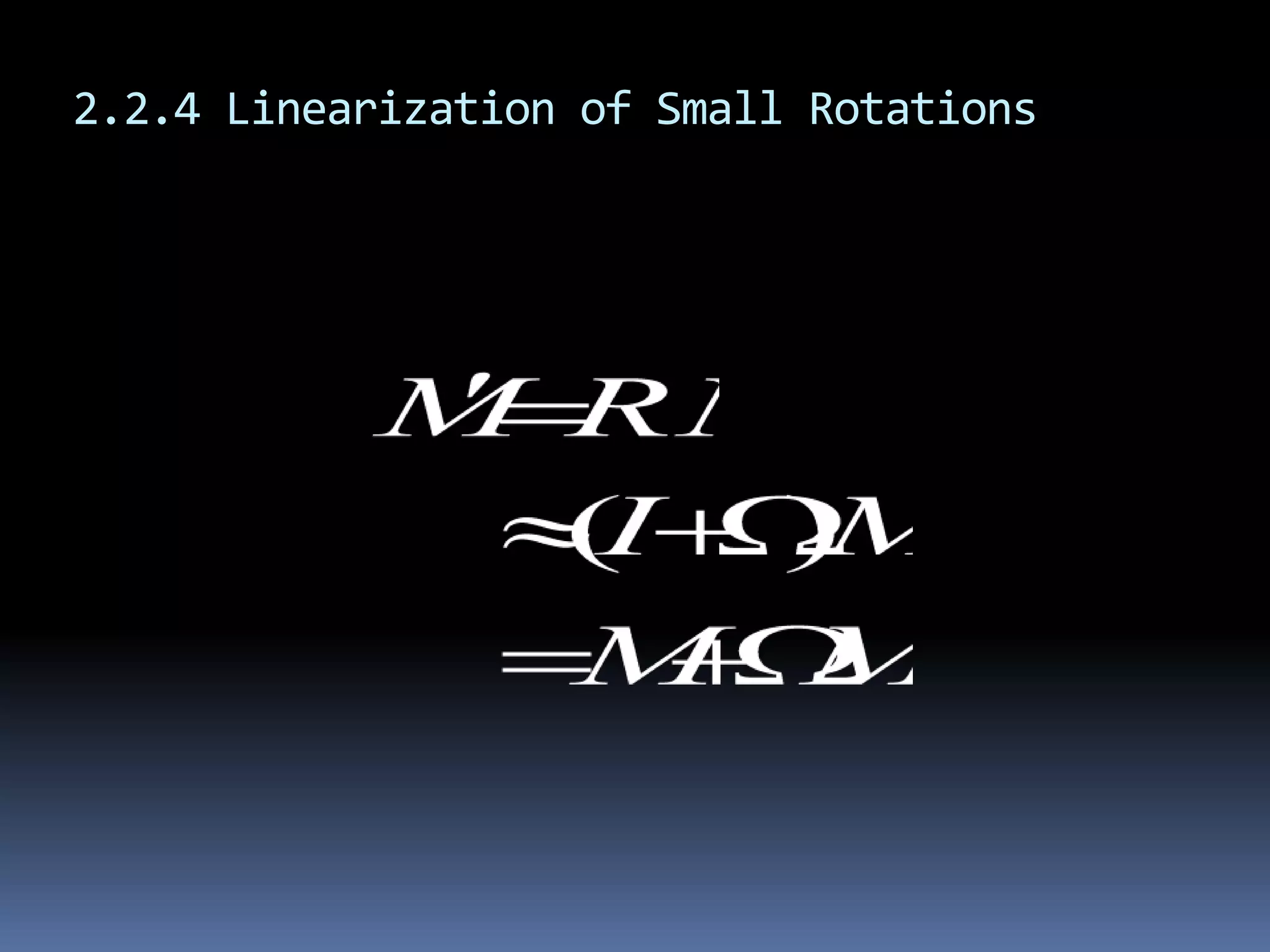
2.2.4 Linearization of Small Rotations
estimated camera positions(when the internal parameters are known)2.3 Estimating the External parameters Matrix
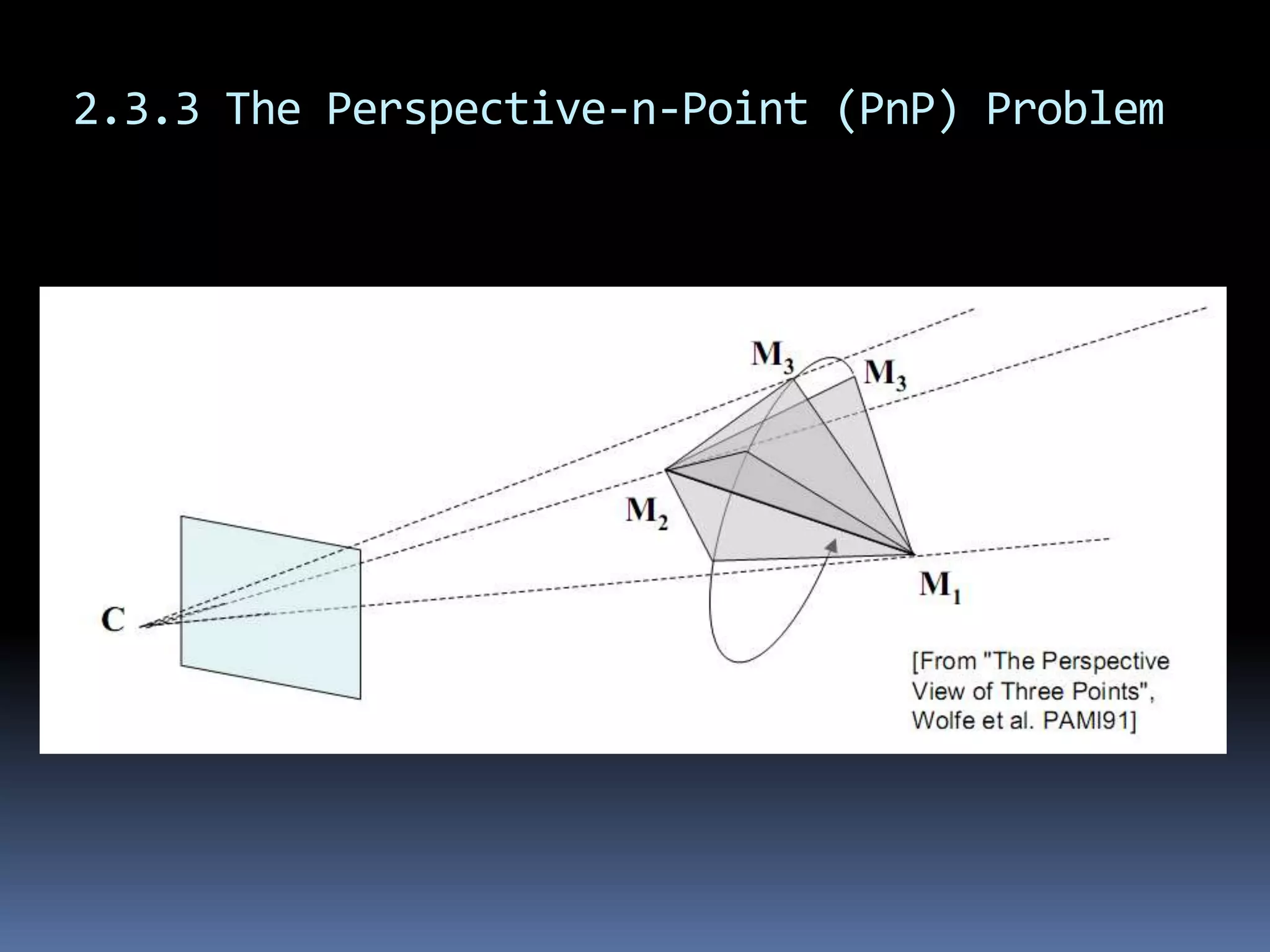
2.3.1 How many Correspondences are necessary?n=3 known correspondences	produce 4 possible solution	(P3P Problem)n>=4 known correspondences	produce 2 possible solutionn>=4 known correspondences	(points are coplanar)	produce unique solutionn>=6 known correspondences 	produce unique solution
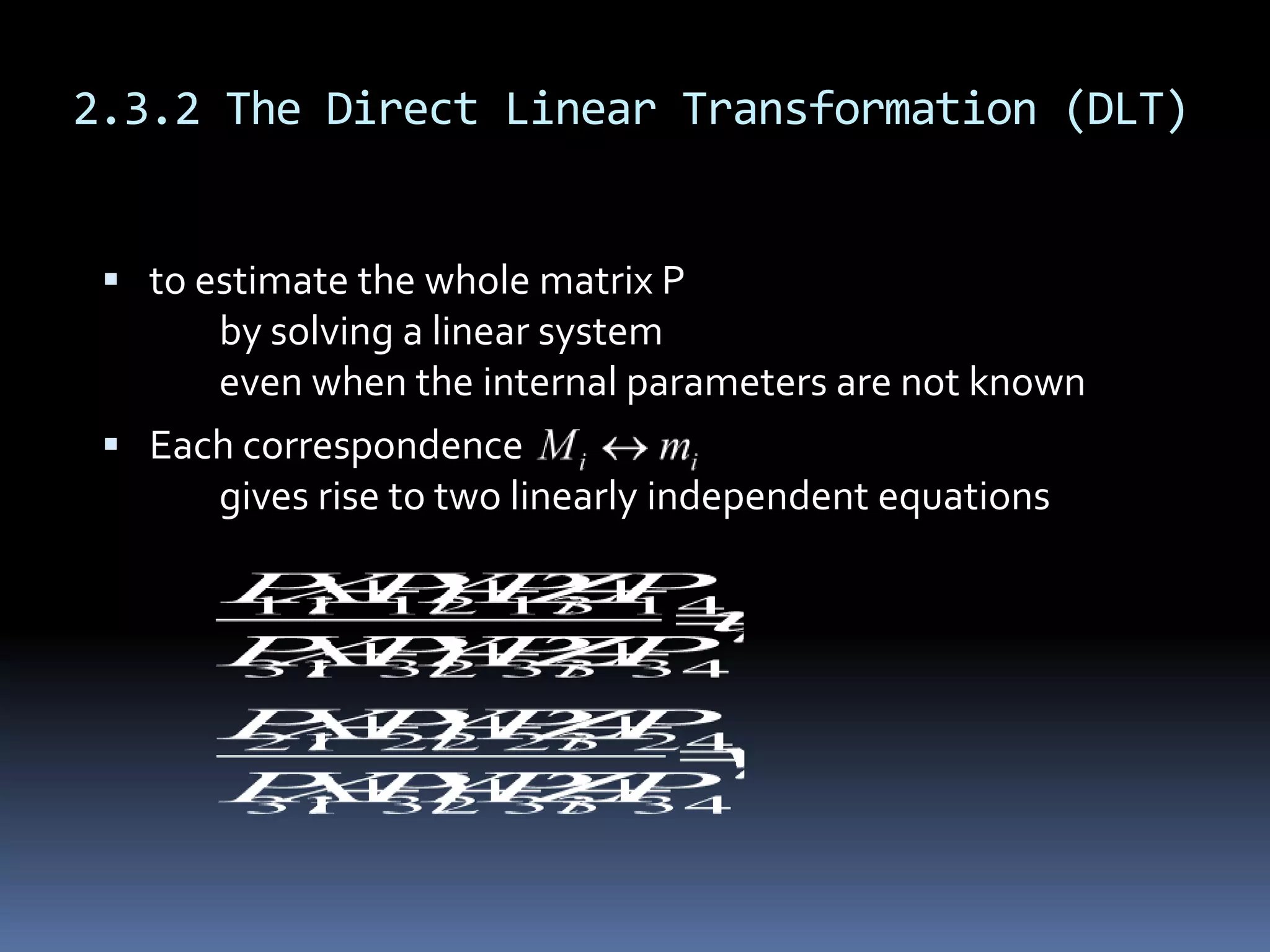
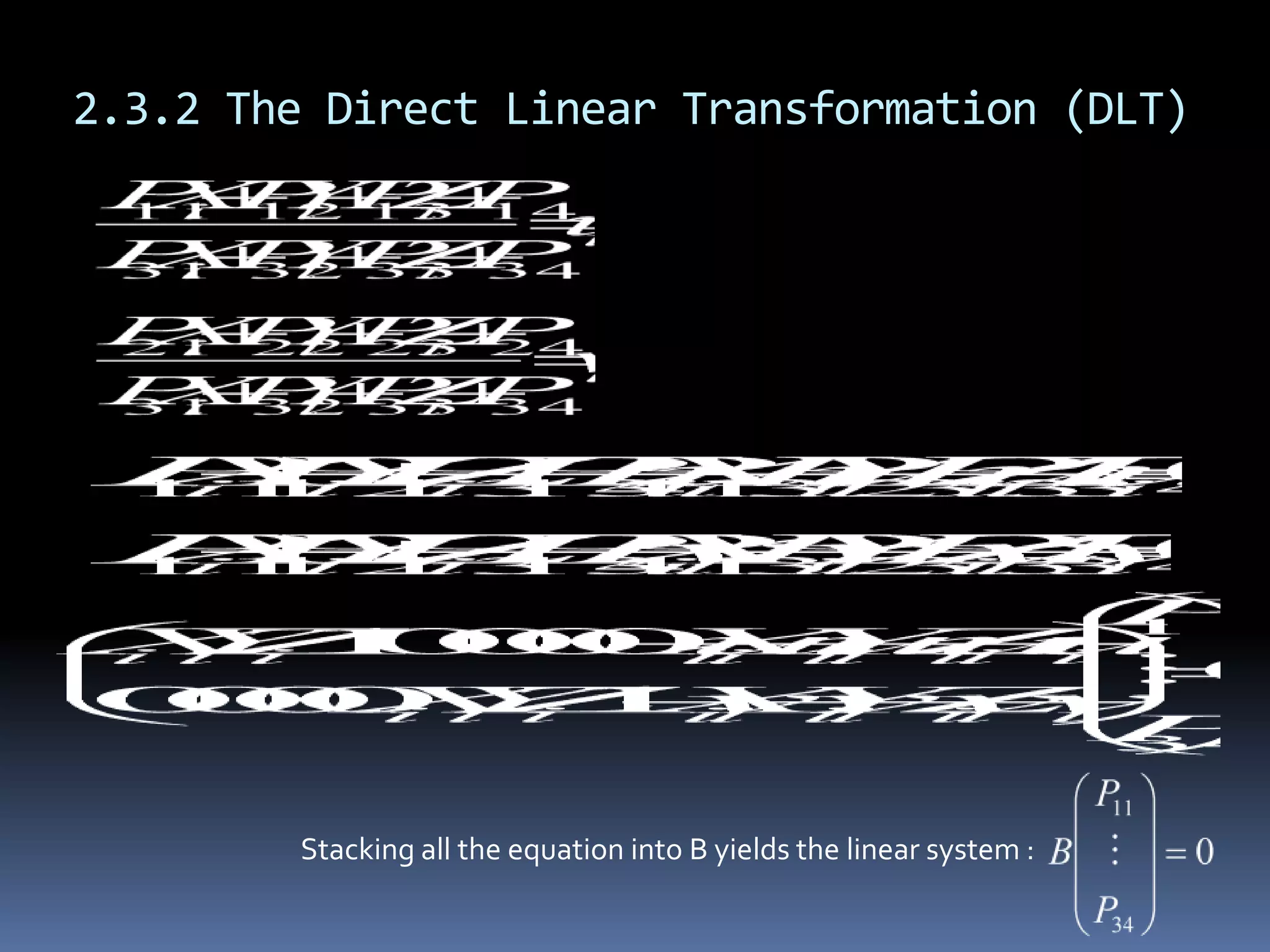
2.3.2 The Direct Linear Transformation (DLT)to estimate the whole matrix P 	by solving a linear system	even when the internal parameters are not knownEach correspondence	gives rise to two linearly independent equations
2.3.2 The Direct Linear Transformation (DLT)Stacking all the equation into B yields the linear system :
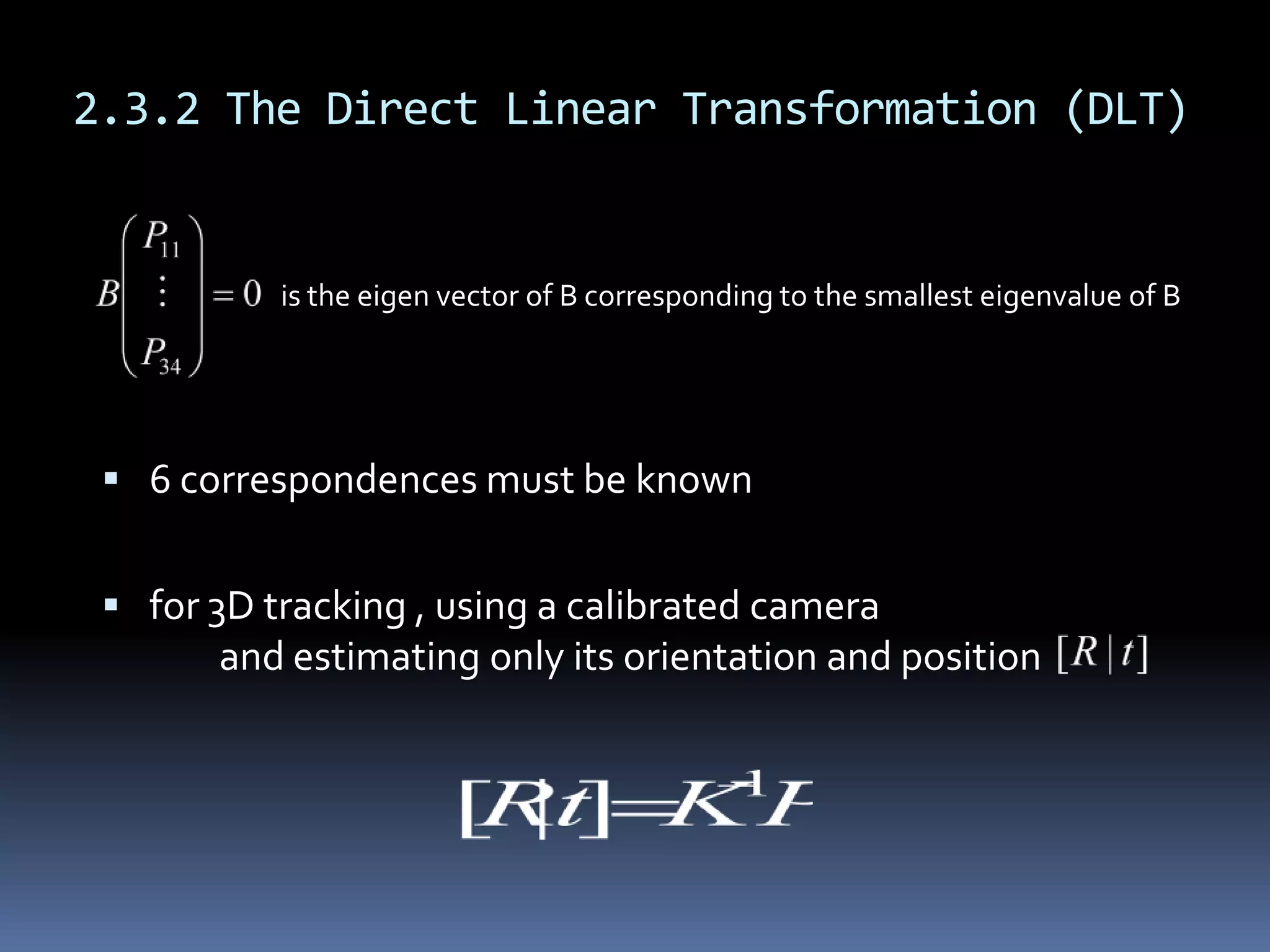
2.3.2 The Direct Linear Transformation (DLT)is the eigen vector of B corresponding to the smallest eigenvalue of B6 correspondences must be knownfor 3D tracking , using a calibrated camera	and estimating only its orientation and position
2.3.3 The Perspective-n-Point (PnP) Problem
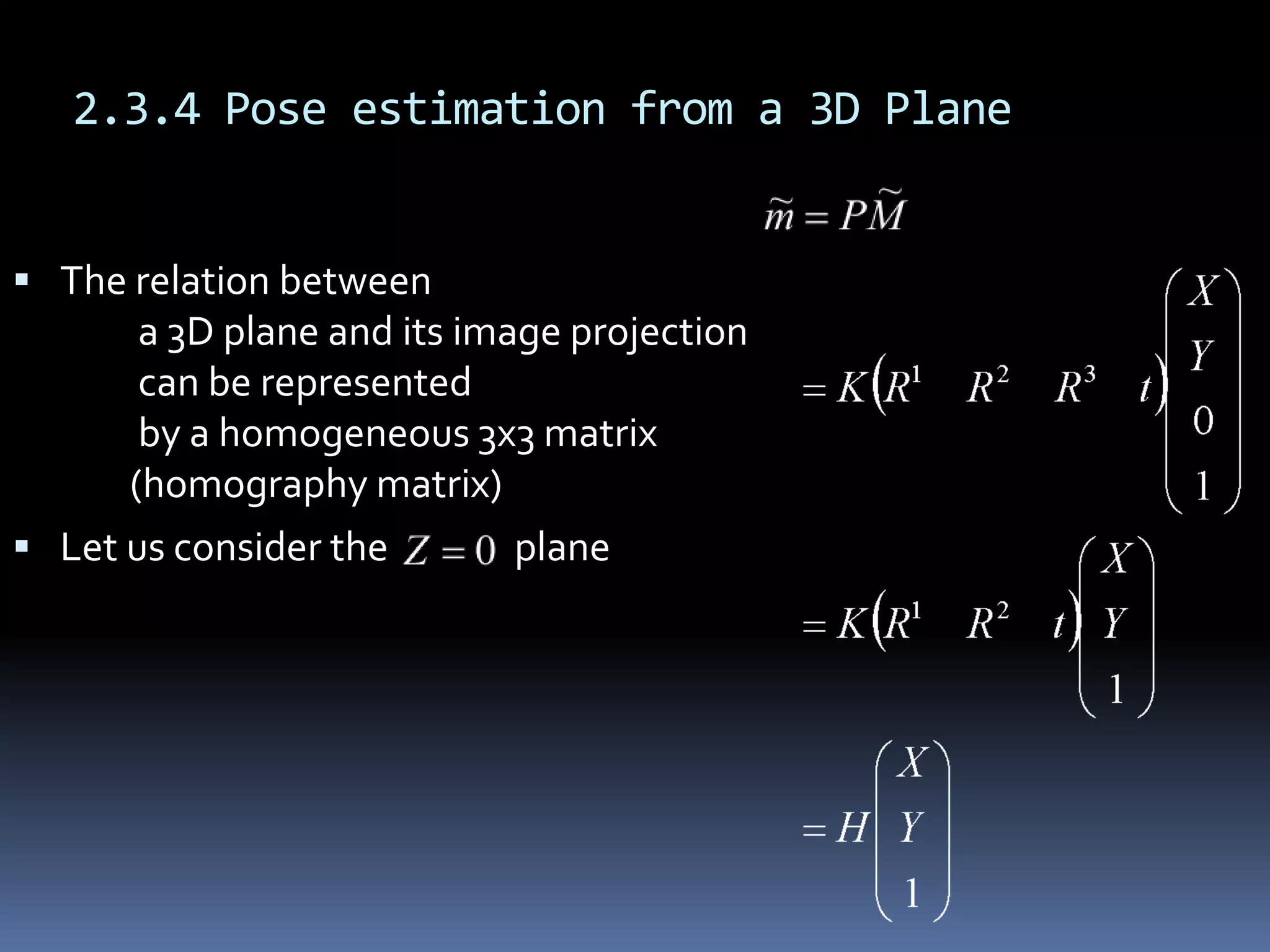
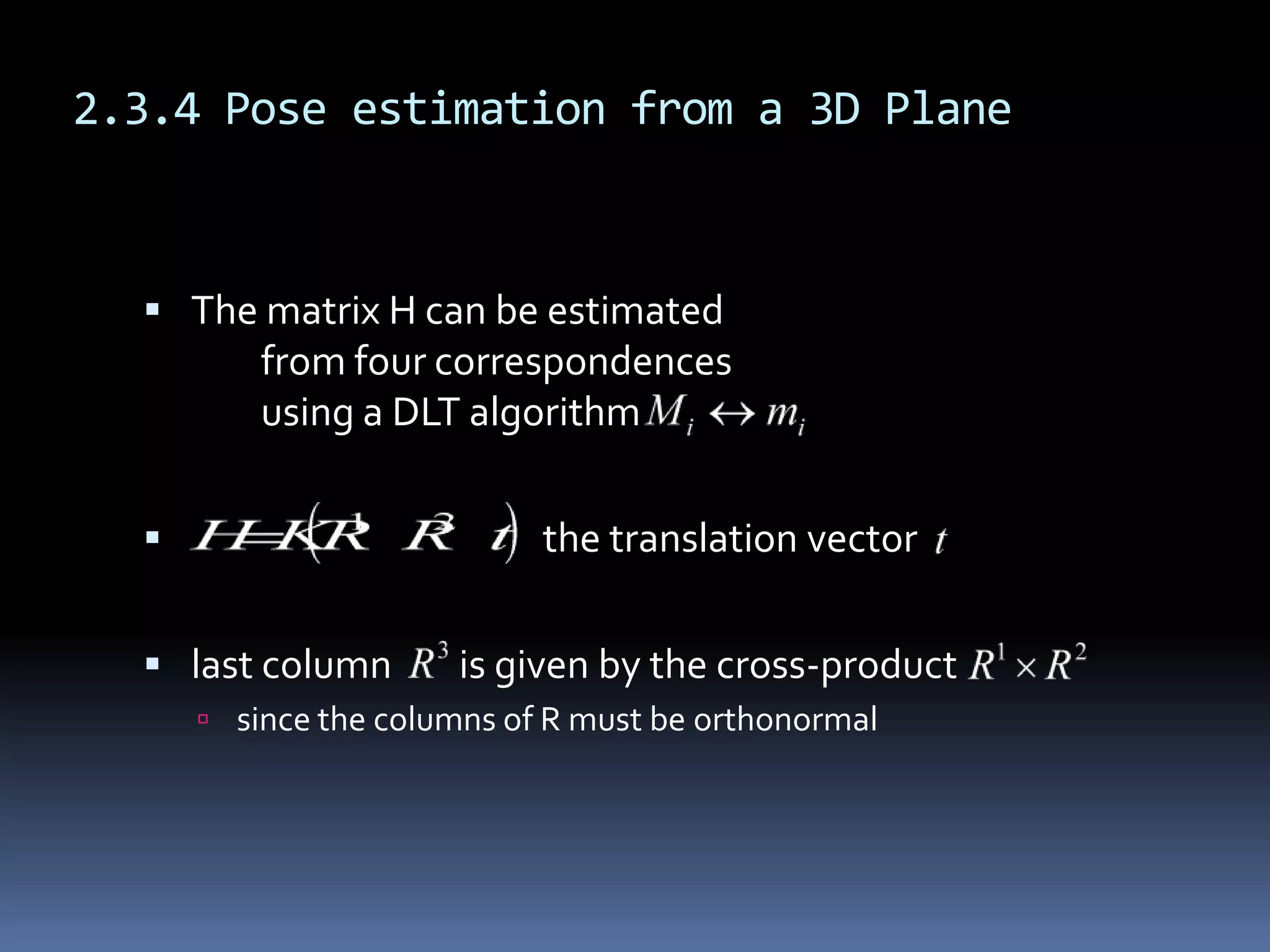
2.3.4 Pose estimation from a 3D PlaneThe relation between	 a 3D plane and its image projection	 can be represented	 by a homogeneous 3x3 matrix	(homography matrix)Let us consider the               plane
2.3.4 Pose estimation from a 3D PlaneThe matrix H can be estimated	from four correspondences	using a DLT algorithm                                          the translation vector last column        is given by the cross-productsince the columns of R must be orthonormal
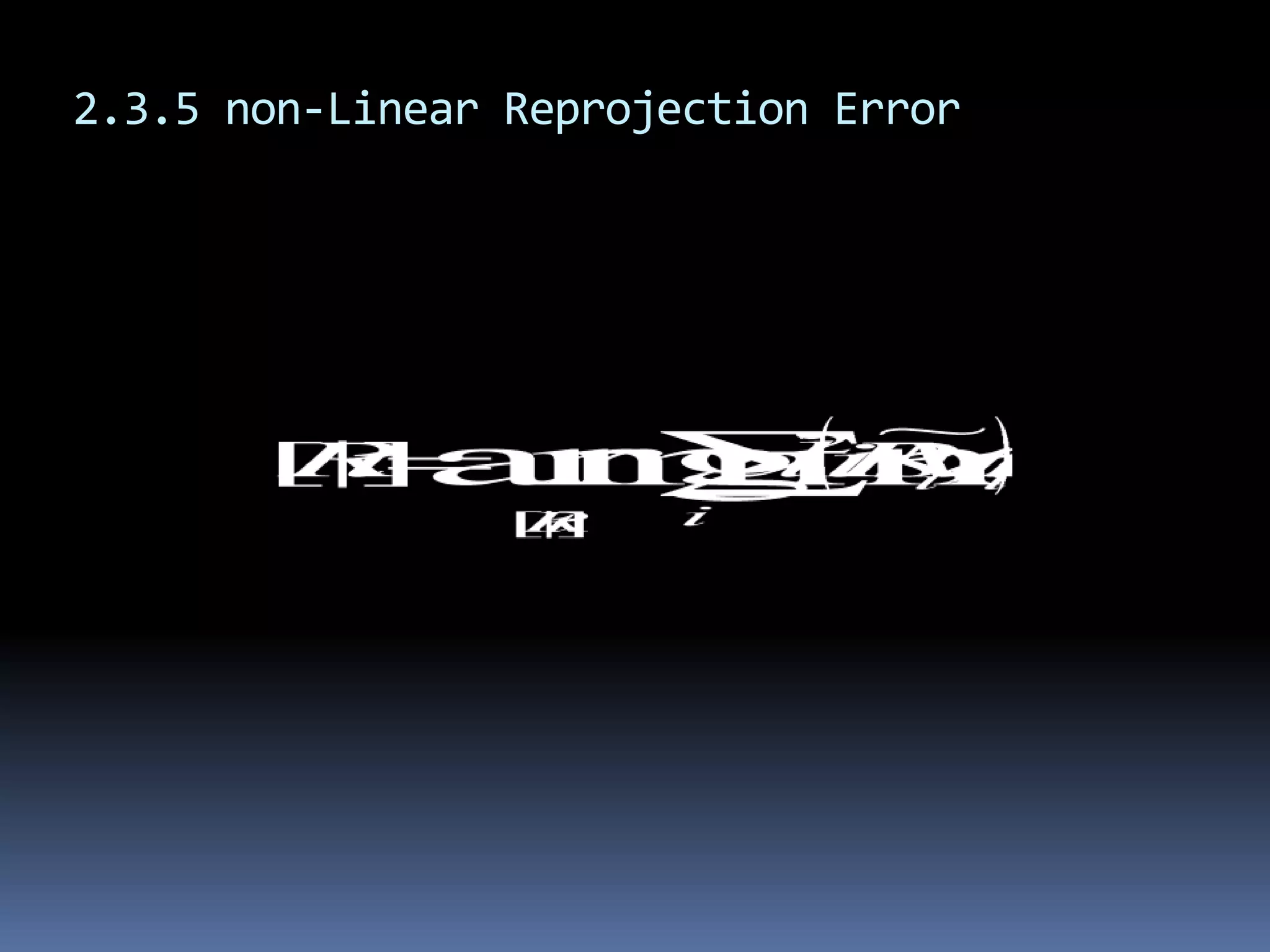
2.3.5 non-Linear Reprojection Error
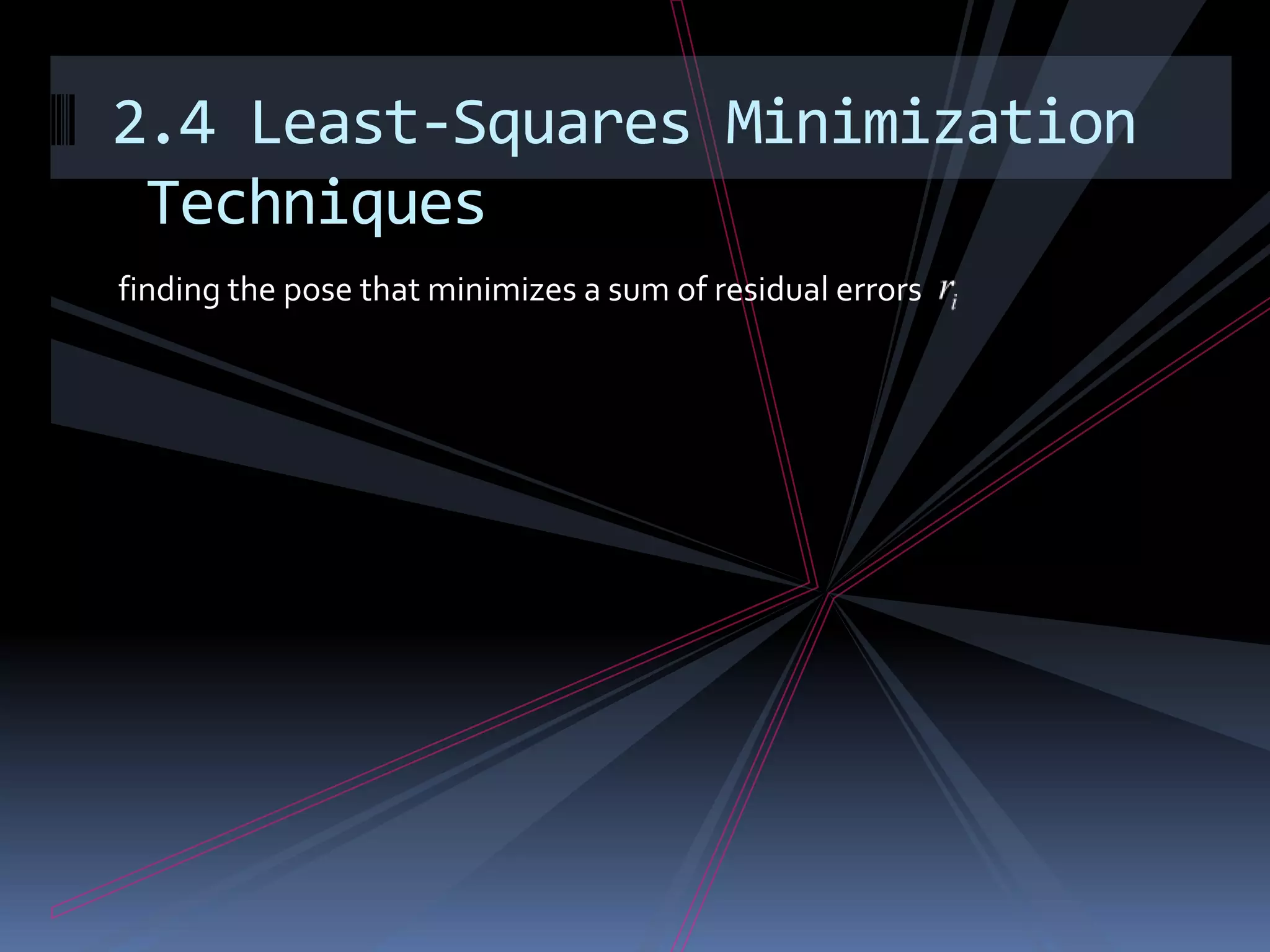
finding the pose that minimizes a sum of residual errors 2.4 Least-Squares Minimization Techniques
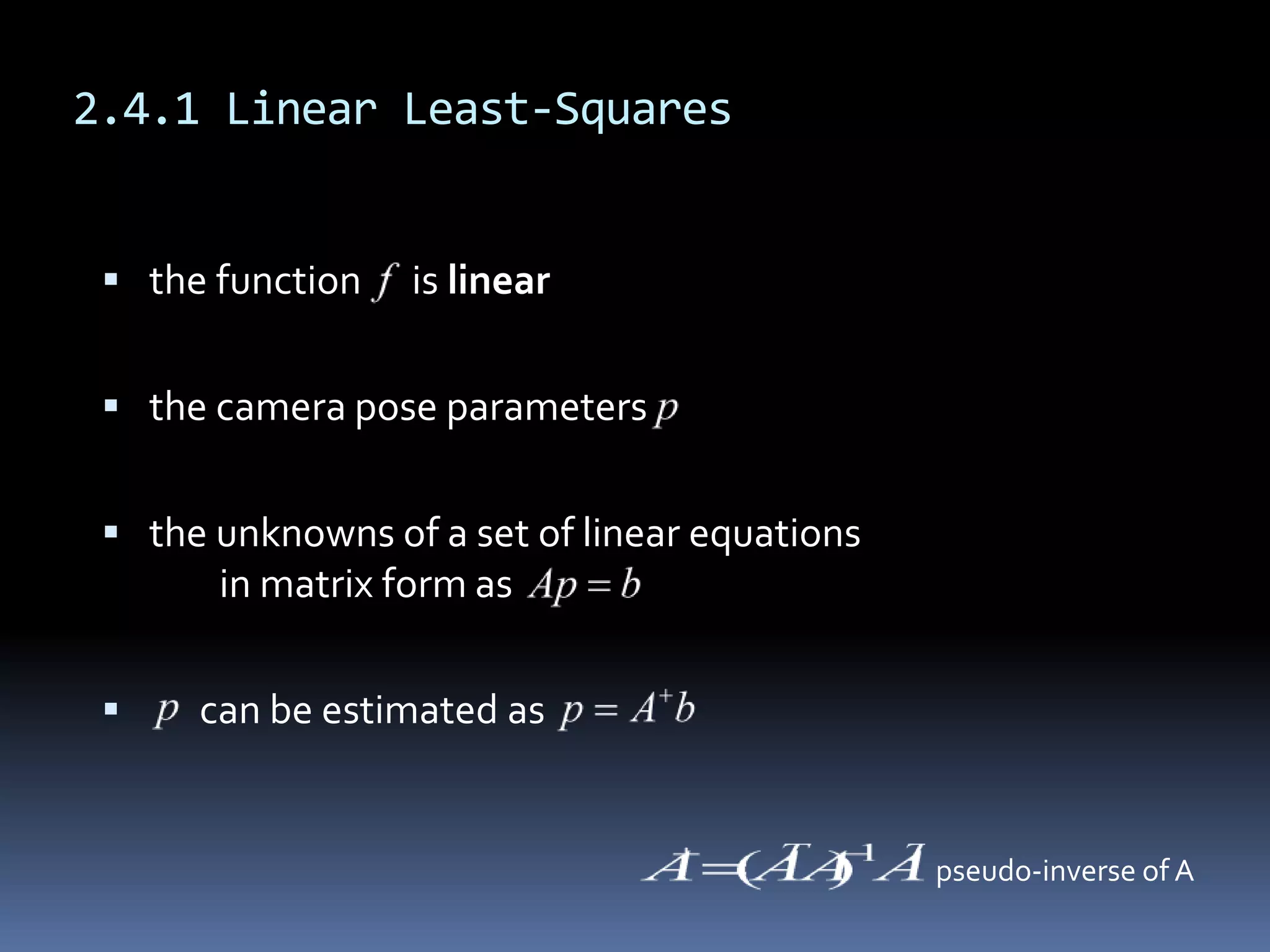
2.4.1 Linear Least-Squaresthe function      is linearthe camera pose parameters the unknowns of a set of linear equations	in matrix form as      can be estimated as pseudo-inverse of A
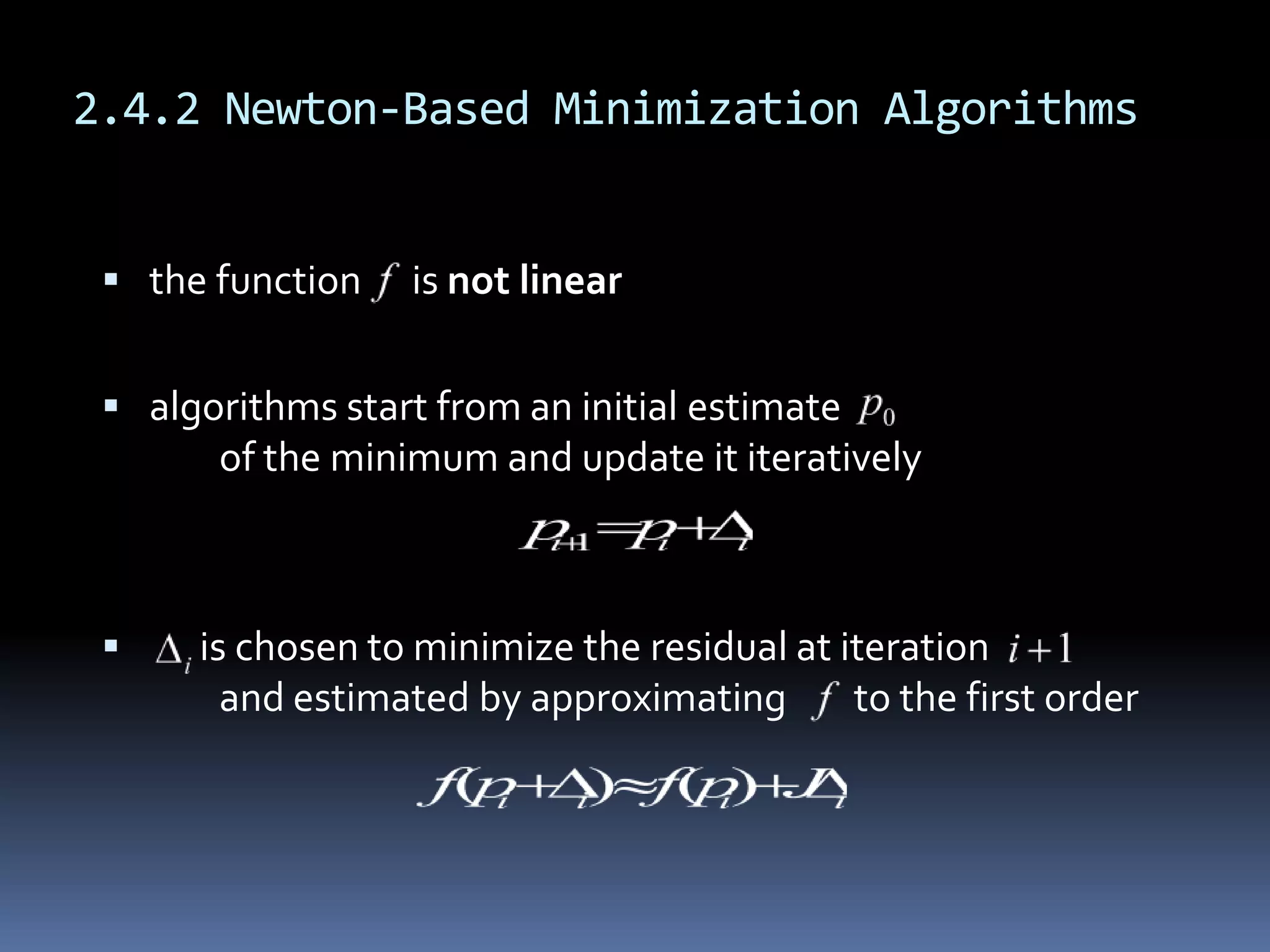
2.4.2 Newton-Based Minimization Algorithmsthe function      is not linearalgorithms start from an initial estimate 	of the minimum and update it iteratively      is chosen to minimize the residual at iteration	and estimated by approximating        to the first order
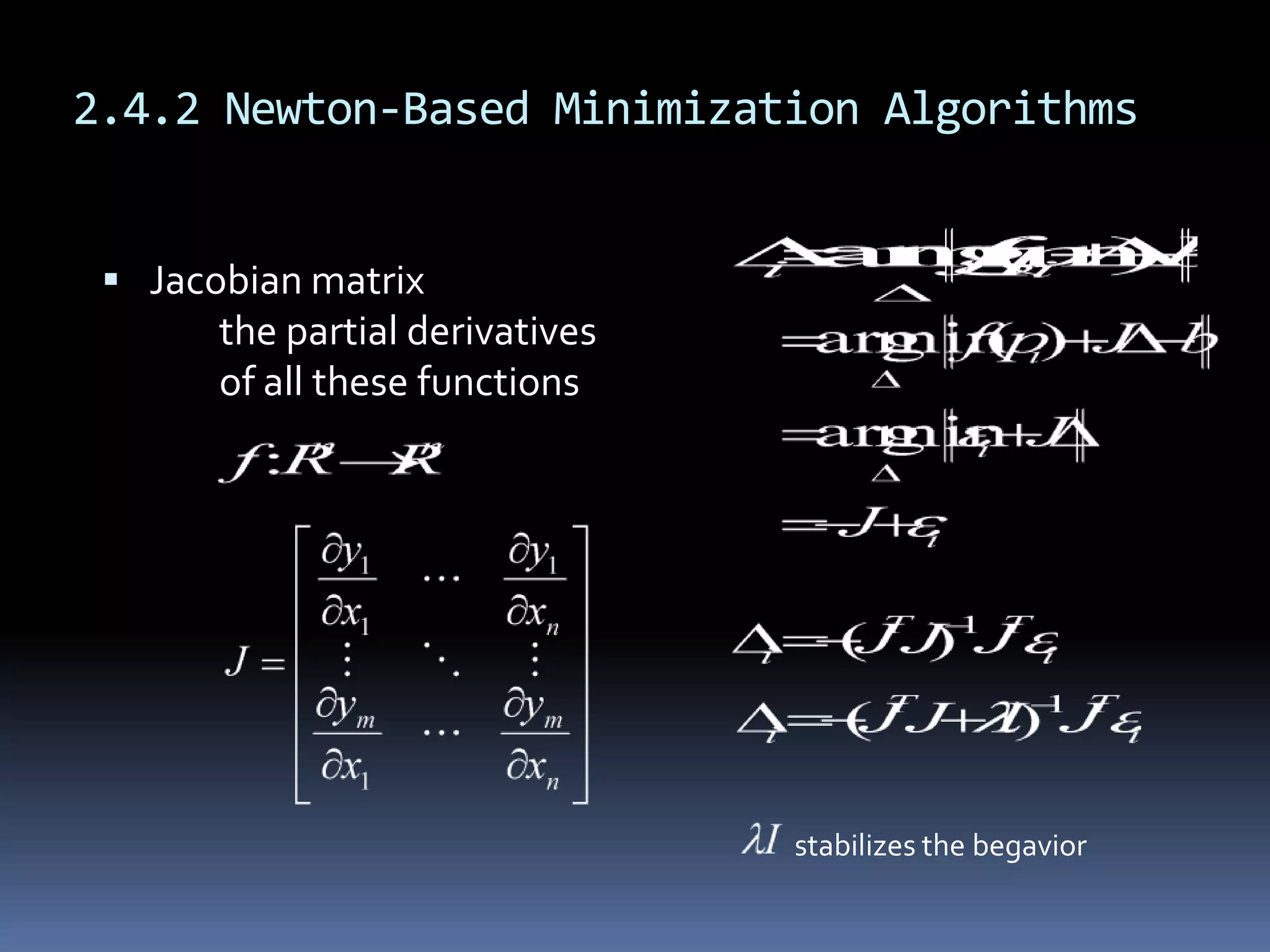
2.4.2 Newton-Based Minimization AlgorithmsJacobian matrix	the partial derivatives 	of all these functionsstabilizes the begavior
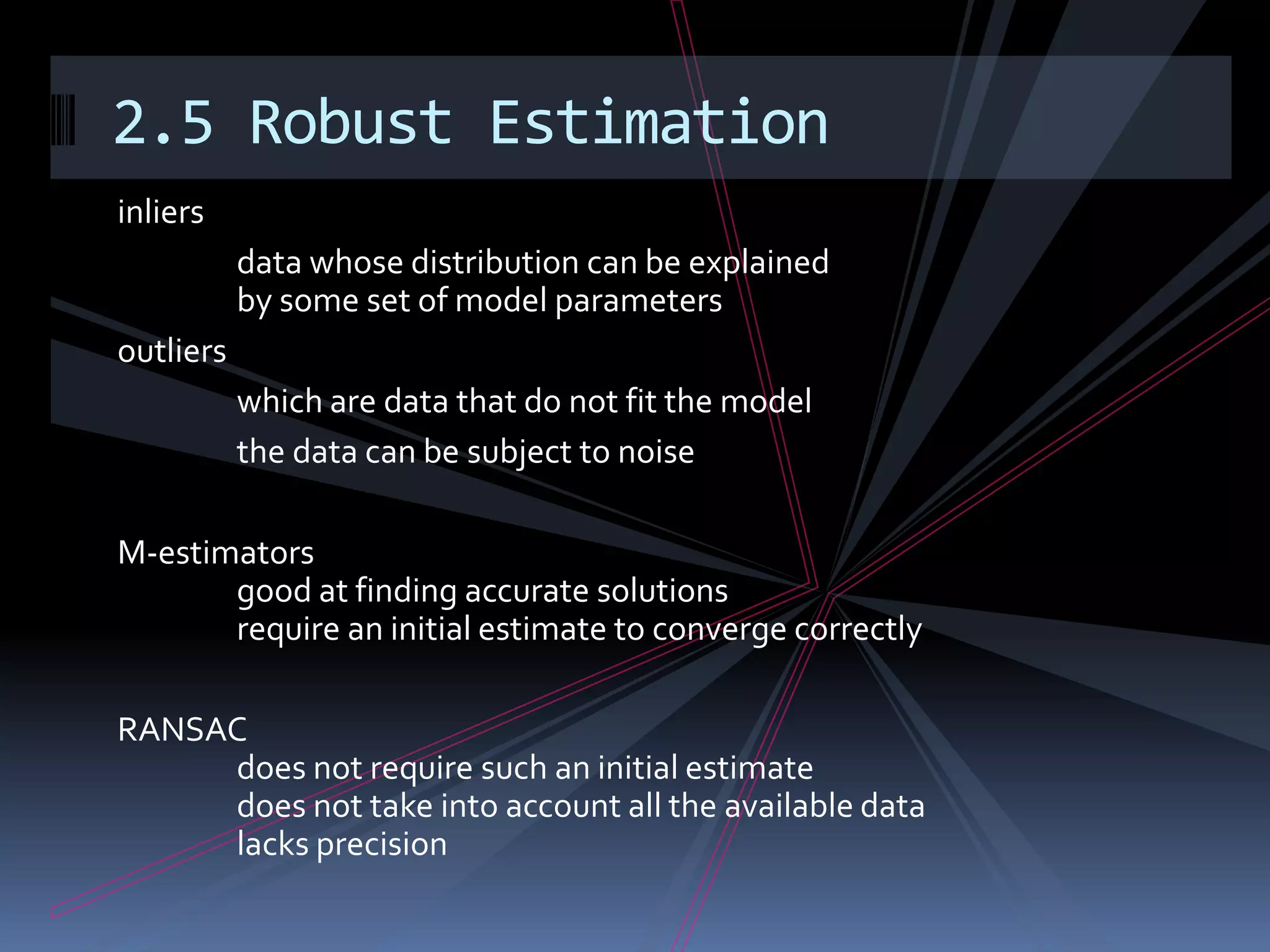
inliers	data whose distribution can be explained	by some set of model parametersoutliers	which are data that do not fit the model	the data can be subject to noiseM-estimators		good at finding accurate solutions	require an initial estimate to converge correctlyRANSAC	does not require such an initial estimate	does not take into account all the available data	lacks precision2.5 Robust Estimation
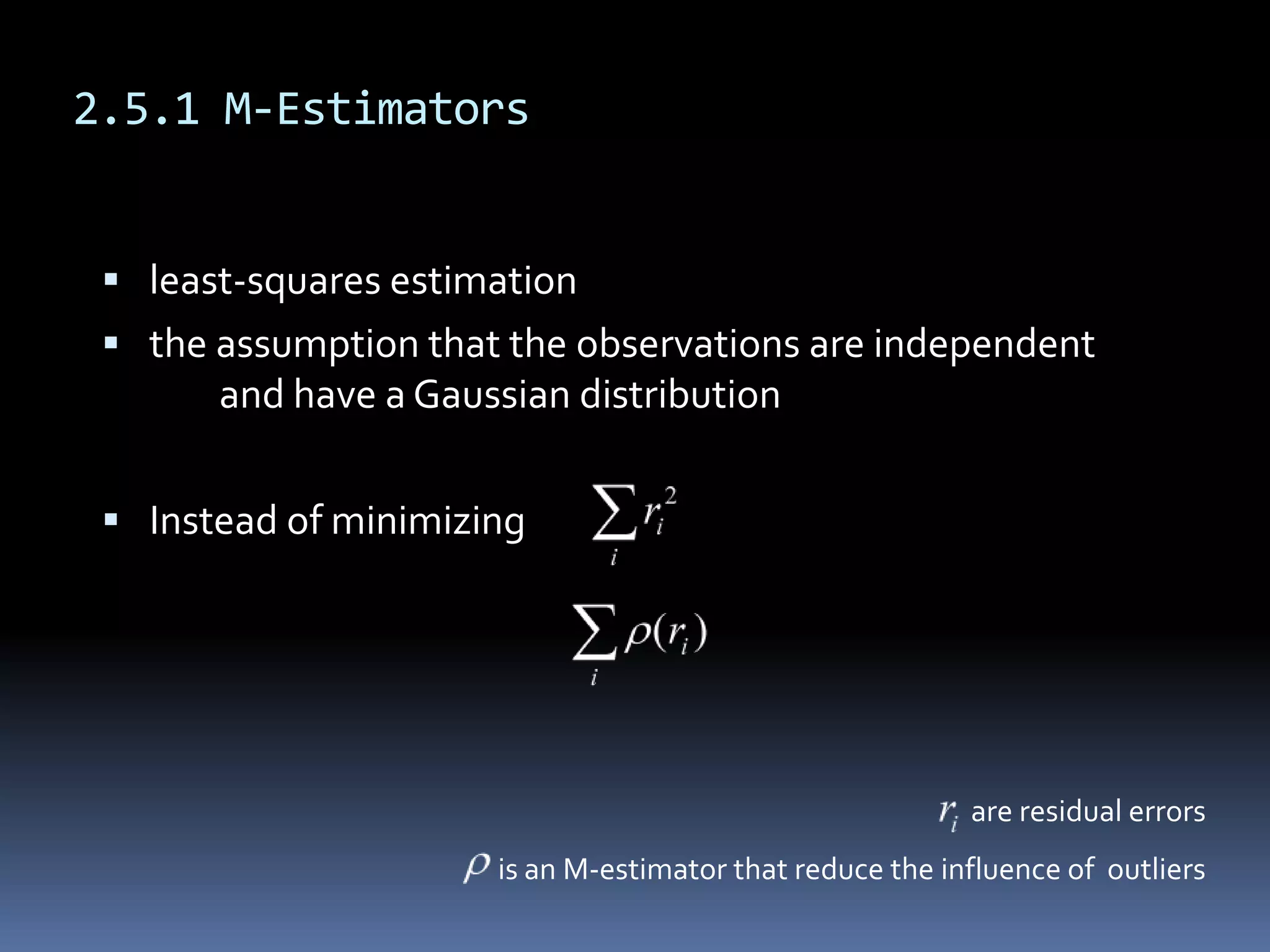
2.5.1 M-Estimatorsleast-squares estimationthe assumption that the observations are independent	and have a Gaussian distributionInstead of minimizingare residual errorsis an M-estimator that reduce the influence of  outliers
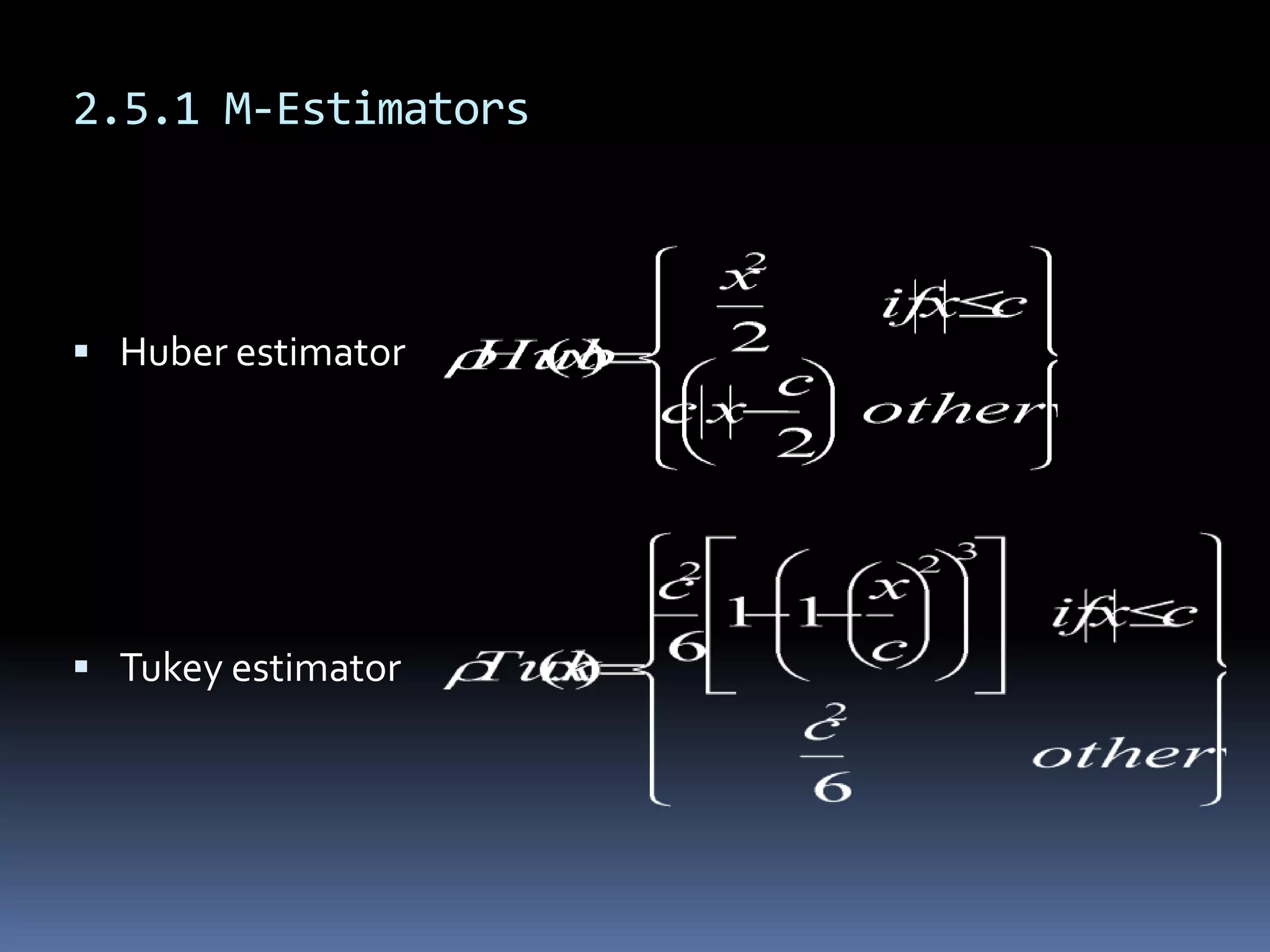
2.5.1 M-EstimatorsHuber estimatorTukey estimator
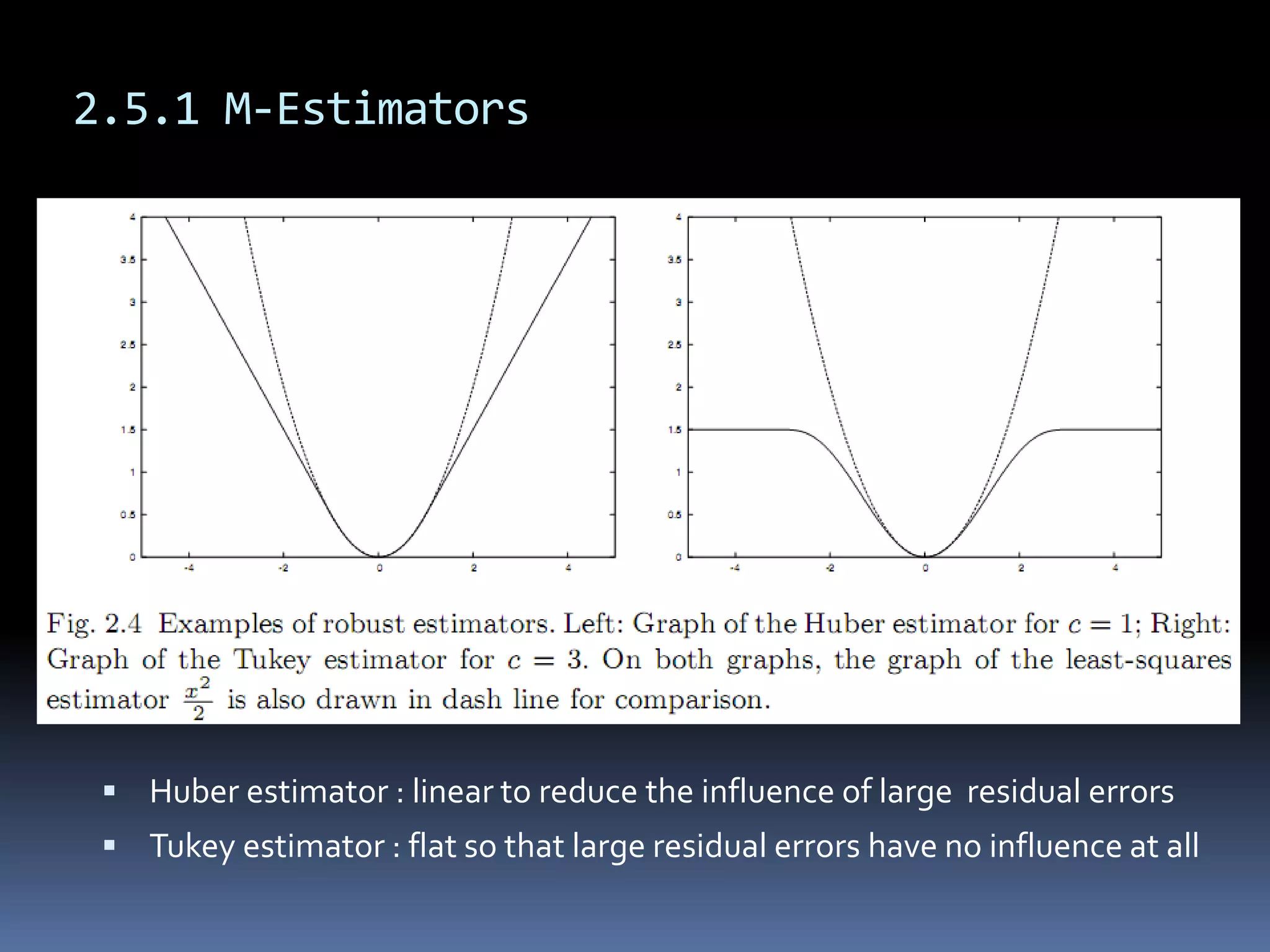
Huber estimator : linear to reduce the influence of large  residual errors
Tukey estimator : flat so that large residual errors have no influence at all2.5.1 M-Estimators
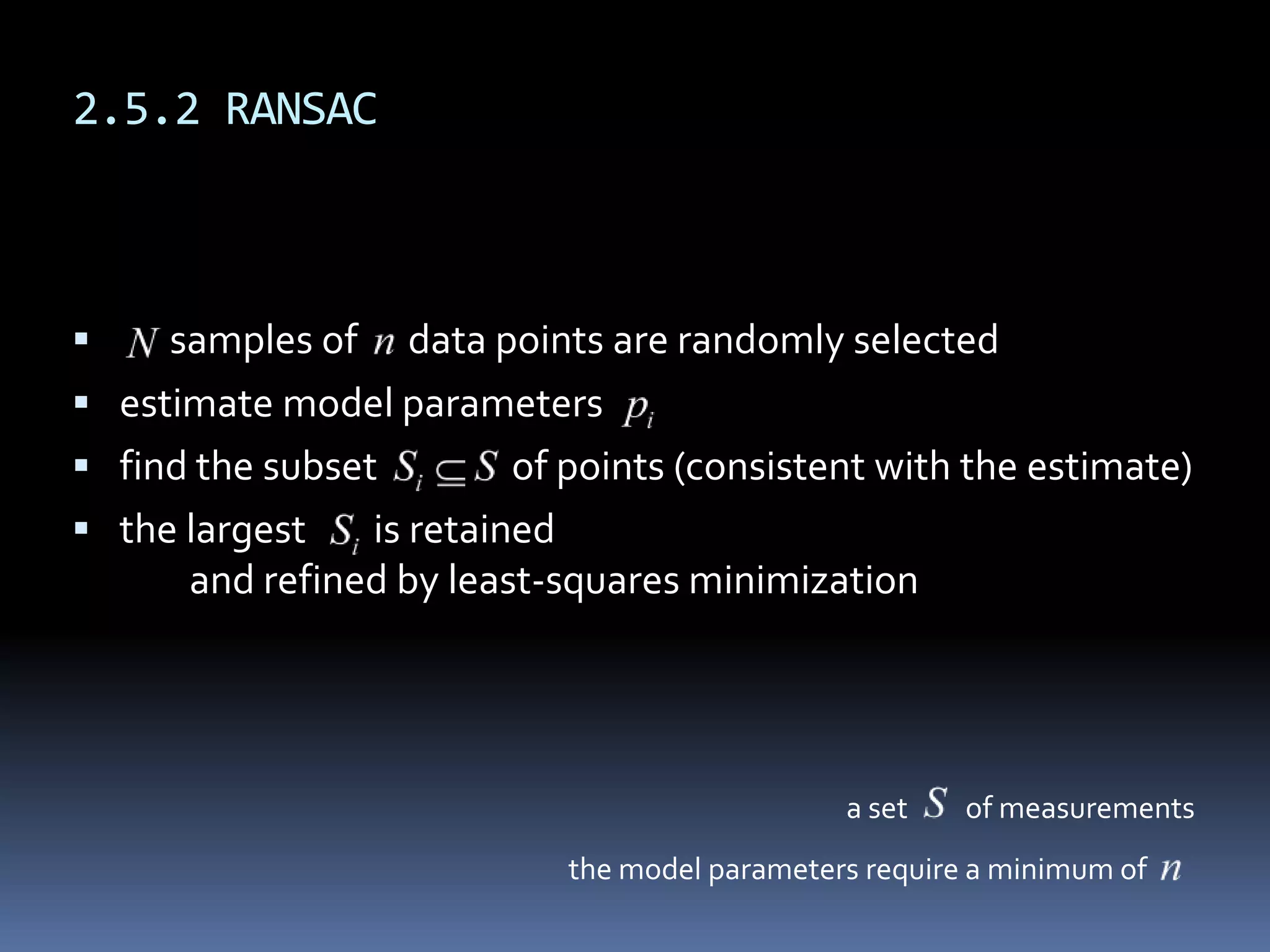
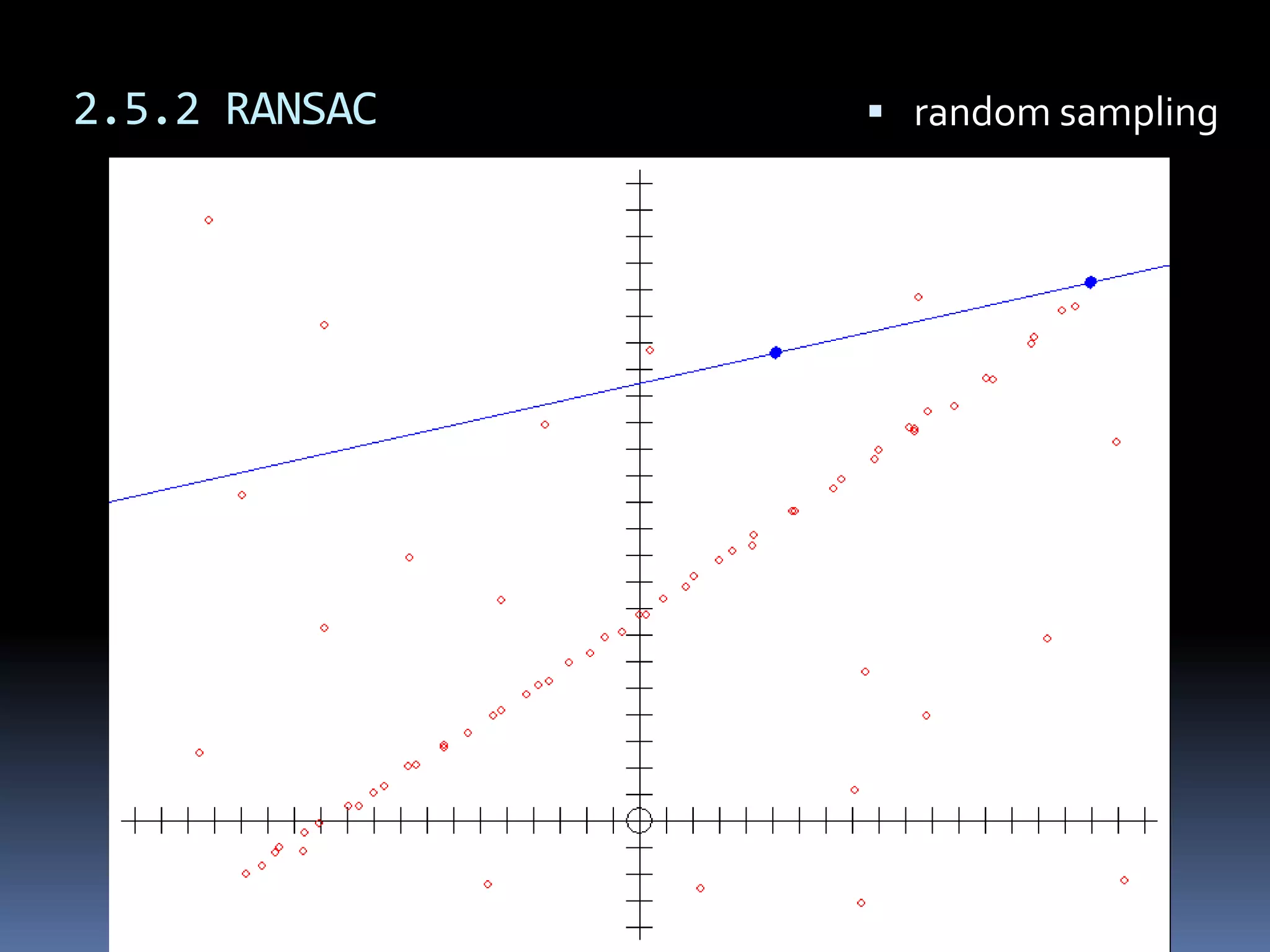
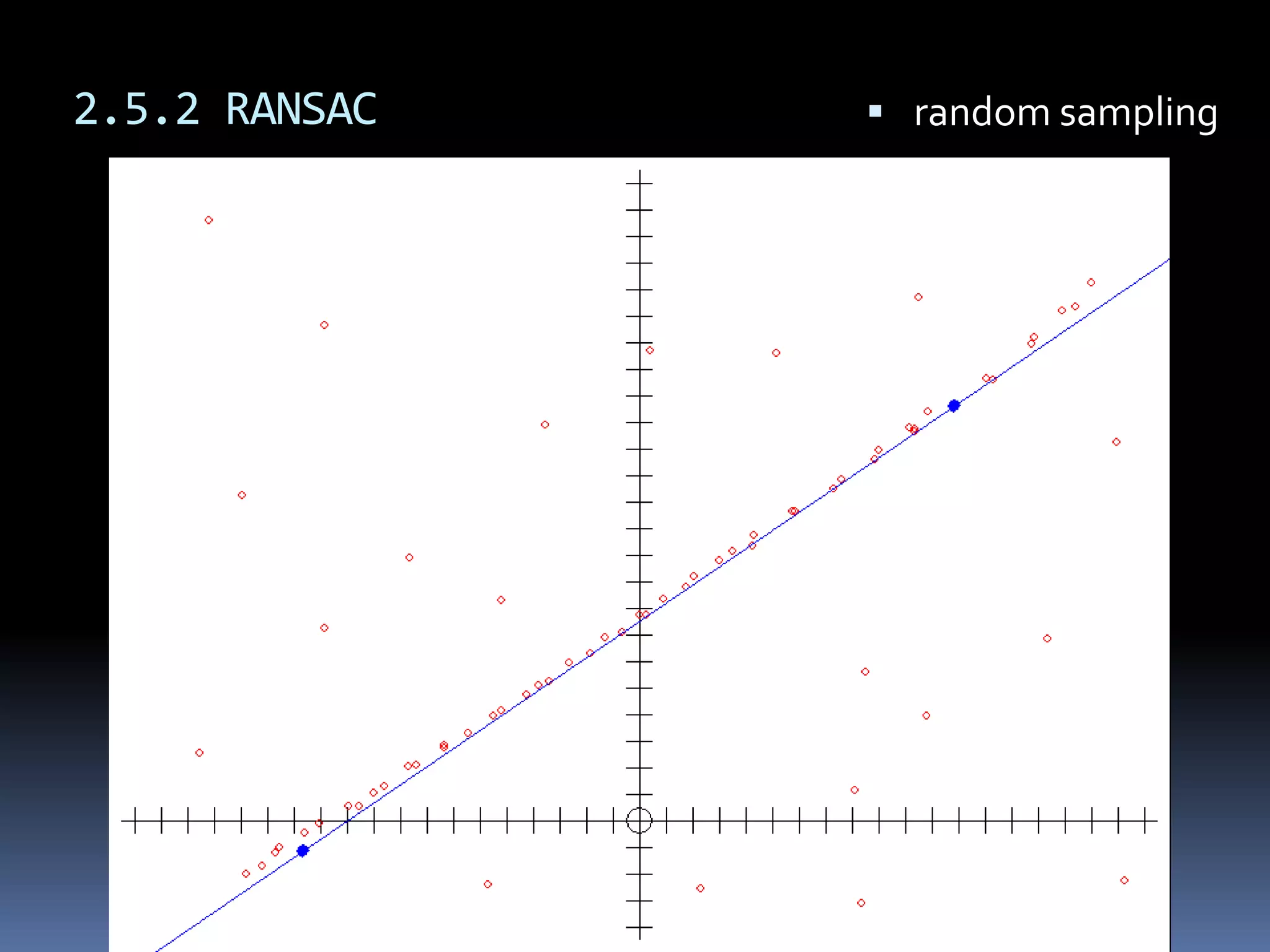
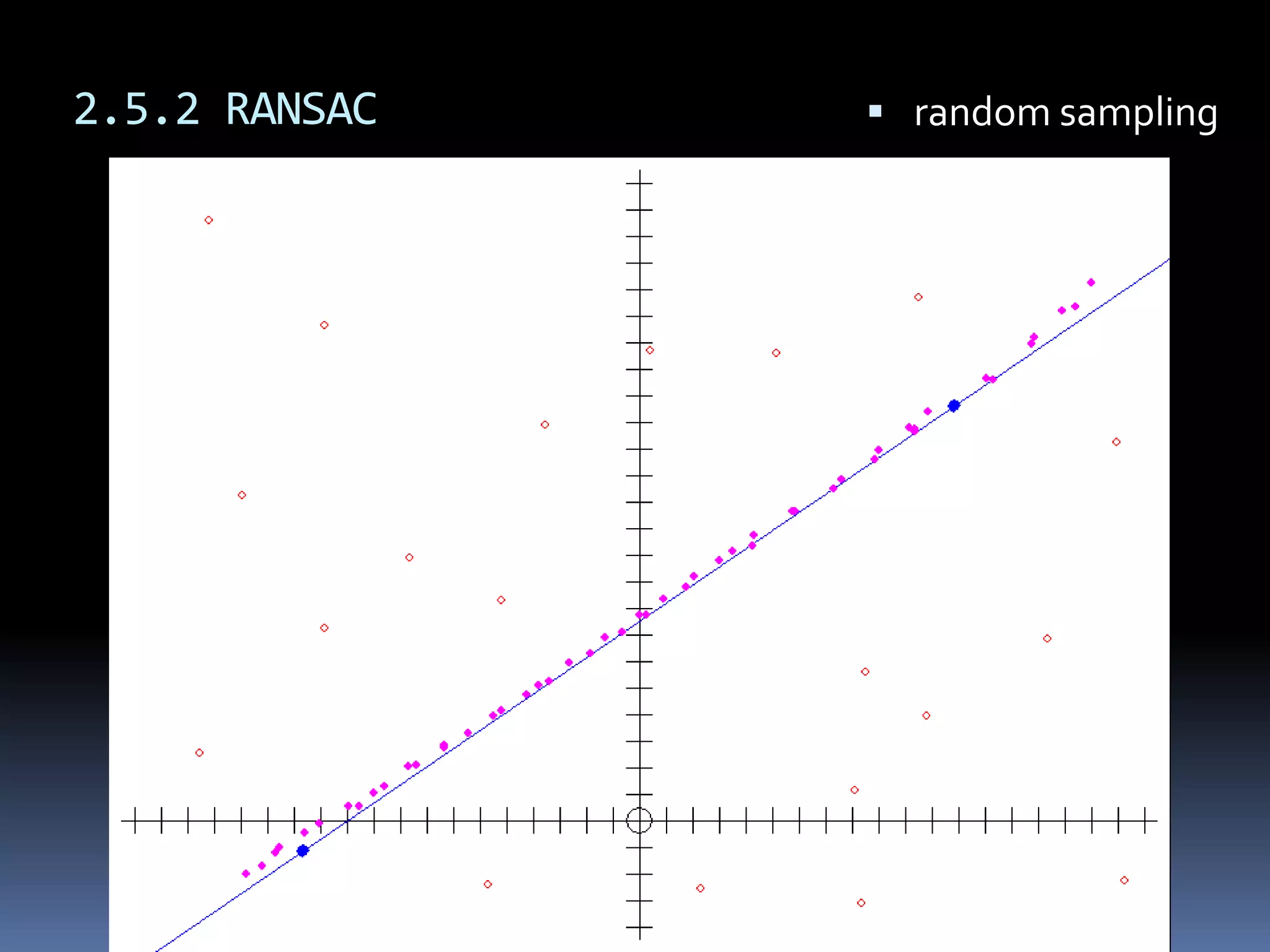
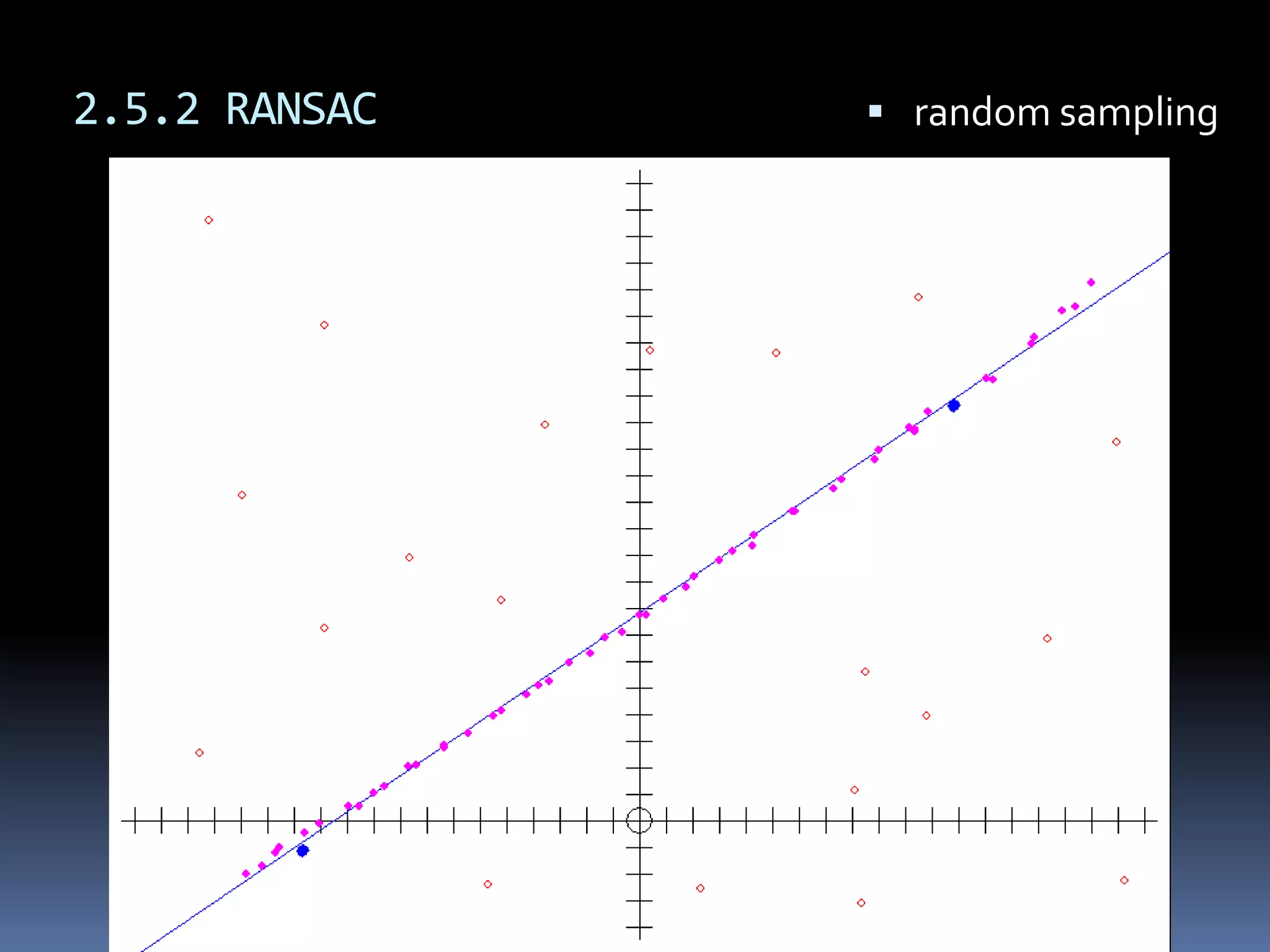
2.5.2 RANSAC      samples of      data pointsare randomly selectedestimate model parametersfind the subset                of points (consistent with the estimate)the largest        is retained	and refined by least-squares minimizationthe model parameters require a minimum ofa set         of measurements
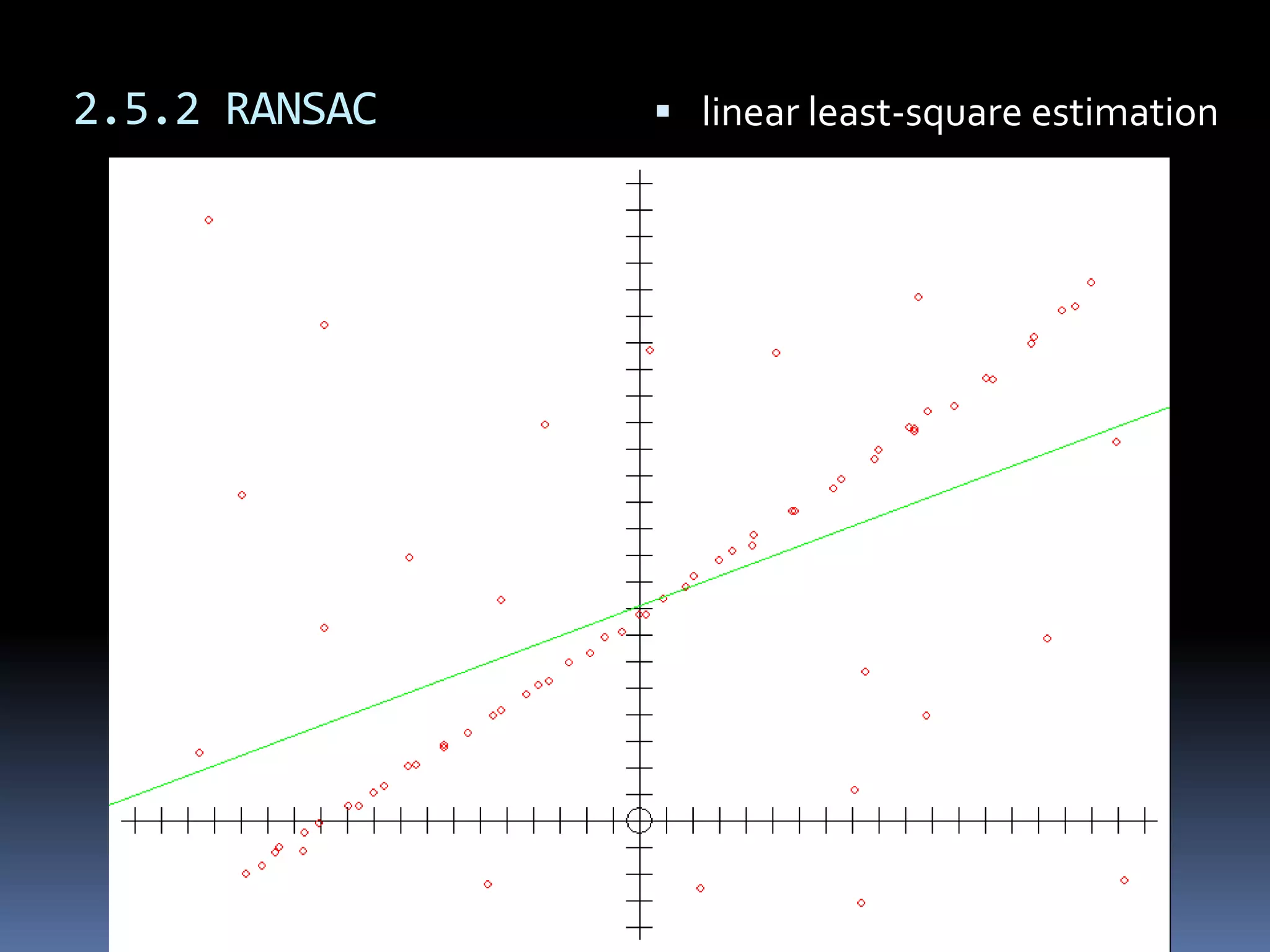
2.5.2 RANSAClinear least-square estimation
2.5.2 RANSACrandom sampling
estimating the density of successive states	in the space of possible camera poses.2.6 Bayesian Tracking
Thank you for your attention

3d tracking : chapter2-1 mathematical tools

  • 1.
    Monocular Model-Based 3DTracking of Rigid Objects: A Survey2008. 12. 04.백운혁Chapter 2. Mathematical Tools
  • 3.
    AgendaMonocular Model-Based 3DTracking of Rigid Objects : A SurveyChapter 2. Mathematical Tools2.1 Camera Representation2.2 Camera Pose Parameterization2.3 Estimating the External Parameters Matrix2.4 Least-Squares Minimization Techniques2.5 Robust Estimation2.6 Bayesian Tracking
  • 4.
    the standard pinholecamera model2.1 Camera Representation
  • 5.
    2.1.1 The PerspectiveProjection ModelImage coordinate systemWorld CoordinatesImage Coordinates(in the image)Projection Matrix
  • 6.
    2.1.2 The CameraCalibration Matrixinternal parametersfocal lengthprincipal pointskew parameterthe number of pixels per unit distance in the uthe number of pixels per unit distance in the v
  • 7.
    2.1.2 The CameraCalibration Matrixprojectionfocal lengthImage Plane
  • 8.
    2.1.2 The CameraCalibration Matrixprojection to imageprincipal point (center of image plane)the number of pixels per unit distance in the uthe number of pixels per unit distance in the v
  • 9.
    2.1.2 The CameraCalibration Matrixskewfield of viewreferred as the skew, usuallyimage plane size and field of view are assumed to be fixed,but not fixed focal length
  • 10.
    2.1.3 The ExternalParameters Matrixworld coordinate to camera coordinateThe 3x4 external parametersrotation matrixtranslation vectorin the world coordinate systemin the camera coordinate system
  • 11.
    2.1.3 The ExternalParameters Matrix
  • 12.
    2.1.4 Estimating theCamera Calibration Matrixinternal parameters are assumed to be fixedmake use of a calibration pattern of known sizeinside the field of viewcorrespondence between the 3D points and the 2D image points
  • 13.
    2.1.5 Handling LensDistortion(usually ignored)radial distortiontangential distortion
  • 14.
    can be avoidedby locally re-pametrizing the rotation2.2 Camera Pose Parameterization
  • 15.
    2.2.1 Euler Anglesα,β,γto be rotation angles around the Z, Y, and X axis respectively yields
  • 16.
  • 17.
    gimbal lock problem2.2.2QuaternionsA rotation about the unit vector by an angle a scalar plus a 3-vector2.2.3 Exponential MapA rotation about the unit vector by an angle Let be a 3D vector2.2.3 Exponential MapRodrigues’ formulathe exponential map represents a rotation as a 3-vector that gives its axis and magnitude.is the skew-symmetric matrix
  • 18.
    2.2.4 Linearization ofSmall Rotations
  • 19.
    estimated camera positions(whenthe internal parameters are known)2.3 Estimating the External parameters Matrix
  • 20.
    2.3.1 How manyCorrespondences are necessary?n=3 known correspondences produce 4 possible solution (P3P Problem)n>=4 known correspondences produce 2 possible solutionn>=4 known correspondences (points are coplanar) produce unique solutionn>=6 known correspondences produce unique solution
  • 21.
    2.3.2 The DirectLinear Transformation (DLT)to estimate the whole matrix P by solving a linear system even when the internal parameters are not knownEach correspondence gives rise to two linearly independent equations
  • 22.
    2.3.2 The DirectLinear Transformation (DLT)Stacking all the equation into B yields the linear system :
  • 23.
    2.3.2 The DirectLinear Transformation (DLT)is the eigen vector of B corresponding to the smallest eigenvalue of B6 correspondences must be knownfor 3D tracking , using a calibrated camera and estimating only its orientation and position
  • 24.
  • 25.
    2.3.4 Pose estimationfrom a 3D PlaneThe relation between a 3D plane and its image projection can be represented by a homogeneous 3x3 matrix (homography matrix)Let us consider the plane
  • 26.
    2.3.4 Pose estimationfrom a 3D PlaneThe matrix H can be estimated from four correspondences using a DLT algorithm the translation vector last column is given by the cross-productsince the columns of R must be orthonormal
  • 27.
  • 28.
    finding the posethat minimizes a sum of residual errors 2.4 Least-Squares Minimization Techniques
  • 29.
    2.4.1 Linear Least-Squaresthefunction is linearthe camera pose parameters the unknowns of a set of linear equations in matrix form as can be estimated as pseudo-inverse of A
  • 30.
    2.4.2 Newton-Based MinimizationAlgorithmsthe function is not linearalgorithms start from an initial estimate of the minimum and update it iteratively is chosen to minimize the residual at iteration and estimated by approximating to the first order
  • 31.
    2.4.2 Newton-Based MinimizationAlgorithmsJacobian matrix the partial derivatives of all these functionsstabilizes the begavior
  • 32.
    inliers data whose distributioncan be explained by some set of model parametersoutliers which are data that do not fit the model the data can be subject to noiseM-estimators good at finding accurate solutions require an initial estimate to converge correctlyRANSAC does not require such an initial estimate does not take into account all the available data lacks precision2.5 Robust Estimation
  • 33.
    2.5.1 M-Estimatorsleast-squares estimationtheassumption that the observations are independent and have a Gaussian distributionInstead of minimizingare residual errorsis an M-estimator that reduce the influence of outliers
  • 34.
  • 35.
    Huber estimator :linear to reduce the influence of large residual errors
  • 36.
    Tukey estimator :flat so that large residual errors have no influence at all2.5.1 M-Estimators
  • 37.
    2.5.2 RANSAC samples of data pointsare randomly selectedestimate model parametersfind the subset of points (consistent with the estimate)the largest is retained and refined by least-squares minimizationthe model parameters require a minimum ofa set of measurements
  • 38.
  • 39.
  • 40.
  • 41.
  • 42.
  • 43.
    estimating the densityof successive states in the space of possible camera poses.2.6 Bayesian Tracking
  • 45.
    Thank you foryour attention