Making a Presentation
This work is licensed under a Creative Commons Attribution-
NonCommercial 3.0 Unported License.
www.myenglishonline.ca
Presentation Topic
Your Home Country
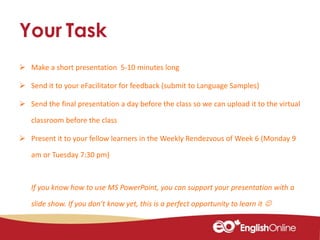
 Make a short presentation 5-10 minutes long
 Send it to your eFacilitator for feedback (submit to Language Samples)
 Send the final presentation a day before the class so we can upload it to the virtual
classroom before the class
 Present it to your fellow learners in the Weekly Rendezvous of Week 6 (Monday 9
am or Tuesday 7:30 pm)
If you know how to use MS PowerPoint, you can support your presentation with a
slide show. If you don’t know yet, this is a perfect opportunity to learn it 
Your Task
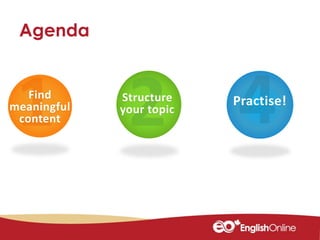
Find
meaningful
content
Structure
your topic
Practise!
Agenda
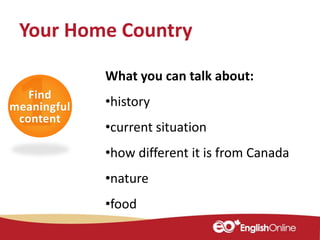
What you can talk about:
•history
•current situation
•how different it is from Canada
•nature
•food
Your Home Country
Find
meaningful
content
Structure
your topic
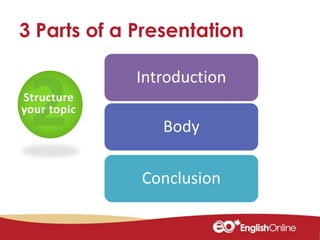
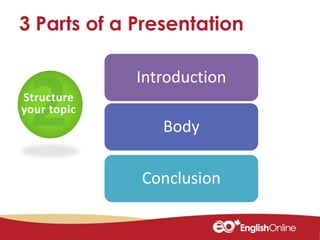
Introduction
Body
Conclusion
3 Parts of a Presentation
Make some
notes
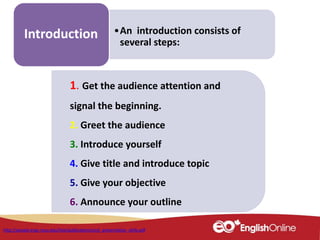
•An introduction consists of
several steps:
Introduction
1. Get the audience attention and
signal the beginning.
2. Greet the audience
3. Introduce yourself
4. Give title and introduce topic
5. Give your objective
6. Announce your outline
http://people.engr.ncsu.edu/txie/publications/oral_presentation_skills.pdf
Make some
notes
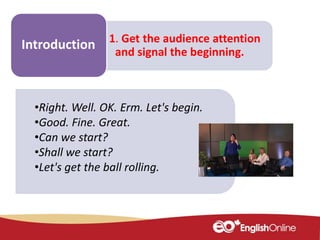
1. Get the audience attention
and signal the beginning.
Introduction
•Right. Well. OK. Erm. Let's begin.
•Good. Fine. Great.
•Can we start?
•Shall we start?
•Let's get the ball rolling.
Make some
notes
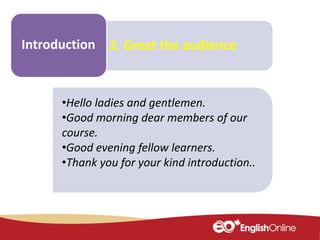
2. Greet the audienceIntroduction
•Hello ladies and gentlemen.
•Good morning dear members of our
course.
•Good evening fellow learners.
•Thank you for your kind introduction..
Make some
notes
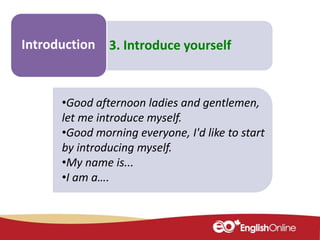
3. Introduce yourselfIntroduction
•Good afternoon ladies and gentlemen,
let me introduce myself.
•Good morning everyone, I'd like to start
by introducing myself.
•My name is...
•I am a….
Make some
notes
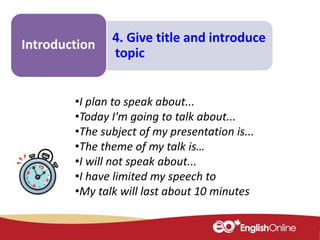
4. Give title and introduce
topic
Introduction
•I plan to speak about...
•Today I'm going to talk about...
•The subject of my presentation is...
•The theme of my talk is…
•I will not speak about...
•I have limited my speech to
•My talk will last about 10 minutes
Make some
notes
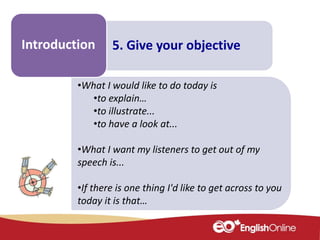
5. Give your objectiveIntroduction
•What I would like to do today is
•to explain…
•to illustrate...
•to have a look at...
•What I want my listeners to get out of my
speech is...
•If there is one thing I'd like to get across to you
today it is that…
Make some
notes
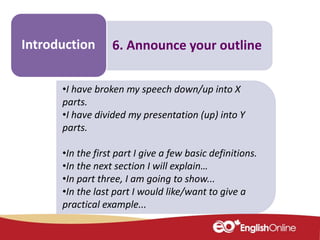
6. Announce your outlineIntroduction
•I have broken my speech down/up into X
parts.
•I have divided my presentation (up) into Y
parts.
•In the first part I give a few basic definitions.
•In the next section I will explain…
•In part three, I am going to show...
•In the last part I would like/want to give a
practical example...
Structure
your topic
Introduction
Body
Conclusion
3 Parts of a Presentation
Structure
your topic
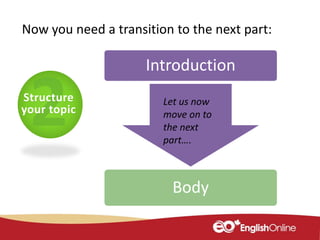
Now you need a transition to the next part:
Introduction
Body
Let us now
move on to
the next
part….
Make some
notes
Body
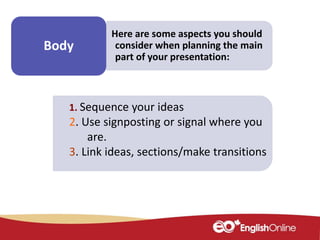
Here are some aspects you should
consider when planning the main
part of your presentation:
1. Sequence your ideas
2. Use signposting or signal where you
are.
3. Link ideas, sections/make transitions
Make some
notes
Body 1. Sequence your ideas
Here are a few possibilities for organizing your
ideas:
•logical; chronological order;
•from general to specific;
•from known to unknown;
•from accepted to controversial;
•cause/effect;
•problem/solution.
Make some
notes
Body
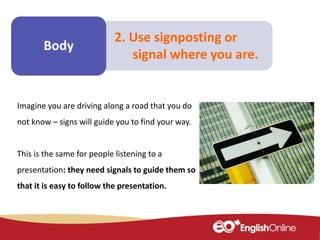
2. Use signposting or
signal where you are.
Imagine you are driving along a road that you do
not know – signs will guide you to find your way.
This is the same for people listening to a
presentation: they need signals to guide them so
that it is easy to follow the presentation.
Make some
notes
Body 2. Use signposting
Function Language
I'd like to start by...
Let's begin by...
Introducing First of all, I'll...
the subject
Starting with...
I'll begin by...
Make some
notes
Body 2. Use signposting
Function Language
Well, I've told you about...
Finishing one subject... We've looked at...
So much for….
Make some
notes
Body 2. Use signposting
Function Language
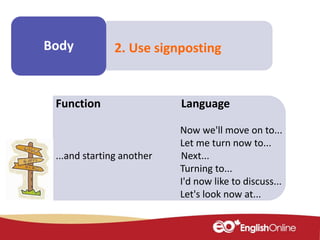
Now we'll move on to...
Let me turn now to...
...and starting another Next...
Turning to...
I'd now like to discuss...
Let's look now at...
Make some
notes
Body 2. Use signposting
Function Language
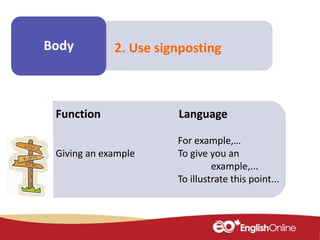
For example,…
Giving an example To give you an
example,...
To illustrate this point...
Make some
notes
Body 2. Use signposting
Function Language
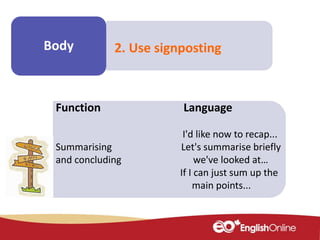
I'd like now to recap...
Summarising Let's summarise briefly
and concluding we've looked at…
If I can just sum up the
main points...
Structure
your topic
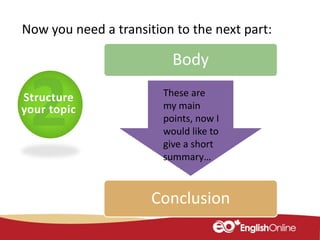
Now you need a transition to the next part:
Body
Conclusion
These are
my main
points, now I
would like to
give a short
summary…
Structure
your topic
Introduction
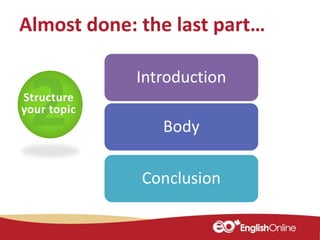
Body
Conclusion
Almost done: the last part…
Make some
notes
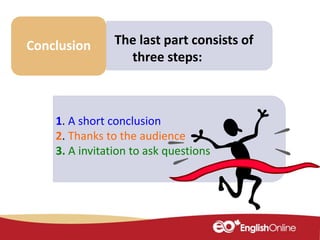
Conclusion The last part consists of
three steps:
1. A short conclusion
2. Thanks to the audience
3. A invitation to ask questions
Make some
notes
Conclusion 1. Short conclusion
•I'd like now to recap...
•Let's summarise briefly whatwe've looked at…
•If I can just sum up the main points...
•In conclusion I would like to say that...
•My final comments concern...
•I would like to finish by reminding everyone that...
Make some
notes
Conclusion 3. A invitation to ask
questions
•I'd be happy to answer any questions....
•If there are any questions please feel free to ask.
•Thank you very much for your attention and if
there are any suggestions or comments…
Structure
your topic
Prepare your presentation
step-by-step.
The following overview
might help you.
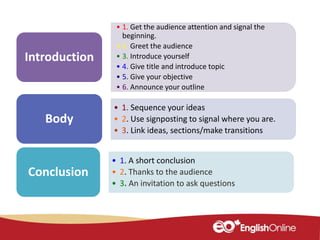
• 1. Get the audience attention and signal the
beginning.
• 2. Greet the audience
• 3. Introduce yourself
• 4. Give title and introduce topic
• 5. Give your objective
• 6. Announce your outline
Introduction
• 1. Sequence your ideas
• 2. Use signposting to signal where you are.
• 3. Link ideas, sections/make transitions
Body
• 1. A short conclusion
• 2. Thanks to the audience
• 3. An invitation to ask questions
Conclusion
Since your presentation will only
be about 5-10 minutes long, it
will be easy to practise it:
•Close the door and speak loudly!
Imagine you are in front of an
audience.
•Time your presentation!
Practising in front of a partner
might even better!
Talk to Yourself
Practise!
Don't read your presentation. You
can use short notes, but reading a presentation
is unnatural; also, it makes it very difficult for
your audience to follow.
Don't try to cover too much
material. Remember you only have 5-10
minutes.
Important Don’ts
Practise!
Important Do’s
Be organized!
The more organized and focused your
presentation is, the more relaxed you'll feel.
Breathe! (It helps you relax.)
Speak clearly, slowly and at an
appropriate level for your audience.
Use vocabulary that is appropriate
for your audience.
Your eFacilitators and classmates look forward to
listening to your presentation as part of our Online
Folklorama marathon during Week 6 Rendezvous.
Make sure that you contact an e-Facilitator if you have
a PowerPoint slideshow to accompany your talk.
Ready to go?
Further Resources
• Further resources
http://people.engr.ncsu.edu/txie/publications/oral_presentation_skills.pdf
http://www.eslpartyland.com/teachers/listening/presentations1.htm
http://www.eslpartyland.com/teachers/listening/presentations2.htm
Video examples of bad
presentations
http://www.youtube.com/watch?v=YivQYeI0vys&feature=related
http://www.youtube.com/watch?v=BBthvuOQpKc&feature=related
The End 
This work is licensed under a Creative Commons Attribution-
NonCommercial 3.0 Unported License.
www.myenglishonline.ca

Making a Presentation about Your Home Country

  • 1.
    Making a Presentation Thiswork is licensed under a Creative Commons Attribution- NonCommercial 3.0 Unported License. www.myenglishonline.ca
  • 2.
  • 3.
     Make ashort presentation 5-10 minutes long  Send it to your eFacilitator for feedback (submit to Language Samples)  Send the final presentation a day before the class so we can upload it to the virtual classroom before the class  Present it to your fellow learners in the Weekly Rendezvous of Week 6 (Monday 9 am or Tuesday 7:30 pm) If you know how to use MS PowerPoint, you can support your presentation with a slide show. If you don’t know yet, this is a perfect opportunity to learn it  Your Task
  • 4.
  • 5.
    What you cantalk about: •history •current situation •how different it is from Canada •nature •food Your Home Country Find meaningful content
  • 6.
  • 7.
    Make some notes •An introductionconsists of several steps: Introduction 1. Get the audience attention and signal the beginning. 2. Greet the audience 3. Introduce yourself 4. Give title and introduce topic 5. Give your objective 6. Announce your outline http://people.engr.ncsu.edu/txie/publications/oral_presentation_skills.pdf
  • 8.
    Make some notes 1. Getthe audience attention and signal the beginning. Introduction •Right. Well. OK. Erm. Let's begin. •Good. Fine. Great. •Can we start? •Shall we start? •Let's get the ball rolling.
  • 9.
    Make some notes 2. Greetthe audienceIntroduction •Hello ladies and gentlemen. •Good morning dear members of our course. •Good evening fellow learners. •Thank you for your kind introduction..
  • 10.
    Make some notes 3. IntroduceyourselfIntroduction •Good afternoon ladies and gentlemen, let me introduce myself. •Good morning everyone, I'd like to start by introducing myself. •My name is... •I am a….
  • 11.
    Make some notes 4. Givetitle and introduce topic Introduction •I plan to speak about... •Today I'm going to talk about... •The subject of my presentation is... •The theme of my talk is… •I will not speak about... •I have limited my speech to •My talk will last about 10 minutes
  • 12.
    Make some notes 5. Giveyour objectiveIntroduction •What I would like to do today is •to explain… •to illustrate... •to have a look at... •What I want my listeners to get out of my speech is... •If there is one thing I'd like to get across to you today it is that…
  • 13.
    Make some notes 6. Announceyour outlineIntroduction •I have broken my speech down/up into X parts. •I have divided my presentation (up) into Y parts. •In the first part I give a few basic definitions. •In the next section I will explain… •In part three, I am going to show... •In the last part I would like/want to give a practical example...
  • 14.
  • 15.
    Structure your topic Now youneed a transition to the next part: Introduction Body Let us now move on to the next part….
  • 16.
    Make some notes Body Here aresome aspects you should consider when planning the main part of your presentation: 1. Sequence your ideas 2. Use signposting or signal where you are. 3. Link ideas, sections/make transitions
  • 17.
    Make some notes Body 1.Sequence your ideas Here are a few possibilities for organizing your ideas: •logical; chronological order; •from general to specific; •from known to unknown; •from accepted to controversial; •cause/effect; •problem/solution.
  • 18.
    Make some notes Body 2. Usesignposting or signal where you are. Imagine you are driving along a road that you do not know – signs will guide you to find your way. This is the same for people listening to a presentation: they need signals to guide them so that it is easy to follow the presentation.
  • 19.
    Make some notes Body 2.Use signposting Function Language I'd like to start by... Let's begin by... Introducing First of all, I'll... the subject Starting with... I'll begin by...
  • 20.
    Make some notes Body 2.Use signposting Function Language Well, I've told you about... Finishing one subject... We've looked at... So much for….
  • 21.
    Make some notes Body 2.Use signposting Function Language Now we'll move on to... Let me turn now to... ...and starting another Next... Turning to... I'd now like to discuss... Let's look now at...
  • 22.
    Make some notes Body 2.Use signposting Function Language For example,… Giving an example To give you an example,... To illustrate this point...
  • 23.
    Make some notes Body 2.Use signposting Function Language I'd like now to recap... Summarising Let's summarise briefly and concluding we've looked at… If I can just sum up the main points...
  • 24.
    Structure your topic Now youneed a transition to the next part: Body Conclusion These are my main points, now I would like to give a short summary…
  • 25.
  • 26.
    Make some notes Conclusion Thelast part consists of three steps: 1. A short conclusion 2. Thanks to the audience 3. A invitation to ask questions
  • 27.
    Make some notes Conclusion 1.Short conclusion •I'd like now to recap... •Let's summarise briefly whatwe've looked at… •If I can just sum up the main points... •In conclusion I would like to say that... •My final comments concern... •I would like to finish by reminding everyone that...
  • 28.
    Make some notes Conclusion 3.A invitation to ask questions •I'd be happy to answer any questions.... •If there are any questions please feel free to ask. •Thank you very much for your attention and if there are any suggestions or comments…
  • 29.
    Structure your topic Prepare yourpresentation step-by-step. The following overview might help you.
  • 30.
    • 1. Getthe audience attention and signal the beginning. • 2. Greet the audience • 3. Introduce yourself • 4. Give title and introduce topic • 5. Give your objective • 6. Announce your outline Introduction • 1. Sequence your ideas • 2. Use signposting to signal where you are. • 3. Link ideas, sections/make transitions Body • 1. A short conclusion • 2. Thanks to the audience • 3. An invitation to ask questions Conclusion
  • 31.
    Since your presentationwill only be about 5-10 minutes long, it will be easy to practise it: •Close the door and speak loudly! Imagine you are in front of an audience. •Time your presentation! Practising in front of a partner might even better! Talk to Yourself
  • 32.
    Practise! Don't read yourpresentation. You can use short notes, but reading a presentation is unnatural; also, it makes it very difficult for your audience to follow. Don't try to cover too much material. Remember you only have 5-10 minutes. Important Don’ts
  • 33.
    Practise! Important Do’s Be organized! Themore organized and focused your presentation is, the more relaxed you'll feel. Breathe! (It helps you relax.) Speak clearly, slowly and at an appropriate level for your audience. Use vocabulary that is appropriate for your audience.
  • 34.
    Your eFacilitators andclassmates look forward to listening to your presentation as part of our Online Folklorama marathon during Week 6 Rendezvous. Make sure that you contact an e-Facilitator if you have a PowerPoint slideshow to accompany your talk. Ready to go?
  • 35.
    Further Resources • Furtherresources http://people.engr.ncsu.edu/txie/publications/oral_presentation_skills.pdf http://www.eslpartyland.com/teachers/listening/presentations1.htm http://www.eslpartyland.com/teachers/listening/presentations2.htm Video examples of bad presentations http://www.youtube.com/watch?v=YivQYeI0vys&feature=related http://www.youtube.com/watch?v=BBthvuOQpKc&feature=related
  • 36.
    The End  Thiswork is licensed under a Creative Commons Attribution- NonCommercial 3.0 Unported License. www.myenglishonline.ca

Editor's Notes

  • #2 IG: Pub Transportation in Winnipeg, not MB, since the focus is on Winnipeg
  • #7 http://people.engr.ncsu.edu/txie/publications/oral_presentation_skills.pdf
  • #8  http://people.engr.ncsu.edu/txie/publications/oral_presentation_skills.pdf
  • #9  http://people.engr.ncsu.edu/txie/publications/oral_presentation_skills.pdf
  • #10  http://people.engr.ncsu.edu/txie/publications/oral_presentation_skills.pdf
  • #11  http://people.engr.ncsu.edu/txie/publications/oral_presentation_skills.pdf
  • #12  http://people.engr.ncsu.edu/txie/publications/oral_presentation_skills.pdf
  • #13  http://people.engr.ncsu.edu/txie/publications/oral_presentation_skills.pdf
  • #14  http://people.engr.ncsu.edu/txie/publications/oral_presentation_skills.pdf
  • #15 http://people.engr.ncsu.edu/txie/publications/oral_presentation_skills.pdf
  • #16 http://people.engr.ncsu.edu/txie/publications/oral_presentation_skills.pdf
  • #17  http://people.engr.ncsu.edu/txie/publications/oral_presentation_skills.pdf
  • #18  http://people.engr.ncsu.edu/txie/publications/oral_presentation_skills.pdf
  • #19  http://people.engr.ncsu.edu/txie/publications/oral_presentation_skills.pdf
  • #20  http://www.eslpartyland.com/teachers/listening/presentations2.htm
  • #21  http://www.eslpartyland.com/teachers/listening/presentations2.htm
  • #22  http://www.eslpartyland.com/teachers/listening/presentations2.htm
  • #23  http://www.eslpartyland.com/teachers/listening/presentations2.htm
  • #24  http://www.eslpartyland.com/teachers/listening/presentations2.htm
  • #25 http://people.engr.ncsu.edu/txie/publications/oral_presentation_skills.pdf
  • #26 http://people.engr.ncsu.edu/txie/publications/oral_presentation_skills.pdf
  • #27  http://www.eslpartyland.com/teachers/listening/presentations2.htm
  • #28  http://www.eslpartyland.com/teachers/listening/presentations2.htm
  • #29  http://www.eslpartyland.com/teachers/listening/presentations2.htm
  • #30 http://people.engr.ncsu.edu/txie/publications/oral_presentation_skills.pdf
  • #33 http://www.eslpartyland.com/teachers/listening/presentations1.htm
  • #34 http://www.eslpartyland.com/teachers/listening/presentations1.htm