SINGAPORE
Flag Description

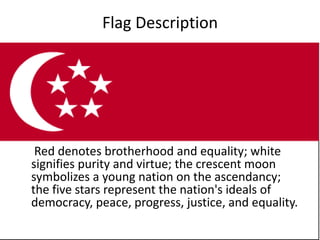
Red denotes brotherhood and equality; white
signifies purity and virtue; the crescent moon
symbolizes a young nation on the ascendancy;
the five stars represent the nation's ideals of
democracy, peace, progress, justice, and equality.
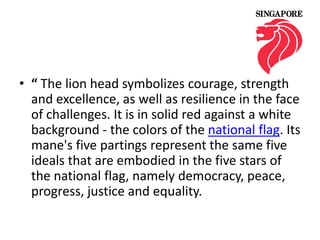
• “ The lion head symbolizes courage, strength
and excellence, as well as resilience in the face
of challenges. It is in solid red against a white
background - the colors of the national flag. Its
mane's five partings represent the same five
ideals that are embodied in the five stars of
the national flag, namely democracy, peace,
progress, justice and equality.
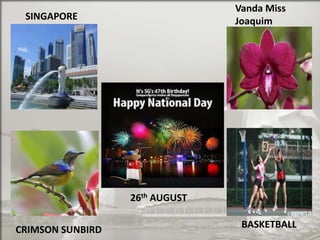
Vanda Miss
Joaquim

SINGAPORE

26th AUGUST
CRIMSON SUNBIRD

BASKETBALL
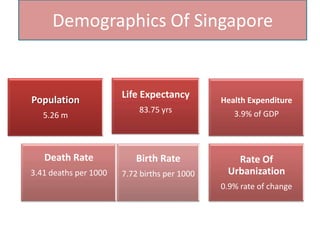
Demographics Of Singapore

Population

Life Expectancy

Health Expenditure

83.75 yrs

3.9% of GDP

Death Rate

Birth Rate

3.41 deaths per 1000

7.72 births per 1000

Rate Of
Urbanization

5.26 m

0.9% rate of change
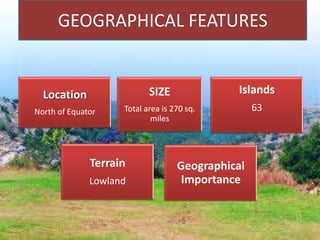
GEOGRAPHICAL FEATURES

Location

SIZE

Islands

North of Equator

Total area is 270 sq.
miles

63

Terrain
Lowland

Geographical
Importance
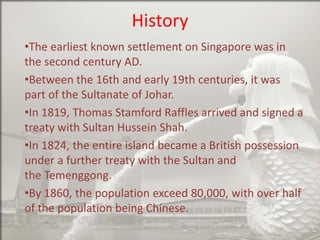
History
•The earliest known settlement on Singapore was in
the second century AD.
•Between the 16th and early 19th centuries, it was
part of the Sultanate of Johar.
•In 1819, Thomas Stamford Raffles arrived and signed a
treaty with Sultan Hussein Shah.
•In 1824, the entire island became a British possession
under a further treaty with the Sultan and
the Temenggong.
•By 1860, the population exceed 80,000, with over half
of the population being Chinese.
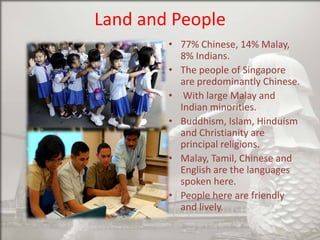
Land and People
• 77% Chinese, 14% Malay,
8% Indians.
• The people of Singapore
are predominantly Chinese.
• With large Malay and
Indian minorities.
• Buddhism, Islam, Hinduism
and Christianity are
principal religions.
• Malay, Tamil, Chinese and
English are the languages
spoken here.
• People here are friendly
and lively.
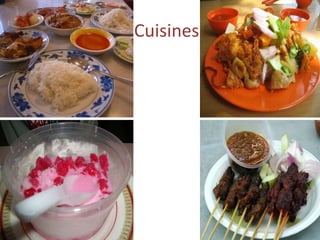
Cuisines
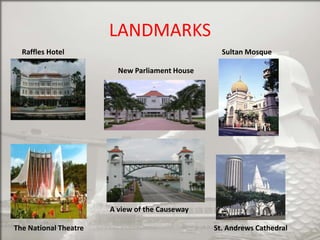
LANDMARKS
Raffles Hotel

Sultan Mosque
New Parliament House

A view of the Causeway
The National Theatre

St. Andrews Cathedral
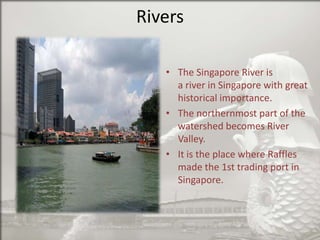
Rivers
• The Singapore River is
a river in Singapore with great
historical importance.
• The northernmost part of the
watershed becomes River
Valley.
• It is the place where Raffles

made the 1st trading port in
Singapore.
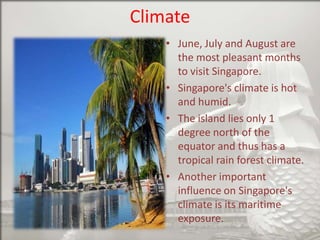
Climate
• June, July and August are
the most pleasant months
to visit Singapore.
• Singapore's climate is hot
and humid.
• The island lies only 1
degree north of the
equator and thus has a
tropical rain forest climate.
• Another important
influence on Singapore's
climate is its maritime
exposure.
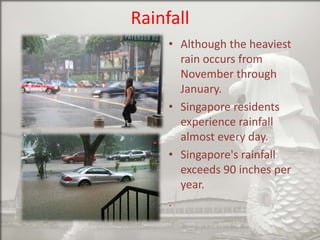
Rainfall
• Although the heaviest
rain occurs from
November through
January.
• Singapore residents
experience rainfall
almost every day.
• Singapore's rainfall
exceeds 90 inches per
year.
.
Temperature and Humidity
• Singapore's close
proximity to the equator
means that its
temperature and humidity
remain relatively even
throughout the year.
• Its average daytime
temperatures are around
87 degrees Fahrenheit.
• The hottest weather
occurs in April.
1

2

3

4

5

• Lack of natural resources; Fishing and marine life exists

• Small area of land is suitable for agricultural purposes.

• Singapore is the world's third-largest oil-refining center.
• The production of chemicals is the second leading
industry
• Human resource as the biggest natural resource.
Government
• English common law
• Constitution: The Constitution of Singapore is
the supreme law of Singapore and it is
a codified constitution.
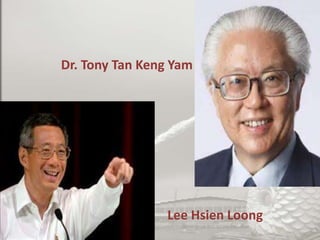
Dr. Tony Tan Keng Yam

Lee Hsien Loong
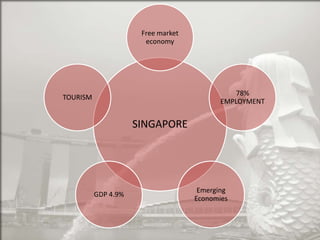
Free market
economy

78%
EMPLOYMENT

TOURISM

SINGAPORE

GDP 4.9%

Emerging
Economies
Political Environment
• Political ideology: Collectivism
• Singapore’s government system revolves
around a political ideology- meritocracy.
• Singapore has a total of 43 active parties.
• Singapore’s ruling party is the People’s Action
Party (PAP).
Corporate Social Responsibility
• The awareness and implementation of
Corporate Social Responsibility (CSR) in
Singapore has been increasing over the past
four years since the formation of
the SINGAPORE COMPACT, a national society
promoting CSR in Singapore
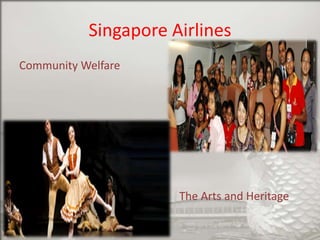
Singapore Airlines
Community Welfare

The Arts and Heritage
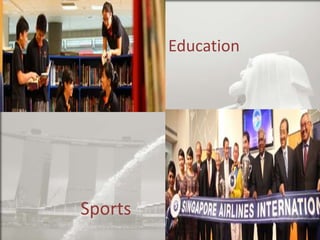
Education

Sports
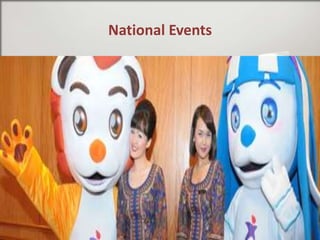
National Events
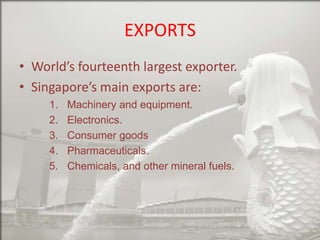
EXPORTS
• World’s fourteenth largest exporter.
• Singapore’s main exports are:
1.
2.
3.
4.
5.

Machinery and equipment.
Electronics.
Consumer goods
Pharmaceuticals.
Chemicals, and other mineral fuels.
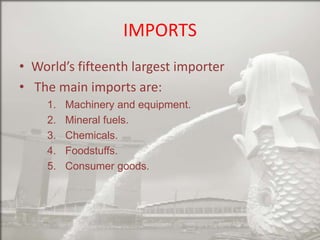
IMPORTS
• World’s fifteenth largest importer
• The main imports are:
1.
2.
3.
4.
5.

Machinery and equipment.
Mineral fuels.
Chemicals.
Foodstuffs.
Consumer goods.
BIOTECHNOLOGY
•
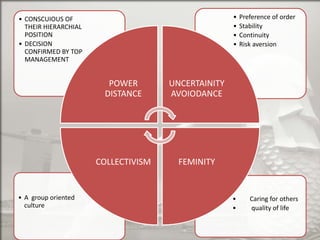
HOFSTEDE’S CULTURAL DIMENSIONS
•
•
•
•

• CONSCUIOUS OF
THEIR HIERARCHIAL
POSITION
• DECISION
CONFIRMED BY TOP
MANAGEMENT

POWER
DISTANCE

• A group oriented
culture

UNCERTAINITY
AVOIODANCE

COLLECTIVISM

Preference of order
Stability
Continuity
Risk aversion

FEMINITY

•
•

Caring for others
quality of life
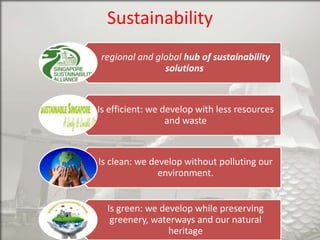
Sustainability
regional and global hub of sustainability
solutions

Is efficient: we develop with less resources
and waste

Is clean: we develop without polluting our
environment.
Is green: we develop while preserving
greenery, waterways and our natural
heritage
Corruption
• Singapore has constantly
been ranked as one of the
least corrupted countries
globally. In fact, Singapore
ranks as the fifth least
corrupt country, behind
New Zealand, Denmark,
Finland and Sweden on
the Transparency
International's Corruption
Perceptions Index 2012.
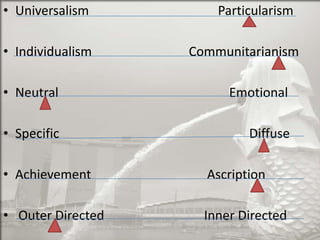
Trompenaar’s Cultural Dimensions
• Universalism
• Individualism

Particularism
Communitarianism

• Neutral

Emotional

• Specific

Diffuse

• Achievement

Ascription

• Outer Directed

Inner Directed
Strategic Predisposition
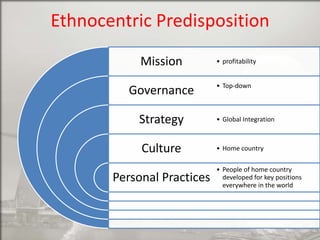
Ethnocentric Predisposition
Mission
Governance

Strategy
Culture
Personal Practices

• profitability
• Top-down

• Global Integration

• Home country
• People of home country
developed for key positions
everywhere in the world
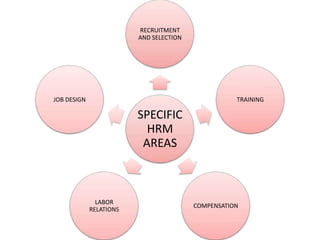
RECRUITMENT
AND SELECTION

JOB DESIGN

TRAINING

SPECIFIC
HRM
AREAS

LABOR
RELATIONS

COMPENSATION
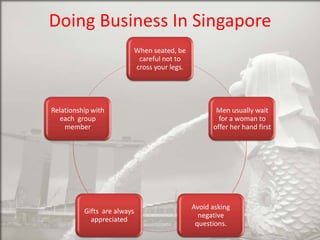
Doing Business In Singapore
When seated, be
careful not to
cross your legs.

Relationship with
each group
member

Gifts are always
appreciated

Men usually wait
for a woman to
offer her hand first

Avoid asking
negative
questions.
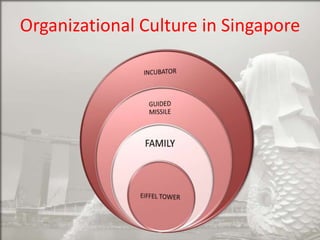
Organizational Culture in Singapore
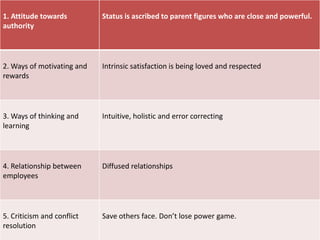
1. Attitude towards
authority

Status is ascribed to parent figures who are close and powerful.

2. Ways of motivating and
rewards

Intrinsic satisfaction is being loved and respected

3. Ways of thinking and
learning

Intuitive, holistic and error correcting

4. Relationship between
employees

Diffused relationships

5. Criticism and conflict
resolution

Save others face. Don’t lose power game.
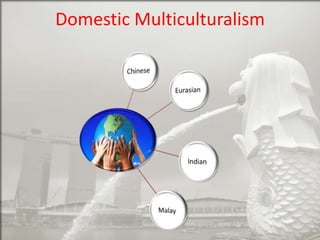
Domestic Multiculturalism
GROUP THINK
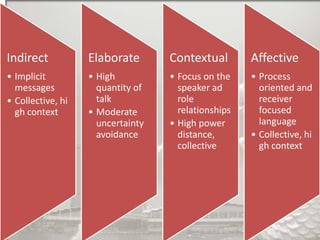
Verbal Communication
Indirect

Elaborate

Contextual

Affective

• Implicit
messages
• Collective, hi
gh context

• High
quantity of
talk
• Moderate
uncertainty
avoidance

• Focus on the
speaker ad
role
relationships
• High power
distance,
collective

• Process
oriented and
receiver
focused
language
• Collective, hi
gh context
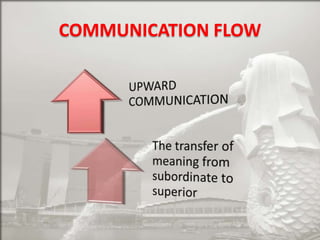
COMMUNICATION FLOW
Non Verbal Communication
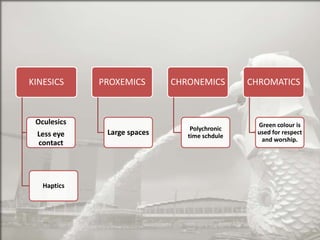
KINESICS

PROXEMICS

Oculesics
Less eye
contact

Haptics

Large spaces

CHRONEMICS

CHROMATICS

Polychronic
time schdule

Green colour is
used for respect
and worship.
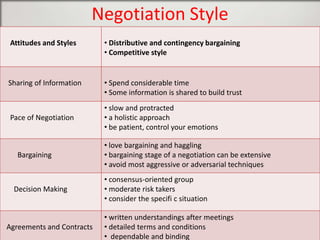
Negotiation Style
Attitudes and Styles

• Distributive and contingency bargaining
• Competitive style

Sharing of Information

• Spend considerable time
• Some information is shared to build trust

Pace of Negotiation

Bargaining

Decision Making

Agreements and Contracts

• slow and protracted
• a holistic approach
• be patient, control your emotions
• love bargaining and haggling
• bargaining stage of a negotiation can be extensive
• avoid most aggressive or adversarial techniques
• consensus-oriented group
• moderate risk takers
• consider the specifi c situation
• written understandings after meetings
• detailed terms and conditions
• dependable and binding
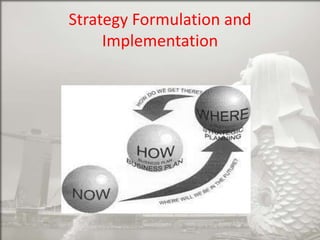
Strategy Formulation and
Implementation
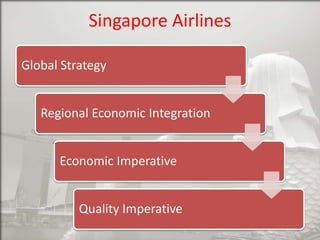
Singapore Airlines
Global Strategy
Regional Economic Integration
Economic Imperative
Quality Imperative
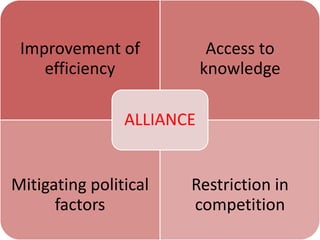
Improvement of
efficiency

Access to
knowledge

ALLIANCE

Mitigating political
factors

Restriction in
competition
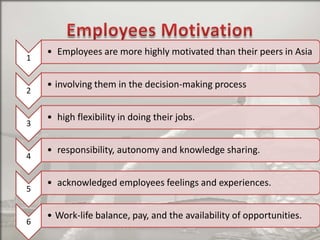
1

2

3

4

5

6

• Employees are more highly motivated than their peers in Asia

• involving them in the decision-making process
• high flexibility in doing their jobs.

• responsibility, autonomy and knowledge sharing.
• acknowledged employees feelings and experiences.

• Work-life balance, pay, and the availability of opportunities.
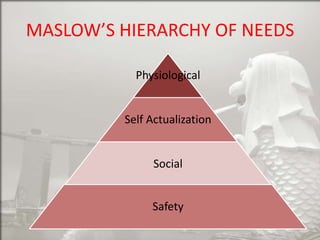
MASLOW’S HIERARCHY OF NEEDS
Physiological

Self Actualization

Social
Safety
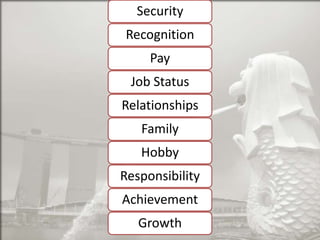
Security

Recognition
Pay
Job Status

Relationships
Family
Hobby

Responsibility
Achievement
Growth
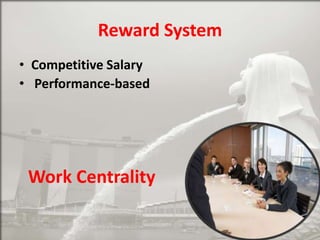
Reward System
• Competitive Salary
• Performance-based

Work Centrality
Theory Y
Participative style
Charismatic leaders

Future Orientation Values
Performance Orientation
Authentic leadership
YOUNG
ENTREPRENEURS OF
SINGAPORE
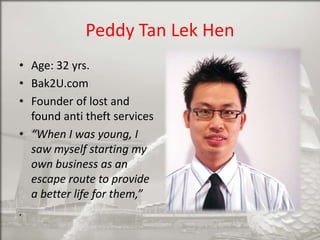
Peddy Tan Lek Hen
• Age: 32 yrs.
• Bak2U.com
• Founder of lost and
found anti theft services
• “When I was young, I
saw myself starting my
own business as an
escape route to provide
a better life for them,”
.
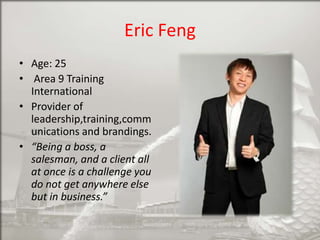
Eric Feng
• Age: 25
• Area 9 Training
International
• Provider of
leadership,training,comm
unications and brandings.
• “Being a boss, a
salesman, and a client all
at once is a challenge you
do not get anywhere else
but in business.”
Singapore
Singapore

Singapore