VOICES: Oxfam learning event
       “There is no I in TEAM”
Community groups are becoming increasingly involved in how, what and
when change happens at a local level. Supporting community groups to
articulate their own needs and desires and giving them the confidence to
influence decisions that affect their own lives is an important influencing
strategy: collective action is much more powerful than individual action.

Managing the dynamics in these groups and keeping the group together
and focused on the issue can be challenging however. In this session
partners will share their community mobilisation strategies, the processes
and methods they have developed to work with groups and the successes
and challenges they have had to overcome to create and sustain change
at a local level.
Planned Outcomes of the session
• Partners share and learn some of the successful ways in
which community groups have been involved in change in
their communities.

• Partners identify dynamics and issues that need to be
addressed in community groups and some strategies that
can be used to address them.
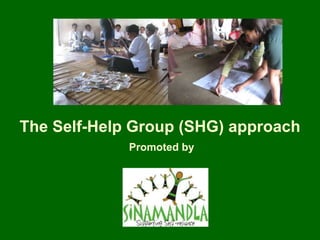
The Self-Help Group (SHG) approach
             Promoted by
Vision: Socially and economically empowered
women within households made vulnerable by
poverty, the impact of HIV and AIDS, gender
inequalities and other societal injustices.

Mission: Sinamandla assists, capacitates and
supports local South African non-profit and
community-based organisations to promote self-
reliance in the communities they serve.

See www.sinamandla.org.za
Mobilising women for change
- The SHG approach focuses on the poorest and most
vulnerable sections of the community, organising women into
strong affinity groups (called SHGs) so that they are no longer
voiceless and powerless individuals.
- Second, it helps women realize their potential as individuals
through initiating a savings and loan system whereby the
members in the group save from their own meager resources
and administer their own fund.
-Third, it improves capacity and builds competence through a
series of training modules provided by a local implementing
organisation that can support the processes which increase
self-confidence, develop self-reliance, and help SHG
members to set their own agenda.
Mobilising women for change
-The  final component is building the model through clustering
six to ten SHGs into a Cluster Level Association (CLA) to
work on the things that cannot be done by SHGs themselves
effectively, such as linkages and coordinating larger
community projects.
- Eventually eight or more CLAs can be clustered together
into a formalized network called a Federation (operating at
district level).
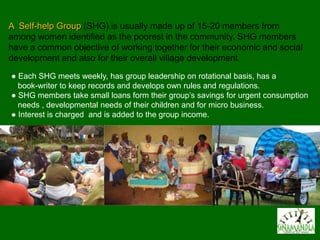
A Self-help Group (SHG) is usually made up of 15-20 members from
among women identified as the poorest in the community. SHG members
have a common objective of working together for their economic and social
development and also for their overall village development
● Each SHG meets weekly, has group leadership on rotational basis, has a
  book-writer to keep records and develops own rules and regulations.
● SHG members take small loans form their group’s savings for urgent consumption
  needs , developmental needs of their children and for micro business.
● Interest is charged and is added to the group income.
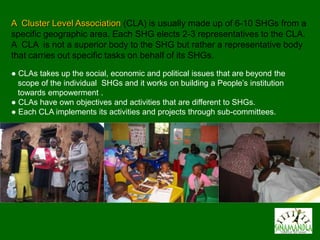
A Cluster Level Association (CLA) is usually made up of 6-10 SHGs from a
specific geographic area. Each SHG elects 2-3 representatives to the CLA.
A CLA is not a superior body to the SHG but rather a representative body
that carries out specific tasks on behalf of its SHGs.
● CLAs takes up the social, economic and political issues that are beyond the
  scope of the individual SHGs and it works on building a People’s institution
  towards empowerment .
● CLAs have own objectives and activities that are different to SHGs.
● Each CLA implements its activities and projects through sub-committees.
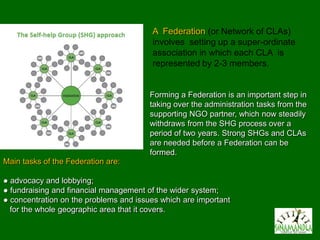
A Federation (or Network of CLAs)
                                        involves setting up a super-ordinate
                                        association in which each CLA is
                                        represented by 2-3 members.


                                        Forming a Federation is an important step in
                                        taking over the administration tasks from the
                                        supporting NGO partner, which now steadily
                                        withdraws from the SHG process over a
                                        period of two years. Strong SHGs and CLAs
                                        are needed before a Federation can be
                                        formed.
Main tasks of the Federation are:

● advocacy and lobbying;
● fundraising and financial management of the wider system;
● concentration on the problems and issues which are important
  for the whole geographic area that it covers.
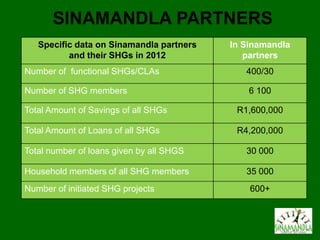
SINAMANDLA PARTNERS
   Specific data on Sinamandla partners   In Sinamandla
          and their SHGs in 2012             partners
Number of functional SHGs/CLAs               400/30

Number of SHG members                         6 100

Total Amount of Savings of all SHGs        R1,600,000

Total Amount of Loans of all SHGs          R4,200,000

Total number of loans given by all SHGS      30 000

Household members of all SHG members         35 000
Number of initiated SHG projects              600+
Success in the SHG approach
 Sufficient food – no one goes hungry
 Meeting school expenses – uniform,
  transport, stationary
 Home building/renovations
 Breaking loan shark interest cycle
 Saving (in various ways)
 Investing in income-generating activities
 Using SHG small loans effectively
More success…
 Major social and psychological benefits
 Improved community relations and social
  cohesion
 Greater civic activities – assisting others
  and mobilising around human rights
 Improved health – as a consequence of
  access to services and in health education
 Improved women’s status at home and in
  the community
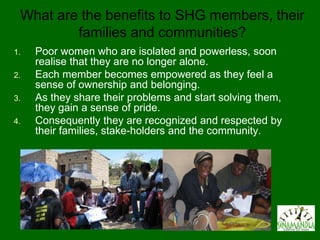
What are the benefits to SHG members, their
         families and communities?
1.   Poor women who are isolated and powerless, soon
     realise that they are no longer alone.
2.   Each member becomes empowered as they feel a
     sense of ownership and belonging.
3.   As they share their problems and start solving them,
     they gain a sense of pride.
4.   Consequently they are recognized and respected by
     their families, stake-holders and the community.
Mobilising around GBV & HIV/AIDS
Women facilitated into SHGs gain recognition and are respected
by their families, stake-holders and the community as they:

-    share their problems and start solving them,
-    they put own efforts in campaigns that uplift community life.
-    begin initiatives /projects that address social concerns


Sinamandla partners assist in the building of capacity (GBV
&HIV/AIDS) that strengthens the efforts of women in SHGs in
their response to HIV/AIDS in the community and enables
gender-based violence to be addressed more directly.
Lessons learnt
● Savings and loan in SHGs enables household
  level economic needs to be met and quality of life
  is being further enhanced as a result of IGAs

● Women report a greater sense of well-being and
  reduction of stress as a result of social support
  shared in the group.

● At a community level, the SHGs are increasing
  commercial availability of resources and by
  working together.
Lessons learnt
   Members are creating structures to address
    problems that are most pressing at a community
    level.

   The positive socioeconomic impacts of social
    grant receipt are significantly magnified through
    participation in SHGs.
Challenges/Opportunities
 At SHG level – the performance and
  retention of stipendiary CFs
  Better remuneration to retain CFs
  Better care, support & capacity building
 Limited ownership and support by the
  organisational leadership in some cases.
  SHG vision leading to integration with other
  internal programs
  Learning exposure between partners
  Reinforce understanding of concept
Challenges/opportunities
   Need to identify broader product range,
    retail outlets and marketing possibilities for
    SHG members
    Work with SHG members, partners and
    experts to assist SHGs to develop a
    market-oriented approach to income
    generation thereby enabling an accurate
    market analysis before embarking on the
    production of saleable items.
Challenges/Solutions
   Funding – finding donors who see long term
    partnerships
    Promotion of SHG concept in SA context
    Engagement with government – help them
    understand that SHG is not a quick fix
    Potential replication of programme
Challenges/Solutions
   Role of culture and a patriarchal system
    Engagement of men in dialogue
    Better understanding of culture and tradition
There is no "I" in TEAM - Simandla

There is no "I" in TEAM - Simandla

  • 1.
    VOICES: Oxfam learningevent “There is no I in TEAM” Community groups are becoming increasingly involved in how, what and when change happens at a local level. Supporting community groups to articulate their own needs and desires and giving them the confidence to influence decisions that affect their own lives is an important influencing strategy: collective action is much more powerful than individual action. Managing the dynamics in these groups and keeping the group together and focused on the issue can be challenging however. In this session partners will share their community mobilisation strategies, the processes and methods they have developed to work with groups and the successes and challenges they have had to overcome to create and sustain change at a local level.
  • 2.
    Planned Outcomes ofthe session • Partners share and learn some of the successful ways in which community groups have been involved in change in their communities. • Partners identify dynamics and issues that need to be addressed in community groups and some strategies that can be used to address them.
  • 3.
    The Self-Help Group(SHG) approach Promoted by
  • 4.
    Vision: Socially andeconomically empowered women within households made vulnerable by poverty, the impact of HIV and AIDS, gender inequalities and other societal injustices. Mission: Sinamandla assists, capacitates and supports local South African non-profit and community-based organisations to promote self- reliance in the communities they serve. See www.sinamandla.org.za
  • 5.
    Mobilising women forchange - The SHG approach focuses on the poorest and most vulnerable sections of the community, organising women into strong affinity groups (called SHGs) so that they are no longer voiceless and powerless individuals. - Second, it helps women realize their potential as individuals through initiating a savings and loan system whereby the members in the group save from their own meager resources and administer their own fund. -Third, it improves capacity and builds competence through a series of training modules provided by a local implementing organisation that can support the processes which increase self-confidence, develop self-reliance, and help SHG members to set their own agenda.
  • 6.
    Mobilising women forchange -The final component is building the model through clustering six to ten SHGs into a Cluster Level Association (CLA) to work on the things that cannot be done by SHGs themselves effectively, such as linkages and coordinating larger community projects. - Eventually eight or more CLAs can be clustered together into a formalized network called a Federation (operating at district level).
  • 7.
    A Self-help Group(SHG) is usually made up of 15-20 members from among women identified as the poorest in the community. SHG members have a common objective of working together for their economic and social development and also for their overall village development ● Each SHG meets weekly, has group leadership on rotational basis, has a book-writer to keep records and develops own rules and regulations. ● SHG members take small loans form their group’s savings for urgent consumption needs , developmental needs of their children and for micro business. ● Interest is charged and is added to the group income.
  • 8.
    A Cluster LevelAssociation (CLA) is usually made up of 6-10 SHGs from a specific geographic area. Each SHG elects 2-3 representatives to the CLA. A CLA is not a superior body to the SHG but rather a representative body that carries out specific tasks on behalf of its SHGs. ● CLAs takes up the social, economic and political issues that are beyond the scope of the individual SHGs and it works on building a People’s institution towards empowerment . ● CLAs have own objectives and activities that are different to SHGs. ● Each CLA implements its activities and projects through sub-committees.
  • 9.
    A Federation (orNetwork of CLAs) involves setting up a super-ordinate association in which each CLA is represented by 2-3 members. Forming a Federation is an important step in taking over the administration tasks from the supporting NGO partner, which now steadily withdraws from the SHG process over a period of two years. Strong SHGs and CLAs are needed before a Federation can be formed. Main tasks of the Federation are: ● advocacy and lobbying; ● fundraising and financial management of the wider system; ● concentration on the problems and issues which are important for the whole geographic area that it covers.
  • 10.
    SINAMANDLA PARTNERS Specific data on Sinamandla partners In Sinamandla and their SHGs in 2012 partners Number of functional SHGs/CLAs 400/30 Number of SHG members 6 100 Total Amount of Savings of all SHGs R1,600,000 Total Amount of Loans of all SHGs R4,200,000 Total number of loans given by all SHGS 30 000 Household members of all SHG members 35 000 Number of initiated SHG projects 600+
  • 11.
    Success in theSHG approach  Sufficient food – no one goes hungry  Meeting school expenses – uniform, transport, stationary  Home building/renovations  Breaking loan shark interest cycle  Saving (in various ways)  Investing in income-generating activities  Using SHG small loans effectively
  • 12.
    More success…  Majorsocial and psychological benefits  Improved community relations and social cohesion  Greater civic activities – assisting others and mobilising around human rights  Improved health – as a consequence of access to services and in health education  Improved women’s status at home and in the community
  • 13.
    What are thebenefits to SHG members, their families and communities? 1. Poor women who are isolated and powerless, soon realise that they are no longer alone. 2. Each member becomes empowered as they feel a sense of ownership and belonging. 3. As they share their problems and start solving them, they gain a sense of pride. 4. Consequently they are recognized and respected by their families, stake-holders and the community.
  • 14.
    Mobilising around GBV& HIV/AIDS Women facilitated into SHGs gain recognition and are respected by their families, stake-holders and the community as they: - share their problems and start solving them, - they put own efforts in campaigns that uplift community life. - begin initiatives /projects that address social concerns Sinamandla partners assist in the building of capacity (GBV &HIV/AIDS) that strengthens the efforts of women in SHGs in their response to HIV/AIDS in the community and enables gender-based violence to be addressed more directly.
  • 15.
    Lessons learnt ● Savingsand loan in SHGs enables household level economic needs to be met and quality of life is being further enhanced as a result of IGAs ● Women report a greater sense of well-being and reduction of stress as a result of social support shared in the group. ● At a community level, the SHGs are increasing commercial availability of resources and by working together.
  • 16.
    Lessons learnt  Members are creating structures to address problems that are most pressing at a community level.  The positive socioeconomic impacts of social grant receipt are significantly magnified through participation in SHGs.
  • 17.
    Challenges/Opportunities  At SHGlevel – the performance and retention of stipendiary CFs Better remuneration to retain CFs Better care, support & capacity building  Limited ownership and support by the organisational leadership in some cases. SHG vision leading to integration with other internal programs Learning exposure between partners Reinforce understanding of concept
  • 18.
    Challenges/opportunities  Need to identify broader product range, retail outlets and marketing possibilities for SHG members Work with SHG members, partners and experts to assist SHGs to develop a market-oriented approach to income generation thereby enabling an accurate market analysis before embarking on the production of saleable items.
  • 19.
    Challenges/Solutions  Funding – finding donors who see long term partnerships Promotion of SHG concept in SA context Engagement with government – help them understand that SHG is not a quick fix Potential replication of programme
  • 20.
    Challenges/Solutions  Role of culture and a patriarchal system Engagement of men in dialogue Better understanding of culture and tradition