© 2014 SAGE Publications, Inc.
Chapter 2: Overview of theChapter 2: Overview of the
Nonprofit SectorNonprofit Sector
© 2014 SAGE Publications, Inc.
Historical OverviewHistorical Overview
Deep roots in American history and culture
•Greco-Roman culture emphasis on
• Community
• Citizenry
• Social responsibility
•Judeo-Christian culture of helping others
© 2014 SAGE Publications, Inc.
The Industrial RevolutionThe Industrial Revolution
The rise of great wealth resulting from the
Industrial Revolution led to the modern era
• John D. Rockefeller
• Andrew Carnegie’s Gospel of Wealth (1889)
© 2014 SAGE Publications, Inc.
Charity versus PhilanthropyCharity versus Philanthropy
Charity
Giving intended to meet
current individual human
needs or to alleviate
current human suffering
that is often emotionally
driven and impulsive
•Feed the homeless
•Aid victims of a natural
disaster
Philanthropy
Giving designed as a long-
term investment in the
infrastructure of society
•Construction of hospitals
•Endowments for universities
•Charitable foundations
intended to exist in
perpetuity
© 2014 SAGE Publications, Inc.
Searching for a CommonSearching for a Common
VocabularyVocabulary
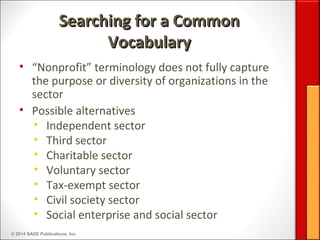
• “Nonprofit” terminology does not fully capture
the purpose or diversity of organizations in the
sector
• Possible alternatives
• Independent sector
• Third sector
• Charitable sector
• Voluntary sector
• Tax-exempt sector
• Civil society sector
• Social enterprise and social sector
© 2014 SAGE Publications, Inc.
Size of the Nonprofit Sector in theSize of the Nonprofit Sector in the
U.S.U.S.
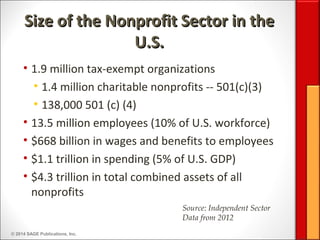
• 1.9 million tax-exempt organizations
• 1.4 million charitable nonprofits -- 501(c)(3)
• 138,000 501 (c) (4)
• 13.5 million employees (10% of U.S. workforce)
• $668 billion in wages and benefits to employees
• $1.1 trillion in spending (5% of U.S. GDP)
• $4.3 trillion in total combined assets of all
nonprofits
Source: Independent Sector
Data from 2012
© 2014 SAGE Publications, Inc.
Strategies for CategorizingStrategies for Categorizing
NonprofitsNonprofits
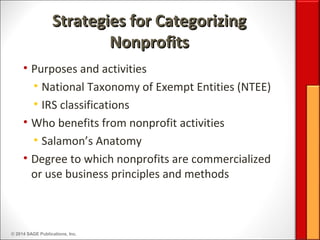
• Purposes and activities
• National Taxonomy of Exempt Entities (NTEE)
• IRS classifications
• Who benefits from nonprofit activities
• Salamon’s Anatomy
• Degree to which nonprofits are commercialized
or use business principles and methods
© 2014 SAGE Publications, Inc.
IRS Classifications: Social WelfareIRS Classifications: Social Welfare
OrganizationsOrganizations
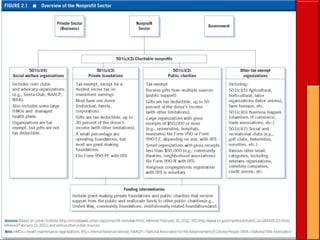
• IRS tax code – 501(c)(4)
• Vast majority are advocacy organizations:
organizations "to further the common good and
general welfare of the people of a community“
• Small number are HMOs and other medical and
dental insurance plans
• Key differences between 501(c)(3) and 501(c)(4)
status
• Both groups are tax-exempt, but gifts made to
501(c)(4) organizations are not tax deductible
• 501(c)(4) organizations do not face the same
limitations on political activity as 501(c)(3)
organizations
© 2014 SAGE Publications, Inc.
IRS Classifications: CharitableIRS Classifications: Charitable
NonprofitsNonprofits
• IRS tax code -- 501(c)(3)
• Requirements for receiving 501(c)(3) status
• Organization’s mission and work must fall under
at least one of eight categories defined by the IRS
• Organization must meet the non-distribution test
• Individual owners are not receiving benefits
from the organization’s assets
• Managers are not being personally enriched
through excessive compensation
• Organization must limit its political activities
• Cannot support or oppose candidates for public
office
• Limits on expenditures on lobbying
© 2014 SAGE Publications, Inc.
IRS Classifications: CharitableIRS Classifications: Charitable
SubsectorsSubsectors
• Religious congregations
• Arts, culture, and humanities
• Education
• Environment and animals
• Health
• Human service
• International and foreign affairs
• Funding intermediaries
© 2014 SAGE Publications, Inc.
IRS Classifications: Public CharitiesIRS Classifications: Public Charities
and Private Foundationsand Private Foundations
• Both are 501(c)(3) organizations
• Definitions
• Public charities -- organizations that receive
most of their support from a relatively diverse
set of donors or from government
• Private foundations -- organizations with that
receive most of their support from a single
donor or a small group of donors
• Differences in treatment
• Taxes
• Limits on lobbying
© 2014 SAGE Publications, Inc.
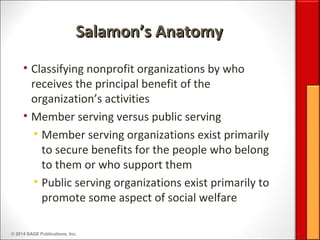
Salamon’s AnatomySalamon’s Anatomy
• Classifying nonprofit organizations by who
receives the principal benefit of the
organization’s activities
• Member serving versus public serving
• Member serving organizations exist primarily
to secure benefits for the people who belong
to them or who support them
• Public serving organizations exist primarily to
promote some aspect of social welfare
© 2014 SAGE Publications, Inc.
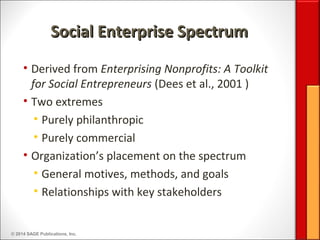
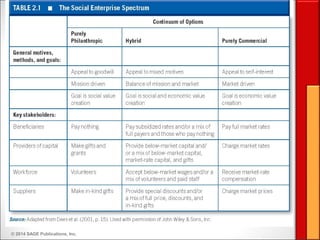
Social Enterprise SpectrumSocial Enterprise Spectrum
• Derived from Enterprising Nonprofits: A Toolkit
for Social Entrepreneurs (Dees et al., 2001 )
• Two extremes
• Purely philanthropic
• Purely commercial
• Organization’s placement on the spectrum
• General motives, methods, and goals
• Relationships with key stakeholders
© 2014 SAGE Publications, Inc.
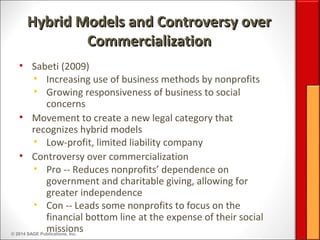
Hybrid Models and Controversy overHybrid Models and Controversy over
CommercializationCommercialization
• Sabeti (2009)
• Increasing use of business methods by nonprofits
• Growing responsiveness of business to social
concerns
• Movement to create a new legal category that
recognizes hybrid models
• Low-profit, limited liability company
• Controversy over commercialization
• Pro -- Reduces nonprofits’ dependence on
government and charitable giving, allowing for
greater independence
• Con -- Leads some nonprofits to focus on the
financial bottom line at the expense of their social
missions
© 2014 SAGE Publications, Inc.
Commercialization and Tax IssuesCommercialization and Tax Issues
• Common misunderstandings -- nonprofit
organizations cannot earn profits and are always
exempt from taxation
• Nonprofits are exempt from taxation on
revenues related to activities that directly
address their social missions
• Revenues from activities that are not related to
the mission are subject to the unrelated business
income tax (UBIT)
• Concern about engaging in unrelated business
activities
• Substantial reliance would put the organization’s
tax exempt status in jeopardy
© 2014 SAGE Publications, Inc.
Implications for NonprofitImplications for Nonprofit
ManagersManagers
• Nonprofit management as a balancing act
• Organization’s mission against financial
sustainability
• Nonprofit sector’s unique traditions against
rapid changes in competitive markets
• Social and political forces against core values
and independence
• Nonprofit management requires a unique blend
of skills, distinguishing it from management in
government or the for-profit sector

Overview Of The Nonprofit Sector

  • 1.
    © 2014 SAGEPublications, Inc. Chapter 2: Overview of theChapter 2: Overview of the Nonprofit SectorNonprofit Sector
  • 2.
    © 2014 SAGEPublications, Inc. Historical OverviewHistorical Overview Deep roots in American history and culture •Greco-Roman culture emphasis on • Community • Citizenry • Social responsibility •Judeo-Christian culture of helping others
  • 3.
    © 2014 SAGEPublications, Inc. The Industrial RevolutionThe Industrial Revolution The rise of great wealth resulting from the Industrial Revolution led to the modern era • John D. Rockefeller • Andrew Carnegie’s Gospel of Wealth (1889)
  • 4.
    © 2014 SAGEPublications, Inc. Charity versus PhilanthropyCharity versus Philanthropy Charity Giving intended to meet current individual human needs or to alleviate current human suffering that is often emotionally driven and impulsive •Feed the homeless •Aid victims of a natural disaster Philanthropy Giving designed as a long- term investment in the infrastructure of society •Construction of hospitals •Endowments for universities •Charitable foundations intended to exist in perpetuity
  • 5.
    © 2014 SAGEPublications, Inc. Searching for a CommonSearching for a Common VocabularyVocabulary • “Nonprofit” terminology does not fully capture the purpose or diversity of organizations in the sector • Possible alternatives • Independent sector • Third sector • Charitable sector • Voluntary sector • Tax-exempt sector • Civil society sector • Social enterprise and social sector
  • 6.
    © 2014 SAGEPublications, Inc. Size of the Nonprofit Sector in theSize of the Nonprofit Sector in the U.S.U.S. • 1.9 million tax-exempt organizations • 1.4 million charitable nonprofits -- 501(c)(3) • 138,000 501 (c) (4) • 13.5 million employees (10% of U.S. workforce) • $668 billion in wages and benefits to employees • $1.1 trillion in spending (5% of U.S. GDP) • $4.3 trillion in total combined assets of all nonprofits Source: Independent Sector Data from 2012
  • 7.
    © 2014 SAGEPublications, Inc. Strategies for CategorizingStrategies for Categorizing NonprofitsNonprofits • Purposes and activities • National Taxonomy of Exempt Entities (NTEE) • IRS classifications • Who benefits from nonprofit activities • Salamon’s Anatomy • Degree to which nonprofits are commercialized or use business principles and methods
  • 8.
    © 2014 SAGEPublications, Inc.
  • 9.
    © 2014 SAGEPublications, Inc. IRS Classifications: Social WelfareIRS Classifications: Social Welfare OrganizationsOrganizations • IRS tax code – 501(c)(4) • Vast majority are advocacy organizations: organizations "to further the common good and general welfare of the people of a community“ • Small number are HMOs and other medical and dental insurance plans • Key differences between 501(c)(3) and 501(c)(4) status • Both groups are tax-exempt, but gifts made to 501(c)(4) organizations are not tax deductible • 501(c)(4) organizations do not face the same limitations on political activity as 501(c)(3) organizations
  • 10.
    © 2014 SAGEPublications, Inc. IRS Classifications: CharitableIRS Classifications: Charitable NonprofitsNonprofits • IRS tax code -- 501(c)(3) • Requirements for receiving 501(c)(3) status • Organization’s mission and work must fall under at least one of eight categories defined by the IRS • Organization must meet the non-distribution test • Individual owners are not receiving benefits from the organization’s assets • Managers are not being personally enriched through excessive compensation • Organization must limit its political activities • Cannot support or oppose candidates for public office • Limits on expenditures on lobbying
  • 11.
    © 2014 SAGEPublications, Inc. IRS Classifications: CharitableIRS Classifications: Charitable SubsectorsSubsectors • Religious congregations • Arts, culture, and humanities • Education • Environment and animals • Health • Human service • International and foreign affairs • Funding intermediaries
  • 12.
    © 2014 SAGEPublications, Inc. IRS Classifications: Public CharitiesIRS Classifications: Public Charities and Private Foundationsand Private Foundations • Both are 501(c)(3) organizations • Definitions • Public charities -- organizations that receive most of their support from a relatively diverse set of donors or from government • Private foundations -- organizations with that receive most of their support from a single donor or a small group of donors • Differences in treatment • Taxes • Limits on lobbying
  • 13.
    © 2014 SAGEPublications, Inc. Salamon’s AnatomySalamon’s Anatomy • Classifying nonprofit organizations by who receives the principal benefit of the organization’s activities • Member serving versus public serving • Member serving organizations exist primarily to secure benefits for the people who belong to them or who support them • Public serving organizations exist primarily to promote some aspect of social welfare
  • 14.
    © 2014 SAGEPublications, Inc. Social Enterprise SpectrumSocial Enterprise Spectrum • Derived from Enterprising Nonprofits: A Toolkit for Social Entrepreneurs (Dees et al., 2001 ) • Two extremes • Purely philanthropic • Purely commercial • Organization’s placement on the spectrum • General motives, methods, and goals • Relationships with key stakeholders
  • 15.
    © 2014 SAGEPublications, Inc.
  • 16.
    © 2014 SAGEPublications, Inc. Hybrid Models and Controversy overHybrid Models and Controversy over CommercializationCommercialization • Sabeti (2009) • Increasing use of business methods by nonprofits • Growing responsiveness of business to social concerns • Movement to create a new legal category that recognizes hybrid models • Low-profit, limited liability company • Controversy over commercialization • Pro -- Reduces nonprofits’ dependence on government and charitable giving, allowing for greater independence • Con -- Leads some nonprofits to focus on the financial bottom line at the expense of their social missions
  • 17.
    © 2014 SAGEPublications, Inc. Commercialization and Tax IssuesCommercialization and Tax Issues • Common misunderstandings -- nonprofit organizations cannot earn profits and are always exempt from taxation • Nonprofits are exempt from taxation on revenues related to activities that directly address their social missions • Revenues from activities that are not related to the mission are subject to the unrelated business income tax (UBIT) • Concern about engaging in unrelated business activities • Substantial reliance would put the organization’s tax exempt status in jeopardy
  • 18.
    © 2014 SAGEPublications, Inc. Implications for NonprofitImplications for Nonprofit ManagersManagers • Nonprofit management as a balancing act • Organization’s mission against financial sustainability • Nonprofit sector’s unique traditions against rapid changes in competitive markets • Social and political forces against core values and independence • Nonprofit management requires a unique blend of skills, distinguishing it from management in government or the for-profit sector