Downloaded 20 times


![Trauma Informed Care Training
36
Hopper, E. K., Bassuk, E. L., & Olivet, J.(2010). Shelter from the Storm: Trauma-Informed Care in
Homelessness Services Settings. The Open Health Services and Policy Journal, 3(2), 80-100.
National Child Traumatic Stress Network. (2014). Complex trauma: Facts for caregivers. Los
Angeles, CA, & Durham, NC: National Center for Child Traumatic Stress.
O’Connor, Cailin. (2019, March 20). “Are the words “toxic stress” toxic?” [Webinar]. Digital
Dialogue - Child Abuse and Neglect Technical Assistance and Strategic Dissemination Center.
Retrieved from http://cantasd.org/explore-topics/trauma-and-resilience/are-the-words-toxic-
stress-toxic/
Populations at Risk. (2018, May 25). The National Child Traumatic Stress Network.Retrieved 2018
from www.nctsn.org/what-is-child-trauma/populations-at-risk
Psychiatry Online | DSM Library. (n.d.). Retrieved 2018 from www.dsm.psychiatryonline.org/
Reunited Films: Chad's Story. (2018). Retrieved 2018 from www.changingmindsnow.org/stories
Substance Abuse and Mental Health Services Administration. Trauma-Informed Care in Behavioral
Health Services. Treatment Improvement Protocol (TIP) Series 57. HHS Publication No. (SMA)
13-4801. Rockville, MD: Substance Abuse and Mental Health Services Administration, 2014.
Trauma and Violence | SAMHSA - Substance Abuse and Mental Health Services
Administration. (2019, January 14). Retrieved from www.samhsa.gov/trauma-violence
Trauma Types. (2018, May 25). The National Child Traumatic Stress Network.Retrieved 2018 from
www.nctsn.org/what-is-child-trauma/trauma-types
Traumatic Experiences Widespread Among U.S. Youth, New Data Show. (2018, May 31). Robert
Wood Johnson Foundation. Retrieved from www.rwjf.org/en/library/articles-and-
news/2017/10/traumatic-experiences-widespread-among-u-s--youth--new-data-show.html](https://image.slidesharecdn.com/traumainformedcaretraining-210521062145/85/Trauma-informed-care-36-320.jpg)

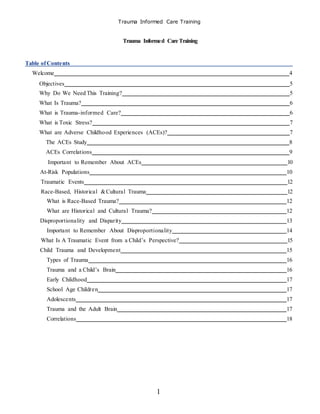
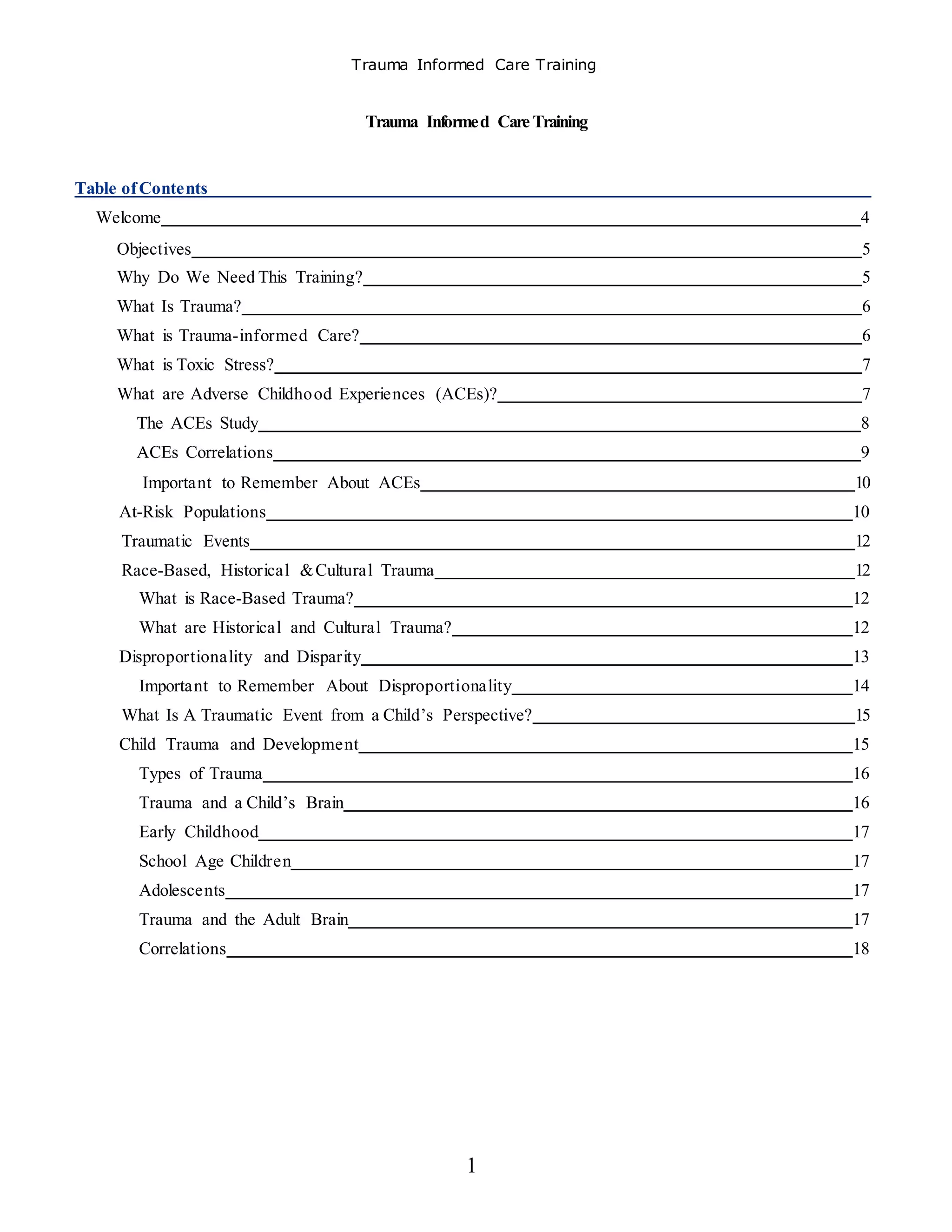
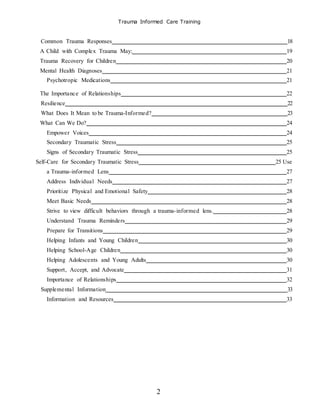
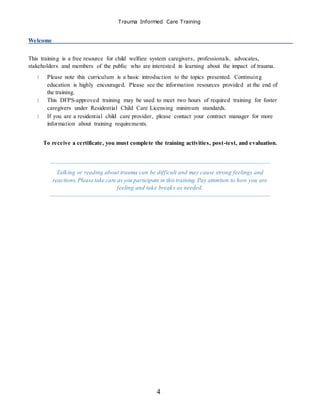
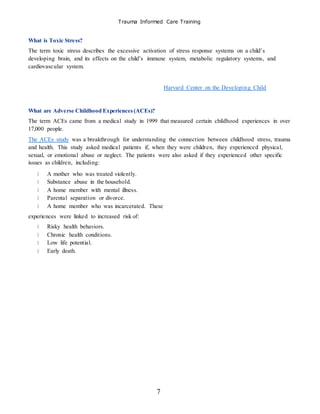
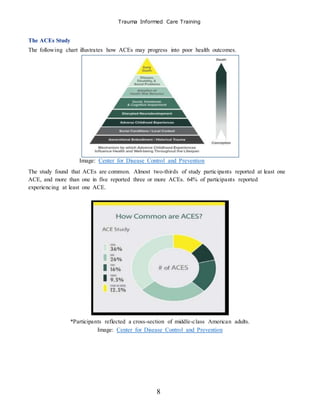
This document provides an overview of trauma-informed care training. It defines trauma and discusses how adverse childhood experiences (ACEs) like abuse, neglect, and household dysfunction can negatively impact health and development. The ACEs study found strong correlations between early life stressors and poor physical, mental, and social outcomes later in life. Trauma can alter brain development, especially in children and teens. Becoming trauma-informed requires understanding how trauma affects individuals and systems in order to minimize further harm and support recovery. The training discusses trauma responses, resilience factors, and practical strategies for applying trauma-informed approaches.


