WORK PERMIT SYSTEM
The use of certificates is only an additional factor in ensuring safe conditions & in no way
detracts from the importance of rendering working place safe. The permit to work is essential
in order to achieve the fullest possible co-ordination between operating and maintenances
departments. The aims of these certificates is to ensure that statutory requirements are met
& safe working conditions prevail
WHY PERMIT- TO- WORK CERTIFICATE:
A certificate of safety will be necessary for the following work
•Circumstances where there is a legal requirement for a certificate
1. Entry into vessel, confined space, chamber, tank, vat, pit, pipe flue. – Section 36
2. Access to fragile roofs – Rule 73F
3. Hot work in certain areas. – Rule 73C
•Situation in which hazardous conditions could arise but for which no legal requirement
demands certification e.g. work on equipments/ pipelines carrying chemicals, fore permits
in certain areas.
•Work involving removal of equipment from a plant
4. Circumstances involving work of general but hazardous nature where it is essential that
he operators concerned understand the risk and are Required to take certain precaution e.g.
work on roofs, demolition, erection, excavation, work at dangerous heights, jobs directly
connected with plants such as painting structures, equipments pipelines, wall etc. floor /
drain repairs in process/ storages.
Plant siting and layout
PLANT SITING
Safety is a prime consideration in plant siting . Other important factors include access to raw material
and to markets; availability of land, labour and cooling water; means of effluent disposal ; interlinking
with other plants ; and government policies , including planning permission and investment incentives.
Only safety aspects are considered here, however.
As far as safety of the public is concerned, the most important feature of siting is the distance between
the site and built up areas. Sites may be classed as (1) Rural and (2) Urban, with intermediate area of (a)
low population density and (b) medium or high population density.
In general , distance always tends to reduce casualties ,the value of distance in this respect depends on
the nature of hazard . If the hazard is an explosion, then the effect of distance is to reduce the intensity of
the blast wave. The principle danger to life from a blast wave is lung hemorrhage and bodily translation,
building collapse and flying glass and other projectiles. Explosion overpressure falls off rapidly with
distance, but the effects are immediate and allow no time for evacuation.
If the hazard is a toxic release, then the effect of distance is to reduce the concentration of the gas cloud.
Distance is also of value in that it buys time. The toxic vapour may eventually have effect at a much
greater distance than the blast wave, but there is a time lag before these effects occurs. This time may be
utilize to carry out evacuation or other measures. In this case, therefore, the extent to which distance
reduces casualties depends partly on effectiveness of the emergency planning.
An area of low population density around the works does contribute to minimizing the casualties to the
public. In the ideal case the works is surrounded by fields or waste land forming a complete cordon
sanitaire.
PLANT LAYOUT
Plant layout is a crucial factor in the economics and safety of process plant.
Some of the ways in which plant layout affects safety and loss prevention are
1. Minimization of vulnerable pipe work;
2. Segregation of different risks;
3. Efficient and safe construction ;
4. Facilitation of process operation
5. Efficient and safe operation
6. Minimization of personal injuries
7. Safe control room design
8. Emergency control facilities
9. Fire fighting facilities
10. Access for emergency services
11. Security
Plant layout can have a large impact on plant economics. Addition space tends to
increase safety, but is expensive in land and in also in additional pipe work and
operating costs. It is important, therefore, to provide space where it is needed for
safety but not to waste it.
The topics considered under the heading of plant layout are traditionally
rather wide-ranging.. This applies in particular to such topics as emission of
flammables, fires, fire prevention and protection, and fire fighting; storage tanks
and ancillaries; and emergency arrangements.
It is appropriate to repeat here his caution that the practice described
should be regarded only as typical and that it may need to be modified in the light
of local conditions, legislation and established safe practices. In particular, the
approach taken generally assumes a ‘green field ‘site and some compromise is
normally necessary for an existing site.
Design:
To ensure that the designs are strong enough to withstand the rigours of service
conditions the designer needs to know:
- The expected loading history in service.
- The expected environmental conditions.
This is to be given a prime importance while carrying the following activities (2):
-Selection of site
-Site plan / lay-out plan
-Piping & instrumentation/equipment diagrams
Selection of site :
While selecting a site the following factors are considered:
-Space requirement
-Necessary facilities (water, electicity, transportation, labour supply etc.)
-Climatic conditions
-Possible hazards to community
The unit requirements should not be adjusted as per the availability of space
or the network of piping, equipment should not be so located that feeling of
confined space occurs when one enters a plant.
Such crowding and the resulting congestion of buildings and other facilities
lead to increased hazards. The size of the site is determined by both present
space requirements and possible future expansion. Plans should include all
necessary safety precautions such as:-
-Minimum distances between Manufacturing and Storage facilities
-Minimum distances from adjoining property
-Well located waste disposal areas
-Drainage system and
-Outside facilities, such as fence, entrances, bridges, receiving facilities,
roadways & walkways, trestles, parking lots, lighting, ventilation etc.
Climatic condition
Climatic condition of the area is one of the important factors, prevailing
wind may determine the best location of process unit and administrative
building. With prevailing wind, its velocity is also considered. While
selecting a site, civil engineering should take care of such forces. Codes
indicate the thickness & height of walls which will withstand specific wind
loads while unsupported. Wind velocities can be withstood by concrete
block walls of varying height. Plans and specifications should include
suitable protective measures for personnel considering the eventualities
like a hurricane, tornado, earthquake or flood area, and safety factors
must be designed accordingly into the operation.
Possible hazards to community
The plant, component or a structure proposed for construction, should
not pose hazards to community when it comes in service. So in design
stage itself due consideration should be given on following aspects;
-In-built safety in the system
-Adequate safety measures
-Pollution monitoring system
-Risk assessment
UNIT OPERATIONS
Crystallisation
Distillation.
Drying.
Evaporation.
Extraction.
Centrifugation.
Scrubbing.
Filtration.
Heat Exchange.
Mixing.
Halogenation.
Hydrogenation.
Hydrolysis.
Nitration.
Oxidation.
Polymerisation.
Reducton
Sulphonation .
CRYSTALLISATION
Safety Aspects :
The main point to be taken care of is the over spilling of solution. This may
result in accumulation of solids on external surfaces, surrounding areas,
adjacent machinery with hazards depending on the specific properties.
In laboratory, ethers and alcohols are frequently used as solvents for
crystallisation and purification of products. Due care has to be taken while
handling these inflammable solvents.
DISTILLATION
Generation of vapour is inherent in any distillation operation and hence when a
flammable liquid is involved, the operation becomes hazardous. Here the strategy
adopted is to minimize the inventory held up in the column and ancillaries by in
a train of distillation columns, elimination of feed preheater by operating of the
upstream column with partial condenser.
Consideration should also be given to any hazards associated with the accumulation
of the residues in the still for a batch distillation, or on the heat transfer surfaces (e.g.
in preheater or reboiler) for a continuous distillation. In a batch operation, near the
end of the distillation, the temperature in the still rises and the concentration of an
unstable impurities also increase. This factor has been responsible for many
explosions.
On the other hand, a large amount of heat is given up at the condenser. If cooling in
the condenser is lost, the column may suffer over pressure. It is, therefore necessary
to provide relief system in such circumstances.
NITRATION
The nitration mixtures are very sensitive and liable to explode. The heat generation,
during the reaction, poses a problem. Very efficient temperature control is, therefore
absolutely essential.
There have been a number of expulsions in nitration reactions, which have taken place
due to the fact that the temperature of the reaction was too close at which a runaway
reaction could start.
Another hazard in nitration is the ingress of water, which can result in large heat
release which causes an explosion either directly or by initiating some other effect.
CHLORINATION
The chlorination reaction is normally highly exothermic reactions.
The hydrocarbons, which are used as raw materials, are flammable. Chlorine itself is a
very toxic gas.
Many chlorination reactions can proceed at a rate leading to fire or explosion, unless
they are carefully controlled.
SULPHONATION
Sulphonation reactions are also exothermic. Depending upon the product which is
being sulphoneated, there is a critical temperature of sulphonation, above which the
reaction can become a runaway reaction. These reactions proceed at elevated
temperatures and hence though its control is essential, very low temperature (as
encountered in nitrations) are not required.
Hazards associated with highly corrosive sulphonating agents; avoiding ingress of
water; through mixing of the reactor contents to avoid local concentration of the
sulphonating agents (which may result into oxidation) are some of the other points to
be taken care of.
HYDROGENATION
The main hazard involved in the hydrogenation process is the use of hydrogen under
pressures, due to following reasons :-
(1)Extremely low temperature in liquid state (i.e. under pressure)
(2)Very large liquid to gas expansion (1:850 at 30 deg.C)
(3)Wide range to flammability limits, after its vaporization (4% to 76%, by volume, in air).
(4)Poor visibility of its flame, that can injure anyone instantly.
(5) The greatest danger involved in the storage and use of hydrogen is the ease with
which it ignites and explodes. If a mixture of hydrogen and even small quantity of
oxygen (or air) is exposed to heat or flame, it becomes vary dangerous. Energy of
friction or vibration is adequate to ignite it. On ignition, the mixture releases large
amount of energy in the form of heat or explosive force.
MATERIAL SAFETY DATA SHEET ( M.S.D.S.)
STATUTORY PROVISIONS
Sec. 41 B (7) of THE FACTORIES ACT, 1948
The occupier of a factory involving hazardous process shall, with the previous approval of the
chief Inspector, lay down measures for handling, usage, transportation and storage of
hazardous substances inside the factory premises and the disposal of such substances
outside the factory premises and publicize them in the manner prescribed among the workers
and general public living in the vicinity.
Rule 73-M of THE MAHARASHTRA FACTORIES RULES 1963.
The occupier of every Factory carrying on a :hazardous process” shall arrange to obtain or
develop information on the form of Material Safety Data Sheet in respect of every hazardous
substance or material handled in the manufacture, transportation and storage in the factory. It
shall be accessible upon request to a worker for reference.
Every such Material Safety Data Sheet shall include the information in the form in the
schedule to this rule.
THE MANUFACTURE, STORAGE & IMPORT OF HAZARDOUS CHEMICALS
(AMENDMENT) RULES 2000.
Rule 17 (2) – An Occupier, who has control of an Industrial Activity, shall arrange to obtain or
develop information in the form of MATERIAL SAFETY DATA SHEET as specified in Schedule
9.
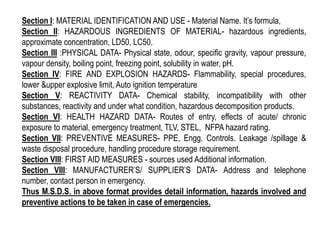
Section I: MATERIAL IDENTIFICATION AND USE - Material Name. It’s formula,
Section II: HAZARDOUS INGREDIENTS OF MATERIAL- hazardous ingredients,
approximate concentration, LD50, LC50.
Section III :PHYSICAL DATA- Physical state, odour, specific gravity, vapour pressure,
vapour density, boiling point, freezing point, solubility in water, pH.
Section IV: FIRE AND EXPLOSION HAZARDS- Flammability, special procedures,
lower &upper explosive limit, Auto ignition temperature
Section V: REACTIVITY DATA- Chemical stability, incompatibility with other
substances, reactivity and under what condition, hazardous decomposition products.
Section VI: HEALTH HAZARD DATA- Routes of entry, effects of acute/ chronic
exposure to material, emergency treatment, TLV, STEL, NFPA hazard rating.
Section VII: PREVENTIVE MEASURES- PPE, Engg. Controls. Leakage /spillage &
waste disposal procedure, handling procedure storage requirement.
Section VIII: FIRST AID MEASURES - sources used Additional information.
Section VIII: MANUFACTURER’S/ SUPPLIER’S DATA- Address and telephone
number, contact person in emergency.
Thus M.S.D.S. in above format provides detail information, hazards involved and
preventive actions to be taken in case of emergencies.
sci.pptx

sci.pptx

  • 1.
  • 2.
    The use ofcertificates is only an additional factor in ensuring safe conditions & in no way detracts from the importance of rendering working place safe. The permit to work is essential in order to achieve the fullest possible co-ordination between operating and maintenances departments. The aims of these certificates is to ensure that statutory requirements are met & safe working conditions prevail WHY PERMIT- TO- WORK CERTIFICATE: A certificate of safety will be necessary for the following work •Circumstances where there is a legal requirement for a certificate 1. Entry into vessel, confined space, chamber, tank, vat, pit, pipe flue. – Section 36 2. Access to fragile roofs – Rule 73F 3. Hot work in certain areas. – Rule 73C •Situation in which hazardous conditions could arise but for which no legal requirement demands certification e.g. work on equipments/ pipelines carrying chemicals, fore permits in certain areas. •Work involving removal of equipment from a plant 4. Circumstances involving work of general but hazardous nature where it is essential that he operators concerned understand the risk and are Required to take certain precaution e.g. work on roofs, demolition, erection, excavation, work at dangerous heights, jobs directly connected with plants such as painting structures, equipments pipelines, wall etc. floor / drain repairs in process/ storages.
  • 3.
  • 4.
    PLANT SITING Safety isa prime consideration in plant siting . Other important factors include access to raw material and to markets; availability of land, labour and cooling water; means of effluent disposal ; interlinking with other plants ; and government policies , including planning permission and investment incentives. Only safety aspects are considered here, however. As far as safety of the public is concerned, the most important feature of siting is the distance between the site and built up areas. Sites may be classed as (1) Rural and (2) Urban, with intermediate area of (a) low population density and (b) medium or high population density. In general , distance always tends to reduce casualties ,the value of distance in this respect depends on the nature of hazard . If the hazard is an explosion, then the effect of distance is to reduce the intensity of the blast wave. The principle danger to life from a blast wave is lung hemorrhage and bodily translation, building collapse and flying glass and other projectiles. Explosion overpressure falls off rapidly with distance, but the effects are immediate and allow no time for evacuation. If the hazard is a toxic release, then the effect of distance is to reduce the concentration of the gas cloud. Distance is also of value in that it buys time. The toxic vapour may eventually have effect at a much greater distance than the blast wave, but there is a time lag before these effects occurs. This time may be utilize to carry out evacuation or other measures. In this case, therefore, the extent to which distance reduces casualties depends partly on effectiveness of the emergency planning. An area of low population density around the works does contribute to minimizing the casualties to the public. In the ideal case the works is surrounded by fields or waste land forming a complete cordon sanitaire.
  • 5.
    PLANT LAYOUT Plant layoutis a crucial factor in the economics and safety of process plant. Some of the ways in which plant layout affects safety and loss prevention are 1. Minimization of vulnerable pipe work; 2. Segregation of different risks; 3. Efficient and safe construction ; 4. Facilitation of process operation 5. Efficient and safe operation 6. Minimization of personal injuries 7. Safe control room design 8. Emergency control facilities 9. Fire fighting facilities 10. Access for emergency services 11. Security
  • 6.
    Plant layout canhave a large impact on plant economics. Addition space tends to increase safety, but is expensive in land and in also in additional pipe work and operating costs. It is important, therefore, to provide space where it is needed for safety but not to waste it. The topics considered under the heading of plant layout are traditionally rather wide-ranging.. This applies in particular to such topics as emission of flammables, fires, fire prevention and protection, and fire fighting; storage tanks and ancillaries; and emergency arrangements. It is appropriate to repeat here his caution that the practice described should be regarded only as typical and that it may need to be modified in the light of local conditions, legislation and established safe practices. In particular, the approach taken generally assumes a ‘green field ‘site and some compromise is normally necessary for an existing site.
  • 7.
    Design: To ensure thatthe designs are strong enough to withstand the rigours of service conditions the designer needs to know: - The expected loading history in service. - The expected environmental conditions. This is to be given a prime importance while carrying the following activities (2): -Selection of site -Site plan / lay-out plan -Piping & instrumentation/equipment diagrams Selection of site : While selecting a site the following factors are considered: -Space requirement -Necessary facilities (water, electicity, transportation, labour supply etc.) -Climatic conditions -Possible hazards to community
  • 8.
    The unit requirementsshould not be adjusted as per the availability of space or the network of piping, equipment should not be so located that feeling of confined space occurs when one enters a plant. Such crowding and the resulting congestion of buildings and other facilities lead to increased hazards. The size of the site is determined by both present space requirements and possible future expansion. Plans should include all necessary safety precautions such as:- -Minimum distances between Manufacturing and Storage facilities -Minimum distances from adjoining property -Well located waste disposal areas -Drainage system and -Outside facilities, such as fence, entrances, bridges, receiving facilities, roadways & walkways, trestles, parking lots, lighting, ventilation etc.
  • 9.
    Climatic condition Climatic conditionof the area is one of the important factors, prevailing wind may determine the best location of process unit and administrative building. With prevailing wind, its velocity is also considered. While selecting a site, civil engineering should take care of such forces. Codes indicate the thickness & height of walls which will withstand specific wind loads while unsupported. Wind velocities can be withstood by concrete block walls of varying height. Plans and specifications should include suitable protective measures for personnel considering the eventualities like a hurricane, tornado, earthquake or flood area, and safety factors must be designed accordingly into the operation. Possible hazards to community The plant, component or a structure proposed for construction, should not pose hazards to community when it comes in service. So in design stage itself due consideration should be given on following aspects; -In-built safety in the system -Adequate safety measures -Pollution monitoring system -Risk assessment
  • 10.
  • 11.
  • 12.
    CRYSTALLISATION Safety Aspects : Themain point to be taken care of is the over spilling of solution. This may result in accumulation of solids on external surfaces, surrounding areas, adjacent machinery with hazards depending on the specific properties. In laboratory, ethers and alcohols are frequently used as solvents for crystallisation and purification of products. Due care has to be taken while handling these inflammable solvents. DISTILLATION Generation of vapour is inherent in any distillation operation and hence when a flammable liquid is involved, the operation becomes hazardous. Here the strategy adopted is to minimize the inventory held up in the column and ancillaries by in a train of distillation columns, elimination of feed preheater by operating of the upstream column with partial condenser.
  • 13.
    Consideration should alsobe given to any hazards associated with the accumulation of the residues in the still for a batch distillation, or on the heat transfer surfaces (e.g. in preheater or reboiler) for a continuous distillation. In a batch operation, near the end of the distillation, the temperature in the still rises and the concentration of an unstable impurities also increase. This factor has been responsible for many explosions. On the other hand, a large amount of heat is given up at the condenser. If cooling in the condenser is lost, the column may suffer over pressure. It is, therefore necessary to provide relief system in such circumstances.
  • 14.
    NITRATION The nitration mixturesare very sensitive and liable to explode. The heat generation, during the reaction, poses a problem. Very efficient temperature control is, therefore absolutely essential. There have been a number of expulsions in nitration reactions, which have taken place due to the fact that the temperature of the reaction was too close at which a runaway reaction could start. Another hazard in nitration is the ingress of water, which can result in large heat release which causes an explosion either directly or by initiating some other effect.
  • 15.
    CHLORINATION The chlorination reactionis normally highly exothermic reactions. The hydrocarbons, which are used as raw materials, are flammable. Chlorine itself is a very toxic gas. Many chlorination reactions can proceed at a rate leading to fire or explosion, unless they are carefully controlled.
  • 16.
    SULPHONATION Sulphonation reactions arealso exothermic. Depending upon the product which is being sulphoneated, there is a critical temperature of sulphonation, above which the reaction can become a runaway reaction. These reactions proceed at elevated temperatures and hence though its control is essential, very low temperature (as encountered in nitrations) are not required. Hazards associated with highly corrosive sulphonating agents; avoiding ingress of water; through mixing of the reactor contents to avoid local concentration of the sulphonating agents (which may result into oxidation) are some of the other points to be taken care of.
  • 17.
    HYDROGENATION The main hazardinvolved in the hydrogenation process is the use of hydrogen under pressures, due to following reasons :- (1)Extremely low temperature in liquid state (i.e. under pressure) (2)Very large liquid to gas expansion (1:850 at 30 deg.C) (3)Wide range to flammability limits, after its vaporization (4% to 76%, by volume, in air). (4)Poor visibility of its flame, that can injure anyone instantly. (5) The greatest danger involved in the storage and use of hydrogen is the ease with which it ignites and explodes. If a mixture of hydrogen and even small quantity of oxygen (or air) is exposed to heat or flame, it becomes vary dangerous. Energy of friction or vibration is adequate to ignite it. On ignition, the mixture releases large amount of energy in the form of heat or explosive force.
  • 18.
    MATERIAL SAFETY DATASHEET ( M.S.D.S.) STATUTORY PROVISIONS Sec. 41 B (7) of THE FACTORIES ACT, 1948 The occupier of a factory involving hazardous process shall, with the previous approval of the chief Inspector, lay down measures for handling, usage, transportation and storage of hazardous substances inside the factory premises and the disposal of such substances outside the factory premises and publicize them in the manner prescribed among the workers and general public living in the vicinity. Rule 73-M of THE MAHARASHTRA FACTORIES RULES 1963. The occupier of every Factory carrying on a :hazardous process” shall arrange to obtain or develop information on the form of Material Safety Data Sheet in respect of every hazardous substance or material handled in the manufacture, transportation and storage in the factory. It shall be accessible upon request to a worker for reference. Every such Material Safety Data Sheet shall include the information in the form in the schedule to this rule. THE MANUFACTURE, STORAGE & IMPORT OF HAZARDOUS CHEMICALS (AMENDMENT) RULES 2000. Rule 17 (2) – An Occupier, who has control of an Industrial Activity, shall arrange to obtain or develop information in the form of MATERIAL SAFETY DATA SHEET as specified in Schedule 9.
  • 19.
    Section I: MATERIALIDENTIFICATION AND USE - Material Name. It’s formula, Section II: HAZARDOUS INGREDIENTS OF MATERIAL- hazardous ingredients, approximate concentration, LD50, LC50. Section III :PHYSICAL DATA- Physical state, odour, specific gravity, vapour pressure, vapour density, boiling point, freezing point, solubility in water, pH. Section IV: FIRE AND EXPLOSION HAZARDS- Flammability, special procedures, lower &upper explosive limit, Auto ignition temperature Section V: REACTIVITY DATA- Chemical stability, incompatibility with other substances, reactivity and under what condition, hazardous decomposition products. Section VI: HEALTH HAZARD DATA- Routes of entry, effects of acute/ chronic exposure to material, emergency treatment, TLV, STEL, NFPA hazard rating. Section VII: PREVENTIVE MEASURES- PPE, Engg. Controls. Leakage /spillage & waste disposal procedure, handling procedure storage requirement. Section VIII: FIRST AID MEASURES - sources used Additional information. Section VIII: MANUFACTURER’S/ SUPPLIER’S DATA- Address and telephone number, contact person in emergency. Thus M.S.D.S. in above format provides detail information, hazards involved and preventive actions to be taken in case of emergencies.