Silica vesicles increase stability of Salmonella-specific phages
isolated from chicken in environments mimicking the
gastrointestinal tract
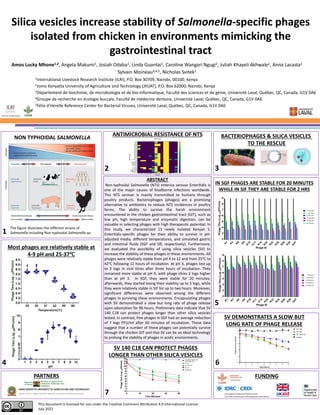
ABSTRACT
Non-typhoidal Salmonella (NTS) enterica serovar Enteritidis is
one of the major causes of foodborne infections worldwide.
This NTS serovar is mainly transmitted to humans through
poultry products. Bacteriophages (phages) are a promising
alternative to antibiotics to reduce NTS incidences in poultry
farms. The ability to survive the harsh environment
encountered in the chicken gastrointestinal tract (GIT), such as
low pH, high temperature and enzymatic digestion, can be
valuable in selecting phages with high therapeutic potential. In
this study, we characterized 13 newly isolated Kenyan S.
Enteritidis-specific phages for their ability to survive in pH-
adjusted media, different temperatures, and simulated gastric
and intestinal fluids (SGF and SIF, respectively). Furthermore,
we evaluated the possibility of using silica vesicles (SV) to
increase the stability of these phages in these environments. All
phages were relatively stable from pH 4 to 12 and from 25℃ to
42℃ following 12 hours of incubation. At pH 3, phages lost up
to 3 logs in viral titres after three hours of incubation. They
remained more stable at pH 9, with phage titres 2 logs higher
than at pH 3. In SGF, they were stable for 20 minutes;
afterwards, they started losing their viability up to 5 logs, while
they were relatively stable in SIF for up to two hours. Moreover,
significant differences were observed among the different
phages in surviving these environments. Encapsulating phages
with SV demonstrated a slow but long rate of phage release
upon adsorption for 96 hours. Preliminary data indicate that SV
140 C18 can protect phages longer than other silica vesicles
tested. In contrast, free phages in SGF had an average reduction
of 7 logs PFU/ml after 60 minutes of incubation. These data
suggest that a number of these phages can potentially survive
through the chicken GIT and that SV can be an ideal technology
to prolong the stability of phages in acidic environments.
Amos Lucky Mhone1,2, Angela Makumi1, Josiah Odaba1, Linda Guantai1, Caroline Wangari Ngugi2, Juliah Khayeli Akhwale2, Anna Lacasta1
Sylvain Moineau3,4,5, Nicholas Svitek1
1International Livestock Research Institute (ILRI), P.O. Box 30709, Nairobi, 00100, Kenya
2Jomo Kenyatta University of Agriculture and Technology (JKUAT), P.O. Box 62000, Nairobi, Kenya
3Département de biochimie, de microbiologie et de bio-informatique, Faculté des sciences et de génie, Université Laval, Québec, QC, Canada, G1V 0A6
4Groupe de recherche en écologie buccale, Faculté de médecine dentaire, Université Laval, Québec, QC, Canada, G1V 0A6
5Félix d’Hérelle Reference Center for Bacterial Viruses, Université Laval, Québec, QC, Canada, G1V 0A6
NON TYPHOIDAL SALMONELLA
IN SGF PHAGES ARE STABLE FOR 20 MINUTES
WHILE IN SIF THEY ARE STABLE FOR 2 HRS
BACTERIOPHAGES & SILICA VESICLES
TO THE RESCUE
PARTNERS FUNDING
Most phages are relatively stable at
4-9 pH and 25-37℃
1
2 3
5
ANTIMICROBIAL RESISTANCE OF NTS
SV DEMONSTRATES A SLOW BUT
LONG RATE OF PHAGE RELEASE
6
SV 140 C18 CAN PROTECT PHAGES
LONGER THAN OTHER SILICA VESICLES
7
4
The figure illustrates the different strains of
Salmonella including Non-typhoidal Salmonella sp.
0 1 2 2 4 3 6 4 8 6 0 7 2 8 4 9 6
0
2
4
6
8
1 0
Time (Hours)
Phage
Titre
(Log
10
(PFU/ml)
SV 100
SV 140
SV 140-C18
Control
0 15 30 45 60
0
1
2
3
4
5
6
7
8
9
10
11
12
13
Time (Minutes)
Phage
Titre
(Log
10
(PFU/ml)
Simulated Gatric Fluid
with Phage Only
SV 140
SV 140-C18
SV 100
Phage only
CIP AMP SXT CAZ10CAZ30 K S10 TET S30 E P CTX C N
SP 16
SP73
SP157
SP172
SP177
SP181
SP182
SP187
SP188
SP192
SP312
SP 568
SP 569
SP571
SP 572
S. branderup
STM
S.braendeburg
S.enteritidis
S.choleresius
STM.NTCC
E. coli
E.coli sp64
E.coli sp56
Shigella spp 56
Shigella spp 76
S.Pullorum
AMR Profiles
Antibiotics
Bacteria
isolates
1.0
1.5
2.0
2.5
3.0
This document is licensed for use under the Creative Commons Attribution 4.0 International Licence.
July 2022

Silica vesicles increase stability of Salmonella-specific phages isolated from chicken in environments mimicking the gastrointestinal tract

  • 1.
    Silica vesicles increasestability of Salmonella-specific phages isolated from chicken in environments mimicking the gastrointestinal tract ABSTRACT Non-typhoidal Salmonella (NTS) enterica serovar Enteritidis is one of the major causes of foodborne infections worldwide. This NTS serovar is mainly transmitted to humans through poultry products. Bacteriophages (phages) are a promising alternative to antibiotics to reduce NTS incidences in poultry farms. The ability to survive the harsh environment encountered in the chicken gastrointestinal tract (GIT), such as low pH, high temperature and enzymatic digestion, can be valuable in selecting phages with high therapeutic potential. In this study, we characterized 13 newly isolated Kenyan S. Enteritidis-specific phages for their ability to survive in pH- adjusted media, different temperatures, and simulated gastric and intestinal fluids (SGF and SIF, respectively). Furthermore, we evaluated the possibility of using silica vesicles (SV) to increase the stability of these phages in these environments. All phages were relatively stable from pH 4 to 12 and from 25℃ to 42℃ following 12 hours of incubation. At pH 3, phages lost up to 3 logs in viral titres after three hours of incubation. They remained more stable at pH 9, with phage titres 2 logs higher than at pH 3. In SGF, they were stable for 20 minutes; afterwards, they started losing their viability up to 5 logs, while they were relatively stable in SIF for up to two hours. Moreover, significant differences were observed among the different phages in surviving these environments. Encapsulating phages with SV demonstrated a slow but long rate of phage release upon adsorption for 96 hours. Preliminary data indicate that SV 140 C18 can protect phages longer than other silica vesicles tested. In contrast, free phages in SGF had an average reduction of 7 logs PFU/ml after 60 minutes of incubation. These data suggest that a number of these phages can potentially survive through the chicken GIT and that SV can be an ideal technology to prolong the stability of phages in acidic environments. Amos Lucky Mhone1,2, Angela Makumi1, Josiah Odaba1, Linda Guantai1, Caroline Wangari Ngugi2, Juliah Khayeli Akhwale2, Anna Lacasta1 Sylvain Moineau3,4,5, Nicholas Svitek1 1International Livestock Research Institute (ILRI), P.O. Box 30709, Nairobi, 00100, Kenya 2Jomo Kenyatta University of Agriculture and Technology (JKUAT), P.O. Box 62000, Nairobi, Kenya 3Département de biochimie, de microbiologie et de bio-informatique, Faculté des sciences et de génie, Université Laval, Québec, QC, Canada, G1V 0A6 4Groupe de recherche en écologie buccale, Faculté de médecine dentaire, Université Laval, Québec, QC, Canada, G1V 0A6 5Félix d’Hérelle Reference Center for Bacterial Viruses, Université Laval, Québec, QC, Canada, G1V 0A6 NON TYPHOIDAL SALMONELLA IN SGF PHAGES ARE STABLE FOR 20 MINUTES WHILE IN SIF THEY ARE STABLE FOR 2 HRS BACTERIOPHAGES & SILICA VESICLES TO THE RESCUE PARTNERS FUNDING Most phages are relatively stable at 4-9 pH and 25-37℃ 1 2 3 5 ANTIMICROBIAL RESISTANCE OF NTS SV DEMONSTRATES A SLOW BUT LONG RATE OF PHAGE RELEASE 6 SV 140 C18 CAN PROTECT PHAGES LONGER THAN OTHER SILICA VESICLES 7 4 The figure illustrates the different strains of Salmonella including Non-typhoidal Salmonella sp. 0 1 2 2 4 3 6 4 8 6 0 7 2 8 4 9 6 0 2 4 6 8 1 0 Time (Hours) Phage Titre (Log 10 (PFU/ml) SV 100 SV 140 SV 140-C18 Control 0 15 30 45 60 0 1 2 3 4 5 6 7 8 9 10 11 12 13 Time (Minutes) Phage Titre (Log 10 (PFU/ml) Simulated Gatric Fluid with Phage Only SV 140 SV 140-C18 SV 100 Phage only CIP AMP SXT CAZ10CAZ30 K S10 TET S30 E P CTX C N SP 16 SP73 SP157 SP172 SP177 SP181 SP182 SP187 SP188 SP192 SP312 SP 568 SP 569 SP571 SP 572 S. branderup STM S.braendeburg S.enteritidis S.choleresius STM.NTCC E. coli E.coli sp64 E.coli sp56 Shigella spp 56 Shigella spp 76 S.Pullorum AMR Profiles Antibiotics Bacteria isolates 1.0 1.5 2.0 2.5 3.0 This document is licensed for use under the Creative Commons Attribution 4.0 International Licence. July 2022