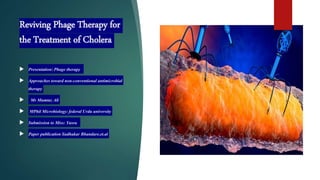
Reviving Phage Therapy for
the Treatment of Cholera
 Presentation:Phage therapy
 Approaches toward non-conventional antimicrobial
therapy
 Mr Mumtaz Ali
 MPhil Microbiology:federal Urdu university
 Submission to Miss: Yusra
 Paper publicationSudhakar Bhandare.et.al
Abstract/Aim of the
paper .
Cholera remains a major risk in developing countries,
Vibrio cholerae El Tor is the most important cause of
these outbreaks, and is becoming increasingly resistant to
antibiotics,
Alternative therapies are urgently needed. In this study, a
single bacteriophage, Phi_1, was used to control cholera
prophylactically and therapeutically in an infant rabbit
model.
In both cases, phage-treated animals showed no clinical
signs of disease There was evidence of phage
multiplication only in animals that received a V. cholerae
challenge.
Abstract Cont.…..
No phage-resistant bacterial mutants were isolated from the
animals, despite extensive searching.
This is the first evidence that a single phage could be effective in
the treatment of cholera, without detectable levels of resistance.
Clinical trials in human patients should be considered.
Keywords. bacteriophage therapy; cholera; phage; infant rabbit;
rabbit; prophylaxis; Vibrio cholera
Introduction.
Cholera is contracted from contaminated food and water in developing
countries.
Vibrio cholerae has caused 7 cholera pandemics since 1817, leading to
significant morbidity and mortality.
The first 6 pandemics (1816–1923) were caused by the Classical O1
biotype, whereas the seventh (1961 to the present) was caused by the El
Tor biotype.
The current pandemic affects 3–5 million persons per annum, causing 21
000–143 000 deaths.
During 1985-1987 23 cases were reported in CMH Rawalpindi.
AKUH 1990-1996 (888 ) cases studied of different species of vibrio.
Introduction Cont.…..
Rehydration therapy reduces mortality rates and, with
antibiotics,
However, the World Health Organization now advises
that only severe cases of cholera should be treated with
antibiotics owing to the spread of antimicrobial
resistance.
Alternative approaches to cholera control are urgently
needed using bacteriophages (phages) is one
alternative, particularly where antibiotic resistance is a
problem and according to the paper phage (vB_VchoP_1
(Phi_1) were used in different animals to treat cholera
Method.
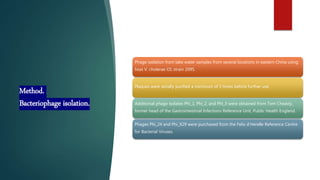
Bacteriophage isolation.
Phage isolation from lake water samples from several locations in eastern China using
host V. cholerae O1 strain 2095.
Plaques were serially purified a minimum of 5 times before further use.
Additional phage isolates Phi_1, Phi_2, and Phi_3 were obtained from Tom Cheasty,
former head of the Gastrointestinal Infections Reference Unit, Public Health England.
Phages Phi_24 and Phi_X29 were purchased from the Felix d’Herelle Reference Centre
for Bacterial Viruses.
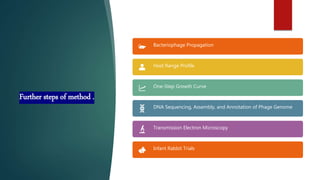
Further steps of method .
Bacteriophage Propagation
Host Range Profile
One-Step Growth Curve
DNA Sequencing, Assembly, and Annotation of Phage Genome
Transmission Electron Microscopy
Infant Rabbit Trials
Results.
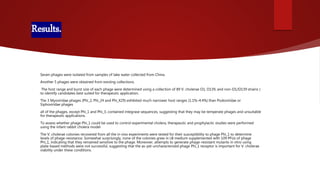
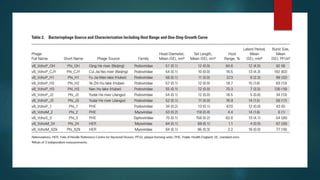
 Seven phages were isolated from samples of lake water collected from China.
 Another 5 phages were obtained from existing collections.
 The host range and burst size of each phage were determined using a collection of 89 V. cholerae O1, O139, and non-O1/O139 strains )
to identify candidates best suited for therapeutic application.
 The 3 Myoviridae phages (Phi_2, Phi_24 and Phi_X29) exhibited much narrower host ranges (1.1%–4.4%) than Podoviridae or
Siphoviridae phages
 all of the phages, except Phi_1 and Phi_3, contained integrase sequences, suggesting that they may be temperate phages and unsuitable
for therapeutic applications.
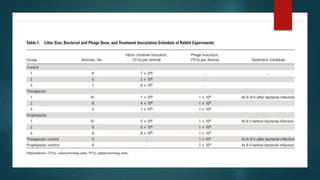
 To assess whether phage Phi_1 could be used to control experimental cholera, therapeutic and prophylactic studies were performed
using the infant rabbit cholera model
 The V. cholerae colonies recovered from all the in vivo experiments were tested for their susceptibility to phage Phi_1 to determine
levels of phage-resistance. Somewhat surprisingly, none of the colonies grew in LB medium supplemented with 109 PFUs of phage
Phi_1, indicating that they remained sensitive to the phage. Moreover, attempts to generate phage-resistant mutants in vitro using
plate-based methods were not successful, suggesting that the as-yet-uncharacterized phage Phi_1 receptor is important for V. cholerae
viability under these conditions.
Discussion.
In the current study, we show for the first time that oral
administration of a single Podoviridae phage could prevent
clinical cholera symptoms in infant rabbits without the
development of phage resistance.
Our findings provide further evidence that phage can both
reduce the severity of disease and limit spread of the
organism to the environment.
Given the well-documented challenges associated with the
emergence of antibiotic-resistant bacteria, phage may yet
provide a viable alternative to antibiotics.
The strain of V. cholerae used has been shown experimentally
by this group to result in cholera using the infant rabbit
model.
References.
 1. Hu D, Liu B, Feng L, et al. Origins of the current seventh cholera pandemic. Proc Natl Acad Sci U S A 2016; 113:E7730–9. 2. Ali M, Nelson AR, Lopez AL, Sack DA. Updated global
burden of cholera in endemic countries. PLoS Negl Trop Dis 2015; 9:e0003832.
 3. Sugimoto JD, Koepke AA, Kenah EE, et al. Household transmission of Vibrio cholerae in Bangladesh. PLoS Negl Trop Dis 2014; 8:e3314. 4. Kitaoka M, Miyata ST, Unterweger D,
Pukatzki S. Antibiotic resistance mechanisms of Vibrio cholerae. J Med Microbiol 2011; 60:397–407. 5. Czaplewski L, Bax R, Clokie M, et al. Alternatives to antibiotics—a pipeline portfolio
review. Lancet Infect Dis 2016; 16:239–51. 6. Smith HW, Huggins MB. Effectiveness of phages in treating experimental Escherichia coli diarrhoea in calves, piglets and lambs. J Gen
Microbiol 1983; 129:2659–75.
 7. Barrow P, Lovell M, Berchieri A Jr. Use of lytic bacteriophage for control of experimental Escherichia coli septicemia and meningitis in chickens and calves. Clin Diagn Lab Immunol
1998; 5:294–8. 8. Smith HW, Huggins MB. Successful treatment of experimental Escherichia coli infections in mice using phage: its general superiority over antibiotics. J Gen Microbiol
1982; 128:307–18. 9. Clokie MRJ, Kropinski AM. Bacteriophages : methods and protocols. 1st ed. New York, NY: Humana Press; 2009.
 10. Sambrook J, Fritsch EF, Maniatis T. Molecular cloning a laboratory manual. 2nd ed. Cold Spring Harbor, NY: Cold Spring Harbor Laboratory Press; 1989.
 11. Atterbury RJ, Van Bergen MA, Ortiz F, et al. Bacteriophage therapy to reduce salmonella colonization of broiler chickens. Appl Environ Microbiol 2007; 73:4543–9.
 12. Choi C, Kuatsjah E, Wu E, Yuan S. The effect of cell size on the burst size of T4 bacteriophage infections of Escherichia coli B23. J Exp Microbiol Immunol 2010; 14:85–91.
 13. Bankevich A, Nurk S, Antipov D, et al. SPAdes: a new genome assembly algorithm and its applications to single-cell sequencing. J Comput Biol 2012; 19:455–77.
 14. Aziz RK, Bartels D, Best AA, et al. The RAST Server: rapid annotations using subsystems technology. BMC Genomics 2008; 9:75.
 15. Finn RD, Bateman A, Clements J, et al. Pfam: the protein families database. Nucleic Acids Res 2014; 42:222–230.
 16. Schattner P, Brooks AN, Lowe TM. The tRNAscan-SE, snoscan and snoGPS web servers for the detection of tRNAs and snoRNAs. Nucleic Acids Res 2005; 33:W686–9.
 17. Laslett D, Canback B. ARAGORN, a program to detect tRNA genes and tmRNA genes in nucleotide sequences. Nucleic Acids Res 2004; 32:11–6.
 18. Thompson JD, Higgins DG, Gibson TJ. CLUSTAL W: improving the sensitivity of progressive multiple sequence alignment through sequence weighting, position-specific gap penalties and weight matrix choice. Nucleic Acids Res 1994; 22:4673–80.
 19. Price MN, Dehal PS, Arkin AP. FastTree: computing large minimum evolution trees with profiles instead of a distance matrix. Mol Biol Evol 2009; 26:1641–50.
 20. Hooton SP, Timms AR, Rowsell J, Wilson R, Connerton IF. Salmonella Typhimurium-specific bacteriophage ΦSH19 and the origins of species specificity in the Vi01-like phage family. Virol J 2011; 8:498.
 21. Ritchie JM, Rui H, Bronson RT, Waldor MK. Back to the future: studying cholera pathogenesis using infant rabbits. MBio 2010; 1:e00047–10.
 22. Nhung PH, Ohkusu K, Miyasaka J, Sun XS, Ezaki T. Rapid and specific identification of 5 human pathogenic Vibrio species by multiplex polymerase chain reaction targeted to dnaJ gene. Diagn Microbiol Infect Dis 2007; 59:271–5.

 23. Ritchie JM, Rui H, Bronson RT, Waldor MK. Back to the future: studying cholera pathogenesis using infant rabbits. MBio 2010; 1.
 24. De SN, Chatterje DN. An experimental study of the mechanism of action of Vibrio cholerae on the intestinal mucous membrane. J Pathol Bacteriol 1953; 66:559–62.
 25. Yen M, Cairns LS, Camilli A. A cocktail of three virulent bacteriophages prevents Vibrio cholerae infection in animal models. Nat Commun 2017; 8:14187
 26. Baig A, Colom J, Barrow P, et al. Biology and genomics of an historic therapeutic Escherichia coli bacteriophage collection. Front Microbiol 2017; 8:1652.
 27. Seed KD, Faruque SM, Mekalanos JJ, Calderwood SB, Qadri F, Camilli A. Phase variable O antigen biosynthetic genes control expression of the major protective antigen and bacteriophage receptor in Vibrio cholerae O1. PLoS Pathog 2012; 8:e1002917.
 28. Marcuk LM, Nikiforov VN, Scerbak JF, et al. Clinical studies of the use of bacteriophage in the treatment of cholera. Bull World Health Organ 1971; 45:77–8
References.
bacteriophage use in therapy

bacteriophage use in therapy

  • 2.
    Reviving Phage Therapyfor the Treatment of Cholera  Presentation:Phage therapy  Approaches toward non-conventional antimicrobial therapy  Mr Mumtaz Ali  MPhil Microbiology:federal Urdu university  Submission to Miss: Yusra  Paper publicationSudhakar Bhandare.et.al
  • 3.
    Abstract/Aim of the paper. Cholera remains a major risk in developing countries, Vibrio cholerae El Tor is the most important cause of these outbreaks, and is becoming increasingly resistant to antibiotics, Alternative therapies are urgently needed. In this study, a single bacteriophage, Phi_1, was used to control cholera prophylactically and therapeutically in an infant rabbit model. In both cases, phage-treated animals showed no clinical signs of disease There was evidence of phage multiplication only in animals that received a V. cholerae challenge.
  • 4.
    Abstract Cont.….. No phage-resistantbacterial mutants were isolated from the animals, despite extensive searching. This is the first evidence that a single phage could be effective in the treatment of cholera, without detectable levels of resistance. Clinical trials in human patients should be considered. Keywords. bacteriophage therapy; cholera; phage; infant rabbit; rabbit; prophylaxis; Vibrio cholera
  • 5.
    Introduction. Cholera is contractedfrom contaminated food and water in developing countries. Vibrio cholerae has caused 7 cholera pandemics since 1817, leading to significant morbidity and mortality. The first 6 pandemics (1816–1923) were caused by the Classical O1 biotype, whereas the seventh (1961 to the present) was caused by the El Tor biotype. The current pandemic affects 3–5 million persons per annum, causing 21 000–143 000 deaths. During 1985-1987 23 cases were reported in CMH Rawalpindi. AKUH 1990-1996 (888 ) cases studied of different species of vibrio.
  • 6.
    Introduction Cont.….. Rehydration therapyreduces mortality rates and, with antibiotics, However, the World Health Organization now advises that only severe cases of cholera should be treated with antibiotics owing to the spread of antimicrobial resistance. Alternative approaches to cholera control are urgently needed using bacteriophages (phages) is one alternative, particularly where antibiotic resistance is a problem and according to the paper phage (vB_VchoP_1 (Phi_1) were used in different animals to treat cholera
  • 7.
    Method. Bacteriophage isolation. Phage isolationfrom lake water samples from several locations in eastern China using host V. cholerae O1 strain 2095. Plaques were serially purified a minimum of 5 times before further use. Additional phage isolates Phi_1, Phi_2, and Phi_3 were obtained from Tom Cheasty, former head of the Gastrointestinal Infections Reference Unit, Public Health England. Phages Phi_24 and Phi_X29 were purchased from the Felix d’Herelle Reference Centre for Bacterial Viruses.
  • 8.
    Further steps ofmethod . Bacteriophage Propagation Host Range Profile One-Step Growth Curve DNA Sequencing, Assembly, and Annotation of Phage Genome Transmission Electron Microscopy Infant Rabbit Trials
  • 9.
    Results.  Seven phageswere isolated from samples of lake water collected from China.  Another 5 phages were obtained from existing collections.  The host range and burst size of each phage were determined using a collection of 89 V. cholerae O1, O139, and non-O1/O139 strains ) to identify candidates best suited for therapeutic application.  The 3 Myoviridae phages (Phi_2, Phi_24 and Phi_X29) exhibited much narrower host ranges (1.1%–4.4%) than Podoviridae or Siphoviridae phages  all of the phages, except Phi_1 and Phi_3, contained integrase sequences, suggesting that they may be temperate phages and unsuitable for therapeutic applications.  To assess whether phage Phi_1 could be used to control experimental cholera, therapeutic and prophylactic studies were performed using the infant rabbit cholera model  The V. cholerae colonies recovered from all the in vivo experiments were tested for their susceptibility to phage Phi_1 to determine levels of phage-resistance. Somewhat surprisingly, none of the colonies grew in LB medium supplemented with 109 PFUs of phage Phi_1, indicating that they remained sensitive to the phage. Moreover, attempts to generate phage-resistant mutants in vitro using plate-based methods were not successful, suggesting that the as-yet-uncharacterized phage Phi_1 receptor is important for V. cholerae viability under these conditions.
  • 12.
    Discussion. In the currentstudy, we show for the first time that oral administration of a single Podoviridae phage could prevent clinical cholera symptoms in infant rabbits without the development of phage resistance. Our findings provide further evidence that phage can both reduce the severity of disease and limit spread of the organism to the environment. Given the well-documented challenges associated with the emergence of antibiotic-resistant bacteria, phage may yet provide a viable alternative to antibiotics. The strain of V. cholerae used has been shown experimentally by this group to result in cholera using the infant rabbit model.
  • 13.
    References.  1. HuD, Liu B, Feng L, et al. Origins of the current seventh cholera pandemic. Proc Natl Acad Sci U S A 2016; 113:E7730–9. 2. Ali M, Nelson AR, Lopez AL, Sack DA. Updated global burden of cholera in endemic countries. PLoS Negl Trop Dis 2015; 9:e0003832.  3. Sugimoto JD, Koepke AA, Kenah EE, et al. Household transmission of Vibrio cholerae in Bangladesh. PLoS Negl Trop Dis 2014; 8:e3314. 4. Kitaoka M, Miyata ST, Unterweger D, Pukatzki S. Antibiotic resistance mechanisms of Vibrio cholerae. J Med Microbiol 2011; 60:397–407. 5. Czaplewski L, Bax R, Clokie M, et al. Alternatives to antibiotics—a pipeline portfolio review. Lancet Infect Dis 2016; 16:239–51. 6. Smith HW, Huggins MB. Effectiveness of phages in treating experimental Escherichia coli diarrhoea in calves, piglets and lambs. J Gen Microbiol 1983; 129:2659–75.  7. Barrow P, Lovell M, Berchieri A Jr. Use of lytic bacteriophage for control of experimental Escherichia coli septicemia and meningitis in chickens and calves. Clin Diagn Lab Immunol 1998; 5:294–8. 8. Smith HW, Huggins MB. Successful treatment of experimental Escherichia coli infections in mice using phage: its general superiority over antibiotics. J Gen Microbiol 1982; 128:307–18. 9. Clokie MRJ, Kropinski AM. Bacteriophages : methods and protocols. 1st ed. New York, NY: Humana Press; 2009.  10. Sambrook J, Fritsch EF, Maniatis T. Molecular cloning a laboratory manual. 2nd ed. Cold Spring Harbor, NY: Cold Spring Harbor Laboratory Press; 1989.  11. Atterbury RJ, Van Bergen MA, Ortiz F, et al. Bacteriophage therapy to reduce salmonella colonization of broiler chickens. Appl Environ Microbiol 2007; 73:4543–9.  12. Choi C, Kuatsjah E, Wu E, Yuan S. The effect of cell size on the burst size of T4 bacteriophage infections of Escherichia coli B23. J Exp Microbiol Immunol 2010; 14:85–91.  13. Bankevich A, Nurk S, Antipov D, et al. SPAdes: a new genome assembly algorithm and its applications to single-cell sequencing. J Comput Biol 2012; 19:455–77.
  • 14.
     14. AzizRK, Bartels D, Best AA, et al. The RAST Server: rapid annotations using subsystems technology. BMC Genomics 2008; 9:75.  15. Finn RD, Bateman A, Clements J, et al. Pfam: the protein families database. Nucleic Acids Res 2014; 42:222–230.  16. Schattner P, Brooks AN, Lowe TM. The tRNAscan-SE, snoscan and snoGPS web servers for the detection of tRNAs and snoRNAs. Nucleic Acids Res 2005; 33:W686–9.  17. Laslett D, Canback B. ARAGORN, a program to detect tRNA genes and tmRNA genes in nucleotide sequences. Nucleic Acids Res 2004; 32:11–6.  18. Thompson JD, Higgins DG, Gibson TJ. CLUSTAL W: improving the sensitivity of progressive multiple sequence alignment through sequence weighting, position-specific gap penalties and weight matrix choice. Nucleic Acids Res 1994; 22:4673–80.  19. Price MN, Dehal PS, Arkin AP. FastTree: computing large minimum evolution trees with profiles instead of a distance matrix. Mol Biol Evol 2009; 26:1641–50.  20. Hooton SP, Timms AR, Rowsell J, Wilson R, Connerton IF. Salmonella Typhimurium-specific bacteriophage ΦSH19 and the origins of species specificity in the Vi01-like phage family. Virol J 2011; 8:498.  21. Ritchie JM, Rui H, Bronson RT, Waldor MK. Back to the future: studying cholera pathogenesis using infant rabbits. MBio 2010; 1:e00047–10.  22. Nhung PH, Ohkusu K, Miyasaka J, Sun XS, Ezaki T. Rapid and specific identification of 5 human pathogenic Vibrio species by multiplex polymerase chain reaction targeted to dnaJ gene. Diagn Microbiol Infect Dis 2007; 59:271–5.   23. Ritchie JM, Rui H, Bronson RT, Waldor MK. Back to the future: studying cholera pathogenesis using infant rabbits. MBio 2010; 1.  24. De SN, Chatterje DN. An experimental study of the mechanism of action of Vibrio cholerae on the intestinal mucous membrane. J Pathol Bacteriol 1953; 66:559–62.  25. Yen M, Cairns LS, Camilli A. A cocktail of three virulent bacteriophages prevents Vibrio cholerae infection in animal models. Nat Commun 2017; 8:14187  26. Baig A, Colom J, Barrow P, et al. Biology and genomics of an historic therapeutic Escherichia coli bacteriophage collection. Front Microbiol 2017; 8:1652.  27. Seed KD, Faruque SM, Mekalanos JJ, Calderwood SB, Qadri F, Camilli A. Phase variable O antigen biosynthetic genes control expression of the major protective antigen and bacteriophage receptor in Vibrio cholerae O1. PLoS Pathog 2012; 8:e1002917.  28. Marcuk LM, Nikiforov VN, Scerbak JF, et al. Clinical studies of the use of bacteriophage in the treatment of cholera. Bull World Health Organ 1971; 45:77–8 References.