Silent Way
Background
 Decline of Audio-lingualism (1960s)
 Theoretical Attack
 Rejection of structural linguistics
 Rejection of Behaviorism
 Emergence of Cognitive-code learning theory
 Practical Attack
 Inability to use L2 habits to communicative
situations
 Boring & unsatisfying teaching procedures
 Alternative Teaching proposals (1980s)
 Silent Way by Caleb Gattegno
 Total Physical Response by James Asher
 Community Language Learning by Charles A.
Curran
Approach
Language theory
 Structural approach
 sentence a basic unit of teaching
 teaching & learning grammar inductively
 teaching functional vocabulary
 Learning theory
 Cognitive-code view of learning
 L2 learning radically different from L1 learning
 Meaningful, discovery learning
 Focus on having an artificial teaching approach
 Primacy of learning to teaching
 Rejection of repetition
 Silence a powerful tool for mental organization
 Inner criteria, self-correction
Design
Teaching Objectives
 To attain near-native fluency in L2
 Objectives for low-level students
 To gain oral-aural facility in basic L2 elements
 To gain a basic practical knowledge of L2 grammar
 To Perform adequately in reading , and writing
Syllabus
 More lexico-grammatical units
 No precise selection & arrangement of content
 Grammatical complexity
 Ease of visual presentation
Types of Teaching / Learning Activities
 Problem-solving activities
Using charts, rods, other aids
 Helping Ss develop independence, autonomy,
responsibility
Developing inner criteria & correct themselves
Cooperating with other Ss to solve language
problems
Cooperative rather than competitive
procedures
Teacher Roles
 Stimulator / Not a hand holder
Being silent most of the time
Getting out of the way for Ss to develop inner
criteria
 Cooperative rather than competitive procedures
Role of Instructional Materials
 A Pointer
 Cuisenaire rods
 To teach Vocabulary (Colors/ numbers/adjectives / Verbs)
 To teach syntax ( prepositions, conditionals, word order…)
 12 Word Chart
 Containing about 500 functional English vocabulary
 Having identical color code with sound & Fidel charts
 8 Color-Coded Fidel Charts
 To associate sounds with spelling
 A Sound- color chart
 Representing vowels & consonants of L2
 To show how to form syllables, words, sentences
 To teach stress pattern of words

The Cuisenaire Rods
Are used to teach items such as
prepositions of place,
sentence and word stress
Used to represent a series of useful situations for a language
lesson
Are named after their inventor, Georges Cuisenaire (1891-1976),
a Belgian primary school teacher,
Are used for both mathematics and language teaching
Rods of equal length are assigned the same color.
Important:
Effective use of rods depends on efficient teacher training.
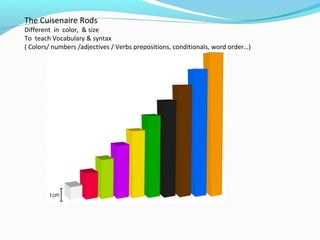
The Cuisenaire Rods
Different in color, & size
To teach Vocabulary & syntax
( Colors/ numbers /adjectives / Verbs prepositions, conditionals, word order…)
Word Chart
Functional words of the language are printed in color.
color code is the same as that of the rectangle chart and the
Fidel.
Only structural words (about 500 words) is included:
pronouns
Articles
Prepositions
common adjectives and adverbs
Conjunctions
auxiliary verbs
a few common verbs but very few nouns.
The use of colour enables students to read directly in languages
with a different alphabet or characters and to pronounce
correctly what they read.
Procedure
Teaching L2 sounds first
 Using sound-color chart
 Considering L1 background of Ss
 Modeling sounds at the beginning
 Using pointer to indicate stress/phrasing /intonation
Teaching sentence-patterns & vocabulary
 Using colored rods for visual realization
 Modeling utterances by the teacher first
 Having a S model & produce utterances
 No encouragement or correction by the teacher
 Regarding learning as personal responsibility
 Practice with L2 structure without repetition
 Self-correction gestures / peer correction
Structured feedback

Silent Way PBI unit 5

  • 2.
    Silent Way Background  Declineof Audio-lingualism (1960s)  Theoretical Attack  Rejection of structural linguistics  Rejection of Behaviorism  Emergence of Cognitive-code learning theory  Practical Attack  Inability to use L2 habits to communicative situations  Boring & unsatisfying teaching procedures  Alternative Teaching proposals (1980s)  Silent Way by Caleb Gattegno  Total Physical Response by James Asher  Community Language Learning by Charles A. Curran
  • 3.
    Approach Language theory  Structuralapproach  sentence a basic unit of teaching  teaching & learning grammar inductively  teaching functional vocabulary  Learning theory  Cognitive-code view of learning  L2 learning radically different from L1 learning  Meaningful, discovery learning  Focus on having an artificial teaching approach  Primacy of learning to teaching  Rejection of repetition  Silence a powerful tool for mental organization  Inner criteria, self-correction
  • 4.
    Design Teaching Objectives  Toattain near-native fluency in L2  Objectives for low-level students  To gain oral-aural facility in basic L2 elements  To gain a basic practical knowledge of L2 grammar  To Perform adequately in reading , and writing Syllabus  More lexico-grammatical units  No precise selection & arrangement of content  Grammatical complexity  Ease of visual presentation
  • 5.
    Types of Teaching/ Learning Activities  Problem-solving activities Using charts, rods, other aids  Helping Ss develop independence, autonomy, responsibility Developing inner criteria & correct themselves Cooperating with other Ss to solve language problems Cooperative rather than competitive procedures
  • 6.
    Teacher Roles  Stimulator/ Not a hand holder Being silent most of the time Getting out of the way for Ss to develop inner criteria  Cooperative rather than competitive procedures
  • 7.
    Role of InstructionalMaterials  A Pointer  Cuisenaire rods  To teach Vocabulary (Colors/ numbers/adjectives / Verbs)  To teach syntax ( prepositions, conditionals, word order…)  12 Word Chart  Containing about 500 functional English vocabulary  Having identical color code with sound & Fidel charts  8 Color-Coded Fidel Charts  To associate sounds with spelling  A Sound- color chart  Representing vowels & consonants of L2  To show how to form syllables, words, sentences  To teach stress pattern of words 
  • 8.
    The Cuisenaire Rods Areused to teach items such as prepositions of place, sentence and word stress Used to represent a series of useful situations for a language lesson Are named after their inventor, Georges Cuisenaire (1891-1976), a Belgian primary school teacher, Are used for both mathematics and language teaching Rods of equal length are assigned the same color. Important: Effective use of rods depends on efficient teacher training.
  • 9.
    The Cuisenaire Rods Differentin color, & size To teach Vocabulary & syntax ( Colors/ numbers /adjectives / Verbs prepositions, conditionals, word order…)
  • 10.
    Word Chart Functional wordsof the language are printed in color. color code is the same as that of the rectangle chart and the Fidel. Only structural words (about 500 words) is included: pronouns Articles Prepositions common adjectives and adverbs Conjunctions auxiliary verbs a few common verbs but very few nouns. The use of colour enables students to read directly in languages with a different alphabet or characters and to pronounce correctly what they read.
  • 11.
    Procedure Teaching L2 soundsfirst  Using sound-color chart  Considering L1 background of Ss  Modeling sounds at the beginning  Using pointer to indicate stress/phrasing /intonation Teaching sentence-patterns & vocabulary  Using colored rods for visual realization  Modeling utterances by the teacher first  Having a S model & produce utterances  No encouragement or correction by the teacher  Regarding learning as personal responsibility  Practice with L2 structure without repetition  Self-correction gestures / peer correction Structured feedback