Prepared by
Mrs. Sapana Amol Chougule
Assistant Professor,
Civil Engineering Department,
ATS’s SBGI Miraj
Signals in
Triangulation
Station marks
1. Object of station marks is to provide a
surface mark with a permanent mark buried
below the surface on which a target or
instruments is to centered over it
2.Should be bronze or copper marks
cemented into rock or concrete surface
3.Normally station marks are buried below the
ground surface to protect from the
disturbances
• Control points canbe constructed in
concrete with center mark in bronze
or copper and buried at the required
place
• Fewdead measurements are taken
using permanent features around
the stationand keep asa diagram
Signals in Triangulation 3
Station Marks
Signals in Triangulation 4
Signals
• Theyare the deviceserected to definethe exact
position of astation
• Asignalis placed at eachstation sothat the line of
sights are established between triangulation
stations
• Signalsmaybe opaque (3-4 leggedtype) or
luminous
Requirements of Signal
1. It should clearly visible, kept
at least 75 cm above the
station mark.
2. Capable of being accurately
centered over the station
mark.
3. It should be suitable for
accurate bisection from other
stations.
Classification of signals
1.Non-luminous, opaque or
daylight signals
2.Luminous signals-
a. Sun signals
b. Night Signals
Signals in Triangulation 7
Non-luminous, opaque or
daylight signals
1. Pole Signal
2. Target Signal
3. Pole and Brush Signals
4. Stone Cairn
5. Beacon
6. Elevated Tower
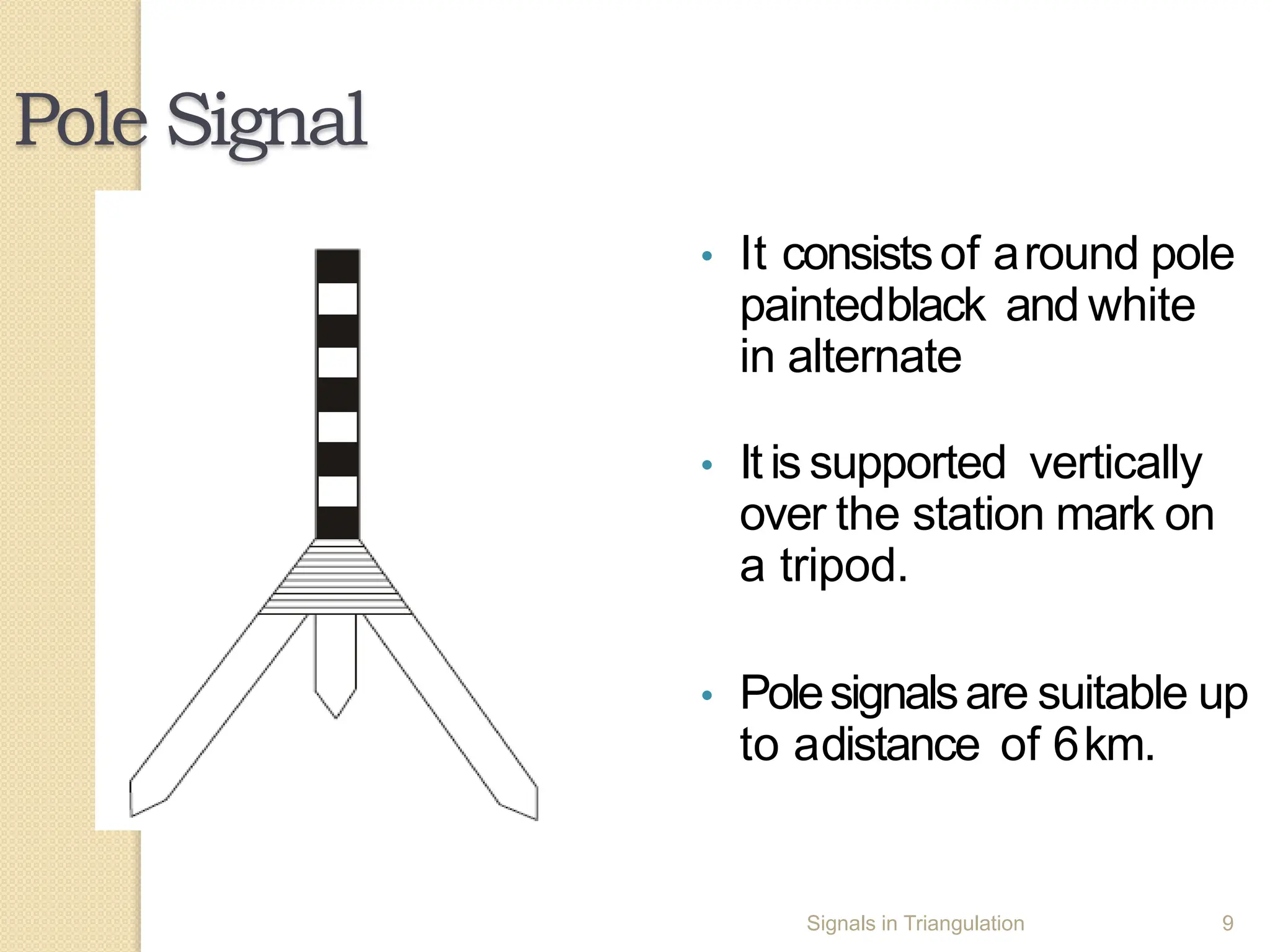
Pole Signal
• It consistsof around pole
paintedblack and white
in alternate
• It is supported vertically
over the station mark on
a tripod.
• Polesignalsare suitable up
to adistance of 6km.
Signals in Triangulation 9
• It consistsof apole carrying two
square or rectangular targets
placed at rightanglesto each
other
• Thetargets are
generally madeof cloth
stretched on wooden
frames
• Targetsignalsare suitable up to
adistanceof 6km
Target Signal
Signals in Triangulation 10
Pole and Brush Signals
• It consists of a straight pole about
2·5 meter long with a bunch of
long grass tied symmetrically round
the top making across
• The signal is erected vertically
over the station mark by
heaping a pile of stones up to 1·7
meters
round the pole
• A rough coat of white wash is
applied to make it more
conspicuous to be seen against a
blackback ground
Signals in Triangulation 11
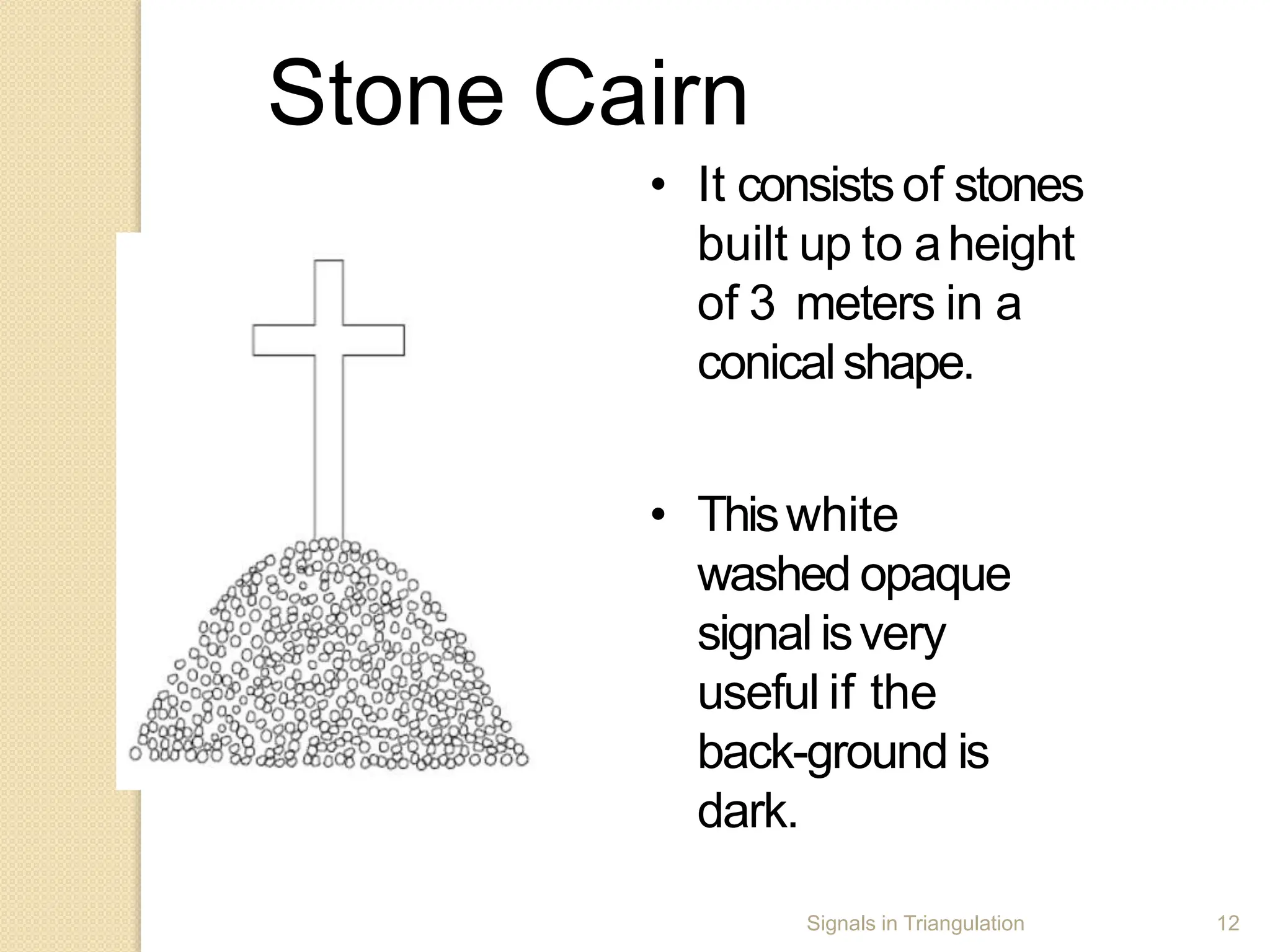
• It consistsof stones
built up to aheight
of 3 meters in a
conicalshape.
• Thiswhite
washed opaque
signal isvery
useful if the
back-ground is
dark.
Stone Cairn
Signals in Triangulation 12
• It consists of red and white
cloth tied round the three
straightpoles.
• This canbe easily centered
over the station marks
• Beaconsare useful when
simultaneous observations
are made at both the
stations.
Beacon
Signals in Triangulation 13
• If the country is quite
plane, elevated
towers are erected
over the station
mark.
• These signals are
used up to a distance
of 30 to 40 km
Elevated Tower
Signals in Triangulation 14
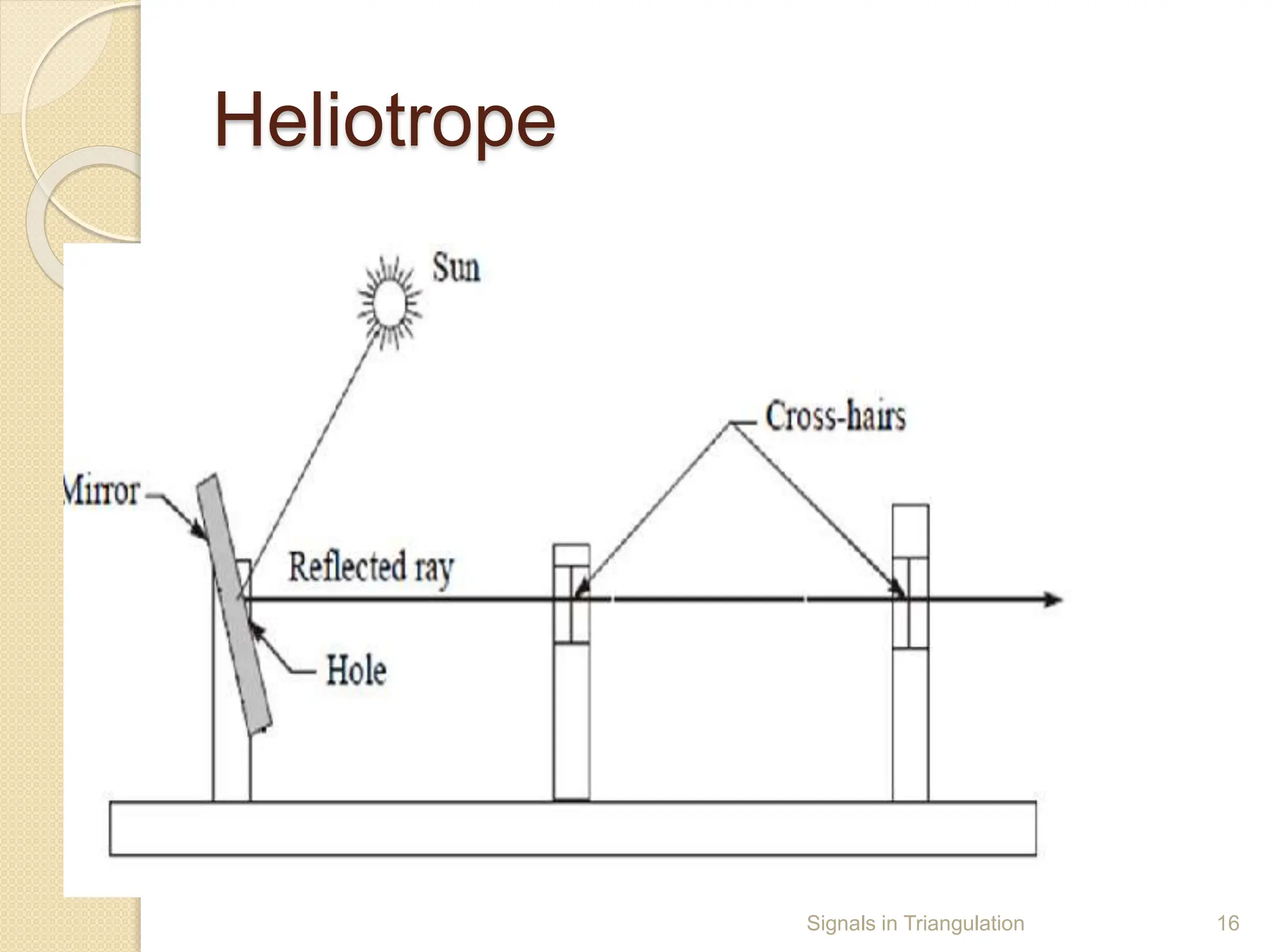
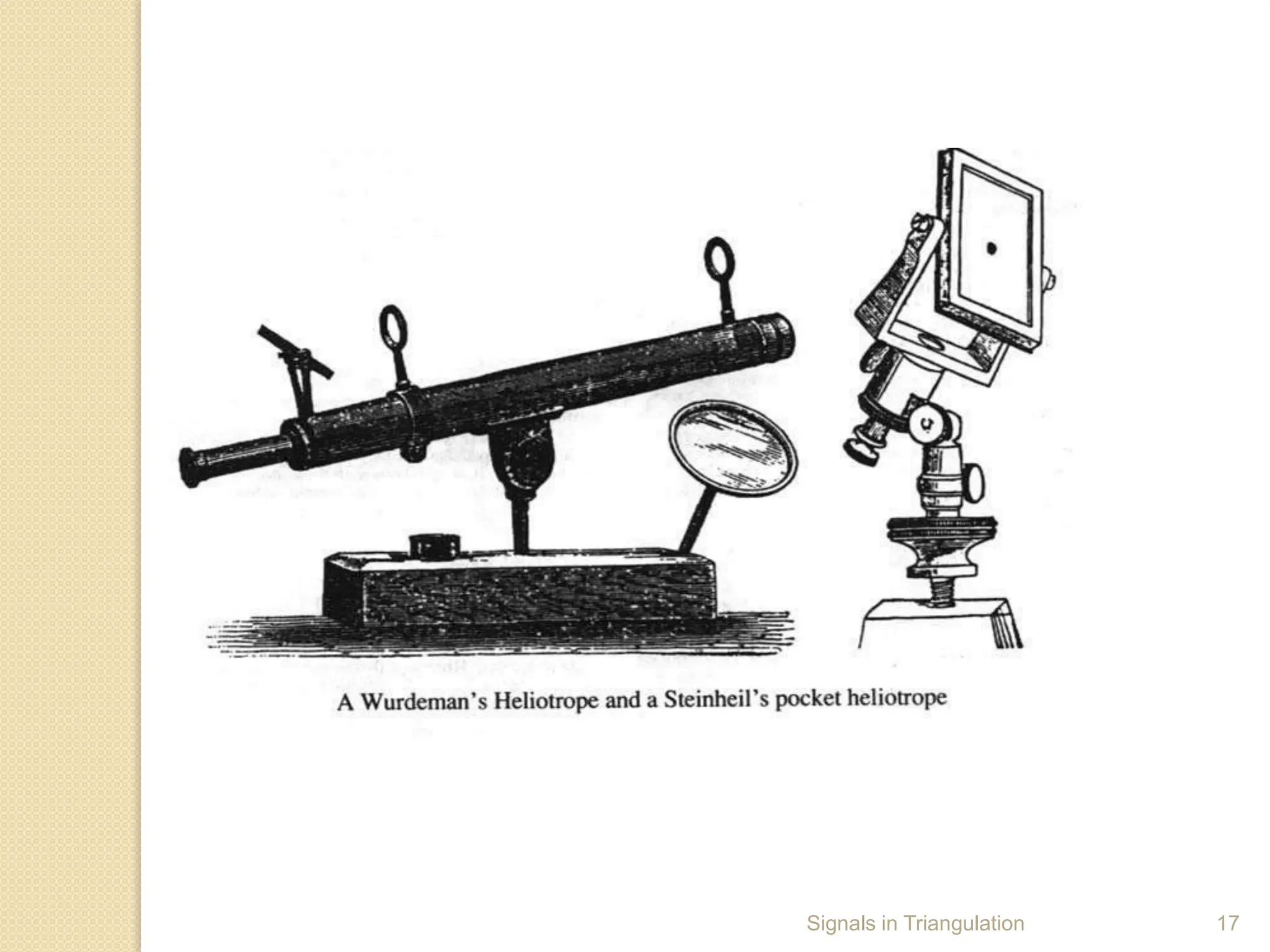
• Those signals which reflect the rays of the sun
towards the station of observation, are known
asheliotropes.
• Suchsignalscanonly be usedin clear weather.
• Heliotropes do not give better resultsas
compared to the opaquesignals.
Sun signals
Signals in Triangulation 15
Heliotrope
Signals in Triangulation 16
Signals in Triangulation 17
Night Signals
• While making observations at night,
night signalsare used.
• Various types of night signalsare:
– Various forms of oil lamps with a reflector.
These are usedfor sights lessthan 80km.
– Acetylene lamps designed by captain G.T
.
McCaw. These are used for sights more than 80
km.
Signals in Triangulation 18
Signals in Triangulation 19

signals in triangulation .. ...Surveying

  • 1.
    Prepared by Mrs. SapanaAmol Chougule Assistant Professor, Civil Engineering Department, ATS’s SBGI Miraj Signals in Triangulation
  • 2.
    Station marks 1. Objectof station marks is to provide a surface mark with a permanent mark buried below the surface on which a target or instruments is to centered over it 2.Should be bronze or copper marks cemented into rock or concrete surface 3.Normally station marks are buried below the ground surface to protect from the disturbances
  • 3.
    • Control pointscanbe constructed in concrete with center mark in bronze or copper and buried at the required place • Fewdead measurements are taken using permanent features around the stationand keep asa diagram Signals in Triangulation 3
  • 4.
    Station Marks Signals inTriangulation 4
  • 5.
    Signals • Theyare thedeviceserected to definethe exact position of astation • Asignalis placed at eachstation sothat the line of sights are established between triangulation stations • Signalsmaybe opaque (3-4 leggedtype) or luminous
  • 6.
    Requirements of Signal 1.It should clearly visible, kept at least 75 cm above the station mark. 2. Capable of being accurately centered over the station mark. 3. It should be suitable for accurate bisection from other stations.
  • 7.
    Classification of signals 1.Non-luminous,opaque or daylight signals 2.Luminous signals- a. Sun signals b. Night Signals Signals in Triangulation 7
  • 8.
    Non-luminous, opaque or daylightsignals 1. Pole Signal 2. Target Signal 3. Pole and Brush Signals 4. Stone Cairn 5. Beacon 6. Elevated Tower
  • 9.
    Pole Signal • Itconsistsof around pole paintedblack and white in alternate • It is supported vertically over the station mark on a tripod. • Polesignalsare suitable up to adistance of 6km. Signals in Triangulation 9
  • 10.
    • It consistsofapole carrying two square or rectangular targets placed at rightanglesto each other • Thetargets are generally madeof cloth stretched on wooden frames • Targetsignalsare suitable up to adistanceof 6km Target Signal Signals in Triangulation 10
  • 11.
    Pole and BrushSignals • It consists of a straight pole about 2·5 meter long with a bunch of long grass tied symmetrically round the top making across • The signal is erected vertically over the station mark by heaping a pile of stones up to 1·7 meters round the pole • A rough coat of white wash is applied to make it more conspicuous to be seen against a blackback ground Signals in Triangulation 11
  • 12.
    • It consistsofstones built up to aheight of 3 meters in a conicalshape. • Thiswhite washed opaque signal isvery useful if the back-ground is dark. Stone Cairn Signals in Triangulation 12
  • 13.
    • It consistsof red and white cloth tied round the three straightpoles. • This canbe easily centered over the station marks • Beaconsare useful when simultaneous observations are made at both the stations. Beacon Signals in Triangulation 13
  • 14.
    • If thecountry is quite plane, elevated towers are erected over the station mark. • These signals are used up to a distance of 30 to 40 km Elevated Tower Signals in Triangulation 14
  • 15.
    • Those signalswhich reflect the rays of the sun towards the station of observation, are known asheliotropes. • Suchsignalscanonly be usedin clear weather. • Heliotropes do not give better resultsas compared to the opaquesignals. Sun signals Signals in Triangulation 15
  • 16.
  • 17.
  • 18.
    Night Signals • Whilemaking observations at night, night signalsare used. • Various types of night signalsare: – Various forms of oil lamps with a reflector. These are usedfor sights lessthan 80km. – Acetylene lamps designed by captain G.T . McCaw. These are used for sights more than 80 km. Signals in Triangulation 18
  • 19.