SIZE SEPARATION
Presented by: Miss. Pooja Nikam
(Assistant professor)
‱ CONTENT:
‱ Objective
‱ Applications
‱ Official standards of powders
‱ Sieves
‱ Size separation principle
‱ Sieve shaker machine
‱ Cyclone separator
‱ Air separator
‱ Bag filter
‱ Elutriation tank
‱ Size Separation
‱ A special technique is used to separate particles of specified size
which is known as the "process of size separation".
‱ Large pieces of material are usually estimated visually,
difficulties arising only in the estimation of powders. size
separation is a unit operation that involves the separation of
mixture of various size of particles into two or more portion by
means of screening surface also known as sieving, sifting,
classifying or screening.
Objectives:
‱ To obtain powders of desired size distribution.
‱ To improve mixing
‱ To set a quality control parameter for raw material.
‱ To avoid the variations in physicochemical properties.
Application:
1. Capsule filling: uniform size particles are easy to fill in the
capsule giving good flow properties.
2. Tablet formulation: uniform particle size ensures good flow from
hopper which avoids weight variation.
3. Removal of impurities on the basis of size.
4. To recover valuable products or byproducts.
OFFICIAL STANDARDS FOR POWDERS
‱ Standards for powders for pharmaceutical purposes are laid down
principally in the Indian Pharmacopoeia which states, that the
degree of coarseness or fineness of a powder is differentiated and
expressed by the size of the mesh of the sieve through which the
powder is able to pass.
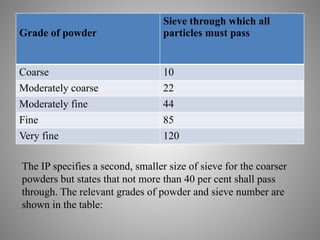
‱ The IP specifies five grades of powder and the number of the sieve
through which all the particles must pass.
Grade of powder
Sieve through which all
particles must pass
Coarse 10
Moderately coarse 22
Moderately fine 44
Fine 85
Very fine 120
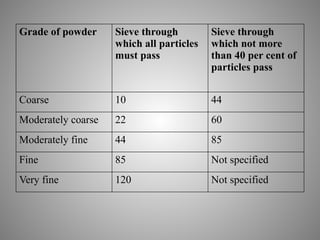
The IP specifies a second, smaller size of sieve for the coarser
powders but states that not more than 40 per cent shall pass
through. The relevant grades of powder and sieve number are
shown in the table:
Grade of powder Sieve through
which all particles
must pass
Sieve through
which not more
than 40 per cent of
particles pass
Coarse 10 44
Moderately coarse 22 60
Moderately fine 44 85
Fine 85 Not specified
Very fine 120 Not specified
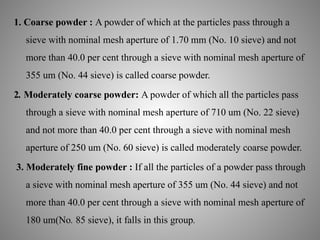
1. Coarse powder : A powder of which at the particles pass through a
sieve with nominal mesh aperture of 1.70 mm (No. 10 sieve) and not
more than 40.0 per cent through a sieve with nominal mesh aperture of
355 um (No. 44 sieve) is called coarse powder.
2. Moderately coarse powder: A powder of which all the particles pass
through a sieve with nominal mesh aperture of 710 um (No. 22 sieve)
and not more than 40.0 per cent through a sieve with nominal mesh
aperture of 250 um (No. 60 sieve) is called moderately coarse powder.
3. Moderately fine powder : If all the particles of a powder pass through
a sieve with nominal mesh aperture of 355 um (No. 44 sieve) and not
more than 40.0 per cent through a sieve with nominal mesh aperture of
180 um(No. 85 sieve), it falls in this group.
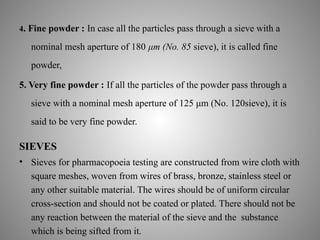
4. Fine powder : In case all the particles pass through a sieve with a
nominal mesh aperture of 180 ÎŒm (No. 85 sieve), it is called fine
powder,
5. Very fine powder : If all the particles of the powder pass through a
sieve with a nominal mesh aperture of 125 ÎŒm (No. 120sieve), it is
said to be very fine powder.
SIEVES
‱ Sieves for pharmacopoeia testing are constructed from wire cloth with
square meshes, woven from wires of brass, bronze, stainless steel or
any other suitable material. The wires should be of uniform circular
cross-section and should not be coated or plated. There should not be
any reaction between the material of the sieve and the substance
which is being sifted from it.
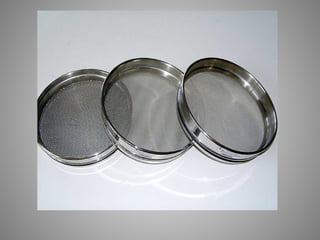
Types of Sieves:
1. Woven Wire sieves: These are general purpose sieves and
widely used in pharmacy practice. Types: a) Plain Weave b)
Twilled Weave
2. Bolting cloth Sieves: Silk, nylon and cotton are generally used.
These used for separation of fine powders.
3. Bar screen: These are used in handling large and heavy pieces
of materials.
4. Punched Plates (Perforated screen): These are used for coarse
sizing.
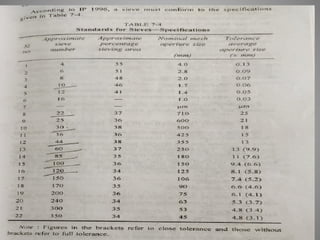
‱ Standards for sieves used for pharmacopoeia testing must
specify the following:
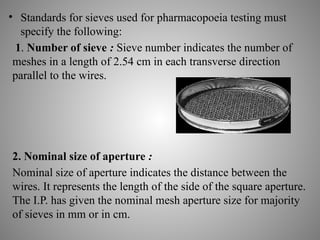
1. Number of sieve : Sieve number indicates the number of
meshes in a length of 2.54 cm in each transverse direction
parallel to the wires.
2. Nominal size of aperture :
Nominal size of aperture indicates the distance between the
wires. It represents the length of the side of the square aperture.
The I.P. has given the nominal mesh aperture size for majority
of sieves in mm or in cm.
3. Nominal diameter of the wire : Wire mesh sieves are
made from the wire having the specified diameter in order to give a
suitable aperture size an sufficient strength to avoid distortion of the
sieve.
4. Approximate percentage sieving area : This standard
expresses the area of the meshes a percentage of the total area of the
sieve. It depends on the size of the wire used for any particular sieve
number. Generally the sieving area is kept within the range of 35 to
40 per cent in order to give suitable strength to the sieve.
5. Tolerance average aperture size :
Some variation in the aperture size is unavoidable and when
this variation is expressed as a percentage, it is known as the
'aperture tolerance average'.
The term tolerance is used in engineering practice to mean the
limits within which a particular quantity or dimension can be
allowed to vary and still be acceptable for the purpose for
which it is required.
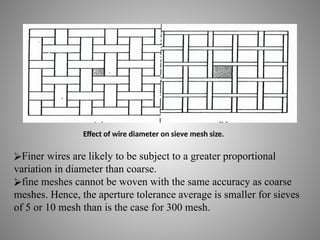
Effect of wire diameter on sieve mesh size.
⼚Finer wires are likely to be subject to a greater proportional
variation in diameter than coarse.
⼚fine meshes cannot be woven with the same accuracy as coarse
meshes. Hence, the aperture tolerance average is smaller for sieves
of 5 or 10 mesh than is the case for 300 mesh.
‱ SIEVING METHOD
‱ In this method, the fine powder is separated from the coarse powder
by using sieves of desired number. The degree of fineness of a powder
is known with the help of sieve through which the powdered material
is passed. Sieves are numbered in order to distinguish from each
other. Size separation of powder is done by passing the powdered
material through a set of sieves. Sieves are arranged in descending
order i.e. sieve of larger size is at the top and the smallest one at the
bottom. The bottom sieve is attached to the receiving pan.
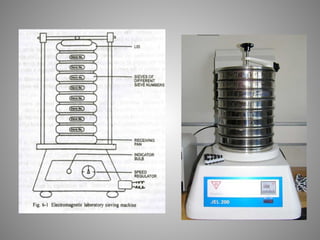
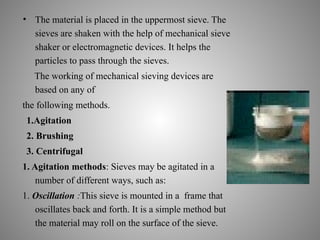
‱ The material is placed in the uppermost sieve. The
sieves are shaken with the help of mechanical sieve
shaker or electromagnetic devices. It helps the
particles to pass through the sieves.
The working of mechanical sieving devices are
based on any of
the following methods.
1.Agitation
2. Brushing
3. Centrifugal
1. Agitation methods: Sieves may be agitated in a
number of different ways, such as:
1. Oscillation :This sieve is mounted in a frame that
oscillates back and forth. It is a simple method but
the material may roll on the surface of the sieve.
2. Vibration : The sieve is vibrated at high speed by means of an electric device.
The rapid vibration is imparted to the particles on the sieve which helps to
pass the powdered material through it.
3. Gyration : In this method, a system is made so that sieve is on rubber
mounting and connected to an eccentric fly wheel. This gives a rotary
movement of small amplitude to sieve which in turn gives spinning motion to
the particles that helps to pass them through a sieve. Agitation methods are
not continuous methods‘ but can be made so by inclination of the sieve and
the provision of separate outlets for undersize and oversize particles.
2. Brushing methods: In this case, a brush is used to move the particles on the
surface of the sieve and to keep the meshes clear. The brush is rotated in the
middle in the case of a circular sieve but spiral brush is rotated on the
longitudinal axis in case Of a horizontal cylindrical sieve.
3. Centrifugal methods: In this method, a high speed rotor is fixed inside the
vertical cylindrical sieve, so that on rotation of rotor the particles are
thrown outwards by centrifugal force. The current of air which is produced
due to high speed of rotor helps in sieving the powder. On shaking the
powdered material in a mechanical or electromagnetic device using any of
the above methods, the weight of powder retained on each sieve is
determined. The percentage of each fraction is then calculated. Sieving
method is a rapid process and it requires very little skill. The equipment
used for sieving is not expensive.
Advantages:
1. centrifugal methods are extremely useful in cases where conventional
sieving tends to blocks the sieves.
2. Useful for fine powder, because sieves have the limitation of mesh size.
‱ Sieve Analysis- Testing of Powder
Size distribution analysis is important in different areas as:
1. quality control tool for the analysis of raw material
2. testing the efficiency of a size reduction equipment or process.
3. Optimizing the process conditions such as method of agitation, time of
screening.
4. Selecting the sieve system for commercial equipment.
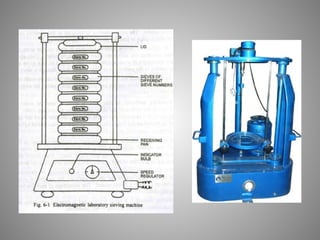
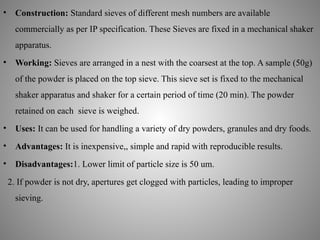
‱ Sieve Shaker Machine:
‱ Principle: The Powdered drug is separated according to its particle size
using a number of sieves in a nest. These are subjected to different types of
agitation, so that size separation is rapid.
‱ Construction: Standard sieves of different mesh numbers are available
commercially as per IP specification. These Sieves are fixed in a mechanical shaker
apparatus.
‱ Working: Sieves are arranged in a nest with the coarsest at the top. A sample (50g)
of the powder is placed on the top sieve. This sieve set is fixed to the mechanical
shaker apparatus and shaker for a certain period of time (20 min). The powder
retained on each sieve is weighed.
‱ Uses: It can be used for handling a variety of dry powders, granules and dry foods.
‱ Advantages: It is inexpensive,, simple and rapid with reproducible results.
‱ Disadvantages:1. Lower limit of particle size is 50 um.
2. If powder is not dry, apertures get clogged with particles, leading to improper
sieving.
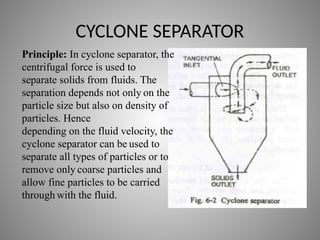
CYCLONE SEPARATOR
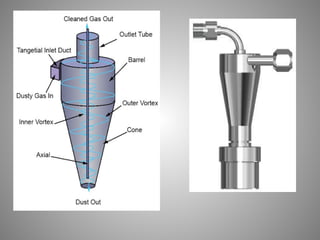
Principle: In cyclone separator, the
centrifugal force is used to
separate solids from fluids. The
separation depends not only on the
particle size but also on density of
particles. Hence
depending on the fluid velocity, the
cyclone separator can be used to
separate all types of particles or to
remove only coarse particles and
allow fine particles to be carried
through with the fluid.
‱ Construction: It consists of a cylindrical vessel with a conical
base. In the upper part of the vessel is fitted with a tangential
inlet and a fluid outlet and at the base it is fitted with solid
outlet.
‱ Working: The suspension of a solid in gas (usually air) is
introduced tangentially at a very high velocity, so that rotary
movement takes place within the vessel. The fluid is removed
from a central outlet at the top. The rotatory flow within the
cyclone separator causes the particles to be acted on by
centrifugal force. The solids are thrown out to the walls, there
after it falls to the conical base and discharged out through
solids outlet.
Uses:
1. Cyclone separators are used to separate the suspension of a solid in a gas (air).
2. It can be used with liquid suspensions of solids.
3. It is used in oil refineries to separate oils and gases.
Advantages:
1. low capital cost.
2. Relative simplicity and few maintenance problems.
3. Low pressure drop.
4. Dry collection and disposal.
5. Relatively small space requirement.
6. No moving part.
7. Can be used under extreme processing conditions.
‱ Disadvantages: inability to handle sticky material.
AIR SEPARATOR
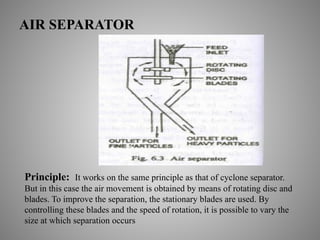
Principle: It works on the same principle as that of cyclone separator.
But in this case the air movement is obtained by means of rotating disc and
blades. To improve the separation, the stationary blades are used. By
controlling these blades and the speed of rotation, it is possible to vary the
size at which separation occurs
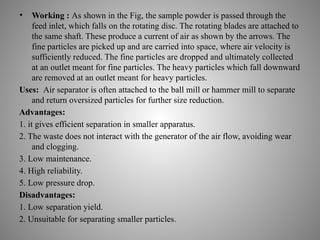
‱ Construction: It consists of a cylindrical vessel with a conical base. In the
upper part of the separator the vessel is fitted with feed inlet, and at the base
there are two outlets, one for line particles and other for heavy particles.
The rotating disc and rotating blades are attached to the central shaft, to
produce air movement
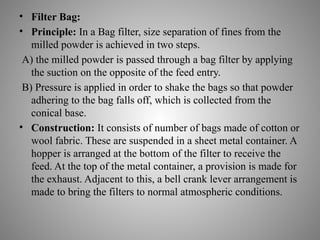
‱ Working : As shown in the Fig, the sample powder is passed through the
feed inlet, which falls on the rotating disc. The rotating blades are attached to
the same shaft. These produce a current of air as shown by the arrows. The
fine particles are picked up and are carried into space, where air velocity is
sufficiently reduced. The fine particles are dropped and ultimately collected
at an outlet meant for fine particles. The heavy particles which fall downward
are removed at an outlet meant for heavy particles.
Uses: Air separator is often attached to the ball mill or hammer mill to separate
and return oversized particles for further size reduction.
Advantages:
1. it gives efficient separation in smaller apparatus.
2. The waste does not interact with the generator of the air flow, avoiding wear
and clogging.
3. Low maintenance.
4. High reliability.
5. Low pressure drop.
Disadvantages:
1. Low separation yield.
2. Unsuitable for separating smaller particles.
‱ Filter Bag:
‱ Principle: In a Bag filter, size separation of fines from the
milled powder is achieved in two steps.
A) the milled powder is passed through a bag filter by applying
the suction on the opposite of the feed entry.
B) Pressure is applied in order to shake the bags so that powder
adhering to the bag falls off, which is collected from the
conical base.
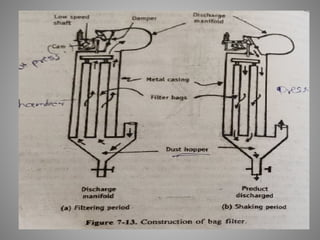
‱ Construction: It consists of number of bags made of cotton or
wool fabric. These are suspended in a sheet metal container. A
hopper is arranged at the bottom of the filter to receive the
feed. At the top of the metal container, a provision is made for
the exhaust. Adjacent to this, a bell crank lever arrangement is
made to bring the filters to normal atmospheric conditions.
‱ Working: A) Filtering period- during this period the vaccum fan
produces a pressure lower than the atmospheric pressure within the
vessel. Gas to be filtered enters the hopper, passes through the bags, and
out of the top of the apparatus. The particles are retained within the bags.
B) Shaking period- during this period the bell-cranck lever first close the
discharge manifold and air enters through the top so the vacuum is
broken. At the same time it gives a violent jerking action to the bags so
that they are freed from the dust. The fine particles are collected at the
conical base.
‱ Uses: 1. it is used along with other size separation equipment, e.g. a
cyclone separator.
2. They are use on the top of fluidized bed dryer for drying to separate the
dusts.
3. They are used to clean the air of a room.
‱ Advantages: 1. bag filter is extremely useful for removing fines, which
cannot be separated by other methods.
2. These can be used to remove dust.
3. No high voltage requirements.
‱ Disadvantage:
1. it has a high resistance which is about 600-1200 P.
2. collection of hygroscopic materials or condensation of
moisture can lead to fabric plugging loss of cleaning
efficiency, large pressure losses.
Pharmaceutical Engineering Size Separation

  • 1.
    SIZE SEPARATION Presented by:Miss. Pooja Nikam (Assistant professor)
  • 2.
    ‱ CONTENT: ‱ Objective ‱Applications ‱ Official standards of powders ‱ Sieves ‱ Size separation principle ‱ Sieve shaker machine ‱ Cyclone separator ‱ Air separator ‱ Bag filter ‱ Elutriation tank
  • 3.
    ‱ Size Separation ‱A special technique is used to separate particles of specified size which is known as the "process of size separation". ‱ Large pieces of material are usually estimated visually, difficulties arising only in the estimation of powders. size separation is a unit operation that involves the separation of mixture of various size of particles into two or more portion by means of screening surface also known as sieving, sifting, classifying or screening.
  • 4.
    Objectives: ‱ To obtainpowders of desired size distribution. ‱ To improve mixing ‱ To set a quality control parameter for raw material. ‱ To avoid the variations in physicochemical properties. Application: 1. Capsule filling: uniform size particles are easy to fill in the capsule giving good flow properties. 2. Tablet formulation: uniform particle size ensures good flow from hopper which avoids weight variation. 3. Removal of impurities on the basis of size. 4. To recover valuable products or byproducts.
  • 5.
    OFFICIAL STANDARDS FORPOWDERS ‱ Standards for powders for pharmaceutical purposes are laid down principally in the Indian Pharmacopoeia which states, that the degree of coarseness or fineness of a powder is differentiated and expressed by the size of the mesh of the sieve through which the powder is able to pass. ‱ The IP specifies five grades of powder and the number of the sieve through which all the particles must pass.
  • 6.
    Grade of powder Sievethrough which all particles must pass Coarse 10 Moderately coarse 22 Moderately fine 44 Fine 85 Very fine 120 The IP specifies a second, smaller size of sieve for the coarser powders but states that not more than 40 per cent shall pass through. The relevant grades of powder and sieve number are shown in the table:
  • 7.
    Grade of powderSieve through which all particles must pass Sieve through which not more than 40 per cent of particles pass Coarse 10 44 Moderately coarse 22 60 Moderately fine 44 85 Fine 85 Not specified Very fine 120 Not specified
  • 8.
    1. Coarse powder: A powder of which at the particles pass through a sieve with nominal mesh aperture of 1.70 mm (No. 10 sieve) and not more than 40.0 per cent through a sieve with nominal mesh aperture of 355 um (No. 44 sieve) is called coarse powder. 2. Moderately coarse powder: A powder of which all the particles pass through a sieve with nominal mesh aperture of 710 um (No. 22 sieve) and not more than 40.0 per cent through a sieve with nominal mesh aperture of 250 um (No. 60 sieve) is called moderately coarse powder. 3. Moderately fine powder : If all the particles of a powder pass through a sieve with nominal mesh aperture of 355 um (No. 44 sieve) and not more than 40.0 per cent through a sieve with nominal mesh aperture of 180 um(No. 85 sieve), it falls in this group.
  • 9.
    4. Fine powder: In case all the particles pass through a sieve with a nominal mesh aperture of 180 ÎŒm (No. 85 sieve), it is called fine powder, 5. Very fine powder : If all the particles of the powder pass through a sieve with a nominal mesh aperture of 125 ÎŒm (No. 120sieve), it is said to be very fine powder. SIEVES ‱ Sieves for pharmacopoeia testing are constructed from wire cloth with square meshes, woven from wires of brass, bronze, stainless steel or any other suitable material. The wires should be of uniform circular cross-section and should not be coated or plated. There should not be any reaction between the material of the sieve and the substance which is being sifted from it.
  • 10.
    Types of Sieves: 1.Woven Wire sieves: These are general purpose sieves and widely used in pharmacy practice. Types: a) Plain Weave b) Twilled Weave 2. Bolting cloth Sieves: Silk, nylon and cotton are generally used. These used for separation of fine powders. 3. Bar screen: These are used in handling large and heavy pieces of materials. 4. Punched Plates (Perforated screen): These are used for coarse sizing.
  • 13.
    ‱ Standards forsieves used for pharmacopoeia testing must specify the following: 1. Number of sieve : Sieve number indicates the number of meshes in a length of 2.54 cm in each transverse direction parallel to the wires. 2. Nominal size of aperture : Nominal size of aperture indicates the distance between the wires. It represents the length of the side of the square aperture. The I.P. has given the nominal mesh aperture size for majority of sieves in mm or in cm.
  • 14.
    3. Nominal diameterof the wire : Wire mesh sieves are made from the wire having the specified diameter in order to give a suitable aperture size an sufficient strength to avoid distortion of the sieve. 4. Approximate percentage sieving area : This standard expresses the area of the meshes a percentage of the total area of the sieve. It depends on the size of the wire used for any particular sieve number. Generally the sieving area is kept within the range of 35 to 40 per cent in order to give suitable strength to the sieve.
  • 15.
    5. Tolerance averageaperture size : Some variation in the aperture size is unavoidable and when this variation is expressed as a percentage, it is known as the 'aperture tolerance average'. The term tolerance is used in engineering practice to mean the limits within which a particular quantity or dimension can be allowed to vary and still be acceptable for the purpose for which it is required.
  • 16.
    Effect of wirediameter on sieve mesh size. ⼚Finer wires are likely to be subject to a greater proportional variation in diameter than coarse. ⼚fine meshes cannot be woven with the same accuracy as coarse meshes. Hence, the aperture tolerance average is smaller for sieves of 5 or 10 mesh than is the case for 300 mesh.
  • 17.
    ‱ SIEVING METHOD ‱In this method, the fine powder is separated from the coarse powder by using sieves of desired number. The degree of fineness of a powder is known with the help of sieve through which the powdered material is passed. Sieves are numbered in order to distinguish from each other. Size separation of powder is done by passing the powdered material through a set of sieves. Sieves are arranged in descending order i.e. sieve of larger size is at the top and the smallest one at the bottom. The bottom sieve is attached to the receiving pan.
  • 19.
    ‱ The materialis placed in the uppermost sieve. The sieves are shaken with the help of mechanical sieve shaker or electromagnetic devices. It helps the particles to pass through the sieves. The working of mechanical sieving devices are based on any of the following methods. 1.Agitation 2. Brushing 3. Centrifugal 1. Agitation methods: Sieves may be agitated in a number of different ways, such as: 1. Oscillation :This sieve is mounted in a frame that oscillates back and forth. It is a simple method but the material may roll on the surface of the sieve.
  • 20.
    2. Vibration :The sieve is vibrated at high speed by means of an electric device. The rapid vibration is imparted to the particles on the sieve which helps to pass the powdered material through it. 3. Gyration : In this method, a system is made so that sieve is on rubber mounting and connected to an eccentric fly wheel. This gives a rotary movement of small amplitude to sieve which in turn gives spinning motion to the particles that helps to pass them through a sieve. Agitation methods are not continuous methods‘ but can be made so by inclination of the sieve and the provision of separate outlets for undersize and oversize particles. 2. Brushing methods: In this case, a brush is used to move the particles on the surface of the sieve and to keep the meshes clear. The brush is rotated in the middle in the case of a circular sieve but spiral brush is rotated on the longitudinal axis in case Of a horizontal cylindrical sieve.
  • 21.
    3. Centrifugal methods:In this method, a high speed rotor is fixed inside the vertical cylindrical sieve, so that on rotation of rotor the particles are thrown outwards by centrifugal force. The current of air which is produced due to high speed of rotor helps in sieving the powder. On shaking the powdered material in a mechanical or electromagnetic device using any of the above methods, the weight of powder retained on each sieve is determined. The percentage of each fraction is then calculated. Sieving method is a rapid process and it requires very little skill. The equipment used for sieving is not expensive. Advantages: 1. centrifugal methods are extremely useful in cases where conventional sieving tends to blocks the sieves. 2. Useful for fine powder, because sieves have the limitation of mesh size.
  • 22.
    ‱ Sieve Analysis-Testing of Powder Size distribution analysis is important in different areas as: 1. quality control tool for the analysis of raw material 2. testing the efficiency of a size reduction equipment or process. 3. Optimizing the process conditions such as method of agitation, time of screening. 4. Selecting the sieve system for commercial equipment. ‱ Sieve Shaker Machine: ‱ Principle: The Powdered drug is separated according to its particle size using a number of sieves in a nest. These are subjected to different types of agitation, so that size separation is rapid.
  • 24.
    ‱ Construction: Standardsieves of different mesh numbers are available commercially as per IP specification. These Sieves are fixed in a mechanical shaker apparatus. ‱ Working: Sieves are arranged in a nest with the coarsest at the top. A sample (50g) of the powder is placed on the top sieve. This sieve set is fixed to the mechanical shaker apparatus and shaker for a certain period of time (20 min). The powder retained on each sieve is weighed. ‱ Uses: It can be used for handling a variety of dry powders, granules and dry foods. ‱ Advantages: It is inexpensive,, simple and rapid with reproducible results. ‱ Disadvantages:1. Lower limit of particle size is 50 um. 2. If powder is not dry, apertures get clogged with particles, leading to improper sieving.
  • 25.
    CYCLONE SEPARATOR Principle: Incyclone separator, the centrifugal force is used to separate solids from fluids. The separation depends not only on the particle size but also on density of particles. Hence depending on the fluid velocity, the cyclone separator can be used to separate all types of particles or to remove only coarse particles and allow fine particles to be carried through with the fluid.
  • 26.
    ‱ Construction: Itconsists of a cylindrical vessel with a conical base. In the upper part of the vessel is fitted with a tangential inlet and a fluid outlet and at the base it is fitted with solid outlet. ‱ Working: The suspension of a solid in gas (usually air) is introduced tangentially at a very high velocity, so that rotary movement takes place within the vessel. The fluid is removed from a central outlet at the top. The rotatory flow within the cyclone separator causes the particles to be acted on by centrifugal force. The solids are thrown out to the walls, there after it falls to the conical base and discharged out through solids outlet.
  • 28.
    Uses: 1. Cyclone separatorsare used to separate the suspension of a solid in a gas (air). 2. It can be used with liquid suspensions of solids. 3. It is used in oil refineries to separate oils and gases. Advantages: 1. low capital cost. 2. Relative simplicity and few maintenance problems. 3. Low pressure drop. 4. Dry collection and disposal. 5. Relatively small space requirement. 6. No moving part. 7. Can be used under extreme processing conditions. ‱ Disadvantages: inability to handle sticky material.
  • 29.
    AIR SEPARATOR Principle: Itworks on the same principle as that of cyclone separator. But in this case the air movement is obtained by means of rotating disc and blades. To improve the separation, the stationary blades are used. By controlling these blades and the speed of rotation, it is possible to vary the size at which separation occurs
  • 30.
    ‱ Construction: Itconsists of a cylindrical vessel with a conical base. In the upper part of the separator the vessel is fitted with feed inlet, and at the base there are two outlets, one for line particles and other for heavy particles. The rotating disc and rotating blades are attached to the central shaft, to produce air movement
  • 31.
    ‱ Working :As shown in the Fig, the sample powder is passed through the feed inlet, which falls on the rotating disc. The rotating blades are attached to the same shaft. These produce a current of air as shown by the arrows. The fine particles are picked up and are carried into space, where air velocity is sufficiently reduced. The fine particles are dropped and ultimately collected at an outlet meant for fine particles. The heavy particles which fall downward are removed at an outlet meant for heavy particles. Uses: Air separator is often attached to the ball mill or hammer mill to separate and return oversized particles for further size reduction. Advantages: 1. it gives efficient separation in smaller apparatus. 2. The waste does not interact with the generator of the air flow, avoiding wear and clogging. 3. Low maintenance. 4. High reliability. 5. Low pressure drop. Disadvantages: 1. Low separation yield. 2. Unsuitable for separating smaller particles.
  • 32.
    ‱ Filter Bag: ‱Principle: In a Bag filter, size separation of fines from the milled powder is achieved in two steps. A) the milled powder is passed through a bag filter by applying the suction on the opposite of the feed entry. B) Pressure is applied in order to shake the bags so that powder adhering to the bag falls off, which is collected from the conical base. ‱ Construction: It consists of number of bags made of cotton or wool fabric. These are suspended in a sheet metal container. A hopper is arranged at the bottom of the filter to receive the feed. At the top of the metal container, a provision is made for the exhaust. Adjacent to this, a bell crank lever arrangement is made to bring the filters to normal atmospheric conditions.
  • 34.
    ‱ Working: A)Filtering period- during this period the vaccum fan produces a pressure lower than the atmospheric pressure within the vessel. Gas to be filtered enters the hopper, passes through the bags, and out of the top of the apparatus. The particles are retained within the bags. B) Shaking period- during this period the bell-cranck lever first close the discharge manifold and air enters through the top so the vacuum is broken. At the same time it gives a violent jerking action to the bags so that they are freed from the dust. The fine particles are collected at the conical base. ‱ Uses: 1. it is used along with other size separation equipment, e.g. a cyclone separator. 2. They are use on the top of fluidized bed dryer for drying to separate the dusts. 3. They are used to clean the air of a room. ‱ Advantages: 1. bag filter is extremely useful for removing fines, which cannot be separated by other methods. 2. These can be used to remove dust. 3. No high voltage requirements.
  • 35.
    ‱ Disadvantage: 1. ithas a high resistance which is about 600-1200 P. 2. collection of hygroscopic materials or condensation of moisture can lead to fabric plugging loss of cleaning efficiency, large pressure losses.