SIEM POC Assessment
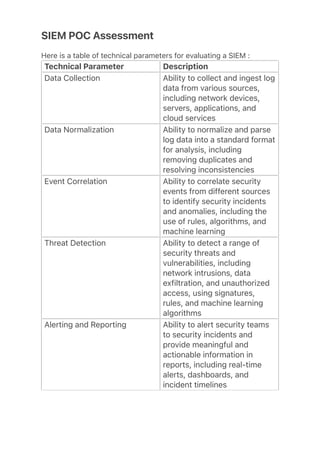
Here is a table of technical parameters for evaluating a SIEM :
Technical Parameter Description
Data Collection Ability to collect and ingest log
data from various sources,
including network devices,
servers, applications, and
cloud services
Data Normalization Ability to normalize and parse
log data into a standard format
for analysis, including
removing duplicates and
resolving inconsistencies
Event Correlation Ability to correlate security
events from different sources
to identify security incidents
and anomalies, including the
use of rules, algorithms, and
machine learning
Threat Detection Ability to detect a range of
security threats and
vulnerabilities, including
network intrusions, data
exfiltration, and unauthorized
access, using signatures,
rules, and machine learning
algorithms
Alerting and Reporting Ability to alert security teams
to security incidents and
provide meaningful and
actionable information in
reports, including real-time
alerts, dashboards, and
incident timelines
Incident Response Ability to provide a streamlined
and efficient process for
incident response and
escalation, including incident
prioritization, assignment, and
tracking
reports, including real-time
alerts, dashboards, and
incident timelines
Incident Response Ability to provide a streamlined
and efficient process for
incident response and
escalation, including incident
prioritization, assignment, and
tracking
User Management Ability to control access and
manage user accounts,
permissions, and roles,
including role-based access
control and audit trails
Data Privacy and Security Measures in place to protect
the privacy and security of log
data stored in the SIEM
system, including encryption,
access controls, and data
retention policies
Scalability and Performance Ability to scale to meet the
demands of a large and
complex network environment,
including the ability to handle
high volumes of log data and
handle multiple concurrent
users
Integration with Other Security
Tools
Ability to integrate with other
security tools and systems to
provide a unified view of the
organization's security
posture, including security
information and event
management (SIEM), security
orchestration, automation and
response (SOAR), and security
analytics tools
This table provides a more comprehensive set of technical
parameters for evaluating a SIEM during Proof of Concept (POC).
Evaluating these parameters can provide a deeper understanding of
the SIEM system's capabilities and help determine its suitability for
full deployment in your organization's network environment.
Produced By: Reza Adineh
Think Smarter, Stay Secure …

SIEM POC Assessment.pdf

  • 1.
    SIEM POC Assessment Hereis a table of technical parameters for evaluating a SIEM : Technical Parameter Description Data Collection Ability to collect and ingest log data from various sources, including network devices, servers, applications, and cloud services Data Normalization Ability to normalize and parse log data into a standard format for analysis, including removing duplicates and resolving inconsistencies Event Correlation Ability to correlate security events from different sources to identify security incidents and anomalies, including the use of rules, algorithms, and machine learning Threat Detection Ability to detect a range of security threats and vulnerabilities, including network intrusions, data exfiltration, and unauthorized access, using signatures, rules, and machine learning algorithms Alerting and Reporting Ability to alert security teams to security incidents and provide meaningful and actionable information in reports, including real-time alerts, dashboards, and incident timelines Incident Response Ability to provide a streamlined and efficient process for incident response and escalation, including incident prioritization, assignment, and tracking
  • 2.
    reports, including real-time alerts,dashboards, and incident timelines Incident Response Ability to provide a streamlined and efficient process for incident response and escalation, including incident prioritization, assignment, and tracking User Management Ability to control access and manage user accounts, permissions, and roles, including role-based access control and audit trails Data Privacy and Security Measures in place to protect the privacy and security of log data stored in the SIEM system, including encryption, access controls, and data retention policies Scalability and Performance Ability to scale to meet the demands of a large and complex network environment, including the ability to handle high volumes of log data and handle multiple concurrent users Integration with Other Security Tools Ability to integrate with other security tools and systems to provide a unified view of the organization's security posture, including security information and event management (SIEM), security orchestration, automation and response (SOAR), and security analytics tools This table provides a more comprehensive set of technical parameters for evaluating a SIEM during Proof of Concept (POC). Evaluating these parameters can provide a deeper understanding of the SIEM system's capabilities and help determine its suitability for full deployment in your organization's network environment.
  • 3.
    Produced By: RezaAdineh Think Smarter, Stay Secure …