







OPTIMIZING
SECURITY
OPERATIONS
FIVE KEYS
TO SUCCESS
www.siriuscom.com
Sirius is a national integrator of technology-
based business solutions that span the
enterprise, including the data center and
lines of business. Built on products and
services from the world’s top technology
companies, Sirius solutions are installed,
configured and supported by our dedicated
teams of highly certified experts.
Sponsored by
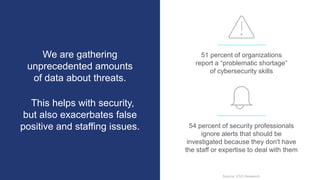
We are gathering
unprecedented amounts
of data about threats.
This helps with security,
but also exacerbates false
positive and staffing issues. 54 percent of security professionals
ignore alerts that should be
investigated because they don't have
the staff or expertise to deal with them
51 percent of organizations
report a “problematic shortage”
of cybersecurity skills
Source: ESG Research
Too many alerts, too many
technologies, and not
enough people!
THE RESULT…
CYBER FATIGUE
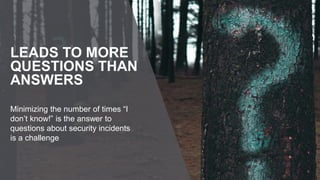
Minimizing the number of times “I
don’t know!” is the answer to
questions about security incidents
is a challenge
LEADS TO MORE
QUESTIONS THAN
ANSWERS
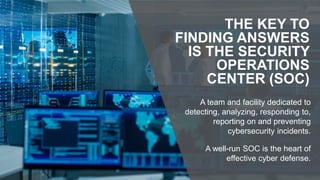
A team and facility dedicated to
detecting, analyzing, responding to,
reporting on and preventing
cybersecurity incidents.
A well-run SOC is the heart of
effective cyber defense.
THE KEY TO
FINDING ANSWERS
IS THE SECURITY
OPERATIONS
CENTER (SOC)
Ask yourself:
WHICH BEST DESCRIBES
YOUR COMPANY’S CURRENT
SECOPs CAPABILITIES?
a) We have a SIEM
b) We have a fully staffed, on-prem SOC
c) We have an on-prem SOC, but it’s not fully staffed
d) We have a small team, and managed services
e) We’re just now building out our operations
5 KEYS TO OPTIMIZING
SECURITY OPERATIONS
Determine the right approach
For your business
ONE
EVALUATE
SOC MODELS
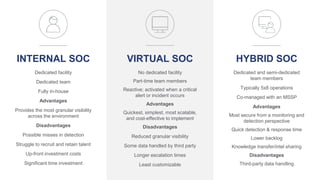
INTERNAL SOC
Dedicated facility
Dedicated team
Fully in-house
Advantages
Provides the most granular visibility
across the environment
Disadvantages
Possible misses in detection
Struggle to recruit and retain talent
Up-front investment costs
Significant time investment
VIRTUAL SOC
No dedicated facility
Part-time team members
Reactive; activated when a critical
alert or incident occurs
Advantages
Quickest, simplest, most scalable,
and cost-effective to implement
Disadvantages
Reduced granular visibility
Some data handled by third party
Longer escalation times
Least customizable
HYBRID SOC
Dedicated and semi-dedicated
team members
Typically 5x8 operations
Co-managed with an MSSP
Advantages
Most secure from a monitoring and
detection perspective
Quick detection & response time
Lower backlog
Knowledge transfer/intel sharing
Disadvantages
Third-party data handling
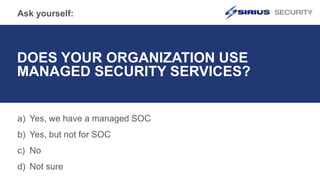
Ask yourself:
DOES YOUR ORGANIZATION USE
MANAGED SECURITY SERVICES?
a) Yes, we have a managed SOC
b) Yes, but not for SOC
c) No
d) Not sure
Many companies rely heavily on SIEM to
support compliance and threat detection
efforts. While SIEM is a critical tool,
organizations are increasingly
complementing their deployments with
solutions that really take their analytics
capabilities to the next level.
TWO
IMPLEMENT
ADVANCED
ANALYTICS
Consider the following questions:
• What security controls do you have in your environment? When was the last time your technology was evaluated?
• Do you have the visibility you need into your business activities, and the assets that are most likely to be targeted by
cyber adversaries?
• Can your security controls ingest and display threat intelligence delivered in a variety of formats (XML, CSV, and JSON)
in the form of indicators, tags, labels, text, and reports?
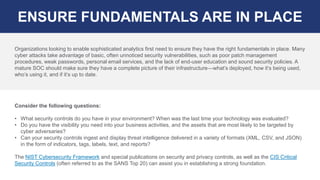
The NIST Cybersecurity Framework and special publications on security and privacy controls, as well as the CIS Critical
Security Controls (often referred to as the SANS Top 20) can assist you in establishing a strong foundation.
ENSURE FUNDAMENTALS ARE IN PLACE
Organizations looking to enable sophisticated analytics first need to ensure they have the right fundamentals in place. Many
cyber attacks take advantage of basic, often unnoticed security vulnerabilities, such as poor patch management
procedures, weak passwords, personal email services, and the lack of end-user education and sound security policies. A
mature SOC should make sure they have a complete picture of their infrastructure—what’s deployed, how it’s being used,
who’s using it, and if it’s up to date.
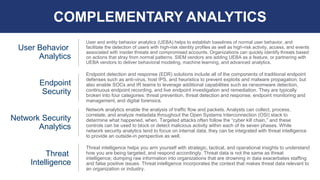
User and entity behavior analytics (UEBA) helps to establish baselines of normal user behavior, and
facilitate the detection of users with high-risk identity profiles as well as high-risk activity, access, and events
associated with insider threats and compromised accounts. Organizations can quickly identify threats based
on actions that stray from normal patterns. SIEM vendors are adding UEBA as a feature, or partnering with
UEBA vendors to deliver behavioral modeling, machine learning, and advanced analytics.
User Behavior
Analytics
COMPLEMENTARY ANALYTICS
Endpoint detection and response (EDR) solutions include all of the components of traditional endpoint
defenses such as anti-virus, host IPS, and heuristics to prevent exploits and malware propagation, but
also enable SOCs and IR teams to leverage additional capabilities such as ransomware detection,
continuous endpoint recording, and live endpoint investigation and remediation. They are typically
broken into four categories: threat prevention, threat detection and response, endpoint monitoring and
management, and digital forensics.
Network analytics enable the analysis of traffic flow and packets. Analysts can collect, process,
correlate, and analyze metadata throughout the Open Systems Interconnection (OSI) stack to
determine what happened, when. Targeted attacks often follow the “cyber kill chain,” and these
controls can be used to block or detect malicious activity within each of its seven phases. While
network security analytics tend to focus on internal data, they can be integrated with threat intelligence
to provide an outside-in perspective as well.
Threat intelligence helps you arm yourself with strategic, tactical, and operational insights to understand
how you are being targeted, and respond accordingly. Threat data is not the same as threat
intelligence; dumping raw information into organizations that are drowning in data exacerbates staffing
and false positive issues. Threat intelligence incorporates the context that makes threat data relevant to
an organization or industry.
Endpoint
Security
Threat
Intelligence
Network Security
Analytics
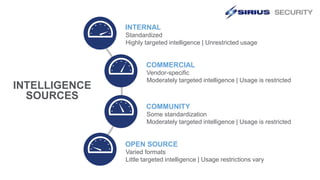
INTERNAL
Standardized
Highly targeted intelligence | Unrestricted usage
COMMERCIAL
Vendor-specific
Moderately targeted intelligence | Usage is restricted
Some standardization
Moderately targeted intelligence | Usage is restricted
COMMUNITY
Varied formats
Little targeted intelligence | Usage restrictions vary
OPEN SOURCE
INTELLIGENCE
SOURCES
Enable analysts to make better decisions
from better data
THREE
INTEGRATE
CONTROLS &
AUTOMATE
PROCESSES
17
FOUR
BOOST INCIDENT
RESPONSE
Triage detected threats and avoid
bottlenecks in IR processes
19
20
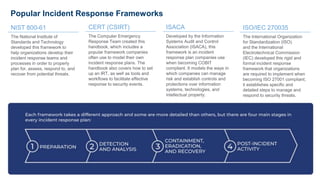
Popular Incident Response Frameworks
NIST 800-61
The National Institute of
Standards and Technology
developed this framework to
help organizations develop their
incident response teams and
processes in order to properly
plan for, assess, respond to, and
recover from potential threats.
CERT (CSIRT)
The Computer Emergency
Response Team created this
handbook, which includes a
popular framework companies
often use to model their own
incident response plans. The
handbook also covers how to set
up an IRT, as well as tools and
workflows to facilitate effective
response to security events.
ISACA
Developed by the Information
Systems Audit and Control
Association (ISACA), this
framework is an incident
response plan companies use
when becoming COBIT
compliant. It models the ways in
which companies can manage
risk and establish controls and
protections over information
systems, technologies, and
intellectual property.
ISO/IEC 270035
The International Organization
for Standardization (ISO)
and the International
Electrotechnical Commission
(IEC) developed this rigid and
formal incident response
framework that organizations
are required to implement when
becoming ISO 27001 compliant;
it establishes specific and
detailed steps to manage and
respond to security threats.
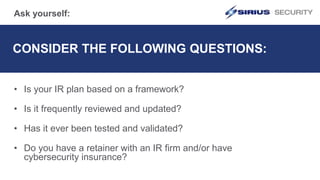
CONSIDER THE FOLLOWING QUESTIONS:
• Is your IR plan based on a framework?
• Is it frequently reviewed and updated?
• Has it ever been tested and validated?
• Do you have a retainer with an IR firm and/or have
cybersecurity insurance?
Ask yourself:
FIVE
MEASURE YOUR
EFFORTS
Report the performance of people,
processes, and technologies
Detect and respond to incidents
Identify threats and vulnerabilities
Document activities
for management,
auditors, and regulators
BUILDING
NEXT-GEN
SECURITY
OPERATIONS
http://focus.forsythe.com/articles/627/5-Keys-to-
Optimizing-Security-Operations
CHECK OUT THE
ORIGINAL ARTICLE:
http://focus.forsythe.com
OR FIND MORE ARTICLES ABOUT
BUSINESS AND TECHNOLOGY
SOLUTIONS AT FOCUS ONLINE:
Author:
Chris Hoke
Managing Director, Security, Sirius
Jose Ferreira
Security Solutions Territory Manager, Sirius
www.siriuscom.com
Sirius is a national integrator of technology-
based business solutions that span the
enterprise, including the data center and
lines of business. Built on products and
services from the world’s top technology
companies, Sirius solutions are installed,
configured and supported by our dedicated
teams of highly certified experts.
Optimizing Security Operations: 5 Keys to Success

Optimizing Security Operations: 5 Keys to Success

  • 1.
  • 2.
    www.siriuscom.com Sirius is anational integrator of technology- based business solutions that span the enterprise, including the data center and lines of business. Built on products and services from the world’s top technology companies, Sirius solutions are installed, configured and supported by our dedicated teams of highly certified experts. Sponsored by
  • 3.
    We are gathering unprecedentedamounts of data about threats. This helps with security, but also exacerbates false positive and staffing issues. 54 percent of security professionals ignore alerts that should be investigated because they don't have the staff or expertise to deal with them 51 percent of organizations report a “problematic shortage” of cybersecurity skills Source: ESG Research
  • 4.
    Too many alerts,too many technologies, and not enough people! THE RESULT… CYBER FATIGUE
  • 5.
    Minimizing the numberof times “I don’t know!” is the answer to questions about security incidents is a challenge LEADS TO MORE QUESTIONS THAN ANSWERS
  • 6.
    A team andfacility dedicated to detecting, analyzing, responding to, reporting on and preventing cybersecurity incidents. A well-run SOC is the heart of effective cyber defense. THE KEY TO FINDING ANSWERS IS THE SECURITY OPERATIONS CENTER (SOC)
  • 7.
    Ask yourself: WHICH BESTDESCRIBES YOUR COMPANY’S CURRENT SECOPs CAPABILITIES? a) We have a SIEM b) We have a fully staffed, on-prem SOC c) We have an on-prem SOC, but it’s not fully staffed d) We have a small team, and managed services e) We’re just now building out our operations
  • 8.
    5 KEYS TOOPTIMIZING SECURITY OPERATIONS
  • 9.
    Determine the rightapproach For your business ONE EVALUATE SOC MODELS
  • 10.
    INTERNAL SOC Dedicated facility Dedicatedteam Fully in-house Advantages Provides the most granular visibility across the environment Disadvantages Possible misses in detection Struggle to recruit and retain talent Up-front investment costs Significant time investment VIRTUAL SOC No dedicated facility Part-time team members Reactive; activated when a critical alert or incident occurs Advantages Quickest, simplest, most scalable, and cost-effective to implement Disadvantages Reduced granular visibility Some data handled by third party Longer escalation times Least customizable HYBRID SOC Dedicated and semi-dedicated team members Typically 5x8 operations Co-managed with an MSSP Advantages Most secure from a monitoring and detection perspective Quick detection & response time Lower backlog Knowledge transfer/intel sharing Disadvantages Third-party data handling
  • 11.
    Ask yourself: DOES YOURORGANIZATION USE MANAGED SECURITY SERVICES? a) Yes, we have a managed SOC b) Yes, but not for SOC c) No d) Not sure
  • 12.
    Many companies relyheavily on SIEM to support compliance and threat detection efforts. While SIEM is a critical tool, organizations are increasingly complementing their deployments with solutions that really take their analytics capabilities to the next level. TWO IMPLEMENT ADVANCED ANALYTICS
  • 13.
    Consider the followingquestions: • What security controls do you have in your environment? When was the last time your technology was evaluated? • Do you have the visibility you need into your business activities, and the assets that are most likely to be targeted by cyber adversaries? • Can your security controls ingest and display threat intelligence delivered in a variety of formats (XML, CSV, and JSON) in the form of indicators, tags, labels, text, and reports? The NIST Cybersecurity Framework and special publications on security and privacy controls, as well as the CIS Critical Security Controls (often referred to as the SANS Top 20) can assist you in establishing a strong foundation. ENSURE FUNDAMENTALS ARE IN PLACE Organizations looking to enable sophisticated analytics first need to ensure they have the right fundamentals in place. Many cyber attacks take advantage of basic, often unnoticed security vulnerabilities, such as poor patch management procedures, weak passwords, personal email services, and the lack of end-user education and sound security policies. A mature SOC should make sure they have a complete picture of their infrastructure—what’s deployed, how it’s being used, who’s using it, and if it’s up to date.
  • 14.
    User and entitybehavior analytics (UEBA) helps to establish baselines of normal user behavior, and facilitate the detection of users with high-risk identity profiles as well as high-risk activity, access, and events associated with insider threats and compromised accounts. Organizations can quickly identify threats based on actions that stray from normal patterns. SIEM vendors are adding UEBA as a feature, or partnering with UEBA vendors to deliver behavioral modeling, machine learning, and advanced analytics. User Behavior Analytics COMPLEMENTARY ANALYTICS Endpoint detection and response (EDR) solutions include all of the components of traditional endpoint defenses such as anti-virus, host IPS, and heuristics to prevent exploits and malware propagation, but also enable SOCs and IR teams to leverage additional capabilities such as ransomware detection, continuous endpoint recording, and live endpoint investigation and remediation. They are typically broken into four categories: threat prevention, threat detection and response, endpoint monitoring and management, and digital forensics. Network analytics enable the analysis of traffic flow and packets. Analysts can collect, process, correlate, and analyze metadata throughout the Open Systems Interconnection (OSI) stack to determine what happened, when. Targeted attacks often follow the “cyber kill chain,” and these controls can be used to block or detect malicious activity within each of its seven phases. While network security analytics tend to focus on internal data, they can be integrated with threat intelligence to provide an outside-in perspective as well. Threat intelligence helps you arm yourself with strategic, tactical, and operational insights to understand how you are being targeted, and respond accordingly. Threat data is not the same as threat intelligence; dumping raw information into organizations that are drowning in data exacerbates staffing and false positive issues. Threat intelligence incorporates the context that makes threat data relevant to an organization or industry. Endpoint Security Threat Intelligence Network Security Analytics
  • 15.
    INTERNAL Standardized Highly targeted intelligence| Unrestricted usage COMMERCIAL Vendor-specific Moderately targeted intelligence | Usage is restricted Some standardization Moderately targeted intelligence | Usage is restricted COMMUNITY Varied formats Little targeted intelligence | Usage restrictions vary OPEN SOURCE INTELLIGENCE SOURCES
  • 16.
    Enable analysts tomake better decisions from better data THREE INTEGRATE CONTROLS & AUTOMATE PROCESSES
  • 17.
  • 18.
    FOUR BOOST INCIDENT RESPONSE Triage detectedthreats and avoid bottlenecks in IR processes
  • 19.
  • 20.
    20 Popular Incident ResponseFrameworks NIST 800-61 The National Institute of Standards and Technology developed this framework to help organizations develop their incident response teams and processes in order to properly plan for, assess, respond to, and recover from potential threats. CERT (CSIRT) The Computer Emergency Response Team created this handbook, which includes a popular framework companies often use to model their own incident response plans. The handbook also covers how to set up an IRT, as well as tools and workflows to facilitate effective response to security events. ISACA Developed by the Information Systems Audit and Control Association (ISACA), this framework is an incident response plan companies use when becoming COBIT compliant. It models the ways in which companies can manage risk and establish controls and protections over information systems, technologies, and intellectual property. ISO/IEC 270035 The International Organization for Standardization (ISO) and the International Electrotechnical Commission (IEC) developed this rigid and formal incident response framework that organizations are required to implement when becoming ISO 27001 compliant; it establishes specific and detailed steps to manage and respond to security threats.
  • 21.
    CONSIDER THE FOLLOWINGQUESTIONS: • Is your IR plan based on a framework? • Is it frequently reviewed and updated? • Has it ever been tested and validated? • Do you have a retainer with an IR firm and/or have cybersecurity insurance? Ask yourself:
  • 22.
    FIVE MEASURE YOUR EFFORTS Report theperformance of people, processes, and technologies
  • 23.
    Detect and respondto incidents Identify threats and vulnerabilities Document activities for management, auditors, and regulators BUILDING NEXT-GEN SECURITY OPERATIONS
  • 24.
  • 25.
    http://focus.forsythe.com OR FIND MOREARTICLES ABOUT BUSINESS AND TECHNOLOGY SOLUTIONS AT FOCUS ONLINE:
  • 26.
    Author: Chris Hoke Managing Director,Security, Sirius Jose Ferreira Security Solutions Territory Manager, Sirius www.siriuscom.com Sirius is a national integrator of technology- based business solutions that span the enterprise, including the data center and lines of business. Built on products and services from the world’s top technology companies, Sirius solutions are installed, configured and supported by our dedicated teams of highly certified experts.