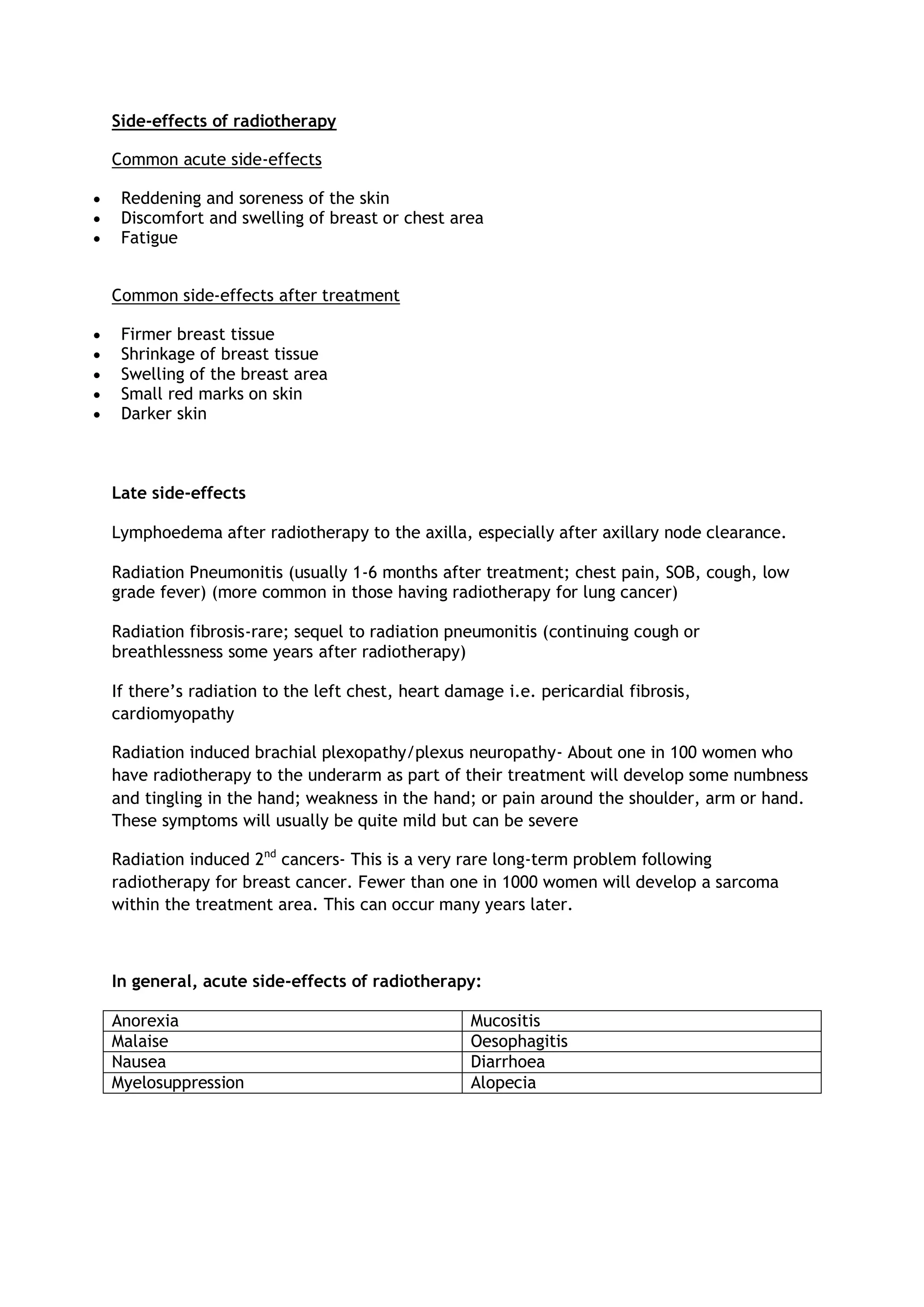
Side-effects of radiotherapy
Common acute side-effects
 Reddening and soreness of the skin
 Discomfort and swelling of breast or chest area
 Fatigue
Common side-effects after treatment
 Firmer breast tissue
 Shrinkage of breast tissue
 Swelling of the breast area
 Small red marks on skin
 Darker skin
Late side-effects
Lymphoedema after radiotherapy to the axilla, especially after axillary node clearance.
Radiation Pneumonitis (usually 1-6 months after treatment; chest pain, SOB, cough, low
grade fever) (more common in those having radiotherapy for lung cancer)
Radiation fibrosis-rare; sequel to radiation pneumonitis (continuing cough or
breathlessness some years after radiotherapy)
If there’s radiation to the left chest, heart damage i.e. pericardial fibrosis,
cardiomyopathy
Radiation induced brachial plexopathy/plexus neuropathy- About one in 100 women who
have radiotherapy to the underarm as part of their treatment will develop some numbness
and tingling in the hand; weakness in the hand; or pain around the shoulder, arm or hand.
These symptoms will usually be quite mild but can be severe
Radiation induced 2nd
cancers- This is a very rare long-term problem following
radiotherapy for breast cancer. Fewer than one in 1000 women will develop a sarcoma
within the treatment area. This can occur many years later.
In general, acute side-effects of radiotherapy:
Anorexia Mucositis
Malaise Oesophagitis
Nausea Diarrhoea
Myelosuppression Alopecia
Late side-effects
Skin Ischaemia, Ulceration
Bone Necrosis, fracture, sarcoma
Mouth Ulceration, xerostomia, sialitis
Bowel Stenosis, fistula, diarrhoea
Bladder Cystitis
CNS Myelopathy
Lung Fibrosis
Heart Pericardial fibrosis, cardiomyopathy
Gonads Infertility, menopause
Second Malignancies
Evidence: Radiation pneumonitis
Source 1
The incidence of radiation pneumonitis was correlated with the combined use of
chemotherapy (CT) and a third field. Three percent (11/328) of patients treated with a 3-
field technique who received chemotherapy developed radiation pneumonitis compared to
0.5% (6 of 1296) for all other patients (p = 0.0001). When patients treated with a 3-field
technique received chemotherapy concurrently with radiation therapy, the incidence of
radiation pneumonitis was 8.8% (8/92) compared with 1.3% (3/236) for those who received
sequential chemotherapy and radiation therapy (p = 0.002).
Int J RadiatOncolBiol Phys. 1991 Jul;21(2):355-60………Radiation pneumonitis in breast
cancer patients treated with conservative surgery and radiation therapy…..Lingos TI,
Recht A, Vicini F, Abner A, Silver B, Harris JR.
Source 2
British Journal of Cancer (2008) 98, 1870–1875. doi:10.1038/sj.bjc.6604393
www.bjcancer.com
Incidence of interstitial pneumonitis among breast cancer patients: a 10-year Danish
population-based cohort study
S Christensen1
, L Pedersen1
, M Grijota1
, J B Kornum1
, A Beiderbeck2
and H T Sørensen1,3
The SIR comparing breast cancer patients with the general population was 8.4 (95% CI:
5.7–11.9). Thus, although IP is a rare adverse event among breast cancer patients, its risk
is substantially higher than that in the general population.

Side-effects of radiotherapy

  • 1.
    Side-effects of radiotherapy Commonacute side-effects  Reddening and soreness of the skin  Discomfort and swelling of breast or chest area  Fatigue Common side-effects after treatment  Firmer breast tissue  Shrinkage of breast tissue  Swelling of the breast area  Small red marks on skin  Darker skin Late side-effects Lymphoedema after radiotherapy to the axilla, especially after axillary node clearance. Radiation Pneumonitis (usually 1-6 months after treatment; chest pain, SOB, cough, low grade fever) (more common in those having radiotherapy for lung cancer) Radiation fibrosis-rare; sequel to radiation pneumonitis (continuing cough or breathlessness some years after radiotherapy) If there’s radiation to the left chest, heart damage i.e. pericardial fibrosis, cardiomyopathy Radiation induced brachial plexopathy/plexus neuropathy- About one in 100 women who have radiotherapy to the underarm as part of their treatment will develop some numbness and tingling in the hand; weakness in the hand; or pain around the shoulder, arm or hand. These symptoms will usually be quite mild but can be severe Radiation induced 2nd cancers- This is a very rare long-term problem following radiotherapy for breast cancer. Fewer than one in 1000 women will develop a sarcoma within the treatment area. This can occur many years later. In general, acute side-effects of radiotherapy: Anorexia Mucositis Malaise Oesophagitis Nausea Diarrhoea Myelosuppression Alopecia
  • 2.
    Late side-effects Skin Ischaemia,Ulceration Bone Necrosis, fracture, sarcoma Mouth Ulceration, xerostomia, sialitis Bowel Stenosis, fistula, diarrhoea Bladder Cystitis CNS Myelopathy Lung Fibrosis Heart Pericardial fibrosis, cardiomyopathy Gonads Infertility, menopause Second Malignancies Evidence: Radiation pneumonitis Source 1 The incidence of radiation pneumonitis was correlated with the combined use of chemotherapy (CT) and a third field. Three percent (11/328) of patients treated with a 3- field technique who received chemotherapy developed radiation pneumonitis compared to 0.5% (6 of 1296) for all other patients (p = 0.0001). When patients treated with a 3-field technique received chemotherapy concurrently with radiation therapy, the incidence of radiation pneumonitis was 8.8% (8/92) compared with 1.3% (3/236) for those who received sequential chemotherapy and radiation therapy (p = 0.002). Int J RadiatOncolBiol Phys. 1991 Jul;21(2):355-60………Radiation pneumonitis in breast cancer patients treated with conservative surgery and radiation therapy…..Lingos TI, Recht A, Vicini F, Abner A, Silver B, Harris JR. Source 2 British Journal of Cancer (2008) 98, 1870–1875. doi:10.1038/sj.bjc.6604393 www.bjcancer.com Incidence of interstitial pneumonitis among breast cancer patients: a 10-year Danish population-based cohort study S Christensen1 , L Pedersen1 , M Grijota1 , J B Kornum1 , A Beiderbeck2 and H T Sørensen1,3 The SIR comparing breast cancer patients with the general population was 8.4 (95% CI: 5.7–11.9). Thus, although IP is a rare adverse event among breast cancer patients, its risk is substantially higher than that in the general population.