Mathematics Summit Southern Indiana Deanery: Focus on Mathematics Instruction
Standards for the Day Deepen understanding of creating  a mathematically literate classroom Apply a variety of strategies to support and promote the learning of mathematics Promote own and others’ learning through community conversation, collaboration and reflection
Agenda DAY I Grant Overview/Introduction Mini-lesson: connecting Mathematical Literacy  Vocabulary Development Routines- GOs and Word Walls Developing Classroom Discourse for Deeper Understanding DAY II Analysis of New Common Core State Standards Using Multiple Representations to Develop Deeper Understanding  Using Number lines and manipulatives to support conceptual understanding
Introductions Introduce yourself, let us know School, grade, experience (if you want) Something interesting you did or are going to do this summer Anything else you want to share! Be sure you have a name tag and have signed in
Project Overview- Part 1 6 days of PD during the year Developing curriculum, instructional practices, and resources that support mathematics instruction Provide teachers with feedback through: coaching, analysis of student work, & informal discussion
Project Overview- Part 2 2 days of summer training 1 st  Semester:  1 cadre day to be held at a school, during September/early October 2 x 1 day grade level coaching for each group (5/6, 7/8), late October/early November 2 nd  Semester:  1 cadre day, during late February/early March Distance support for mathematics teachers
Take a few moments to compare the  NCTM Processes and CCSS Practice Standards Guiding Questions:  How are the processes and practices similar?  How do they differ?  What do the new practices mean for my instruction? Indiana Transition Info
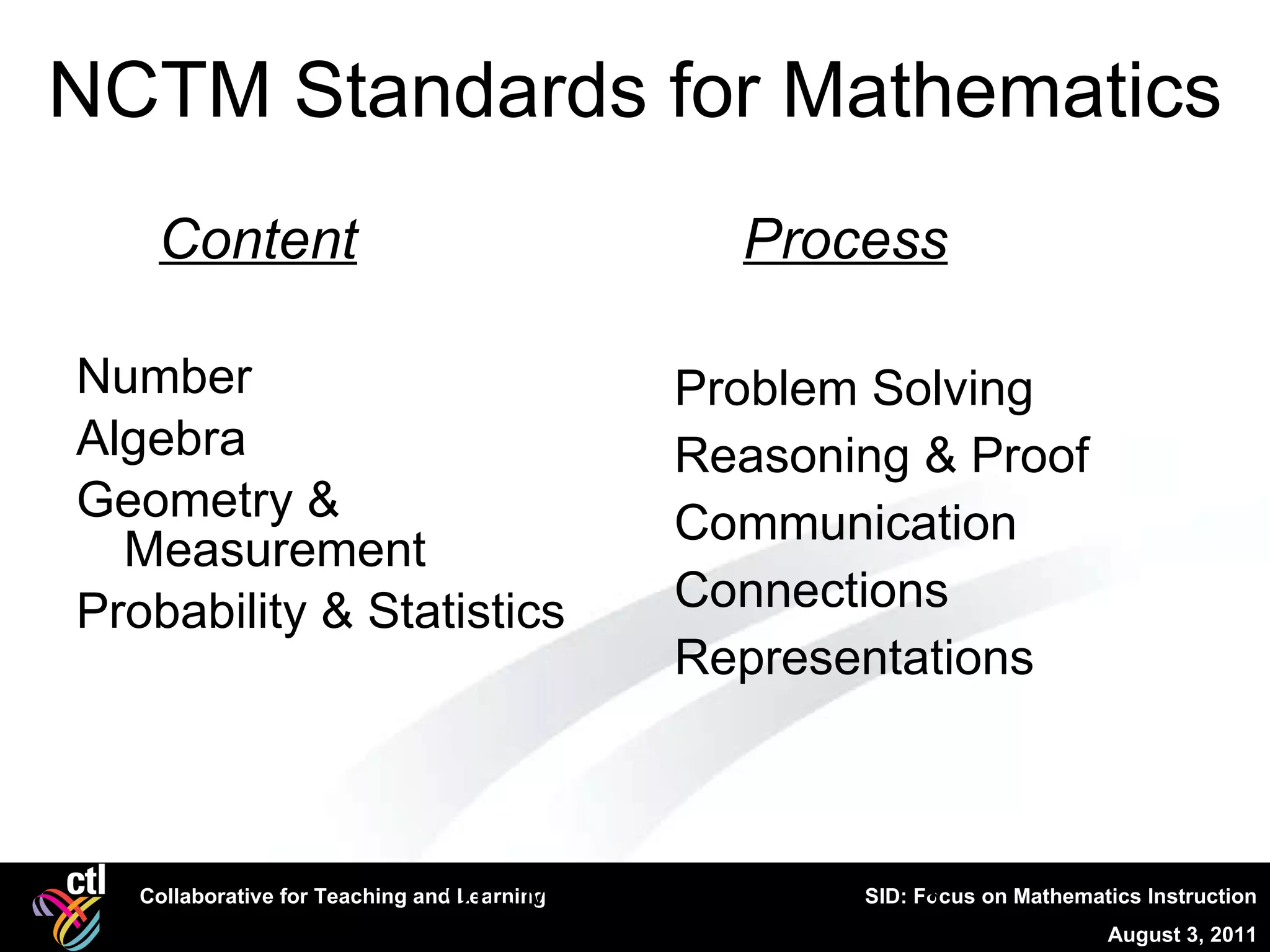
NCTM Standards for Mathematics Content Number Algebra Geometry & Measurement Probability & Statistics Process Problem Solving Reasoning & Proof Communication Connections Representations CTL, Mathematical Literacy
Instructional Programs  Pre K-12 Should Enable All Students To: Organize & consolidate their mathematical thinking through communication Communicate their mathematical thinking coherently and clearly to peers, teachers, and others Analyze & evaluate the mathematical thinking & strategies of others Use the language of mathematics to express mathematical ideas precisely ( NCTM Standards, p. 269) CTL, Mathematical Literacy
CCSS Content for Mathematics  Number and Operations k – 12  Algebra k – 5, 9 – 12  Measurement & Data k – 5  Geometry k – 12  Expressions & Equations 6 – 8  Proportionality 6 – 7  Statistics & Probability 6 – 12  Functions 8 – 12  Modeling 9 – 12  CCSS Mathematics Standards
CCSS Practices for Mathematics Make sense of problems/persevere in solving them. Reason abstractly and quantitatively. Construct viable arguments and critique the reasoning of others. Model with mathematics. Use appropriate tools strategically. Attend to precision. Look for and make use of structure. Look for and express regularity in repeated reasoning .
Take a few moments to compare the  NCTM Processes and CCSS Practice Standards Guiding Questions:  How are the processes and practices similar?  How do they differ?  What do the new practices mean for my instruction?
"The ability to read, listen, think creatively, and communicate about problem situations, mathematical representations, and the validation of solution will help students to develop and deepen their understanding of mathematics." (NCTM Standards, p. 80)
What are the necessary ingredients to communicate mathematics effectively?
“ Students should be encouraged to increase their ability to express themselves clearly and coherently.  As they become older, their styles of argument and dialogue should more closely adhere to established conventions, and students should become more aware of, and responsive to, their audience. The ability to write about mathematics should be particularly nurtured across the grades .”
“ Students should be encouraged to increase their ability to express themselves clearly and coherently.  As they become older, their styles of argument and dialogue should more closely adhere to established conventions, and students should become more aware of, and responsive to, their audience.  The ability to write about mathematics should be particularly nurtured across the grades .”
“ Students should be encouraged to increase their ability to express themselves clearly and coherently. As they become older, their styles of argument and dialogue should more closely adhere to established conventions, and students should become more aware of, and responsive to, their audience.  The ability to write about mathematics should be particularly nurtured across the grades.”
Mathematics as a Language Includes Elements, Notation, and Syntax Is the language (science) of patterns and change Is a way of thinking about the world Is a necessary ingredient for developing & demonstrating understanding – both oral & written language ( Sensible, Sense-Making Mathematics , by Steve Leinwand ) CTL, Mathematical Literacy
How do we represent in mathematics?
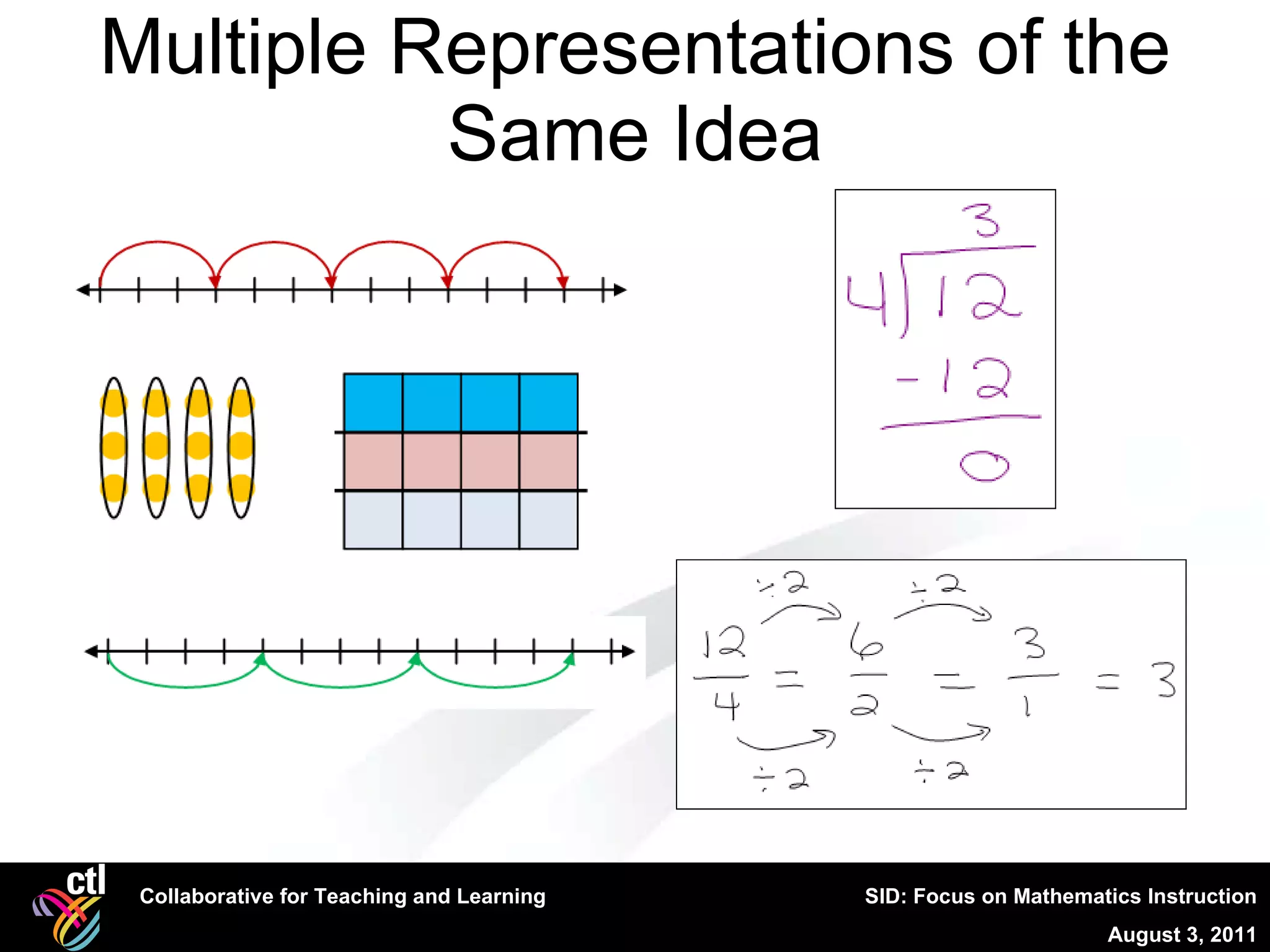
CTL, Mathematical Literacy How many ways can we say or represent  12 ÷ 4 mathematically?
Multiple Representations of the Same Idea
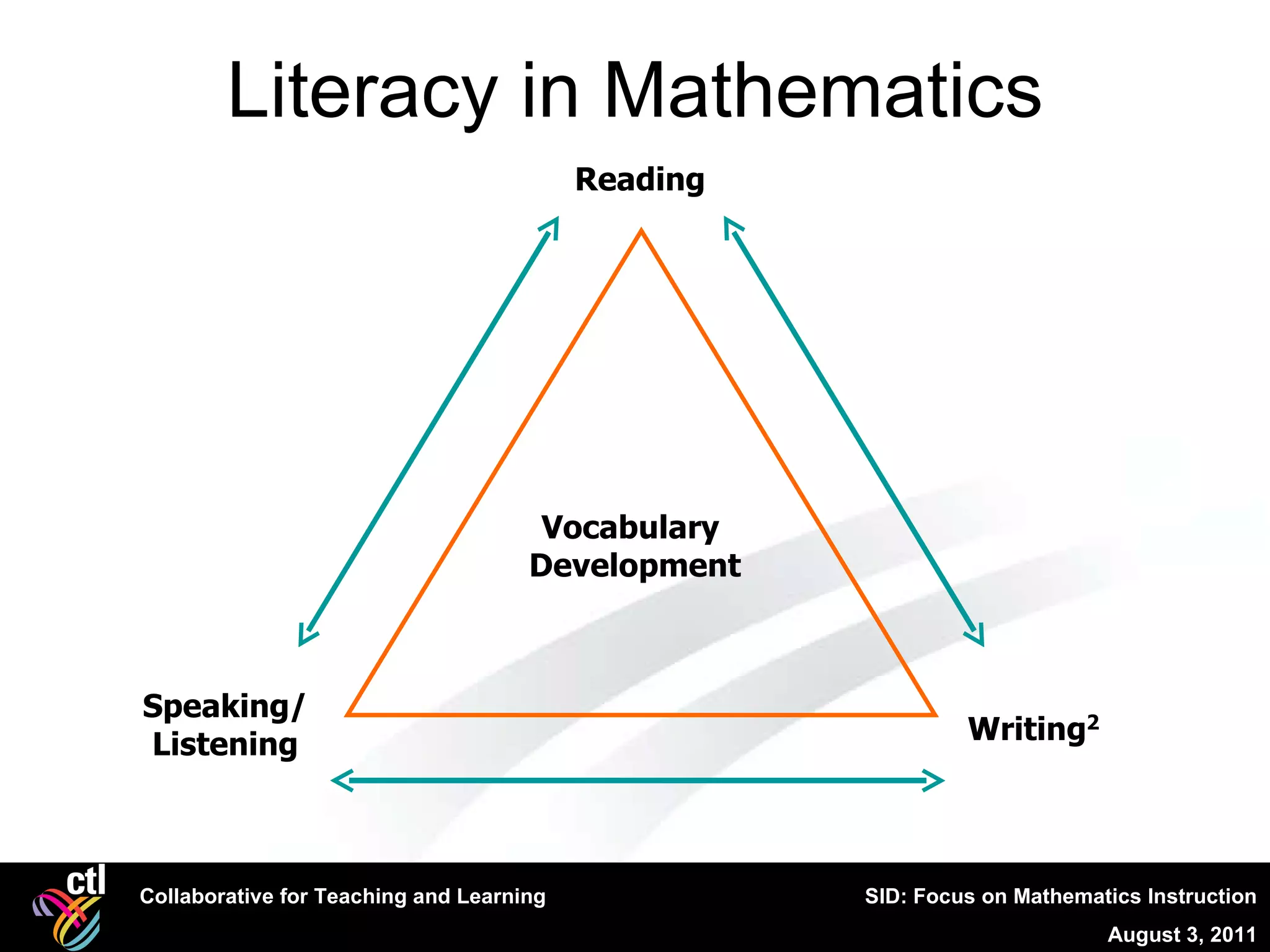
Literacy in Mathematics Vocabulary  Development Reading Writing 2 Speaking/ Listening
 
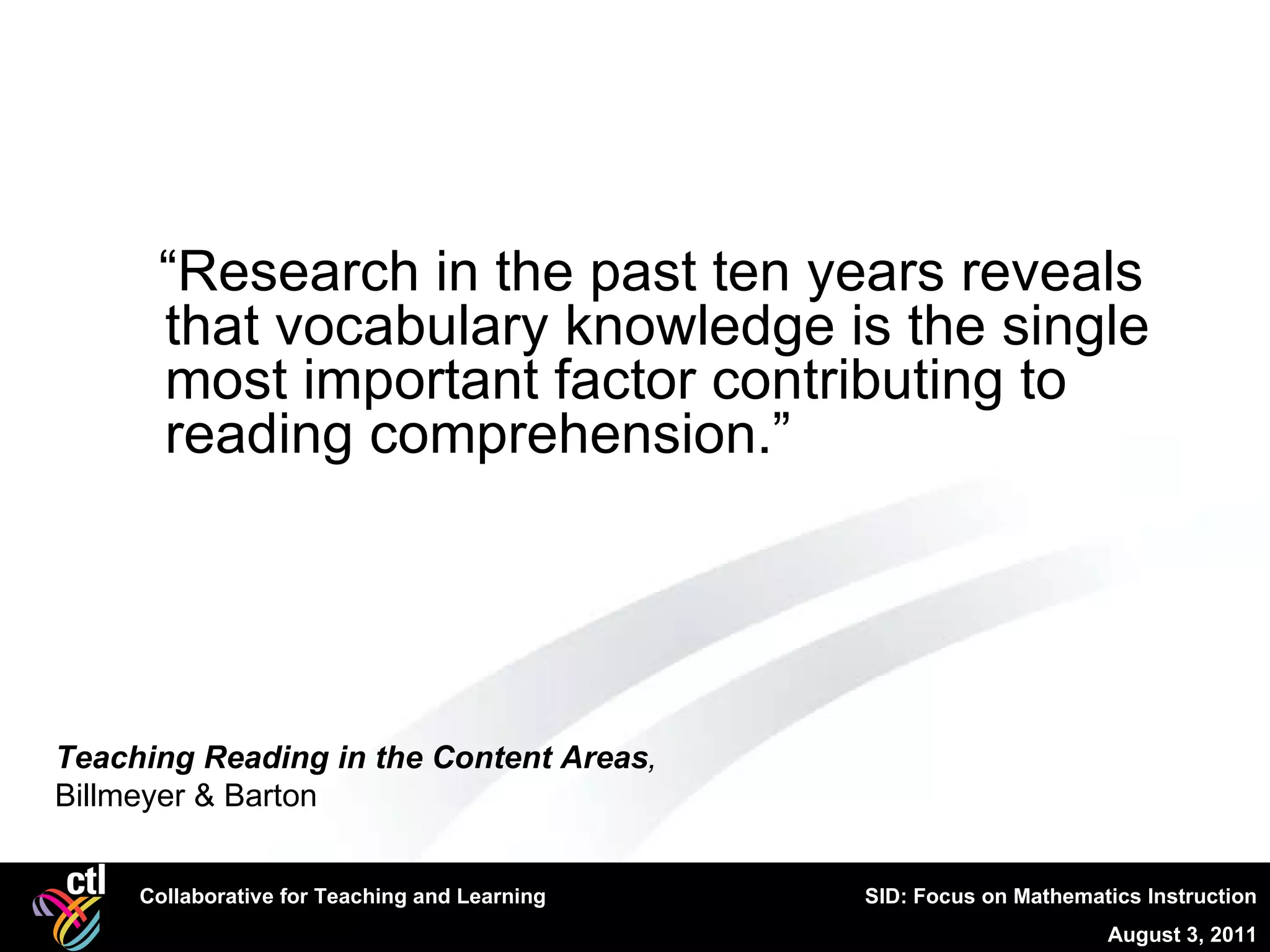
“ Research in the past ten years reveals that vocabulary knowledge is the single most important factor contributing to reading comprehension.” Teaching Reading in the Content Areas ,  Billmeyer & Barton
“ Reading mathematics means decoding and comprehending not only words but mathematical signs, symbols, and diagrams/graphs.” “ Consequently, students need to learn the meaning of each symbol and to connect each symbol, the idea that the symbol represents, and the written or spoken word(s) that correspond to that idea.” (McREL, Teaching Reading in Mathematics)
The Precise Language of Mathematics CTL, Mathematical Literacy Graphic Organizers that allow for multiple representations/interactions  Frayer Model, VVWA, Alphablocks, Foldables
Gradual Release Model I Do, You Watch I Do, You Help You Do, I Help You Do, I Watch Extended Scaffolding I Suggest, You Do You Decide to Do
CTL, Mathematical Literacy “ The Mathematical Communication Standard is closely tied to problem solving and reasoning. Thus as students’ mathematical language develops, so does their ability to reason and solve problems. Additionally, problem-solving situations provide a setting for the development & extension of communication skills & reasoning ability.” (NCTM Standards, pp 80)
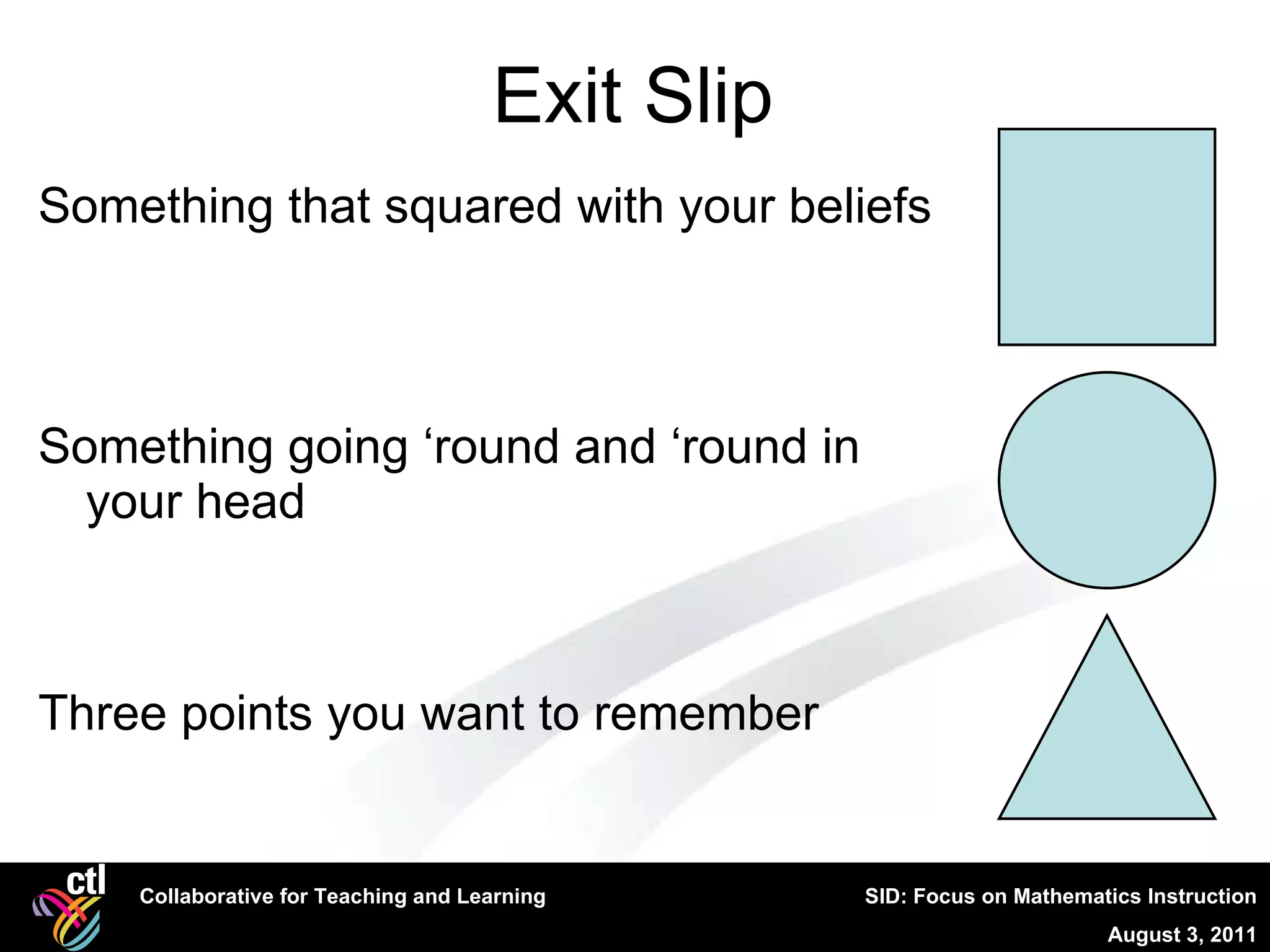
Something that squared with your beliefs Something going ‘round and ‘round in your head Three points you want to remember Exit Slip
Developing Discourse in the Classroom  Choose an article to read  We are using two reading strategies as we read: Text coding Margin notes You have 30 minutes to read the article
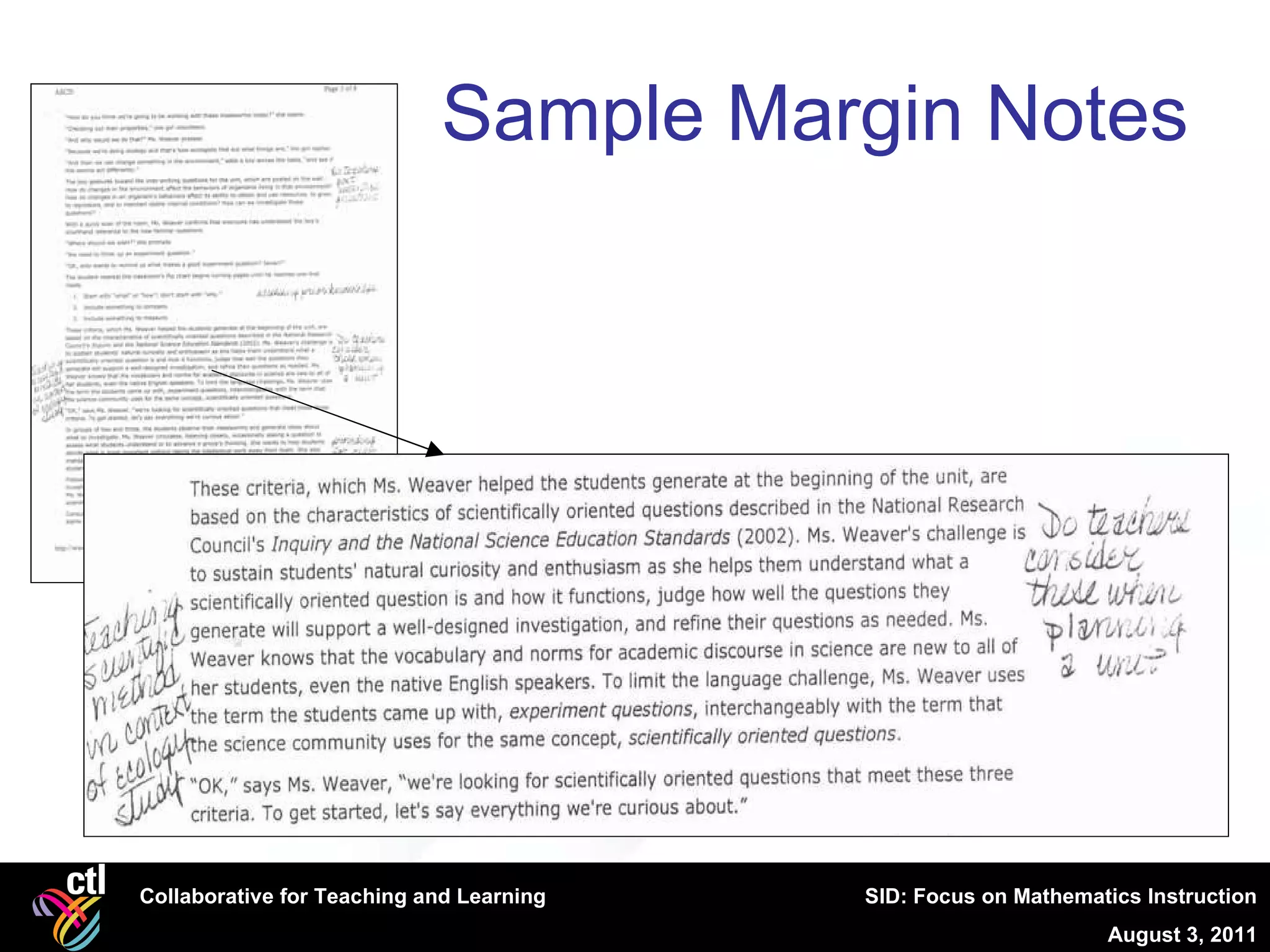
Sample Margin Notes
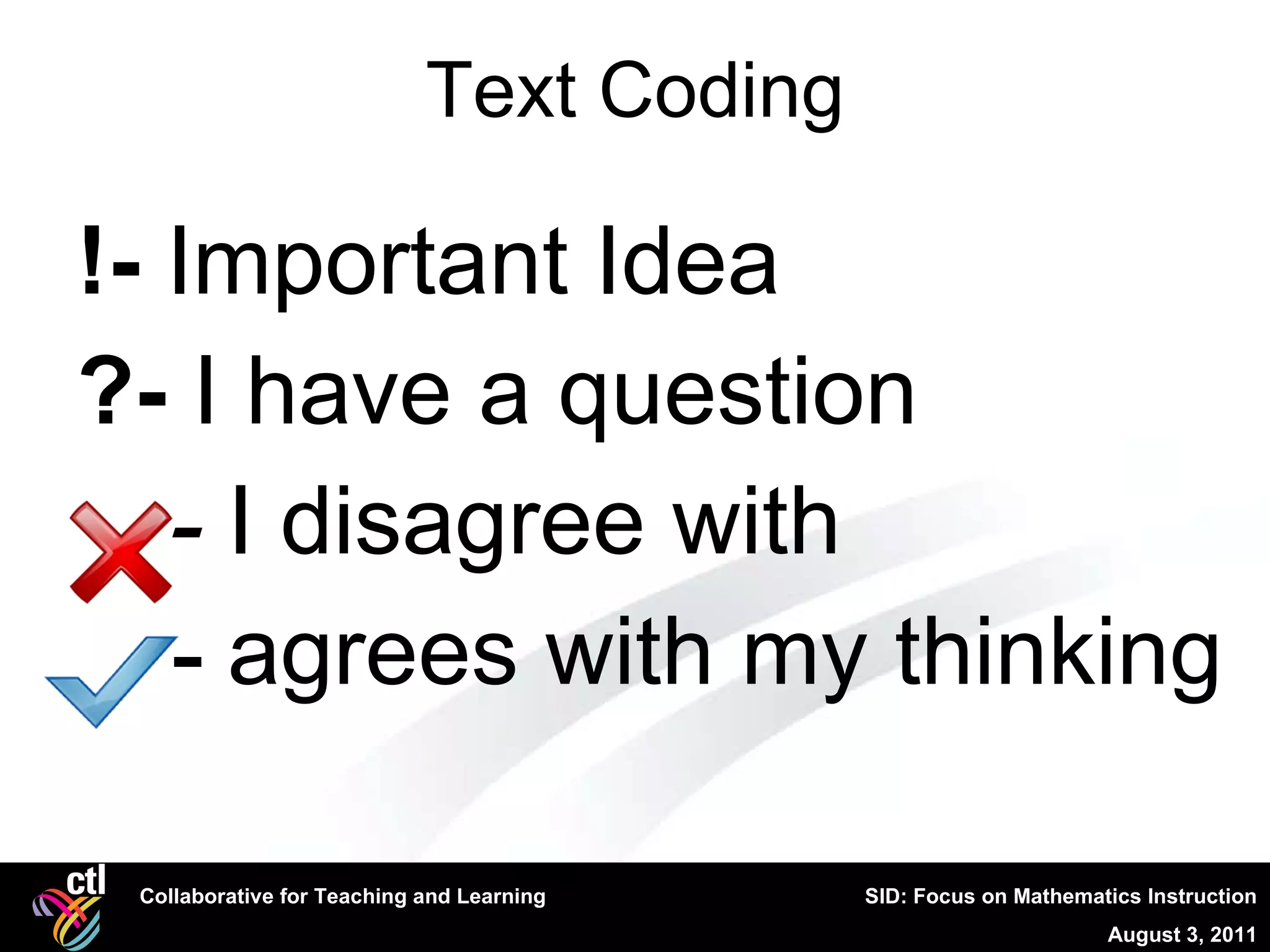
Text Coding !-  Important Idea ?-  I have a question   -  I disagree with  -  agrees with my thinking
Discourse Discussion In similar article groups discuss the main idea of the article and the appropriate guiding questions In mixed groups we are going to have a  Café Conversation
Something that squared with your beliefs Something going ‘round and ‘round in your head Three points you want to remember Exit Slip

SID Day 1 Mathematics Workshop

  • 1.
    Mathematics Summit SouthernIndiana Deanery: Focus on Mathematics Instruction
  • 2.
    Standards for theDay Deepen understanding of creating a mathematically literate classroom Apply a variety of strategies to support and promote the learning of mathematics Promote own and others’ learning through community conversation, collaboration and reflection
  • 3.
    Agenda DAY IGrant Overview/Introduction Mini-lesson: connecting Mathematical Literacy Vocabulary Development Routines- GOs and Word Walls Developing Classroom Discourse for Deeper Understanding DAY II Analysis of New Common Core State Standards Using Multiple Representations to Develop Deeper Understanding Using Number lines and manipulatives to support conceptual understanding
  • 4.
    Introductions Introduce yourself,let us know School, grade, experience (if you want) Something interesting you did or are going to do this summer Anything else you want to share! Be sure you have a name tag and have signed in
  • 5.
    Project Overview- Part1 6 days of PD during the year Developing curriculum, instructional practices, and resources that support mathematics instruction Provide teachers with feedback through: coaching, analysis of student work, & informal discussion
  • 6.
    Project Overview- Part2 2 days of summer training 1 st Semester: 1 cadre day to be held at a school, during September/early October 2 x 1 day grade level coaching for each group (5/6, 7/8), late October/early November 2 nd Semester: 1 cadre day, during late February/early March Distance support for mathematics teachers
  • 7.
    Take a fewmoments to compare the NCTM Processes and CCSS Practice Standards Guiding Questions: How are the processes and practices similar? How do they differ? What do the new practices mean for my instruction? Indiana Transition Info
  • 8.
    NCTM Standards forMathematics Content Number Algebra Geometry & Measurement Probability & Statistics Process Problem Solving Reasoning & Proof Communication Connections Representations CTL, Mathematical Literacy
  • 9.
    Instructional Programs Pre K-12 Should Enable All Students To: Organize & consolidate their mathematical thinking through communication Communicate their mathematical thinking coherently and clearly to peers, teachers, and others Analyze & evaluate the mathematical thinking & strategies of others Use the language of mathematics to express mathematical ideas precisely ( NCTM Standards, p. 269) CTL, Mathematical Literacy
  • 10.
    CCSS Content forMathematics Number and Operations k – 12 Algebra k – 5, 9 – 12 Measurement & Data k – 5 Geometry k – 12 Expressions & Equations 6 – 8 Proportionality 6 – 7 Statistics & Probability 6 – 12 Functions 8 – 12 Modeling 9 – 12 CCSS Mathematics Standards
  • 11.
    CCSS Practices forMathematics Make sense of problems/persevere in solving them. Reason abstractly and quantitatively. Construct viable arguments and critique the reasoning of others. Model with mathematics. Use appropriate tools strategically. Attend to precision. Look for and make use of structure. Look for and express regularity in repeated reasoning .
  • 12.
    Take a fewmoments to compare the NCTM Processes and CCSS Practice Standards Guiding Questions: How are the processes and practices similar? How do they differ? What do the new practices mean for my instruction?
  • 13.
    "The ability toread, listen, think creatively, and communicate about problem situations, mathematical representations, and the validation of solution will help students to develop and deepen their understanding of mathematics." (NCTM Standards, p. 80)
  • 14.
    What are thenecessary ingredients to communicate mathematics effectively?
  • 15.
    “ Students shouldbe encouraged to increase their ability to express themselves clearly and coherently. As they become older, their styles of argument and dialogue should more closely adhere to established conventions, and students should become more aware of, and responsive to, their audience. The ability to write about mathematics should be particularly nurtured across the grades .”
  • 16.
    “ Students shouldbe encouraged to increase their ability to express themselves clearly and coherently. As they become older, their styles of argument and dialogue should more closely adhere to established conventions, and students should become more aware of, and responsive to, their audience. The ability to write about mathematics should be particularly nurtured across the grades .”
  • 17.
    “ Students shouldbe encouraged to increase their ability to express themselves clearly and coherently. As they become older, their styles of argument and dialogue should more closely adhere to established conventions, and students should become more aware of, and responsive to, their audience. The ability to write about mathematics should be particularly nurtured across the grades.”
  • 18.
    Mathematics as aLanguage Includes Elements, Notation, and Syntax Is the language (science) of patterns and change Is a way of thinking about the world Is a necessary ingredient for developing & demonstrating understanding – both oral & written language ( Sensible, Sense-Making Mathematics , by Steve Leinwand ) CTL, Mathematical Literacy
  • 19.
    How do werepresent in mathematics?
  • 20.
    CTL, Mathematical LiteracyHow many ways can we say or represent 12 ÷ 4 mathematically?
  • 21.
  • 22.
    Literacy in MathematicsVocabulary Development Reading Writing 2 Speaking/ Listening
  • 23.
  • 24.
    “ Research inthe past ten years reveals that vocabulary knowledge is the single most important factor contributing to reading comprehension.” Teaching Reading in the Content Areas , Billmeyer & Barton
  • 25.
    “ Reading mathematicsmeans decoding and comprehending not only words but mathematical signs, symbols, and diagrams/graphs.” “ Consequently, students need to learn the meaning of each symbol and to connect each symbol, the idea that the symbol represents, and the written or spoken word(s) that correspond to that idea.” (McREL, Teaching Reading in Mathematics)
  • 26.
    The Precise Languageof Mathematics CTL, Mathematical Literacy Graphic Organizers that allow for multiple representations/interactions Frayer Model, VVWA, Alphablocks, Foldables
  • 27.
    Gradual Release ModelI Do, You Watch I Do, You Help You Do, I Help You Do, I Watch Extended Scaffolding I Suggest, You Do You Decide to Do
  • 28.
    CTL, Mathematical Literacy“ The Mathematical Communication Standard is closely tied to problem solving and reasoning. Thus as students’ mathematical language develops, so does their ability to reason and solve problems. Additionally, problem-solving situations provide a setting for the development & extension of communication skills & reasoning ability.” (NCTM Standards, pp 80)
  • 29.
    Something that squaredwith your beliefs Something going ‘round and ‘round in your head Three points you want to remember Exit Slip
  • 30.
    Developing Discourse inthe Classroom Choose an article to read We are using two reading strategies as we read: Text coding Margin notes You have 30 minutes to read the article
  • 31.
  • 32.
    Text Coding !- Important Idea ?- I have a question - I disagree with - agrees with my thinking
  • 33.
    Discourse Discussion Insimilar article groups discuss the main idea of the article and the appropriate guiding questions In mixed groups we are going to have a Café Conversation
  • 34.
    Something that squaredwith your beliefs Something going ‘round and ‘round in your head Three points you want to remember Exit Slip

Editor's Notes

  • #3 8:30-8:45 Introduction, hello, standards, and outline of our work together, slides 2-5 Hand out paper pads for notetaking No handouts, just PPT
  • #8 8:45-9:10 Comparison between NCTM Practices and CCSS Practice Standards Introduction to new standards in Indiana nothing this year, next two years (2012-13, and 2013-14 are transitional and baseline data years) and 2014-15 are full online testing through the PARCC system.
  • #9 Provide participants handout comparing NCTM Processes and CCSS Practices, as well as the mathematics as a language information for Lienwald.
  • #13 Participants use the printout of the CCSS Mathematical Processes and NCTM Processes and Communication Standard to analyze the necessary characteristics to communicate effectively in mathematics
  • #14 9:10-9:45 Mini-lesson on mathematical literacy, lay the foundation for communication standards/practices
  • #15 Use a concept map to display participant responses. Necessary Ingredients include an understanding of the following: Multiple symbol system – both numbers and symbols ( %, $, !, ±, ¼, >, =, Ø…..) Content (Number Theory, Geometry & Measurement, Algebraic Ideas, Probability & Statistics – Data Analysis); Process & Skills; Relationships/connections Vocabulary or Language of Mathematics Representations of Mathematics (Models, charts, graphs, symbols…) Problem Solving Reasoning Communicating Let’s explore the communications standard more closely.
  • #19 Syntax- “a system or orderly arrangement of symbols.” dictionary.com
  • #20 “ How do we represent in mathematics?” Participants work in small groups to identify different ways we represent ideas in mathematics Participants share out different ways to represent mathematical ideas, with the rule of no repeats. Focus on having participants include number, algebra, graphical, and sentence. The goal of this slide is to have participants understand the variety of different ways we communicate ideas mathematically and to begin to understand that we need to not only expose students to each representation but to incorporate instructional routines that develop student capacity to communicate in a variety of ways.
  • #21 “ Multiple Representations of the Same Idea” “ How many ways do we say 12÷4 mathematically?” Have participants develop and share as many ways as possible including modeling. Let participants do a think/pair/share for 45 seconds with their neighbors to develop several different representations. Here are a few if participants struggle for possibilities: 12  4 12 / 4 4 ( long division symbol ) 12 Twelve divided by four 4 divided into 12 How many groups of 4 are in 12? How many go into 4 groups from 12? Importance of exposing students to multiple ways of doing things because of the fact that they are exposed to many different ways of writing and entering problems, and that solutions to easy problems are not always straight forward in their understanding.
  • #22 See notes from previous slide.
  • #23 Transition, into the Content Literacy discussion of a balance between reading/writing/speaking-listening and the use of vocabulary in enabling students to rigorously communicate in your classroom.
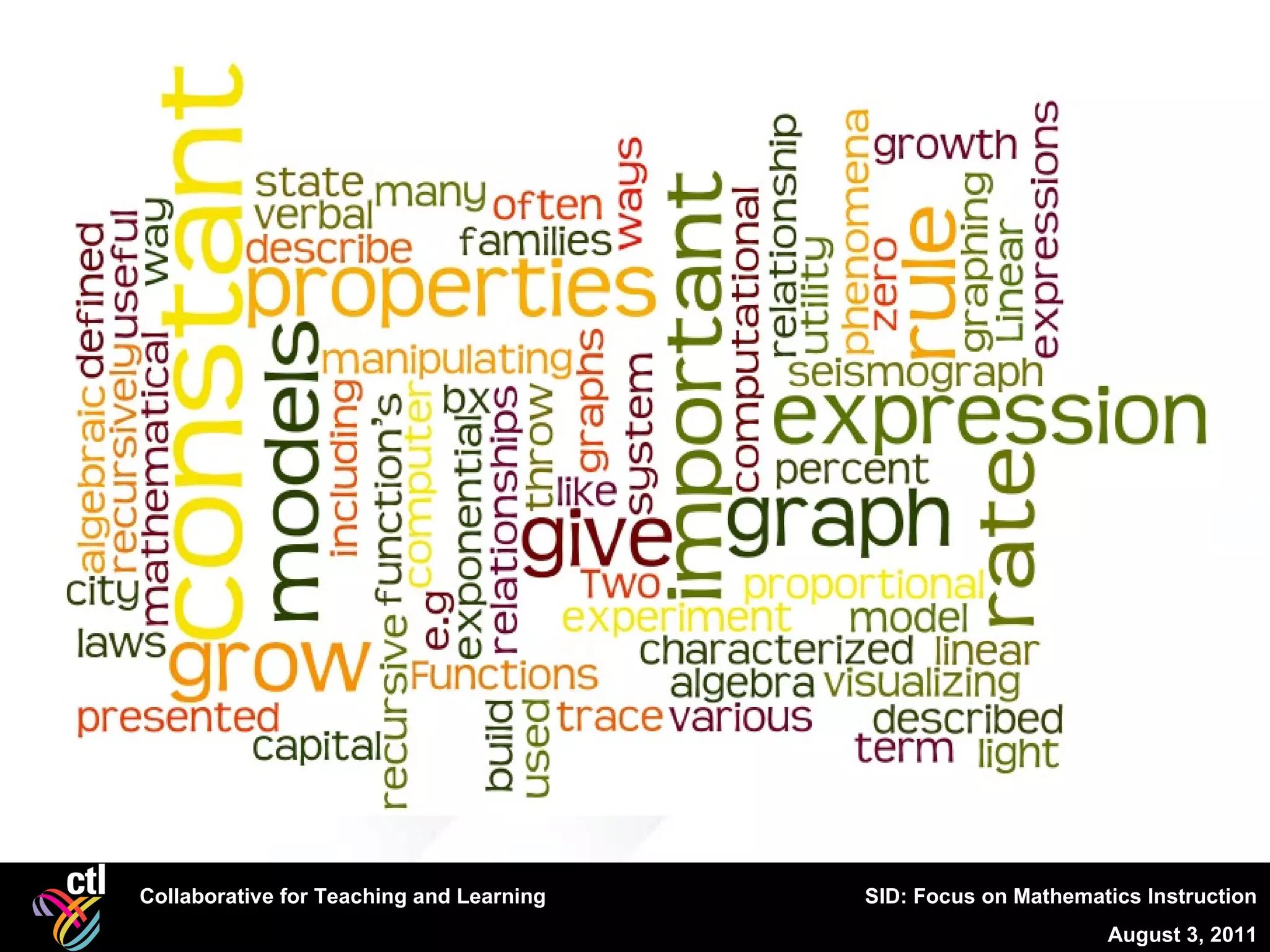
  • #24 Mathematics teachers have not traditionally been taught how to teach vocabulary as part of their methods courses, so how do math teachers teach vocabulary? (expected answers are that we teach how we were taught) This is a wordle of some of the vocabulary from an algebra 1 unit, including words from some routine problems solving situations. Look at the words and think about how dense the vocabulary is for one unit of study and the different applications of some of the words. Ask participants to identify 2 or 3 words that students might struggle with because of the different ways it seems to be applied during a unit of study. i.e. graph- the graph of a set of points or the graph of a rule/equation/function. To mathematicians the uses are the same (input, output), but to a student learning algebra applying the same understanding of (input, output) to different situations may not be as clear Expression- The term expression means 1. The process of making known one's thoughts or feelings. 2. The conveying of opinions publicly without interference by the government: "freedom of expression" But mathematically it means a mathematical phrase that can contain ordinary numbers, variables (like x or y) and operators (like add, subtract, multiply, and divide). 
  • #25 Participants work in small groups to create a word wall around a content topic of their choice i.e. linear relationships in algebra 1, proportionality in grades 6 or 7, geometry (prefer to stay away from geometry as the example because some teachers treat it as the exception rather than ‘normal’ approach), rational numbers in 5, 6 Participants use sentence strips to add the words they think are important for the word wall. Facilitator adds ‘words’ that drive home the importance of looking at vocabulary development in mathematics as a critical blending of number, symbol, graphical, and written language. Add things like: Linear in algebra 1: numbers that allow for combination (-3, 3, -6, 5, 8, 11, ½, 0.5, ¼, 0.24), symbols (+, -, ÷, ●, ≈, √, ∞), graphical (line segment, ->, ↓, ↔), variables ( x , y, z, others that you would use during the unit, x /2, 1/2 x ) Discuss the differences between the WWs Participants interact with the word wall using a variety of strategies: Participants add words to the ww, laying any repeated words over the top of each other. (indicates words that are prominent or that students have familiarity with) Facilitator then adds other ‘words’ to the word wall with discussion as to why these words need to be added. - multiple representations - connections between numbers to for use in admit/exit slip responses - small chunks rather than big pieces already put together for students for increased flexibility in use - language of mathematics is all of these not just written word 3) Choose an activity for participants to engage in around the ww: - Choose a term, next person chooses a term that connects, continue until out of terms/students/or meet time deadline (variations: Repeat by choosing a different term to start with and see the difference in the connections Teacher asks clarifying questions, or extension questions when necessary Call on students or let students raise their hands (calling on students makes everyone be ready and allows for strategic participation for students who need greater support)) - Draw a diagram on chart/poster paper and have participants label the different components of the diagram and add components to the diagram as applicable - Have participants identify the different vocabulary used during the lesson, and write 2-3 mathematical sentences from the list as an exit slip - Have students sort vocabulary according to some characteristic - Have students do a reflective piece on their own paper that has them sort the words according to words they understand well, words they kind of know, and words they need extensive help with and create learning/study goals around the words for the week.
  • #26 Words that have the same meaning in mathematical English & ordinary English (dollars, cents, because, balloons, distance…) Words that have the same meaning in only mathematics – ‘technical vernacular’- (hypotenuse, square root, numerator..) Words that have different meanings in mathematical English & ordinary English (difference, similar…) (McREl, Teaching Reading in Mathematics)
  • #27 9:45-10:15 Have participants look at vocabulary on the ww and create a Frayer Model around the word “linear” or “vertical angles” depending on audience. Variations: - use two frayers on same page for words that are often confused (function/inverse, expression/equation, solve/evaluate) - create a frayer with simple definition and examples, revisit the frayer intentionally as students gain more experience with the term and are better able to differentiate non-examples and characteristics - have students write the book definition and their own definition in the definition quadrant for clarification - have alpha-blocks that are large enough for models and definitions - include NAGS whenever possible Allow participants to represent these series of steps in any symbol system that choose to use. Walk around and hopefully you will be able to have participants present various representations – numeric, pictorial/tiles (model), symbolic (abstract symbols). An illustration of the role of written symbols in representing ideas where students learn to use precise language in conjunction with the symbol systems of mathematics is as follows. The number thought of: Add five: Multiply by two: Subtract four: Divide by two: Subtract the number thought of:
  • #28 Before participants start the work, model (Gradual Release Model) process/thinking using the word “Polygon.” (or may have Participants give you a word – it needs to be big and important to building mathematical vocabulary.) Discuss: this is not a linear process however, in working with students it seems that one good place to start is with EXAMPLES (may fill in Characteristics at the same time) and then proceed to NON-EXAMPLES. Definition is usually the last to be completed. There seems to be a one-to-one correspondence between the characteristics and definition. Sample responses might be: EXAMPLES/MODELS : rectangle, triangle, trapezoid, parallelogram……. CHARACTERISTICS: closed, 2-dimensional (plane figure), has three or more line segments, curve does not intersect itself – simple, no dangling parts NON-EXAMPLES: Cone, 3-dimensional figures, point, arrow(ray), letter M, circle, DEFINITION : A simple, closed figure made up of three or more line segments. [Discuss the Gradual Release Model with teachers. Students need to have models and practice (with and without others) This SCAFFOLDS learning for students as they move from being dependent to independent learners.] [Speak to other experiences: putting simplify and solve or expression and equation on the same page with two Frayers.Have student tease out the differences so that they construct meaning regarding each.] [Do not over use – with the big words.] [pp. 61 – 93 in McRel, Teaching Reading in Mathematics – Vocabulary Development]
  • #29 The issue is – you can’t have one without the other – the ability to communicate mathematically provides one with the tools to solve problems and reason. And then- to be able to solve problems and reason – I must have the language of the science. Thus I must know the vocabulary and symbols; must be able to read the problem and write about my understanding of the solution. An understanding of the symbols we associate with mathematics come from within a long process of exploring, questioning, challenging, and of doing mathematics. How do you create an environment that is safe and encourages students to investigate, make & test conjectures, look for patterns, reflect & rewrite, communicate mathematically?
  • #30 11:45-12:00 Participants respond to the Exit Slip on their way to lunch
  • #35 11:45-12:00 Participants respond to the Exit Slip on their way to lunch