Good Planning +  Good Strategies = Good Teaching Winston-Salem Forsyth County Schools 2008-2009
Let’s Talk Trees: Keys to Good Planning Concept Maps, Essential Questions, and Guiding Questions
Overview The Forest:  How do  concept maps  enhance instruction? The Trees:  How do good  essential questions  foster higher order thinking? The Branches:  How do  guiding questions  assist the learner?
“Teaching the answers without first raising the questions takes most of the meaning out of learning.” --Francis Slater, London School of Education
The Forest: Why are concept maps important? Ensures instruction addresses NCSCOS Ensures instruction addresses student needs Helps “chunk” learning into logical, meaningful portions Helps students form connections between content and concepts
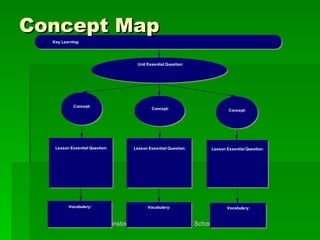
Concept Map
How can concept maps enhance instruction? Help students track learning progress Help students review learning Help frame new concepts Help preview upcoming ideas Help students understand how vocabulary connects to concepts
How do concept maps look in the classroom? Posted on wall using large paper Poster-sized printout from computer file Computer/Overhead image referred to during lesson Student-generated components added to teacher-created template HOWEVER, NOT a “build-as-you-go” activity; concept map should be posted prior to learning
The Trees:  What constitutes a  good  essential question? A  good  essential question is one that Requires students to make a decision or plan a course of action Fosters higher order thinking skills Promotes critical thinking skills and problem solving
How do teachers write good essential questions? Consider what students should  do  or  determine  rather than just what they should know (refer to a Bloom’s taxonomy tool) Consider the use of strong verbs Use higher level questions Use open-ended questions
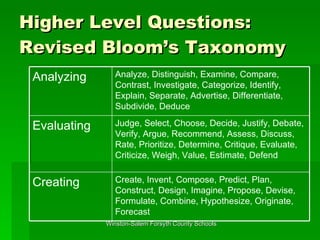
Higher Level Questions: Revised Bloom’s Taxonomy Create, Invent, Compose, Predict, Plan, Construct, Design, Imagine, Propose, Devise, Formulate, Combine, Hypothesize, Originate, Forecast Creating Judge, Select, Choose, Decide, Justify, Debate, Verify, Argue, Recommend, Assess, Discuss, Rate, Prioritize, Determine, Critique, Evaluate, Criticize, Weigh, Value, Estimate, Defend Evaluating Analyze, Distinguish, Examine, Compare, Contrast, Investigate, Categorize, Identify, Explain, Separate, Advertise, Differentiate, Subdivide, Deduce Analyzing
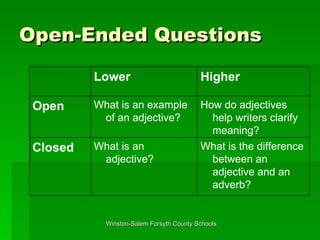
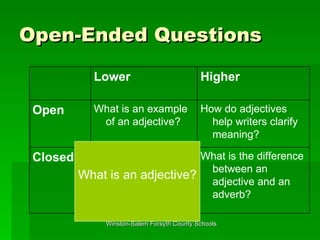
Open-Ended Questions What is the difference between an adjective and an adverb? What is an adjective? Closed How do adjectives help writers clarify meaning? What is an example of an adjective? Open Higher Lower
Open-Ended Questions What is an adjective? What is the difference between an adjective and an adverb? Closed How do adjectives help writers clarify meaning? What is an example of an adjective? Open Higher Lower
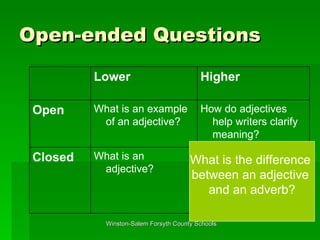
Open-ended Questions What is the difference  between an adjective  and an adverb? What is an adjective? Closed How do adjectives help writers clarify meaning? What is an example of an adjective? Open Higher Lower
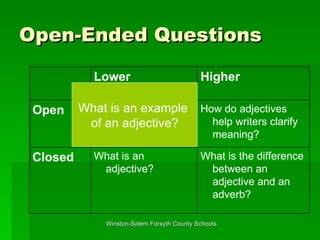
Open-Ended Questions What is an example  of an adjective? What is the difference between an adjective and an adverb? What is an adjective? Closed How do adjectives help writers clarify meaning? Open Higher Lower
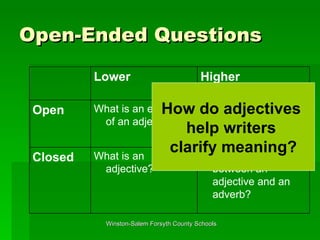
Open-Ended Questions How do adjectives  help writers  clarify meaning? What is the difference between an adjective and an adverb? What is an adjective? Closed What is an example of an adjective? Open Higher Lower
Essential Question Samples Key question openers:  How? Why? Add “How can I…” to the beginning of almost any NCSCOS objective benchmark How can I explain how the author develops a setting? How can I evaluate the effects of an author’s style/craft? Why did the author use a _____ organizational structure?
The Branches:  Guiding Questions Guiding questions can Lead students through the process of addressing the essential question Frame instruction around an essential question Identify the steps necessary to answer an essential question Help the student identify “What do I need to know?”
Let’s Practice: Be a Tree What are you  doing  in class now/next? Content What do you want students to be able to  do  at the end of the lesson? SCOS Revised Bloom’s What open-ended question will  direct  the students’ learning?
Remember… The Trees are Our Friends! Write Good Essential Questions!
Marzano’s High Yield Strategies For Improved Reading Comprehension
Identifying Similarities & Differences Percentile Gain: 45 Enhance student’s understanding of and ability to use knowledge by engaging them in mental processes that involve identifying ways items are alike and different.  Students should compare, classify, and create metaphors, analogies, and graphic representations.
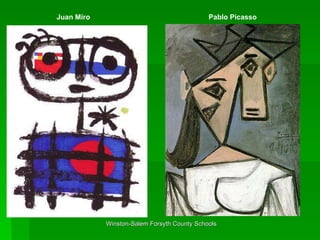
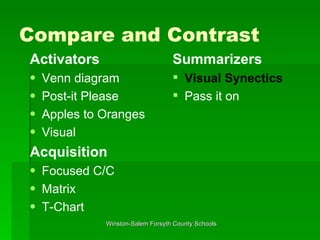
Compare and Contrast Activators Venn diagram Post-it Please Apples to Oranges Visual Acquisition Focused C/C Matrix T-Chart Summarizers Visual Synectics Pass it on
Juan Miro Pablo Picasso
Compare and Contrast Activators Venn diagram Post-it Please Apples to Oranges Visual Acquisition Focused C/C Matrix T-Chart Summarizers Visual Synectics Pass it on
 
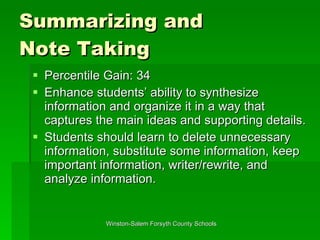
Summarizing and  Note Taking Percentile Gain: 34 Enhance students’ ability to synthesize information and organize it in a way that captures the main ideas and supporting details.  Students should learn to delete unnecessary information, substitute some information, keep important information, writer/rewrite, and analyze information.
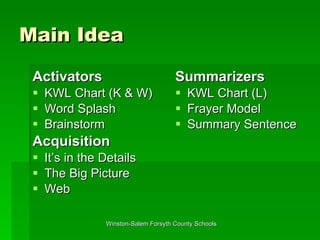
Main Idea Activators KWL Chart (K & W) Word Splash Brainstorm Acquisition It’s in the Details The Big Picture Web Summarizers KWL Chart (L) Frayer Model Summary Sentence
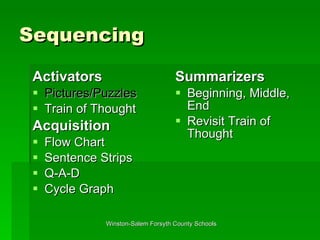
Sequencing Activators Pictures/Puzzles Train of Thought Acquisition Flow Chart Sentence Strips Q-A-D Cycle Graph Summarizers Beginning, Middle, End Revisit Train of Thought
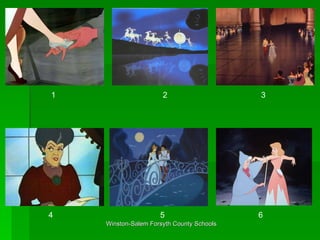
1   2   3 4   5   6
Summarizing Activators ABC Review Quick Write Summary Ball Acquisition Distributed Think-Pair-Share Numbered Heads A/B Partners Jigsaw Luck of the Draw
Summarizing Summarizers Somebody-Wanted-But-So Something-Happened-But-Then Sum it up Shaping Up Final Countdown One Word Sketch to Stretch
Note Taking Acquisition Cornell Notes Teacher Prepared Notes Web Combination Notes Inquiry Charts SQ3R Summarizers Cornell: Bottom box Combination Notes: Graphic representation Inquiry Chart: Bottom Box
Generating and Testing Hypotheses Percentile Gain: 23 Enhance students’ understanding of and ability to use knowledge by engaging them in mental processes that involve making and testing hypotheses.  Students should generate, explain, test, and defend hypotheses using both inductive and deductive strategies through problem solving, history investigation, invention, experimental inquiry, and decision making.
Cause & Effect Activators Matching Visual Brainstorm Acquisition Butterfly/Spider Fishbone C/E Chain  Summarizers Human Chain 3-2-1 Extend & Refine Student Visual If…Then… Because Events & Consequences Diamante Poem
Inference Activators KLI (K&L) Picture This The Envelope Please Acquisition Making Inferences Higher Order Questions Summarizers KLI (I)


Reasoning Activators Logic Puzzles Anticipation Guide Four Corners Acquisition Constructing Support Prediction Tree Justify your Answer Inductive Reasoning Summarizers Revisit Anticipation Guide Extend & Refine Debate
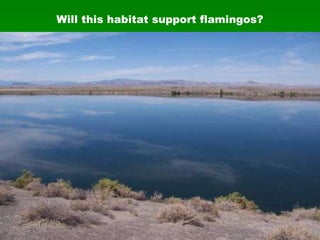
Will this habitat support flamingos?
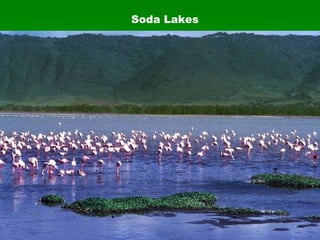
Soda Lakes
Evaluating Evidence Activators Cross the Line Acquisition Analyzing Perspectives Constructing Support for Effectiveness Source Credibility Summarizers Save the Last Word 4-2-1
Marzano’s High Yield Strategies Identifying similarities and differences Summarizing and note taking Reinforcing effort and providing recognition Homework and practice Nonlinguistic representations Cooperative learning Setting objectives and providing feedback Generating and testing hypotheses Cues, questions, and advance organizers

Marzano And Rcs

  • 1.
    Good Planning + Good Strategies = Good Teaching Winston-Salem Forsyth County Schools 2008-2009
  • 2.
    Let’s Talk Trees:Keys to Good Planning Concept Maps, Essential Questions, and Guiding Questions
  • 3.
    Overview The Forest: How do concept maps enhance instruction? The Trees: How do good essential questions foster higher order thinking? The Branches: How do guiding questions assist the learner?
  • 4.
    “Teaching the answerswithout first raising the questions takes most of the meaning out of learning.” --Francis Slater, London School of Education
  • 5.
    The Forest: Whyare concept maps important? Ensures instruction addresses NCSCOS Ensures instruction addresses student needs Helps “chunk” learning into logical, meaningful portions Helps students form connections between content and concepts
  • 6.
  • 7.
    How can conceptmaps enhance instruction? Help students track learning progress Help students review learning Help frame new concepts Help preview upcoming ideas Help students understand how vocabulary connects to concepts
  • 8.
    How do conceptmaps look in the classroom? Posted on wall using large paper Poster-sized printout from computer file Computer/Overhead image referred to during lesson Student-generated components added to teacher-created template HOWEVER, NOT a “build-as-you-go” activity; concept map should be posted prior to learning
  • 9.
    The Trees: What constitutes a good essential question? A good essential question is one that Requires students to make a decision or plan a course of action Fosters higher order thinking skills Promotes critical thinking skills and problem solving
  • 10.
    How do teacherswrite good essential questions? Consider what students should do or determine rather than just what they should know (refer to a Bloom’s taxonomy tool) Consider the use of strong verbs Use higher level questions Use open-ended questions
  • 11.
    Higher Level Questions:Revised Bloom’s Taxonomy Create, Invent, Compose, Predict, Plan, Construct, Design, Imagine, Propose, Devise, Formulate, Combine, Hypothesize, Originate, Forecast Creating Judge, Select, Choose, Decide, Justify, Debate, Verify, Argue, Recommend, Assess, Discuss, Rate, Prioritize, Determine, Critique, Evaluate, Criticize, Weigh, Value, Estimate, Defend Evaluating Analyze, Distinguish, Examine, Compare, Contrast, Investigate, Categorize, Identify, Explain, Separate, Advertise, Differentiate, Subdivide, Deduce Analyzing
  • 12.
    Open-Ended Questions Whatis the difference between an adjective and an adverb? What is an adjective? Closed How do adjectives help writers clarify meaning? What is an example of an adjective? Open Higher Lower
  • 13.
    Open-Ended Questions Whatis an adjective? What is the difference between an adjective and an adverb? Closed How do adjectives help writers clarify meaning? What is an example of an adjective? Open Higher Lower
  • 14.
    Open-ended Questions Whatis the difference between an adjective and an adverb? What is an adjective? Closed How do adjectives help writers clarify meaning? What is an example of an adjective? Open Higher Lower
  • 15.
    Open-Ended Questions Whatis an example of an adjective? What is the difference between an adjective and an adverb? What is an adjective? Closed How do adjectives help writers clarify meaning? Open Higher Lower
  • 16.
    Open-Ended Questions Howdo adjectives help writers clarify meaning? What is the difference between an adjective and an adverb? What is an adjective? Closed What is an example of an adjective? Open Higher Lower
  • 17.
    Essential Question SamplesKey question openers: How? Why? Add “How can I…” to the beginning of almost any NCSCOS objective benchmark How can I explain how the author develops a setting? How can I evaluate the effects of an author’s style/craft? Why did the author use a _____ organizational structure?
  • 18.
    The Branches: Guiding Questions Guiding questions can Lead students through the process of addressing the essential question Frame instruction around an essential question Identify the steps necessary to answer an essential question Help the student identify “What do I need to know?”
  • 19.
    Let’s Practice: Bea Tree What are you doing in class now/next? Content What do you want students to be able to do at the end of the lesson? SCOS Revised Bloom’s What open-ended question will direct the students’ learning?
  • 20.
    Remember… The Treesare Our Friends! Write Good Essential Questions!
  • 21.
    Marzano’s High YieldStrategies For Improved Reading Comprehension
  • 22.
    Identifying Similarities &Differences Percentile Gain: 45 Enhance student’s understanding of and ability to use knowledge by engaging them in mental processes that involve identifying ways items are alike and different. Students should compare, classify, and create metaphors, analogies, and graphic representations.
  • 23.
    Compare and ContrastActivators Venn diagram Post-it Please Apples to Oranges Visual Acquisition Focused C/C Matrix T-Chart Summarizers Visual Synectics Pass it on
  • 24.
  • 25.
    Compare and ContrastActivators Venn diagram Post-it Please Apples to Oranges Visual Acquisition Focused C/C Matrix T-Chart Summarizers Visual Synectics Pass it on
  • 26.
  • 27.
    Summarizing and Note Taking Percentile Gain: 34 Enhance students’ ability to synthesize information and organize it in a way that captures the main ideas and supporting details. Students should learn to delete unnecessary information, substitute some information, keep important information, writer/rewrite, and analyze information.
  • 28.
    Main Idea ActivatorsKWL Chart (K & W) Word Splash Brainstorm Acquisition It’s in the Details The Big Picture Web Summarizers KWL Chart (L) Frayer Model Summary Sentence
  • 29.
    Sequencing Activators Pictures/PuzzlesTrain of Thought Acquisition Flow Chart Sentence Strips Q-A-D Cycle Graph Summarizers Beginning, Middle, End Revisit Train of Thought
  • 30.
    1 2 3 4 5 6
  • 31.
    Summarizing Activators ABCReview Quick Write Summary Ball Acquisition Distributed Think-Pair-Share Numbered Heads A/B Partners Jigsaw Luck of the Draw
  • 32.
    Summarizing Summarizers Somebody-Wanted-But-SoSomething-Happened-But-Then Sum it up Shaping Up Final Countdown One Word Sketch to Stretch
  • 33.
    Note Taking AcquisitionCornell Notes Teacher Prepared Notes Web Combination Notes Inquiry Charts SQ3R Summarizers Cornell: Bottom box Combination Notes: Graphic representation Inquiry Chart: Bottom Box
  • 34.
    Generating and TestingHypotheses Percentile Gain: 23 Enhance students’ understanding of and ability to use knowledge by engaging them in mental processes that involve making and testing hypotheses. Students should generate, explain, test, and defend hypotheses using both inductive and deductive strategies through problem solving, history investigation, invention, experimental inquiry, and decision making.
  • 35.
    Cause & EffectActivators Matching Visual Brainstorm Acquisition Butterfly/Spider Fishbone C/E Chain Summarizers Human Chain 3-2-1 Extend & Refine Student Visual If…Then… Because Events & Consequences Diamante Poem
  • 36.
    Inference Activators KLI(K&L) Picture This The Envelope Please Acquisition Making Inferences Higher Order Questions Summarizers KLI (I)
  • 37.
  • 38.
  • 39.
  • 40.
    Reasoning Activators LogicPuzzles Anticipation Guide Four Corners Acquisition Constructing Support Prediction Tree Justify your Answer Inductive Reasoning Summarizers Revisit Anticipation Guide Extend & Refine Debate
  • 41.
    Will this habitatsupport flamingos?
  • 42.
  • 43.
    Evaluating Evidence ActivatorsCross the Line Acquisition Analyzing Perspectives Constructing Support for Effectiveness Source Credibility Summarizers Save the Last Word 4-2-1
  • 44.
    Marzano’s High YieldStrategies Identifying similarities and differences Summarizing and note taking Reinforcing effort and providing recognition Homework and practice Nonlinguistic representations Cooperative learning Setting objectives and providing feedback Generating and testing hypotheses Cues, questions, and advance organizers

Editor's Notes

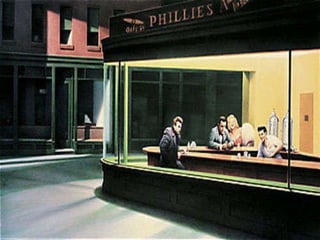
  • #38 Ask teachers the following questions (or others of your choosing): In what decade is this painting set? (1950’s) How do you know? (architecture, diner, coffee urns, famous people: [l to r] James Dean, Humphrey Bogart, Marilyn Monroe, Elvis Presley) Is this a safe or unsafe neighborhood? (evidence available for both) How do you know? (safe: clean, quiet streets; unsafe: empty storefronts and windows, isolated)
  • #39 Ask the following questions (or others of your choosing): Where was this photograph taken? (northern coast of Turkey, but DON”T TELL UNTIL THE END!...most folks say Italy or Greece) How do you know? (mountains near coastline, red tile roofs) What season is it in the photograph? (I have no idea…it’s more about making inferences) How do you know?
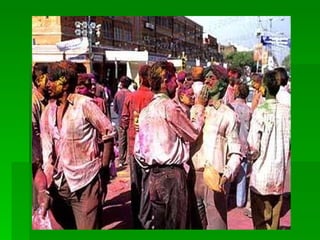
  • #40 Ask the following questions (or others of your choosing): Is this a celebratory or violent occasion? (Celebratory: Indian rite of spring….colored paint used to symbolize the coming colors of the growing season….again, don’t tell until the inferences have been shared) How do you know? (listen to answers given)