Mathematics Summit


Southern Indiana Deanery: Focus on
      Mathematics Instruction
Standards for the Day
• Deepen understanding of new Common
  Core State Standards for mathematics
• Create understanding of using multiple
  representations and approaches to problem
  solving
• Apply a variety of strategies to support and
  promote the learning of mathematics


  Collaborative for Teaching and Learning   SID: Focus on Mathematics Instruction
                                                                  August 3, 2011
Agenda
DAY II
• Analysis of New Common Core State Standards
• Using Multiple Representations to Develop Deeper
  Understanding
• Using Number lines and manipulatives to support
  conceptual understanding


   Collaborative for Teaching and Learning    SID: Focus on Mathematics Instruction
                                                                    August 3, 2011
Quick Write
From our time together yesterday,
What ideas, strategies, concepts, routines do
  you want to revisit as you plan your
  classroom for the upcoming year? Which do
  you want to focus on initially? & How do you
  plan on accomplishing this?


  Collaborative for Teaching and Learning   SID: Focus on Mathematics Instruction
                                                                  August 3, 2011
Reasoning Abstractly and
            Quantitatively
• 5.NBT.6: Find whole-number quotients of
  whole numbers with up to four-digit
  dividends and two-digit divisors, using
  strategies based on place value, the
  properties of operations, and/or the
  relationship between multiplication and
  division. Illustrate and explain the
  calculation by using equations, rectangular
  arrays, and/or area models.
  Collaborative for Teaching and Learning   SID: Focus on Mathematics Instruction
                                                                  August 3, 2011
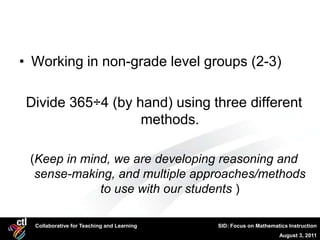
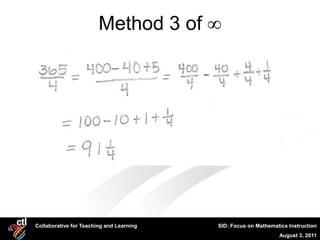
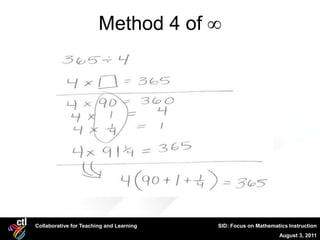
• Working in non-grade level groups (2-3)

 Divide 365÷4 (by hand) using three different
                   methods.

 (Keep in mind, we are developing reasoning and
  sense-making, and multiple approaches/methods
             to use with our students )

  Collaborative for Teaching and Learning   SID: Focus on Mathematics Instruction
                                                                  August 3, 2011
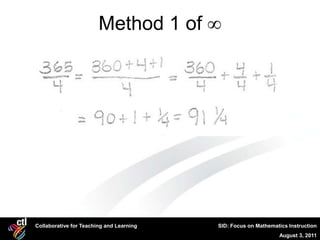
Method 1 of ∞


Collaborative for Teaching and Learning   SID: Focus on Mathematics Instruction
                                                                August 3, 2011
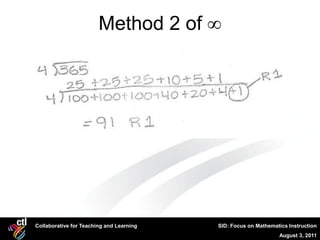
Method 2 of ∞


Collaborative for Teaching and Learning   SID: Focus on Mathematics Instruction
                                                                August 3, 2011
Method 3 of ∞


Collaborative for Teaching and Learning   SID: Focus on Mathematics Instruction
                                                                August 3, 2011
Method 4 of ∞


Collaborative for Teaching and Learning   SID: Focus on Mathematics Instruction
                                                                August 3, 2011
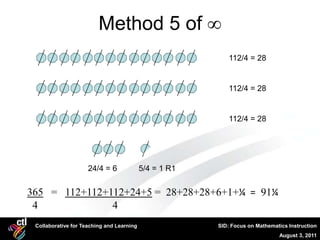
Method 5 of ∞
                                                            112/4 = 28


                                                            112/4 = 28


                                                            112/4 = 28


                     24/4 = 6              5/4 = 1 R1


365 = 112+112+112+24+5 = 28+28+28+6+1+¼ = 91¼
 4             4
 Collaborative for Teaching and Learning                SID: Focus on Mathematics Instruction
                                                                              August 3, 2011
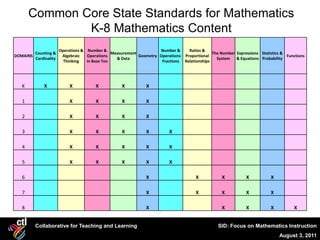
Common Core State Standards for Mathematics
              K-8 Mathematics Content
                        Operations & Number &                         Number &      Ratios &
          Counting &                             Measurement                                   The Number Expressions Statistics &
DOMAINS                  Algebraic   Operations              Geometry Operations: Proportional                                     Functions
          Cardinality                              & Data                                        System & Equations Probability
                          Thinking   in Base Ten                       Fractions Relationships


  K           X              X           X           X           X

  1                          X           X           X           X

  2                          X           X           X           X

  3                          X           X           X           X          X

  4                          X           X           X           X          X

  5                          X           X           X           X          X

  6                                                              X                      X           X           X           X

  7                                                              X                      X           X           X           X

  8                                                              X                                  X           X           X          X


          Collaborative for Teaching and Learning                                                  SID: Focus on Mathematics Instruction
                                                                                                                                August 3, 2011
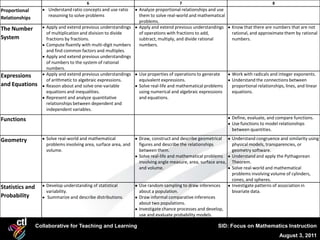
6                                            7                                               8
Proportional          Understand ratio concepts and use ratio     Analyze proportional relationships and use
                      reasoning to solve problems                 them to solve real‐world and mathematical
Relationships
                                                                  problems.
The Number           Apply and extend previous understandings     Apply and extend previous understandings       Know that there are numbers that are not
                     of multiplication and division to divide     of operations with fractions to add,           rational, and approximate them by rational
System               fractions by fractions.                      subtract, multiply, and divide rational        numbers.
                     Compute fluently with multi‐digit numbers    numbers.
                     and find common factors and multiples.
                     Apply and extend previous understandings
                     of numbers to the system of rational
                     numbers.
Expressions          Apply and extend previous understandings     Use properties of operations to generate       Work with radicals and integer exponents.
                     of arithmetic to algebraic expressions.      equivalent expressions.                        Understand the connections between
and Equations        Reason about and solve one‐variable          Solve real‐life and mathematical problems      proportional relationships, lines, and linear
                     equations and inequalities.                  using numerical and algebraic expressions      equations.
                     Represent and analyze quantitative           and equations.
                     relationships between dependent and
                     independent variables.

Functions                                                                                                        Define, evaluate, and compare functions.
                                                                                                                 Use functions to model relationships
                                                                                                                 between quantities.

Geometry             Solve real‐world and mathematical            Draw, construct and describe geometrical       Understand congruence and similarity using
                     problems involving area, surface area, and   figures and describe the relationships         physical models, transparencies, or
                     volume.                                      between them.                                  geometry software.
                                                                  Solve real‐life and mathematical problems      Understand and apply the Pythagorean
                                                                  involving angle measure, area, surface area,   Theorem.
                                                                  and volume.                                    Solve real‐world and mathematical
                                                                                                                 problems involving volume of cylinders,
                                                                                                                 cones, and spheres.
Statistics and       Develop understanding of statistical         Use random sampling to draw inferences         Investigate patterns of association in
                     variability.                                 about a population.                            bivariate data.
Probability          Summarize and describe distributions.        Draw informal comparative inferences
                                                                  about two populations.
                                                                  Investigate chance processes and develop,
                                                                  use and evaluate probability models.

                 Collaborative for Teaching and Learning                                                 SID: Focus on Mathematics Instruction
                                                                                                                                          August 3, 2011
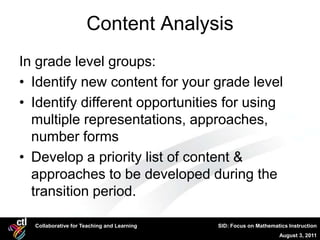
Content Analysis
In grade level groups:
• Identify new content for your grade level
• Identify different opportunities for using
  multiple representations, approaches,
  number forms
• Develop a priority list of content &
  approaches to be developed during the
  transition period.

  Collaborative for Teaching and Learning   SID: Focus on Mathematics Instruction
                                                                  August 3, 2011
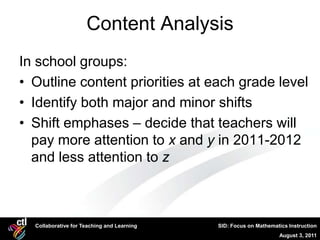
Content Analysis
In school groups:
• Outline content priorities at each grade level
• Identify both major and minor shifts
• Shift emphases – decide that teachers will
  pay more attention to x and y in 2011-2012
  and less attention to z


  Collaborative for Teaching and Learning   SID: Focus on Mathematics Instruction
                                                                  August 3, 2011
Quick Write
Based on this morning’s conversations, what
 do you want to remember? How have you
 added any more thinking to the
 routines/processes that you are planning on
 implementing this year?


  Collaborative for Teaching and Learning   SID: Focus on Mathematics Instruction
                                                                  August 3, 2011
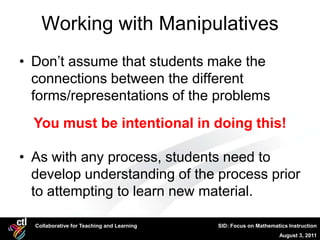
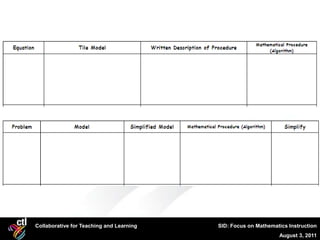
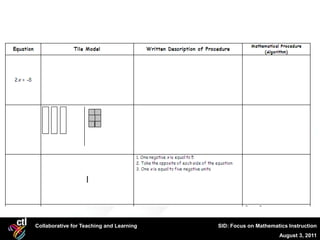
Working with Manipulatives
• Don’t assume that students make the
  connections between the different
  forms/representations of the problems
  You must be intentional in doing this!

• As with any process, students need to
  develop understanding of the process prior
  to attempting to learn new material.

  Collaborative for Teaching and Learning   SID: Focus on Mathematics Instruction
                                                                  August 3, 2011
Collaborative for Teaching and Learning   SID: Focus on Mathematics Instruction
                                                                August 3, 2011
Collaborative for Teaching and Learning   SID: Focus on Mathematics Instruction
                                                                August 3, 2011
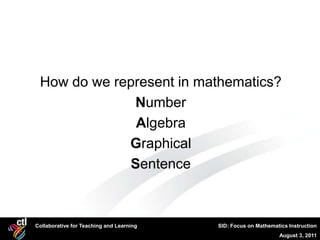
How do we represent in mathematics?
              Number
              Algebra
             Graphical
             Sentence


Collaborative for Teaching and Learning   SID: Focus on Mathematics Instruction
                                                                August 3, 2011
Grade Level Content

Working in multi-grade groups work through
  several of the problems on the page.

What does it look like?
How do the ideas progress across the
grades?
How do I support, develop student skills in
this area?

  Collaborative for Teaching andCTL, Mathematical
                                Learning                  21
                                                    SID: Focus on Mathematics Instruction
                           Literacy                                       August 3, 2011
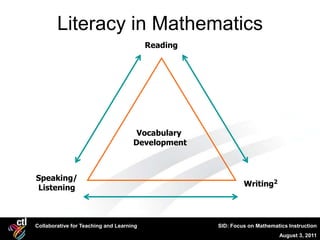
Literacy in Mathematics
                                          Reading


                                      Vocabulary
                                     Development


Speaking/
Listening                                                    Writing2


Collaborative for Teaching and Learning             SID: Focus on Mathematics Instruction
                                                                          August 3, 2011
Community Wiki

                  sidmath.pbworks.com


Collaborative for Teaching and Learning   SID: Focus on Mathematics Instruction
                                                                August 3, 2011
Community Wiki

                  sidmath.pbworks.com

          By the way, what is a Wiki?

                 rodaniel@ctlonline.org

Collaborative for Teaching and Learning   SID: Focus on Mathematics Instruction
                                                                August 3, 2011

SID Day 2 Mathematics Workshop

  • 1.
    Mathematics Summit Southern IndianaDeanery: Focus on Mathematics Instruction
  • 2.
    Standards for theDay • Deepen understanding of new Common Core State Standards for mathematics • Create understanding of using multiple representations and approaches to problem solving • Apply a variety of strategies to support and promote the learning of mathematics Collaborative for Teaching and Learning SID: Focus on Mathematics Instruction August 3, 2011
  • 3.
    Agenda DAY II • Analysisof New Common Core State Standards • Using Multiple Representations to Develop Deeper Understanding • Using Number lines and manipulatives to support conceptual understanding Collaborative for Teaching and Learning SID: Focus on Mathematics Instruction August 3, 2011
  • 4.
    Quick Write From ourtime together yesterday, What ideas, strategies, concepts, routines do you want to revisit as you plan your classroom for the upcoming year? Which do you want to focus on initially? & How do you plan on accomplishing this? Collaborative for Teaching and Learning SID: Focus on Mathematics Instruction August 3, 2011
  • 5.
    Reasoning Abstractly and Quantitatively • 5.NBT.6: Find whole-number quotients of whole numbers with up to four-digit dividends and two-digit divisors, using strategies based on place value, the properties of operations, and/or the relationship between multiplication and division. Illustrate and explain the calculation by using equations, rectangular arrays, and/or area models. Collaborative for Teaching and Learning SID: Focus on Mathematics Instruction August 3, 2011
  • 6.
    • Working innon-grade level groups (2-3) Divide 365÷4 (by hand) using three different methods. (Keep in mind, we are developing reasoning and sense-making, and multiple approaches/methods to use with our students ) Collaborative for Teaching and Learning SID: Focus on Mathematics Instruction August 3, 2011
  • 7.
    Method 1 of∞ Collaborative for Teaching and Learning SID: Focus on Mathematics Instruction August 3, 2011
  • 8.
    Method 2 of∞ Collaborative for Teaching and Learning SID: Focus on Mathematics Instruction August 3, 2011
  • 9.
    Method 3 of∞ Collaborative for Teaching and Learning SID: Focus on Mathematics Instruction August 3, 2011
  • 10.
    Method 4 of∞ Collaborative for Teaching and Learning SID: Focus on Mathematics Instruction August 3, 2011
  • 11.
    Method 5 of∞ 112/4 = 28 112/4 = 28 112/4 = 28 24/4 = 6 5/4 = 1 R1 365 = 112+112+112+24+5 = 28+28+28+6+1+¼ = 91¼ 4 4 Collaborative for Teaching and Learning SID: Focus on Mathematics Instruction August 3, 2011
  • 12.
    Common Core StateStandards for Mathematics K-8 Mathematics Content Operations & Number & Number & Ratios & Counting & Measurement The Number Expressions Statistics & DOMAINS Algebraic Operations Geometry Operations: Proportional Functions Cardinality & Data System & Equations Probability Thinking in Base Ten Fractions Relationships K X X X X X 1 X X X X 2 X X X X 3 X X X X X 4 X X X X X 5 X X X X X 6 X X X X X 7 X X X X X 8 X X X X X Collaborative for Teaching and Learning SID: Focus on Mathematics Instruction August 3, 2011
  • 13.
    6 7 8 Proportional Understand ratio concepts and use ratio Analyze proportional relationships and use reasoning to solve problems them to solve real‐world and mathematical Relationships problems. The Number Apply and extend previous understandings Apply and extend previous understandings Know that there are numbers that are not of multiplication and division to divide of operations with fractions to add, rational, and approximate them by rational System fractions by fractions. subtract, multiply, and divide rational numbers. Compute fluently with multi‐digit numbers numbers. and find common factors and multiples. Apply and extend previous understandings of numbers to the system of rational numbers. Expressions Apply and extend previous understandings Use properties of operations to generate Work with radicals and integer exponents. of arithmetic to algebraic expressions. equivalent expressions. Understand the connections between and Equations Reason about and solve one‐variable Solve real‐life and mathematical problems proportional relationships, lines, and linear equations and inequalities. using numerical and algebraic expressions equations. Represent and analyze quantitative and equations. relationships between dependent and independent variables. Functions Define, evaluate, and compare functions. Use functions to model relationships between quantities. Geometry Solve real‐world and mathematical Draw, construct and describe geometrical Understand congruence and similarity using problems involving area, surface area, and figures and describe the relationships physical models, transparencies, or volume. between them. geometry software. Solve real‐life and mathematical problems Understand and apply the Pythagorean involving angle measure, area, surface area, Theorem. and volume. Solve real‐world and mathematical problems involving volume of cylinders, cones, and spheres. Statistics and Develop understanding of statistical Use random sampling to draw inferences Investigate patterns of association in variability. about a population. bivariate data. Probability Summarize and describe distributions. Draw informal comparative inferences about two populations. Investigate chance processes and develop, use and evaluate probability models. Collaborative for Teaching and Learning SID: Focus on Mathematics Instruction August 3, 2011
  • 14.
    Content Analysis In gradelevel groups: • Identify new content for your grade level • Identify different opportunities for using multiple representations, approaches, number forms • Develop a priority list of content & approaches to be developed during the transition period. Collaborative for Teaching and Learning SID: Focus on Mathematics Instruction August 3, 2011
  • 15.
    Content Analysis In schoolgroups: • Outline content priorities at each grade level • Identify both major and minor shifts • Shift emphases – decide that teachers will pay more attention to x and y in 2011-2012 and less attention to z Collaborative for Teaching and Learning SID: Focus on Mathematics Instruction August 3, 2011
  • 16.
    Quick Write Based onthis morning’s conversations, what do you want to remember? How have you added any more thinking to the routines/processes that you are planning on implementing this year? Collaborative for Teaching and Learning SID: Focus on Mathematics Instruction August 3, 2011
  • 17.
    Working with Manipulatives •Don’t assume that students make the connections between the different forms/representations of the problems You must be intentional in doing this! • As with any process, students need to develop understanding of the process prior to attempting to learn new material. Collaborative for Teaching and Learning SID: Focus on Mathematics Instruction August 3, 2011
  • 18.
    Collaborative for Teachingand Learning SID: Focus on Mathematics Instruction August 3, 2011
  • 19.
    Collaborative for Teachingand Learning SID: Focus on Mathematics Instruction August 3, 2011
  • 20.
    How do werepresent in mathematics? Number Algebra Graphical Sentence Collaborative for Teaching and Learning SID: Focus on Mathematics Instruction August 3, 2011
  • 21.
    Grade Level Content Workingin multi-grade groups work through several of the problems on the page. What does it look like? How do the ideas progress across the grades? How do I support, develop student skills in this area? Collaborative for Teaching andCTL, Mathematical Learning 21 SID: Focus on Mathematics Instruction Literacy August 3, 2011
  • 22.
    Literacy in Mathematics Reading Vocabulary Development Speaking/ Listening Writing2 Collaborative for Teaching and Learning SID: Focus on Mathematics Instruction August 3, 2011
  • 23.
    Community Wiki sidmath.pbworks.com Collaborative for Teaching and Learning SID: Focus on Mathematics Instruction August 3, 2011
  • 24.
    Community Wiki sidmath.pbworks.com By the way, what is a Wiki? rodaniel@ctlonline.org Collaborative for Teaching and Learning SID: Focus on Mathematics Instruction August 3, 2011