Common Core State
      Standards Overview
              The Shifts:
What they are and why they are important
Rationale for the CCSS
   Declining US competitiveness with other
    developed countries

   High rates of college remediation

   NAEP performance that is largely flat over the past
    40 years in 8th grade
       Slight improvement at the 4th grade level
       Slight decline at the high school level
Principles of the CCSS
   Aligned to requirements for college and career
    readiness

   Based on evidence

   Honest about time
ELA/Literacy: 3 shifts
             The What
1.   Building knowledge through content-
     rich nonfiction


2.   Reading, writing, and speaking grounded in
     evidence from text, both literary and
     informational


3.   Regular practice with complex text and its
     academic language
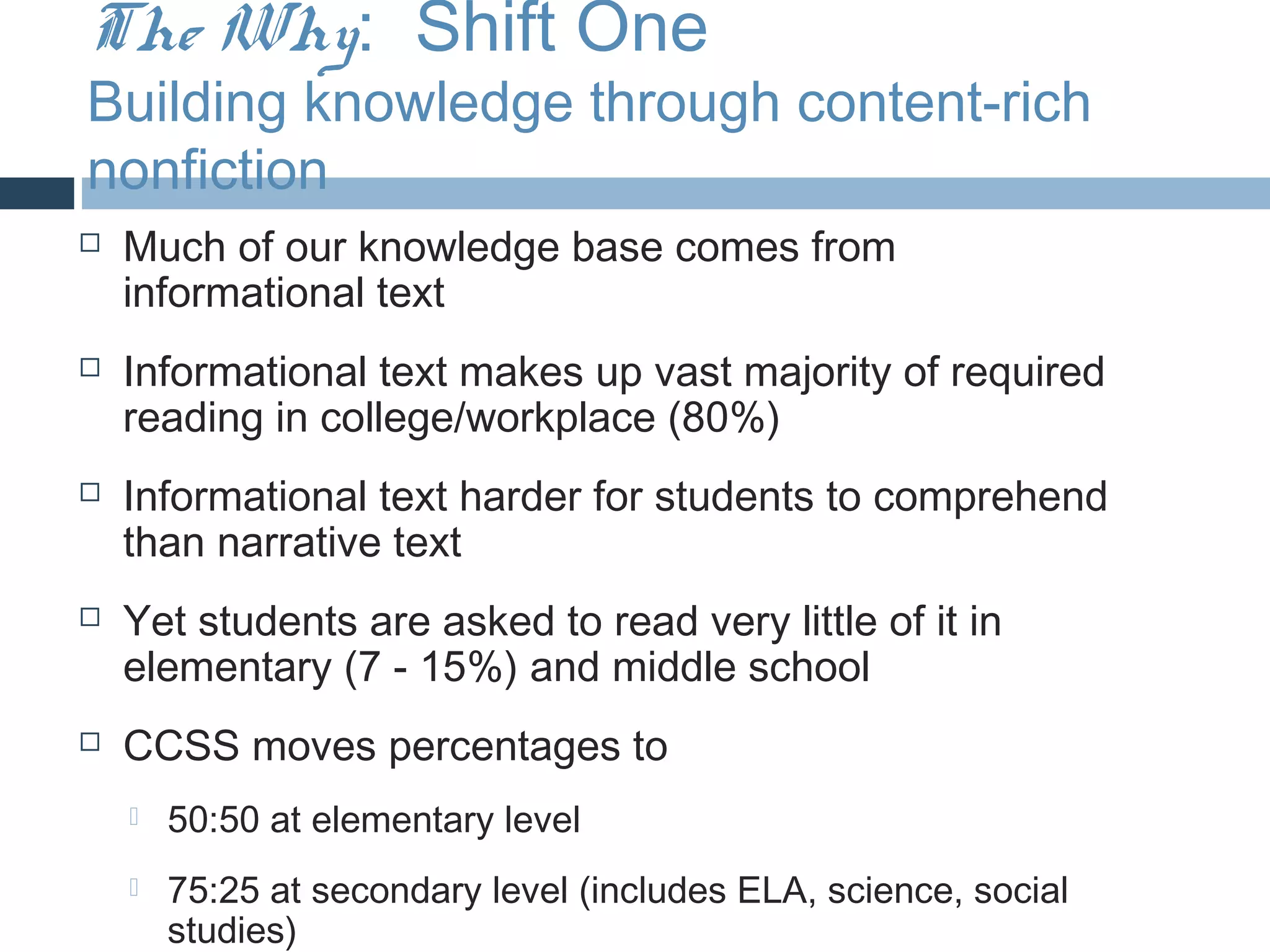
The Why: Shift One
Building knowledge through content-rich
nonfiction
   Much of our knowledge base comes from
    informational text
   Informational text makes up vast majority of required
    reading in college/workplace (80%)
   Informational text harder for students to comprehend
    than narrative text
   Yet students are asked to read very little of it in
    elementary (7 - 15%) and middle school
   CCSS moves percentages to
       50:50 at elementary level
       75:25 at secondary level (includes ELA, science, social
        studies)
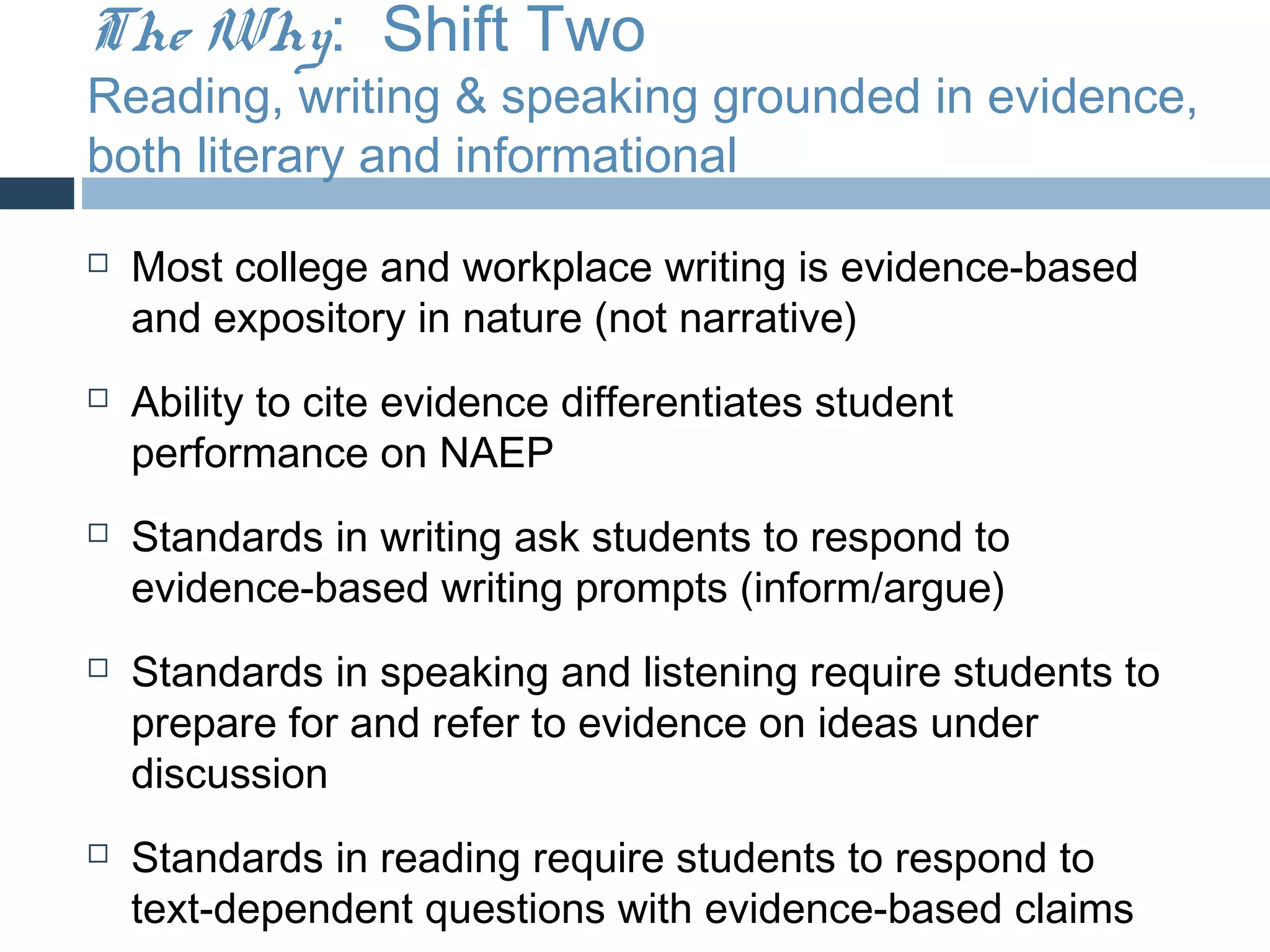
The Why: Shift Two
Reading, writing & speaking grounded in evidence,
both literary and informational

   Most college and workplace writing is evidence-based
    and expository in nature (not narrative)
   Ability to cite evidence differentiates student
    performance on NAEP
   Standards in writing ask students to respond to
    evidence-based writing prompts (inform/argue)
   Standards in speaking and listening require students to
    prepare for and refer to evidence on ideas under
    discussion
   Standards in reading require students to respond to
    text-dependent questions with evidence-based claims
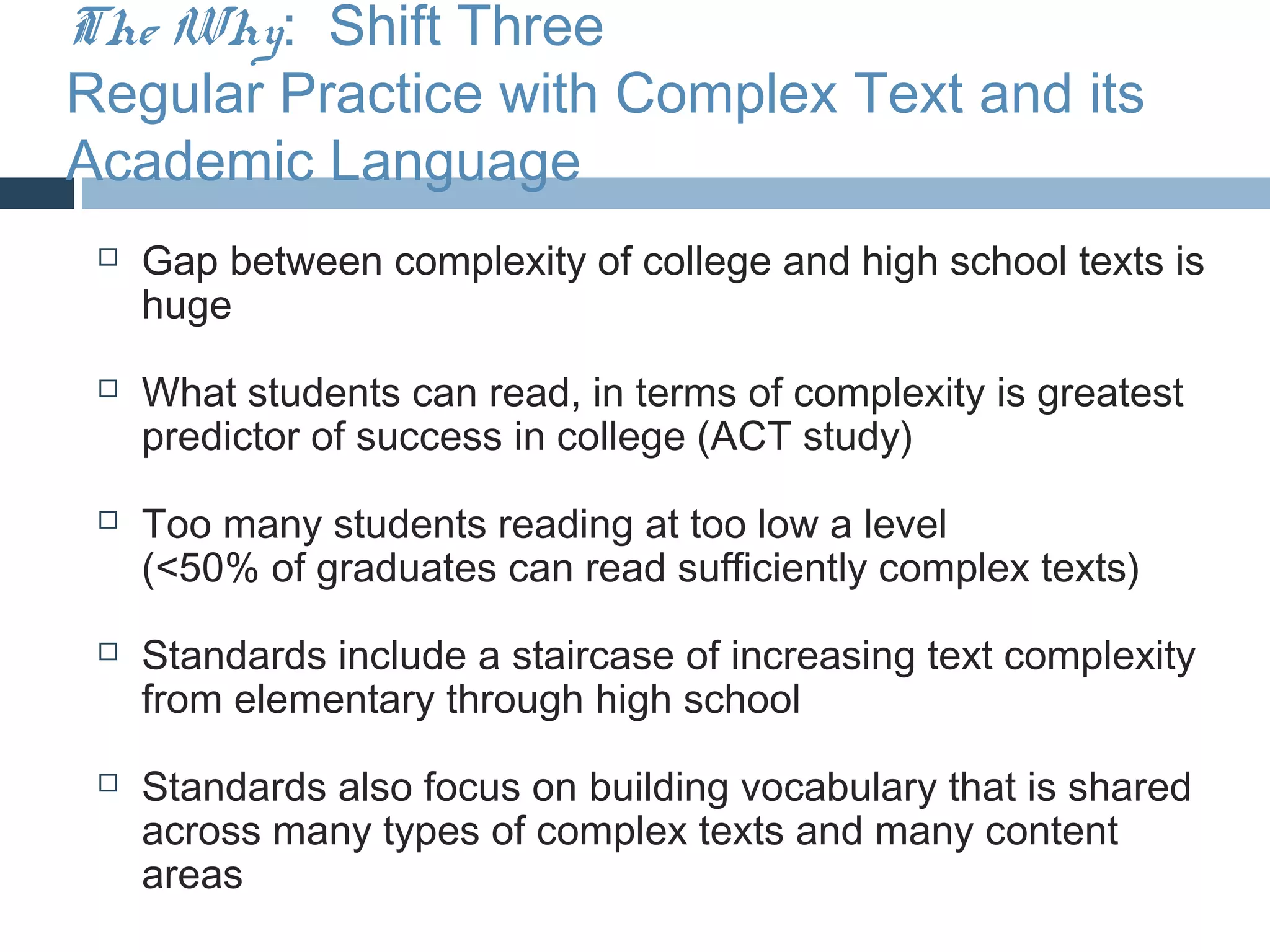
The Why: Shift Three
Regular Practice with Complex Text and its
Academic Language
    Gap between complexity of college and high school texts is
     huge
    What students can read, in terms of complexity is greatest
     predictor of success in college (ACT study)
    Too many students reading at too low a level
     (<50% of graduates can read sufficiently complex texts)
    Standards include a staircase of increasing text complexity
     from elementary through high school
    Standards also focus on building vocabulary that is shared
     across many types of complex texts and many content
     areas
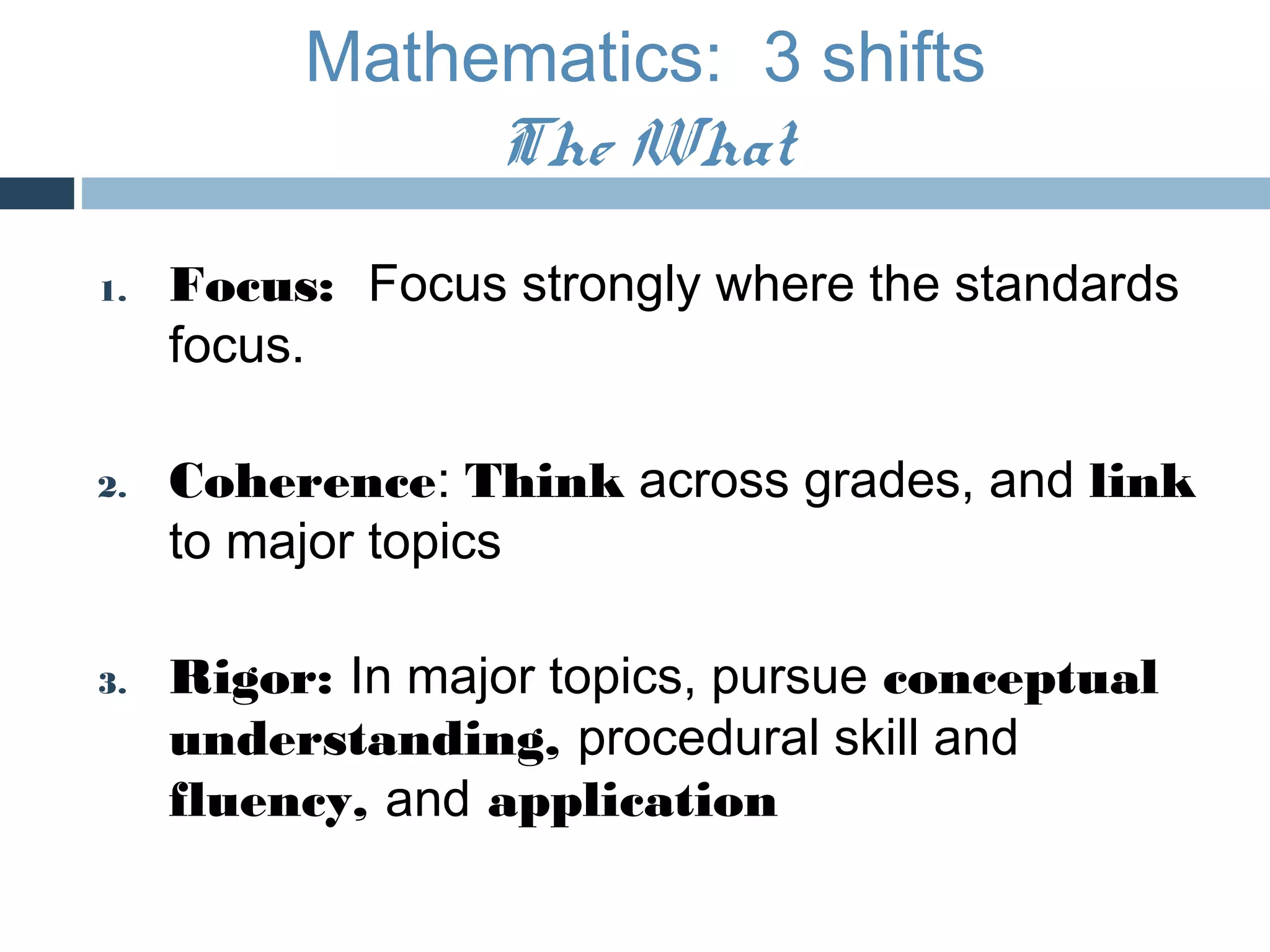
Mathematics: 3 shifts
               The What
1.   Focus: Focus strongly where the standards
     focus.

2.   Coherence: Think across grades, and link
     to major topics

3.   Rigor: In major topics, pursue conceptual
     understanding, procedural skill and
     fluency, and application
The Why: Shift One
Focus strongly where the Standards
focus
   Significantly narrow the scope of content and
    deepen how time and energy is spent in the
    math classroom

   Focus deeply only on what is emphasized in
    the standards, so that students gain strong
    foundations
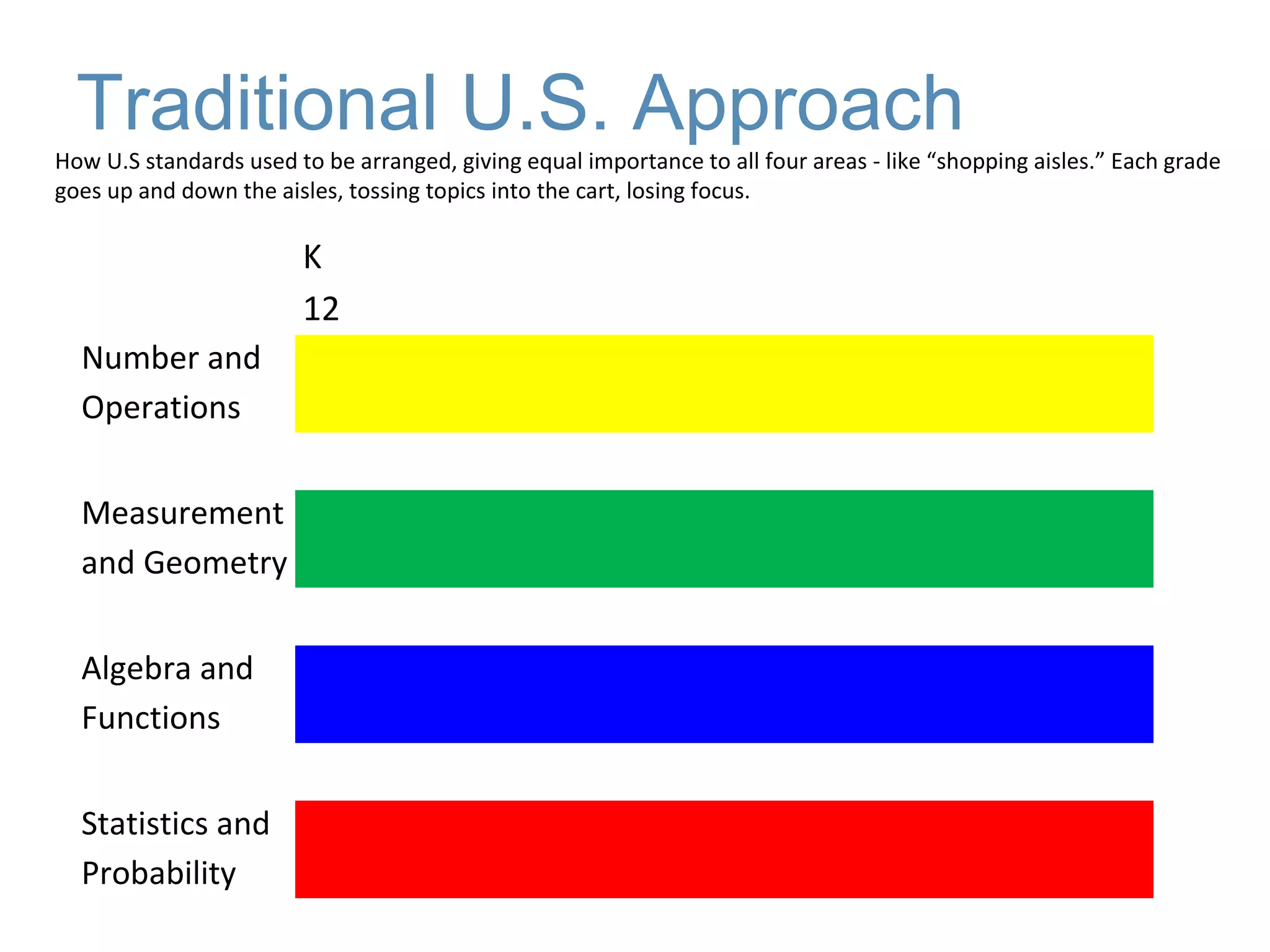
Traditional U.S. Approach
How U.S standards used to be arranged, giving equal importance to all four areas - like “shopping aisles.” Each grade
goes up and down the aisles, tossing topics into the cart, losing focus.

                        K
                        12
  Number and
  Operations

  Measurement
  and Geometry

  Algebra and
  Functions


  Statistics and
  Probability
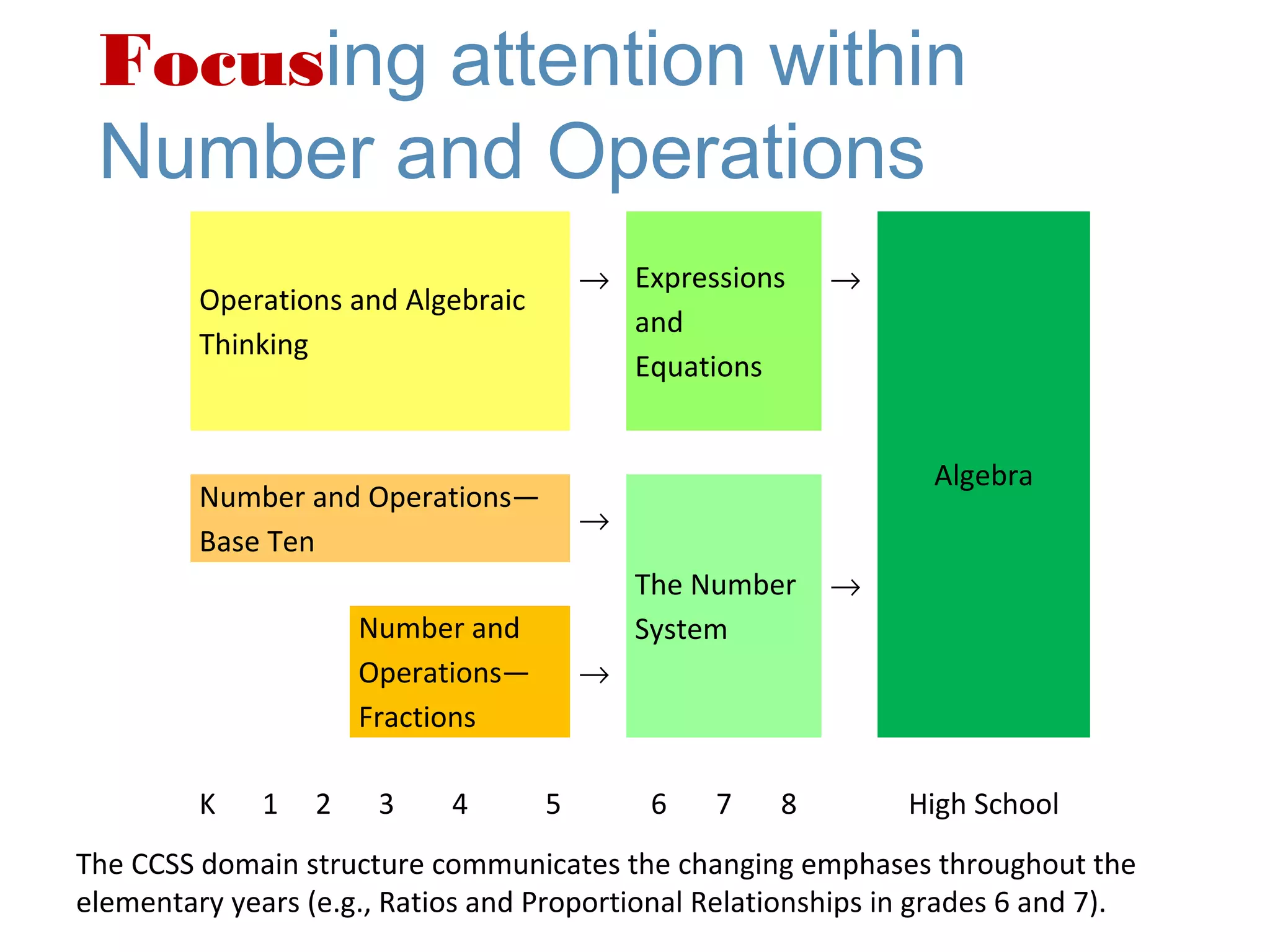
Focusing attention within
 Number and Operations
                                        → Expressions    →
         Operations and Algebraic
                                          and
         Thinking
                                          Equations


                                                                 Algebra
         Number and Operations—
                                        →
         Base Ten
                                            The Number   →
                      Number and            System
                      Operations—       →
                      Fractions

         K    1   2    3    4       5       6    7   8         High School
The CCSS domain structure communicates the changing emphases throughout the
elementary years (e.g., Ratios and Proportional Relationships in grades 6 and 7).
The Why: Shift Two
Coherence Think across
grades, and link to major topics
within grades
   Carefully connect the learning within and across
    grades so that students can build new
    understanding onto foundations built in previous
    years.

   Begin to count on solid conceptual
    understanding of core content and build on it.
    Each standard is not a new event, but an
    extension of previous learning.
Coherence: Think across grades

Carefully laid progressions of conceptual development, not just moving topics earlier in
the grade sequence.

  Fraction example:
  “The coherence and sequential nature of mathematics
    dictate the foundational skills that are necessary for the
    learning of algebra. The most important foundational
    skill not presently developed appears to be proficiency
    with fractions (including decimals, percents, and
    negative fractions). The teaching of fractions must
    be acknowledged as critically important and
    improved before an increase in student
    achievement in algebra can be expected.”

  Final Report of the National Mathematics Advisory Panel (2008, p. 18)
Coherence: Link to major topics within
                      grades

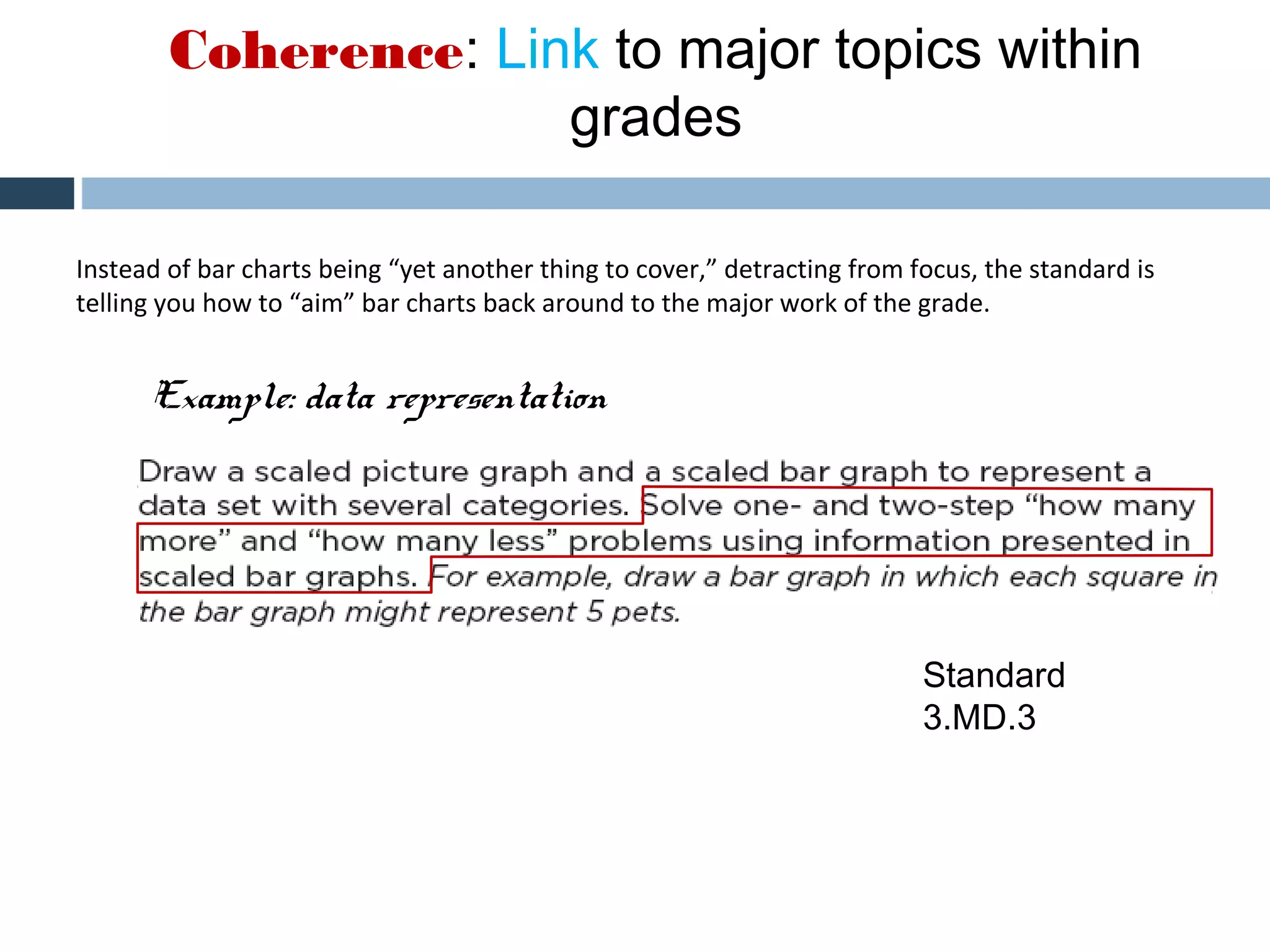
Instead of bar charts being “yet another thing to cover,” detracting from focus, the standard is
telling you how to “aim” bar charts back around to the major work of the grade.


      Example: data representation


                                                                           Standard
                                                                           3.MD.3
Coherence: Link to major topics within
    grades

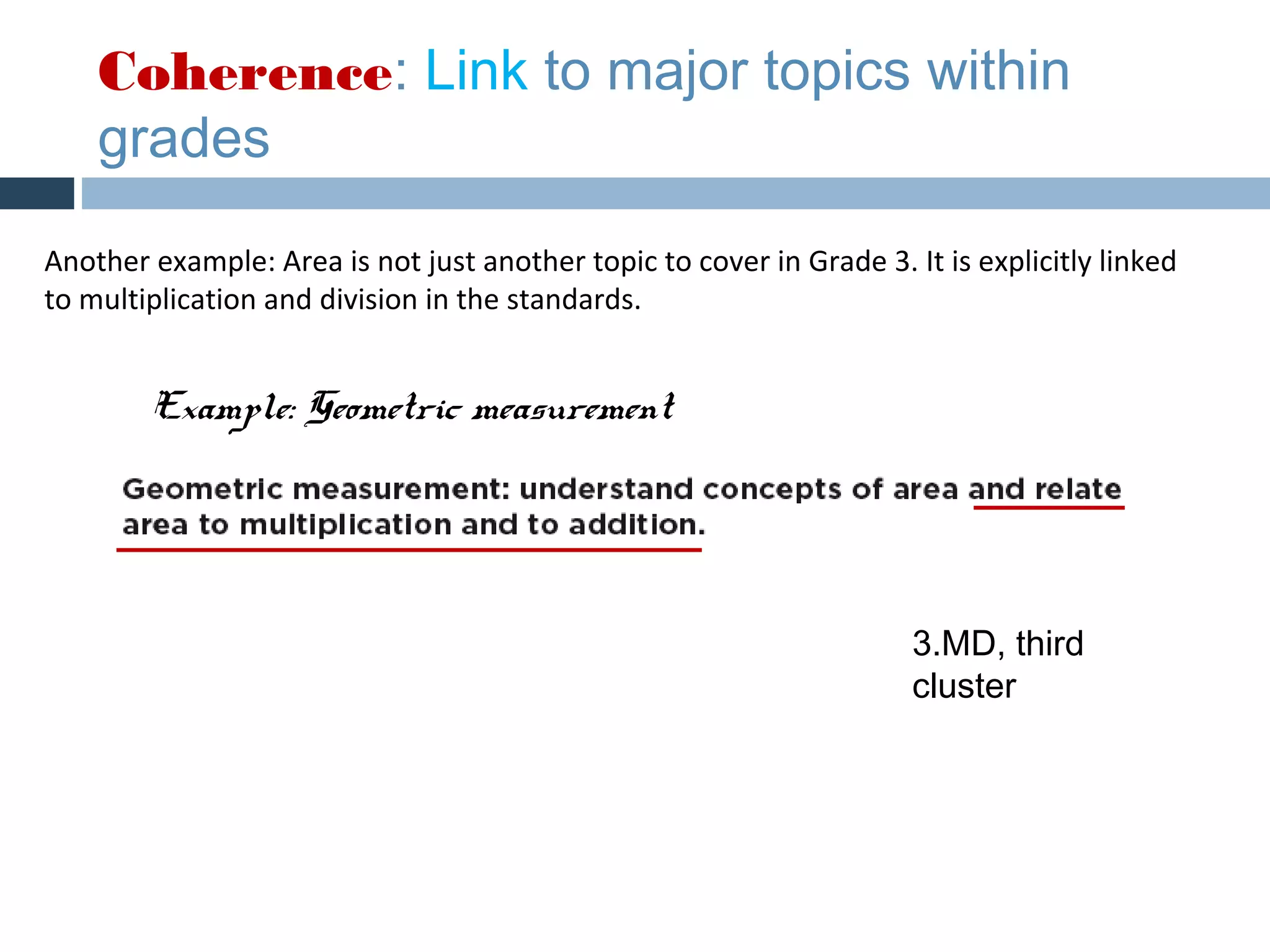
Another example: Area is not just another topic to cover in Grade 3. It is explicitly linked
to multiplication and division in the standards.


        Example: Geometric measurement


                                                                      3.MD, third
                                                                      cluster
The Why: Shift Three
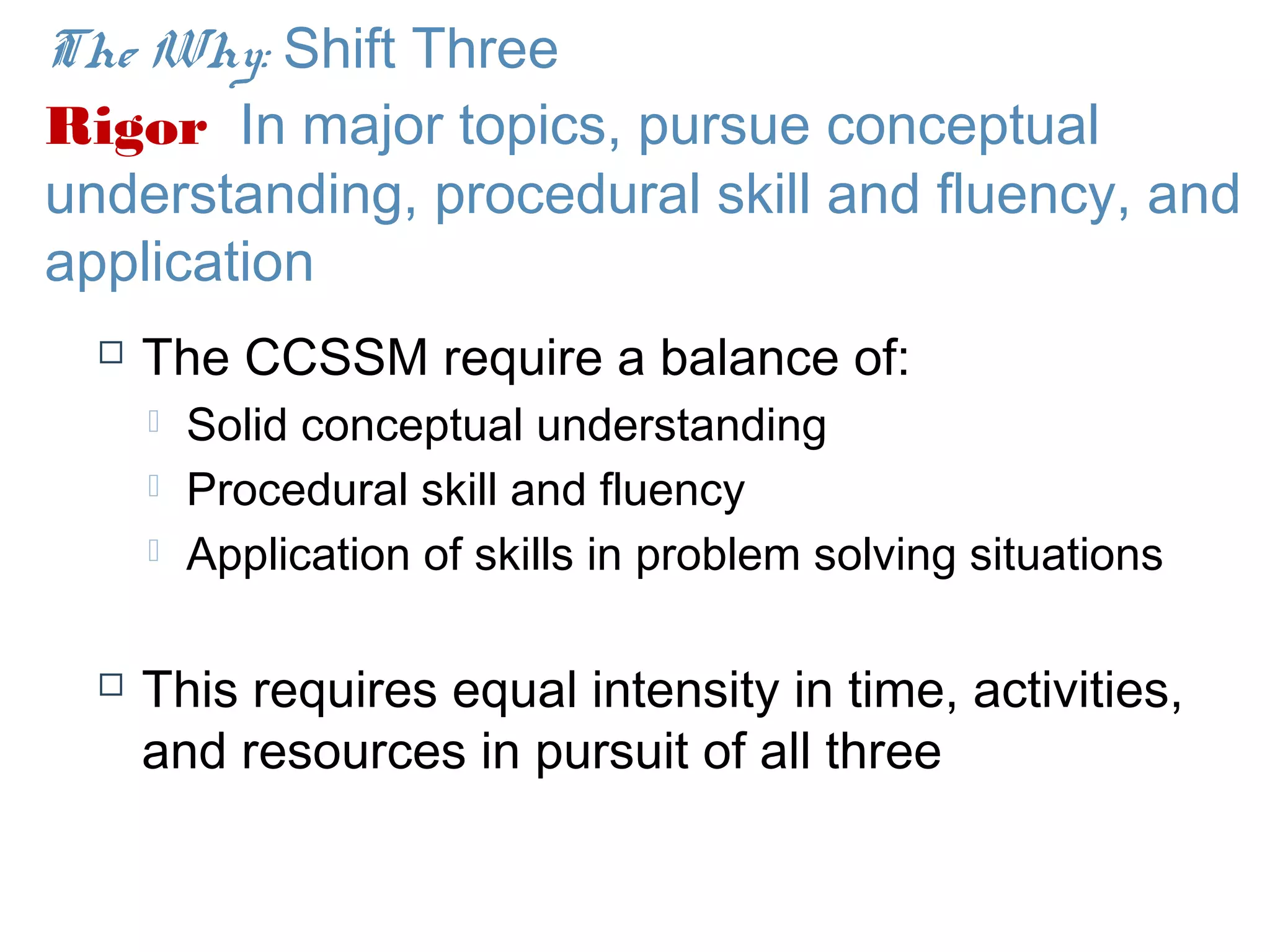
Rigor In major topics, pursue conceptual
understanding, procedural skill and fluency, and
application
     The CCSSM require a balance of:
         Solid conceptual understanding
         Procedural skill and fluency
         Application of skills in problem solving situations

     This requires equal intensity in time, activities,
      and resources in pursuit of all three
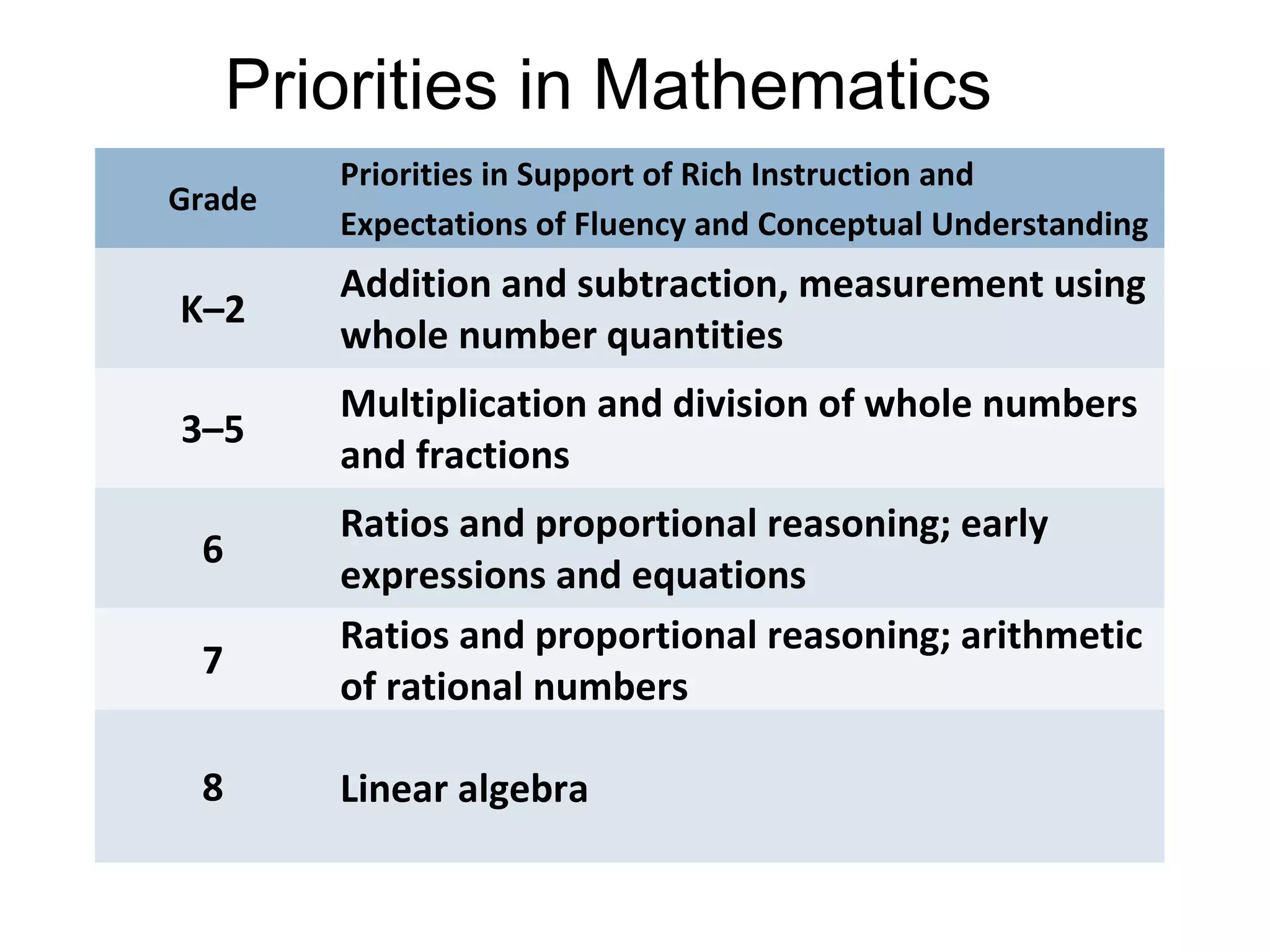
Priorities in Mathematics
        Priorities in Support of Rich Instruction and
Grade
        Expectations of Fluency and Conceptual Understanding
        Addition and subtraction, measurement using
K–2
        whole number quantities
        Multiplication and division of whole numbers
3–5
        and fractions
        Ratios and proportional reasoning; early
 6
        expressions and equations
        Ratios and proportional reasoning; arithmetic
 7
        of rational numbers

 8      Linear algebra
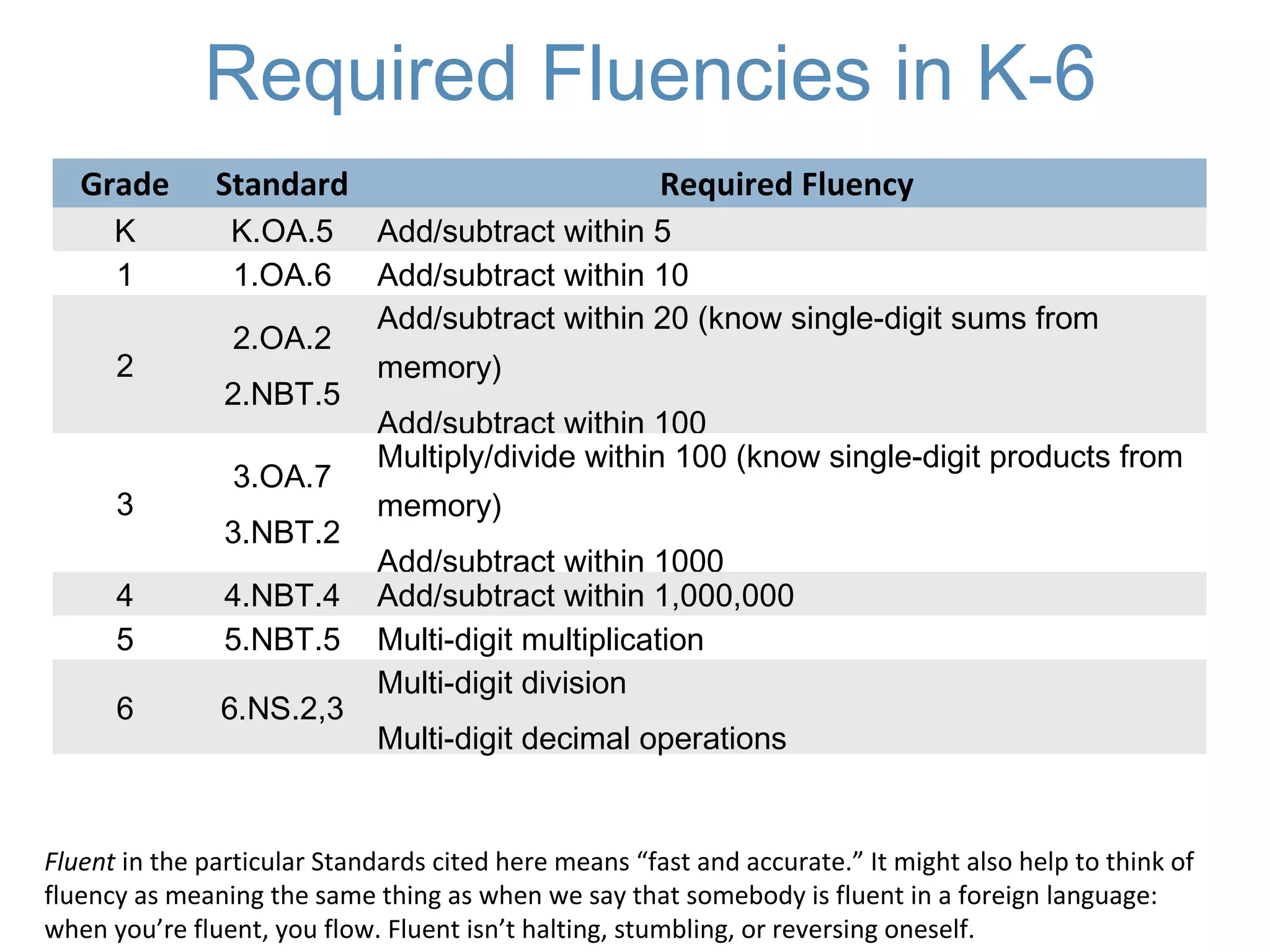
Required Fluencies in K-6
   Grade       Standard                                Required Fluency
      K         K.OA.5       Add/subtract within 5
      1         1.OA.6       Add/subtract within 10
                             Add/subtract within 20 (know single-digit sums from
                2.OA.2
      2                      memory)
                2.NBT.5
                             Add/subtract within 100
                             Multiply/divide within 100 (know single-digit products from
                3.OA.7
      3                      memory)
                3.NBT.2
                             Add/subtract within 1000
      4         4.NBT.4      Add/subtract within 1,000,000
      5         5.NBT.5      Multi-digit multiplication
                             Multi-digit division
      6        6.NS.2,3
                             Multi-digit decimal operations


Fluent in the particular Standards cited here means “fast and accurate.” It might also help to think of
fluency as meaning the same thing as when we say that somebody is fluent in a foreign language:
when you’re fluent, you flow. Fluent isn’t halting, stumbling, or reversing oneself.
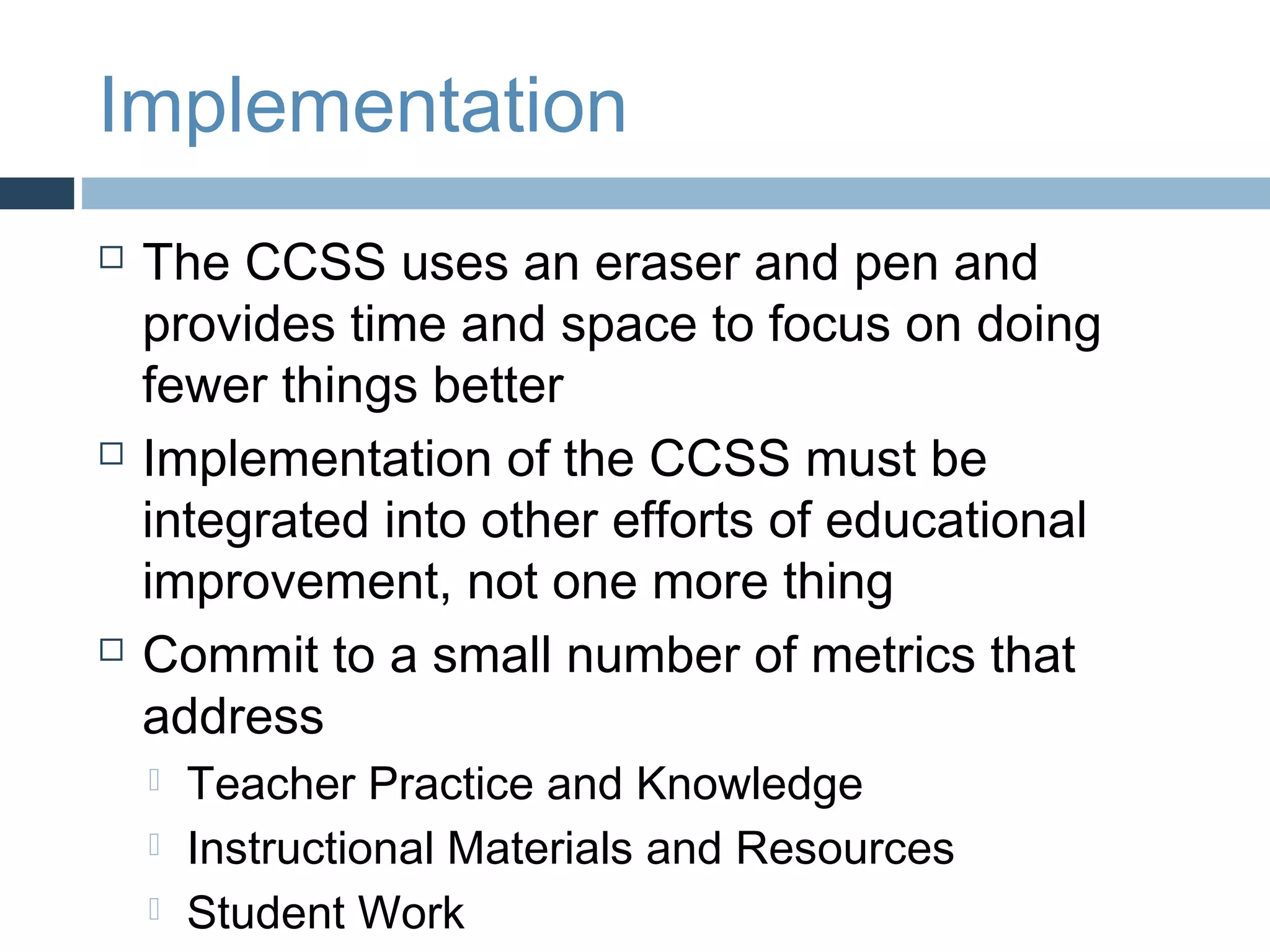
Implementation
   The CCSS uses an eraser and pen and
    provides time and space to focus on doing
    fewer things better
   Implementation of the CCSS must be
    integrated into other efforts of educational
    improvement, not one more thing
   Commit to a small number of metrics that
    address
       Teacher Practice and Knowledge
       Instructional Materials and Resources
       Student Work
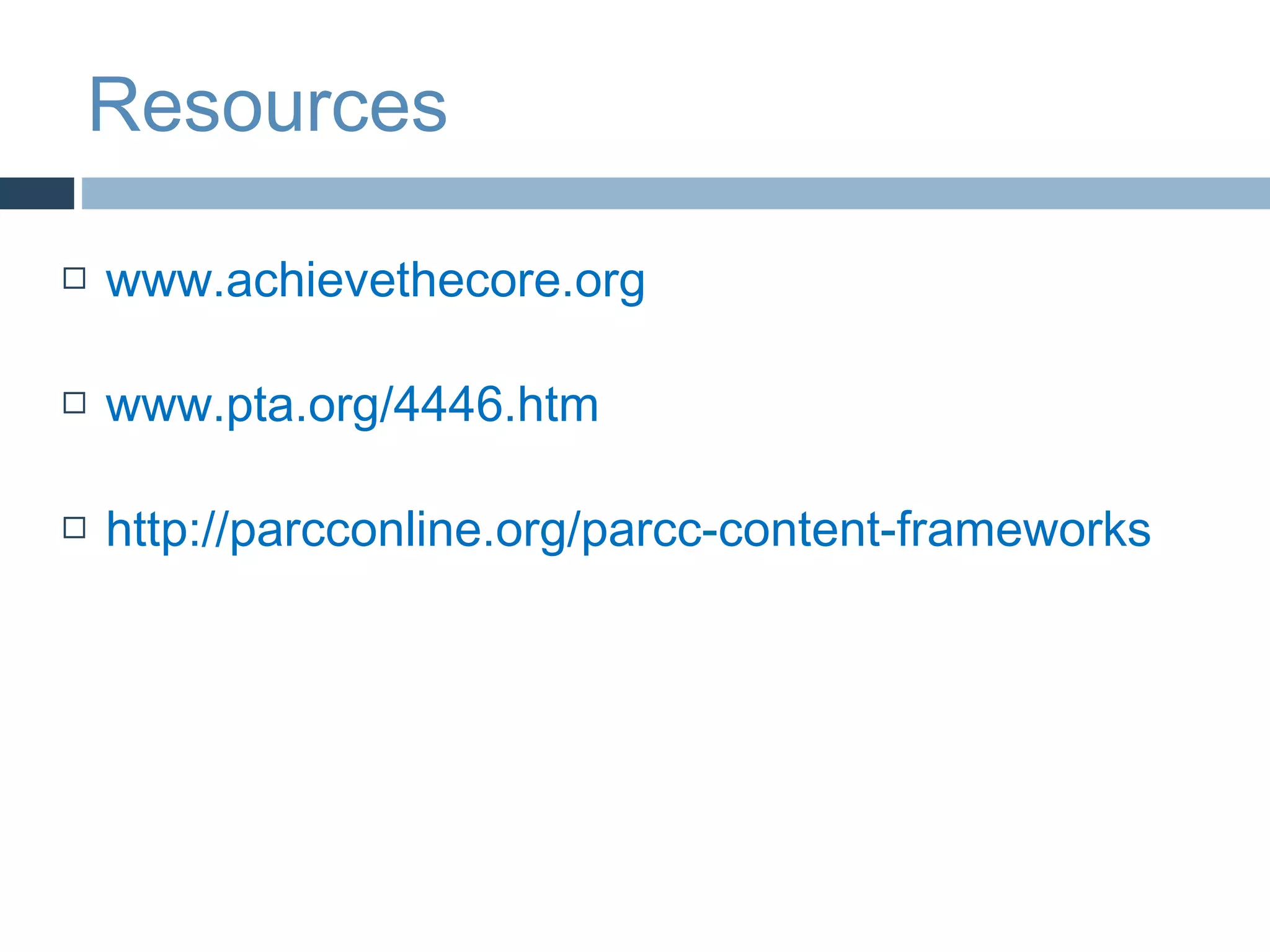
Resources

   www.achievethecore.org

   www.pta.org/4446.htm

   http://parcconline.org/parcc-content-frameworks

CCSS California Shifts overview

  • 1.
    Common Core State Standards Overview The Shifts: What they are and why they are important
  • 2.
    Rationale for theCCSS  Declining US competitiveness with other developed countries  High rates of college remediation  NAEP performance that is largely flat over the past 40 years in 8th grade  Slight improvement at the 4th grade level  Slight decline at the high school level
  • 3.
    Principles of theCCSS  Aligned to requirements for college and career readiness  Based on evidence  Honest about time
  • 4.
    ELA/Literacy: 3 shifts The What 1. Building knowledge through content- rich nonfiction 2. Reading, writing, and speaking grounded in evidence from text, both literary and informational 3. Regular practice with complex text and its academic language
  • 5.
    The Why: ShiftOne Building knowledge through content-rich nonfiction  Much of our knowledge base comes from informational text  Informational text makes up vast majority of required reading in college/workplace (80%)  Informational text harder for students to comprehend than narrative text  Yet students are asked to read very little of it in elementary (7 - 15%) and middle school  CCSS moves percentages to  50:50 at elementary level  75:25 at secondary level (includes ELA, science, social studies)
  • 6.
    The Why: ShiftTwo Reading, writing & speaking grounded in evidence, both literary and informational  Most college and workplace writing is evidence-based and expository in nature (not narrative)  Ability to cite evidence differentiates student performance on NAEP  Standards in writing ask students to respond to evidence-based writing prompts (inform/argue)  Standards in speaking and listening require students to prepare for and refer to evidence on ideas under discussion  Standards in reading require students to respond to text-dependent questions with evidence-based claims
  • 7.
    The Why: ShiftThree Regular Practice with Complex Text and its Academic Language  Gap between complexity of college and high school texts is huge  What students can read, in terms of complexity is greatest predictor of success in college (ACT study)  Too many students reading at too low a level (<50% of graduates can read sufficiently complex texts)  Standards include a staircase of increasing text complexity from elementary through high school  Standards also focus on building vocabulary that is shared across many types of complex texts and many content areas
  • 8.
    Mathematics: 3 shifts The What 1. Focus: Focus strongly where the standards focus. 2. Coherence: Think across grades, and link to major topics 3. Rigor: In major topics, pursue conceptual understanding, procedural skill and fluency, and application
  • 9.
    The Why: ShiftOne Focus strongly where the Standards focus  Significantly narrow the scope of content and deepen how time and energy is spent in the math classroom  Focus deeply only on what is emphasized in the standards, so that students gain strong foundations
  • 10.
    Traditional U.S. Approach HowU.S standards used to be arranged, giving equal importance to all four areas - like “shopping aisles.” Each grade goes up and down the aisles, tossing topics into the cart, losing focus. K 12 Number and Operations Measurement and Geometry Algebra and Functions Statistics and Probability
  • 11.
    Focusing attention within Number and Operations → Expressions → Operations and Algebraic and Thinking Equations Algebra Number and Operations— → Base Ten The Number → Number and System Operations— → Fractions K 1 2 3 4 5 6 7 8 High School The CCSS domain structure communicates the changing emphases throughout the elementary years (e.g., Ratios and Proportional Relationships in grades 6 and 7).
  • 12.
    The Why: ShiftTwo Coherence Think across grades, and link to major topics within grades  Carefully connect the learning within and across grades so that students can build new understanding onto foundations built in previous years.  Begin to count on solid conceptual understanding of core content and build on it. Each standard is not a new event, but an extension of previous learning.
  • 13.
    Coherence: Think acrossgrades Carefully laid progressions of conceptual development, not just moving topics earlier in the grade sequence. Fraction example: “The coherence and sequential nature of mathematics dictate the foundational skills that are necessary for the learning of algebra. The most important foundational skill not presently developed appears to be proficiency with fractions (including decimals, percents, and negative fractions). The teaching of fractions must be acknowledged as critically important and improved before an increase in student achievement in algebra can be expected.” Final Report of the National Mathematics Advisory Panel (2008, p. 18)
  • 14.
    Coherence: Link tomajor topics within grades Instead of bar charts being “yet another thing to cover,” detracting from focus, the standard is telling you how to “aim” bar charts back around to the major work of the grade. Example: data representation Standard 3.MD.3
  • 15.
    Coherence: Link tomajor topics within grades Another example: Area is not just another topic to cover in Grade 3. It is explicitly linked to multiplication and division in the standards. Example: Geometric measurement 3.MD, third cluster
  • 16.
    The Why: ShiftThree Rigor In major topics, pursue conceptual understanding, procedural skill and fluency, and application  The CCSSM require a balance of:  Solid conceptual understanding  Procedural skill and fluency  Application of skills in problem solving situations  This requires equal intensity in time, activities, and resources in pursuit of all three
  • 17.
    Priorities in Mathematics Priorities in Support of Rich Instruction and Grade Expectations of Fluency and Conceptual Understanding Addition and subtraction, measurement using K–2 whole number quantities Multiplication and division of whole numbers 3–5 and fractions Ratios and proportional reasoning; early 6 expressions and equations Ratios and proportional reasoning; arithmetic 7 of rational numbers 8 Linear algebra
  • 18.
    Required Fluencies inK-6 Grade Standard Required Fluency K K.OA.5 Add/subtract within 5 1 1.OA.6 Add/subtract within 10 Add/subtract within 20 (know single-digit sums from 2.OA.2 2 memory) 2.NBT.5 Add/subtract within 100 Multiply/divide within 100 (know single-digit products from 3.OA.7 3 memory) 3.NBT.2 Add/subtract within 1000 4 4.NBT.4 Add/subtract within 1,000,000 5 5.NBT.5 Multi-digit multiplication Multi-digit division 6 6.NS.2,3 Multi-digit decimal operations Fluent in the particular Standards cited here means “fast and accurate.” It might also help to think of fluency as meaning the same thing as when we say that somebody is fluent in a foreign language: when you’re fluent, you flow. Fluent isn’t halting, stumbling, or reversing oneself.
  • 19.
    Implementation  The CCSS uses an eraser and pen and provides time and space to focus on doing fewer things better  Implementation of the CCSS must be integrated into other efforts of educational improvement, not one more thing  Commit to a small number of metrics that address  Teacher Practice and Knowledge  Instructional Materials and Resources  Student Work
  • 20.
    Resources  www.achievethecore.org  www.pta.org/4446.htm  http://parcconline.org/parcc-content-frameworks

Editor's Notes

  • #11 How U.S standards used to be arranged, giving equal importance to all four areas - like “shopping aisles.” Each grade goes up and down the aisles, tossing topics into the cart, losing focus. The CCSS domain structure communicates the changing emphases throughout the elementary years (e.g., Ratios and Proportional Relationships in grades 6 and 7).
  • #14 Carefully laid progressions of conceptual development, not just moving topics earlier in the grade sequence.
  • #15 Instead of bar charts being “yet another thing to cover,” detracting from focus, the standard is telling you how to “aim” bar charts back around to the major work of the grade.
  • #16 Another example: Area is not just another topic to cover in Grade 3. It is explicitly linked to multiplication and division in the standards.
  • #17 This shift is about the depth of what is expected in the standards, and also about what one should expect to see happening in the classroom, in curricular materials, and so on.
  • #19 Fluent in the particular Standards cited here means “fast and accurate.” It might also help to think of fluency as meaning the same thing as when we say that somebody is fluent in a foreign language: when you’re fluent, you flow. Fluent isn’t halting, stumbling, or reversing oneself. The word fluency was used judiciously in the Standards to mark the endpoints of progressions of learning that begin with solid underpinnings and then pass upward through stages of growing maturity. Some of these fluency expectations are meant to be mental and others with pencil and paper. But for each of them, there should be no hesitation in getting the answer with accuracy.