E-sense: Communication
through Energy Sensing
Presented by:
K.SHYNIMOL
VIAHECS020
INTRODUCTION
 Esense is a new paradigm of communication between
devices that have fundamentally different physical layers.
 This same paradigm can also be used for communication
between devices belonging to the same standard, which are
out of communication range but within carriersense range.
 We term our scheme Esense since it is based on energy
sensing.
 Our scheme can enable communication in any setting as long
as the two end points can sense each others energy.
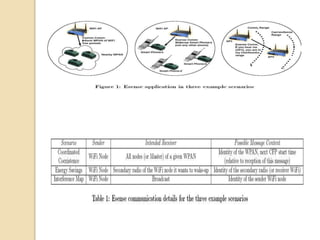
Coordinated Coexistence
• Coexistence between the standards becomes a very
important issue.
• The problem can be much more effectively solved by
explicit communication, and coordination between the
different entities operating in the same spectrum.
• They can then potentially share the spectrum in a time
multiplexed fashion.
Energy Management
 WiFi enabled devices often employ a variety of
techniques to conserve battery power.
 These techniques include disabling the WiFi interface or
turning the entire device off.
 A solution that helps in this setting is to employ an
extremely low power secondary radio that operates in
the same frequency band as WiFi but consumes
significantly lesser power than WiFi.
Network Management
 Debugging performance anomalies in deployed WiFi
networks needs a good interference map of the
network.
 However interference maps are hard to construct since
often the interference range exceeds the transmission
range.
 A node may be able to sense interference but is often
clueless as to who is responsible for it since it cannot
interpret the incoming packets.
 Our energy based framework achieves its task of
communication by constructing an alphabet set of
packet sizes.
 We enable unidirectional communication from an IEEE
802.11 radio to an 802.15.4 radio.
 Esense is equally applicable to enable bi-directional
communication as well as communication across other
wireless standards.
 The 802.11 to 802.15.4 communication is directly
applicable in the first two of the three scenarios.
 The communication is uni-directional and originates
from the WiFi domain, with the receiver being an
802.15.4 radio.
 In the third scenario, the receiver is an 802.11 radio.
 Analysis of the packet size traces of many WiFi
installations reveals a packet size distribution that is
mostly bimodal.
RELATED WORKS
 Some aspects of Esense resemble steganography,
where information is concealed in otherwise normal
looking messages.
 Esense resembles steganography in that we construct
an information stream embedded within another
information stream.
 Coexistence studies have shown that there could be
considerable interference between the different
standards resulting in as high as 90% frame loss rate.
 The most common solution to the above problem is to
assess the amount of interference in a given channel
and choose a channel that has no or minimum
interference.
 This would lead to better throughput, lesser delay, and
energy efficiency.
 The IEEE 802.11 standard supports a power save
mode (PSM) which permits the WiFi interface to duty-
cycle.
 Wake-on-WLAN is another solution that employs a
secondary radio and looks at the problem of energy
savings in rural long-distance WiFi networks.
 This solution however employs the secondary radio
only on the receiver side (not sender) and avoids the
range-mismatch problem by making the secondary
radio directly sense the WiFi energy of the sender.
 Cell2notify is another approach that also tries to
overcome the range mismatch problem.
 Our Esense-based solution has the following
advantages.
 First, it can work in a variety of settings.
 Second, it does not suffer from the range mismatch
problem.
 Third, our solution needs software changes at the WiFi
sender side and integration of a very low cost ($10), low
power (60mW) secondary radio1 at the receiver side.
THE ESENSE COMMUNICATION
FRAMEWORK
Esense: Overall approach
Choices for Esense:
 In an energy based communication system, the receiver
can sense only the energy patterns on the channel.
 Based on this sensing, it can interpret three possible
parameters: the intensity of the energy, the gap
between energy bursts, and the duration of an energy
burst.
Alphabet set:
 For any message exchange, we need a base alphabet,
and a set size of two is a minimum requirement for
building a vocabulary.
 The larger the alphabet set, the more efficient and less
complex the communication framework would be.
 In an operational network, there may normally be
energy bursts of different lengths.
 In choosing the Esense alphabet set, while we must
seek a large set, we must also seek to minimize the
false positive rate.
Packet sizes in WiFi traces:
 There are a variety of WiFi traces available in the public
domain .
 The five traces are: Cafeteria (Powells), Library, PSU-
CSE department , OSDI Conference, Stanford CSE
department .
 Across all traces, the majority of the packets are
either small packets (< 140 bytes) corresponding to
the ACKs, beacons, management frames.
A possible approach for Esense:
 Suppose we assume that the 802.15.4 node can detect
any packet size upto an accuracy of a byte.
 The solution then is to exclude all packet sizes whose
frequency of occurrence in the WiFi traces is greater
than a threshold percentage.
 The higher we choose the threshold percentage, the
larger the alphabet set since we would be excluding
lesser number of packet sizes.
Detecting Esense alphabets:
 The task of the receiving 802.15.4 node would be to measure
the duration of energy on the channel and subsequently map
it to a corresponding packet size.
 If it sees a packet that belongs to the alphabet set, it
considers it as an Esense packet and the measured packet
size corresponds to an Esense alphabet.
 In detecting the alphabets, we could have a small number of
false positives
Practical limitations
 In reality, the above described scheme faces two main
practical challenges.
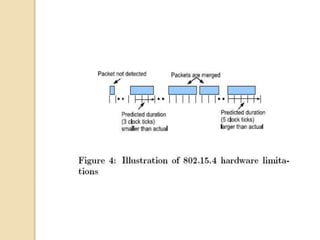
1) The 802.15.4 Esense receiver can only sense the energy
burst duration.
2) The accuracy of commodity IEEE 802.15.4 radio hardware
in detecting channel occupancy is limited.
 Further the below two issues make this even harder.
1) The first issue implies that we cannot quite use packet sizes
to encode Esense alphabets.
2) The second issue, that of inaccuracy in channel occupancy
estimation
APPLICABILITY IN OTHER
CONTEXTS
 We have evaluated our ideas in the context of
802.11b/g and 802.15.4 standards and considered only
unidirectional communication.
 All that is needed is the capability of sensing energy at
good accuracy in a specific frequency band.
 One could make do with current implementations if
they export such sensing functionality or design new
hardware that does the job with adequate accuracy.
POSSIBLE CONSIDERATION FOR
ESENSE IN FUTURE STANDARDS
 We believe that there is a strong case for having native
support for Esense in future wireless standards.
 A wireless standard could incorporate support for
Esense, for instance, by means of reserving certain
packet lengths or certain energy run-length.
 Further, the kind of scenarios we envision for Esense
communication are very low data rate.
 Such coordination is often very low data rate that its
affect on the capacity of the individual standards will be
very minimal.
CONCLUSION
 This paper, we consider a new method of
communication between devices that cannot interpret
the individual bits of the packet.
 We facilitate their communication by sensing and
interpreting energy patterns on the air.
 Also we describe how this framework opens up new
approaches to solving problems in at least three distinct
research domains.
 This framework has implications in other areas beyond
the three example scenarios.
THANK YOU

Shy slides.ppt

  • 1.
    E-sense: Communication through EnergySensing Presented by: K.SHYNIMOL VIAHECS020
  • 2.
    INTRODUCTION  Esense isa new paradigm of communication between devices that have fundamentally different physical layers.  This same paradigm can also be used for communication between devices belonging to the same standard, which are out of communication range but within carriersense range.  We term our scheme Esense since it is based on energy sensing.  Our scheme can enable communication in any setting as long as the two end points can sense each others energy.
  • 3.
    Coordinated Coexistence • Coexistencebetween the standards becomes a very important issue. • The problem can be much more effectively solved by explicit communication, and coordination between the different entities operating in the same spectrum. • They can then potentially share the spectrum in a time multiplexed fashion.
  • 4.
    Energy Management  WiFienabled devices often employ a variety of techniques to conserve battery power.  These techniques include disabling the WiFi interface or turning the entire device off.  A solution that helps in this setting is to employ an extremely low power secondary radio that operates in the same frequency band as WiFi but consumes significantly lesser power than WiFi.
  • 5.
    Network Management  Debuggingperformance anomalies in deployed WiFi networks needs a good interference map of the network.  However interference maps are hard to construct since often the interference range exceeds the transmission range.  A node may be able to sense interference but is often clueless as to who is responsible for it since it cannot interpret the incoming packets.
  • 7.
     Our energybased framework achieves its task of communication by constructing an alphabet set of packet sizes.  We enable unidirectional communication from an IEEE 802.11 radio to an 802.15.4 radio.  Esense is equally applicable to enable bi-directional communication as well as communication across other wireless standards.  The 802.11 to 802.15.4 communication is directly applicable in the first two of the three scenarios.
  • 8.
     The communicationis uni-directional and originates from the WiFi domain, with the receiver being an 802.15.4 radio.  In the third scenario, the receiver is an 802.11 radio.  Analysis of the packet size traces of many WiFi installations reveals a packet size distribution that is mostly bimodal.
  • 9.
    RELATED WORKS  Someaspects of Esense resemble steganography, where information is concealed in otherwise normal looking messages.  Esense resembles steganography in that we construct an information stream embedded within another information stream.  Coexistence studies have shown that there could be considerable interference between the different standards resulting in as high as 90% frame loss rate.  The most common solution to the above problem is to assess the amount of interference in a given channel and choose a channel that has no or minimum interference.
  • 10.
     This wouldlead to better throughput, lesser delay, and energy efficiency.  The IEEE 802.11 standard supports a power save mode (PSM) which permits the WiFi interface to duty- cycle.  Wake-on-WLAN is another solution that employs a secondary radio and looks at the problem of energy savings in rural long-distance WiFi networks.  This solution however employs the secondary radio only on the receiver side (not sender) and avoids the range-mismatch problem by making the secondary radio directly sense the WiFi energy of the sender.
  • 11.
     Cell2notify isanother approach that also tries to overcome the range mismatch problem.  Our Esense-based solution has the following advantages.  First, it can work in a variety of settings.  Second, it does not suffer from the range mismatch problem.  Third, our solution needs software changes at the WiFi sender side and integration of a very low cost ($10), low power (60mW) secondary radio1 at the receiver side.
  • 12.
    THE ESENSE COMMUNICATION FRAMEWORK Esense:Overall approach Choices for Esense:  In an energy based communication system, the receiver can sense only the energy patterns on the channel.  Based on this sensing, it can interpret three possible parameters: the intensity of the energy, the gap between energy bursts, and the duration of an energy burst.
  • 13.
    Alphabet set:  Forany message exchange, we need a base alphabet, and a set size of two is a minimum requirement for building a vocabulary.  The larger the alphabet set, the more efficient and less complex the communication framework would be.  In an operational network, there may normally be energy bursts of different lengths.  In choosing the Esense alphabet set, while we must seek a large set, we must also seek to minimize the false positive rate.
  • 14.
    Packet sizes inWiFi traces:  There are a variety of WiFi traces available in the public domain .  The five traces are: Cafeteria (Powells), Library, PSU- CSE department , OSDI Conference, Stanford CSE department .  Across all traces, the majority of the packets are either small packets (< 140 bytes) corresponding to the ACKs, beacons, management frames.
  • 15.
    A possible approachfor Esense:  Suppose we assume that the 802.15.4 node can detect any packet size upto an accuracy of a byte.  The solution then is to exclude all packet sizes whose frequency of occurrence in the WiFi traces is greater than a threshold percentage.  The higher we choose the threshold percentage, the larger the alphabet set since we would be excluding lesser number of packet sizes.
  • 16.
    Detecting Esense alphabets: The task of the receiving 802.15.4 node would be to measure the duration of energy on the channel and subsequently map it to a corresponding packet size.  If it sees a packet that belongs to the alphabet set, it considers it as an Esense packet and the measured packet size corresponds to an Esense alphabet.  In detecting the alphabets, we could have a small number of false positives
  • 18.
    Practical limitations  Inreality, the above described scheme faces two main practical challenges. 1) The 802.15.4 Esense receiver can only sense the energy burst duration. 2) The accuracy of commodity IEEE 802.15.4 radio hardware in detecting channel occupancy is limited.  Further the below two issues make this even harder. 1) The first issue implies that we cannot quite use packet sizes to encode Esense alphabets. 2) The second issue, that of inaccuracy in channel occupancy estimation
  • 19.
    APPLICABILITY IN OTHER CONTEXTS We have evaluated our ideas in the context of 802.11b/g and 802.15.4 standards and considered only unidirectional communication.  All that is needed is the capability of sensing energy at good accuracy in a specific frequency band.  One could make do with current implementations if they export such sensing functionality or design new hardware that does the job with adequate accuracy.
  • 20.
    POSSIBLE CONSIDERATION FOR ESENSEIN FUTURE STANDARDS  We believe that there is a strong case for having native support for Esense in future wireless standards.  A wireless standard could incorporate support for Esense, for instance, by means of reserving certain packet lengths or certain energy run-length.  Further, the kind of scenarios we envision for Esense communication are very low data rate.  Such coordination is often very low data rate that its affect on the capacity of the individual standards will be very minimal.
  • 21.
    CONCLUSION  This paper,we consider a new method of communication between devices that cannot interpret the individual bits of the packet.  We facilitate their communication by sensing and interpreting energy patterns on the air.  Also we describe how this framework opens up new approaches to solving problems in at least three distinct research domains.  This framework has implications in other areas beyond the three example scenarios.
  • 22.