SHS. 101
ANATOMY I
LECTURE NO. 5
DR NOORAY AFZAL
Noor.Afzal@umt.edu.pk
UPPER LIMB
• It is associated with lateral aspect of lower
portion of neck and thoracic wall
• It is suspended from trunk by muscles and
articulation
• Upper limb is divided into shoulder, arm,
forearm, and hand
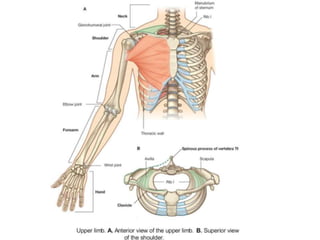
REGIONS OF UPPER LIMB
• Shoulder - area of upper limb attachment to
trunk
• Arm - between shoulder and elbow joint
• Forearm - between elbow joint and wrist joint
• Hand - distal to wrist joint
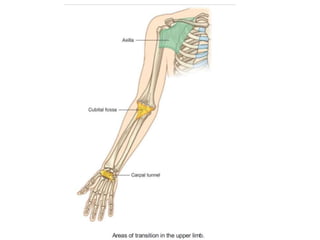
TRANSITION AREAS OF UPPER LIMB
• Axilla
• Cubital fossa
• Carpal tunnel
• Important structures pass through, or are related
to, each of these areas
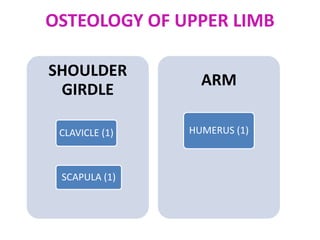
OSTEOLOGY OF UPPER LIMB
SHOULDER
GIRDLE
CLAVICLE (1)
SCAPULA (1)
ARM
HUMERUS (1)
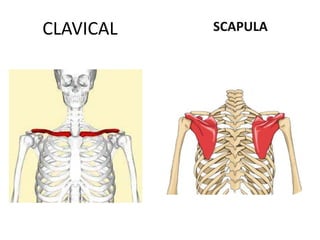
CLAVICAL SCAPULA
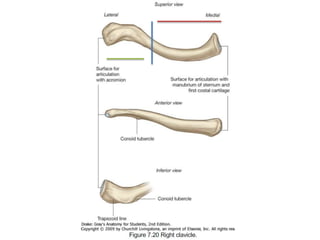
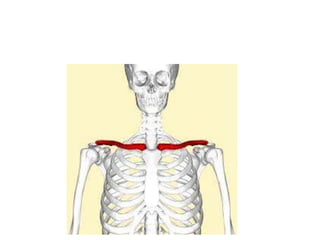
CLAVICLE
• Only bony attachment between trunk and
upper limb
• Long slender bone
• Lies horizontally
• S-shaped bone
• Subcutaneous bone
CLAVICLE
• Medial 2/3rd convex forward
• Lateral 1/3rd concave forward
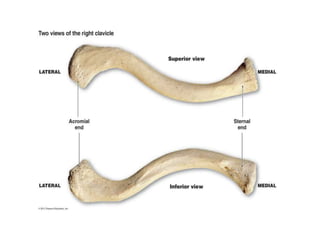
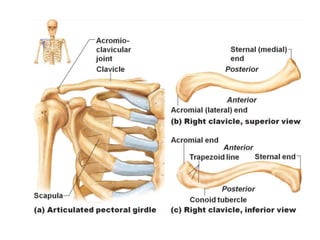
ENDS OF CLAVICLE
• Acromial (lateral) end - flat
• Sternal (medial) end - quadrangular
ACROMIAL END( lateral end )
• It has a small oval facet on its surface
• It articulate with a similar facet on the medial
surface of acromion of scapula
STERNAL END (medial end )
• It has a much larger facet
• Articulate with manubrium of sternum
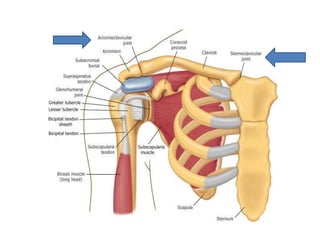
ARTICULATION OF CLAVICLE
• Medially – sternum and 1st costal cartilage
• Laterally – acromian process of scapula
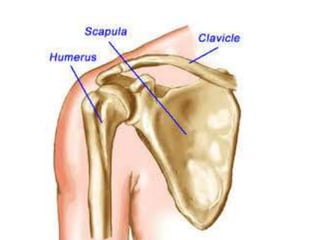
SCAPULA
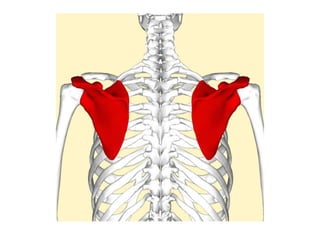
• Flat triangular bone
• Posterior chest wall – 2nd and 7th rib
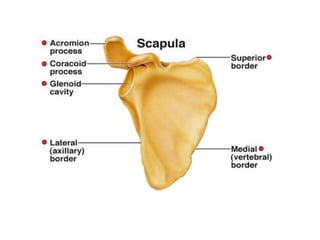
SCAPULA
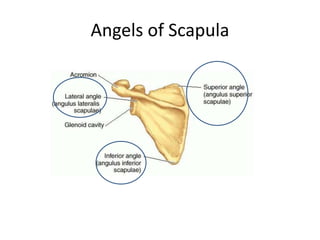
• Three angles (lateral, superior, and inferior)
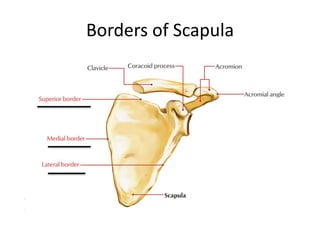
• Three borders (superior, lateral, and medial)
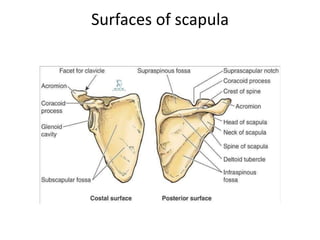
• Two surfaces (costal and posterior)
• Three processes (acromion, spine, and coracoid
process)
Angels of Scapula
Borders of Scapula
Surfaces of scapula
SUBSCAPULAR FOSSA
• Costal surface of scapula is unremarkable
• Characterized by a shallow concave
subscapular fossa
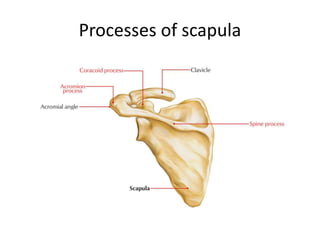
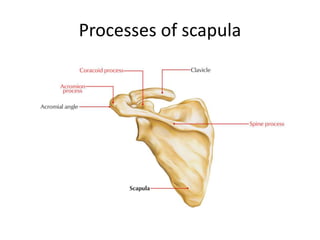
PROCESSES OF SCAPULA
• Spine of scapula
• Acromion
• Glenoid cavity
• Coracoid process
Processes of scapula
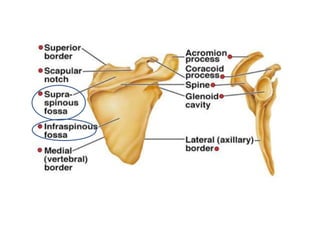
SPINE OF SCAPULA
• A prominent spine subdivides posterior
surface of scapula
– Supraspinous fossa
– Infraspinous fossa
ACROMION PROCESS
• It is an anterolateral projection of spine
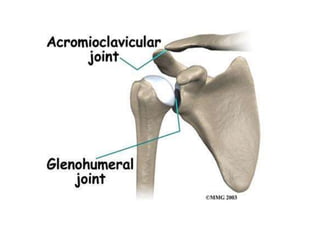
• Arches over the glenohumeral ( shoulder ) joint
• Articulates, via a small oval facet with clavicle
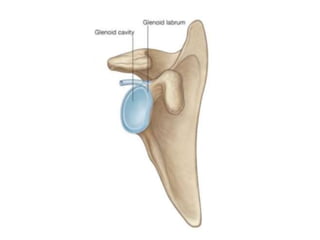
GLENOID CAVITY
• Lateral angle of scapula is marked by a shallow,
comma-shaped glenoid cavity
• It articulates with head of humerus to form
glenohumeral joint
CORACOID PROCESS
• A hook-like structure that projects anterolaterally
• Positioned directly inferior to lateral part of
clavicle
• Small distinct suprascapular notch lies
immediately medial to root of coracoid process
Processes of scapula
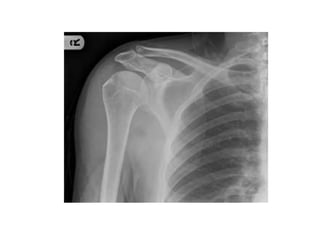
ARTICULATIONS OF SCAPULA
• Glenoid cavity - Humerus
• Acromion – Clavicle
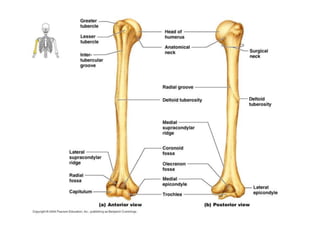
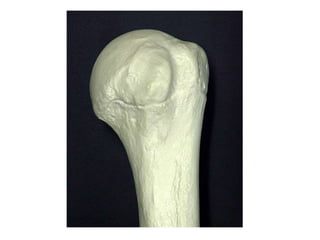
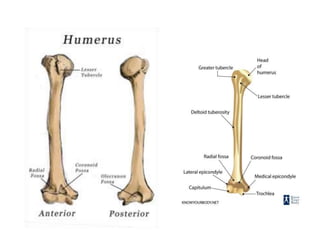
HUMERUS
Long bone of arm
PARTS OF HUMERUS:
• Head
• Surgical neck
• Anatomical neck
• Shaft
• Lower end
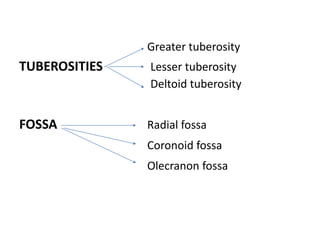
Greater tuberosity
TUBEROSITIES Lesser tuberosity
Deltoid tuberosity
FOSSA Radial fossa
Coronoid fossa
Olecranon fossa
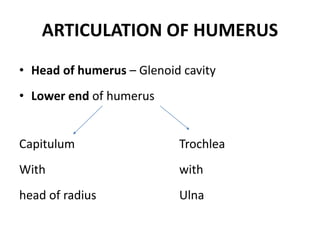
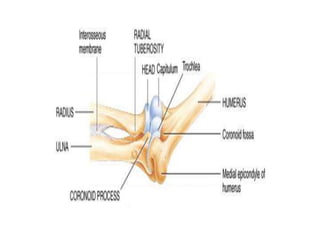
ARTICULATION OF HUMERUS
• Head of humerus – Glenoid cavity
• Lower end of humerus
Capitulum Trochlea
With with
head of radius Ulna
QUESTION
2. The only long bone that lies horizontally is?
a. Humerus
b. Clavicle
c. Scapula
d. All of above
QUESTION
2. The only long bone that lies horizontally is?
a. Humerus
b. Clavicle
c. Scapula
d. All of above
QUESTION
3. End of clavicle that is quadrangular?
a. Acromial
b. Coracoid
c. Sternal
d. Both a and b
QUESTION
3. End of clavicle that is quadrangular?
a. Acromial
b. Coracoid
c. Sternal
d. Both a and b
QUESTION
4. The process of scapula that articulates with
humerus is?
a. Acromian
b. Coracoid
c. Spine
d. Glenoid
QUESTION
4. The process of scapula that articulates with
humerus is?
a. Acromian
b. Coracoid
c. Spine
d. Glenoid
QUESTION
5. Intertubercular groove lies between?
a. Deltoid and lesser tuberosity
b. Deltoid and greater tuberosity
c. Lesser and greater tuberosity
d. None of above
QUESTION
5. Intertubercular groove lies between?
a. Deltoid and lesser tuberosity
b. Deltoid and greater tuberosity
c. Lesser and greater tuberosity
d. None of above

Shs.101 lec 05 nooray

  • 1.
    SHS. 101 ANATOMY I LECTURENO. 5 DR NOORAY AFZAL Noor.Afzal@umt.edu.pk
  • 2.
    UPPER LIMB • Itis associated with lateral aspect of lower portion of neck and thoracic wall • It is suspended from trunk by muscles and articulation • Upper limb is divided into shoulder, arm, forearm, and hand
  • 3.
    REGIONS OF UPPERLIMB • Shoulder - area of upper limb attachment to trunk • Arm - between shoulder and elbow joint • Forearm - between elbow joint and wrist joint • Hand - distal to wrist joint
  • 5.
    TRANSITION AREAS OFUPPER LIMB • Axilla • Cubital fossa • Carpal tunnel • Important structures pass through, or are related to, each of these areas
  • 7.
    OSTEOLOGY OF UPPERLIMB SHOULDER GIRDLE CLAVICLE (1) SCAPULA (1) ARM HUMERUS (1)
  • 9.
  • 10.
    CLAVICLE • Only bonyattachment between trunk and upper limb • Long slender bone • Lies horizontally • S-shaped bone • Subcutaneous bone
  • 12.
    CLAVICLE • Medial 2/3rdconvex forward • Lateral 1/3rd concave forward
  • 13.
    ENDS OF CLAVICLE •Acromial (lateral) end - flat • Sternal (medial) end - quadrangular
  • 15.
    ACROMIAL END( lateralend ) • It has a small oval facet on its surface • It articulate with a similar facet on the medial surface of acromion of scapula
  • 16.
    STERNAL END (medialend ) • It has a much larger facet • Articulate with manubrium of sternum
  • 19.
    ARTICULATION OF CLAVICLE •Medially – sternum and 1st costal cartilage • Laterally – acromian process of scapula
  • 22.
    SCAPULA • Flat triangularbone • Posterior chest wall – 2nd and 7th rib
  • 24.
    SCAPULA • Three angles(lateral, superior, and inferior) • Three borders (superior, lateral, and medial) • Two surfaces (costal and posterior) • Three processes (acromion, spine, and coracoid process)
  • 25.
  • 26.
  • 27.
  • 28.
    SUBSCAPULAR FOSSA • Costalsurface of scapula is unremarkable • Characterized by a shallow concave subscapular fossa
  • 29.
    PROCESSES OF SCAPULA •Spine of scapula • Acromion • Glenoid cavity • Coracoid process
  • 30.
  • 31.
    SPINE OF SCAPULA •A prominent spine subdivides posterior surface of scapula – Supraspinous fossa – Infraspinous fossa
  • 33.
    ACROMION PROCESS • Itis an anterolateral projection of spine • Arches over the glenohumeral ( shoulder ) joint • Articulates, via a small oval facet with clavicle
  • 35.
    GLENOID CAVITY • Lateralangle of scapula is marked by a shallow, comma-shaped glenoid cavity • It articulates with head of humerus to form glenohumeral joint
  • 37.
    CORACOID PROCESS • Ahook-like structure that projects anterolaterally • Positioned directly inferior to lateral part of clavicle • Small distinct suprascapular notch lies immediately medial to root of coracoid process
  • 38.
  • 39.
    ARTICULATIONS OF SCAPULA •Glenoid cavity - Humerus • Acromion – Clavicle
  • 42.
    HUMERUS Long bone ofarm PARTS OF HUMERUS: • Head • Surgical neck • Anatomical neck • Shaft • Lower end
  • 45.
    Greater tuberosity TUBEROSITIES Lessertuberosity Deltoid tuberosity FOSSA Radial fossa Coronoid fossa Olecranon fossa
  • 47.
    ARTICULATION OF HUMERUS •Head of humerus – Glenoid cavity • Lower end of humerus Capitulum Trochlea With with head of radius Ulna
  • 49.
    QUESTION 2. The onlylong bone that lies horizontally is? a. Humerus b. Clavicle c. Scapula d. All of above
  • 50.
    QUESTION 2. The onlylong bone that lies horizontally is? a. Humerus b. Clavicle c. Scapula d. All of above
  • 51.
    QUESTION 3. End ofclavicle that is quadrangular? a. Acromial b. Coracoid c. Sternal d. Both a and b
  • 52.
    QUESTION 3. End ofclavicle that is quadrangular? a. Acromial b. Coracoid c. Sternal d. Both a and b
  • 53.
    QUESTION 4. The processof scapula that articulates with humerus is? a. Acromian b. Coracoid c. Spine d. Glenoid
  • 54.
    QUESTION 4. The processof scapula that articulates with humerus is? a. Acromian b. Coracoid c. Spine d. Glenoid
  • 55.
    QUESTION 5. Intertubercular groovelies between? a. Deltoid and lesser tuberosity b. Deltoid and greater tuberosity c. Lesser and greater tuberosity d. None of above
  • 56.
    QUESTION 5. Intertubercular groovelies between? a. Deltoid and lesser tuberosity b. Deltoid and greater tuberosity c. Lesser and greater tuberosity d. None of above