Ashour’s High Yield Guide
USMLE Clinical Anatomy
Case report
A 42-year-old male presented to the
emergency department after falling onto
his arm. He reported severe pain and
restricted movement in the right
shoulder. Physical examination revealed
swelling and tenderness over the lateral
aspect of the shoulder, with preserved
distal neurovascular function.
Radiographic imaging confirmed a
fracture of the surgical neck of the
humerus. The patient was managed
conservatively with immobilization using
a sling, analgesics, and was referred for
physiotherapy to restore range of motion.
Follow-up showed gradual healing.
BONE
&
JOINT
FEATURES
ILOs
A. Identify Major Bones: Recognize and label the primary bones of the upper limb, including the clavicle, scapula,
humerus, radius, ulna, and the bones of the hand (carpals, metacarpals, and phalanges).
B. Understand Bone Structures: Describe the anatomical features of each bone, such as the scapular spine, acromion
process, humeral head, greater and lesser tubercles, and the carpal bones, including their landmarks and
articulations.
C. Explain Functional Anatomy: Understand the functional roles of each bone in the upper limb, including how they
contribute to the range of motion and stability of the shoulder, elbow, wrist, and hand, and their roles in supporting
various activities and movements.
D. Describe Joints and Articulations: Explain the main joints involving these bones, such as the shoulder joint
(glenohumeral joint), elbow joint, wrist joint, and the interphalangeal joints of the fingers, including their types,
movements, and how the bones articulate with one another.
The upper limb skeleton, also known as
the appendicular skeleton, consists of the
bones of the arms and hands. It plays a
crucial role in supporting and facilitating
a wide range of movements.
Understanding the anatomy of the upper
limb skeleton is essential for healthcare
professionals involved in orthopedics,
physical therapy, and related fields. It
provides the foundation for diagnosing
and treating injuries, fractures, and other
conditions affecting the upper limb.
BONE
Overview
The bones of the upper limb are
organized into four main regions:
Shoulder Girdle
Clavicle (Collarbone) & Scapula
(Shoulder Blade)
Arm (Brachium)
Humerus
Forearm (Antebrachium)
Radius & Ulna
Hand
Carpal Bones, Metacarpal Bones &
Phalanges
Hand
Forearm
Arm
Shoulder Girdle
Clavicle
The clavicle, or collarbone, is a long, slender bone that
serves as a strut between the sternum (breastbone) and
the scapula (shoulder blade).
Acromial End
clavicle
1. Sternal End (Medial End)
Shape: Rounded
Articulates with the manubrium of the sternum to form the sternoclavicular joint.
2. Acromial End (Lateral End)
Shape: Flattened.
Articulates with the acromion of the scapula to form the acromioclavicular joint.
Sternal End
Acromial End
Sternal End
Sternoclavicular joint
Manubrium of sternum
Acromion of the scapula
Acromioclavicular joint
Acromial End
3. Shaft
Shape: S-shaped when viewed from above or below, with a medial convex
curvature and a lateral concave curvature.
Lateral concave curvature
Medial convex curvature
Surfaces:
Superior Surface: Generally smooth
Inferior Surface: Roughened with various grooves and ridges for muscle and
ligament attachment.
Superior Surface
Inferior Surface
Fractures of the clavicle
Fractures of the clavicle are common, especially in children.
The fracture usually results from a fall on an outstretched hand or from direct
trauma and commonly occurs in the middle third of the clavicle.
Clinical Insight
Virchow node
Is a supraclavicular lymph node. It is a
prime collector of malignant cells when
cancer is present somewhere in the body
(especially in the abdomen) and can
become enlarged and palpable when this
occurs.
Clinical Insight
Scapula
The scapula, commonly known as the
shoulder blade, is a flat, triangular bone
located on the posterior side of the rib
cage. It plays a crucial role in the
movement and stability of the shoulder
joint.
The scapula's design allows for a wide
range of shoulder movements and
provides attachment sites for numerous
muscles, contributing to the upper limb's
versatility and strength.
scapula
Borders
1. Superior Border: The shortest and
thinnest border.
2. Medial (Vertebral) Border: positioned
parallel to the vertebral column.
3. Lateral (Axillary) Border: The thickest
border.
Superior Border
Medial Border
Lateral Border
Angles
1. Superior Angle: Located at
the junction of the superior
and medial borders.
2. Inferior Angle: Formed
where the medial and lateral
borders meet, serving as an
attachment point for several
muscles.
3. Lateral Angle: The most
complex part, containing the
glenoid cavity which
articulates with the head of the
humerus.
Lateral angel
Superior angel
Inferior angel
Surfaces
1. Costal (Anterior) Surface: Faces the rib cage, slightly concave to form the
subscapular fossa.
2. Dorsal (Posterior) Surface: Divided by the spine of the scapula into two regions:
- Supraspinous Fossa: Above the spine
- Infraspinous Fossa: Below the spine
Subscapular fossa
Supraspinous Fossa
Scapular spine
Infraspinous Fossa
Costal (Anterior) Surface Dorsal (Posterior) Surface
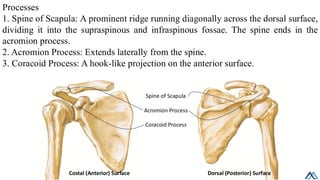
Processes
1. Spine of Scapula: A prominent ridge running diagonally across the dorsal surface,
dividing it into the supraspinous and infraspinous fossae. The spine ends in the
acromion process.
2. Acromion Process: Extends laterally from the spine.
3. Coracoid Process: A hook-like projection on the anterior surface.
Spine of Scapula
Acromion Process
Coracoid Process
Costal (Anterior) Surface Dorsal (Posterior) Surface
Other Notable Features
1. Glenoid Cavity (Fossa): A shallow,
concave articular surface on the lateral
angle, which articulates with the head of
the humerus.
2. Infraglenoid Tubercle: Located below
the glenoid cavity.
3. Supraglenoid Tubercle: Located above
the glenoid cavity.
Supraglenoid Tubercle
Glenoid Cavity
Infraglenoid Tubercle
Other Notable Features
4. Suprascapular Notch: Located on the
superior border.
Suprascapular Notch
Humerus
The humerus is the only long bone in the
upper arm that runs from the shoulder to
the elbow.
It plays a crucial role in the function of
the upper limb, providing structural
support and facilitating movement.
humerus
1. Head of the Humerus
Shape: Spherical.
Articulation: Articulates with the glenoid
cavity of the scapula to form the
glenohumeral (shoulder) joint.
Head of the Humerus
Glenohumeral (shoulder) joint
Glenoid cavity of the scapula
2. Anatomical Neck
Location: Just below the head.
3. Greater Tubercle
Location: Lateral aspect.
4. Intertubercular Groove
Location: Between the greater and lesser
tubercles.
5. Lesser Tubercle
Location: Anterior aspect.
Anatomical Neck
Greater Tubercle
Intertubercular Groove
Lesser Tubercle
Humerus tubercles
Girls In Leadership
Greater tubercle
Intertubercular groove
Lesser tubercle
6. Bicipital Groove:
Location: between medial and lateral lips
7. Surgical Neck
Location: Just below the tubercles.
Surgical Neck
Lateral lip
Bicipital Groove
Medial lip
Shaft
1. Deltoid Tuberosity
Location: Lateral aspect, about halfway down the shaft.
2. Radial (Spiral) Groove
Location: Posterior aspect.
Deltoid Tuberosity Radial (Spiral) Groove
Ant. Shaft
Post. Shaft
Distal End
1. Medial and Lateral Epicondyles
Location: Protrusions on either side of
the distal end.
2. Trochlea
Shape: Pulley-like.
3. Capitulum
Shape: Rounded.
Lateral Epicondyle
Capitulum
Trochlea
Medial Epicondyle
capitulum
Trochlea
Ulna
Radius
Elbow joint articulation
Captain Richard married Terrific Ula
Captain Richard → Capitulum articulates with Radius
Terrific Ula→ Trochlea articulates with Ulna
4. Coronoid Fossa
Location: Anterior aspect, above the trochlea.
5. Radial Fossa
Location Anterior aspect, above the capitulum.
6. Olecranon Fossa
Location: Posterior aspect, above the trochlea.
Ant. Shaft
Post. Shaft Olecranon Fossa
Coronoid Fossa
Radial Fossa
Fractures of the scapula
are relatively uncommon.
Fractures of the surgical neck of the humerus
are common and may injure the axillary nerve from the
brachial plexus.
Midshaft fracture of the humerus
may injure the radial nerve.
Clinical Insight
Ulna
The ulna is one of the two long bones in the forearm, the other being the radius. It is
located on the medial side (the side closest to the body) when in the standard
anatomical position.
The ulna plays a crucial role in forming the elbow joint and articulating with the
radius.
Proximal End
1. Olecranon
Location: The prominent, bony
projection at the proximal end.
2. Coronoid Process
Location: A triangular eminence
projecting forward from the upper and
front part of the ulna.
Olecranon
Coronoid Process
3. Trochlear Notch
Location: A large, curved area between
the olecranon and coronoid process.
4. Radial Notch
Location: On the lateral side of the
coronoid process.
Trochlear Notch
Radial Notch
Shaft
1. Interosseous Border
Location: A sharp edge along the lateral
side of the ulna.
2. Body/Shaft
Shape: Triangular in cross-section.
Interosseous Border
Body/Shaft
Distal End
1. Head of Ulna
Location: The rounded, distal end of the
ulna.
2. Ulnar Styloid Process
Location: A small, pointed projection on
the medial side of the distal ulna.
Head of Ulna
Ulnar Styloid Process
Radius
The radius is one of the two long bones in the forearm, the other being the ulna.
It is located on the lateral side of the forearm (thumb side) and plays a crucial role
in the movement and function of the arm.
1. Head
Shape: Disc-shaped.
Location: Proximal end of the radius.
2. Neck
Location: Just below the head.
3. Radial Tuberosity
Location: Anteromedial aspect of the
radius, just distal to the neck.
4. Shaft
Shape: Long and slightly curved.
Head
Neck
Radial
Tuberosity
Shaft
5. Styloid Process
Location: Distal end of the radius,
extending laterally.
6. Ulnar Notch
Location: Medial distal end of the
radius.
Ulnar Notch
Styloid Process
Dinner fork deformity
A Colles’ fracture is a fracture of the distal radius, commonly occurring from a fall
on an outstretched hand.
In such fractures, the distal fragment of the radius is forced proximally and dorsally,
resulting in a “dinner fork” deformity.
Clinical Insight
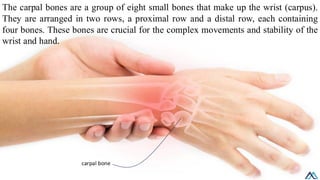
Carpal bones
The carpal bones are a group of eight small bones that make up the wrist (carpus).
They are arranged in two rows, a proximal row and a distal row, each containing
four bones. These bones are crucial for the complex movements and stability of the
wrist and hand.
carpal bone
Proximal Row (from lateral to medial)
1. Scaphoid
Shape: Boat-shaped.
2. Lunate
Shape: Crescent-shaped.
3. Triquetrum
Shape: Pyramidal.
4. Pisiform
Shape: Pea-shaped.
Scaphoid
Lunate
Triquetrum
Pisiform
Clinical Insight
Scaphoid fracture
The scaphoid, at the base of the thumb, is
the most fractured carpal bone. It is
second only to distal radius fractures in
causing wrist fractures. It usually results
from falling on an outstretched (flexed)
hand.
Scaphoid fracture
The scaphoid is the most frequently
fractured of the carpal bones.
This fracture may separate the proximal
head of the scaphoid from its blood
supply (which enters the bone at the
distal head) and may result in avascular
necrosis of the proximal head.
Clinical Insight
Lunate dislocation
The lunate is the most commonly
dislocated carpal bone (it dislocates
anteriorly into the carpal tunnel and may
compress the median nerve).
Clinical Insight
Distal Row (from lateral to medial)
1. Trapezium
Shape: Irregular.
2. Trapezoid
Shape: Wedge-shaped.
3. Capitate
Shape: Large and head-shaped.
4. Hamate
Shape: Wedge-shaped with a hook-like
projection (hamulus).
Trapezium
Trapezoid
Capitate
Hamate
Fracture hook hamate
A fall on the outstretched hand may
fracture the hook of the hamate, which
may damage the ulnar nerve as it passes
into the hand.
Clinical Insight
Carpal bones
She Likes To Play, Try To Catch Her
Scaphoid
Lunate
Triquetrum
Pisiform
Trapezium
Trapezoid
Capitate
Hamate
Metacarpal bones
The metacarpal bones are the five long bones in the hand that are located between
the carpal bones of the wrist and the phalanges (bones of the fingers). Each
metacarpal bone is associated with one of the five fingers.
metacarpal bone
Five Metacarpals: Numbered I to V from
the lateral to the medial side.
1. Base
Location: The proximal end of each
metacarpal bone.
2. Shaft (Body)
Location The elongated middle portion
of the metacarpal bone.
Shape: Slightly curved, with a dorsal
convexity.
3. Head
Location: The distal end of each
metacarpal bone.
Head
Shaft
Base
1
2
3
4
5
Boxer fractures
Fractures of the metacarpals can occur
from direct blows (boxer fractures) and
can not only disrupt the bones and
ligaments but also affect the pull of the
muscle tendons that attach to the
metacarpals.
Clinical Insight
Phalanges of hand
The phalanges are the bones that make
up the fingers of the hand.
Each finger has three phalanges, while
the thumb has two.
These bones are critical for the dexterity
and functionality of the hand, allowing
for a wide range of movements necessary
for grasping, manipulating objects, and
performing fine motor tasks.
1. Proximal Phalanges
Location: The bones
closest to the hand.
2. Middle Phalanges
Location: The bones
between the proximal and
distal phalanges.
3. Distal Phalanges
Location: The bones at the
tips of the fingers.
Distal Phalanges
Middle Phalanges
Proximal Phalanges
Distal Phalanges
Proximal Phalanges
Bones of the Hand
• Phalanges
• Metacarpal bones
• Carpal bones
Phalanges
Metacarpal bones
Carpal bones
Bones of the Hand
Please Make Cookies
Phalanges
Metacarpal bones
Carpal bones
Joint in the hand
• Radiocarpal
• Intercarpal
• Carpometacarpal
Carpometacarpal
Intercarpal
Radiocarpal
Joint in the hand
Roads In California
Radiocarpal
Intercarpal
Carpometacarpal
Clinical Insight
FINGER
SPLINT
Mallet finger
Mallet finger may occur from a direct
blow to the fingertip such as from a
baseball or volleyball.
Blow to the fingertip often resulting in
extensor tendon damage with unopposed
traction of the flexor tendon causing a
hammer [Mallet] like deformity.
Clinical Insight
MALLET FINGER MALLET
Mallet finger with
extensor tendon
damage with
unopposed traction
of the flexor tendon
causing a hammer
[MALLET] like
deformity
MOVEMENTS
Scapula
1. Elevation: This involves lifting the scapula upwards towards the ears. This
movement is typically seen when shrugging the shoulders.
2. Depression: This involves moving the scapula downwards away from the ears. It
is the opposite of elevation and occurs when pushing the shoulders down.
3. Protraction: Also known as abduction, this movement involves moving the
scapula away from the spine, around the ribcage. This can be seen when reaching
forward or pushing something away.
4. Retraction: Also known as adduction, this movement involves pulling the scapula
towards the spine, squeezing the shoulder blades together. This occurs when pulling
the shoulders back.
5. Upward Rotation: Rotating the scapula so that the glenoid cavity (the socket for
the humerus) moves upward.
6. Downward Rotation: Rotating the scapula so that the glenoid cavity moves
downward.
Elevate scapula
Retract scapula
protract scapula
Rotate the scapula
upwards in raising the
arm above the head
Shoulder Joint (Glenohumeral Joint)
1. Flexion: Moving the arm forward and upward.
2. Extension: Moving the arm backward and downward.
3. Abduction: Moving the arm away from the body.
4. Adduction: Moving the arm towards the body.
5. Medial (Internal) Rotation: Rotating the arm inward towards the body.
6. Lateral (External) Rotation: Rotating the arm outward away from the body.
7. Circumduction: A circular movement that combines flexion, extension,
abduction, and adduction.
Flexion
Shoulder Joint
Extension
Shoulder Joint
Abduction
Shoulder Joint
Adduction
Shoulder Joint
Humerus abduction beyond 90 degrees
Moving the Humerus beyond 90 degrees
(raising it above shoulder level) can
increase the risk of a humerus fracture in
case of fixation scapula. This is likely
due to increased stress and potential
impingement in the shoulder joint,
especially if there are underlying
conditions causing fixation scapula.
At 90 degrees , the humeral head is
LOCKED in the glenoid cavity. To raise
the arm above 90 degrees, scapular
rotation is needed.
Clinical Insight
Medial (Internal) Rotation
Shoulder Joint
Lateral (External) Rotation
Shoulder Joint
Circumduction
Shoulder Joint
Elbow Joint
1. Flexion: Bending the elbow to decrease the angle between the upper arm and
forearm.
2. Extension: Straightening the elbow to increase the angle between the upper arm
and forearm.
Flexor
Elbow Joint
Extension
Elbow Joint
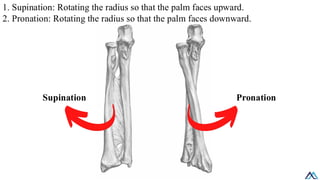
Radioulnar Joints (Proximal and Distal)
1. Supination: Rotating the radius so that the palm faces upward.
2. Pronation: Rotating the radius so that the palm faces downward.
Supination Pronation
In pronation / supination,
the ulna remains relatively fixed,
while the radius rotates.
ULNA
RADIUS
Pronates
Radioulnar Joints
Supination
Radioulnar Joints
Supination is the movement of the palm up to hold a Soap
Pronation is the movement of the palm down to perform Pushups
Supination Pronation
Wrist Joint (Radiocarpal Joint)
1. Flexion (Palmar Flexion): Bending the wrist forward.
2. Extension (Dorsiflexion): Bending the wrist backward.
3. Radial Deviation (Abduction): Moving the wrist towards the thumb side.
4. Ulnar Deviation (Adduction): Moving the wrist towards the little finger side.
5. Circumduction: A circular movement of the wrist.
Flexion of
wrist
Extension of
wrist
Radial Deviation
(Abduction)
Wrist Joint
Ulnar Deviation
(Adduction)
Wrist joint
Metacarpophalangeal Joints (MCP) and
1. Flexion: Bending the fingers towards the palm.
2. Extension: Straightening the fingers away from the palm.
3. Abduction: Spreading the fingers apart.
4. Adduction: Bringing the fingers together.
Flexion
Metacarpophalangeal
Joints
Extension
Metacarpophalangeal
Joints
Metacarpophalangeal Joints Metacarpophalangeal Joints
Interphalangeal Joints (PIP and DIP)
1. Flexion: Bending the fingers towards the palm.
2. Extension: Straightening the fingers away from the palm.
Flexion
Interphalangeal Joints
Extend
Interphalangeal Joints
Formative Quiz
Q1. A 45-year-old male presents to the
emergency department with a history of
falling off his bicycle. Examination
reveals tenderness and swelling over the
RT clavicle. X-rays confirm a midshaft
fracture of the RT clavicle. During the
examination, the patient complains of
numbness and tingling in his RT arm.
Which nerve is at risk of injury in such
cases?
a) Ulnar nerve
b) Radial nerve
c) Brachial plexus
d) Median nerve
RT
Q2. A 42-year-old male presents to the
emergency department with a history of
falling onto his left upper limb. He
complains of severe pain and limited
movement in left shoulder. Examination
reveals tenderness and swelling over the
lateral aspect of the shoulder.
Radiographs confirm a fracture of the
surgical neck of the humerus. Which of
the following important structures is at
risk of injury near this location?
a) Axillary nerve
b) Brachial artery
c) Radial nerve
d) Ulnar artery
Q3. A 28-year-old male presents to the
emergency department after falling onto
his outstretched hand during a basketball
game. On examination, there is
tenderness over the anatomical snuffbox
and pain with wrist extension.
Radiographs reveal a fracture involving
the distal radius with dorsal
displacement. Which bone in the upper
limb is commonly fractured when
attempting to break a fall with an
outstretched hand (FOOSH injury)?
A) Scaphoid
B) Lunate
C) Distal radius
D) Capitate
Q4. A patient presents with wrist pain,
especially during movements of
abduction and adduction of the hand.
Which carpal bone is most likely
affected?
a) Scaphoid
b) Lunate
c) Triquetrum
d) Pisiform
Q5. A patient is diagnosed with "tennis
elbow," a condition characterized by pain
and tenderness on the lateral epicondyle
of the humerus. Which muscle/tendon is
primarily involved?
a) Biceps brachii
b) Triceps brachii
c) Extensor carpi radialis brevis
d) Flexor carpi ulnaris
Q6. An elderly patient falls and fractures
their proximal humerus. What important
blood supply to the humeral head might
be compromised in such injuries?
a) Brachial artery
b) Subclavian artery
c) Axillary artery
d) Suprascapular artery
Q7. A 35-year-old male presents to the
clinic with complaints of shoulder pain
and difficulty raising his arm overhead.
Upon examination, you notice
asymmetry of the scapulae, with RT
scapula protruding prominently when the
patient extends his arms against
resistance. Which of the following nerves
is most likely injured in this patient?
a) Radial nerve
b) Axillary nerve
c) Long thoracic nerve
d) Median nerve
Q8. A patient with a wrist injury
complains of numbness and tingling in
the thumb, index, and middle fingers.
Which nerve is likely affected?
a) Ulnar nerve
b) Radial nerve
c) Median nerve
d) Brachial plexus
Q9. A patient has a fracture of the hook
of the hamate bone. Which clinical
condition may result from such an
injury?
a) Carpal tunnel syndrome
b) Ulnar tunnel syndrome
c) Median nerve compression
d) Radial tunnel syndrome
Q10. A patient presents with a dislocated
acromioclavicular (AC) joint after a
sports injury. Which classification
system is commonly used to grade the
severity of AC joint injuries?
a) Smith's classification
b) Neer's classification
c) Rockwood's classification
d) Hawkins-Kennedy classification
Q11 A 27-year-old man is brought to the
emergency department after falling off a
ladder from the height of the roof. An x-
ray of the patient’s right arm is shown.
Which of the following neurologic
deficits is most likely to occur as a result
of his fracture?
• A protruding scapula
• Inability to abduct the arm fullY
• Inability to hold a piece of paper
between the fingers
• Pain over the palmar aspects of the
first three and a half digits
• Weakness in wrist extension
Q12 A 45-year-old woman comes to
clinic because of left wrist pain after
landing on her outstretched left hand to
break a fall 1 day ago. On physical
examination, she has tenderness in the
dorsum of the left hand between the
tendons of extensor pollicis longus and
brevis. This patient most likely fractured
which of the following bones?
Capitate
Hamate
Lunate
Pisiform
Scaphoid
Trapezium
Trapezoid
Q13 A visibly upset 15-year-old boy is
brought to the emergency department
because he punched a wall and now has
pain in his hand. The physician tells the
patient that he has broken his hand.
Which of the following is the most likely
site of this patient’s fracture?
(A) Distal radius
(B) Hamate
(C) Metacarpals
(D) Phalanges
(E) Scaphoid
Q14 A 40-year-old man presents to the
emergency department after falling onto
his outstretched arm. On examination, he
cannot extend his wrist and fingers, and
there is a loss of sensation over the
dorsum of the hand. X-ray reveals a mid-
shaft humeral fracture. The injured bone
structure is closely associated with a
nerve that lies in a groove on its posterior
aspect. Which nerve is most likely
injured in this fracture?
A. Median nerve
B. Ulnar nerve
C. Radial nerve
D. Musculocutaneous nerve
E. Axillary nerve
Q15 A 28-year-old cyclist falls during a race and lands on his shoulder. He presents
with a visible deformity and swelling over the middle third of the clavicle. On
physical exam, the medial fragment is elevated, while the lateral fragment is
depressed and pulled medially. This displacement is due to the pull of specific
muscles and ligaments. The clavicle is the most commonly fractured bone in the
body, particularly at its middle third, which is the weakest point.
Which muscle is primarily responsible for the upward displacement of the medial
fragment?
A. Deltoid
B. Trapezius
C. Sternocleidomastoid
D. Subclavius
E. Pectoralis major
Q15
MCQ Answer
1
2
3
4
5
6
7
8
9
10
11
12
13
14
15
SCORE
15
Q1 Brachial plexus
Q2 Axillary nerve
Q3 Distal radius
Q4 Scaphoid
Q5 Extensor carpi radialis brevis
Q6 Suprascapular artery
Q7 Long thoracic nerve
Q8 Median nerve
Q9 Ulnar tunnel syndrome
Q10 Rockwood's classification
Q11 Weakness in wrist extension
Q12 Scaphoid
Q13 Metacarpals
Q14 Radial nerve
Q15 Sternocleidomastoid
List of Texts and Recommended Readings
• Last's Anatomy, Regional and Applied. Chummy S. Sinnatamby. 12th edition 2011, ISBN:13 - 978 0 7020 3394 0
(Available in ClinicalKey: https://www.clinicalkey.com/#!/browse/book/3-s2.0- C2009060533X)
• Estomih Mtui, Gregory Gruener and Peter Dockery. Fitzgerald's Clinical Neuroanatomy and Neuroscience. 7th
edition; 2016, ISBN: 13 - 978-0-7020- 6727-3 (Available in ClinicalKey:
https://www.clinicalkey.com/#!/browse/book/3-s2.0- C20130134113
• Drake, Richard L. Gray's Anatomy for Students, Third Edition, Elsevier Saunders 2015. ISBN-13: 978-0702051319
(Available in ClinicalKey: https://www.clinicalkey.com/#!/browse/book/3- s2.0-C20110061707).
• Sobotta Atlas of Human Anatomy. F. Paulsen. Vol.1, 15th Edition; 2013, ISBN: 9780702052514 (Available in
ClinicalKey: https://www.clinicalkey.com/#!/content/book/3- s2.0-B9780702052514500067)
• Sobotta Atlas of Human Anatomy. F. Paulsen. Vol.2, 15th Edition; 2013, ISBN:13 - 978-0-7020-5252-1 (Available in
ClinicalKey: https://www.clinicalkey.com/#!/browse/book/3- s2.0-C20130046919)
Recap
L012 Upper Limb Bone / Upper Limb Bone.pdf

L012 Upper Limb Bone / Upper Limb Bone.pdf

  • 1.
    Ashour’s High YieldGuide USMLE Clinical Anatomy
  • 2.
  • 3.
    A 42-year-old malepresented to the emergency department after falling onto his arm. He reported severe pain and restricted movement in the right shoulder. Physical examination revealed swelling and tenderness over the lateral aspect of the shoulder, with preserved distal neurovascular function. Radiographic imaging confirmed a fracture of the surgical neck of the humerus. The patient was managed conservatively with immobilization using a sling, analgesics, and was referred for physiotherapy to restore range of motion. Follow-up showed gradual healing.
  • 4.
  • 5.
    ILOs A. Identify MajorBones: Recognize and label the primary bones of the upper limb, including the clavicle, scapula, humerus, radius, ulna, and the bones of the hand (carpals, metacarpals, and phalanges). B. Understand Bone Structures: Describe the anatomical features of each bone, such as the scapular spine, acromion process, humeral head, greater and lesser tubercles, and the carpal bones, including their landmarks and articulations. C. Explain Functional Anatomy: Understand the functional roles of each bone in the upper limb, including how they contribute to the range of motion and stability of the shoulder, elbow, wrist, and hand, and their roles in supporting various activities and movements. D. Describe Joints and Articulations: Explain the main joints involving these bones, such as the shoulder joint (glenohumeral joint), elbow joint, wrist joint, and the interphalangeal joints of the fingers, including their types, movements, and how the bones articulate with one another.
  • 6.
    The upper limbskeleton, also known as the appendicular skeleton, consists of the bones of the arms and hands. It plays a crucial role in supporting and facilitating a wide range of movements. Understanding the anatomy of the upper limb skeleton is essential for healthcare professionals involved in orthopedics, physical therapy, and related fields. It provides the foundation for diagnosing and treating injuries, fractures, and other conditions affecting the upper limb.
  • 8.
  • 9.
  • 10.
    The bones ofthe upper limb are organized into four main regions: Shoulder Girdle Clavicle (Collarbone) & Scapula (Shoulder Blade) Arm (Brachium) Humerus Forearm (Antebrachium) Radius & Ulna Hand Carpal Bones, Metacarpal Bones & Phalanges Hand Forearm Arm Shoulder Girdle
  • 11.
  • 12.
    The clavicle, orcollarbone, is a long, slender bone that serves as a strut between the sternum (breastbone) and the scapula (shoulder blade). Acromial End clavicle
  • 13.
    1. Sternal End(Medial End) Shape: Rounded Articulates with the manubrium of the sternum to form the sternoclavicular joint. 2. Acromial End (Lateral End) Shape: Flattened. Articulates with the acromion of the scapula to form the acromioclavicular joint. Sternal End Acromial End
  • 14.
    Sternal End Sternoclavicular joint Manubriumof sternum Acromion of the scapula Acromioclavicular joint Acromial End
  • 15.
    3. Shaft Shape: S-shapedwhen viewed from above or below, with a medial convex curvature and a lateral concave curvature. Lateral concave curvature Medial convex curvature
  • 16.
    Surfaces: Superior Surface: Generallysmooth Inferior Surface: Roughened with various grooves and ridges for muscle and ligament attachment. Superior Surface Inferior Surface
  • 17.
    Fractures of theclavicle Fractures of the clavicle are common, especially in children. The fracture usually results from a fall on an outstretched hand or from direct trauma and commonly occurs in the middle third of the clavicle. Clinical Insight
  • 18.
    Virchow node Is asupraclavicular lymph node. It is a prime collector of malignant cells when cancer is present somewhere in the body (especially in the abdomen) and can become enlarged and palpable when this occurs. Clinical Insight
  • 19.
  • 20.
    The scapula, commonlyknown as the shoulder blade, is a flat, triangular bone located on the posterior side of the rib cage. It plays a crucial role in the movement and stability of the shoulder joint. The scapula's design allows for a wide range of shoulder movements and provides attachment sites for numerous muscles, contributing to the upper limb's versatility and strength. scapula
  • 21.
    Borders 1. Superior Border:The shortest and thinnest border. 2. Medial (Vertebral) Border: positioned parallel to the vertebral column. 3. Lateral (Axillary) Border: The thickest border. Superior Border Medial Border Lateral Border
  • 22.
    Angles 1. Superior Angle:Located at the junction of the superior and medial borders. 2. Inferior Angle: Formed where the medial and lateral borders meet, serving as an attachment point for several muscles. 3. Lateral Angle: The most complex part, containing the glenoid cavity which articulates with the head of the humerus. Lateral angel Superior angel Inferior angel
  • 23.
    Surfaces 1. Costal (Anterior)Surface: Faces the rib cage, slightly concave to form the subscapular fossa. 2. Dorsal (Posterior) Surface: Divided by the spine of the scapula into two regions: - Supraspinous Fossa: Above the spine - Infraspinous Fossa: Below the spine Subscapular fossa Supraspinous Fossa Scapular spine Infraspinous Fossa Costal (Anterior) Surface Dorsal (Posterior) Surface
  • 24.
    Processes 1. Spine ofScapula: A prominent ridge running diagonally across the dorsal surface, dividing it into the supraspinous and infraspinous fossae. The spine ends in the acromion process. 2. Acromion Process: Extends laterally from the spine. 3. Coracoid Process: A hook-like projection on the anterior surface. Spine of Scapula Acromion Process Coracoid Process Costal (Anterior) Surface Dorsal (Posterior) Surface
  • 25.
    Other Notable Features 1.Glenoid Cavity (Fossa): A shallow, concave articular surface on the lateral angle, which articulates with the head of the humerus. 2. Infraglenoid Tubercle: Located below the glenoid cavity. 3. Supraglenoid Tubercle: Located above the glenoid cavity. Supraglenoid Tubercle Glenoid Cavity Infraglenoid Tubercle
  • 26.
    Other Notable Features 4.Suprascapular Notch: Located on the superior border. Suprascapular Notch
  • 27.
  • 28.
    The humerus isthe only long bone in the upper arm that runs from the shoulder to the elbow. It plays a crucial role in the function of the upper limb, providing structural support and facilitating movement. humerus
  • 29.
    1. Head ofthe Humerus Shape: Spherical. Articulation: Articulates with the glenoid cavity of the scapula to form the glenohumeral (shoulder) joint. Head of the Humerus Glenohumeral (shoulder) joint Glenoid cavity of the scapula
  • 30.
    2. Anatomical Neck Location:Just below the head. 3. Greater Tubercle Location: Lateral aspect. 4. Intertubercular Groove Location: Between the greater and lesser tubercles. 5. Lesser Tubercle Location: Anterior aspect. Anatomical Neck Greater Tubercle Intertubercular Groove Lesser Tubercle
  • 31.
    Humerus tubercles Girls InLeadership Greater tubercle Intertubercular groove Lesser tubercle
  • 32.
    6. Bicipital Groove: Location:between medial and lateral lips 7. Surgical Neck Location: Just below the tubercles. Surgical Neck Lateral lip Bicipital Groove Medial lip
  • 33.
    Shaft 1. Deltoid Tuberosity Location:Lateral aspect, about halfway down the shaft. 2. Radial (Spiral) Groove Location: Posterior aspect. Deltoid Tuberosity Radial (Spiral) Groove Ant. Shaft Post. Shaft
  • 34.
    Distal End 1. Medialand Lateral Epicondyles Location: Protrusions on either side of the distal end. 2. Trochlea Shape: Pulley-like. 3. Capitulum Shape: Rounded. Lateral Epicondyle Capitulum Trochlea Medial Epicondyle
  • 35.
  • 36.
    Elbow joint articulation CaptainRichard married Terrific Ula Captain Richard → Capitulum articulates with Radius Terrific Ula→ Trochlea articulates with Ulna
  • 37.
    4. Coronoid Fossa Location:Anterior aspect, above the trochlea. 5. Radial Fossa Location Anterior aspect, above the capitulum. 6. Olecranon Fossa Location: Posterior aspect, above the trochlea. Ant. Shaft Post. Shaft Olecranon Fossa Coronoid Fossa Radial Fossa
  • 38.
    Fractures of thescapula are relatively uncommon. Fractures of the surgical neck of the humerus are common and may injure the axillary nerve from the brachial plexus. Midshaft fracture of the humerus may injure the radial nerve. Clinical Insight
  • 39.
  • 40.
    The ulna isone of the two long bones in the forearm, the other being the radius. It is located on the medial side (the side closest to the body) when in the standard anatomical position. The ulna plays a crucial role in forming the elbow joint and articulating with the radius.
  • 41.
    Proximal End 1. Olecranon Location:The prominent, bony projection at the proximal end. 2. Coronoid Process Location: A triangular eminence projecting forward from the upper and front part of the ulna. Olecranon Coronoid Process
  • 42.
    3. Trochlear Notch Location:A large, curved area between the olecranon and coronoid process. 4. Radial Notch Location: On the lateral side of the coronoid process. Trochlear Notch Radial Notch
  • 43.
    Shaft 1. Interosseous Border Location:A sharp edge along the lateral side of the ulna. 2. Body/Shaft Shape: Triangular in cross-section. Interosseous Border Body/Shaft
  • 44.
    Distal End 1. Headof Ulna Location: The rounded, distal end of the ulna. 2. Ulnar Styloid Process Location: A small, pointed projection on the medial side of the distal ulna. Head of Ulna Ulnar Styloid Process
  • 45.
  • 46.
    The radius isone of the two long bones in the forearm, the other being the ulna. It is located on the lateral side of the forearm (thumb side) and plays a crucial role in the movement and function of the arm.
  • 47.
    1. Head Shape: Disc-shaped. Location:Proximal end of the radius. 2. Neck Location: Just below the head. 3. Radial Tuberosity Location: Anteromedial aspect of the radius, just distal to the neck. 4. Shaft Shape: Long and slightly curved. Head Neck Radial Tuberosity Shaft
  • 48.
    5. Styloid Process Location:Distal end of the radius, extending laterally. 6. Ulnar Notch Location: Medial distal end of the radius. Ulnar Notch Styloid Process
  • 49.
    Dinner fork deformity AColles’ fracture is a fracture of the distal radius, commonly occurring from a fall on an outstretched hand. In such fractures, the distal fragment of the radius is forced proximally and dorsally, resulting in a “dinner fork” deformity. Clinical Insight
  • 51.
  • 52.
    The carpal bonesare a group of eight small bones that make up the wrist (carpus). They are arranged in two rows, a proximal row and a distal row, each containing four bones. These bones are crucial for the complex movements and stability of the wrist and hand. carpal bone
  • 53.
    Proximal Row (fromlateral to medial) 1. Scaphoid Shape: Boat-shaped. 2. Lunate Shape: Crescent-shaped. 3. Triquetrum Shape: Pyramidal. 4. Pisiform Shape: Pea-shaped. Scaphoid Lunate Triquetrum Pisiform
  • 54.
    Clinical Insight Scaphoid fracture Thescaphoid, at the base of the thumb, is the most fractured carpal bone. It is second only to distal radius fractures in causing wrist fractures. It usually results from falling on an outstretched (flexed) hand.
  • 55.
    Scaphoid fracture The scaphoidis the most frequently fractured of the carpal bones. This fracture may separate the proximal head of the scaphoid from its blood supply (which enters the bone at the distal head) and may result in avascular necrosis of the proximal head. Clinical Insight
  • 56.
    Lunate dislocation The lunateis the most commonly dislocated carpal bone (it dislocates anteriorly into the carpal tunnel and may compress the median nerve). Clinical Insight
  • 57.
    Distal Row (fromlateral to medial) 1. Trapezium Shape: Irregular. 2. Trapezoid Shape: Wedge-shaped. 3. Capitate Shape: Large and head-shaped. 4. Hamate Shape: Wedge-shaped with a hook-like projection (hamulus). Trapezium Trapezoid Capitate Hamate
  • 59.
    Fracture hook hamate Afall on the outstretched hand may fracture the hook of the hamate, which may damage the ulnar nerve as it passes into the hand. Clinical Insight
  • 60.
    Carpal bones She LikesTo Play, Try To Catch Her Scaphoid Lunate Triquetrum Pisiform Trapezium Trapezoid Capitate Hamate
  • 61.
  • 62.
    The metacarpal bonesare the five long bones in the hand that are located between the carpal bones of the wrist and the phalanges (bones of the fingers). Each metacarpal bone is associated with one of the five fingers. metacarpal bone
  • 63.
    Five Metacarpals: NumberedI to V from the lateral to the medial side. 1. Base Location: The proximal end of each metacarpal bone. 2. Shaft (Body) Location The elongated middle portion of the metacarpal bone. Shape: Slightly curved, with a dorsal convexity. 3. Head Location: The distal end of each metacarpal bone. Head Shaft Base 1 2 3 4 5
  • 64.
    Boxer fractures Fractures ofthe metacarpals can occur from direct blows (boxer fractures) and can not only disrupt the bones and ligaments but also affect the pull of the muscle tendons that attach to the metacarpals. Clinical Insight
  • 65.
  • 66.
    The phalanges arethe bones that make up the fingers of the hand. Each finger has three phalanges, while the thumb has two. These bones are critical for the dexterity and functionality of the hand, allowing for a wide range of movements necessary for grasping, manipulating objects, and performing fine motor tasks.
  • 67.
    1. Proximal Phalanges Location:The bones closest to the hand. 2. Middle Phalanges Location: The bones between the proximal and distal phalanges. 3. Distal Phalanges Location: The bones at the tips of the fingers. Distal Phalanges Middle Phalanges Proximal Phalanges Distal Phalanges Proximal Phalanges
  • 68.
    Bones of theHand • Phalanges • Metacarpal bones • Carpal bones Phalanges Metacarpal bones Carpal bones
  • 69.
    Bones of theHand Please Make Cookies Phalanges Metacarpal bones Carpal bones
  • 70.
    Joint in thehand • Radiocarpal • Intercarpal • Carpometacarpal Carpometacarpal Intercarpal Radiocarpal
  • 71.
    Joint in thehand Roads In California Radiocarpal Intercarpal Carpometacarpal
  • 72.
    Clinical Insight FINGER SPLINT Mallet finger Malletfinger may occur from a direct blow to the fingertip such as from a baseball or volleyball. Blow to the fingertip often resulting in extensor tendon damage with unopposed traction of the flexor tendon causing a hammer [Mallet] like deformity.
  • 73.
    Clinical Insight MALLET FINGERMALLET Mallet finger with extensor tendon damage with unopposed traction of the flexor tendon causing a hammer [MALLET] like deformity
  • 74.
  • 75.
  • 76.
    1. Elevation: Thisinvolves lifting the scapula upwards towards the ears. This movement is typically seen when shrugging the shoulders. 2. Depression: This involves moving the scapula downwards away from the ears. It is the opposite of elevation and occurs when pushing the shoulders down. 3. Protraction: Also known as abduction, this movement involves moving the scapula away from the spine, around the ribcage. This can be seen when reaching forward or pushing something away. 4. Retraction: Also known as adduction, this movement involves pulling the scapula towards the spine, squeezing the shoulder blades together. This occurs when pulling the shoulders back. 5. Upward Rotation: Rotating the scapula so that the glenoid cavity (the socket for the humerus) moves upward. 6. Downward Rotation: Rotating the scapula so that the glenoid cavity moves downward.
  • 77.
  • 78.
  • 79.
  • 80.
    Rotate the scapula upwardsin raising the arm above the head
  • 82.
  • 83.
    1. Flexion: Movingthe arm forward and upward. 2. Extension: Moving the arm backward and downward. 3. Abduction: Moving the arm away from the body. 4. Adduction: Moving the arm towards the body. 5. Medial (Internal) Rotation: Rotating the arm inward towards the body. 6. Lateral (External) Rotation: Rotating the arm outward away from the body. 7. Circumduction: A circular movement that combines flexion, extension, abduction, and adduction.
  • 84.
  • 85.
  • 86.
    Humerus abduction beyond90 degrees Moving the Humerus beyond 90 degrees (raising it above shoulder level) can increase the risk of a humerus fracture in case of fixation scapula. This is likely due to increased stress and potential impingement in the shoulder joint, especially if there are underlying conditions causing fixation scapula. At 90 degrees , the humeral head is LOCKED in the glenoid cavity. To raise the arm above 90 degrees, scapular rotation is needed. Clinical Insight
  • 87.
  • 88.
  • 89.
  • 90.
  • 91.
    1. Flexion: Bendingthe elbow to decrease the angle between the upper arm and forearm. 2. Extension: Straightening the elbow to increase the angle between the upper arm and forearm.
  • 92.
  • 93.
  • 94.
  • 95.
    1. Supination: Rotatingthe radius so that the palm faces upward. 2. Pronation: Rotating the radius so that the palm faces downward. Supination Pronation
  • 96.
    In pronation /supination, the ulna remains relatively fixed, while the radius rotates. ULNA RADIUS
  • 97.
  • 98.
  • 99.
    Supination is themovement of the palm up to hold a Soap Pronation is the movement of the palm down to perform Pushups Supination Pronation
  • 100.
  • 101.
    1. Flexion (PalmarFlexion): Bending the wrist forward. 2. Extension (Dorsiflexion): Bending the wrist backward. 3. Radial Deviation (Abduction): Moving the wrist towards the thumb side. 4. Ulnar Deviation (Adduction): Moving the wrist towards the little finger side. 5. Circumduction: A circular movement of the wrist.
  • 102.
  • 103.
  • 104.
  • 106.
  • 107.
    1. Flexion: Bendingthe fingers towards the palm. 2. Extension: Straightening the fingers away from the palm. 3. Abduction: Spreading the fingers apart. 4. Adduction: Bringing the fingers together.
  • 108.
  • 109.
  • 110.
  • 111.
  • 112.
    1. Flexion: Bendingthe fingers towards the palm. 2. Extension: Straightening the fingers away from the palm.
  • 113.
  • 114.
  • 115.
  • 116.
    Q1. A 45-year-oldmale presents to the emergency department with a history of falling off his bicycle. Examination reveals tenderness and swelling over the RT clavicle. X-rays confirm a midshaft fracture of the RT clavicle. During the examination, the patient complains of numbness and tingling in his RT arm. Which nerve is at risk of injury in such cases? a) Ulnar nerve b) Radial nerve c) Brachial plexus d) Median nerve RT
  • 117.
    Q2. A 42-year-oldmale presents to the emergency department with a history of falling onto his left upper limb. He complains of severe pain and limited movement in left shoulder. Examination reveals tenderness and swelling over the lateral aspect of the shoulder. Radiographs confirm a fracture of the surgical neck of the humerus. Which of the following important structures is at risk of injury near this location? a) Axillary nerve b) Brachial artery c) Radial nerve d) Ulnar artery
  • 118.
    Q3. A 28-year-oldmale presents to the emergency department after falling onto his outstretched hand during a basketball game. On examination, there is tenderness over the anatomical snuffbox and pain with wrist extension. Radiographs reveal a fracture involving the distal radius with dorsal displacement. Which bone in the upper limb is commonly fractured when attempting to break a fall with an outstretched hand (FOOSH injury)? A) Scaphoid B) Lunate C) Distal radius D) Capitate
  • 119.
    Q4. A patientpresents with wrist pain, especially during movements of abduction and adduction of the hand. Which carpal bone is most likely affected? a) Scaphoid b) Lunate c) Triquetrum d) Pisiform
  • 120.
    Q5. A patientis diagnosed with "tennis elbow," a condition characterized by pain and tenderness on the lateral epicondyle of the humerus. Which muscle/tendon is primarily involved? a) Biceps brachii b) Triceps brachii c) Extensor carpi radialis brevis d) Flexor carpi ulnaris
  • 121.
    Q6. An elderlypatient falls and fractures their proximal humerus. What important blood supply to the humeral head might be compromised in such injuries? a) Brachial artery b) Subclavian artery c) Axillary artery d) Suprascapular artery
  • 122.
    Q7. A 35-year-oldmale presents to the clinic with complaints of shoulder pain and difficulty raising his arm overhead. Upon examination, you notice asymmetry of the scapulae, with RT scapula protruding prominently when the patient extends his arms against resistance. Which of the following nerves is most likely injured in this patient? a) Radial nerve b) Axillary nerve c) Long thoracic nerve d) Median nerve
  • 123.
    Q8. A patientwith a wrist injury complains of numbness and tingling in the thumb, index, and middle fingers. Which nerve is likely affected? a) Ulnar nerve b) Radial nerve c) Median nerve d) Brachial plexus
  • 124.
    Q9. A patienthas a fracture of the hook of the hamate bone. Which clinical condition may result from such an injury? a) Carpal tunnel syndrome b) Ulnar tunnel syndrome c) Median nerve compression d) Radial tunnel syndrome
  • 125.
    Q10. A patientpresents with a dislocated acromioclavicular (AC) joint after a sports injury. Which classification system is commonly used to grade the severity of AC joint injuries? a) Smith's classification b) Neer's classification c) Rockwood's classification d) Hawkins-Kennedy classification
  • 126.
    Q11 A 27-year-oldman is brought to the emergency department after falling off a ladder from the height of the roof. An x- ray of the patient’s right arm is shown. Which of the following neurologic deficits is most likely to occur as a result of his fracture? • A protruding scapula • Inability to abduct the arm fullY • Inability to hold a piece of paper between the fingers • Pain over the palmar aspects of the first three and a half digits • Weakness in wrist extension
  • 127.
    Q12 A 45-year-oldwoman comes to clinic because of left wrist pain after landing on her outstretched left hand to break a fall 1 day ago. On physical examination, she has tenderness in the dorsum of the left hand between the tendons of extensor pollicis longus and brevis. This patient most likely fractured which of the following bones? Capitate Hamate Lunate Pisiform Scaphoid Trapezium Trapezoid
  • 128.
    Q13 A visiblyupset 15-year-old boy is brought to the emergency department because he punched a wall and now has pain in his hand. The physician tells the patient that he has broken his hand. Which of the following is the most likely site of this patient’s fracture? (A) Distal radius (B) Hamate (C) Metacarpals (D) Phalanges (E) Scaphoid
  • 129.
    Q14 A 40-year-oldman presents to the emergency department after falling onto his outstretched arm. On examination, he cannot extend his wrist and fingers, and there is a loss of sensation over the dorsum of the hand. X-ray reveals a mid- shaft humeral fracture. The injured bone structure is closely associated with a nerve that lies in a groove on its posterior aspect. Which nerve is most likely injured in this fracture? A. Median nerve B. Ulnar nerve C. Radial nerve D. Musculocutaneous nerve E. Axillary nerve
  • 130.
    Q15 A 28-year-oldcyclist falls during a race and lands on his shoulder. He presents with a visible deformity and swelling over the middle third of the clavicle. On physical exam, the medial fragment is elevated, while the lateral fragment is depressed and pulled medially. This displacement is due to the pull of specific muscles and ligaments. The clavicle is the most commonly fractured bone in the body, particularly at its middle third, which is the weakest point. Which muscle is primarily responsible for the upward displacement of the medial fragment? A. Deltoid B. Trapezius C. Sternocleidomastoid D. Subclavius E. Pectoralis major
  • 131.
  • 132.
  • 133.
    Q1 Brachial plexus Q2Axillary nerve Q3 Distal radius Q4 Scaphoid Q5 Extensor carpi radialis brevis Q6 Suprascapular artery Q7 Long thoracic nerve Q8 Median nerve Q9 Ulnar tunnel syndrome Q10 Rockwood's classification Q11 Weakness in wrist extension Q12 Scaphoid Q13 Metacarpals Q14 Radial nerve Q15 Sternocleidomastoid
  • 134.
    List of Textsand Recommended Readings • Last's Anatomy, Regional and Applied. Chummy S. Sinnatamby. 12th edition 2011, ISBN:13 - 978 0 7020 3394 0 (Available in ClinicalKey: https://www.clinicalkey.com/#!/browse/book/3-s2.0- C2009060533X) • Estomih Mtui, Gregory Gruener and Peter Dockery. Fitzgerald's Clinical Neuroanatomy and Neuroscience. 7th edition; 2016, ISBN: 13 - 978-0-7020- 6727-3 (Available in ClinicalKey: https://www.clinicalkey.com/#!/browse/book/3-s2.0- C20130134113 • Drake, Richard L. Gray's Anatomy for Students, Third Edition, Elsevier Saunders 2015. ISBN-13: 978-0702051319 (Available in ClinicalKey: https://www.clinicalkey.com/#!/browse/book/3- s2.0-C20110061707). • Sobotta Atlas of Human Anatomy. F. Paulsen. Vol.1, 15th Edition; 2013, ISBN: 9780702052514 (Available in ClinicalKey: https://www.clinicalkey.com/#!/content/book/3- s2.0-B9780702052514500067) • Sobotta Atlas of Human Anatomy. F. Paulsen. Vol.2, 15th Edition; 2013, ISBN:13 - 978-0-7020-5252-1 (Available in ClinicalKey: https://www.clinicalkey.com/#!/browse/book/3- s2.0-C20130046919)
  • 135.