Shoulder Injection
Ade Wijaya, MD – September 2018
Reference: 2017 Atlas of Pain Management Injection Techniques
Outline
 Glenohumeral joint
 Acromioclavicular joint
 Supraspinatus tendon
 Infraspinatus tendon
 Subscapularis tendon
 Bicipital tendinitis
 Subacromial impingement syndrome
 Rotator cuff tear
 Frozen shoulder
Intra-Articular Injection of
the Glenohumeral Joint
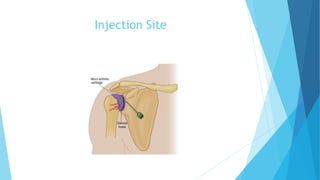
INDICATIONS AND CLINICAL CONSIDERATIONS
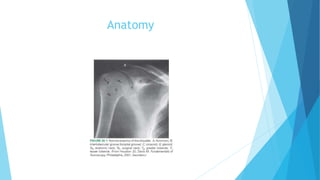
 The shoulder joint is susceptible to the development of arthritis
 Pain worse with activity, interfere sleep, crepitus might be found
 Limited ROM to do daily activities
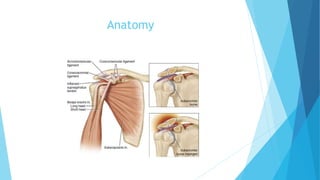
Anatomy
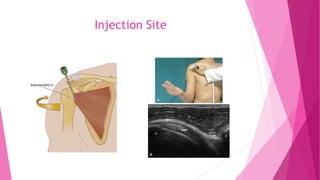
Injection Site
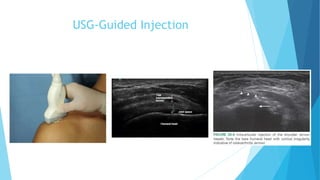
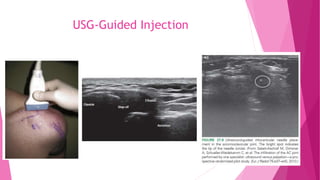
USG-Guided Injection
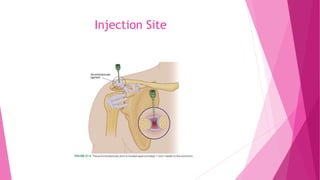
Acromioclavicular Joint Injection
INDICATIONS AND CLINICAL CONSIDERATIONS
 The acromioclavicular joint is vulnerable to injury
from both acute trauma and repetitive microtrauma
 Increased pain when reaching across the chest. Often
the patient is unable to sleep on the affected
shoulder
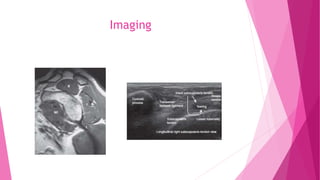
IMAGING
Injection Site
USG-Guided Injection
Supraspinatus Tendon Injection
INDICATIONS AND CLINICAL CONSIDERATIONS
 Shoulder prone to tendinitis due to:
1. Wide range of motion
2. Restricted by coracoacromial arch
3. Poor blood supply
 Supraspinatus tendinitis usually acute, occurring after overuse or misuse of
the shoulder joint
 Carrying heavy objects
 Vigorous use of exercise equipments
 Positive Dawbarn sign
 Often with bursitis
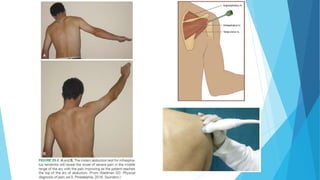
Dawbarn’s Test / Dawbarn Sign
 Pain on palpation over the greater tuberosity of the humerus when the arm is
hanging down that disappears when the arm is fully abducted
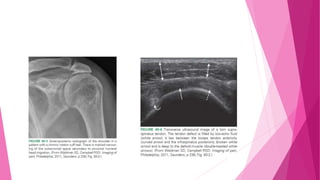
Ultrasound
Ultrasound
Injection Site
Infraspinatus Tendon Injection
Ultrasound
Normal Tendinopathy
Subscapularis Tendon
Injection
Imaging
Injection Site
Long Head of the Biceps Injection
for Bicipital Tendinitis
Anatomy
Physical Examination
 Yergason test, which is production
of pain on active supination of the
forearm against resistance with the
elbow flexed at a right angle
 Popeye deformity
Ultrasound
Injection Site
Injection Technique for
Subacromial Impingement Syndrome
INDICATIONS AND CLINICAL CONSIDERATIONS
 Diffuse shoulder pain with an associated feeling of weakness combined with
loss of range of motion.
 Worsened at night and impair sleep
 Increasing shoulder pain with any activities that abduct and/or forward flex
the shoulder
 Positive neer’s test
Anatomy
Etiology
MRI
Injection Site
USG-Guided Injection
Injection Technique for
Rotator Cuff Tear
MR arthrogram
Injection Site
USG-Guided Injection
Injection Technique for
Frozen Shoulder Syndrome
INDICATIONS AND CLINICAL CONSIDERATIONS
 The term frozen shoulder describes a constellation of clinical symptoms,
including the unilateral progressive limitation of passive and active range of
motion of the shoulder and pain on range of motion.
 Frozen shoulder is distinguishable from other painful conditions of the
shoulder, such as tendinitis and bursitis, in that the limitation of range of
motion associated with frozen shoulder affects both passive and active range
of motion, whereas tendinitis and bursitis affect only active range of motion.
Injection Site
Treatment
USG-Guided
Injection
Shoulder Injection

Shoulder Injection