SHOULDER COMPLEX
Dr/Mohamed Ahmed Raafat
Lecturer of Physical Therapy for
Neurology Disorders and it’s Surgery
South valley University
FOUR JOINTS & FOUR BONES WITHIN THE SHOULDER COMPLEX
Four joints:
• Sternoclavicular joint
• Acromioclavicular joint
• Scapulothoracic joint
• Glenohumeral joint
4
Four bones:
• Sternum,
• Clavicle,
• Scapula,
• Proximal-to-Mid Humerus
GENERAL FUNCTION
• Provides very mobile, yet strong base for hand to perform its intricate
gross and skilled functions
• Transmits loads from upper extremity to axial skeleton.
• Clavicle:
✓Acts a strut connecting upper extremity to thorax
✓Protects brachial plexus & vascular structures
✓Serves as attachment site for many shoulder muscles
5
STERNUM
• costal facets located on the lateral edge of the manubrium
provide bilateral attachment sites for the first two ribs.
6
CLAVICLE
• Shaft: convex medially and concave laterally
• long axis of the clavicle is oriented slightly above the
horizontal plane and about 20 degrees posterior to
the frontal plane.
• costal facet (inferior surface) rests against the first
rib.
• costal tuberosity, an attachment for the
costoclavicular ligament.
7
SCAPULA
8
• Triangular-shaped scapula has three angles: inferior, superior,and lateral.
• Palpation of the inferior angle provides a convenient method for following the
movement of the scapula during arm motion.
• The scapula also has three borders.
• posterior surface of the scapula is separated into a supraspinous fossa and an
infraspinous fossa by the prominent spine. The depth of the supraspinous fossa is
filled by the supraspinatus muscle.
• The medial end of the spine diminishes in height at the root of the spine.
• the lateral end of the spine gains considerable height and flattens into the broad
and prominent acromion.
• The clavicular facet on the acromion forms part of the acromioclavicular joint.
• scapula articulates with the head of the humerus at the slightly concave glenoid
fossa (gleno-humeral joint).
9
SCAPULA
10
• The slope of the glenoid fossa is inclined upward about 4 degrees relative
to a horizontal axis through the body of the scapula.
• (scapular plane) : At rest the scapula is normally positioned against the
posterior-lateral surface of the thorax, with the glenoid fossa facing about
30–40 degrees anterior to the frontal plane.
• coracoid process projects sharply from the scapula, providing multiple
attachments for ligaments and muscles. ????????(mention)
11
12
PROXIMAL-TO-MID HUMERUS
13
PROXIMAL-TO-MID HUMERUS
• Humeral head :
✓ faces medially and superiorly,
✓forming an approximate 135 degree angle of inclination with the long axis
of the humeral shaft.
✓normally rotated (or twisted) posteriorly about 30 degrees within the
horizontal plane.
▪ Humeral neck:
✓has prominent lesser and greater tubercles.
✓greater tubercle has an upper, middle, and lower facet, marking the distal
attachment of the supraspinatus, infraspinatus, and teres minor, respectively
14
15
PROXIMAL-TO-MID HUMERUS
• Sharp crests extend distally from the anterior side of the greater and
lesser tubercles. These crests receive the distal attachments of the
pectoralis major and teres major.
• intertubercular (bicipital) groove:
✓which houses the tendon of the long head of the biceps brachii.
✓The latissimus dorsi muscle attaches to the floor of the intertubercular
groove, medial to the biceps tendon.
✓Distal and lateral to the termination of the intertubercular groove is the
deltoid tuberosity.
16
PROXIMAL-TO-MID HUMERUS
• radial (spiral) groove:
✓runs obliquely across the posterior surface of
the humerus.
✓separates the proximal attachments of the
lateral and medial heads of the triceps
✓Traveling distally, the radial nerve spirals
around the posterior side of the humerus in the
radial groove,
✓The oblique path of the radial groove and its
contained nerve may be explained as a physical
remnant of the natural de-rotation of the
excessively retroverted humerus
17
• As the shoulder girdle
composed of 4 joints , the
term “shoulder movement”
describes the combined
motions at both
(glenohumeral j +the
scapulothoracic j).
•
18
19
STERNOCLAVICULAR JOINT
• Irregular saddle-shaped articular joint
surface (medial end of the clavicle is
usually convex along its longitudinal
diameter and slightly concave along its
transverse diameter).
• The remarkable stability at the SC joint is
due to the arrangement of the
periarticular connective tissues and
muscles, means Large forces through the
clavicle often cause # of the bone before
the SC joint dislocates.
20
21
STERNOCLAVICULAR JOINT
Frontal plane
Fronal plan
Elev/Dep
Sagittal plane
Post Rot
Horizontal plane
ProT/ReT
ROM:
- Axial Rotation: 50°
- EL/DEP: 35°
- PROT/RET: 35°
STERNOCLAVICULAR JOINT
• The osteokinematics of the clavicle rotate in all three degrees of
freedom(sagittal, frontal, and horizontal )
• clavicle elevates and depresses, protracts and retracts, and
rotates around the bone’s longitudinal axis
• The primary purpose of these movements is to place the
scapula in an optimal position to accept the head of the humerus.
as the arm is raised overhead
OSTEOKINEMATIC
23
STERNOCLAVICULAR JOINT
ARTHROKINEMATIC
24
Elevation of the clavicle occurs as its
convex articular surface rolls superiorly
and simultaneously slides inferiorly on
the concavity of the sternum
Retraction occurs as the concave articular
surface of the clavicle rolls and slides
posteriorly on the convex surface of the
sternum
ACROMIOCLAVICULAR JOINT
• The AC joint is a gliding or plane joint, roll-and-slide arthrokinematics
are not described
• The articular surfaces at the AC joint are lined with a layer of fibrocartilage
tissue, usually separated by an articular disc.7
25
ACROMIOCLAVICULAR JOINT
26
ACROMIOCLAVICULAR JOINT
OSTEOKINEMATIC
27
❑ The motions of the AC joint
are described by movement
of scapula relative to the
lateral end of the clavicle.
❑ Motion has been defined for
3 degrees of freedom:
✓ upward (30°) downward rotation
✓ Horizontal plane adjustments (IR+ER)
✓ Sagittal plane adjustments (anterior
tilting +posterior tilting )
❑ Difcult to measur ROM … REFLECT
IN SCAPULOTHORACIC J.
SCAPULOTHORACIC JOINT
❑not a true joint per se but rather a point of contact between the anterior surface of the scapula
and the posterior-lateral wall of the thorax.
❑two surfaces do not make direct contact; rather, they are separated by layers of muscle, such as the
subscapularis, serratus anterior, and erector spinae.
❑plane of the scapula:
➢10 degrees of anterior tilt,
➢5 to 10 degrees of upward rotation, and about
➢30–40 degrees of internal rotation
❑The movements that occur between the scapula and the thorax are a result of cooperation
between the SC and the AC joints:
I. Scapulothoracic elevation & Depression
II. Scapulothoracic Protraction and Retraction
III. Scapulothoracic upward &downward Rotation
28
OSTEOKINEMATIC
29
SCAPULOTHORACIC JOINT
30
GLENOHUMERAL JOINT
❑(GH) joint is the articulation formed between the
relatively large convex head of the humerus and the
shallow concavity of the glenoid fossa.
31
❑glenoid fossa is directed anterior-laterally in the scapular
plane.
❑humeral head is directed medially and superiorly, as well
as posteriorly because of its natural retroversion.
❑Close-packed position
• ABD with LR
JOINT FIBROUS CAPSULE:
✓ Inherently lax
✓ Surface area 2X head size
✓ Provides restraint for ABD, ADD, LR, MR
allows extensive mobility GH joint.
GLENOHUMERAL JOINT
32
GLENOHUMERAL JOINT
33
GLENOHUMERAL JOINT
Capsular Ligaments
34
GLENOHUMERAL JOINT
Rotator Cuff Muscles and Long Head of the Biceps Brachii
35
36
GLENOHUMERAL JOINT
Rotator Cuff Muscles and Long Head of the Biceps Brachii
37
❑GH joint capsule receives significant structural reinforcement from the four
rotator cuff muscles
❑The subscapularis, the thickest of the four muscles, lies just anterior to the
capsule. The supraspinatus, infraspinatus, and teres minor lie superior and
posterior to the capsule.
❑These four muscles form a cuff that protects and actively stabilizes the GH
joint, especially during dynamic activities.
❑tendons of these muscles actually blend into the capsule. This unique
anatomic arrangement helps explain why the mechanical stability of the GH
joint is so dependent on the innervation, strength, and control of the rotator
cuff muscles.
GLENOHUMERAL JOINT
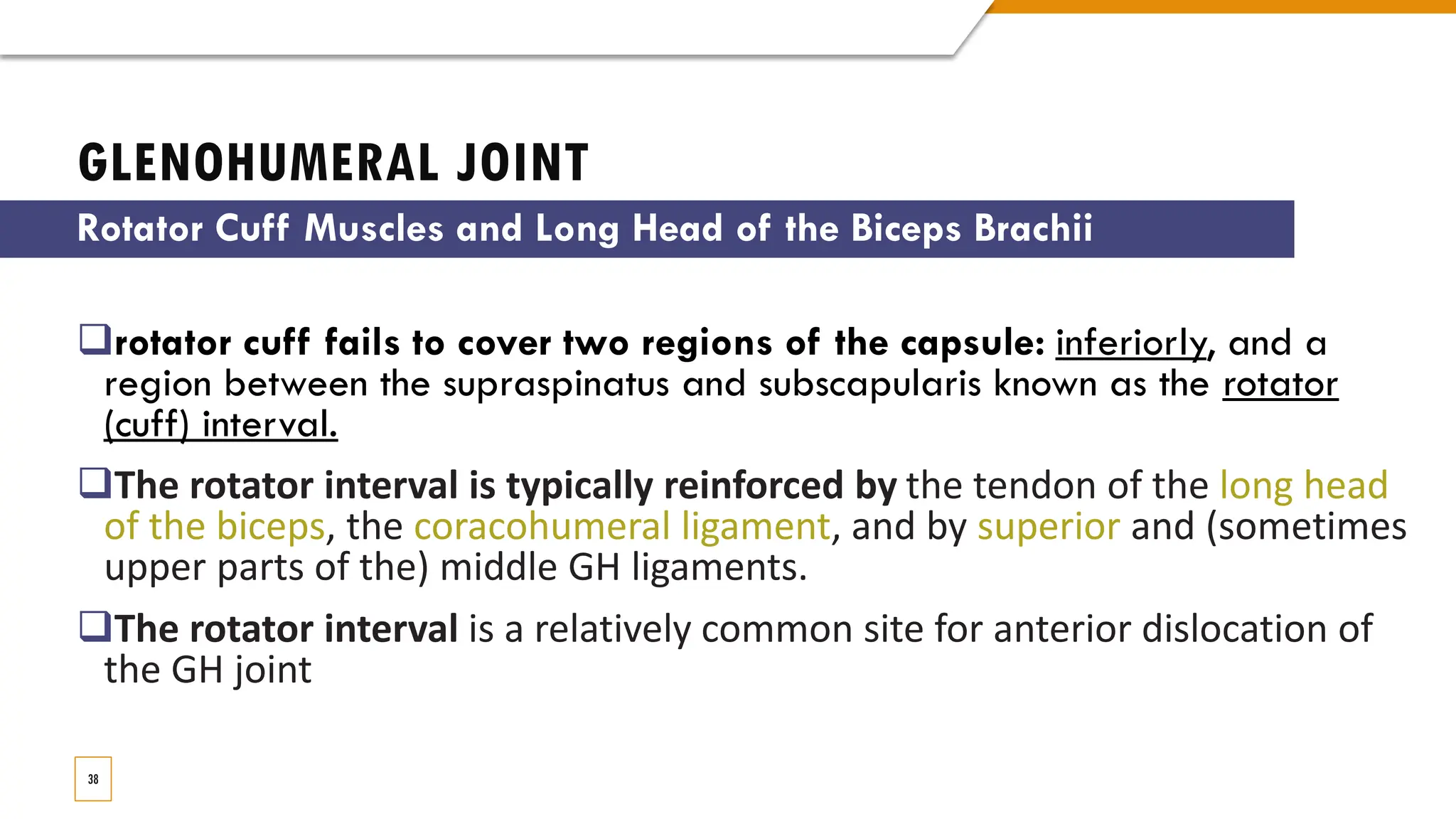
❑rotator cuff fails to cover two regions of the capsule: inferiorly, and a
region between the supraspinatus and subscapularis known as the rotator
(cuff) interval.
❑The rotator interval is typically reinforced by the tendon of the long head
of the biceps, the coracohumeral ligament, and by superior and (sometimes
upper parts of the) middle GH ligaments.
❑The rotator interval is a relatively common site for anterior dislocation of
the GH joint
Rotator Cuff Muscles and Long Head of the Biceps Brachii
38
GLENOHUMERAL JOINT
❑originates off the supraglenoid tubercle of the scapula and adjacent rim of
connective tissue known as the glenoid labrum.
❑From this proximal attachment, this intracapsular tendon crosses over the humeral
head as it courses distally toward the intertubercular groove on the anterior humerus.
❑Function:
➢restricts anterior translation of thehumeral head.
➢position of the tendon across the dome of the humeral head resists superior
translation of the humeral head
Long Head of the Biceps Brachii
39
GLENOHUMERAL JOINT
❑rim of the glenoid fossa is encircled by a triangular fibrocartilagenous
ring, or lip,
❑About 50% of the overall depth of the glenoid fossa has been
attributed to the glenoid labrum.
❑By deepening the concavity of the fossa, the labrum increases contact
area with the humeral head & therefore helps stabilize the joint.
Glenoid Labrum
40
GLENOHUMERAL JOINT
41
SCAPULOTHORACIC POSTURE AND ITS EFFECT
ON STATIC STABILITY
• (A) The rope indicates a muscular force that holds the glenoid fossa in
a slightly upward-rotated position. In this position. the passive tension
in the taut superior capsular structure (SCS) is added to the force
produced by gravity (G), yielding the compression force (CF). The
compression force applied against the slight incline of the glenoid
“locks” the joint.
• (B) With a loss of upward rotation posture of the
scapula (indicated by the cut rope), the change in angle between the
SCS and G vectors reduces the magnitude of the compression force
across the GH joint. As a consequence, the head of the humerus may
slide down
the now vertically oriented glenoid fossa. The dashed lines indicate
the parallelogram method of adding force vectors.
• SCS : superior capsular ligament +the
coracohumeral lig + the of the supraspinatus tendon
42
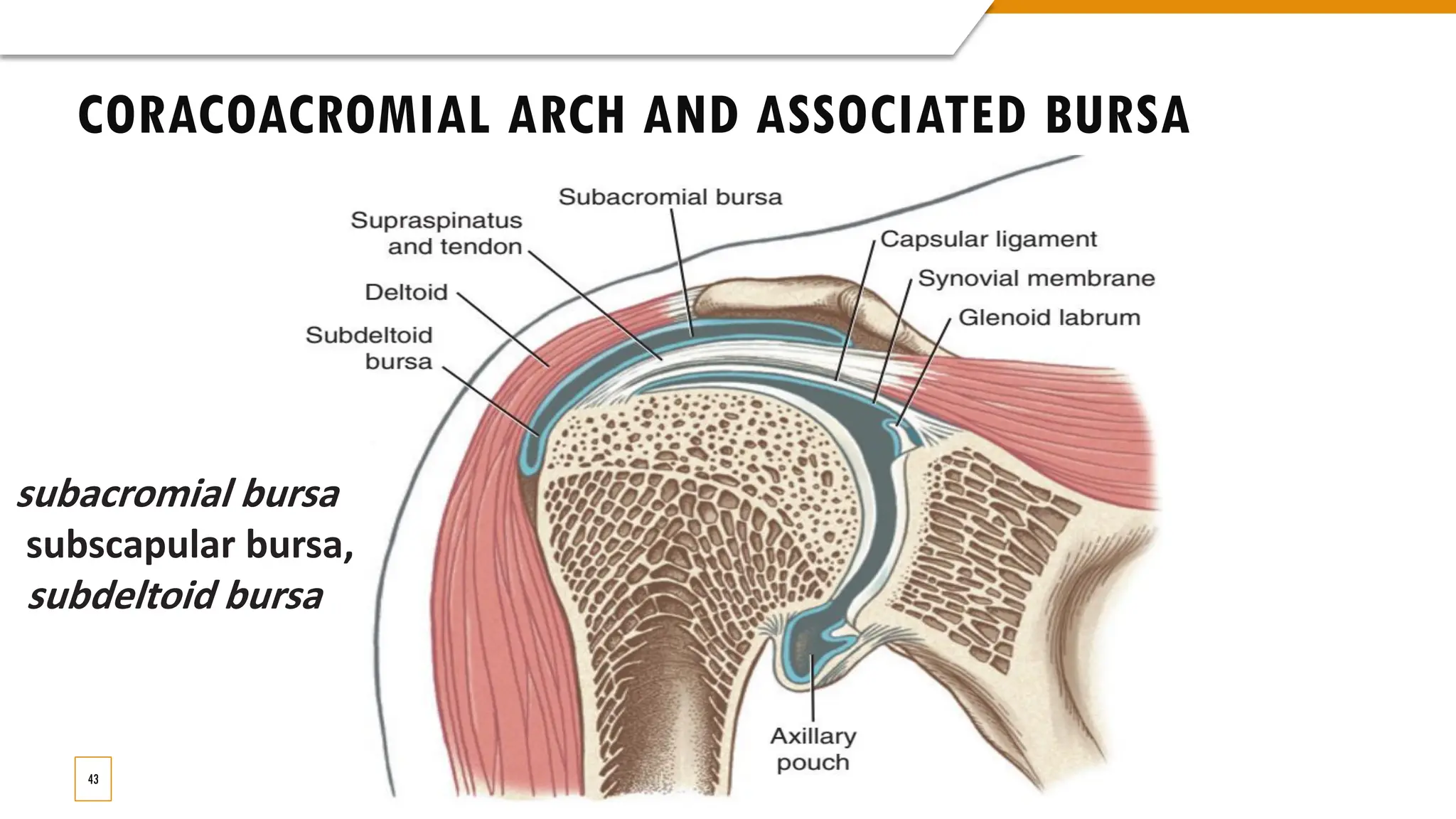
CORACOACROMIAL ARCH AND ASSOCIATED BURSA
43
subacromial bursa
subscapular bursa,
subdeltoid bursa
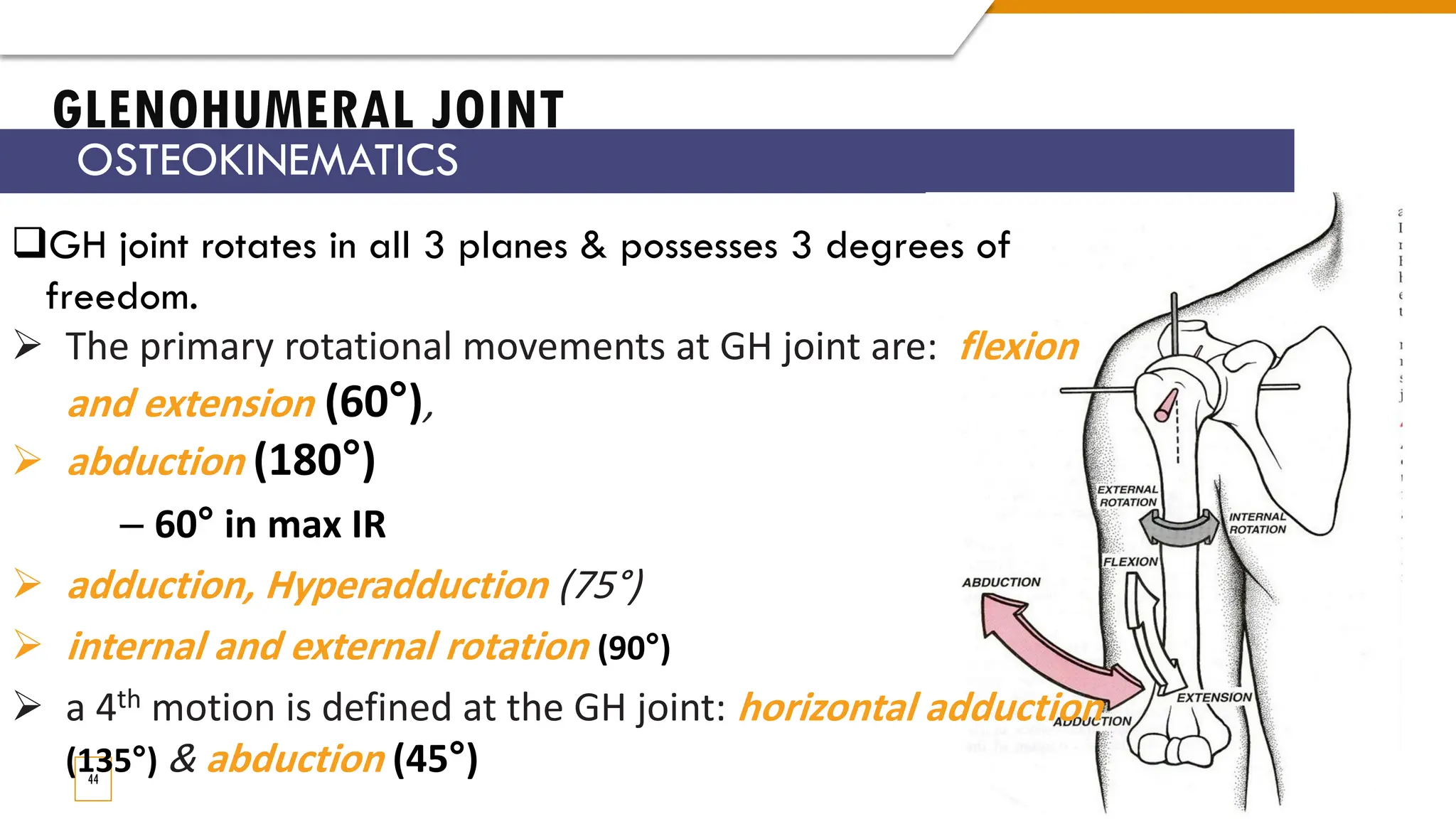
GLENOHUMERAL JOINT
OSTEOKINEMATICS
44
❑GH joint rotates in all 3 planes & possesses 3 degrees of
freedom.
➢ The primary rotational movements at GH joint are: flexion
and extension (60°),
➢ abduction (180°)
– 60° in max IR
➢ adduction, Hyperadduction (75°)
➢ internal and external rotation (90°)
➢ a 4th motion is defined at the GH joint: horizontal adduction
(135°) & abduction (45°)
GLENOHUMERAL JOINT
ARTHROKINEMATICS
45
✓ Abd:
convex head of the humerus
rolling superiorly while
simultaneously sliding inferiorly
✓ Flex &Ext:
a spinning motion of the humeral
head around the glenoid fossa.
✓ ER
humeral head simultaneously
rolls posteriorly + slides
anteriorly on the glenoid fossa
GLENOHUMERAL JOINT
• acromiohumeral distance (AHD)
naturally fluctuates from about 7.5 mm
at 20 degrees of abduction to its
smallest distance of 2.6 mm near 85
degrees of abduction. The AHD then
increases to about 5 mm at 150 degrees
of abduction.
ARTHROKINEMATICS
46
✓ Recall that the longitudinal diameter
of the articular surface of the humeral
head is almost twice the size of the
longitudinal diameter on the glenoid
fossa.
47
48
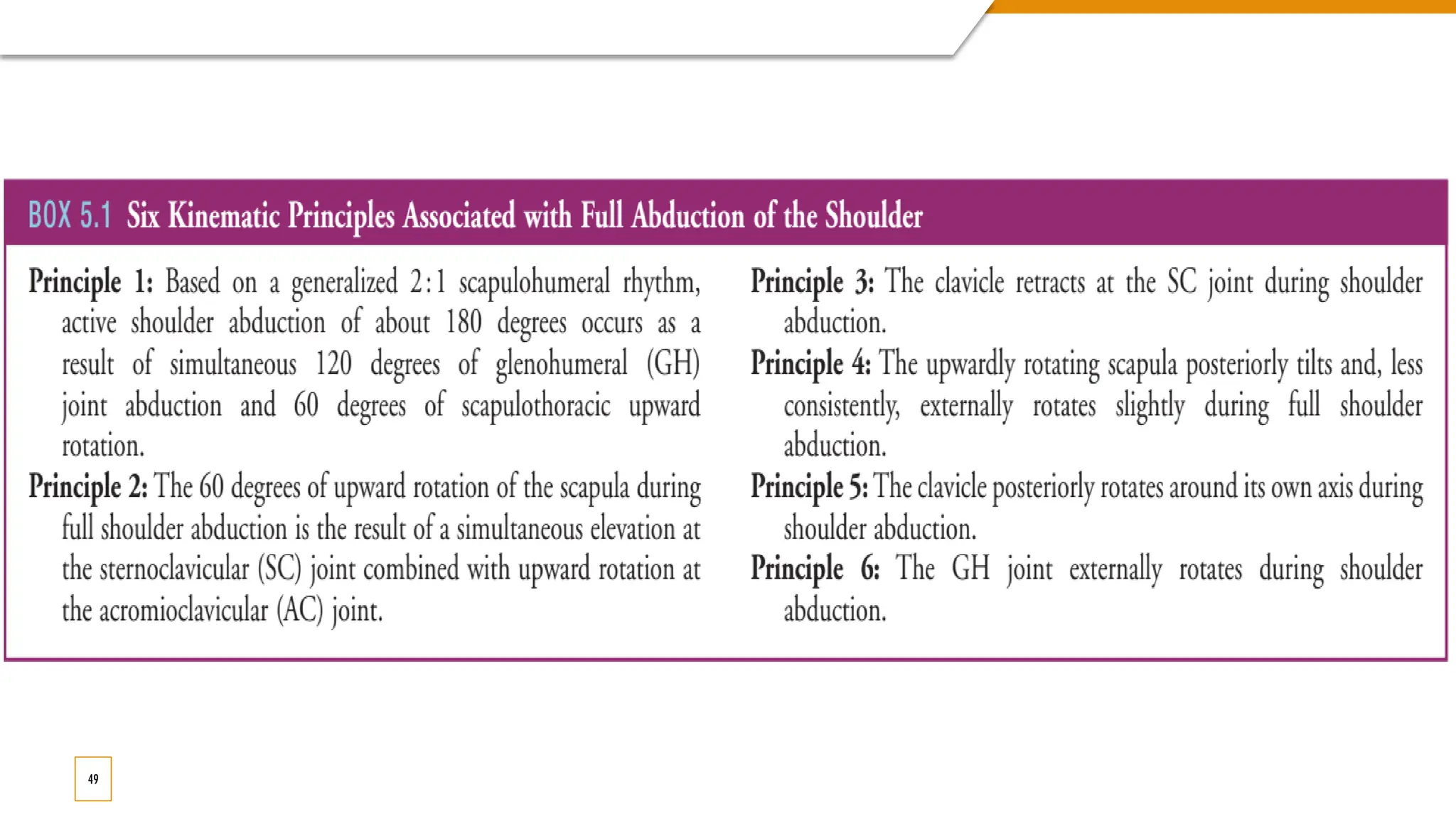
Overall Kinematics of Shoulder Abduction:
49
50
SHOULDER MUSCLES KINITICS:
❑Two functional categories:
➢Proximal stabilizers: originate on the spine, ribs, and cranium and
insert on the scapula and clavicle, such as trap. or SA.
➢Distal mobilizers: originate on the scapula and clavicle and insert on
the humerus or the forearm, such as the deltoid or biceps brachii.
52
MUSCLES OF THE SCAPULOTHORACIC JOINT
53
ELEVATORS
➢Over time, a depressed clavicle has resulted in
superior dislocation of the SC joint
➢As the lateral end of the clavicle is lowered, the
medial end is forced upward because of the fulcrum
action of the underlying 1st rib.
➢The depressed shaft of the clavicle may compress
the subclavian vessels and part of the brachial
plexus.
paralysis of her left upper trapezius caused by the polio virus.
54
ELEVATORS
❑Humeral head being held firmly against the inclined
plane of the glenoid fossa
❑With long-term paralysis of the trapezius,the glenoid
fossa loses its upwardly rotated position, allowing the
humerus to slide inferiorly.
❑downward pull imposed by gravity on an unsupported
arm may strain the capsular ligaments at the GH joint
and lead to an irreversible dislocation.
long-term paralysis of the upper trapezius is an
inferior dislocation (or subluxation) of the GH joint As
Flacid hemiplegia:
55
ELEVATORS
✓Both scapulae are slightly depressed, downwardly
rotated & protracted.
✓both scapulae are also slightly IR & anteriorly
tilted—postures hypothesized to predispose to
impingement of the tissues within the subacromial
space.
healthy young woman with the classic “rounded shoulders”
56
DEPRESSORS
• Subclavius (acts indirectly on the scapula)
small amount of depression torque on the
clavicle compressing +stabilizing SC joint.
• lower trapezius and pectoralis minor act
directly on the scapula.
• latissimus dorsi, depresses the shoulder
girdle indirectly, primarily by pulling the
humerus inferiorly.
57
• force generated by the depressor muscles
can be directed through scapula & UL &
applied against some object, such as the
spring.
action can increase
overall functional
Length of UL
58
❑With the arm firmly held against the armrest
of the wheelchair, contraction of the LT & LD
pulls the thorax and pelvis up toward the
fixed scapula relieve the contact
pressure in the tissues superficial to the ischial
tuberosities.
59
persons with tetraplegia (quadriplegia) who lack sufficient triceps strength to lift
the body weight through elbow extension.
PROTRACTORS
• force of scapular protraction is usually transferred across the GH joint
and employed for forward pushing and reaching activities.
• Although the pectoralis minor has the ability to impart a protraction-
directed force on the scapula, its relative ability to generate this action is
small.
• its role in limiting scapular retraction when the muscle becomes overly
tight.
• Amplify the final phase of the standard prone push-up.
✓NB. The early phase of a push-up is performed primarily by the triceps
and pectoralis major.
60
• A- SA passes anterior to the scapula to attach
along entire length of its medial border. The
muscle’s line of force is shown protracting the
scapula and arm in a forward pushing or
reaching motion.
61
B- protraction torque is primarily the result of SA
force multiplied by the internal moment arm (IMA)
originating at the vertical axis of rotation at SC joint.
RETRACTORS
➢MT has the most optimal line of force for this
action.
➢This proximal stabilization is an essential force
component required for pulling activities, such as
climbing & rowing.
➢Rhomboids & LT are direct antagonists to one
another.
➢The lines of force of Rhomboids & LT combine,
however, to produce pure retraction.
➢Complete paralysis of the trapezius, and to a
lesser extent the rhomboids, reduces the
retraction potential oF scapula.
62
MUSCLES THAT ELEVATE THE ARM
63
MUSCLES THAT ELEVATE THE ARM
❑prime muscles abduct the GH joint are the anterior deltoid, middle
deltoid, & supraspinatus .
❑flexion is performed primarily by the anterior deltoid, coracobrachialis,
and the biceps brachii.
❑anterior and middle deltoid and supraspinatus muscles are activated at
the onset of abduction, reaching a maximum level of activation between
60 and 90 degrees of abduction—a point where the external torque
due to the weight of the arm approaches its greatest level.
MUSCLES THAT ELEVATE ARM AT GLENOHUMERAL JOINT
64
MUSCLES THAT ELEVATE ARM
• With the deltoid paralyzed, supraspinatus ms is generally
capable of fully abducting the GH joint, although the abduction
torque is much reduced.
• with the supraspinatus paralyzed or its tendon completely
ruptured, full abduction is often difficult, albeit achievable.
• muscles that actively abduct the shoulder produce relatively
large compression forces across the GH joint. These joint forces reach
80% to 90% of body weight in a position of 90 degrees of
abduction.
MUSCLES THAT ELEVATE ARM AT GLENOHUMERAL JOINT
MUSCLES THAT ELEVATE THE ARM
❑primary upward rotator muscles are SA , UL &LL.
❑Axis of rotation for scapular upward rotation passing in an anterior-posterior direction through
scapula axis allows a convenient way to analyze the force-couple formed between SA & UL
&LL.
❑This force-couple rotates the scapula in the same rotary direction as the abducting humerus.
❑mechanics of this force-couple assume that force of each of the 3 muscles acts
simultaneously.
❑SA rotates the glenoid fossa upward and laterally.
(most effective upward rotators of the force-couple, primarily because of their larger moment arm for this action)
UT upwardly rotates scapula indirectly by its superior & medial pull on
the clavicle.
LL upwardly rotates the scapula by its inferior & medial pull on
the root of the spine of the scapula.
UPWARD ROTATORS AT THE SCAPULOTHORACIC JOINT
66
67
MUSCLES THAT ELEVATE THE ARM
68
The muscular force-couple formed by these
3 ms is analogous to mechanics of 3
people walking through a revolving door
MUSCLES THAT ELEVATE THE ARM
❑(EMG) analysis of upward rotation of the scapula shows:
LL particularly active during the later phase of shoulder abduction.
MT very active during shoulder abduction.
retraction force on the scapula, which along with the rhomboid ms
helps to neutralize the strong protraction effect of SA.
➢SA & parts of the trapezius function simultaneously as both agonists and
antagonists, acting synergistically in upward rotation but opposing, and
thus partially limiting, each other’s strong protraction and retraction
effects.
➢The net force dominance between the two muscles during elevation of the
arm helps determine the final retraction-protraction position of the upward
rotated scapula.
N.B./During shoulder abduction (especially in the frontal plane), the scapular retractors typically
dominate, as evident by the fact that the clavicle (and linked scapula) retracts during shoulder abduction
UPWARD ROTATORS AT THE SCAPULOTHORACIC JOINT
69
MUSCLES THAT ELEVATE THE ARM
• SA + MT + LL post. tilting & ER the upwardly rotating scapula, most
evident as the shoulder approaches full abduction .
• LT pulls inferiorly on the scapula,
• SA pull anterior-laterally on the scapula.
• MT pulls medially on the scapula
70
These simultaneous muscular
actions, coupled with their
moment arms, would have the
ability to ER
the upwardly rotating scapula.
This ER torque would also secure the medial
border of the scapula firmly against the
thorax.
71
A) SA , MT, LT controlling the adjustment motions of the
upwardly rotating scapula during scapular plane abduction.
B) SA &LT force-couple to
posteriorly tilt scapula
relative to the axis of rotation
at the AC joint (indicated by
the green circle).
C) SA &MT Force-couple
to ER scapula relative to
the axis of rotation at the
AC joint
PARALYSIS OF THE UPWARD ROTATORS OF THE SCAPULOTHORACIC JOINT
• During full abduction of the shoulder, the thoracic spine naturally extends
10–15 degrees. Weakness of the trapezius may reduce the magnitude of this
accompanying thoracic extension, and thereby indirectly distort overall
scapulothoracic kinematics.
• healthy person with paralysis of the trapezius has moderate to marked
difficulty in flexing the shoulder above the head.
(The action can usually be accomplished, however, as long as the SA is fully
innervated and relatively strong).
❑Elevation of the arm in the pure frontal plane (i.e., abduction) is usually
very difficult, and often not achievable, because this action requires that the
MT generates a strong retraction force on the scapula
Trapezius Muscle Weakness
72
PARALYSIS OF THE UPWARD ROTATORS OF THE
SCAPULOTHORACIC JOINT
✓complete paralysis of the SA have great difficulty actively elevating the arm
above the head, regardless of plane of motion.
✓Attempts at shoulder abduction, especially against resistance, typically result in
limited elevation of the arm coupled with excessively downwardly rotated
scapula .
As middle deltoid & supraspintus overshorten rapidly As predicted by the force-
velocity and length tension relationships of muscle producing a paradoxic (and
ineffective) downward rotation of the scapula.
- Normally, contraction of SA strongly upwardly rotates the scapula, thus allowing
the contracting middle deltoid and supraspinatus to rotate the humerus in the
same rotary direction as the scapula.
-
Serratus Anterior Muscle Weakness
73
74
A) paradoxic downwardly rotated
position, which can be exaggerated by
applying resistance against the
shoulder abduction effort. Note also
that the scapula is abnormally
anteriorly tilted + internally rotated.
B) Kinesiologic analysis of the extreme
downward rotated position.
PARALYSIS OF THE UPWARD ROTATORS OF THE SCAPULOTHORACIC JOINT
• 2ND : scapula is also slightly anteriorly tilted & IR (evident by the “flaring”
of the scapula’s inferior angle and medial border, respectively). Such a
distorted posture is often referred to clinically as a “winging” scapula.
• 3RD : described earlier in this chapter, the serratus anterior contributes a
subtle but important posterior tilting + external rotation torque to the
upwardly rotating scapula.
75
Serratus Anterior Muscle Weakness
FUNCTION OF THE ROTATOR CUFF MUSCLES DURING ELEVATION OF THE ARM
❑An important function of the rotator cuff group is to compensate for the GH
joint’s natural laxity and propensity for instability.
❑The distal attachments of the rotator cuff muscles blend into the GH joint capsule
before attaching to the proximal humerus
❑This anatomic arrangement forms a protective cuff around the joint, becoming
rigid when activated by the nervous system.
❑dynamic stabilizing function of the infraspinatus muscle during ER was
discussed.NOOOOOOO
❑This dynamic stabilization is an essential function of all members of the rotator
cuff. Forces produced primarily by the rotator cuff (and their attachments into the
capsule) not only actively rotate the humeral head but also compress and
centralize it against the glenoid fossa
A) Regulators of Dynamic Stability at the Glenohumeral Joint
76
FUNCTION OF THE ROTATOR CUFF MUSCLES DURING ELEVATION OF THE ARM
77
Regulators of Dynamic Stability at the Glenohumeral Joint
FUNCTION OF THE ROTATOR CUFF MUSCLES DURING ELEVATION OF THE ARM
➢horizontally oriented supraspinatus produces a compression force directly into the glenoid fossa; this
force stabilizes the humeral head firmly against the fossa during its superior roll into abduction.
➢the remaining rotator cuff muscles (subscapularis, infraspinatus, and teres minor)+ long head of the
biceps have a line of force that can exert an inferiorly directed force on the humeral head during
abduction.
➢During abduction, the muscle’s contractile force rolls the humeral head superiorly while simultaneously
serving as a musculotendinous “spacer” that restricts an excessive and counterproductive superior
translation of the humeral head.
➢All the aforementioned inferior-directed forces on the humerus are necessary to help neutralize the
contracting deltoid’s strong superior translation effect on the humerus, especially at low abduction
angles.
➢passive forces from muscles being stretched during abduction, such as the latissimus dorsi and teres
major, can likely exert a useful inferior-directed force on the humeral head.
➢Finally, during abduction, the infraspinatus and teres minor muscles can also externally rotate the
humerus to varying degrees to increase the clearance between the greater tubercle and the acromion
B) Active Controllers of the Arthrokinematics at GH Joint
78
79
80
supraspinatus rolls
the humeral head superiorly toward
abduction while also compressing the joint
for added stability.
The remaining rotator cuff muscles
(subscapularis, infraspinatus, and teres
minor) exert a downward translational force
on the humeral head to counteract excessive
superior translation, especially that caused by
deltoid contraction.
81
Note that the distal attachments of these muscles blend into and reinforce
the superior and posterior and posterior aspects of the glenohumeral
Joint capsule .
MUSCLES THAT ADDUCT AND EXTEND THE SHOULDER
• primary adductor and extensor ms of
shoulder are the post deltoid, LD, teres
major, long head of the triceps, and
sternocostal head of the pectoralis major
• extensor and adductor muscles are capable
of generating the largest torques of any
muscle group of shoulder.
Their high torque potential can be appreciated
in tasks such as pulling the arm against
resistance when climbing a rope or propelling
through water.
82
MUSCLES THAT INTERNALLY AND EXTERNALLY ROTATE THE SHOULDER
❑MS. that IR GH joint are the subscapularis, pectoralis major, LD, teres major, and
anterior deltoid.
❑Many of the internal rotators are also powerful extensors and adductors, such as
those used during the propulsive phase of swimming.
❑total muscle mass of the shoulder’s internal rotators exceeds that of the external
rotators. This fact is reflected by the larger maximal-effort torque produced by the
internal rotators, during Both eccentric and concentric activations.
❑ On average the IR produce about 40–70% greater torque than the ER ; however,
this difference varies considerably based on test positon, type and speed of muscle
activation, and individual physical characteristics.
INTERNAL ROTATOR MUSCLES
83
• Superior view of the right shoulder showing
the group action of IR around the
glenohumeral joint’s vertical axis of rotation.
• In this case the scapula is fixed and the
humerus is free to rotate. The line of force of
the pectoralis major is shown with its internal
moment arm.
• Note the roll-and-slide arthrokinematics
of the convex-on-concave motion. For
clarity, the anterior deltoid is not shown.
84
85
Shoulder Complex anatomy for medical .pdf

Shoulder Complex anatomy for medical .pdf

  • 3.
    SHOULDER COMPLEX Dr/Mohamed AhmedRaafat Lecturer of Physical Therapy for Neurology Disorders and it’s Surgery South valley University
  • 4.
    FOUR JOINTS &FOUR BONES WITHIN THE SHOULDER COMPLEX Four joints: • Sternoclavicular joint • Acromioclavicular joint • Scapulothoracic joint • Glenohumeral joint 4 Four bones: • Sternum, • Clavicle, • Scapula, • Proximal-to-Mid Humerus
  • 5.
    GENERAL FUNCTION • Providesvery mobile, yet strong base for hand to perform its intricate gross and skilled functions • Transmits loads from upper extremity to axial skeleton. • Clavicle: ✓Acts a strut connecting upper extremity to thorax ✓Protects brachial plexus & vascular structures ✓Serves as attachment site for many shoulder muscles 5
  • 6.
    STERNUM • costal facetslocated on the lateral edge of the manubrium provide bilateral attachment sites for the first two ribs. 6
  • 7.
    CLAVICLE • Shaft: convexmedially and concave laterally • long axis of the clavicle is oriented slightly above the horizontal plane and about 20 degrees posterior to the frontal plane. • costal facet (inferior surface) rests against the first rib. • costal tuberosity, an attachment for the costoclavicular ligament. 7
  • 8.
  • 9.
    • Triangular-shaped scapulahas three angles: inferior, superior,and lateral. • Palpation of the inferior angle provides a convenient method for following the movement of the scapula during arm motion. • The scapula also has three borders. • posterior surface of the scapula is separated into a supraspinous fossa and an infraspinous fossa by the prominent spine. The depth of the supraspinous fossa is filled by the supraspinatus muscle. • The medial end of the spine diminishes in height at the root of the spine. • the lateral end of the spine gains considerable height and flattens into the broad and prominent acromion. • The clavicular facet on the acromion forms part of the acromioclavicular joint. • scapula articulates with the head of the humerus at the slightly concave glenoid fossa (gleno-humeral joint). 9
  • 10.
  • 11.
    • The slopeof the glenoid fossa is inclined upward about 4 degrees relative to a horizontal axis through the body of the scapula. • (scapular plane) : At rest the scapula is normally positioned against the posterior-lateral surface of the thorax, with the glenoid fossa facing about 30–40 degrees anterior to the frontal plane. • coracoid process projects sharply from the scapula, providing multiple attachments for ligaments and muscles. ????????(mention) 11
  • 12.
  • 13.
  • 14.
    PROXIMAL-TO-MID HUMERUS • Humeralhead : ✓ faces medially and superiorly, ✓forming an approximate 135 degree angle of inclination with the long axis of the humeral shaft. ✓normally rotated (or twisted) posteriorly about 30 degrees within the horizontal plane. ▪ Humeral neck: ✓has prominent lesser and greater tubercles. ✓greater tubercle has an upper, middle, and lower facet, marking the distal attachment of the supraspinatus, infraspinatus, and teres minor, respectively 14
  • 15.
  • 16.
    PROXIMAL-TO-MID HUMERUS • Sharpcrests extend distally from the anterior side of the greater and lesser tubercles. These crests receive the distal attachments of the pectoralis major and teres major. • intertubercular (bicipital) groove: ✓which houses the tendon of the long head of the biceps brachii. ✓The latissimus dorsi muscle attaches to the floor of the intertubercular groove, medial to the biceps tendon. ✓Distal and lateral to the termination of the intertubercular groove is the deltoid tuberosity. 16
  • 17.
    PROXIMAL-TO-MID HUMERUS • radial(spiral) groove: ✓runs obliquely across the posterior surface of the humerus. ✓separates the proximal attachments of the lateral and medial heads of the triceps ✓Traveling distally, the radial nerve spirals around the posterior side of the humerus in the radial groove, ✓The oblique path of the radial groove and its contained nerve may be explained as a physical remnant of the natural de-rotation of the excessively retroverted humerus 17
  • 18.
    • As theshoulder girdle composed of 4 joints , the term “shoulder movement” describes the combined motions at both (glenohumeral j +the scapulothoracic j). • 18
  • 19.
  • 20.
    STERNOCLAVICULAR JOINT • Irregularsaddle-shaped articular joint surface (medial end of the clavicle is usually convex along its longitudinal diameter and slightly concave along its transverse diameter). • The remarkable stability at the SC joint is due to the arrangement of the periarticular connective tissues and muscles, means Large forces through the clavicle often cause # of the bone before the SC joint dislocates. 20
  • 21.
  • 22.
    Frontal plane Fronal plan Elev/Dep Sagittalplane Post Rot Horizontal plane ProT/ReT ROM: - Axial Rotation: 50° - EL/DEP: 35° - PROT/RET: 35° STERNOCLAVICULAR JOINT
  • 23.
    STERNOCLAVICULAR JOINT • Theosteokinematics of the clavicle rotate in all three degrees of freedom(sagittal, frontal, and horizontal ) • clavicle elevates and depresses, protracts and retracts, and rotates around the bone’s longitudinal axis • The primary purpose of these movements is to place the scapula in an optimal position to accept the head of the humerus. as the arm is raised overhead OSTEOKINEMATIC 23
  • 24.
    STERNOCLAVICULAR JOINT ARTHROKINEMATIC 24 Elevation ofthe clavicle occurs as its convex articular surface rolls superiorly and simultaneously slides inferiorly on the concavity of the sternum Retraction occurs as the concave articular surface of the clavicle rolls and slides posteriorly on the convex surface of the sternum
  • 25.
    ACROMIOCLAVICULAR JOINT • TheAC joint is a gliding or plane joint, roll-and-slide arthrokinematics are not described • The articular surfaces at the AC joint are lined with a layer of fibrocartilage tissue, usually separated by an articular disc.7 25
  • 26.
  • 27.
    ACROMIOCLAVICULAR JOINT OSTEOKINEMATIC 27 ❑ Themotions of the AC joint are described by movement of scapula relative to the lateral end of the clavicle. ❑ Motion has been defined for 3 degrees of freedom: ✓ upward (30°) downward rotation ✓ Horizontal plane adjustments (IR+ER) ✓ Sagittal plane adjustments (anterior tilting +posterior tilting ) ❑ Difcult to measur ROM … REFLECT IN SCAPULOTHORACIC J.
  • 28.
    SCAPULOTHORACIC JOINT ❑not atrue joint per se but rather a point of contact between the anterior surface of the scapula and the posterior-lateral wall of the thorax. ❑two surfaces do not make direct contact; rather, they are separated by layers of muscle, such as the subscapularis, serratus anterior, and erector spinae. ❑plane of the scapula: ➢10 degrees of anterior tilt, ➢5 to 10 degrees of upward rotation, and about ➢30–40 degrees of internal rotation ❑The movements that occur between the scapula and the thorax are a result of cooperation between the SC and the AC joints: I. Scapulothoracic elevation & Depression II. Scapulothoracic Protraction and Retraction III. Scapulothoracic upward &downward Rotation 28 OSTEOKINEMATIC
  • 29.
  • 30.
  • 31.
    GLENOHUMERAL JOINT ❑(GH) jointis the articulation formed between the relatively large convex head of the humerus and the shallow concavity of the glenoid fossa. 31 ❑glenoid fossa is directed anterior-laterally in the scapular plane. ❑humeral head is directed medially and superiorly, as well as posteriorly because of its natural retroversion. ❑Close-packed position • ABD with LR JOINT FIBROUS CAPSULE: ✓ Inherently lax ✓ Surface area 2X head size ✓ Provides restraint for ABD, ADD, LR, MR allows extensive mobility GH joint.
  • 32.
  • 33.
  • 34.
  • 35.
    GLENOHUMERAL JOINT Rotator CuffMuscles and Long Head of the Biceps Brachii 35
  • 36.
  • 37.
    GLENOHUMERAL JOINT Rotator CuffMuscles and Long Head of the Biceps Brachii 37 ❑GH joint capsule receives significant structural reinforcement from the four rotator cuff muscles ❑The subscapularis, the thickest of the four muscles, lies just anterior to the capsule. The supraspinatus, infraspinatus, and teres minor lie superior and posterior to the capsule. ❑These four muscles form a cuff that protects and actively stabilizes the GH joint, especially during dynamic activities. ❑tendons of these muscles actually blend into the capsule. This unique anatomic arrangement helps explain why the mechanical stability of the GH joint is so dependent on the innervation, strength, and control of the rotator cuff muscles.
  • 38.
    GLENOHUMERAL JOINT ❑rotator cufffails to cover two regions of the capsule: inferiorly, and a region between the supraspinatus and subscapularis known as the rotator (cuff) interval. ❑The rotator interval is typically reinforced by the tendon of the long head of the biceps, the coracohumeral ligament, and by superior and (sometimes upper parts of the) middle GH ligaments. ❑The rotator interval is a relatively common site for anterior dislocation of the GH joint Rotator Cuff Muscles and Long Head of the Biceps Brachii 38
  • 39.
    GLENOHUMERAL JOINT ❑originates offthe supraglenoid tubercle of the scapula and adjacent rim of connective tissue known as the glenoid labrum. ❑From this proximal attachment, this intracapsular tendon crosses over the humeral head as it courses distally toward the intertubercular groove on the anterior humerus. ❑Function: ➢restricts anterior translation of thehumeral head. ➢position of the tendon across the dome of the humeral head resists superior translation of the humeral head Long Head of the Biceps Brachii 39
  • 40.
    GLENOHUMERAL JOINT ❑rim ofthe glenoid fossa is encircled by a triangular fibrocartilagenous ring, or lip, ❑About 50% of the overall depth of the glenoid fossa has been attributed to the glenoid labrum. ❑By deepening the concavity of the fossa, the labrum increases contact area with the humeral head & therefore helps stabilize the joint. Glenoid Labrum 40
  • 41.
  • 42.
    SCAPULOTHORACIC POSTURE ANDITS EFFECT ON STATIC STABILITY • (A) The rope indicates a muscular force that holds the glenoid fossa in a slightly upward-rotated position. In this position. the passive tension in the taut superior capsular structure (SCS) is added to the force produced by gravity (G), yielding the compression force (CF). The compression force applied against the slight incline of the glenoid “locks” the joint. • (B) With a loss of upward rotation posture of the scapula (indicated by the cut rope), the change in angle between the SCS and G vectors reduces the magnitude of the compression force across the GH joint. As a consequence, the head of the humerus may slide down the now vertically oriented glenoid fossa. The dashed lines indicate the parallelogram method of adding force vectors. • SCS : superior capsular ligament +the coracohumeral lig + the of the supraspinatus tendon 42
  • 43.
    CORACOACROMIAL ARCH ANDASSOCIATED BURSA 43 subacromial bursa subscapular bursa, subdeltoid bursa
  • 44.
    GLENOHUMERAL JOINT OSTEOKINEMATICS 44 ❑GH jointrotates in all 3 planes & possesses 3 degrees of freedom. ➢ The primary rotational movements at GH joint are: flexion and extension (60°), ➢ abduction (180°) – 60° in max IR ➢ adduction, Hyperadduction (75°) ➢ internal and external rotation (90°) ➢ a 4th motion is defined at the GH joint: horizontal adduction (135°) & abduction (45°)
  • 45.
    GLENOHUMERAL JOINT ARTHROKINEMATICS 45 ✓ Abd: convexhead of the humerus rolling superiorly while simultaneously sliding inferiorly ✓ Flex &Ext: a spinning motion of the humeral head around the glenoid fossa. ✓ ER humeral head simultaneously rolls posteriorly + slides anteriorly on the glenoid fossa
  • 46.
    GLENOHUMERAL JOINT • acromiohumeraldistance (AHD) naturally fluctuates from about 7.5 mm at 20 degrees of abduction to its smallest distance of 2.6 mm near 85 degrees of abduction. The AHD then increases to about 5 mm at 150 degrees of abduction. ARTHROKINEMATICS 46 ✓ Recall that the longitudinal diameter of the articular surface of the humeral head is almost twice the size of the longitudinal diameter on the glenoid fossa.
  • 47.
  • 48.
    48 Overall Kinematics ofShoulder Abduction:
  • 49.
  • 50.
  • 52.
    SHOULDER MUSCLES KINITICS: ❑Twofunctional categories: ➢Proximal stabilizers: originate on the spine, ribs, and cranium and insert on the scapula and clavicle, such as trap. or SA. ➢Distal mobilizers: originate on the scapula and clavicle and insert on the humerus or the forearm, such as the deltoid or biceps brachii. 52
  • 53.
    MUSCLES OF THESCAPULOTHORACIC JOINT 53
  • 54.
    ELEVATORS ➢Over time, adepressed clavicle has resulted in superior dislocation of the SC joint ➢As the lateral end of the clavicle is lowered, the medial end is forced upward because of the fulcrum action of the underlying 1st rib. ➢The depressed shaft of the clavicle may compress the subclavian vessels and part of the brachial plexus. paralysis of her left upper trapezius caused by the polio virus. 54
  • 55.
    ELEVATORS ❑Humeral head beingheld firmly against the inclined plane of the glenoid fossa ❑With long-term paralysis of the trapezius,the glenoid fossa loses its upwardly rotated position, allowing the humerus to slide inferiorly. ❑downward pull imposed by gravity on an unsupported arm may strain the capsular ligaments at the GH joint and lead to an irreversible dislocation. long-term paralysis of the upper trapezius is an inferior dislocation (or subluxation) of the GH joint As Flacid hemiplegia: 55
  • 56.
    ELEVATORS ✓Both scapulae areslightly depressed, downwardly rotated & protracted. ✓both scapulae are also slightly IR & anteriorly tilted—postures hypothesized to predispose to impingement of the tissues within the subacromial space. healthy young woman with the classic “rounded shoulders” 56
  • 57.
    DEPRESSORS • Subclavius (actsindirectly on the scapula) small amount of depression torque on the clavicle compressing +stabilizing SC joint. • lower trapezius and pectoralis minor act directly on the scapula. • latissimus dorsi, depresses the shoulder girdle indirectly, primarily by pulling the humerus inferiorly. 57
  • 58.
    • force generatedby the depressor muscles can be directed through scapula & UL & applied against some object, such as the spring. action can increase overall functional Length of UL 58
  • 59.
    ❑With the armfirmly held against the armrest of the wheelchair, contraction of the LT & LD pulls the thorax and pelvis up toward the fixed scapula relieve the contact pressure in the tissues superficial to the ischial tuberosities. 59 persons with tetraplegia (quadriplegia) who lack sufficient triceps strength to lift the body weight through elbow extension.
  • 60.
    PROTRACTORS • force ofscapular protraction is usually transferred across the GH joint and employed for forward pushing and reaching activities. • Although the pectoralis minor has the ability to impart a protraction- directed force on the scapula, its relative ability to generate this action is small. • its role in limiting scapular retraction when the muscle becomes overly tight. • Amplify the final phase of the standard prone push-up. ✓NB. The early phase of a push-up is performed primarily by the triceps and pectoralis major. 60
  • 61.
    • A- SApasses anterior to the scapula to attach along entire length of its medial border. The muscle’s line of force is shown protracting the scapula and arm in a forward pushing or reaching motion. 61 B- protraction torque is primarily the result of SA force multiplied by the internal moment arm (IMA) originating at the vertical axis of rotation at SC joint.
  • 62.
    RETRACTORS ➢MT has themost optimal line of force for this action. ➢This proximal stabilization is an essential force component required for pulling activities, such as climbing & rowing. ➢Rhomboids & LT are direct antagonists to one another. ➢The lines of force of Rhomboids & LT combine, however, to produce pure retraction. ➢Complete paralysis of the trapezius, and to a lesser extent the rhomboids, reduces the retraction potential oF scapula. 62
  • 63.
  • 64.
    MUSCLES THAT ELEVATETHE ARM ❑prime muscles abduct the GH joint are the anterior deltoid, middle deltoid, & supraspinatus . ❑flexion is performed primarily by the anterior deltoid, coracobrachialis, and the biceps brachii. ❑anterior and middle deltoid and supraspinatus muscles are activated at the onset of abduction, reaching a maximum level of activation between 60 and 90 degrees of abduction—a point where the external torque due to the weight of the arm approaches its greatest level. MUSCLES THAT ELEVATE ARM AT GLENOHUMERAL JOINT 64
  • 65.
    MUSCLES THAT ELEVATEARM • With the deltoid paralyzed, supraspinatus ms is generally capable of fully abducting the GH joint, although the abduction torque is much reduced. • with the supraspinatus paralyzed or its tendon completely ruptured, full abduction is often difficult, albeit achievable. • muscles that actively abduct the shoulder produce relatively large compression forces across the GH joint. These joint forces reach 80% to 90% of body weight in a position of 90 degrees of abduction. MUSCLES THAT ELEVATE ARM AT GLENOHUMERAL JOINT
  • 66.
    MUSCLES THAT ELEVATETHE ARM ❑primary upward rotator muscles are SA , UL &LL. ❑Axis of rotation for scapular upward rotation passing in an anterior-posterior direction through scapula axis allows a convenient way to analyze the force-couple formed between SA & UL &LL. ❑This force-couple rotates the scapula in the same rotary direction as the abducting humerus. ❑mechanics of this force-couple assume that force of each of the 3 muscles acts simultaneously. ❑SA rotates the glenoid fossa upward and laterally. (most effective upward rotators of the force-couple, primarily because of their larger moment arm for this action) UT upwardly rotates scapula indirectly by its superior & medial pull on the clavicle. LL upwardly rotates the scapula by its inferior & medial pull on the root of the spine of the scapula. UPWARD ROTATORS AT THE SCAPULOTHORACIC JOINT 66
  • 67.
  • 68.
    MUSCLES THAT ELEVATETHE ARM 68 The muscular force-couple formed by these 3 ms is analogous to mechanics of 3 people walking through a revolving door
  • 69.
    MUSCLES THAT ELEVATETHE ARM ❑(EMG) analysis of upward rotation of the scapula shows: LL particularly active during the later phase of shoulder abduction. MT very active during shoulder abduction. retraction force on the scapula, which along with the rhomboid ms helps to neutralize the strong protraction effect of SA. ➢SA & parts of the trapezius function simultaneously as both agonists and antagonists, acting synergistically in upward rotation but opposing, and thus partially limiting, each other’s strong protraction and retraction effects. ➢The net force dominance between the two muscles during elevation of the arm helps determine the final retraction-protraction position of the upward rotated scapula. N.B./During shoulder abduction (especially in the frontal plane), the scapular retractors typically dominate, as evident by the fact that the clavicle (and linked scapula) retracts during shoulder abduction UPWARD ROTATORS AT THE SCAPULOTHORACIC JOINT 69
  • 70.
    MUSCLES THAT ELEVATETHE ARM • SA + MT + LL post. tilting & ER the upwardly rotating scapula, most evident as the shoulder approaches full abduction . • LT pulls inferiorly on the scapula, • SA pull anterior-laterally on the scapula. • MT pulls medially on the scapula 70 These simultaneous muscular actions, coupled with their moment arms, would have the ability to ER the upwardly rotating scapula. This ER torque would also secure the medial border of the scapula firmly against the thorax.
  • 71.
    71 A) SA ,MT, LT controlling the adjustment motions of the upwardly rotating scapula during scapular plane abduction. B) SA &LT force-couple to posteriorly tilt scapula relative to the axis of rotation at the AC joint (indicated by the green circle). C) SA &MT Force-couple to ER scapula relative to the axis of rotation at the AC joint
  • 72.
    PARALYSIS OF THEUPWARD ROTATORS OF THE SCAPULOTHORACIC JOINT • During full abduction of the shoulder, the thoracic spine naturally extends 10–15 degrees. Weakness of the trapezius may reduce the magnitude of this accompanying thoracic extension, and thereby indirectly distort overall scapulothoracic kinematics. • healthy person with paralysis of the trapezius has moderate to marked difficulty in flexing the shoulder above the head. (The action can usually be accomplished, however, as long as the SA is fully innervated and relatively strong). ❑Elevation of the arm in the pure frontal plane (i.e., abduction) is usually very difficult, and often not achievable, because this action requires that the MT generates a strong retraction force on the scapula Trapezius Muscle Weakness 72
  • 73.
    PARALYSIS OF THEUPWARD ROTATORS OF THE SCAPULOTHORACIC JOINT ✓complete paralysis of the SA have great difficulty actively elevating the arm above the head, regardless of plane of motion. ✓Attempts at shoulder abduction, especially against resistance, typically result in limited elevation of the arm coupled with excessively downwardly rotated scapula . As middle deltoid & supraspintus overshorten rapidly As predicted by the force- velocity and length tension relationships of muscle producing a paradoxic (and ineffective) downward rotation of the scapula. - Normally, contraction of SA strongly upwardly rotates the scapula, thus allowing the contracting middle deltoid and supraspinatus to rotate the humerus in the same rotary direction as the scapula. - Serratus Anterior Muscle Weakness 73
  • 74.
    74 A) paradoxic downwardlyrotated position, which can be exaggerated by applying resistance against the shoulder abduction effort. Note also that the scapula is abnormally anteriorly tilted + internally rotated. B) Kinesiologic analysis of the extreme downward rotated position.
  • 75.
    PARALYSIS OF THEUPWARD ROTATORS OF THE SCAPULOTHORACIC JOINT • 2ND : scapula is also slightly anteriorly tilted & IR (evident by the “flaring” of the scapula’s inferior angle and medial border, respectively). Such a distorted posture is often referred to clinically as a “winging” scapula. • 3RD : described earlier in this chapter, the serratus anterior contributes a subtle but important posterior tilting + external rotation torque to the upwardly rotating scapula. 75 Serratus Anterior Muscle Weakness
  • 76.
    FUNCTION OF THEROTATOR CUFF MUSCLES DURING ELEVATION OF THE ARM ❑An important function of the rotator cuff group is to compensate for the GH joint’s natural laxity and propensity for instability. ❑The distal attachments of the rotator cuff muscles blend into the GH joint capsule before attaching to the proximal humerus ❑This anatomic arrangement forms a protective cuff around the joint, becoming rigid when activated by the nervous system. ❑dynamic stabilizing function of the infraspinatus muscle during ER was discussed.NOOOOOOO ❑This dynamic stabilization is an essential function of all members of the rotator cuff. Forces produced primarily by the rotator cuff (and their attachments into the capsule) not only actively rotate the humeral head but also compress and centralize it against the glenoid fossa A) Regulators of Dynamic Stability at the Glenohumeral Joint 76
  • 77.
    FUNCTION OF THEROTATOR CUFF MUSCLES DURING ELEVATION OF THE ARM 77 Regulators of Dynamic Stability at the Glenohumeral Joint
  • 78.
    FUNCTION OF THEROTATOR CUFF MUSCLES DURING ELEVATION OF THE ARM ➢horizontally oriented supraspinatus produces a compression force directly into the glenoid fossa; this force stabilizes the humeral head firmly against the fossa during its superior roll into abduction. ➢the remaining rotator cuff muscles (subscapularis, infraspinatus, and teres minor)+ long head of the biceps have a line of force that can exert an inferiorly directed force on the humeral head during abduction. ➢During abduction, the muscle’s contractile force rolls the humeral head superiorly while simultaneously serving as a musculotendinous “spacer” that restricts an excessive and counterproductive superior translation of the humeral head. ➢All the aforementioned inferior-directed forces on the humerus are necessary to help neutralize the contracting deltoid’s strong superior translation effect on the humerus, especially at low abduction angles. ➢passive forces from muscles being stretched during abduction, such as the latissimus dorsi and teres major, can likely exert a useful inferior-directed force on the humeral head. ➢Finally, during abduction, the infraspinatus and teres minor muscles can also externally rotate the humerus to varying degrees to increase the clearance between the greater tubercle and the acromion B) Active Controllers of the Arthrokinematics at GH Joint 78
  • 79.
  • 80.
    80 supraspinatus rolls the humeralhead superiorly toward abduction while also compressing the joint for added stability. The remaining rotator cuff muscles (subscapularis, infraspinatus, and teres minor) exert a downward translational force on the humeral head to counteract excessive superior translation, especially that caused by deltoid contraction.
  • 81.
    81 Note that thedistal attachments of these muscles blend into and reinforce the superior and posterior and posterior aspects of the glenohumeral Joint capsule .
  • 82.
    MUSCLES THAT ADDUCTAND EXTEND THE SHOULDER • primary adductor and extensor ms of shoulder are the post deltoid, LD, teres major, long head of the triceps, and sternocostal head of the pectoralis major • extensor and adductor muscles are capable of generating the largest torques of any muscle group of shoulder. Their high torque potential can be appreciated in tasks such as pulling the arm against resistance when climbing a rope or propelling through water. 82
  • 83.
    MUSCLES THAT INTERNALLYAND EXTERNALLY ROTATE THE SHOULDER ❑MS. that IR GH joint are the subscapularis, pectoralis major, LD, teres major, and anterior deltoid. ❑Many of the internal rotators are also powerful extensors and adductors, such as those used during the propulsive phase of swimming. ❑total muscle mass of the shoulder’s internal rotators exceeds that of the external rotators. This fact is reflected by the larger maximal-effort torque produced by the internal rotators, during Both eccentric and concentric activations. ❑ On average the IR produce about 40–70% greater torque than the ER ; however, this difference varies considerably based on test positon, type and speed of muscle activation, and individual physical characteristics. INTERNAL ROTATOR MUSCLES 83
  • 84.
    • Superior viewof the right shoulder showing the group action of IR around the glenohumeral joint’s vertical axis of rotation. • In this case the scapula is fixed and the humerus is free to rotate. The line of force of the pectoralis major is shown with its internal moment arm. • Note the roll-and-slide arthrokinematics of the convex-on-concave motion. For clarity, the anterior deltoid is not shown. 84
  • 85.