MICROCYCLE
-
SHORT TERM PLANING
part 2
Coach Tomaz Brinec
MICROCYCLES WITH ONE WORKOUT
PER DAY
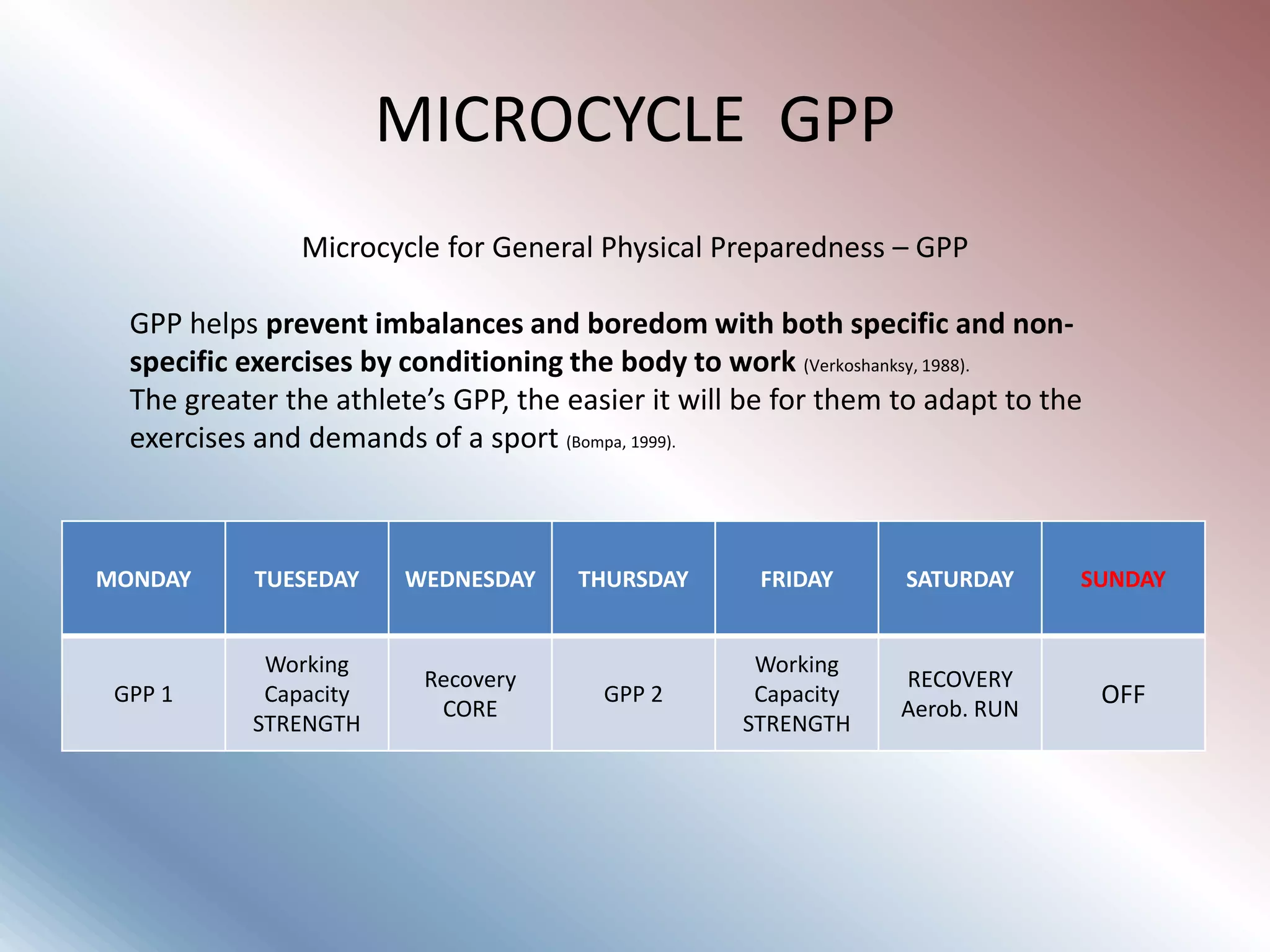
MICROCYCLE GPP
MONDAY TUESEDAY WEDNESDAY THURSDAY FRIDAY SATURDAY SUNDAY
GPP 1
Working
Capacity
STRENGTH
Recovery
CORE
GPP 2
Working
Capacity
STRENGTH
RECOVERY
Aerob. RUN
OFF
Microcycle for General Physical Preparedness – GPP
GPP helps prevent imbalances and boredom with both specific and non-
specific exercises by conditioning the body to work (Verkoshanksy, 1988).
The greater the athlete’s GPP, the easier it will be for them to adapt to the
exercises and demands of a sport (Bompa, 1999).
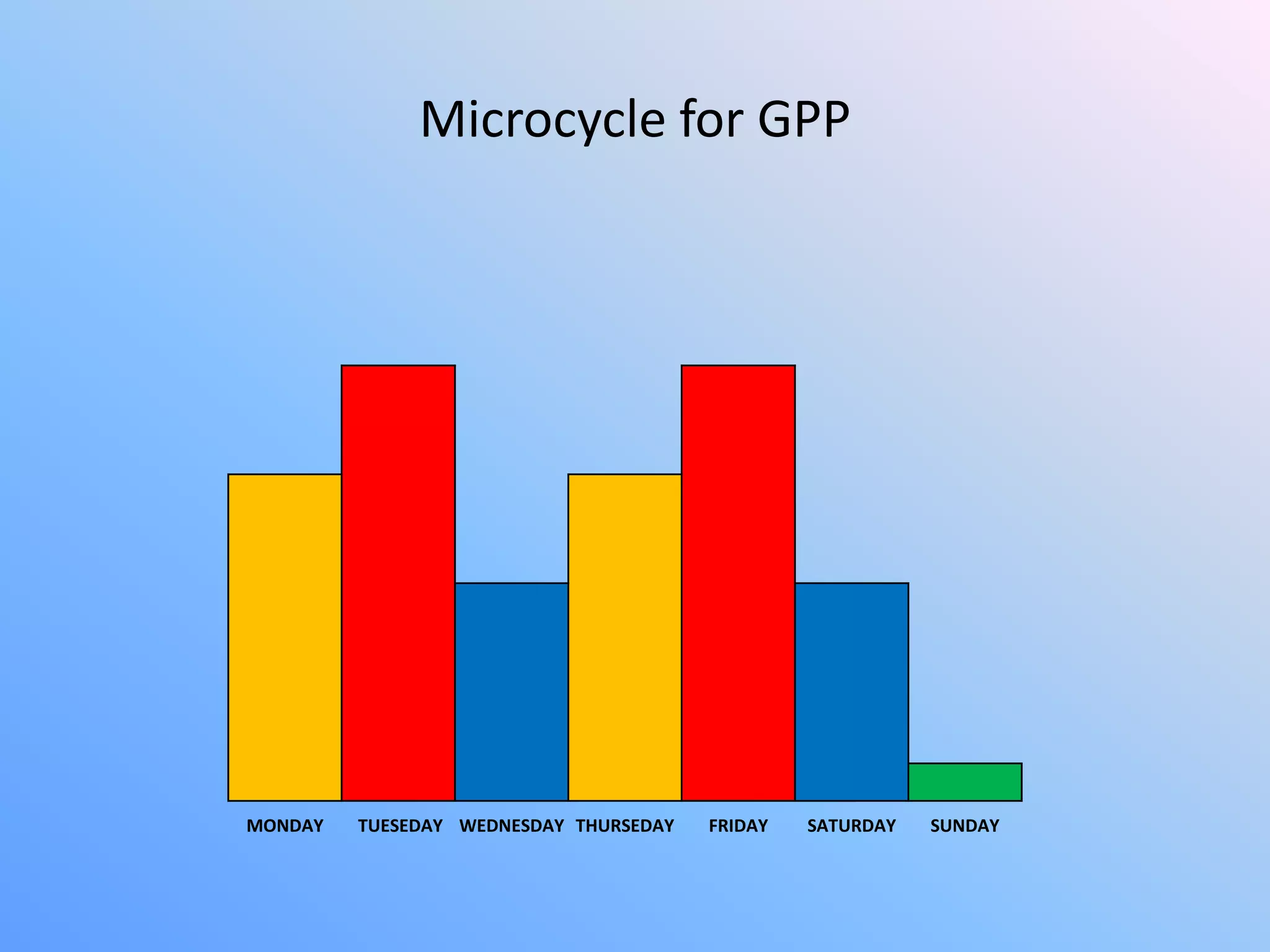
Microcycle for GPP
MONDAY TUESEDAY WEDNESDAY THURSEDAY FRIDAY SATURDAY SUNDAY
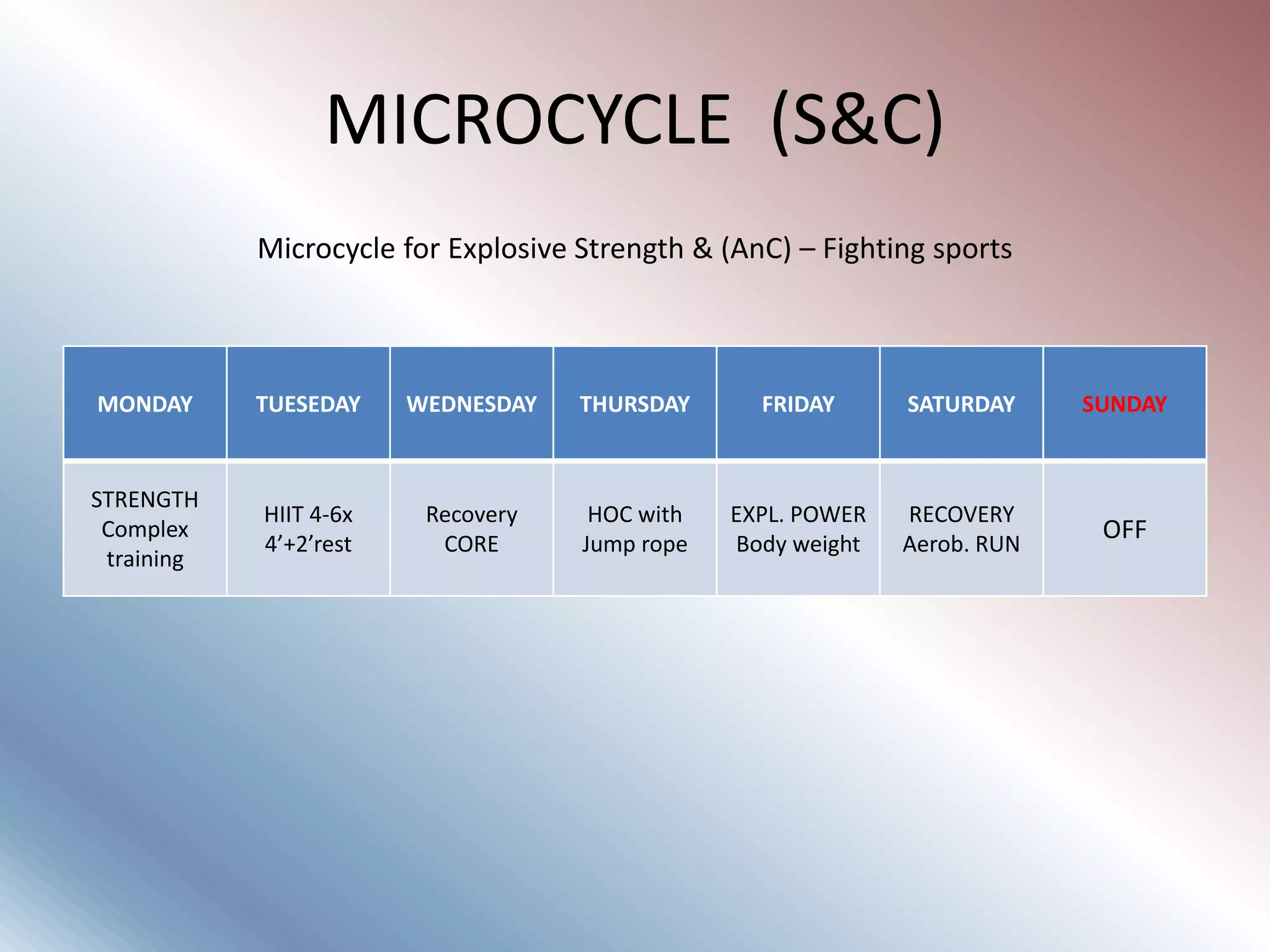
MICROCYCLE (S&C)
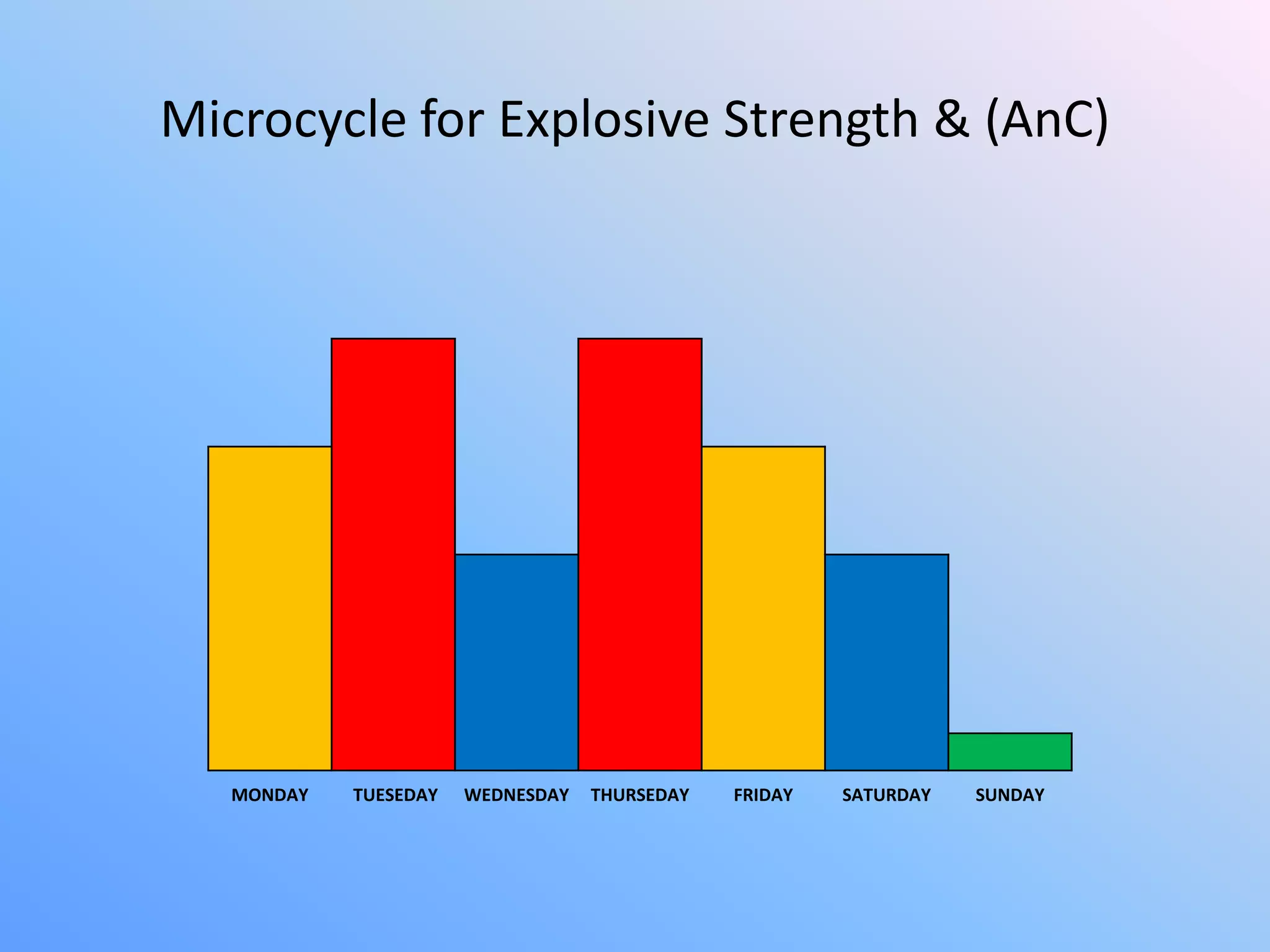
Microcycle for Explosive Strength & (AnC) – Fighting sports
MONDAY TUESEDAY WEDNESDAY THURSDAY FRIDAY SATURDAY SUNDAY
STRENGTH
Complex
training
HIIT 4-6x
4’+2’rest
Recovery
CORE
HOC with
Jump rope
EXPL. POWER
Body weight
RECOVERY
Aerob. RUN
OFF
Microcycle for Explosive Strength & (AnC)
MONDAY TUESEDAY WEDNESDAY THURSEDAY FRIDAY SATURDAY SUNDAY
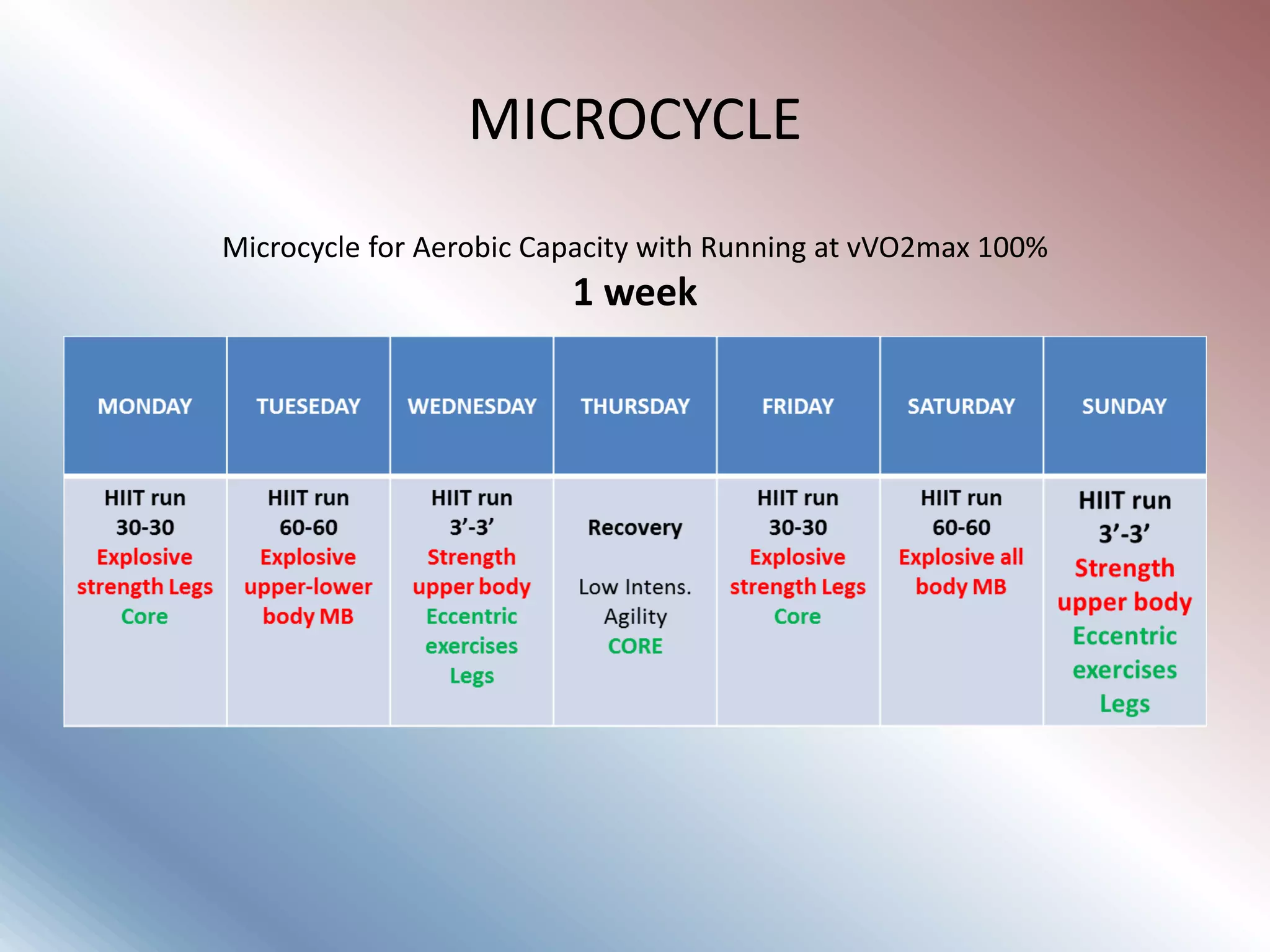
MICROCYCLE
Microcycle for Aerobic Capacity with Running at vVO2max 100%
1 week
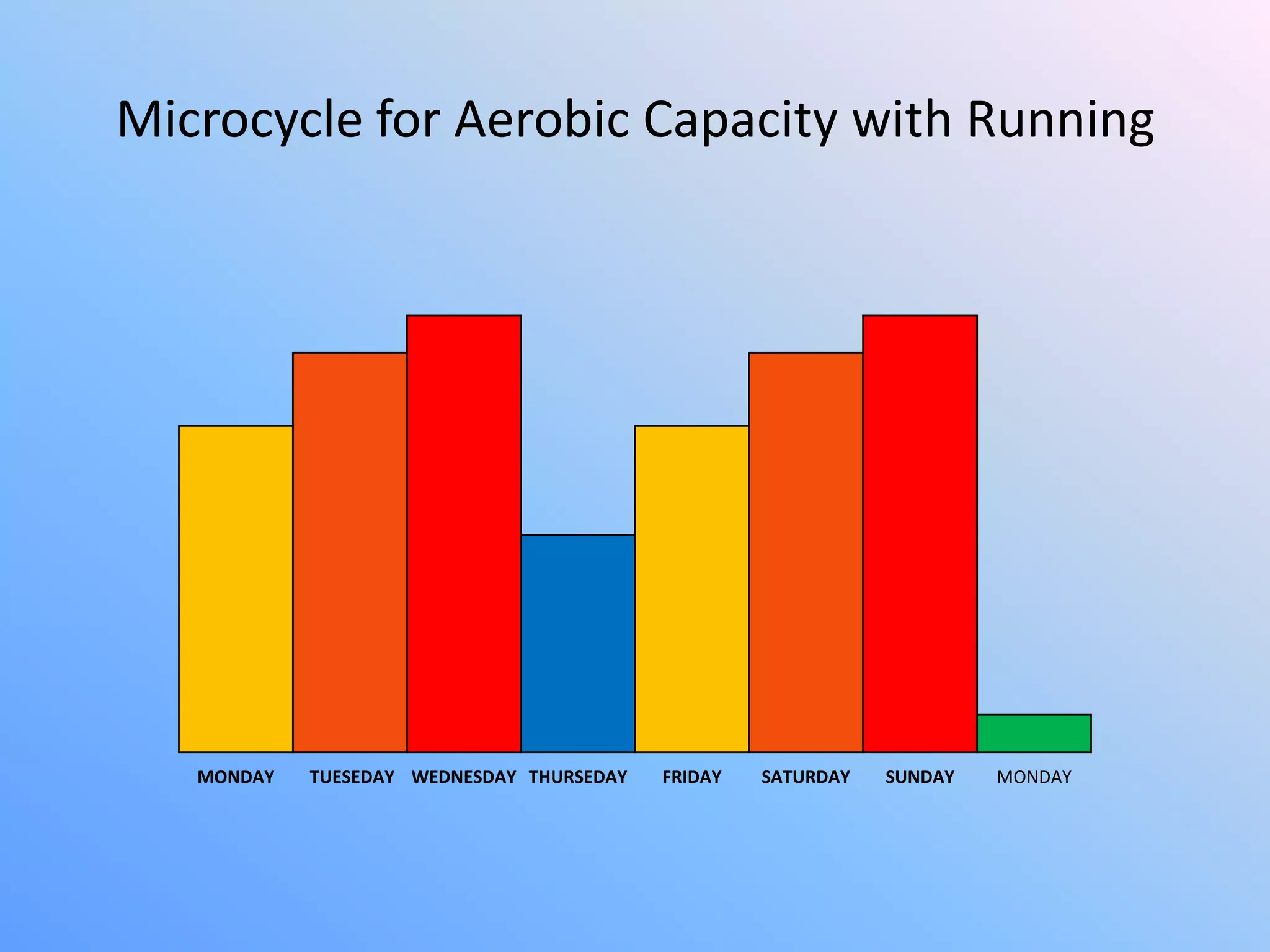
Microcycle for Aerobic Capacity with Running
MONDAY TUESEDAY WEDNESDAY THURSEDAY FRIDAY SATURDAY SUNDAY MONDAY
MICROCYCLE
MONDAY TUESEDAY WEDNESDAY THURSDAY FRIDAY SATURDAY SUNDAY
Sprints
4-6x
30” all out +
4’rest
Interval
30-30 RUN
Strength
complex
Interval RUN
4x4’ or 3x5’
GPP
RECOVERY
CORE
OFF
Microcycle for Aerobic/Anaerobic Capacity
2 & 3 week
MONDAY TUESEDAY WEDNESDAY THURSDAY FRIDAY SATURDAY SUNDAY
Sprints
4-6x
30” all out +
4’rest
Interval
30-30 RUN
Strength GPP 4x4’ RECOVERY
CORE
EXPL.
POWER
OFF
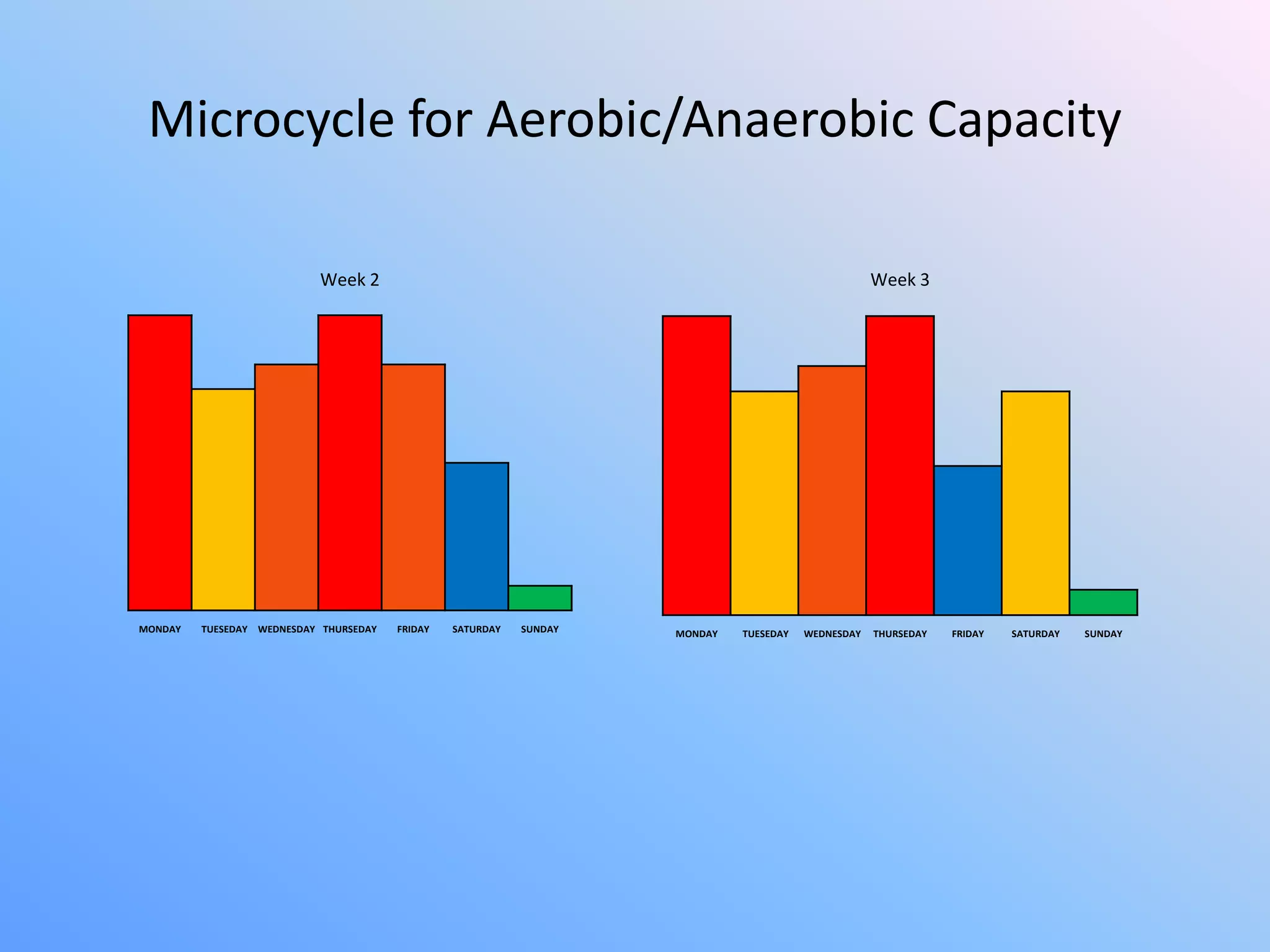
Microcycle for Aerobic/Anaerobic Capacity
Week 2
MONDAY TUESEDAY WEDNESDAY THURSEDAY FRIDAY SATURDAY SUNDAY
Week 3
MONDAY TUESEDAY WEDNESDAY THURSEDAY FRIDAY SATURDAY SUNDAY
MICROCYCLE
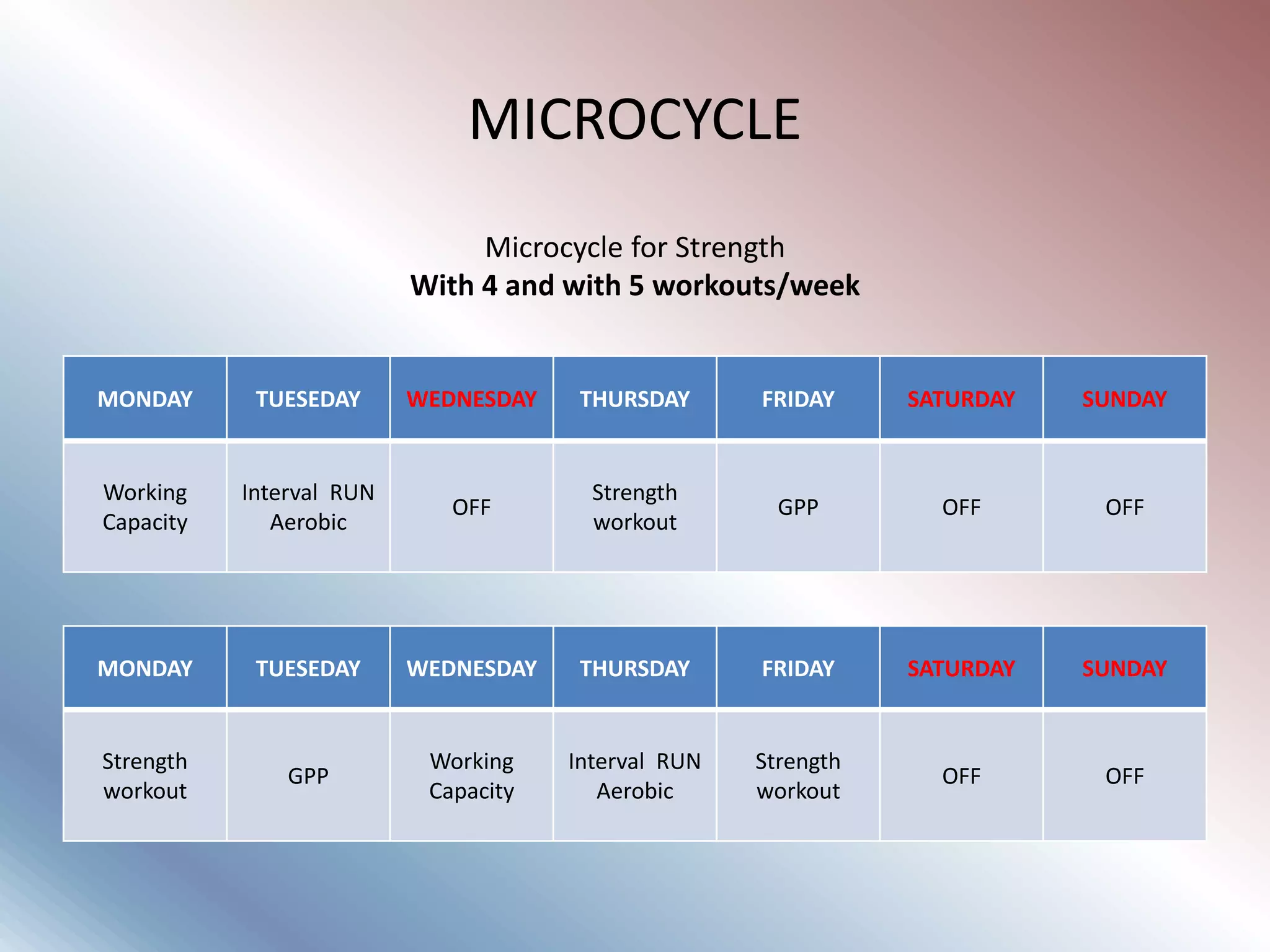
MONDAY TUESEDAY WEDNESDAY THURSDAY FRIDAY SATURDAY SUNDAY
Working
Capacity
Interval RUN
Aerobic
OFF
Strength
workout
GPP OFF OFF
Microcycle for Strength
With 4 and with 5 workouts/week
MONDAY TUESEDAY WEDNESDAY THURSDAY FRIDAY SATURDAY SUNDAY
Strength
workout
GPP
Working
Capacity
Interval RUN
Aerobic
Strength
workout
OFF OFF
MICROCYCLE
HYPOTHETICAL idea of progress / building sports form
SINGLE WORKOUT
Exercises of different training modalities within
the workout
Initial part (after warm-up)
• Maximum speed, maximum strength (neural mechanism), explosive
strength, learning new techno-tactical skills
These exercises demand that the CNS is in an optimal state with full energy
resources
Middle part
• Anaerobic glycolitic power and capacity, maximum aerobic power,
maximum strength (hypertrophy), technique perfection
These exercises can be effectively performed when client is already slightly or
moderately fatigued
Concluding part
• Aerobic endurance, strength endurance, fatigue tolerance of technical
skills
These tasks assume the athlete can sustain increasing fatigue
Coach steps for making Single workout
1.step: get to know what the athletes/clients want
(client wishes)
2.step: get to know what athletes/clients need
(coach observations, tests,..)
3.step: make individualized program
“give the clients what they want so you could give them what they need”
4.step: execute the training program
(observe and communicate with clients to see how they react on exercises
and use this info for correcting the initial program. The program you originally
wrote for clients is never the program you actually do in reality)
5.step: prepare for next practice when ideas and observations
are still fresh
6.step: Importance of Balancing Opposing Movement
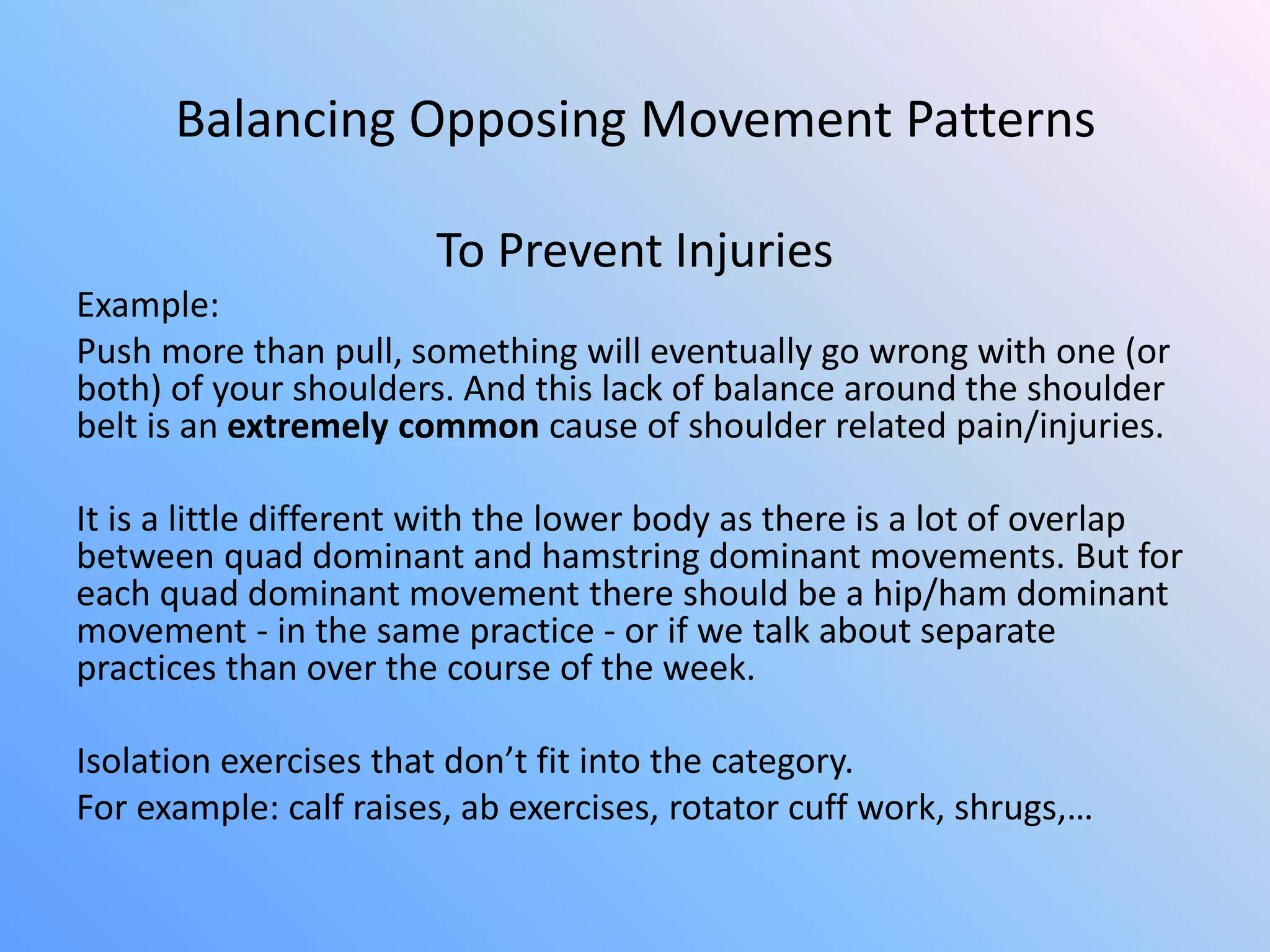
Balancing Opposing Movement Patterns
To Prevent Injuries
Example:
Push more than pull, something will eventually go wrong with one (or
both) of your shoulders. And this lack of balance around the shoulder
belt is an extremely common cause of shoulder related pain/injuries.
It is a little different with the lower body as there is a lot of overlap
between quad dominant and hamstring dominant movements. But for
each quad dominant movement there should be a hip/ham dominant
movement - in the same practice - or if we talk about separate
practices than over the course of the week.
Isolation exercises that don’t fit into the category.
For example: calf raises, ab exercises, rotator cuff work, shrugs,…
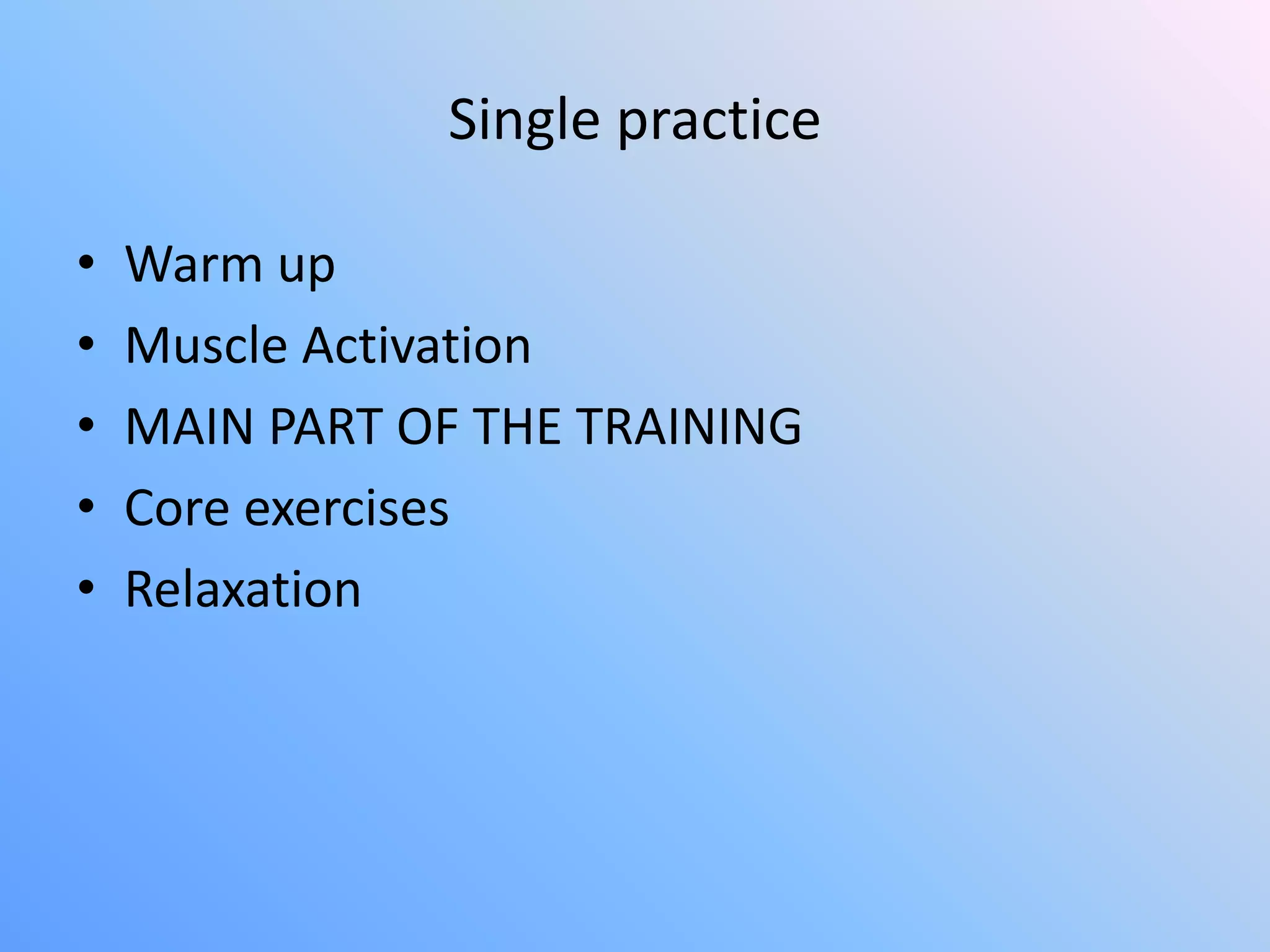
Single practice
• Warm up
• Muscle Activation
• MAIN PART OF THE TRAINING
• Core exercises
• Relaxation
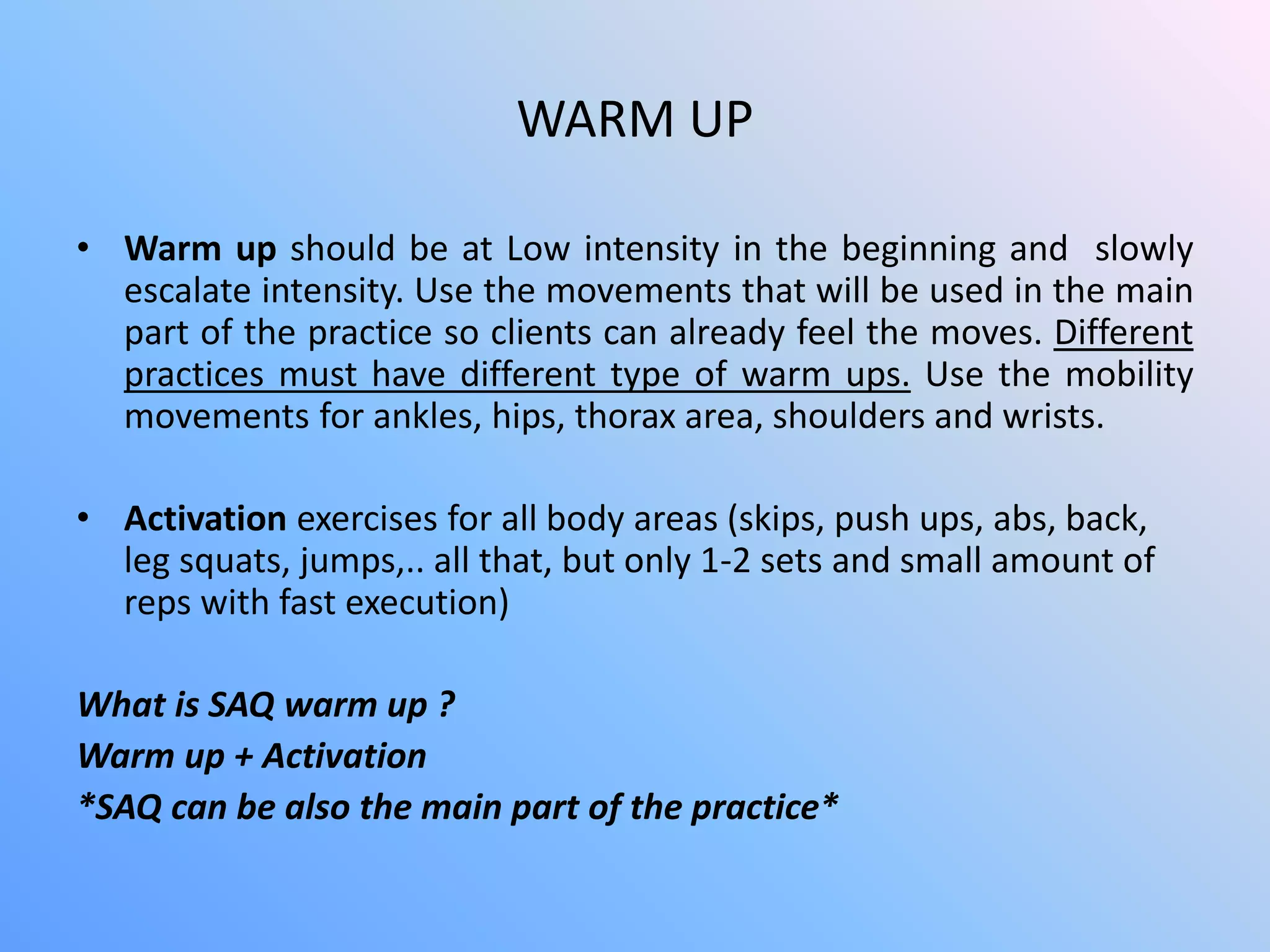
WARM UP
• Warm up should be at Low intensity in the beginning and slowly
escalate intensity. Use the movements that will be used in the main
part of the practice so clients can already feel the moves. Different
practices must have different type of warm ups. Use the mobility
movements for ankles, hips, thorax area, shoulders and wrists.
• Activation exercises for all body areas (skips, push ups, abs, back,
leg squats, jumps,.. all that, but only 1-2 sets and small amount of
reps with fast execution)
What is SAQ warm up ?
Warm up + Activation
*SAQ can be also the main part of the practice*
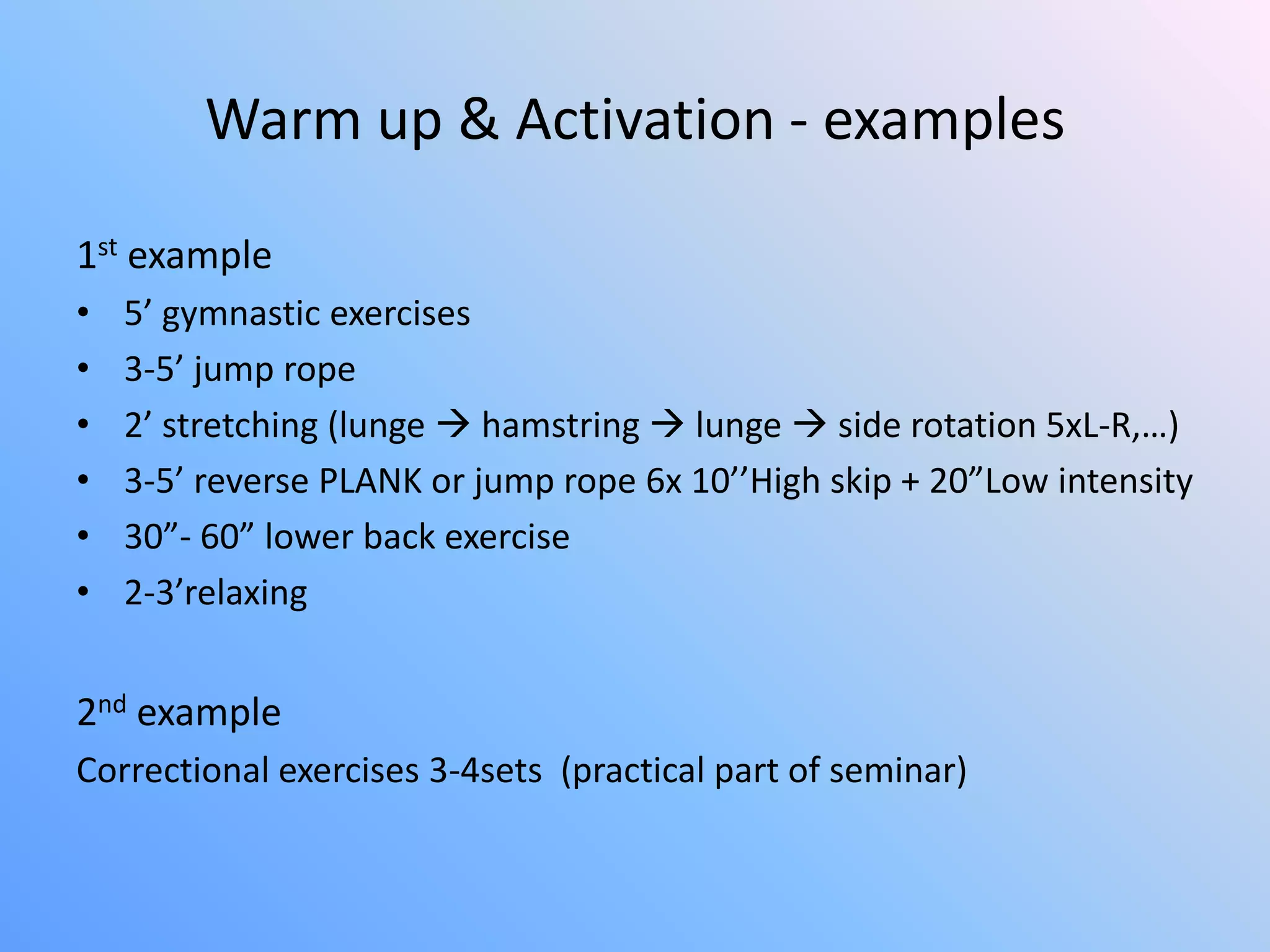
Warm up & Activation - examples
1st example
• 5’ gymnastic exercises
• 3-5’ jump rope
• 2’ stretching (lunge  hamstring  lunge  side rotation 5xL-R,…)
• 3-5’ reverse PLANK or jump rope 6x 10’’High skip + 20”Low intensity
• 30”- 60” lower back exercise
• 2-3’relaxing
2nd example
Correctional exercises 3-4sets (practical part of seminar)
Main part of the practice
• Hypertrophy
• Strength (upper body , lower body, all body)
• Endurance (Aerobic strength, Running, …)
• Speed (SAQ - Acceleration, Deceleration, Changing direction)
• Power
• Core
•
•
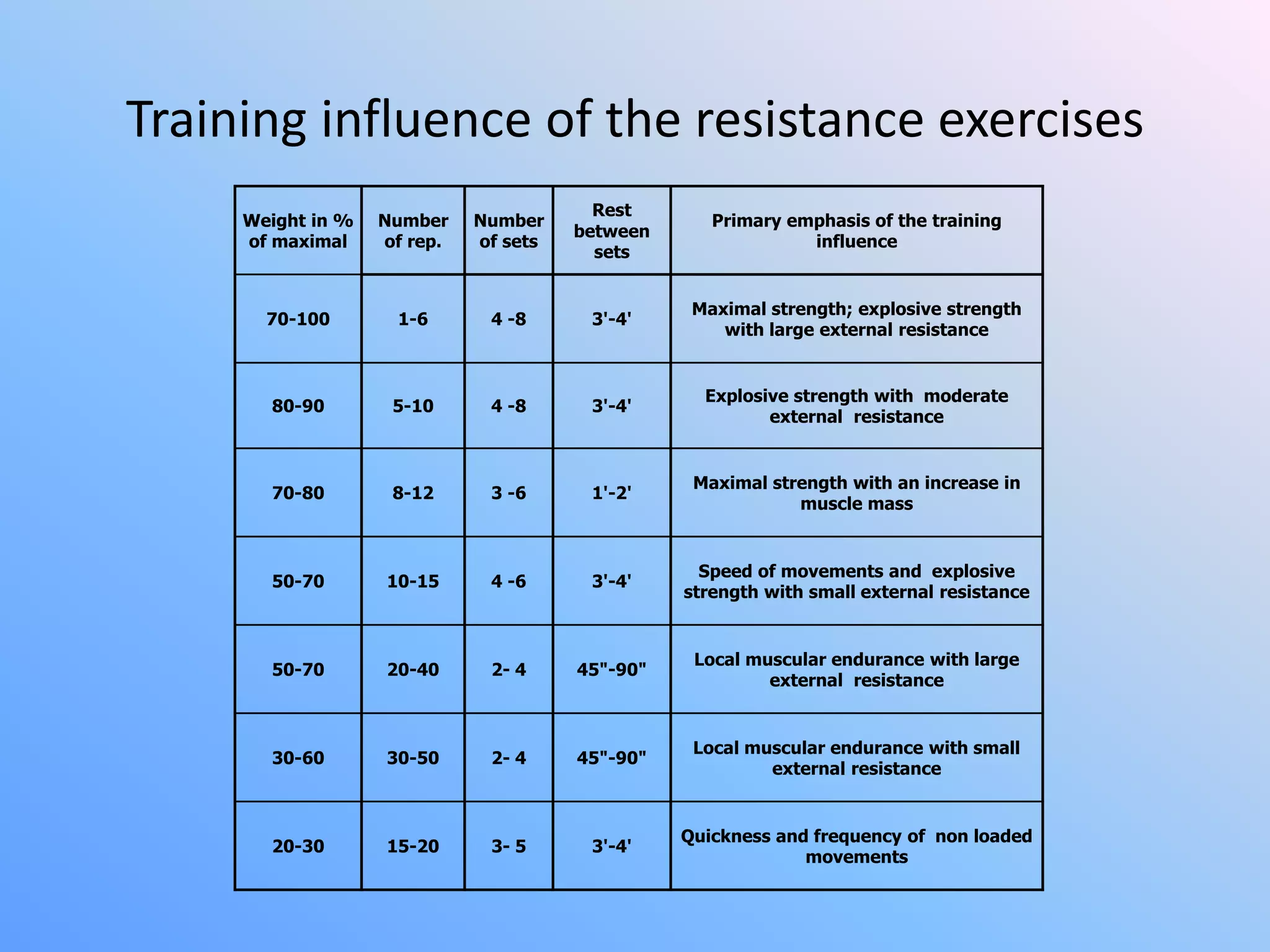
Training influence of the resistance exercises
Weight in %
of maximal
Number
of rep.
Number
of sets
Rest
between
sets
Primary emphasis of the training
influence
70-100 1-6 4 -8 3'-4'
Maximal strength; explosive strength
with large external resistance
80-90 5-10 4 -8 3'-4'
Explosive strength with moderate
external resistance
70-80 8-12 3 -6 1'-2'
Maximal strength with an increase in
muscle mass
50-70 10-15 4 -6 3'-4'
Speed of movements and explosive
strength with small external resistance
50-70 20-40 2- 4 45"-90"
Local muscular endurance with large
external resistance
30-60 30-50 2- 4 45"-90"
Local muscular endurance with small
external resistance
20-30 15-20 3- 5 3'-4'
Quickness and frequency of non loaded
movements
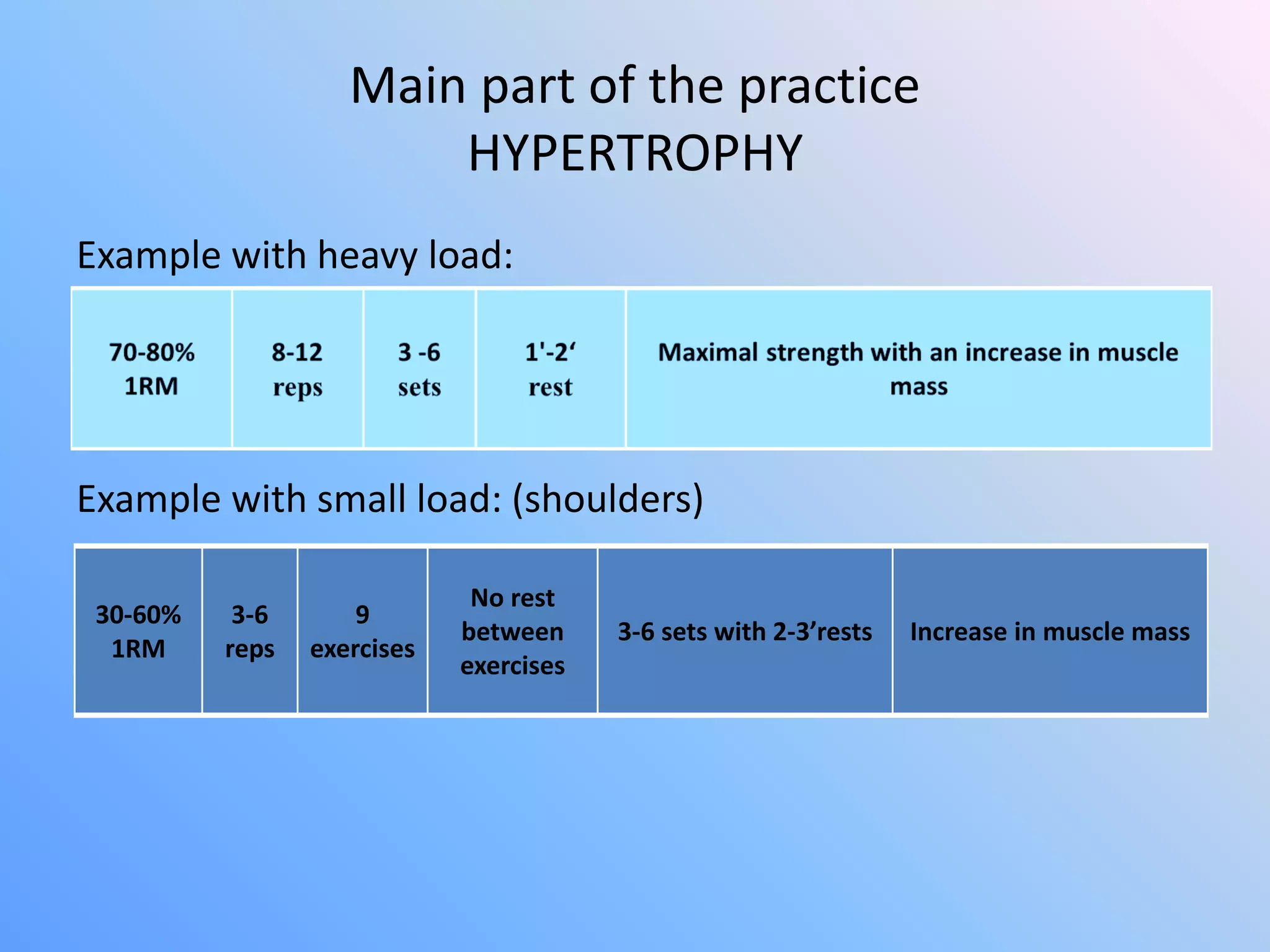
Main part of the practice
HYPERTROPHY
Example with heavy load:
Example with small load: (shoulders)
30-60%
1RM
3-6
reps
9
exercises
No rest
between
exercises
3-6 sets with 2-3’rests Increase in muscle mass
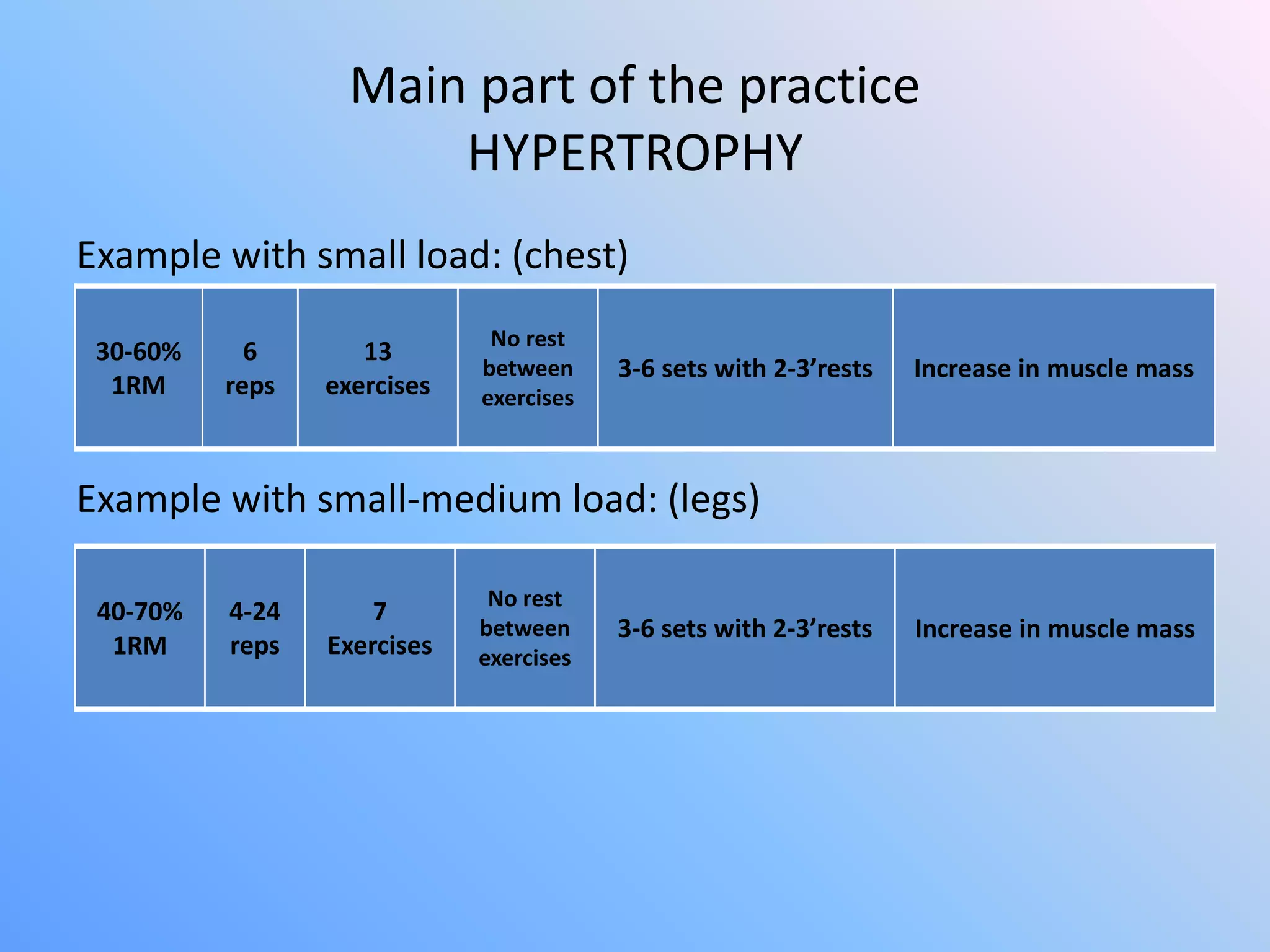
Main part of the practice
HYPERTROPHY
Example with small load: (chest)
Example with small-medium load: (legs)
30-60%
1RM
6
reps
13
exercises
No rest
between
exercises
3-6 sets with 2-3’rests Increase in muscle mass
40-70%
1RM
4-24
reps
7
Exercises
No rest
between
exercises
3-6 sets with 2-3’rests Increase in muscle mass
Time under tension
Goal Aim Speed of lift Rest Reps Rest
HYPERTROPHY
Slow to
moderate
30-180” 8-12 /
Recommendation for
(12 reps)
4 0 1 0
Recommendation for
(8 reps)
6 1 1 0
Eccentric Pause Concentric pause
4” 1” 1” 0”
Tempo read
If for example you have a tempo cadence of:
20-70” of total time under tension per set - for bodybuilding
Main part of the practice
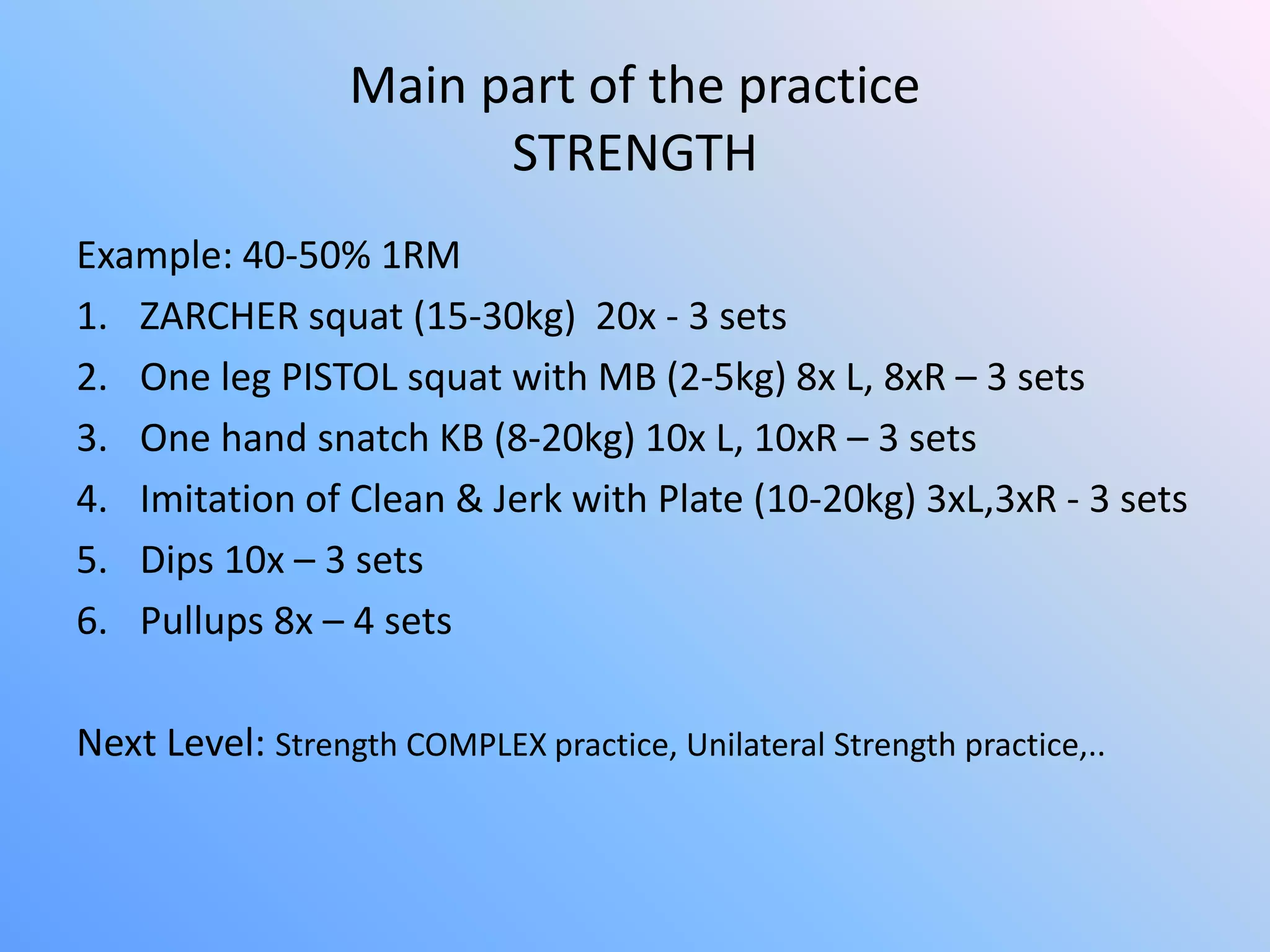
STRENGTH
Example: 40-50% 1RM
1. ZARCHER squat (15-30kg) 20x - 3 sets
2. One leg PISTOL squat with MB (2-5kg) 8x L, 8xR – 3 sets
3. One hand snatch KB (8-20kg) 10x L, 10xR – 3 sets
4. Imitation of Clean & Jerk with Plate (10-20kg) 3xL,3xR - 3 sets
5. Dips 10x – 3 sets
6. Pullups 8x – 4 sets
Next Level: Strength COMPLEX practice, Unilateral Strength practice,..
Main part of the practice
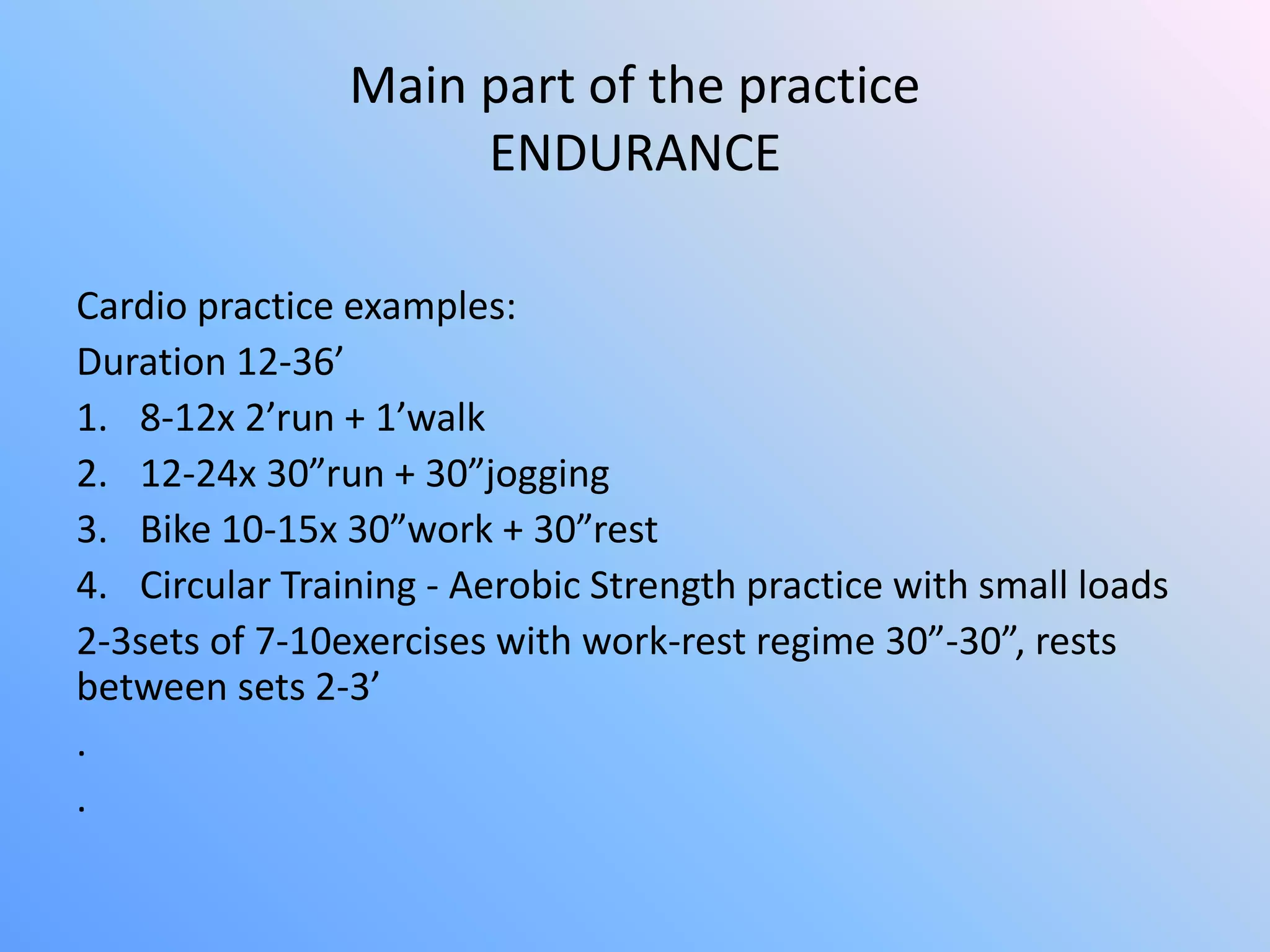
ENDURANCE
Cardio practice examples:
Duration 12-36’
1. 8-12x 2’run + 1’walk
2. 12-24x 30”run + 30”jogging
3. Bike 10-15x 30”work + 30”rest
4. Circular Training - Aerobic Strength practice with small loads
2-3sets of 7-10exercises with work-rest regime 30”-30”, rests
between sets 2-3’
.
.
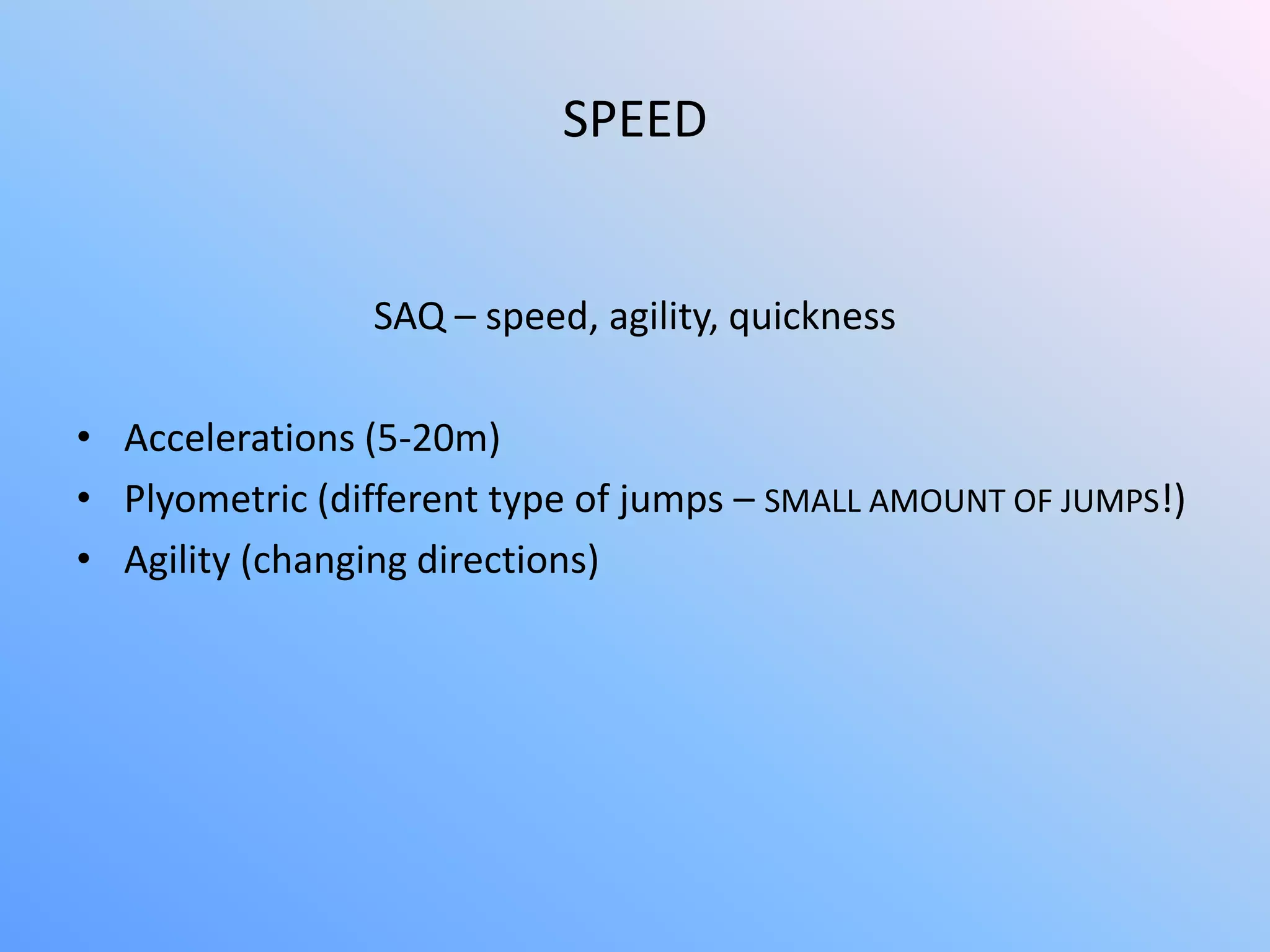
SPEED
SAQ – speed, agility, quickness
• Accelerations (5-20m)
• Plyometric (different type of jumps – SMALL AMOUNT OF JUMPS!)
• Agility (changing directions)
CORE
• MB, Weights, KB, DB
• Machines, benches,..
• Own body, Roller
• Static
• Functional combinations (static, dynamic, rotators stability…)
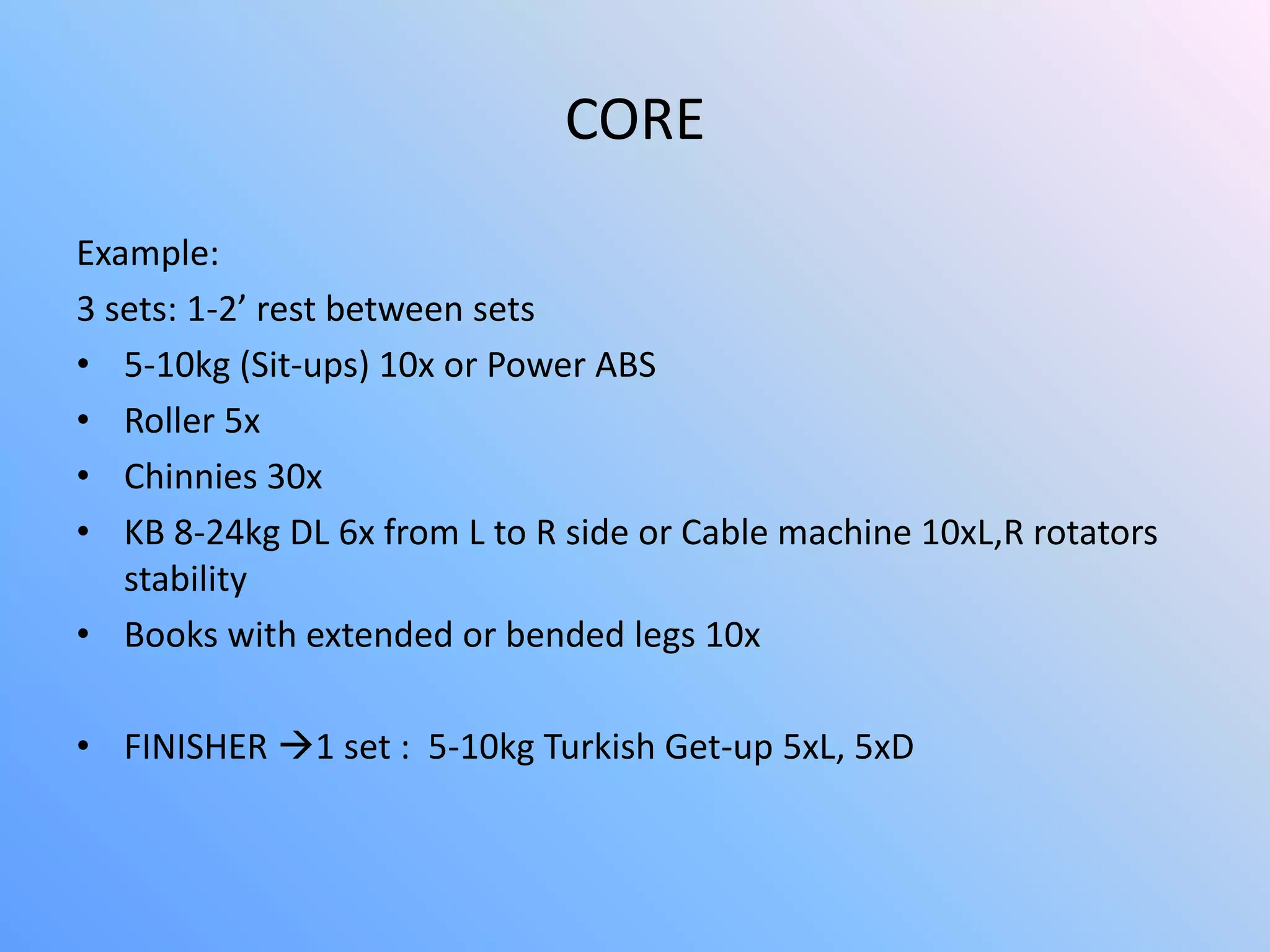
CORE
Example:
3 sets: 1-2’ rest between sets
• 5-10kg (Sit-ups) 10x or Power ABS
• Roller 5x
• Chinnies 30x
• KB 8-24kg DL 6x from L to R side or Cable machine 10xL,R rotators
stability
• Books with extended or bended legs 10x
• FINISHER 1 set : 5-10kg Turkish Get-up 5xL, 5xD
END OF PRACTICE
• Relaxation – Shaking of muscles (Vibrating), massage, rolling
the muscles, stretch all body (special stretch for shoulders and
chest area)
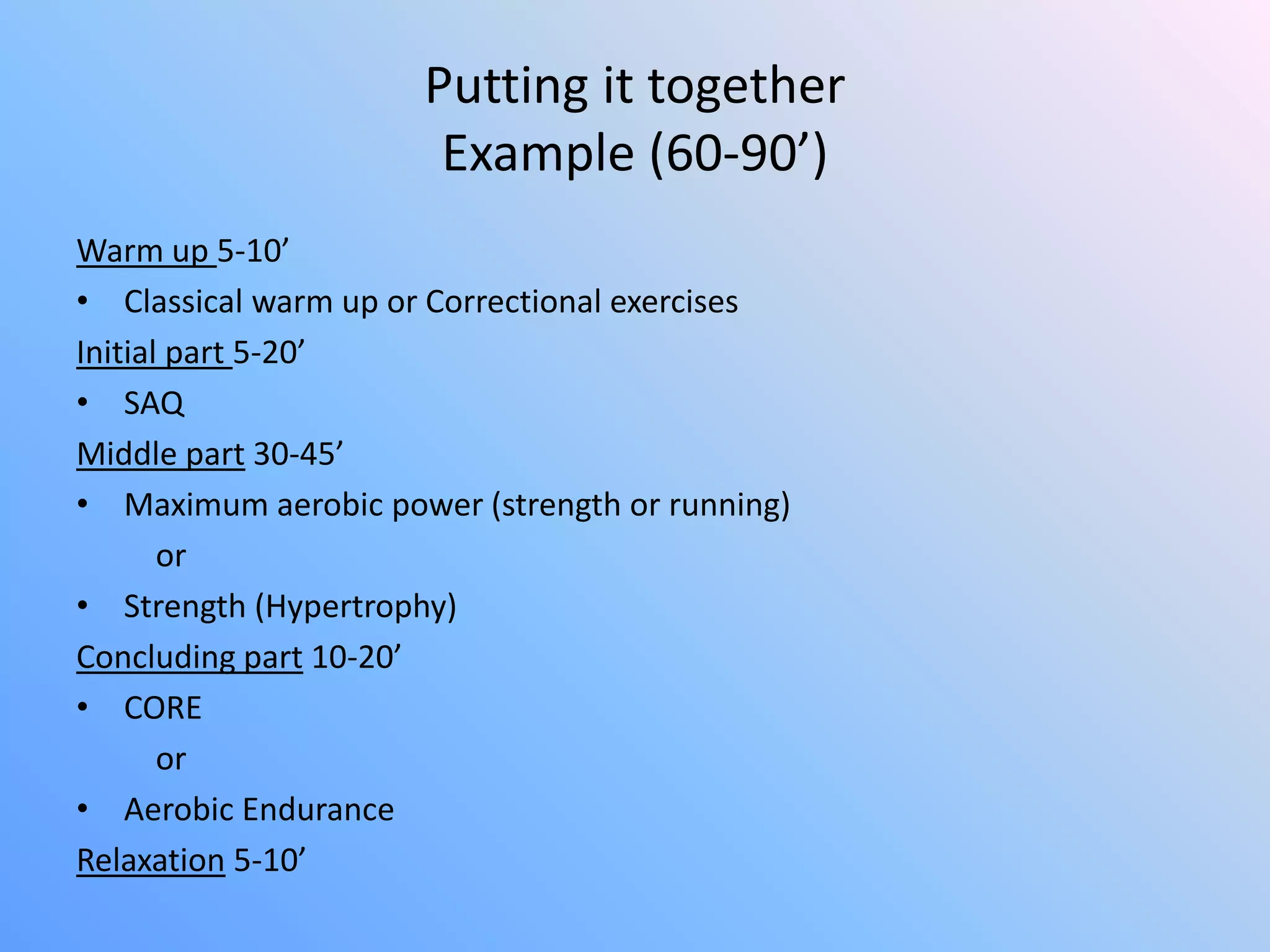
Putting it together
Example (60-90’)
Warm up 5-10’
• Classical warm up or Correctional exercises
Initial part 5-20’
• SAQ
Middle part 30-45’
• Maximum aerobic power (strength or running)
or
• Strength (Hypertrophy)
Concluding part 10-20’
• CORE
or
• Aerobic Endurance
Relaxation 5-10’
MICROCYCLE - SHORT TERM PLANING
by Coach Tomaz Brinec
PRACTICAL

Short term plan microcycle part 2

  • 1.
  • 2.
    MICROCYCLES WITH ONEWORKOUT PER DAY
  • 3.
    MICROCYCLE GPP MONDAY TUESEDAYWEDNESDAY THURSDAY FRIDAY SATURDAY SUNDAY GPP 1 Working Capacity STRENGTH Recovery CORE GPP 2 Working Capacity STRENGTH RECOVERY Aerob. RUN OFF Microcycle for General Physical Preparedness – GPP GPP helps prevent imbalances and boredom with both specific and non- specific exercises by conditioning the body to work (Verkoshanksy, 1988). The greater the athlete’s GPP, the easier it will be for them to adapt to the exercises and demands of a sport (Bompa, 1999).
  • 4.
    Microcycle for GPP MONDAYTUESEDAY WEDNESDAY THURSEDAY FRIDAY SATURDAY SUNDAY
  • 5.
    MICROCYCLE (S&C) Microcycle forExplosive Strength & (AnC) – Fighting sports MONDAY TUESEDAY WEDNESDAY THURSDAY FRIDAY SATURDAY SUNDAY STRENGTH Complex training HIIT 4-6x 4’+2’rest Recovery CORE HOC with Jump rope EXPL. POWER Body weight RECOVERY Aerob. RUN OFF
  • 6.
    Microcycle for ExplosiveStrength & (AnC) MONDAY TUESEDAY WEDNESDAY THURSEDAY FRIDAY SATURDAY SUNDAY
  • 7.
    MICROCYCLE Microcycle for AerobicCapacity with Running at vVO2max 100% 1 week
  • 8.
    Microcycle for AerobicCapacity with Running MONDAY TUESEDAY WEDNESDAY THURSEDAY FRIDAY SATURDAY SUNDAY MONDAY
  • 9.
    MICROCYCLE MONDAY TUESEDAY WEDNESDAYTHURSDAY FRIDAY SATURDAY SUNDAY Sprints 4-6x 30” all out + 4’rest Interval 30-30 RUN Strength complex Interval RUN 4x4’ or 3x5’ GPP RECOVERY CORE OFF Microcycle for Aerobic/Anaerobic Capacity 2 & 3 week MONDAY TUESEDAY WEDNESDAY THURSDAY FRIDAY SATURDAY SUNDAY Sprints 4-6x 30” all out + 4’rest Interval 30-30 RUN Strength GPP 4x4’ RECOVERY CORE EXPL. POWER OFF
  • 10.
    Microcycle for Aerobic/AnaerobicCapacity Week 2 MONDAY TUESEDAY WEDNESDAY THURSEDAY FRIDAY SATURDAY SUNDAY Week 3 MONDAY TUESEDAY WEDNESDAY THURSEDAY FRIDAY SATURDAY SUNDAY
  • 11.
    MICROCYCLE MONDAY TUESEDAY WEDNESDAYTHURSDAY FRIDAY SATURDAY SUNDAY Working Capacity Interval RUN Aerobic OFF Strength workout GPP OFF OFF Microcycle for Strength With 4 and with 5 workouts/week MONDAY TUESEDAY WEDNESDAY THURSDAY FRIDAY SATURDAY SUNDAY Strength workout GPP Working Capacity Interval RUN Aerobic Strength workout OFF OFF
  • 12.
    MICROCYCLE HYPOTHETICAL idea ofprogress / building sports form
  • 13.
  • 14.
    Exercises of differenttraining modalities within the workout Initial part (after warm-up) • Maximum speed, maximum strength (neural mechanism), explosive strength, learning new techno-tactical skills These exercises demand that the CNS is in an optimal state with full energy resources Middle part • Anaerobic glycolitic power and capacity, maximum aerobic power, maximum strength (hypertrophy), technique perfection These exercises can be effectively performed when client is already slightly or moderately fatigued Concluding part • Aerobic endurance, strength endurance, fatigue tolerance of technical skills These tasks assume the athlete can sustain increasing fatigue
  • 15.
    Coach steps formaking Single workout 1.step: get to know what the athletes/clients want (client wishes) 2.step: get to know what athletes/clients need (coach observations, tests,..) 3.step: make individualized program “give the clients what they want so you could give them what they need” 4.step: execute the training program (observe and communicate with clients to see how they react on exercises and use this info for correcting the initial program. The program you originally wrote for clients is never the program you actually do in reality) 5.step: prepare for next practice when ideas and observations are still fresh 6.step: Importance of Balancing Opposing Movement
  • 16.
    Balancing Opposing MovementPatterns To Prevent Injuries Example: Push more than pull, something will eventually go wrong with one (or both) of your shoulders. And this lack of balance around the shoulder belt is an extremely common cause of shoulder related pain/injuries. It is a little different with the lower body as there is a lot of overlap between quad dominant and hamstring dominant movements. But for each quad dominant movement there should be a hip/ham dominant movement - in the same practice - or if we talk about separate practices than over the course of the week. Isolation exercises that don’t fit into the category. For example: calf raises, ab exercises, rotator cuff work, shrugs,…
  • 17.
    Single practice • Warmup • Muscle Activation • MAIN PART OF THE TRAINING • Core exercises • Relaxation
  • 18.
    WARM UP • Warmup should be at Low intensity in the beginning and slowly escalate intensity. Use the movements that will be used in the main part of the practice so clients can already feel the moves. Different practices must have different type of warm ups. Use the mobility movements for ankles, hips, thorax area, shoulders and wrists. • Activation exercises for all body areas (skips, push ups, abs, back, leg squats, jumps,.. all that, but only 1-2 sets and small amount of reps with fast execution) What is SAQ warm up ? Warm up + Activation *SAQ can be also the main part of the practice*
  • 19.
    Warm up &Activation - examples 1st example • 5’ gymnastic exercises • 3-5’ jump rope • 2’ stretching (lunge  hamstring  lunge  side rotation 5xL-R,…) • 3-5’ reverse PLANK or jump rope 6x 10’’High skip + 20”Low intensity • 30”- 60” lower back exercise • 2-3’relaxing 2nd example Correctional exercises 3-4sets (practical part of seminar)
  • 20.
    Main part ofthe practice • Hypertrophy • Strength (upper body , lower body, all body) • Endurance (Aerobic strength, Running, …) • Speed (SAQ - Acceleration, Deceleration, Changing direction) • Power • Core • •
  • 21.
    Training influence ofthe resistance exercises Weight in % of maximal Number of rep. Number of sets Rest between sets Primary emphasis of the training influence 70-100 1-6 4 -8 3'-4' Maximal strength; explosive strength with large external resistance 80-90 5-10 4 -8 3'-4' Explosive strength with moderate external resistance 70-80 8-12 3 -6 1'-2' Maximal strength with an increase in muscle mass 50-70 10-15 4 -6 3'-4' Speed of movements and explosive strength with small external resistance 50-70 20-40 2- 4 45"-90" Local muscular endurance with large external resistance 30-60 30-50 2- 4 45"-90" Local muscular endurance with small external resistance 20-30 15-20 3- 5 3'-4' Quickness and frequency of non loaded movements
  • 22.
    Main part ofthe practice HYPERTROPHY Example with heavy load: Example with small load: (shoulders) 30-60% 1RM 3-6 reps 9 exercises No rest between exercises 3-6 sets with 2-3’rests Increase in muscle mass
  • 23.
    Main part ofthe practice HYPERTROPHY Example with small load: (chest) Example with small-medium load: (legs) 30-60% 1RM 6 reps 13 exercises No rest between exercises 3-6 sets with 2-3’rests Increase in muscle mass 40-70% 1RM 4-24 reps 7 Exercises No rest between exercises 3-6 sets with 2-3’rests Increase in muscle mass
  • 24.
    Time under tension GoalAim Speed of lift Rest Reps Rest HYPERTROPHY Slow to moderate 30-180” 8-12 / Recommendation for (12 reps) 4 0 1 0 Recommendation for (8 reps) 6 1 1 0 Eccentric Pause Concentric pause 4” 1” 1” 0” Tempo read If for example you have a tempo cadence of: 20-70” of total time under tension per set - for bodybuilding
  • 25.
    Main part ofthe practice STRENGTH Example: 40-50% 1RM 1. ZARCHER squat (15-30kg) 20x - 3 sets 2. One leg PISTOL squat with MB (2-5kg) 8x L, 8xR – 3 sets 3. One hand snatch KB (8-20kg) 10x L, 10xR – 3 sets 4. Imitation of Clean & Jerk with Plate (10-20kg) 3xL,3xR - 3 sets 5. Dips 10x – 3 sets 6. Pullups 8x – 4 sets Next Level: Strength COMPLEX practice, Unilateral Strength practice,..
  • 26.
    Main part ofthe practice ENDURANCE Cardio practice examples: Duration 12-36’ 1. 8-12x 2’run + 1’walk 2. 12-24x 30”run + 30”jogging 3. Bike 10-15x 30”work + 30”rest 4. Circular Training - Aerobic Strength practice with small loads 2-3sets of 7-10exercises with work-rest regime 30”-30”, rests between sets 2-3’ . .
  • 27.
    SPEED SAQ – speed,agility, quickness • Accelerations (5-20m) • Plyometric (different type of jumps – SMALL AMOUNT OF JUMPS!) • Agility (changing directions)
  • 28.
    CORE • MB, Weights,KB, DB • Machines, benches,.. • Own body, Roller • Static • Functional combinations (static, dynamic, rotators stability…)
  • 29.
    CORE Example: 3 sets: 1-2’rest between sets • 5-10kg (Sit-ups) 10x or Power ABS • Roller 5x • Chinnies 30x • KB 8-24kg DL 6x from L to R side or Cable machine 10xL,R rotators stability • Books with extended or bended legs 10x • FINISHER 1 set : 5-10kg Turkish Get-up 5xL, 5xD
  • 30.
    END OF PRACTICE •Relaxation – Shaking of muscles (Vibrating), massage, rolling the muscles, stretch all body (special stretch for shoulders and chest area)
  • 31.
    Putting it together Example(60-90’) Warm up 5-10’ • Classical warm up or Correctional exercises Initial part 5-20’ • SAQ Middle part 30-45’ • Maximum aerobic power (strength or running) or • Strength (Hypertrophy) Concluding part 10-20’ • CORE or • Aerobic Endurance Relaxation 5-10’
  • 33.
    MICROCYCLE - SHORTTERM PLANING by Coach Tomaz Brinec
  • 34.