Proceedings of the 2nd International Conference on Current Trends in Engineering and Management ICCTEM -2014 
INTERNATIONAL JOURNAL OF ELECTRONICS AND 
17 – 19, July 2014, Mysore, Karnataka, India 
COMMUNICATION ENGINEERING  TECHNOLOGY (IJECET) 
ISSN 0976 – 6464(Print) 
ISSN 0976 – 6472(Online) 
Volume 5, Issue 8, August (2014), pp. 132-138 
© IAEME: http://www.iaeme.com/IJECET.asp 
Journal Impact Factor (2014): 7.2836 (Calculated by GISI) 
www.jifactor.com 
IJECET 
© I A E M E 
SHOPPING AND AUTOMATIC BILLING USING RFID TECHNOLOGY 
Vinutha M L1, Harshitha P Bale2, Sushma R3, Suchitra M4 
1,2,3B.E 8th sem students, ECE, 
4Associate Professor 
Vidyavardhaka College of Engineering, Mysore, Karnataka, INDIA 
132 
ABSTRACT 
Nowadays, large grocery stores are used by millions of people for the acquisition of products. 
Barcode scanners are a time consuming process engaging the customers to stick to the billing section 
for a long time. Hence there is a need for an innovative product with the societal acceptance that aids 
the convenience, comfort and efficiency in everyday life. 
In this paper, an architecture is presented which blends Radio frequency identification 
(RFID) and wireless technology to provide ‘on spot’ billing in super markets. It uses the RFID based 
system application in the shopping trolley and the RFID card which is used as a security access for 
the product. The Liquid crystal display (LCD) that is fixed to the trolley displays the product name, 
cost and the total cost of all purchased products. The bill is transmitted to the server end through the 
zigbee technology. The software simulation is done using Proteus software and hardware is 
implemented using 18F46K22 microcontroller. This promotes quick shopping and immediate pay 
without any queuing process. It reduces labour efforts and increases efficiency by minimizing errors. 
Keywords: RFID Tags, RFID Reader, Zigbee Technology, 18F46K22 Microcontroller. 
1. INTRODUCTION 
In recent years a deep structural change has occurred, with consequences on economic 
growth and society, especially in factors such as territorial occupation, urbanization, openness to 
global markets, demography, family structures and cultural and consuming patterns. Innovation in 
communication and information technologies has caused a revolution in values, knowledge and 
perceptions in all areas. The grocery industry sector is nowadays extremely important in worldwide 
economy, with its recent evolution in technological, political, social and economic terms making it 
one of the most convenient and diverse businesses across the globe. 
The challenges and opportunities created by electronic business have caused the sharing of 
information between business partners to improve operational performance, consumer service and
Proceedings of the 2nd International Conference on Current Trends in Engineering and Management ICCTEM -2014 
17 – 19, July 2014, Mysore, Karnataka, India 
solution development. The emergence of new technologies, such as Radio Frequency Identification 
(RFID) and wireless networks, makes the traditional retail processes faster, transparent and efficient. 
The main objective of proposed system is to provide a technology oriented, low-cost, easily 
scalable RFID system for shopping. The objective of this project is to improve the speed of 
purchase by using RFID. This project is designed to use the security system application in the 
shopping trolley. If the product is put into the trolley then it will display the amount and also 
the total amount. RFID card is used for accessing of the products. So this project improves the 
security performance and also the speed. 
133 
2. LITERATURE SURVEY 
Bichlien Hoang, Ashley Caudill[1] and Mandeep Kaur, Manjeet Sandhu, Neeraj Mohan, 
Parvinder S.Sandhu[2] have discussed briefly about Radio frequency identification technology 
(RFID) i.e. its working principle, standards and the areas where it can be applied based on its 
advantages. 
P. Rohitha, P. RanjeetKumar, Prof.N. Adinarayana, Prof.T. Venkat Narayana Rao[3] and 
Dr.S.S.Riaz Ahmed[4] has described about Zigbee technology, its applications, characteristics, 
different types of Zigbee topologies, traffic types, architecture, frame structure and device types. 
Ankit Anil Agarwal (Corresponding Author), Saurabh Kumar Sultania, Gaurav Jaiswal and 
Prateek Jain[5], Diana S.S.Santos, Antonio M.J Pereira and Ramiro M.R.M. Goncalves[6] have 
presented the proposal of an architecture and solution of an innovative system for acquisition of 
products in grocery stores. S. Raghupathi and V. Karthikeyan[7] have implemented the architecture 
for automatic billing using Context Aware Shopping Trolley (CAST) technology. Darren Black, Nils 
Jakob Clemmensen and Mikael B. Skov [8] have described about the advantages and disadvantages 
caused through the usage of CAST technology. Zeeshan Ali, Reena Sonkusare [9] have developed 
system comprises of Cart location detection unit (CLDU), Server Communication unit (SCU), User 
Interface and display unit (UIDU) and Billing and Inventory management unit (BIMU). 
These issues will have to be resolved specifically with respect to billing to promote consumer 
confidence. Further, a more sophisticated micro-controller and larger display system can be used to 
provide better consumer experience. 
3. SYSTEM METHODOLOGY 
This section deals with the system architecture of billing using radio frequency identification 
and zigbee technology. 
3.1 Block Diagram 
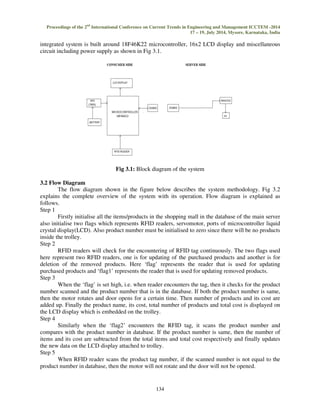
In the development and discussion of the proposed shopping trolley, all the product 
information is stored in a database at a main server. RFID tags are used to uniquely identify 
products. 
As the products are selected and added into the cast, the RFID reader will identify the product 
and the price will be displayed on the LCD display. If the customer chooses to drop a selected 
product, another RFID reader which is at the outlet side of the trolley identifies the product and its 
price will be deducted from the total price and the value will be displayed on the LCD display. 
After the completion of the shopping the customer has to press the ‘complete’ button. This 
enables the total bill being generated after confirmed purchase of all the selected products in the 
shopping trolley. At the same time, this information is sent to the database server through the 
wireless zigbee unit. The server database is then updated to reflect the existing stock available after 
deducting the number of products purchased. This ensures a smooth inventory management. The
Proceedings of the 2nd International Conference on Current Trends in Engineering and Management ICCTEM -2014 
17 – 19, July 2014, Mysore, Karnataka, India 
integrated system is built around 18F46K22 microcontroller, 16x2 LCD display and miscellaneous 
circuit including power supply as shown in Fig 3.1. 
Fig 3.1: Block diagram of the system 
134 
3.2 Flow Diagram 
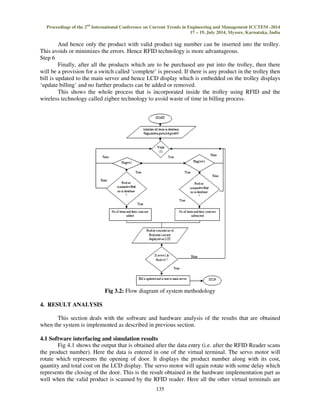
The flow diagram shown in the figure below describes the system methodology. Fig 3.2 
explains the complete overview of the system with its operation. Flow diagram is explained as 
follows. 
Step 1 
Firstly initialise all the items/products in the shopping mall in the database of the main server 
also initialise two flags which represents RFID readers, servomotor, ports of microcontroller liquid 
crystal display(LCD). Also product number must be initialised to zero since there will be no products 
inside the trolley. 
Step 2 
RFID readers will check for the encountering of RFID tag continuously. The two flags used 
here represent two RFID readers, one is for updating of the purchased products and another is for 
deletion of the removed products. Here ‘flag’ represents the reader that is used for updating 
purchased products and ‘flag1’ represents the reader that is used for updating removed products. 
Step 3 
When the ‘flag’ is set high, i.e. when reader encounters the tag, then it checks for the product 
number scanned and the product number that is in the database. If both the product number is same, 
then the motor rotates and door opens for a certain time. Then number of products and its cost are 
added up. Finally the product name, its cost, total number of products and total cost is displayed on 
the LCD display which is embedded on the trolley. 
Step 4 
Similarly when the ‘flag2’ encounters the RFID tag, it scans the product number and 
compares with the product number in database. If the product number is same, then the number of 
items and its cost are subtracted from the total items and total cost respectively and finally updates 
the new data on the LCD display attached to trolley. 
Step 5 
When RFID reader scans the product tag number, if the scanned number is not equal to the 
product number in database, then the motor will not rotate and the door will not be opened.
Proceedings of the 2nd International Conference on Current Trends in Engineering and Management ICCTEM -2014 
17 – 19, July 2014, Mysore, Karnataka, India 
And hence only the product with valid product tag number can be inserted into the trolley. 
This avoids or minimizes the errors. Hence RFID technology is more advantageous. 
Step 6 
Finally, after all the products which are to be purchased are put into the trolley, then there 
will be a provision for a switch called ‘complete’ is pressed. If there is any product in the trolley then 
bill is updated to the main server and hence LCD display which is embedded on the trolley displays 
‘update billing’ and no further products can be added or removed. 
This shows the whole process that is incorporated inside the trolley using RFID and the 
wireless technology called zigbee technology to avoid waste of time in billing process. 
Fig 3.2: Flow diagram of system methodology 
135 
4. RESULT ANALYSIS 
This section deals with the software and hardware analysis of the results that are obtained 
when the system is implemented as described in previous section. 
4.1 Software interfacing and simulation results 
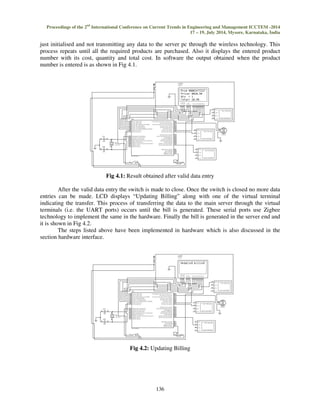
Fig 4.1 shows the output that is obtained after the data entry (i.e. after the RFID Reader scans 
the product number). Here the data is entered in one of the virtual terminal. The servo motor will 
rotate which represents the opening of door. It displays the product number along with its cost, 
quantity and total cost on the LCD display. The servo motor will again rotate with some delay which 
represents the closing of the door. This is the result obtained in the hardware implementation part as 
well when the valid product is scanned by the RFID reader. Here all the other virtual terminals are
Proceedings of the 2nd International Conference on Current Trends in Engineering and Management ICCTEM -2014 
17 – 19, July 2014, Mysore, Karnataka, India 
just initialised and not transmitting any data to the server pc through the wireless technology. This 
process repeats until all the required products are purchased. Also it displays the entered product 
number with its cost, quantity and total cost. In software the output obtained when the product 
number is entered is as shown in Fig 4.1. 
Fig 4.1: Result obtained after valid data entry 
After the valid data entry the switch is made to close. Once the switch is closed no more data 
entries can be made. LCD displays “Updating Billing” along with one of the virtual terminal 
indicating the transfer. This process of transferring the data to the main server through the virtual 
terminals (i.e. the UART ports) occurs until the bill is generated. These serial ports use Zigbee 
technology to implement the same in the hardware. Finally the bill is generated in the server end and 
it is shown in Fig 4.2. 
The steps listed above have been implemented in hardware which is also discussed in the 
136 
section hardware interface. 
Fig 4.2: Updating Billing
Proceedings of the 2nd International Conference on Current Trends in Engineering and Management ICCTEM -2014 
17 – 19, July 2014, Mysore, Karnataka, India 
4.2 Hardware Interface and simulation results 
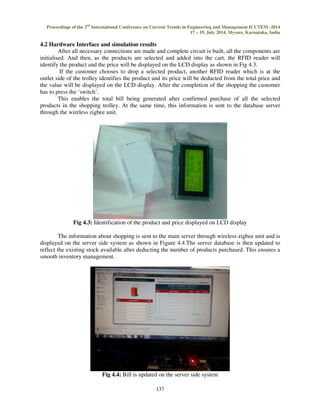
After all necessary connections are made and complete circuit is built, all the components are 
initialised. And then, as the products are selected and added into the cart, the RFID reader will 
identify the product and the price will be displayed on the LCD display as shown in Fig 4.3. 
If the customer chooses to drop a selected product, another RFID reader which is at the 
outlet side of the trolley identifies the product and its price will be deducted from the total price and 
the value will be displayed on the LCD display. After the completion of the shopping the customer 
has to press the ‘switch’. 
This enables the total bill being generated after confirmed purchase of all the selected 
products in the shopping trolley. At the same time, this information is sent to the database server 
through the wireless zigbee unit. 
Fig 4.3: Identification of the product and price displayed on LCD display 
The information about shopping is sent to the main server through wireless zigbee unit and is 
displayed on the server side system as shown in Figure 4.4.The server database is then updated to 
reflect the existing stock available after deducting the number of products purchased. This ensures a 
smooth inventory management. 
Fig 4.4: Bill is updated on the server side system 
137
Proceedings of the 2nd International Conference on Current Trends in Engineering and Management ICCTEM -2014 
17 – 19, July 2014, Mysore, Karnataka, India 
138 
5. CONCLUSION 
The intended objectives were successfully achieved in the prototype model developed. The 
developed product is easy to use, low-cost and does not need any special training. This architecture 
of the system can be used in the shopping systems for intelligent and easy shopping in the malls to 
save time, energy and money of the consumers. In this project RFID card is used as security access 
for product. If the product is put in to the trolley means it will shows the amount and also the total 
amount. In this project RFID card is used for accessing the products. So this project improves the 
security performance and also the speed. This project also best suit for present fast growing RFID 
technology. 
There are a few challenges that can be resolved to make proposed system more efficient by 
using a more sophisticated microcontroller, larger display system, GPS to track the product, internet 
facility inside the card to browse the offers, facility of payment within the cart by using swapping 
card can be used to make cart more advance and to provide consumer a better shopping experience. 
REFERENCES 
[1] Bichlien Hoang and Ashley Caudill, “RFID”, published on IEEE emerging technology 
portal, 2006-2012. 
[2] Mandeep Kaur, Manjeet Sandhu, Neeraj Mohan and Parvinder S.Sandhu, “RFID 
Technology Principles, Advantages, Limitations  Its Applications”, published on 
International Journal of Computer and Electrical Engineering, Vol.3, No.1, February, 2011. 
[3] P.Rohitha, P.RanjeetKumar, Prof.N. Adinarayana and Prof . T. Venkat Narayana Rao, 
“Wireless Networking Through ZigBee Technology”, published on International Journal of 
Advanced Research in Computer Science and Software Engineering, Volume 2, Issue 7, July 
2012. 
[4] Dr.S.S.Riaz Ahmed, “The role of zigbee technology in future data Communication system”, 
published on Journal of Theoretical and Applied Information Technology, 2005 - 2009 
JATIT. 
[5] Ankit Anil Agarwal (Corresponding Author), Saurabh Kumar Sultania, Gourav Jaiswal 
and Prateek Jain, “RFID Based Automatic Shopping Cart”, published on Control Theory 
and Informatics, Vol.1, No.1, 2011. 
[6] Diana S.S.Santos, Antonio M.J Pereira and Ramiro M.R.M. Goncalves, “IntelligentCart: 
Architecture of an Innovative System for the Acquisition of Products in Grocery Stores”, 
published on Communications of IBIMA, Volume 8, 2009. 
[7] S. Raghupathi and V. Karthikeyan, “Implementation of an Efficient Shopping Technique 
with Automatic Billing Through-CAST”, published on International Journal of Advanced 
Research in Computer and Communication Engineering, Vol. 2, Issue 3, March 2013. 
[8] Darren Black, Nils Jakob Clemmensen and Mikael B. Skov, ”Supporting the Supermarket 
Shopping Experience through a Context-Aware Shopping Trolley”, published on OZCHI '09 
Proceedings of the 21st Annual Conference of the Australian Computer-Human Interaction 
Special Interest, 2009. 
[9] Zeeshan Ali, Reena Sonkusare, “RFID Based Smart Shopping and Billing”, published on 
International Journal of Advanced Research in Computer and Communication Engineering, 
Vol. 2, Issue 12, December 2013.

Shopping and automatic billing using rfid technology

  • 1.
    Proceedings of the2nd International Conference on Current Trends in Engineering and Management ICCTEM -2014 INTERNATIONAL JOURNAL OF ELECTRONICS AND 17 – 19, July 2014, Mysore, Karnataka, India COMMUNICATION ENGINEERING TECHNOLOGY (IJECET) ISSN 0976 – 6464(Print) ISSN 0976 – 6472(Online) Volume 5, Issue 8, August (2014), pp. 132-138 © IAEME: http://www.iaeme.com/IJECET.asp Journal Impact Factor (2014): 7.2836 (Calculated by GISI) www.jifactor.com IJECET © I A E M E SHOPPING AND AUTOMATIC BILLING USING RFID TECHNOLOGY Vinutha M L1, Harshitha P Bale2, Sushma R3, Suchitra M4 1,2,3B.E 8th sem students, ECE, 4Associate Professor Vidyavardhaka College of Engineering, Mysore, Karnataka, INDIA 132 ABSTRACT Nowadays, large grocery stores are used by millions of people for the acquisition of products. Barcode scanners are a time consuming process engaging the customers to stick to the billing section for a long time. Hence there is a need for an innovative product with the societal acceptance that aids the convenience, comfort and efficiency in everyday life. In this paper, an architecture is presented which blends Radio frequency identification (RFID) and wireless technology to provide ‘on spot’ billing in super markets. It uses the RFID based system application in the shopping trolley and the RFID card which is used as a security access for the product. The Liquid crystal display (LCD) that is fixed to the trolley displays the product name, cost and the total cost of all purchased products. The bill is transmitted to the server end through the zigbee technology. The software simulation is done using Proteus software and hardware is implemented using 18F46K22 microcontroller. This promotes quick shopping and immediate pay without any queuing process. It reduces labour efforts and increases efficiency by minimizing errors. Keywords: RFID Tags, RFID Reader, Zigbee Technology, 18F46K22 Microcontroller. 1. INTRODUCTION In recent years a deep structural change has occurred, with consequences on economic growth and society, especially in factors such as territorial occupation, urbanization, openness to global markets, demography, family structures and cultural and consuming patterns. Innovation in communication and information technologies has caused a revolution in values, knowledge and perceptions in all areas. The grocery industry sector is nowadays extremely important in worldwide economy, with its recent evolution in technological, political, social and economic terms making it one of the most convenient and diverse businesses across the globe. The challenges and opportunities created by electronic business have caused the sharing of information between business partners to improve operational performance, consumer service and
  • 2.
    Proceedings of the2nd International Conference on Current Trends in Engineering and Management ICCTEM -2014 17 – 19, July 2014, Mysore, Karnataka, India solution development. The emergence of new technologies, such as Radio Frequency Identification (RFID) and wireless networks, makes the traditional retail processes faster, transparent and efficient. The main objective of proposed system is to provide a technology oriented, low-cost, easily scalable RFID system for shopping. The objective of this project is to improve the speed of purchase by using RFID. This project is designed to use the security system application in the shopping trolley. If the product is put into the trolley then it will display the amount and also the total amount. RFID card is used for accessing of the products. So this project improves the security performance and also the speed. 133 2. LITERATURE SURVEY Bichlien Hoang, Ashley Caudill[1] and Mandeep Kaur, Manjeet Sandhu, Neeraj Mohan, Parvinder S.Sandhu[2] have discussed briefly about Radio frequency identification technology (RFID) i.e. its working principle, standards and the areas where it can be applied based on its advantages. P. Rohitha, P. RanjeetKumar, Prof.N. Adinarayana, Prof.T. Venkat Narayana Rao[3] and Dr.S.S.Riaz Ahmed[4] has described about Zigbee technology, its applications, characteristics, different types of Zigbee topologies, traffic types, architecture, frame structure and device types. Ankit Anil Agarwal (Corresponding Author), Saurabh Kumar Sultania, Gaurav Jaiswal and Prateek Jain[5], Diana S.S.Santos, Antonio M.J Pereira and Ramiro M.R.M. Goncalves[6] have presented the proposal of an architecture and solution of an innovative system for acquisition of products in grocery stores. S. Raghupathi and V. Karthikeyan[7] have implemented the architecture for automatic billing using Context Aware Shopping Trolley (CAST) technology. Darren Black, Nils Jakob Clemmensen and Mikael B. Skov [8] have described about the advantages and disadvantages caused through the usage of CAST technology. Zeeshan Ali, Reena Sonkusare [9] have developed system comprises of Cart location detection unit (CLDU), Server Communication unit (SCU), User Interface and display unit (UIDU) and Billing and Inventory management unit (BIMU). These issues will have to be resolved specifically with respect to billing to promote consumer confidence. Further, a more sophisticated micro-controller and larger display system can be used to provide better consumer experience. 3. SYSTEM METHODOLOGY This section deals with the system architecture of billing using radio frequency identification and zigbee technology. 3.1 Block Diagram In the development and discussion of the proposed shopping trolley, all the product information is stored in a database at a main server. RFID tags are used to uniquely identify products. As the products are selected and added into the cast, the RFID reader will identify the product and the price will be displayed on the LCD display. If the customer chooses to drop a selected product, another RFID reader which is at the outlet side of the trolley identifies the product and its price will be deducted from the total price and the value will be displayed on the LCD display. After the completion of the shopping the customer has to press the ‘complete’ button. This enables the total bill being generated after confirmed purchase of all the selected products in the shopping trolley. At the same time, this information is sent to the database server through the wireless zigbee unit. The server database is then updated to reflect the existing stock available after deducting the number of products purchased. This ensures a smooth inventory management. The
  • 3.
    Proceedings of the2nd International Conference on Current Trends in Engineering and Management ICCTEM -2014 17 – 19, July 2014, Mysore, Karnataka, India integrated system is built around 18F46K22 microcontroller, 16x2 LCD display and miscellaneous circuit including power supply as shown in Fig 3.1. Fig 3.1: Block diagram of the system 134 3.2 Flow Diagram The flow diagram shown in the figure below describes the system methodology. Fig 3.2 explains the complete overview of the system with its operation. Flow diagram is explained as follows. Step 1 Firstly initialise all the items/products in the shopping mall in the database of the main server also initialise two flags which represents RFID readers, servomotor, ports of microcontroller liquid crystal display(LCD). Also product number must be initialised to zero since there will be no products inside the trolley. Step 2 RFID readers will check for the encountering of RFID tag continuously. The two flags used here represent two RFID readers, one is for updating of the purchased products and another is for deletion of the removed products. Here ‘flag’ represents the reader that is used for updating purchased products and ‘flag1’ represents the reader that is used for updating removed products. Step 3 When the ‘flag’ is set high, i.e. when reader encounters the tag, then it checks for the product number scanned and the product number that is in the database. If both the product number is same, then the motor rotates and door opens for a certain time. Then number of products and its cost are added up. Finally the product name, its cost, total number of products and total cost is displayed on the LCD display which is embedded on the trolley. Step 4 Similarly when the ‘flag2’ encounters the RFID tag, it scans the product number and compares with the product number in database. If the product number is same, then the number of items and its cost are subtracted from the total items and total cost respectively and finally updates the new data on the LCD display attached to trolley. Step 5 When RFID reader scans the product tag number, if the scanned number is not equal to the product number in database, then the motor will not rotate and the door will not be opened.
  • 4.
    Proceedings of the2nd International Conference on Current Trends in Engineering and Management ICCTEM -2014 17 – 19, July 2014, Mysore, Karnataka, India And hence only the product with valid product tag number can be inserted into the trolley. This avoids or minimizes the errors. Hence RFID technology is more advantageous. Step 6 Finally, after all the products which are to be purchased are put into the trolley, then there will be a provision for a switch called ‘complete’ is pressed. If there is any product in the trolley then bill is updated to the main server and hence LCD display which is embedded on the trolley displays ‘update billing’ and no further products can be added or removed. This shows the whole process that is incorporated inside the trolley using RFID and the wireless technology called zigbee technology to avoid waste of time in billing process. Fig 3.2: Flow diagram of system methodology 135 4. RESULT ANALYSIS This section deals with the software and hardware analysis of the results that are obtained when the system is implemented as described in previous section. 4.1 Software interfacing and simulation results Fig 4.1 shows the output that is obtained after the data entry (i.e. after the RFID Reader scans the product number). Here the data is entered in one of the virtual terminal. The servo motor will rotate which represents the opening of door. It displays the product number along with its cost, quantity and total cost on the LCD display. The servo motor will again rotate with some delay which represents the closing of the door. This is the result obtained in the hardware implementation part as well when the valid product is scanned by the RFID reader. Here all the other virtual terminals are
  • 5.
    Proceedings of the2nd International Conference on Current Trends in Engineering and Management ICCTEM -2014 17 – 19, July 2014, Mysore, Karnataka, India just initialised and not transmitting any data to the server pc through the wireless technology. This process repeats until all the required products are purchased. Also it displays the entered product number with its cost, quantity and total cost. In software the output obtained when the product number is entered is as shown in Fig 4.1. Fig 4.1: Result obtained after valid data entry After the valid data entry the switch is made to close. Once the switch is closed no more data entries can be made. LCD displays “Updating Billing” along with one of the virtual terminal indicating the transfer. This process of transferring the data to the main server through the virtual terminals (i.e. the UART ports) occurs until the bill is generated. These serial ports use Zigbee technology to implement the same in the hardware. Finally the bill is generated in the server end and it is shown in Fig 4.2. The steps listed above have been implemented in hardware which is also discussed in the 136 section hardware interface. Fig 4.2: Updating Billing
  • 6.
    Proceedings of the2nd International Conference on Current Trends in Engineering and Management ICCTEM -2014 17 – 19, July 2014, Mysore, Karnataka, India 4.2 Hardware Interface and simulation results After all necessary connections are made and complete circuit is built, all the components are initialised. And then, as the products are selected and added into the cart, the RFID reader will identify the product and the price will be displayed on the LCD display as shown in Fig 4.3. If the customer chooses to drop a selected product, another RFID reader which is at the outlet side of the trolley identifies the product and its price will be deducted from the total price and the value will be displayed on the LCD display. After the completion of the shopping the customer has to press the ‘switch’. This enables the total bill being generated after confirmed purchase of all the selected products in the shopping trolley. At the same time, this information is sent to the database server through the wireless zigbee unit. Fig 4.3: Identification of the product and price displayed on LCD display The information about shopping is sent to the main server through wireless zigbee unit and is displayed on the server side system as shown in Figure 4.4.The server database is then updated to reflect the existing stock available after deducting the number of products purchased. This ensures a smooth inventory management. Fig 4.4: Bill is updated on the server side system 137
  • 7.
    Proceedings of the2nd International Conference on Current Trends in Engineering and Management ICCTEM -2014 17 – 19, July 2014, Mysore, Karnataka, India 138 5. CONCLUSION The intended objectives were successfully achieved in the prototype model developed. The developed product is easy to use, low-cost and does not need any special training. This architecture of the system can be used in the shopping systems for intelligent and easy shopping in the malls to save time, energy and money of the consumers. In this project RFID card is used as security access for product. If the product is put in to the trolley means it will shows the amount and also the total amount. In this project RFID card is used for accessing the products. So this project improves the security performance and also the speed. This project also best suit for present fast growing RFID technology. There are a few challenges that can be resolved to make proposed system more efficient by using a more sophisticated microcontroller, larger display system, GPS to track the product, internet facility inside the card to browse the offers, facility of payment within the cart by using swapping card can be used to make cart more advance and to provide consumer a better shopping experience. REFERENCES [1] Bichlien Hoang and Ashley Caudill, “RFID”, published on IEEE emerging technology portal, 2006-2012. [2] Mandeep Kaur, Manjeet Sandhu, Neeraj Mohan and Parvinder S.Sandhu, “RFID Technology Principles, Advantages, Limitations Its Applications”, published on International Journal of Computer and Electrical Engineering, Vol.3, No.1, February, 2011. [3] P.Rohitha, P.RanjeetKumar, Prof.N. Adinarayana and Prof . T. Venkat Narayana Rao, “Wireless Networking Through ZigBee Technology”, published on International Journal of Advanced Research in Computer Science and Software Engineering, Volume 2, Issue 7, July 2012. [4] Dr.S.S.Riaz Ahmed, “The role of zigbee technology in future data Communication system”, published on Journal of Theoretical and Applied Information Technology, 2005 - 2009 JATIT. [5] Ankit Anil Agarwal (Corresponding Author), Saurabh Kumar Sultania, Gourav Jaiswal and Prateek Jain, “RFID Based Automatic Shopping Cart”, published on Control Theory and Informatics, Vol.1, No.1, 2011. [6] Diana S.S.Santos, Antonio M.J Pereira and Ramiro M.R.M. Goncalves, “IntelligentCart: Architecture of an Innovative System for the Acquisition of Products in Grocery Stores”, published on Communications of IBIMA, Volume 8, 2009. [7] S. Raghupathi and V. Karthikeyan, “Implementation of an Efficient Shopping Technique with Automatic Billing Through-CAST”, published on International Journal of Advanced Research in Computer and Communication Engineering, Vol. 2, Issue 3, March 2013. [8] Darren Black, Nils Jakob Clemmensen and Mikael B. Skov, ”Supporting the Supermarket Shopping Experience through a Context-Aware Shopping Trolley”, published on OZCHI '09 Proceedings of the 21st Annual Conference of the Australian Computer-Human Interaction Special Interest, 2009. [9] Zeeshan Ali, Reena Sonkusare, “RFID Based Smart Shopping and Billing”, published on International Journal of Advanced Research in Computer and Communication Engineering, Vol. 2, Issue 12, December 2013.