Diversity of Vascular plants
Haider Ali Malik
COOKSONIA
University of Sargodha
Cooksonia
• Cooksonia is extinct grouping of primitive land
plants.
• First fossils discovered in 1937
• They date back to mid of Silurian till end of
Devonian.
• Stem with vascular tissues is present, thus are
transition between primitive non-vascular
bryophytes and vascular plants.
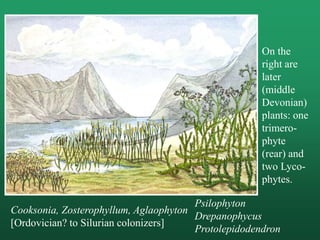
Cooksonia, Zosterophyllum, Aglaophyton
[Ordovician? to Silurian colonizers]
Psilophyton
Drepanophycus
Protolepidodendron
On the
right are
later
(middle
Devonian)
plants: one
trimero-
phyte
(rear) and
two Lyco-
phytes.
Physiology
• Cooksonia is green and red photosynthesizing self
sufficient stem.
• It is likely that some fossils preserve a sporophyte
generation which was dependent on gamatophyte,.
• However, no fossil record of gamatophyte has been
discovered to date.
• The width of Cooksonia fossils span an order of
magnitude.
• In 2018, the sporophyte of a new specie C.
barrandae was described from 432 MYA
Taxonomy
• Cooksonia species were described by William Henry
Lang in 1937 and named in honour of Isabel
Cookson.
• The genus was defined by narrow leafless stem
which branched dichotomously with terminal
sporangia that were short and wide.
• A central vascular cylinder consisting of annular
tracheids were present.
• Six other species were added to genus: C.
Crassiparietilies, C. Caledonica, C. Cambriansis,
C. bohemica, C. Parenesis, C. banksii, C. pertoni,
C. hemispherica.
• A review in 2010 concluded that the delineation of
genus was inaccurate and some species are needed
to be removed in particular to those in which
sporangia is not more or less trumpet shaped.
• Five further species doubtful: C. acuminate, C.
bohemica, C. cambransis, C. downtonesis, and C.
rusanovii
• Four species are excluded; C. hemispherica, C.
banksii, C. caledonica, C. barrandei
Phylogeny
• For some years, it was suspected that Cooksonia and
its species were poorly characterized.
• Thus four different kinds of spores , probably
representing four different species were found in
sporangia.
• Originally identified as C. Pertoni
Other descriptions
• Only sporophyte phase is currently known.
• Individuals were small, a few cm tall and simple in
structure.
• They lacked leaves, flowers and roots. Although it
has been speculated to form from rhizome
• They had a simple stalk that branched
dichotomously a few times, ending in sporangia.
• Lang described sporangia as flattened with terminal
sporangia that are short and wide.
• A 2010 view of genus by Gonez and Gerrienne
produce a tighter definition: “which require to be
sporangia more or less trumpet shaped with a lid or
operculum which disintegrates to release the
spores”.
• Specimens of one species have dark stripe in the
centre of their stalks which has been interpreted as
the earliest remains of water carrying tissues, while
others lack this habit.
• Its specimens occur in range of sizes and vary in
stem in width from 0.03 to 0.3mm
• Specimens of different sizes were different species,
not fragments of larger organism.
• The organisms probably exhibited determined
growth. Stem did not grow further after producing
sporangia.
• Some species bore stomata which had role in
gaseous exchange.
• This clustering of stomata is reminiscent of some
mosses.
• According to Gonez and Gerriene, there are six
possible species. C. pertonii, C. paranesis, C. banksi
are all relatively similar with flat topped, trumpet-
shaped.
• Sporangia stems are narrow in C. Paransis and C.
Pertoni.
• C. bohemica has stouter more branched stem. The
original shape of sporangia is unclear because of
poor preservation.
• C. hemispherica described from same locality as C.
pertoni but differs in having hemispherical tops
rather than flat.
• C. cambriansis also has spherical sporangia but
without gradual widening at base characters of other
species. Preservation is again poor
• C. barrandei was described bin 2018.
Cooksonia