3.205 L12 12/7/06
Phase Transformations:
Grain Growth;
T-T-T Curves
1
Today’s topics:
•  Grain growth kinetics in 2- and 3-D

•  Kinetics of nucleation and growth
transformations: time-temperature
transformation behavior
23.205 L12 12/7/06
Grain growth in polycrystalline materials

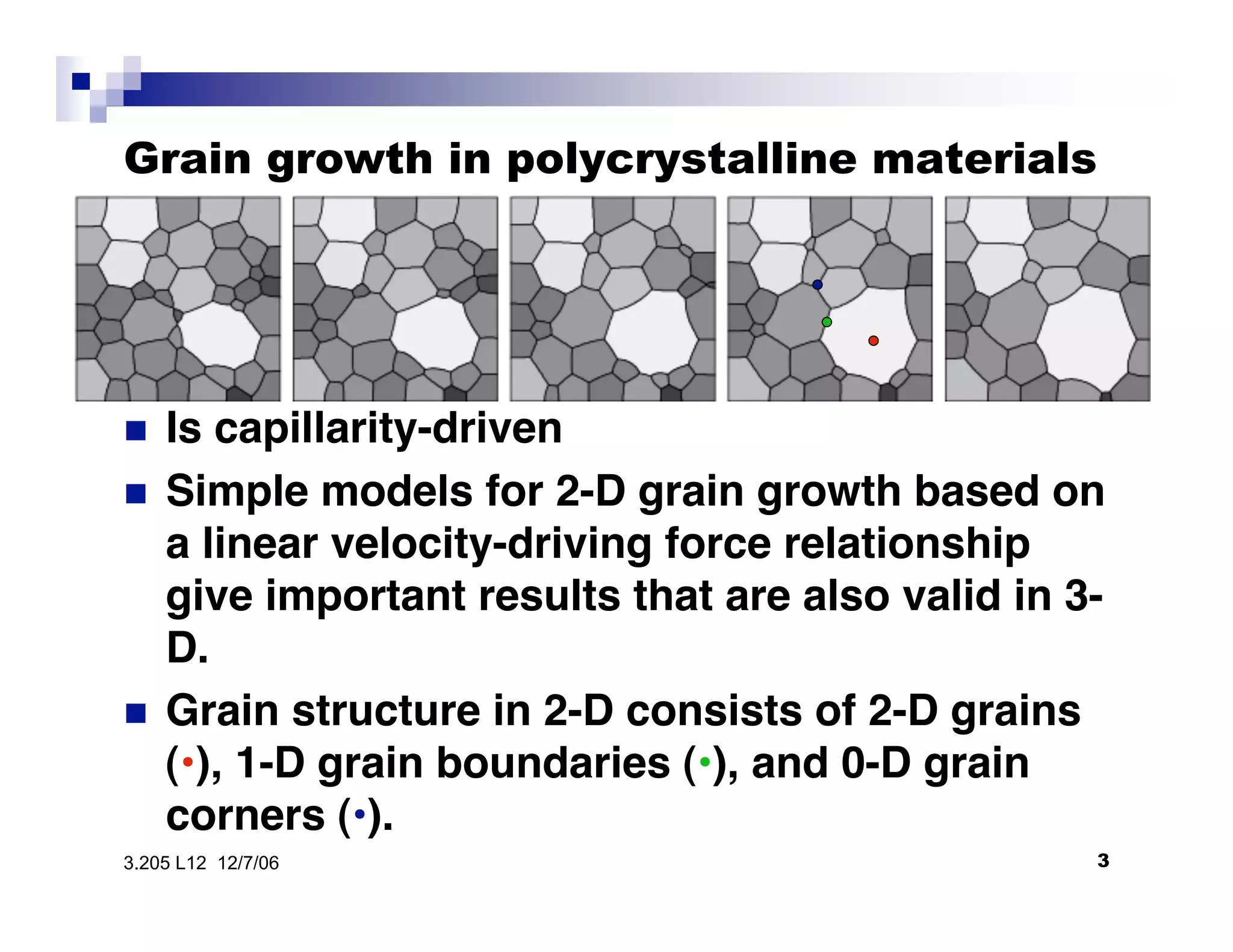
 Is capillarity-driven
•  Simple models for 2-D grain growth based on
a linear velocity-driving force relationship
give important results that are also valid in 3
D.
•  Grain structure in 2-D consists of 2-D grains
(•), 1-D grain boundaries (•), and 0-D grain
corners (•).
33.205 L12 12/7/06
Grain growth in polycrystalline materials

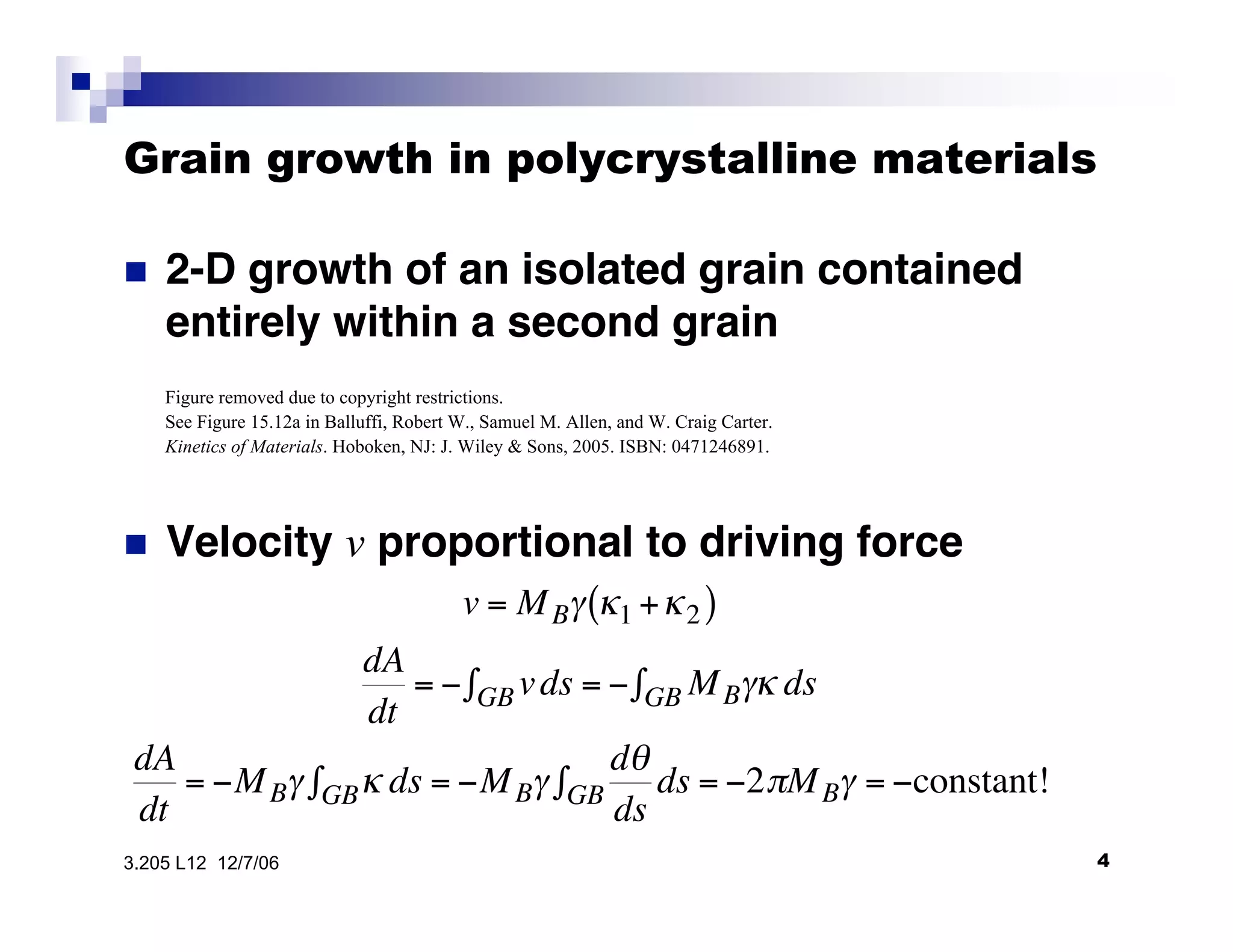
•  2-D growth of an isolated grain contained
entirely within a second grain
•  Velocity v proportional to driving force

v = MB" #1 +#2( )
dA
dt
= $ vdsGB% = $ MB"# dsGB%
dA
dt
= $MB" # dsGB% = $MB"
d&
ds
dsGB% = $2'MB" = $constant!
43.205 L12 12/7/06
Figure removed due to copyright restrictions.
See Figure 15.12a in Balluffi, Robert W., Samuel M. Allen, and W. Craig Carter.
Kinetics of Materials. Hoboken, NJ: J. Wiley & Sons, 2005. ISBN: 0471246891.
Grain growth in polycrystalline materials

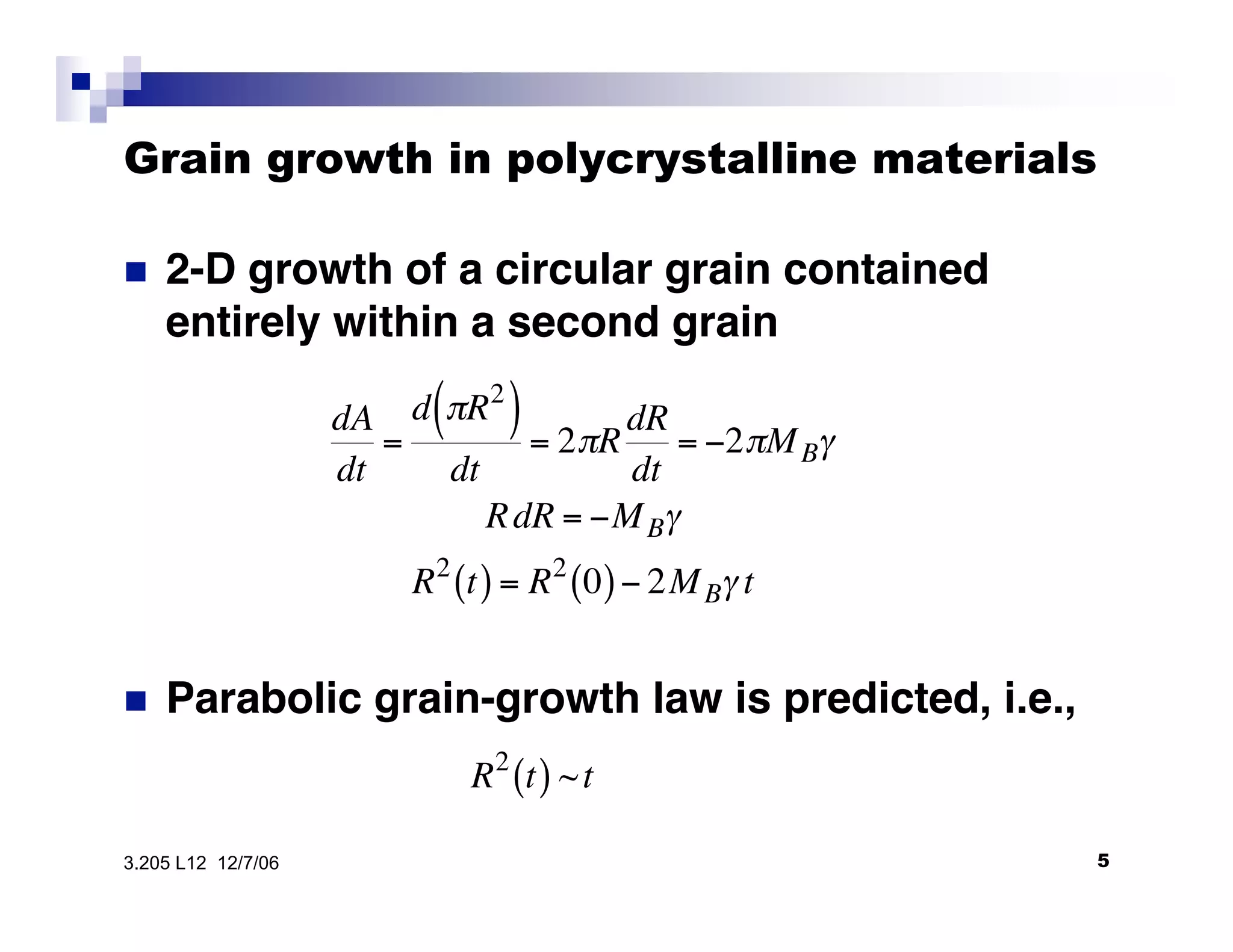
•  2-D growth of a circular grain contained
entirely within a second grain
!
dA
dt
=
d "R2
( )
dt
= 2"R
dR
dt
= #2"MB$
RdR = #MB$
R2
t( ) = R2
0( )# 2MB$ t
•  Parabolic grain-growth law is predicted, i.e.,

!
R2
t( ) ~t
53.205 L12 12/7/06
Grain growth in polycrystalline materials
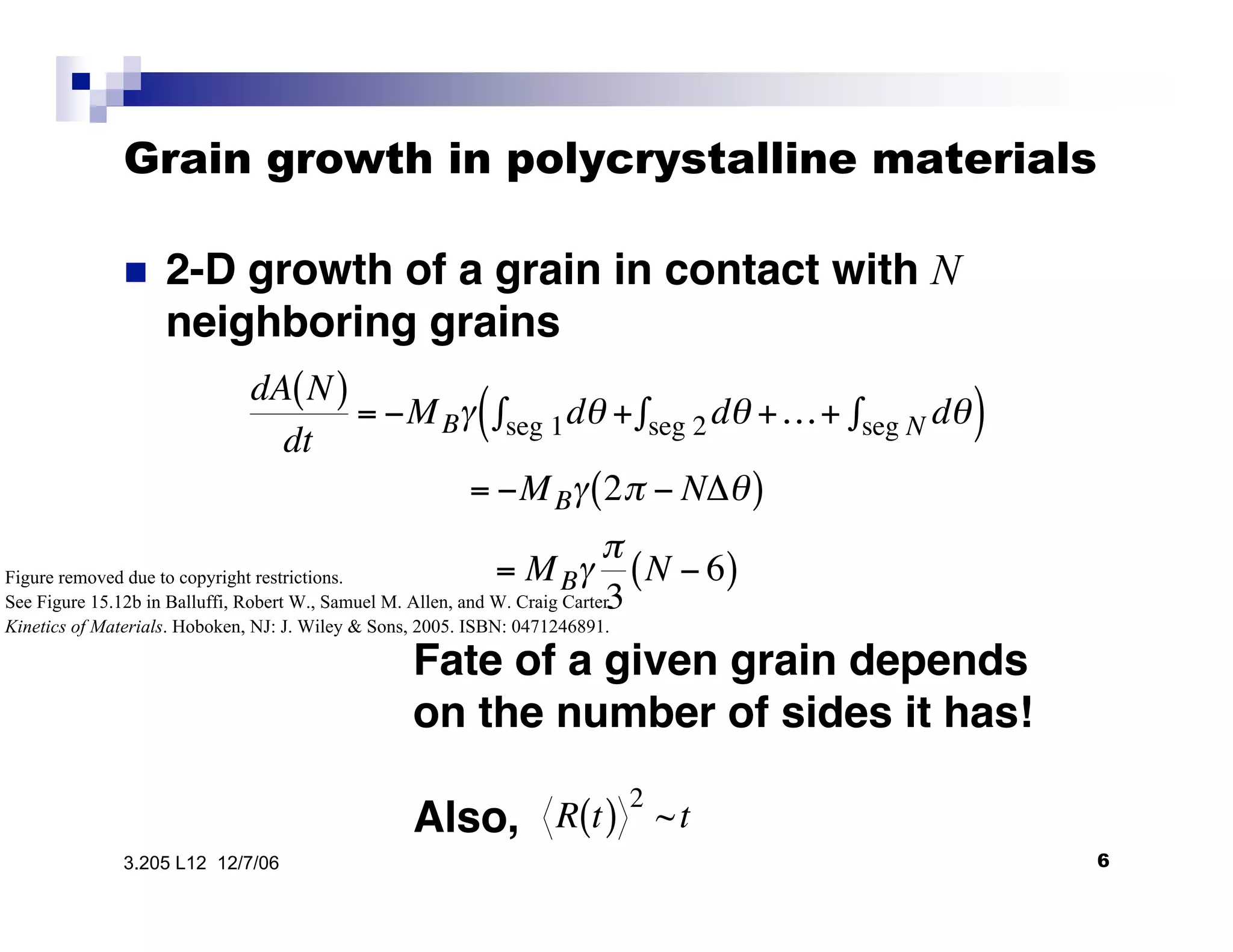
•  2-D growth of a grain in contact with N
neighboring grains
dA N( )
dt
= "MB# d$ +seg 1% d$ +…+ d$seg N%seg 2%( )
= "MB# 2& " N'$( )
= MB#
&
3
N " 6( )
Fate of a given grain depends

on the number of sides it has!

Also,
 R t( )
2
~t
63.205 L12 12/7/06
Figure removed due to copyright restrictions.
See Figure 15.12b in Balluffi, Robert W., Samuel M. Allen, and W. Craig Carter.
Kinetics of Materials. Hoboken, NJ: J. Wiley & Sons, 2005. ISBN: 0471246891.
Grain growth in polycrystalline materials

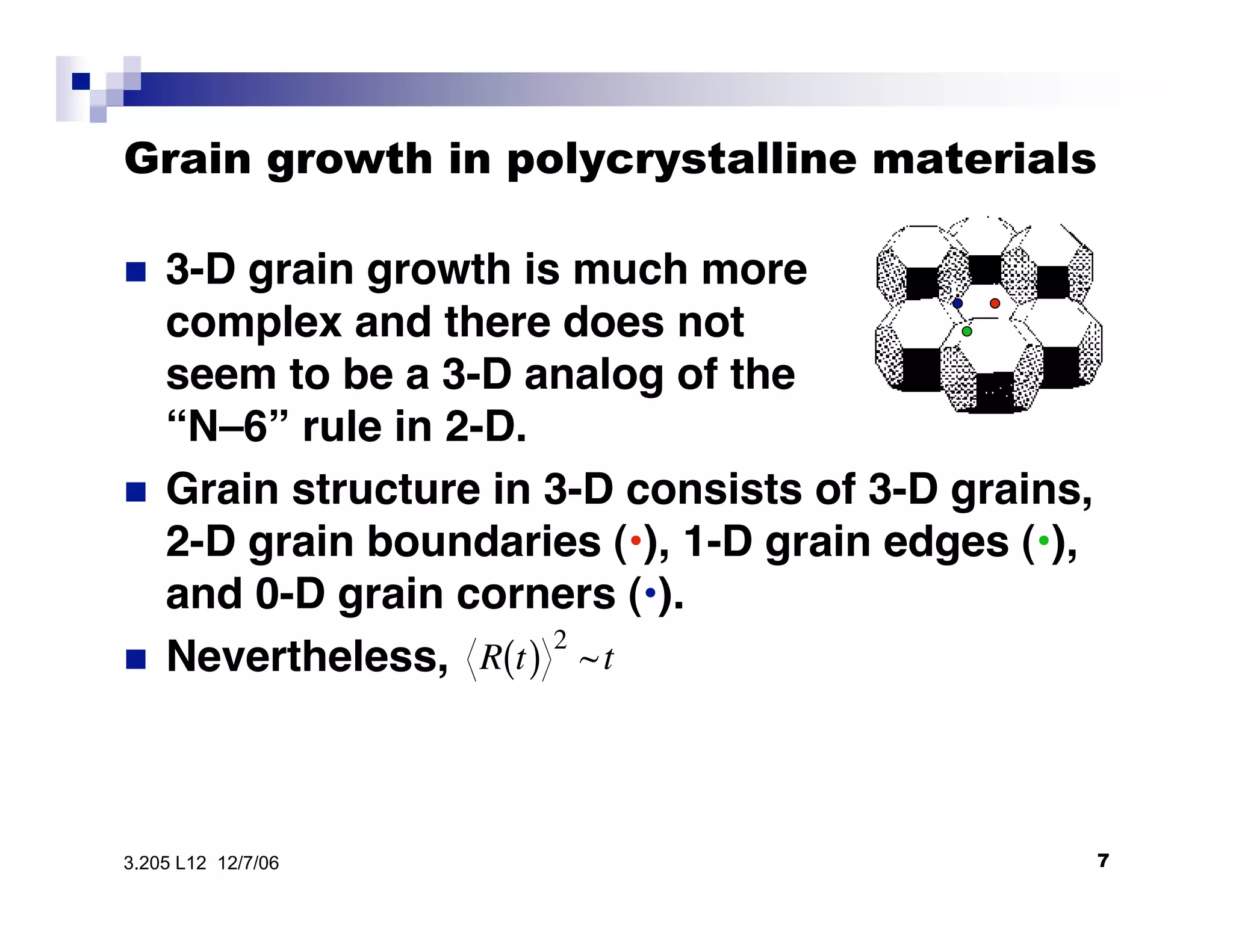
•  3-D grain growth is much more
complex and there does not
seem to be a 3-D analog of the
“N–6” rule in 2-D.
•  Grain structure in 3-D consists of 3-D grains,
2-D grain boundaries (•), 1-D grain edges (•),
and 0-D grain corners (
!
R t( )
2
~t
•).
•  Nevertheless,
73.205 L12 12/7/06
Time-Temperature-Transformation Curves

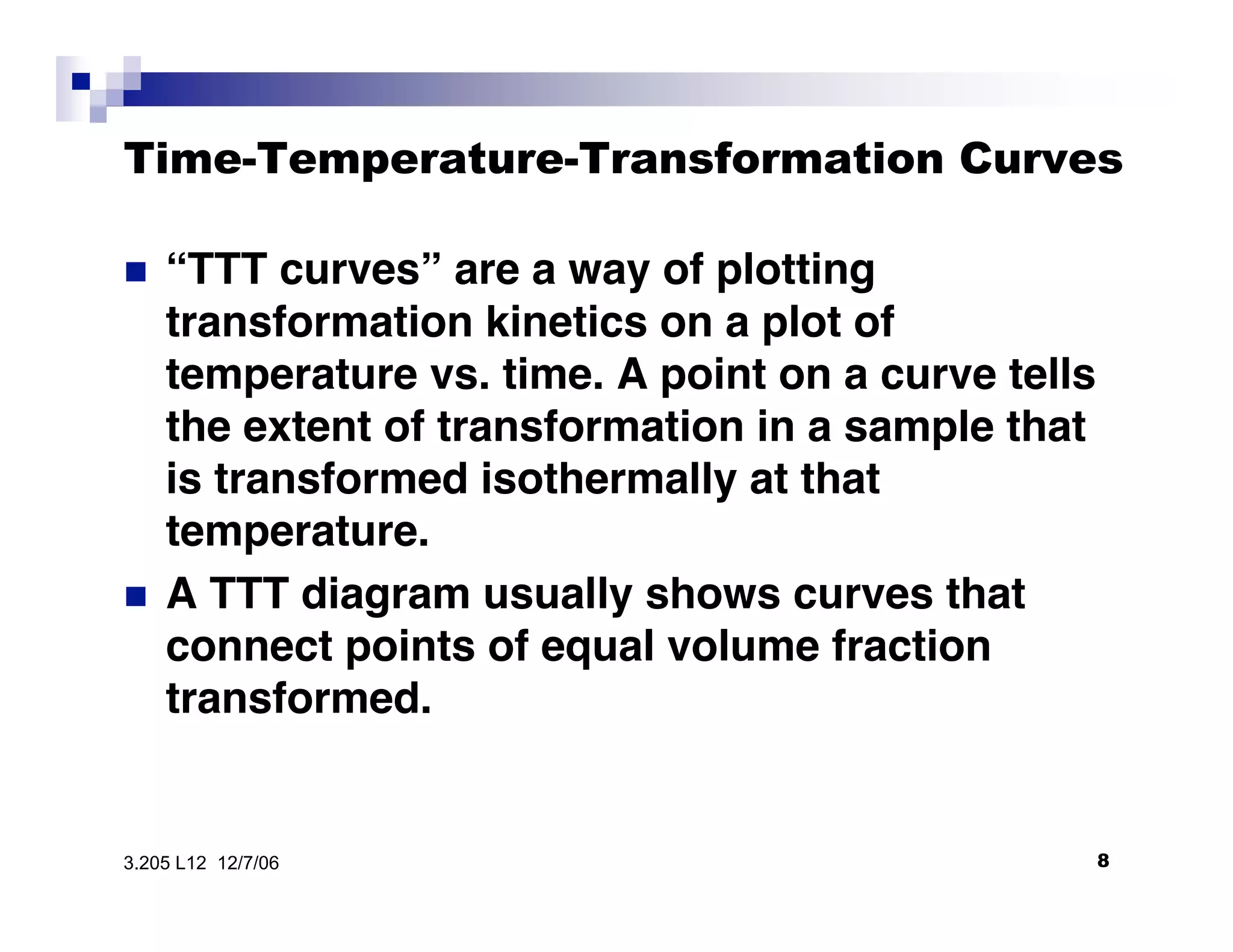
•  “TTT curves” are a way of plotting
transformation kinetics on a plot of
temperature vs. time. A point on a curve tells
the extent of transformation in a sample that
is transformed isothermally at that
temperature.
•  A TTT diagram usually shows curves that
connect points of equal volume fraction
transformed.
83.205 L12 12/7/06
Time-Temperature-Transformation Curves
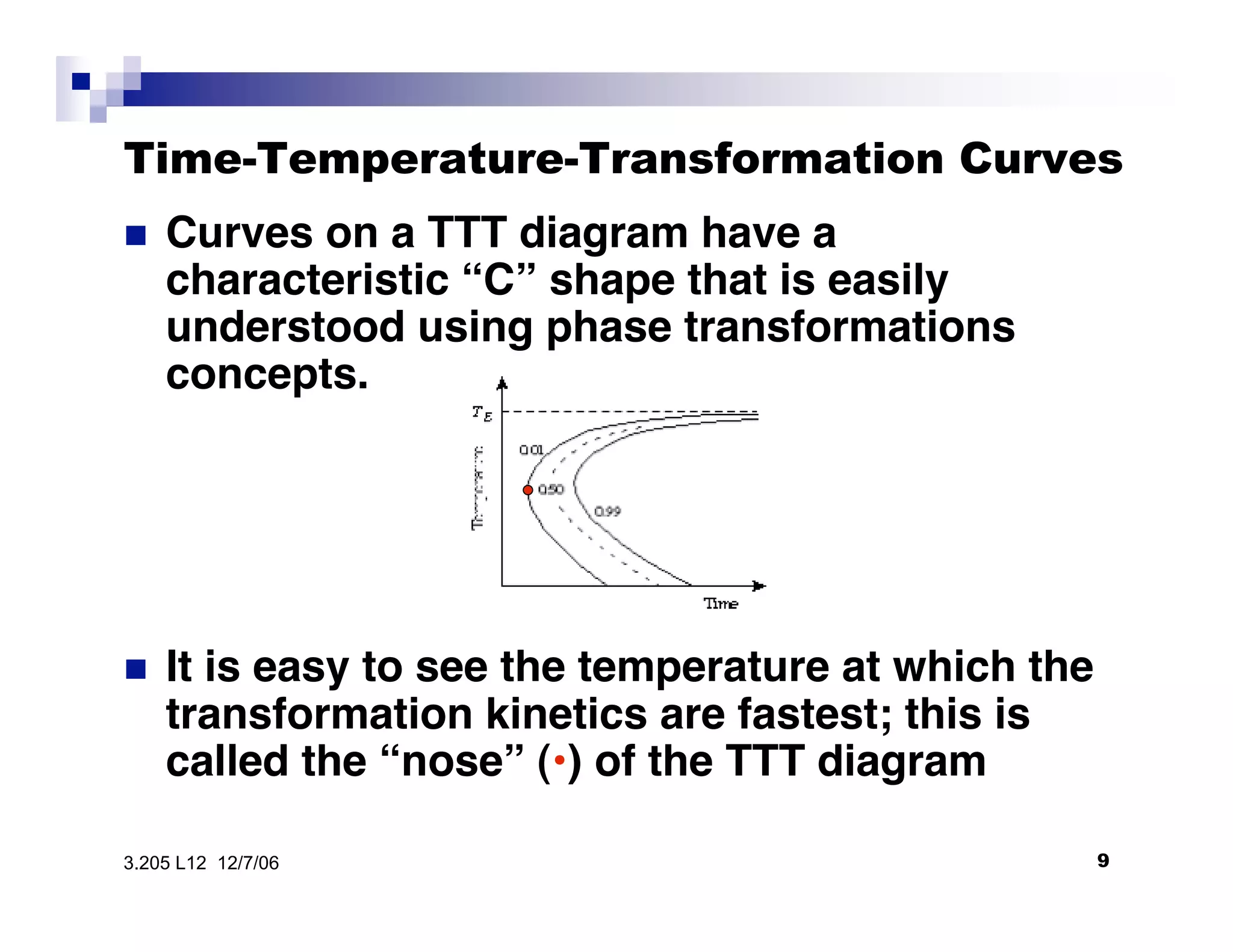
•  Curves on a TTT diagram have a
characteristic “C” shape that is easily
understood using phase transformations
concepts.
•  It is easy to see the temperature at which the
transformation kinetics are fastest; this is
called the “nose” (•) of the TTT diagram
93.205 L12 12/7/06
Time-Temperature-Transformation Curves

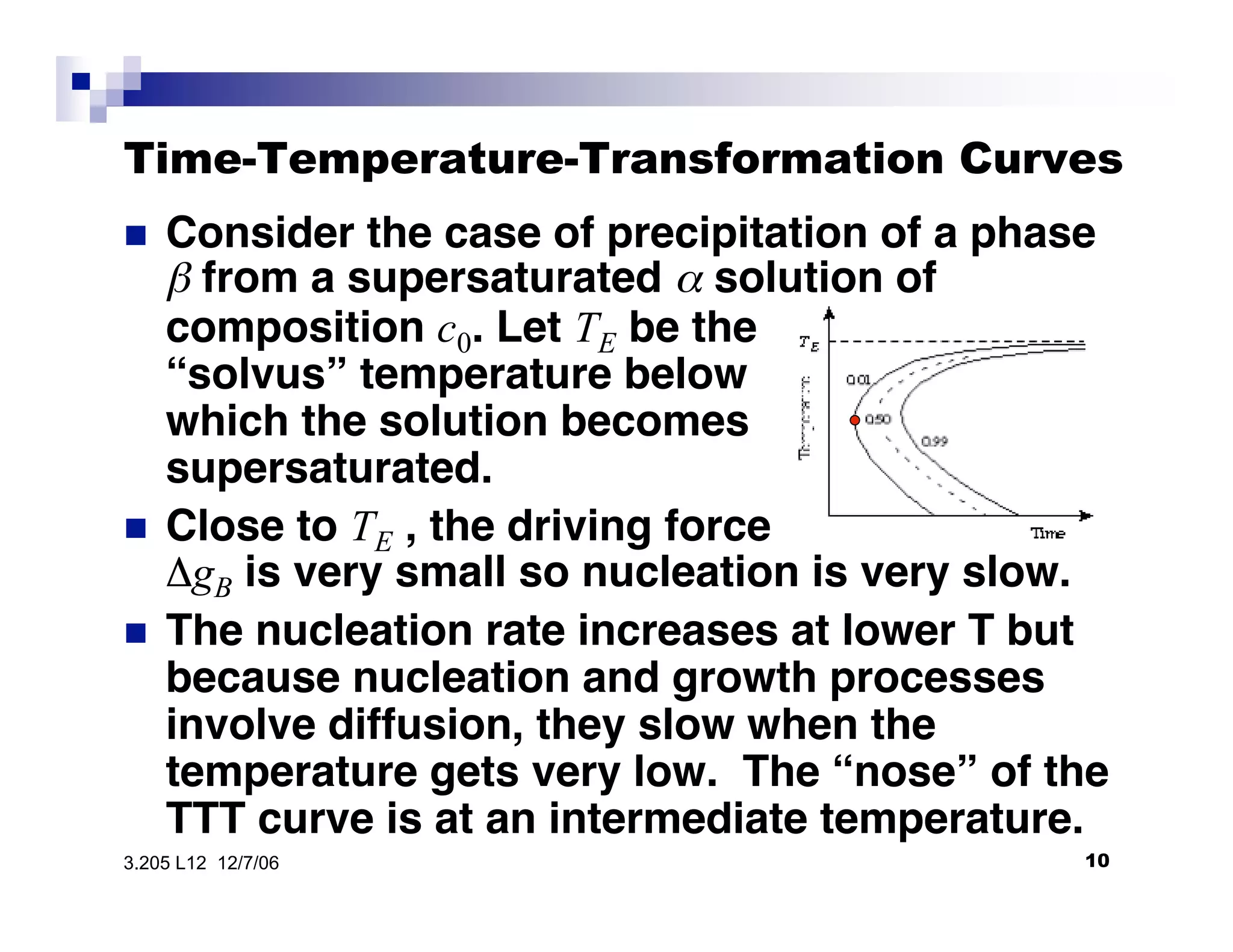
•  Consider the case of precipitation of a phase
β from a supersaturated α solution of
composition c0. Let TE be the
“solvus” temperature below
which the solution becomes
supersaturated.
•  Close to TE , the driving force
ΔgB is very small so nucleation is very slow.
•  The nucleation rate increases at lower T but
because nucleation and growth processes
involve diffusion, they slow when the
temperature gets very low. The “nose” of the
TTT curve is at an intermediate temperature.
3.205 L12 12/7/06 10

Time Temperature Transformation (TTT) curve

  • 1.
    3.205 L12 12/7/06 PhaseTransformations: Grain Growth; T-T-T Curves 1
  • 2.
    Today’s topics: • Grain growth kinetics in 2- and 3-D • Kinetics of nucleation and growth transformations: time-temperature transformation behavior 23.205 L12 12/7/06
  • 3.
    Grain growth inpolycrystalline materials  Is capillarity-driven • Simple models for 2-D grain growth based on a linear velocity-driving force relationship give important results that are also valid in 3 D. • Grain structure in 2-D consists of 2-D grains (•), 1-D grain boundaries (•), and 0-D grain corners (•). 33.205 L12 12/7/06
  • 4.
    Grain growth inpolycrystalline materials • 2-D growth of an isolated grain contained entirely within a second grain • Velocity v proportional to driving force v = MB" #1 +#2( ) dA dt = $ vdsGB% = $ MB"# dsGB% dA dt = $MB" # dsGB% = $MB" d& ds dsGB% = $2'MB" = $constant! 43.205 L12 12/7/06 Figure removed due to copyright restrictions. See Figure 15.12a in Balluffi, Robert W., Samuel M. Allen, and W. Craig Carter. Kinetics of Materials. Hoboken, NJ: J. Wiley & Sons, 2005. ISBN: 0471246891.
  • 5.
    Grain growth inpolycrystalline materials • 2-D growth of a circular grain contained entirely within a second grain ! dA dt = d "R2 ( ) dt = 2"R dR dt = #2"MB$ RdR = #MB$ R2 t( ) = R2 0( )# 2MB$ t • Parabolic grain-growth law is predicted, i.e., ! R2 t( ) ~t 53.205 L12 12/7/06
  • 6.
    Grain growth inpolycrystalline materials • 2-D growth of a grain in contact with N neighboring grains dA N( ) dt = "MB# d$ +seg 1% d$ +…+ d$seg N%seg 2%( ) = "MB# 2& " N'$( ) = MB# & 3 N " 6( ) Fate of a given grain depends on the number of sides it has! Also, R t( ) 2 ~t 63.205 L12 12/7/06 Figure removed due to copyright restrictions. See Figure 15.12b in Balluffi, Robert W., Samuel M. Allen, and W. Craig Carter. Kinetics of Materials. Hoboken, NJ: J. Wiley & Sons, 2005. ISBN: 0471246891.
  • 7.
    Grain growth inpolycrystalline materials • 3-D grain growth is much more complex and there does not seem to be a 3-D analog of the “N–6” rule in 2-D. • Grain structure in 3-D consists of 3-D grains, 2-D grain boundaries (•), 1-D grain edges (•), and 0-D grain corners ( ! R t( ) 2 ~t •). • Nevertheless, 73.205 L12 12/7/06
  • 8.
    Time-Temperature-Transformation Curves • “TTT curves” are a way of plotting transformation kinetics on a plot of temperature vs. time. A point on a curve tells the extent of transformation in a sample that is transformed isothermally at that temperature. • A TTT diagram usually shows curves that connect points of equal volume fraction transformed. 83.205 L12 12/7/06
  • 9.
    Time-Temperature-Transformation Curves • Curves on a TTT diagram have a characteristic “C” shape that is easily understood using phase transformations concepts. • It is easy to see the temperature at which the transformation kinetics are fastest; this is called the “nose” (•) of the TTT diagram 93.205 L12 12/7/06
  • 10.
    Time-Temperature-Transformation Curves • Consider the case of precipitation of a phase β from a supersaturated α solution of composition c0. Let TE be the “solvus” temperature below which the solution becomes supersaturated. • Close to TE , the driving force ΔgB is very small so nucleation is very slow. • The nucleation rate increases at lower T but because nucleation and growth processes involve diffusion, they slow when the temperature gets very low. The “nose” of the TTT curve is at an intermediate temperature. 3.205 L12 12/7/06 10