Notable Disease of Oysters,
Mussels and Other Mollusks
TG Bonjuana de la Peña Cañal
Diseases Caused by Parasites
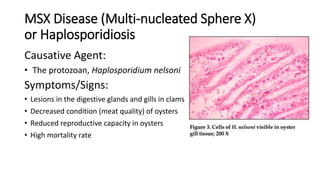
MSX Disease (Multi-nucleated Sphere X)
or Haplosporidiosis
Causative Agent:
• The protozoan, Haplosporidium nelsoni
Symptoms/Signs:
• Lesions in the digestive glands and gills in clams
• Decreased condition (meat quality) of oysters
• Reduced reproductive capacity in oysters
• High mortality rate
Diagnostic Techniques:
• Microscopic examination (Histological diagnostic techniques)
Prevention and control:
• No known methods of prevention and control
• Salinity control (≥ 20 ppt)
• Selective breeding
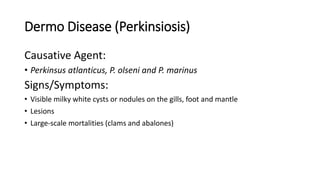
Dermo Disease (Perkinsiosis)
Causative Agent:
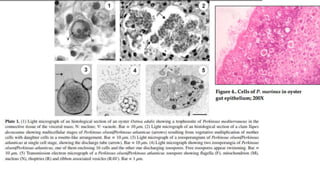
• Perkinsus atlanticus, P. olseni and P. marinus
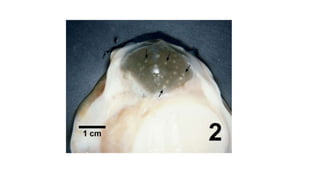
Signs/Symptoms:
• Visible milky white cysts or nodules on the gills, foot and mantle
• Lesions
• Large-scale mortalities (clams and abalones)
Diagnostic Techniques:
• Histology, fluid thioglycollate medium (FTM) assay and PCR
Prevention and Control:
• No reports of methods of control in the natural environment
• Mortality can be minimized by avoiding stressful conditions.
• High densities
• High temperature (esp. during harvesting)
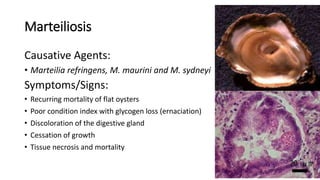
Marteiliosis
Causative Agents:
• Marteilia refringens, M. maurini and M. sydneyi
Symptoms/Signs:
• Recurring mortality of flat oysters
• Poor condition index with glycogen loss (ernaciation)
• Discoloration of the digestive gland
• Cessation of growth
• Tissue necrosis and mortality
Diagnostic Techniques:
• Digestive gland imprints, histology, TEM, in situ hybridization and PCR
Prevention and Control:
• No available control methods
• Knowledge of the life cycle of Marteilia could provide management
strategies
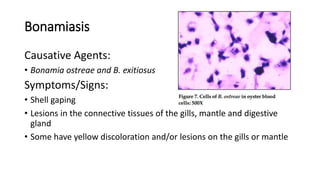
Bonamiasis
Causative Agents:
• Bonamia ostreae and B. exitiosus
Symptoms/Signs:
• Shell gaping
• Lesions in the connective tissues of the gills, mantle and digestive
gland
• Some have yellow discoloration and/or lesions on the gills or mantle
Diagnostic Techniques:
• Tissue (gill, heart) imprints, histology or TEM
Prevention and Control:
• No reports but mortality can be lessened by reducing oyster density
Mytilicolosis
Causative Agents:
• Mytilicola spp.
Symptoms/Signs:
• Poor growth and condition
• Extensive damage of the gut wall and sporadic mortality
Diagnostic Techniques:
• Gross observations, histology and enzyme extraction
Prevention and Control:
• No known methods of prevention or control except of good
husbandry
Disease Caused by Virus
Herpes-like virus of oysters
Causative Agents:
• Not Established
Symptoms/Signs:
• Herpes like infection (oyster larvae and spat)
• Associated with mass mortality (80-90%)
Diagnostic Techniques:
• Histology, TEM, PCR and in situ hybridization
Prevention and Control:
• No method of prevention and control are known
Diseases caused by Bacteria
Brown Ring Disease (BRD)
Causative Agents:
• Vibrio tapetis
Symptons/Signs:
• Disease was only reported from Tapes philippinarum and T.
decussatus (clams)
• Secretion causing brown deposit of organic material
• Shell deposition
• Decrease in glycogen
Diagnostic Techniques:
• Observation of gross signs
• Electron microscopy
• Immunoassays
• Culture and bacteriological identification
Prevention and Control:
• Reduction of Clam density
Larval vibriosis
Causative Agents:
• Vibrio tubiashi, V. anguillarum, V. splendidus, Vibrio ordali, V.
alginolyticus and Vibrio spp.
• Pseudomonas and Aeromonas
Symptoms/Signs:
• Necrosis of mantle epithelium
• Sudden onset with the affected larvae exhibiting reduced feeding rate
• Erratic swimming behaviour
Diagnostic Techniques:
• Biochemical, immunodiagnostic, or molecular methods
• Histology
Prevention and Control:
• Under investigation
References
• Alvarez-Pellitero P. (ed.), Barja J.L. (ed.),Basurco B.(ed.), Berthe F.
(ed.), Toranzo A.E. (ed.). 2004. Mediterranean aquaculture diagnostic
laboratories. Zaragoza, CIHEAM. p. 33-48 (Options Méditerranéennes
: Série B. Etudes et Recherches; n. 49

Notable Diseases of Shellfish

  • 1.
    Notable Disease ofOysters, Mussels and Other Mollusks TG Bonjuana de la Peña Cañal
  • 2.
  • 3.
    MSX Disease (Multi-nucleatedSphere X) or Haplosporidiosis Causative Agent: • The protozoan, Haplosporidium nelsoni Symptoms/Signs: • Lesions in the digestive glands and gills in clams • Decreased condition (meat quality) of oysters • Reduced reproductive capacity in oysters • High mortality rate
  • 4.
    Diagnostic Techniques: • Microscopicexamination (Histological diagnostic techniques) Prevention and control: • No known methods of prevention and control • Salinity control (≥ 20 ppt) • Selective breeding
  • 5.
    Dermo Disease (Perkinsiosis) CausativeAgent: • Perkinsus atlanticus, P. olseni and P. marinus Signs/Symptoms: • Visible milky white cysts or nodules on the gills, foot and mantle • Lesions • Large-scale mortalities (clams and abalones)
  • 8.
    Diagnostic Techniques: • Histology,fluid thioglycollate medium (FTM) assay and PCR Prevention and Control: • No reports of methods of control in the natural environment • Mortality can be minimized by avoiding stressful conditions. • High densities • High temperature (esp. during harvesting)
  • 9.
    Marteiliosis Causative Agents: • Marteiliarefringens, M. maurini and M. sydneyi Symptoms/Signs: • Recurring mortality of flat oysters • Poor condition index with glycogen loss (ernaciation) • Discoloration of the digestive gland • Cessation of growth • Tissue necrosis and mortality
  • 10.
    Diagnostic Techniques: • Digestivegland imprints, histology, TEM, in situ hybridization and PCR Prevention and Control: • No available control methods • Knowledge of the life cycle of Marteilia could provide management strategies
  • 11.
    Bonamiasis Causative Agents: • Bonamiaostreae and B. exitiosus Symptoms/Signs: • Shell gaping • Lesions in the connective tissues of the gills, mantle and digestive gland • Some have yellow discoloration and/or lesions on the gills or mantle
  • 12.
    Diagnostic Techniques: • Tissue(gill, heart) imprints, histology or TEM Prevention and Control: • No reports but mortality can be lessened by reducing oyster density
  • 13.
    Mytilicolosis Causative Agents: • Mytilicolaspp. Symptoms/Signs: • Poor growth and condition • Extensive damage of the gut wall and sporadic mortality
  • 14.
    Diagnostic Techniques: • Grossobservations, histology and enzyme extraction Prevention and Control: • No known methods of prevention or control except of good husbandry
  • 15.
  • 16.
    Herpes-like virus ofoysters Causative Agents: • Not Established Symptoms/Signs: • Herpes like infection (oyster larvae and spat) • Associated with mass mortality (80-90%) Diagnostic Techniques: • Histology, TEM, PCR and in situ hybridization Prevention and Control: • No method of prevention and control are known
  • 17.
  • 18.
    Brown Ring Disease(BRD) Causative Agents: • Vibrio tapetis Symptons/Signs: • Disease was only reported from Tapes philippinarum and T. decussatus (clams) • Secretion causing brown deposit of organic material • Shell deposition • Decrease in glycogen
  • 19.
    Diagnostic Techniques: • Observationof gross signs • Electron microscopy • Immunoassays • Culture and bacteriological identification Prevention and Control: • Reduction of Clam density
  • 20.
    Larval vibriosis Causative Agents: •Vibrio tubiashi, V. anguillarum, V. splendidus, Vibrio ordali, V. alginolyticus and Vibrio spp. • Pseudomonas and Aeromonas Symptoms/Signs: • Necrosis of mantle epithelium • Sudden onset with the affected larvae exhibiting reduced feeding rate • Erratic swimming behaviour
  • 21.
    Diagnostic Techniques: • Biochemical,immunodiagnostic, or molecular methods • Histology Prevention and Control: • Under investigation
  • 22.
    References • Alvarez-Pellitero P.(ed.), Barja J.L. (ed.),Basurco B.(ed.), Berthe F. (ed.), Toranzo A.E. (ed.). 2004. Mediterranean aquaculture diagnostic laboratories. Zaragoza, CIHEAM. p. 33-48 (Options Méditerranéennes : Série B. Etudes et Recherches; n. 49