Semantic Integration Patterns
for Data-driven Digital Twins
in the Manufacturing Industry
Semantic Integration Patterns
for Industry 4.0
Authors:
Felix Strohmeier, Georg Güntner, Dietmar Glachs, Reinhard Mayr
16th IFAC/IFIP International Workshop on Enterprise Integration,
Interoperability and Networking (EI2N 2022 )
In conjunction with the 3rd International Conference on Innovative Intelligent
Industrial Production and Logistics (IN4PL 2022)
24.-26.10.2022, Malta
Presented by: Georg Güntner, Salzburg Research (25.10.2022, online)
Structure of the Presentation
25.10.2022
Semantic Integration Patterns for Industry 4.0 (EI2N-Workshop 2022) 2
• Industrial digitalization
• Digital twins
Introduction
• Standards
• Asset Administration Shell
Industrial
Information
Models
• Platform Architecture
• Semantic Connectors
Semantic
Integration
Patterns
• Potential
• Outlook
Conclusions
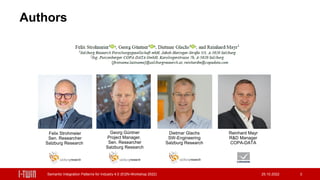
Authors
25.10.2022
Semantic Integration Patterns for Industry 4.0 (EI2N-Workshop 2022) 3
Georg Güntner
Project Manager,
Sen. Researcher
Salzburg Research
Felix Strohmeier
Sen. Researcher
Salzburg Research
Dietmar Glachs
SW-Engineering
Salzburg Research
Reinhard Mayr
R&D Manager
COPA-DATA
25.10.2022
Semantic Integration Patterns for Industry 4.0 (EI2N-Workshop 2022) 4
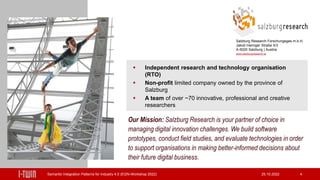
Our Mission: Salzburg Research is your partner of choice in
managing digital innovation challenges. We build software
prototypes, conduct field studies, and evaluate technologies in order
to support organisations in making better-informed decisions about
their future digital business.
 Independent research and technology organisation
(RTO)
 Non-profit limited company owned by the province of
Salzburg
 A team of over ~70 innovative, professional and creative
researchers
Salzburg Research Forschungsges.m.b.H.
Jakob Haringer Straße 5/3
A-5020 Salzburg | Austria
www.salzburgresearch.at
Motivation: Industrial Digitalization as Driver
 Digitalization as main driver for productivity and resource efficiency
in the manufacturing area.
 Every newly designed machine is a smart, connected asset
 Shift from classical hierarchical production-line processes based on
the “automation pyramid” to flexible connected production
networks.
 Complex communication and interoperability requirements
 Development of industrial data models for engineering and
production
– Industry driven / driven by standardization bodies
– Domain specific / generic (domain independent)
– Open / closed / proprietary
25.10.2022
Semantic Integration Patterns for Industry 4.0 (EI2N-Workshop 2022) 5
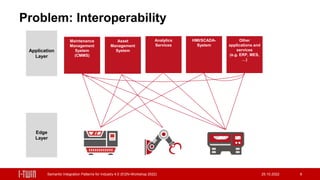
Problem: Interoperability
Maintenance
Management
System
(CMMS)
HMI/SCADA-
System
Analytics
Services
Other
applications and
services
(e.g. ERP, MES,
…)
Asset
Management
System
25.10.2022
Semantic Integration Patterns for Industry 4.0 (EI2N-Workshop 2022) 6
Application
Layer
Edge
Layer
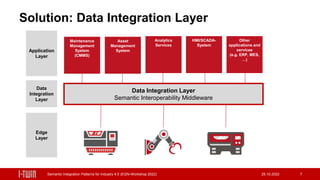
Solution: Data Integration Layer
Data Integration Layer
Semantic Interoperability Middleware
Maintenance
Management
System
(CMMS)
HMI/SCADA-
System
Analytics
Services
Other
applications and
services
(e.g. ERP, MES,
…)
Asset
Management
System
25.10.2022
Semantic Integration Patterns for Industry 4.0 (EI2N-Workshop 2022) 7
Application
Layer
Data
Integration
Layer
Edge
Layer
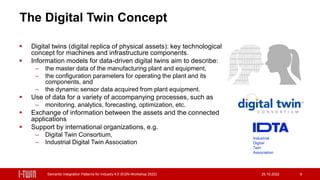
The Digital Twin Concept
 Digital twins (digital replica of physical assets): key technological
concept for machines and infrastructure components.
 Information models for data-driven digital twins aim to describe:
– the master data of the manufacturing plant and equipment,
– the configuration parameters for operating the plant and its
components, and
– the dynamic sensor data acquired from plant equipment.
 Use of data for a variety of accompanying processes, such as
– monitoring, analytics, forecasting, optimization, etc.
 Exchange of information between the assets and the connected
applications
 Support by international organizations, e.g.
– Digital Twin Consortium,
– Industrial Digital Twin Association
25.10.2022
Semantic Integration Patterns for Industry 4.0 (EI2N-Workshop 2022) 8
i-Twin in a Nutshell
Semantic Integration Patterns for Data-driven
Digital Twins in the Manufacturing Industry
 i-Twin investigates interoperability concepts for data-driven
digital twins in the manufacturing industry.
 The project propagates an open source middleware for the
integration of operational management systems and connected
assets based on semantic integration patterns.
 It aims at reducing the integration effort and allowing
exchange of master data and operational data in
manufacturing networks.
 The results are validated in a research laboratory set-up and in
an industrial asset management scenario.
25.10.2022
Semantic Integration Patterns for Industry 4.0 (EI2N-Workshop 2022) 9
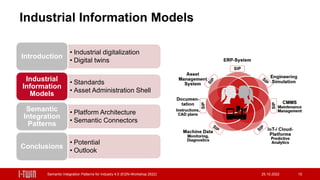
Industrial Information Models
25.10.2022
Semantic Integration Patterns for Industry 4.0 (EI2N-Workshop 2022) 10
• Industrial digitalization
• Digital twins
Introduction
• Standards
• Asset Administration Shell
Industrial
Information
Models
• Platform Architecture
• Semantic Connectors
Semantic
Integration
Patterns
• Potential
• Outlook
Conclusions
Industrial Information Models
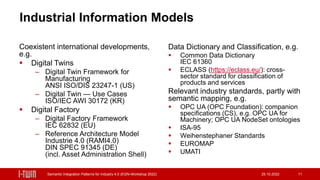
Coexistent international developments,
e.g.
 Digital Twins
– Digital Twin Framework for
Manufacturing
ANSI ISO/DIS 23247-1 (US)
– Digital Twin — Use Cases
ISO/IEC AWI 30172 (KR)
 Digital Factory
– Digital Factory Framework
IEC 62832 (EU)
– Reference Architecture Model
Industrie 4.0 (RAMI4.0)
DIN SPEC 91345 (DE)
(incl. Asset Administration Shell)
25.10.2022
Semantic Integration Patterns for Industry 4.0 (EI2N-Workshop 2022) 11
Data Dictionary and Classification, e.g.
 Common Data Dictionary
IEC 61360
 ECLASS (https://eclass.eu/): cross-
sector standard for classification of
products and services
Relevant industry standards, partly with
semantic mapping, e.g.
 OPC UA (OPC Foundation): companion
specifications (CS), e.g. OPC UA for
Machinery; OPC UA NodeSet ontologies
 ISA-95
 Weihenstephaner Standards
 EUROMAP
 UMATI
Information Model for Industrial Digital Twins
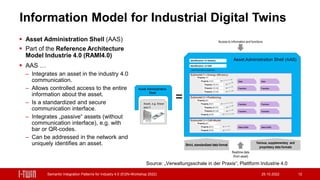
 Asset Administration Shell (AAS)
 Part of the Reference Architecture
Model Industrie 4.0 (RAMI4.0)
 AAS …
– Integrates an asset in the industry 4.0
communication.
– Allows controlled access to the entire
information about the asset.
– Is a standardized and secure
communication interface.
– Integrates „passive“ assets (without
communication interface), e.g. with
bar or QR-codes.
– Can be addressed in the network and
uniquely identifies an asset.
25.10.2022
Semantic Integration Patterns for Industry 4.0 (EI2N-Workshop 2022) 12
Source: „Verwaltungsschale in der Praxis“, Plattform Industrie 4.0
Why AAS?
Reasons for focussing on AAS in i-Twin:
 Mappings to data exchange formats, e.g.
– AASX, XML, JSON, RDF, OPC UA (IEC 62541, 2020), and AutomationML (IEC 62714, 2022)
 Semantic integration via references, e.g.
– ECLASS CDD, Industrial Ontologies Foundation (IOF), OPC UA NodeSet ontologies
 Ability to model physical assets AND software applications
 Standardised models to avoid vendor lock-in effects
 Active open source community (basyx40, Eclipse digital twin, adminshell.io, FA3ST)
References:
 “Details of the Asset Administration Shell” (Plattform Industrie 4.0)
– Part 1 The exchange of information between partners in the value chain of Industrie 4.0
(Version 3.0RC02)
https://www.plattform-
i40.de/IP/Redaktion/DE/Downloads/Publikation/Details_of_the_Asset_Administration_Shell_Part1_V3.html
– Part 2 Interoperability at Runtime – Exchanging Information via Application Programming
Interfaces (Version 1.0RC02)
https://www.plattform-
i40.de/IP/Redaktion/EN/Downloads/Publikation/Details_of_the_Asset_Administration_Shell_Part2_V1.html
25.10.2022
Semantic Integration Patterns for Industry 4.0 (EI2N-Workshop 2022) 13
Semantic Integration Patterns
25.10.2022
Semantic Integration Patterns for Industry 4.0 (EI2N-Workshop 2022) 14
• Industrial digitalization
• Digital twins
Introduction
• Standards
• Asset Administration Shell
Industrial
Information
Models
• Platform Architecture
• Semantic Connectors
Semantic
Integration
Patterns
• Potential
• Outlook
Conclusions
Asset-Connector
(Edge Node)
Asset-Connector
(OPC-UA CS)
Asset-Connector
(AAS)
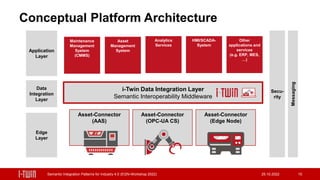
Conceptual Platform Architecture
i-Twin Data Integration Layer
Semantic Interoperability Middleware
Maintenance
Management
System
(CMMS)
HMI/SCADA-
System
Analytics
Services
Other
applications and
services
(e.g. ERP, MES,
…)
Asset
Management
System
25.10.2022
Semantic Integration Patterns for Industry 4.0 (EI2N-Workshop 2022) 15
Application
Layer
Data
Integration
Layer
Edge
Layer
Secu-
rity
Messaging
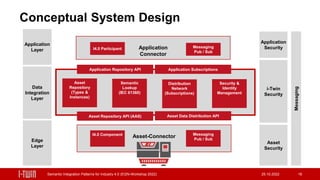
Conceptual System Design
25.10.2022
Semantic Integration Patterns for Industry 4.0 (EI2N-Workshop 2022) 16
Asset-Connector
Application
Layer
Data
Integration
Layer
Edge
Layer
Application
Security
Application Repository API Application Subscriptions
Asset
Repository
(Types &
Instances)
Distribution
Network
(Subscriptions)
Semantic
Lookup
(IEC 61360)
Security &
Identity
Management
Asset Repository API (AAS) Asset Data Distribution API
I4.0 Component Messaging
Pub / Sub
Application
Connector
I4.0 Participant Messaging
Pub / Sub
Asset
Security
i-Twin
Security
Messaging
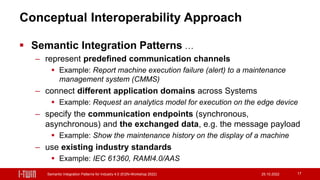
Conceptual Interoperability Approach
 Semantic Integration Patterns …
– represent predefined communication channels
 Example: Report machine execution failure (alert) to a maintenance
management system (CMMS)
– connect different application domains across Systems
 Example: Request an analytics model for execution on the edge device
– specify the communication endpoints (synchronous,
asynchronous) and the exchanged data, e.g. the message payload
 Example: Show the maintenance history on the display of a machine
– use existing industry standards
 Example: IEC 61360, RAMI4.0/AAS
25.10.2022
Semantic Integration Patterns for Industry 4.0 (EI2N-Workshop 2022) 17
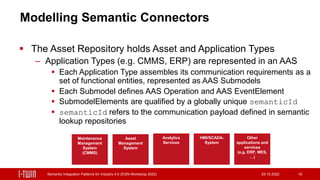
Modelling Semantic Connectors
 The Asset Repository holds Asset and Application Types
– Application Types (e.g. CMMS, ERP) are represented in an AAS
 Each Application Type assembles its communication requirements as a
set of functional entities, represented as AAS Submodels
 Each Submodel defines AAS Operation and AAS EventElement
 SubmodelElements are qualified by a globally unique semanticId
 semanticId refers to the communication payload defined in semantic
lookup repositories
25.10.2022
Semantic Integration Patterns for Industry 4.0 (EI2N-Workshop 2022) 18
Maintenance
Management
System
(CMMS)
HMI/SCADA-
System
Analytics
Services
Other
applications and
services
(e.g. ERP, MES,
…)
Asset
Management
System
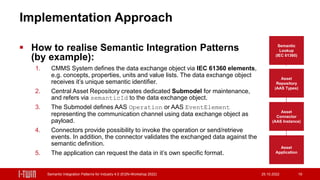
Implementation Approach
 How to realise Semantic Integration Patterns
(by example):
1. CMMS System defines the data exchange object via IEC 61360 elements,
e.g. concepts, properties, units and value lists. The data exchange object
receives it’s unique semantic identifier.
2. Central Asset Repository creates dedicated Submodel for maintenance,
and refers via semanticId to the data exchange object.
3. The Submodel defines AAS Operation or AAS EventElement
representing the communication channel using data exchange object as
payload.
4. Connectors provide possibility to invoke the operation or send/retrieve
events. In addition, the connector validates the exchanged data against the
semantic definition.
5. The application can request the data in it’s own specific format.
25.10.2022
Semantic Integration Patterns for Industry 4.0 (EI2N-Workshop 2022) 19
Semantic
Lookup
(IEC 61360)
Asset
Repository
(AAS Types)
Asset
Connector
(AAS Instance)
Asset
Application
Conclusions
25.10.2022
Semantic Integration Patterns for Industry 4.0 (EI2N-Workshop 2022) 20
• Industrial digitalization
• Digital twins
Introduction
• Standards
• Asset Administration Shell
Industrial
Information
Models
• Platform Architecture
• Semantic Connectors
Semantic
Integration
Patterns
• Potential
• Outlook
Conclusions
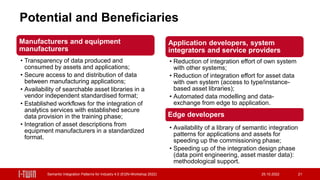
Potential and Beneficiaries
Manufacturers and equipment
manufacturers
• Transparency of data produced and
consumed by assets and applications;
• Secure access to and distribution of data
between manufacturing applications;
• Availability of searchable asset libraries in a
vendor independent standardised format;
• Established workflows for the integration of
analytics services with established secure
data provision in the training phase;
• Integration of asset descriptions from
equipment manufacturers in a standardized
format.
25.10.2022
Semantic Integration Patterns for Industry 4.0 (EI2N-Workshop 2022) 21
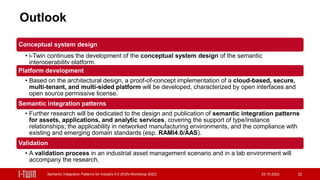
Application developers, system
integrators and service providers
• Reduction of integration effort of own system
with other systems;
• Reduction of integration effort for asset data
with own system (access to type/instance-
based asset libraries);
• Automated data modelling and data-
exchange from edge to application.
Edge developers
• Availability of a library of semantic integration
patterns for applications and assets for
speeding up the commissioning phase;
• Speeding up of the integration design phase
(data point engineering, asset master data):
methodological support.
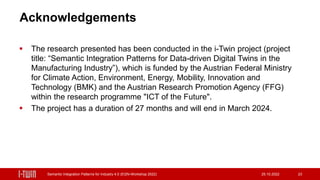
Outlook
Conceptual system design
• i-Twin continues the development of the conceptual system design of the semantic
interoperability platform.
Platform development
• Based on the architectural design, a proof-of-concept implementation of a cloud-based, secure,
multi-tenant, and multi-sided platform will be developed, characterized by open interfaces and
open source permissive license.
Semantic integration patterns
• Further research will be dedicated to the design and publication of semantic integration patterns
for assets, applications, and analytic services, covering the support of type/instance
relationships; the applicability in networked manufacturing environments, and the compliance with
existing and emerging domain standards (esp. RAMI4.0/AAS).
Validation
• A validation process in an industrial asset management scenario and in a lab environment will
accompany the research.
25.10.2022
Semantic Integration Patterns for Industry 4.0 (EI2N-Workshop 2022) 22
Acknowledgements
 The research presented has been conducted in the i-Twin project (project
title: “Semantic Integration Patterns for Data-driven Digital Twins in the
Manufacturing Industry”), which is funded by the Austrian Federal Ministry
for Climate Action, Environment, Energy, Mobility, Innovation and
Technology (BMK) and the Austrian Research Promotion Agency (FFG)
within the research programme "ICT of the Future".
 The project has a duration of 27 months and will end in March 2024.
25.10.2022
Semantic Integration Patterns for Industry 4.0 (EI2N-Workshop 2022) 23
Contact Information
DI Georg Güntner
Salzburg Research Forschungsges.m.b.H.
Jakob Haringer Straße 5/3
A-5020 Salzburg | Austria
Tel: +43-664-2807149
www.salzburgresearch.at
georg.guentner@salzburgresearch.at
Semantic Integration Patterns for Industry 4.0 (EI2N-Workshop 2022)
www.maintenance-competence-center.at
office@maintenance-competence-center.at
Service centre for research, development
and innovation in maintenance and asset
management
25.10.2022 24
Georg Güntner is senior researcher and key account manager at Salzburg Research (a research and technology organization
located in Salzburg, Austria), contributing also to the consulting network at dankl+partner consulting as a senior consultant.
He focuses on accompanying and acceptance research of digital technologies and the internet of things in manufacturing and
maintenance. In his latest work he has been investigating technical concepts and applications of digital twins in asset
management.
Georg Güntner coordinates the "Maintenance Competence Center", an Austrian contact point for research, development and
innovation activities in the area of maintenance. In his recent projects he conducted research on the influence of industry 4.0 and
digitalization on the maintenance sector ("Maintenance 4.0", "i-Maintenance"). He supported digital transformation processes in
the industry ("I40-Transform"). He also dealt with the transfer of recent findings in digitalisation to the industry, especially to
SMEs ("KMU4.0", "Digitales Transferzentrum"). He also coordinated the innovation network "Digital Asset Management" (i-
Asset, 2019-2021) and started the research project i-Twin in 2022 (topic: semantic interoperability for digital twins).
www.maintenance-competence-center.at/i-twin
i-twin-office@salzburgresearch.at
The project is funded by the Austrian Federal
Ministry for Climate Action, Environment, Energy,
Mobility, Innovation, and Technology (BMK) and the
Austrian Research Pro-motion Agency (FFG) within
the ICT of the Future research programme.

Semantic Integration Patterns for Industry 4.0

  • 1.
    Semantic Integration Patterns forData-driven Digital Twins in the Manufacturing Industry Semantic Integration Patterns for Industry 4.0 Authors: Felix Strohmeier, Georg Güntner, Dietmar Glachs, Reinhard Mayr 16th IFAC/IFIP International Workshop on Enterprise Integration, Interoperability and Networking (EI2N 2022 ) In conjunction with the 3rd International Conference on Innovative Intelligent Industrial Production and Logistics (IN4PL 2022) 24.-26.10.2022, Malta Presented by: Georg Güntner, Salzburg Research (25.10.2022, online)
  • 2.
    Structure of thePresentation 25.10.2022 Semantic Integration Patterns for Industry 4.0 (EI2N-Workshop 2022) 2 • Industrial digitalization • Digital twins Introduction • Standards • Asset Administration Shell Industrial Information Models • Platform Architecture • Semantic Connectors Semantic Integration Patterns • Potential • Outlook Conclusions
  • 3.
    Authors 25.10.2022 Semantic Integration Patternsfor Industry 4.0 (EI2N-Workshop 2022) 3 Georg Güntner Project Manager, Sen. Researcher Salzburg Research Felix Strohmeier Sen. Researcher Salzburg Research Dietmar Glachs SW-Engineering Salzburg Research Reinhard Mayr R&D Manager COPA-DATA
  • 4.
    25.10.2022 Semantic Integration Patternsfor Industry 4.0 (EI2N-Workshop 2022) 4 Our Mission: Salzburg Research is your partner of choice in managing digital innovation challenges. We build software prototypes, conduct field studies, and evaluate technologies in order to support organisations in making better-informed decisions about their future digital business.  Independent research and technology organisation (RTO)  Non-profit limited company owned by the province of Salzburg  A team of over ~70 innovative, professional and creative researchers Salzburg Research Forschungsges.m.b.H. Jakob Haringer Straße 5/3 A-5020 Salzburg | Austria www.salzburgresearch.at
  • 5.
    Motivation: Industrial Digitalizationas Driver  Digitalization as main driver for productivity and resource efficiency in the manufacturing area.  Every newly designed machine is a smart, connected asset  Shift from classical hierarchical production-line processes based on the “automation pyramid” to flexible connected production networks.  Complex communication and interoperability requirements  Development of industrial data models for engineering and production – Industry driven / driven by standardization bodies – Domain specific / generic (domain independent) – Open / closed / proprietary 25.10.2022 Semantic Integration Patterns for Industry 4.0 (EI2N-Workshop 2022) 5
  • 6.
    Problem: Interoperability Maintenance Management System (CMMS) HMI/SCADA- System Analytics Services Other applications and services (e.g.ERP, MES, …) Asset Management System 25.10.2022 Semantic Integration Patterns for Industry 4.0 (EI2N-Workshop 2022) 6 Application Layer Edge Layer
  • 7.
    Solution: Data IntegrationLayer Data Integration Layer Semantic Interoperability Middleware Maintenance Management System (CMMS) HMI/SCADA- System Analytics Services Other applications and services (e.g. ERP, MES, …) Asset Management System 25.10.2022 Semantic Integration Patterns for Industry 4.0 (EI2N-Workshop 2022) 7 Application Layer Data Integration Layer Edge Layer
  • 8.
    The Digital TwinConcept  Digital twins (digital replica of physical assets): key technological concept for machines and infrastructure components.  Information models for data-driven digital twins aim to describe: – the master data of the manufacturing plant and equipment, – the configuration parameters for operating the plant and its components, and – the dynamic sensor data acquired from plant equipment.  Use of data for a variety of accompanying processes, such as – monitoring, analytics, forecasting, optimization, etc.  Exchange of information between the assets and the connected applications  Support by international organizations, e.g. – Digital Twin Consortium, – Industrial Digital Twin Association 25.10.2022 Semantic Integration Patterns for Industry 4.0 (EI2N-Workshop 2022) 8
  • 9.
    i-Twin in aNutshell Semantic Integration Patterns for Data-driven Digital Twins in the Manufacturing Industry  i-Twin investigates interoperability concepts for data-driven digital twins in the manufacturing industry.  The project propagates an open source middleware for the integration of operational management systems and connected assets based on semantic integration patterns.  It aims at reducing the integration effort and allowing exchange of master data and operational data in manufacturing networks.  The results are validated in a research laboratory set-up and in an industrial asset management scenario. 25.10.2022 Semantic Integration Patterns for Industry 4.0 (EI2N-Workshop 2022) 9
  • 10.
    Industrial Information Models 25.10.2022 SemanticIntegration Patterns for Industry 4.0 (EI2N-Workshop 2022) 10 • Industrial digitalization • Digital twins Introduction • Standards • Asset Administration Shell Industrial Information Models • Platform Architecture • Semantic Connectors Semantic Integration Patterns • Potential • Outlook Conclusions
  • 11.
    Industrial Information Models Coexistentinternational developments, e.g.  Digital Twins – Digital Twin Framework for Manufacturing ANSI ISO/DIS 23247-1 (US) – Digital Twin — Use Cases ISO/IEC AWI 30172 (KR)  Digital Factory – Digital Factory Framework IEC 62832 (EU) – Reference Architecture Model Industrie 4.0 (RAMI4.0) DIN SPEC 91345 (DE) (incl. Asset Administration Shell) 25.10.2022 Semantic Integration Patterns for Industry 4.0 (EI2N-Workshop 2022) 11 Data Dictionary and Classification, e.g.  Common Data Dictionary IEC 61360  ECLASS (https://eclass.eu/): cross- sector standard for classification of products and services Relevant industry standards, partly with semantic mapping, e.g.  OPC UA (OPC Foundation): companion specifications (CS), e.g. OPC UA for Machinery; OPC UA NodeSet ontologies  ISA-95  Weihenstephaner Standards  EUROMAP  UMATI
  • 12.
    Information Model forIndustrial Digital Twins  Asset Administration Shell (AAS)  Part of the Reference Architecture Model Industrie 4.0 (RAMI4.0)  AAS … – Integrates an asset in the industry 4.0 communication. – Allows controlled access to the entire information about the asset. – Is a standardized and secure communication interface. – Integrates „passive“ assets (without communication interface), e.g. with bar or QR-codes. – Can be addressed in the network and uniquely identifies an asset. 25.10.2022 Semantic Integration Patterns for Industry 4.0 (EI2N-Workshop 2022) 12 Source: „Verwaltungsschale in der Praxis“, Plattform Industrie 4.0
  • 13.
    Why AAS? Reasons forfocussing on AAS in i-Twin:  Mappings to data exchange formats, e.g. – AASX, XML, JSON, RDF, OPC UA (IEC 62541, 2020), and AutomationML (IEC 62714, 2022)  Semantic integration via references, e.g. – ECLASS CDD, Industrial Ontologies Foundation (IOF), OPC UA NodeSet ontologies  Ability to model physical assets AND software applications  Standardised models to avoid vendor lock-in effects  Active open source community (basyx40, Eclipse digital twin, adminshell.io, FA3ST) References:  “Details of the Asset Administration Shell” (Plattform Industrie 4.0) – Part 1 The exchange of information between partners in the value chain of Industrie 4.0 (Version 3.0RC02) https://www.plattform- i40.de/IP/Redaktion/DE/Downloads/Publikation/Details_of_the_Asset_Administration_Shell_Part1_V3.html – Part 2 Interoperability at Runtime – Exchanging Information via Application Programming Interfaces (Version 1.0RC02) https://www.plattform- i40.de/IP/Redaktion/EN/Downloads/Publikation/Details_of_the_Asset_Administration_Shell_Part2_V1.html 25.10.2022 Semantic Integration Patterns for Industry 4.0 (EI2N-Workshop 2022) 13
  • 14.
    Semantic Integration Patterns 25.10.2022 SemanticIntegration Patterns for Industry 4.0 (EI2N-Workshop 2022) 14 • Industrial digitalization • Digital twins Introduction • Standards • Asset Administration Shell Industrial Information Models • Platform Architecture • Semantic Connectors Semantic Integration Patterns • Potential • Outlook Conclusions
  • 15.
    Asset-Connector (Edge Node) Asset-Connector (OPC-UA CS) Asset-Connector (AAS) ConceptualPlatform Architecture i-Twin Data Integration Layer Semantic Interoperability Middleware Maintenance Management System (CMMS) HMI/SCADA- System Analytics Services Other applications and services (e.g. ERP, MES, …) Asset Management System 25.10.2022 Semantic Integration Patterns for Industry 4.0 (EI2N-Workshop 2022) 15 Application Layer Data Integration Layer Edge Layer Secu- rity Messaging
  • 16.
    Conceptual System Design 25.10.2022 SemanticIntegration Patterns for Industry 4.0 (EI2N-Workshop 2022) 16 Asset-Connector Application Layer Data Integration Layer Edge Layer Application Security Application Repository API Application Subscriptions Asset Repository (Types & Instances) Distribution Network (Subscriptions) Semantic Lookup (IEC 61360) Security & Identity Management Asset Repository API (AAS) Asset Data Distribution API I4.0 Component Messaging Pub / Sub Application Connector I4.0 Participant Messaging Pub / Sub Asset Security i-Twin Security Messaging
  • 17.
    Conceptual Interoperability Approach Semantic Integration Patterns … – represent predefined communication channels  Example: Report machine execution failure (alert) to a maintenance management system (CMMS) – connect different application domains across Systems  Example: Request an analytics model for execution on the edge device – specify the communication endpoints (synchronous, asynchronous) and the exchanged data, e.g. the message payload  Example: Show the maintenance history on the display of a machine – use existing industry standards  Example: IEC 61360, RAMI4.0/AAS 25.10.2022 Semantic Integration Patterns for Industry 4.0 (EI2N-Workshop 2022) 17
  • 18.
    Modelling Semantic Connectors The Asset Repository holds Asset and Application Types – Application Types (e.g. CMMS, ERP) are represented in an AAS  Each Application Type assembles its communication requirements as a set of functional entities, represented as AAS Submodels  Each Submodel defines AAS Operation and AAS EventElement  SubmodelElements are qualified by a globally unique semanticId  semanticId refers to the communication payload defined in semantic lookup repositories 25.10.2022 Semantic Integration Patterns for Industry 4.0 (EI2N-Workshop 2022) 18 Maintenance Management System (CMMS) HMI/SCADA- System Analytics Services Other applications and services (e.g. ERP, MES, …) Asset Management System
  • 19.
    Implementation Approach  Howto realise Semantic Integration Patterns (by example): 1. CMMS System defines the data exchange object via IEC 61360 elements, e.g. concepts, properties, units and value lists. The data exchange object receives it’s unique semantic identifier. 2. Central Asset Repository creates dedicated Submodel for maintenance, and refers via semanticId to the data exchange object. 3. The Submodel defines AAS Operation or AAS EventElement representing the communication channel using data exchange object as payload. 4. Connectors provide possibility to invoke the operation or send/retrieve events. In addition, the connector validates the exchanged data against the semantic definition. 5. The application can request the data in it’s own specific format. 25.10.2022 Semantic Integration Patterns for Industry 4.0 (EI2N-Workshop 2022) 19 Semantic Lookup (IEC 61360) Asset Repository (AAS Types) Asset Connector (AAS Instance) Asset Application
  • 20.
    Conclusions 25.10.2022 Semantic Integration Patternsfor Industry 4.0 (EI2N-Workshop 2022) 20 • Industrial digitalization • Digital twins Introduction • Standards • Asset Administration Shell Industrial Information Models • Platform Architecture • Semantic Connectors Semantic Integration Patterns • Potential • Outlook Conclusions
  • 21.
    Potential and Beneficiaries Manufacturersand equipment manufacturers • Transparency of data produced and consumed by assets and applications; • Secure access to and distribution of data between manufacturing applications; • Availability of searchable asset libraries in a vendor independent standardised format; • Established workflows for the integration of analytics services with established secure data provision in the training phase; • Integration of asset descriptions from equipment manufacturers in a standardized format. 25.10.2022 Semantic Integration Patterns for Industry 4.0 (EI2N-Workshop 2022) 21 Application developers, system integrators and service providers • Reduction of integration effort of own system with other systems; • Reduction of integration effort for asset data with own system (access to type/instance- based asset libraries); • Automated data modelling and data- exchange from edge to application. Edge developers • Availability of a library of semantic integration patterns for applications and assets for speeding up the commissioning phase; • Speeding up of the integration design phase (data point engineering, asset master data): methodological support.
  • 22.
    Outlook Conceptual system design •i-Twin continues the development of the conceptual system design of the semantic interoperability platform. Platform development • Based on the architectural design, a proof-of-concept implementation of a cloud-based, secure, multi-tenant, and multi-sided platform will be developed, characterized by open interfaces and open source permissive license. Semantic integration patterns • Further research will be dedicated to the design and publication of semantic integration patterns for assets, applications, and analytic services, covering the support of type/instance relationships; the applicability in networked manufacturing environments, and the compliance with existing and emerging domain standards (esp. RAMI4.0/AAS). Validation • A validation process in an industrial asset management scenario and in a lab environment will accompany the research. 25.10.2022 Semantic Integration Patterns for Industry 4.0 (EI2N-Workshop 2022) 22
  • 23.
    Acknowledgements  The researchpresented has been conducted in the i-Twin project (project title: “Semantic Integration Patterns for Data-driven Digital Twins in the Manufacturing Industry”), which is funded by the Austrian Federal Ministry for Climate Action, Environment, Energy, Mobility, Innovation and Technology (BMK) and the Austrian Research Promotion Agency (FFG) within the research programme "ICT of the Future".  The project has a duration of 27 months and will end in March 2024. 25.10.2022 Semantic Integration Patterns for Industry 4.0 (EI2N-Workshop 2022) 23
  • 24.
    Contact Information DI GeorgGüntner Salzburg Research Forschungsges.m.b.H. Jakob Haringer Straße 5/3 A-5020 Salzburg | Austria Tel: +43-664-2807149 www.salzburgresearch.at georg.guentner@salzburgresearch.at Semantic Integration Patterns for Industry 4.0 (EI2N-Workshop 2022) www.maintenance-competence-center.at office@maintenance-competence-center.at Service centre for research, development and innovation in maintenance and asset management 25.10.2022 24 Georg Güntner is senior researcher and key account manager at Salzburg Research (a research and technology organization located in Salzburg, Austria), contributing also to the consulting network at dankl+partner consulting as a senior consultant. He focuses on accompanying and acceptance research of digital technologies and the internet of things in manufacturing and maintenance. In his latest work he has been investigating technical concepts and applications of digital twins in asset management. Georg Güntner coordinates the "Maintenance Competence Center", an Austrian contact point for research, development and innovation activities in the area of maintenance. In his recent projects he conducted research on the influence of industry 4.0 and digitalization on the maintenance sector ("Maintenance 4.0", "i-Maintenance"). He supported digital transformation processes in the industry ("I40-Transform"). He also dealt with the transfer of recent findings in digitalisation to the industry, especially to SMEs ("KMU4.0", "Digitales Transferzentrum"). He also coordinated the innovation network "Digital Asset Management" (i- Asset, 2019-2021) and started the research project i-Twin in 2022 (topic: semantic interoperability for digital twins). www.maintenance-competence-center.at/i-twin i-twin-office@salzburgresearch.at The project is funded by the Austrian Federal Ministry for Climate Action, Environment, Energy, Mobility, Innovation, and Technology (BMK) and the Austrian Research Pro-motion Agency (FFG) within the ICT of the Future research programme.