HKBK COLLEGE OF
ENGINEERING
DIGITAL TWIN TECHNOLOGY
TECHNICAL SEMINAR
ON
By
Mohammed Zainuddin
1HK18EC065
Guided By:
Prof. Mohamed Jebran
P
Assistant prof. - Dept
of E&C
HKBKCE Bangalore
Importance of Digital Twin
Underlying Technologies of DT
Architecture of Digital Twin
Advantages
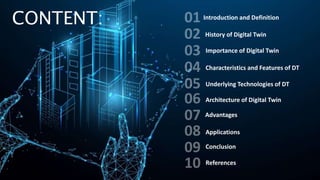
CONTENT:
History of Digital Twin
Introduction and Definition
Applications
Characteristics and Features of DT
Conclusion
References
01. INTRODUCTION
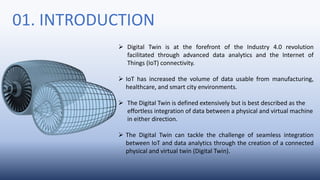
 Digital Twin is at the forefront of the Industry 4.0 revolution
facilitated through advanced data analytics and the Internet of
Things (IoT) connectivity.
 IoT has increased the volume of data usable from manufacturing,
healthcare, and smart city environments.
 The Digital Twin is defined extensively but is best described as the
effortless integration of data between a physical and virtual machine
in either direction.
 The Digital Twin can tackle the challenge of seamless integration
between IoT and data analytics through the creation of a connected
physical and virtual twin (Digital Twin).
 A digital twin is a digital representation or a
digital instantiation of a physical object,
process or a system that is used for various
purpose
 It include the virtual model of the physical
object, data from the object, a unique one-to-
one correspondence to the object and the
ability to monitor the object
 Digital twin contains sensors that collect data
to represent real time data of the physical
asset.
 The sensor data is collected, analysed and
used in predictive analytics by the digital twin
to optimize the product's performance via a
maintenance regime.
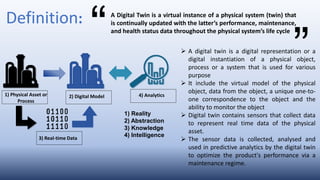
Definition: A Digital Twin is a virtual instance of a physical system (twin) that
is continually updated with the latter’s performance, maintenance,
and health status data throughout the physical system’s life cycle
1) Physical Asset or
Process
2) Digital Model 4) Analytics
3) Real-time Data
1) Reality
2) Abstraction
3) Knowledge
4) Intelligence
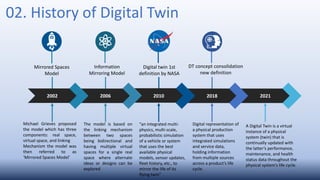
02. History of Digital Twin
2021
2018
2010
2006
2002
Michael Grieves proposed
the model which has three
components: real space,
virtual space, and linking
Mechanism the model was
then referred to as
‘Mirrored Spaces Model’
The model is based on
the linking mechanism
between two spaces
being bidirectional and
having multiple virtual
spaces for a single real
space where alternate
ideas or designs can be
explored
“an integrated multi-
physics, multi-scale,
probabilistic simulation
of a vehicle or system
that uses the best
available physical
models, sensor updates,
fleet history, etc., to
mirror the life of its
flying twin”
Digital representation of
a physical production
system that uses
integrated simulations
and service data,
holding information
from multiple sources
across a product’s life
cycle.
A Digital Twin is a virtual
instance of a physical
system (twin) that is
continually updated with
the latter’s performance,
maintenance, and health
status data throughout the
physical system’s life cycle.
Mirrored Spaces
Model
Information
Mirroring Model
Digital twin 1st
definition by NASA
DT concept consolidation
new definition
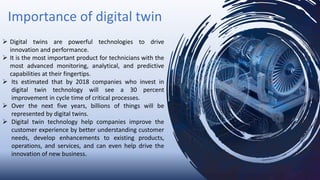
Importance of digital twin
 Digital twins are powerful technologies to drive
innovation and performance.
 It is the most important product for technicians with the
most advanced monitoring, analytical, and predictive
capabilities at their fingertips.
 Its estimated that by 2018 companies who invest in
digital twin technology will see a 30 percent
improvement in cycle time of critical processes.
 Over the next five years, billions of things will be
represented by digital twins.
 Digital twin technology help companies improve the
customer experience by better understanding customer
needs, develop enhancements to existing products,
operations, and services, and can even help drive the
innovation of new business.
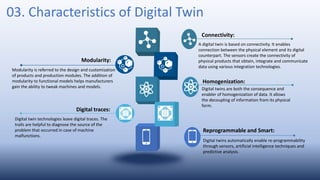
03. Characteristics of Digital Twin
A digital twin is based on connectivity. It enables
connection between the physical element and its digital
counterpart. The sensors create the connectivity of
physical products that obtain, integrate and communicate
data using various integration technologies.
Connectivity:
Modularity is referred to the design and customization
of products and production modules. The addition of
modularity to functional models helps manufacturers
gain the ability to tweak machines and models.
Modularity:
Digital twins are both the consequence and
enabler of homogenization of data. It allows
the decoupling of information from its physical
form.
Homogenization:
Digital twin technologies leave digital traces. The
trails are helpful to diagnose the source of the
problem that occurred in case of machine
malfunctions.
Digital traces:
Digital twins automatically enable re-programmability
through sensors, artificial intelligence techniques and
predictive analysis.
Reprogrammable and Smart:
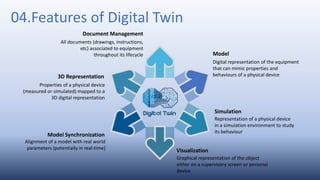
04.Features of Digital Twin
Graphical representation of the object
either on a supervisory screen or personal
device
Visualization
Representation of a physical device
in a simulation environment to study
its behaviour
Simulation
Digital representation of the equipment
that can mimic properties and
behaviours of a physical device
Model
Alignment of a model with real world
parameters (potentially in real-time)
Model Synchronization
Properties of a physical device
(measured or simulated) mapped to a
3D digital representation
3D Representation
All documents (drawings, instructions,
etc) associated to equipment
throughout its lifecycle
Document Management
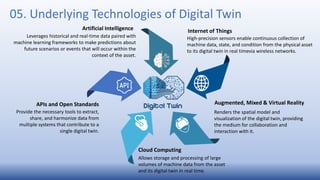
05. Underlying Technologies of Digital Twin
APIs and Open Standards
Provide the necessary tools to extract,
share, and harmonize data from
multiple systems that contribute to a
single digital twin.
Augmented, Mixed & Virtual Reality
Renders the spatial model and
visualization of the digital twin, providing
the medium for collaboration and
interaction with it.
Artificial Intelligence
Leverages historical and real-time data paired with
machine learning frameworks to make predictions about
future scenarios or events that will occur within the
context of the asset.
Internet of Things
High-precision sensors enable continuous collection of
machine data, state, and condition from the physical asset
to its digital twin in real timevia wireless networks.
Cloud Computing
Allows storage and processing of large
volumes of machine data from the asset
and its digital twin in real time.
Digital
twin
conceptual
architecture
06. Architecture
 The conceptual architecture may be
best understood as a sequence of six
steps, as follows :
 Create
 Communicate
 Aggregate
 Analyse
 Insight
 Act
 The digital twin application is usually
written in the primary system language of
the enterprise, which uses the above steps
to model the physical asset and processes.
 It is important to note that the above
conceptual architecture should be
designed for flexibility and scalability in
terms of analytics, processing, the number
of sensors and messages, etc.
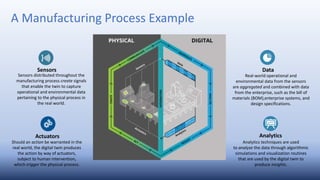
A Manufacturing Process Example
Data
Real-world operational and
environmental data from the sensors
are aggregated and combined with data
from the enterprise, such as the bill of
materials (BOM),enterprise systems, and
design specifications.
Analytics
Analytics techniques are used
to analyse the data through algorithmic
simulations and visualization routines
that are used by the digital twin to
produce insights.
Sensors
Sensors distributed throughout the
manufacturing process create signals
that enable the twin to capture
operational and environmental data
pertaining to the physical process in
the real world.
Actuators
Should an action be warranted in the
real world, the digital twin produces
the action by way of actuators,
subject to human intervention,
which trigger the physical process.
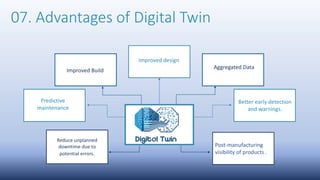
07. Advantages of Digital Twin
Predictive
maintenance
Reduce unplanned
downtime due to
potential errors.
Post-manufacturing
visibility of products:.
Improved Build
Better early detection
and warnings.
Aggregated Data
Improved design
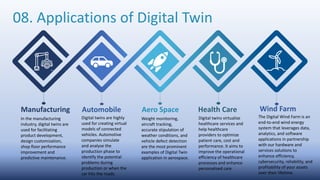
Automobile
Manufacturing Aero Space Health Care Wind Farm
08. Applications of Digital Twin
In the manufacturing
industry, digital twins are
used for facilitating
product development,
design customization,
shop floor performance
improvement and
predictive maintenance.
Digital twins are highly
used for creating virtual
models of connected
vehicles. Automotive
companies simulate
and analyse the
production phase to
identify the potential
problems during
production or when the
car hits the roads.
Weight monitoring,
aircraft tracking,
accurate stipulation of
weather conditions, and
vehicle defect detection
are the most prominent
examples of Digital Twin
application in aerospace.
Digital twins virtualize
healthcare services and
help healthcare
providers to optimize
patient care, cost and
performance. It aims to
improve the operational
efficiency of healthcare
processes and enhance
personalized care.
The Digital Wind Farm is an
end-to-end wind energy
system that leverages data,
analytics, and software
applications in partnership
with our hardware and
services solutions to
enhance efficiency,
cybersecurity, reliability, and
profitability of your assets
over their lifetime.
09. Conclusion
 A digital twin has many applications across the life cycle of a
product and may answer questions in real time that couldn’t be
answered before, providing kinds of value considered nearly
inconceivable just a few years ago.
 The digital twin may drive tangible value for companies, create
new revenue streams, and help them answer key strategic
questions.
 Digital twin technology combined with the latest machine learning
and artificial intelligence tools is helping companies across many
industries reduce operational costs, increase productivity, improve
performance, and change the way predictive maintenance is done.
REFERENCES
[1] A. Fuller, Z. Fan, C. Day and C. Barlow, "Digital Twin: Enabling
Technologies, Challenges and Open Research," in IEEE Access, vol. 8, pp.
108952-108971, 2020, doi: 10.1109/ACCESS.2020.2998358.
[2] N. Mohammadi and J. E. Taylor, ‘‘Smart city digital twins,’’ in Proc.
IEEE Symp. Ser. Comput. Intell. (SSCI), Nov. 2017, pp. 1–5.
[3] A.BilbergandA.A.Malik, “Digital twin driven human– robot
collaborative assembly,’’ CIRP Ann., vol. 68, no. 1, pp. 499–502, 2019.
[4] F. Tao, H. Zhang, A. Liu and A. Y. C. Nee, "Digital Twin in Industry:
State-of-the-Art," in IEEE Transactions on Industrial Informatics, vol. 15,
no. 4, pp. 2405-2415, April 2019, doi: 10.1109/TII.2018.2873186.
[5] F. Pires, A. Cachada, J. Barbosa, A. P. Moreira and P. Leitão, "Digital
Twin in Industry 4.0: Technologies, Applications and Challenges," 2019
IEEE 17th International Conference on Industrial Informatics (INDIN),
2019, pp. 721-726, doi: 10.1109/INDIN41052.2019.8972134.
THANK YOU

digital twin seminar 1.pptx

  • 1.
    HKBK COLLEGE OF ENGINEERING DIGITALTWIN TECHNOLOGY TECHNICAL SEMINAR ON
  • 2.
    By Mohammed Zainuddin 1HK18EC065 Guided By: Prof.Mohamed Jebran P Assistant prof. - Dept of E&C HKBKCE Bangalore
  • 3.
    Importance of DigitalTwin Underlying Technologies of DT Architecture of Digital Twin Advantages CONTENT: History of Digital Twin Introduction and Definition Applications Characteristics and Features of DT Conclusion References
  • 4.
    01. INTRODUCTION  DigitalTwin is at the forefront of the Industry 4.0 revolution facilitated through advanced data analytics and the Internet of Things (IoT) connectivity.  IoT has increased the volume of data usable from manufacturing, healthcare, and smart city environments.  The Digital Twin is defined extensively but is best described as the effortless integration of data between a physical and virtual machine in either direction.  The Digital Twin can tackle the challenge of seamless integration between IoT and data analytics through the creation of a connected physical and virtual twin (Digital Twin).
  • 5.
     A digitaltwin is a digital representation or a digital instantiation of a physical object, process or a system that is used for various purpose  It include the virtual model of the physical object, data from the object, a unique one-to- one correspondence to the object and the ability to monitor the object  Digital twin contains sensors that collect data to represent real time data of the physical asset.  The sensor data is collected, analysed and used in predictive analytics by the digital twin to optimize the product's performance via a maintenance regime. Definition: A Digital Twin is a virtual instance of a physical system (twin) that is continually updated with the latter’s performance, maintenance, and health status data throughout the physical system’s life cycle 1) Physical Asset or Process 2) Digital Model 4) Analytics 3) Real-time Data 1) Reality 2) Abstraction 3) Knowledge 4) Intelligence
  • 6.
    02. History ofDigital Twin 2021 2018 2010 2006 2002 Michael Grieves proposed the model which has three components: real space, virtual space, and linking Mechanism the model was then referred to as ‘Mirrored Spaces Model’ The model is based on the linking mechanism between two spaces being bidirectional and having multiple virtual spaces for a single real space where alternate ideas or designs can be explored “an integrated multi- physics, multi-scale, probabilistic simulation of a vehicle or system that uses the best available physical models, sensor updates, fleet history, etc., to mirror the life of its flying twin” Digital representation of a physical production system that uses integrated simulations and service data, holding information from multiple sources across a product’s life cycle. A Digital Twin is a virtual instance of a physical system (twin) that is continually updated with the latter’s performance, maintenance, and health status data throughout the physical system’s life cycle. Mirrored Spaces Model Information Mirroring Model Digital twin 1st definition by NASA DT concept consolidation new definition
  • 7.
    Importance of digitaltwin  Digital twins are powerful technologies to drive innovation and performance.  It is the most important product for technicians with the most advanced monitoring, analytical, and predictive capabilities at their fingertips.  Its estimated that by 2018 companies who invest in digital twin technology will see a 30 percent improvement in cycle time of critical processes.  Over the next five years, billions of things will be represented by digital twins.  Digital twin technology help companies improve the customer experience by better understanding customer needs, develop enhancements to existing products, operations, and services, and can even help drive the innovation of new business.
  • 8.
    03. Characteristics ofDigital Twin A digital twin is based on connectivity. It enables connection between the physical element and its digital counterpart. The sensors create the connectivity of physical products that obtain, integrate and communicate data using various integration technologies. Connectivity: Modularity is referred to the design and customization of products and production modules. The addition of modularity to functional models helps manufacturers gain the ability to tweak machines and models. Modularity: Digital twins are both the consequence and enabler of homogenization of data. It allows the decoupling of information from its physical form. Homogenization: Digital twin technologies leave digital traces. The trails are helpful to diagnose the source of the problem that occurred in case of machine malfunctions. Digital traces: Digital twins automatically enable re-programmability through sensors, artificial intelligence techniques and predictive analysis. Reprogrammable and Smart:
  • 9.
    04.Features of DigitalTwin Graphical representation of the object either on a supervisory screen or personal device Visualization Representation of a physical device in a simulation environment to study its behaviour Simulation Digital representation of the equipment that can mimic properties and behaviours of a physical device Model Alignment of a model with real world parameters (potentially in real-time) Model Synchronization Properties of a physical device (measured or simulated) mapped to a 3D digital representation 3D Representation All documents (drawings, instructions, etc) associated to equipment throughout its lifecycle Document Management
  • 10.
    05. Underlying Technologiesof Digital Twin APIs and Open Standards Provide the necessary tools to extract, share, and harmonize data from multiple systems that contribute to a single digital twin. Augmented, Mixed & Virtual Reality Renders the spatial model and visualization of the digital twin, providing the medium for collaboration and interaction with it. Artificial Intelligence Leverages historical and real-time data paired with machine learning frameworks to make predictions about future scenarios or events that will occur within the context of the asset. Internet of Things High-precision sensors enable continuous collection of machine data, state, and condition from the physical asset to its digital twin in real timevia wireless networks. Cloud Computing Allows storage and processing of large volumes of machine data from the asset and its digital twin in real time.
  • 11.
    Digital twin conceptual architecture 06. Architecture  Theconceptual architecture may be best understood as a sequence of six steps, as follows :  Create  Communicate  Aggregate  Analyse  Insight  Act  The digital twin application is usually written in the primary system language of the enterprise, which uses the above steps to model the physical asset and processes.  It is important to note that the above conceptual architecture should be designed for flexibility and scalability in terms of analytics, processing, the number of sensors and messages, etc.
  • 12.
    A Manufacturing ProcessExample Data Real-world operational and environmental data from the sensors are aggregated and combined with data from the enterprise, such as the bill of materials (BOM),enterprise systems, and design specifications. Analytics Analytics techniques are used to analyse the data through algorithmic simulations and visualization routines that are used by the digital twin to produce insights. Sensors Sensors distributed throughout the manufacturing process create signals that enable the twin to capture operational and environmental data pertaining to the physical process in the real world. Actuators Should an action be warranted in the real world, the digital twin produces the action by way of actuators, subject to human intervention, which trigger the physical process.
  • 13.
    07. Advantages ofDigital Twin Predictive maintenance Reduce unplanned downtime due to potential errors. Post-manufacturing visibility of products:. Improved Build Better early detection and warnings. Aggregated Data Improved design
  • 14.
    Automobile Manufacturing Aero SpaceHealth Care Wind Farm 08. Applications of Digital Twin In the manufacturing industry, digital twins are used for facilitating product development, design customization, shop floor performance improvement and predictive maintenance. Digital twins are highly used for creating virtual models of connected vehicles. Automotive companies simulate and analyse the production phase to identify the potential problems during production or when the car hits the roads. Weight monitoring, aircraft tracking, accurate stipulation of weather conditions, and vehicle defect detection are the most prominent examples of Digital Twin application in aerospace. Digital twins virtualize healthcare services and help healthcare providers to optimize patient care, cost and performance. It aims to improve the operational efficiency of healthcare processes and enhance personalized care. The Digital Wind Farm is an end-to-end wind energy system that leverages data, analytics, and software applications in partnership with our hardware and services solutions to enhance efficiency, cybersecurity, reliability, and profitability of your assets over their lifetime.
  • 15.
    09. Conclusion  Adigital twin has many applications across the life cycle of a product and may answer questions in real time that couldn’t be answered before, providing kinds of value considered nearly inconceivable just a few years ago.  The digital twin may drive tangible value for companies, create new revenue streams, and help them answer key strategic questions.  Digital twin technology combined with the latest machine learning and artificial intelligence tools is helping companies across many industries reduce operational costs, increase productivity, improve performance, and change the way predictive maintenance is done.
  • 16.
    REFERENCES [1] A. Fuller,Z. Fan, C. Day and C. Barlow, "Digital Twin: Enabling Technologies, Challenges and Open Research," in IEEE Access, vol. 8, pp. 108952-108971, 2020, doi: 10.1109/ACCESS.2020.2998358. [2] N. Mohammadi and J. E. Taylor, ‘‘Smart city digital twins,’’ in Proc. IEEE Symp. Ser. Comput. Intell. (SSCI), Nov. 2017, pp. 1–5. [3] A.BilbergandA.A.Malik, “Digital twin driven human– robot collaborative assembly,’’ CIRP Ann., vol. 68, no. 1, pp. 499–502, 2019. [4] F. Tao, H. Zhang, A. Liu and A. Y. C. Nee, "Digital Twin in Industry: State-of-the-Art," in IEEE Transactions on Industrial Informatics, vol. 15, no. 4, pp. 2405-2415, April 2019, doi: 10.1109/TII.2018.2873186. [5] F. Pires, A. Cachada, J. Barbosa, A. P. Moreira and P. Leitão, "Digital Twin in Industry 4.0: Technologies, Applications and Challenges," 2019 IEEE 17th International Conference on Industrial Informatics (INDIN), 2019, pp. 721-726, doi: 10.1109/INDIN41052.2019.8972134.
  • 17.