AERODYNAMIC
MODIFICATIONS TO THE
SHAPE OF THE BUILDINGS
1AERODYNAMIC MODIFICATIONS TO THE SHAPE OF BUILDINGS
INTRODUCTION
Tall structures are ;
• Flexible, low in damping, slender and light in weight.
• Sensitive to dynamic wind loads.
• Adversely affect the serviceability and occupant comfort.
• Oscillations are observed in the along-wind and crosswind directions and in
torsional mode.
• Behaviour of wind response is largely determined by building shapes.
• Aerodynamic optimization of building shapes is the most efficient way to achieve
wind resistant design.
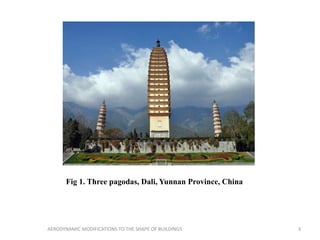
• In ancient China, tall buildings appear to be those of traditional pagodas.
2AERODYNAMIC MODIFICATIONS TO THE SHAPE OF BUILDINGS
Fig 1. Three pagodas, Dali, Yunnan Province, China
3AERODYNAMIC MODIFICATIONS TO THE SHAPE OF BUILDINGS
• Built 1180 years ago.
• Tallest one is 69.13m in height and that of the other two is 42.19m.
• Experienced the extremely strong earthquakes of 1514 and 1925 also strong winds.
Survived.
• Increased inherent damping & weight.
• Width tapered along the height.
• Thus reducing wind loads.
4AERODYNAMIC MODIFICATIONS TO THE SHAPE OF BUILDINGS
AERODYNAMIC FORCES ON BUILDINGS
• Drag forces (along-wind) - act in the direction of the mean flow.
• Lift forces (across-wind) -act perpendicular to the direction of mean wind flow
• Torsional moments - developed due to imbalance in the instantaneous pressure
distribution on each face of the building
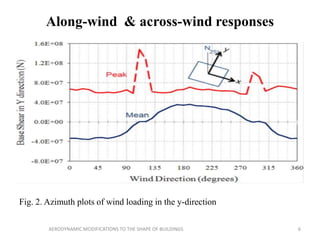
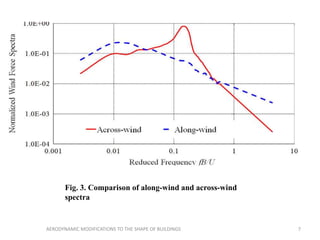
• The crosswind and torsional responses may exceed the along-wind response
5AERODYNAMIC MODIFICATIONS TO THE SHAPE OF BUILDINGS
Along-wind & across-wind responses
6
Fig. 2. Azimuth plots of wind loading in the y-direction
AERODYNAMIC MODIFICATIONS TO THE SHAPE OF BUILDINGS
Fig. 3. Comparison of along-wind and across-wind
spectra
7AERODYNAMIC MODIFICATIONS TO THE SHAPE OF BUILDINGS
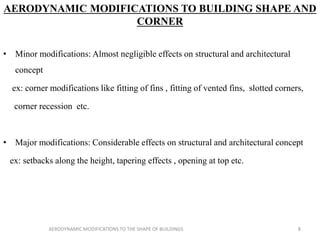
AERODYNAMIC MODIFICATIONS TO BUILDING SHAPE AND
CORNER
• Minor modifications: Almost negligible effects on structural and architectural
concept
ex: corner modifications like fitting of fins , fitting of vented fins, slotted corners,
corner recession etc.
• Major modifications: Considerable effects on structural and architectural concept
ex: setbacks along the height, tapering effects , opening at top etc.
8AERODYNAMIC MODIFICATIONS TO THE SHAPE OF BUILDINGS
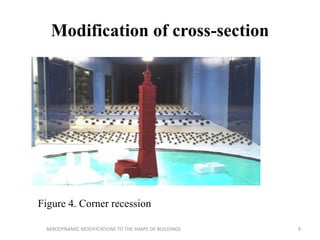
Modification of cross-section
Figure 4. Corner recession
9AERODYNAMIC MODIFICATIONS TO THE SHAPE OF BUILDINGS
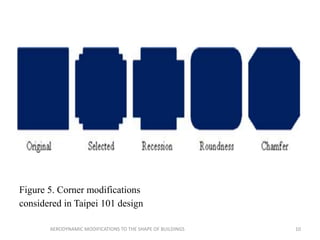
Figure 5. Corner modifications
considered in Taipei 101 design
10AERODYNAMIC MODIFICATIONS TO THE SHAPE OF BUILDINGS
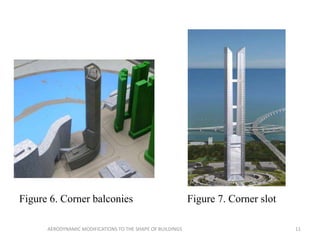
Figure 6. Corner balconies Figure 7. Corner slot
11AERODYNAMIC MODIFICATIONS TO THE SHAPE OF BUILDINGS
Effects of Fins and Vented fins
• Significant effects on the along-wind and crosswind response characteristics.
• Helps to alleviate negative pressures under the separated shear layers on the side
faces.
• An apparent reduction in galloping response when vented fins are fitted.
• Useful only for certain range of reduced wind velocities.
• Fitting of fins and vented fins causes noticeable increase in the along-wind response.
• Increased projected area.
• Increased effective width.
• Not beneficial
12AERODYNAMIC MODIFICATIONS TO THE SHAPE OF BUILDINGS
Effects of Slotted corners, Chamfered corners and Corner recession
• Significant reduction in along-wind and cross-wind responses.
• Recessed corners- for building height 240m to 280m.
• Construction cost reduced.
• Ex: Industries Yokohama Mitsubishi Heavy Building, , Taipei101 building.
13AERODYNAMIC MODIFICATIONS TO THE SHAPE OF BUILDINGS
Effect of roundness of corners
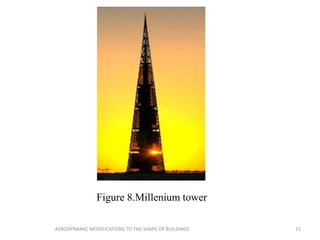
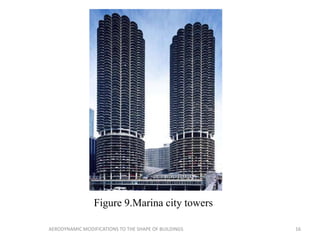
• Improves aerodynamic behaviour against wind excitation.
• Circular cross-section produces the lowest response.
• Allow greater building height at comparatively lower cost.
• Modest rounding of corners up to 10% does not significantly reduce the crosswind
response.
• Ex: The Millennium Tower in Tokyo , Shreepati Skies Tower, Mumbai, and Marina
City towers in Chicago
14AERODYNAMIC MODIFICATIONS TO THE SHAPE OF BUILDINGS
Figure 8.Millenium tower
15AERODYNAMIC MODIFICATIONS TO THE SHAPE OF BUILDINGS
Figure 9.Marina city towers
16AERODYNAMIC MODIFICATIONS TO THE SHAPE OF BUILDINGS
Effects of tapering
• Alters the flow pattern around the building
• Reduce wind induced excitation
• Reduction of transverse periodic loading
• Reduce cross wind forces
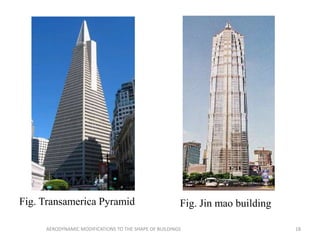
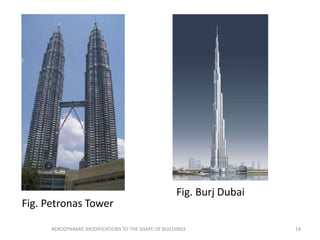
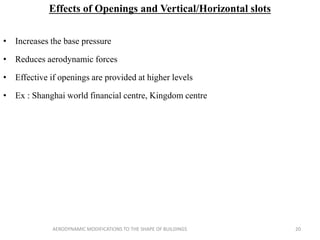
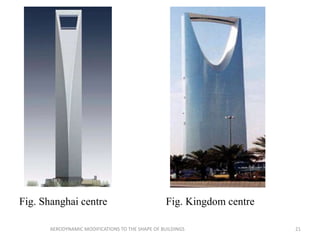
• Transamerica pyramid, Jin mao building, Petronas tower, Millenium tower, Burj
Dubai etc.
17AERODYNAMIC MODIFICATIONS TO THE SHAPE OF BUILDINGS
Fig. Transamerica Pyramid Fig. Jin mao building
18AERODYNAMIC MODIFICATIONS TO THE SHAPE OF BUILDINGS
Fig. Petronas Tower
Fig. Burj Dubai
19AERODYNAMIC MODIFICATIONS TO THE SHAPE OF BUILDINGS
Effects of Openings and Vertical/Horizontal slots
• Increases the base pressure
• Reduces aerodynamic forces
• Effective if openings are provided at higher levels
• Ex : Shanghai world financial centre, Kingdom centre
20AERODYNAMIC MODIFICATIONS TO THE SHAPE OF BUILDINGS
Fig. Shanghai centre Fig. Kingdom centre
21AERODYNAMIC MODIFICATIONS TO THE SHAPE OF BUILDINGS
Effect of twisting of buildings
• An interesting approach to be employed for today’s tall buildings.
• Minimize the wind loads from prevailing direction
• does not coincide with the strongest wind direction
• Avoid the simultaneous vortex shedding along the height of the building
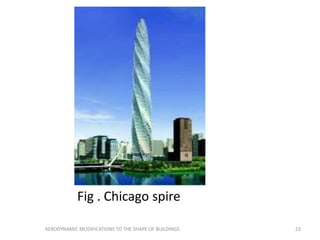
• Ex: Chicago spire , Shanghai Centre
22AERODYNAMIC MODIFICATIONS TO THE SHAPE OF BUILDINGS
Fig . Chicago spire
23AERODYNAMIC MODIFICATIONS TO THE SHAPE OF BUILDINGS
CONCLUSION
• Tapering effect has a more significant effect in across-wind direction.
• A potential mutual-effect between the optimization through twisting and
optimization through building orientation, should be considered.
• The corner roundness is the most effective to suppress the aero elastic instability for
a square building.
• Through the building opening along the along-wind and crosswind direction ,
particularly at top significantly reduces the wind excitation of the building
• Tapering and stepping can reduce across-wind responses
24AERODYNAMIC MODIFICATIONS TO THE SHAPE OF BUILDINGS
REFERENCES
1.Davenport, The response of super tall buildings to wind, second century of the
skyscraper, council of tall buildings and urban habitat, 1988, pp. 705-725.
2.Karim A. Mitigation of Wind induced motion of tall building, Journal of Wind
Engineering and Industrial Aerodynamics, 11(1983) 273-84.
3. Kwok KCS, Bailey PA. Aerodynamic devices for tall building and structures,
Journal of Engineering Mechanics, ASCE, No. 4, 111(1987)349-65.
4. Kwok KCS. Effects of building shape on wind-induced response of tall buildings,
Journal of Wind Engineering and Industrial Aerodynamics, 28(1988) 381-90.
25AERODYNAMIC MODIFICATIONS TO THE SHAPE OF BUILDINGS
THANKYOU.....
26AERODYNAMIC MODIFICATIONS TO THE SHAPE OF BUILDINGS

Shahul

  • 1.
    AERODYNAMIC MODIFICATIONS TO THE SHAPEOF THE BUILDINGS 1AERODYNAMIC MODIFICATIONS TO THE SHAPE OF BUILDINGS
  • 2.
    INTRODUCTION Tall structures are; • Flexible, low in damping, slender and light in weight. • Sensitive to dynamic wind loads. • Adversely affect the serviceability and occupant comfort. • Oscillations are observed in the along-wind and crosswind directions and in torsional mode. • Behaviour of wind response is largely determined by building shapes. • Aerodynamic optimization of building shapes is the most efficient way to achieve wind resistant design. • In ancient China, tall buildings appear to be those of traditional pagodas. 2AERODYNAMIC MODIFICATIONS TO THE SHAPE OF BUILDINGS
  • 3.
    Fig 1. Threepagodas, Dali, Yunnan Province, China 3AERODYNAMIC MODIFICATIONS TO THE SHAPE OF BUILDINGS
  • 4.
    • Built 1180years ago. • Tallest one is 69.13m in height and that of the other two is 42.19m. • Experienced the extremely strong earthquakes of 1514 and 1925 also strong winds. Survived. • Increased inherent damping & weight. • Width tapered along the height. • Thus reducing wind loads. 4AERODYNAMIC MODIFICATIONS TO THE SHAPE OF BUILDINGS
  • 5.
    AERODYNAMIC FORCES ONBUILDINGS • Drag forces (along-wind) - act in the direction of the mean flow. • Lift forces (across-wind) -act perpendicular to the direction of mean wind flow • Torsional moments - developed due to imbalance in the instantaneous pressure distribution on each face of the building • The crosswind and torsional responses may exceed the along-wind response 5AERODYNAMIC MODIFICATIONS TO THE SHAPE OF BUILDINGS
  • 6.
    Along-wind & across-windresponses 6 Fig. 2. Azimuth plots of wind loading in the y-direction AERODYNAMIC MODIFICATIONS TO THE SHAPE OF BUILDINGS
  • 7.
    Fig. 3. Comparisonof along-wind and across-wind spectra 7AERODYNAMIC MODIFICATIONS TO THE SHAPE OF BUILDINGS
  • 8.
    AERODYNAMIC MODIFICATIONS TOBUILDING SHAPE AND CORNER • Minor modifications: Almost negligible effects on structural and architectural concept ex: corner modifications like fitting of fins , fitting of vented fins, slotted corners, corner recession etc. • Major modifications: Considerable effects on structural and architectural concept ex: setbacks along the height, tapering effects , opening at top etc. 8AERODYNAMIC MODIFICATIONS TO THE SHAPE OF BUILDINGS
  • 9.
    Modification of cross-section Figure4. Corner recession 9AERODYNAMIC MODIFICATIONS TO THE SHAPE OF BUILDINGS
  • 10.
    Figure 5. Cornermodifications considered in Taipei 101 design 10AERODYNAMIC MODIFICATIONS TO THE SHAPE OF BUILDINGS
  • 11.
    Figure 6. Cornerbalconies Figure 7. Corner slot 11AERODYNAMIC MODIFICATIONS TO THE SHAPE OF BUILDINGS
  • 12.
    Effects of Finsand Vented fins • Significant effects on the along-wind and crosswind response characteristics. • Helps to alleviate negative pressures under the separated shear layers on the side faces. • An apparent reduction in galloping response when vented fins are fitted. • Useful only for certain range of reduced wind velocities. • Fitting of fins and vented fins causes noticeable increase in the along-wind response. • Increased projected area. • Increased effective width. • Not beneficial 12AERODYNAMIC MODIFICATIONS TO THE SHAPE OF BUILDINGS
  • 13.
    Effects of Slottedcorners, Chamfered corners and Corner recession • Significant reduction in along-wind and cross-wind responses. • Recessed corners- for building height 240m to 280m. • Construction cost reduced. • Ex: Industries Yokohama Mitsubishi Heavy Building, , Taipei101 building. 13AERODYNAMIC MODIFICATIONS TO THE SHAPE OF BUILDINGS
  • 14.
    Effect of roundnessof corners • Improves aerodynamic behaviour against wind excitation. • Circular cross-section produces the lowest response. • Allow greater building height at comparatively lower cost. • Modest rounding of corners up to 10% does not significantly reduce the crosswind response. • Ex: The Millennium Tower in Tokyo , Shreepati Skies Tower, Mumbai, and Marina City towers in Chicago 14AERODYNAMIC MODIFICATIONS TO THE SHAPE OF BUILDINGS
  • 15.
    Figure 8.Millenium tower 15AERODYNAMICMODIFICATIONS TO THE SHAPE OF BUILDINGS
  • 16.
    Figure 9.Marina citytowers 16AERODYNAMIC MODIFICATIONS TO THE SHAPE OF BUILDINGS
  • 17.
    Effects of tapering •Alters the flow pattern around the building • Reduce wind induced excitation • Reduction of transverse periodic loading • Reduce cross wind forces • Transamerica pyramid, Jin mao building, Petronas tower, Millenium tower, Burj Dubai etc. 17AERODYNAMIC MODIFICATIONS TO THE SHAPE OF BUILDINGS
  • 18.
    Fig. Transamerica PyramidFig. Jin mao building 18AERODYNAMIC MODIFICATIONS TO THE SHAPE OF BUILDINGS
  • 19.
    Fig. Petronas Tower Fig.Burj Dubai 19AERODYNAMIC MODIFICATIONS TO THE SHAPE OF BUILDINGS
  • 20.
    Effects of Openingsand Vertical/Horizontal slots • Increases the base pressure • Reduces aerodynamic forces • Effective if openings are provided at higher levels • Ex : Shanghai world financial centre, Kingdom centre 20AERODYNAMIC MODIFICATIONS TO THE SHAPE OF BUILDINGS
  • 21.
    Fig. Shanghai centreFig. Kingdom centre 21AERODYNAMIC MODIFICATIONS TO THE SHAPE OF BUILDINGS
  • 22.
    Effect of twistingof buildings • An interesting approach to be employed for today’s tall buildings. • Minimize the wind loads from prevailing direction • does not coincide with the strongest wind direction • Avoid the simultaneous vortex shedding along the height of the building • Ex: Chicago spire , Shanghai Centre 22AERODYNAMIC MODIFICATIONS TO THE SHAPE OF BUILDINGS
  • 23.
    Fig . Chicagospire 23AERODYNAMIC MODIFICATIONS TO THE SHAPE OF BUILDINGS
  • 24.
    CONCLUSION • Tapering effecthas a more significant effect in across-wind direction. • A potential mutual-effect between the optimization through twisting and optimization through building orientation, should be considered. • The corner roundness is the most effective to suppress the aero elastic instability for a square building. • Through the building opening along the along-wind and crosswind direction , particularly at top significantly reduces the wind excitation of the building • Tapering and stepping can reduce across-wind responses 24AERODYNAMIC MODIFICATIONS TO THE SHAPE OF BUILDINGS
  • 25.
    REFERENCES 1.Davenport, The responseof super tall buildings to wind, second century of the skyscraper, council of tall buildings and urban habitat, 1988, pp. 705-725. 2.Karim A. Mitigation of Wind induced motion of tall building, Journal of Wind Engineering and Industrial Aerodynamics, 11(1983) 273-84. 3. Kwok KCS, Bailey PA. Aerodynamic devices for tall building and structures, Journal of Engineering Mechanics, ASCE, No. 4, 111(1987)349-65. 4. Kwok KCS. Effects of building shape on wind-induced response of tall buildings, Journal of Wind Engineering and Industrial Aerodynamics, 28(1988) 381-90. 25AERODYNAMIC MODIFICATIONS TO THE SHAPE OF BUILDINGS
  • 26.