
The Aerodynamic Behaviour of
Super Slender Monolithic Towers
Danai Iris Anagnostopulos
S. Cammelli, BMT Fluid MechanicsG. Piccardo, Università di Genova
31/03/2016
Introduction
D. Anagnostopulos The Aerodynamic Behaviour of Super Slender Monolithic Towers
Super slender towers
432 Park Avenue in New York
111 West 57th Street in New York
 Impressively high ratio
between height and
width
 More and more popular
among the residential
real estate market
 Lighter, flexible, less
structural damping:
intrinsic vulnerability to
wind action
Slenderness ratio 15:1
Slenderness ratio 24:1
3
Introduction
D. Anagnostopulos The Aerodynamic Behaviour of Super Slender Monolithic Towers
A tall building is like a swing
 Resonant condition:
Critical wind speed 𝑣𝑐𝑟 for which 𝑓𝑠 =𝑓𝑏,𝑖
 Low fundamental frequencies 𝑓𝑏,𝑖 thus
require lower critical wind speed for
resonance
 Possible vortex shedding excitation on:
• First order mode of vibration
• Second order mode of vibration
The importance of vortex shedding
,
,
b im
s cr i
f BSt v
f v
B St

  
wt flow
4
Introduction
D. Anagnostopulos The Aerodynamic Behaviour of Super Slender Monolithic Towers
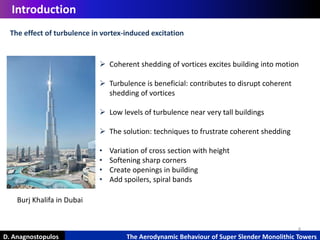
 Coherent shedding of vortices excites building into motion
 Turbulence is beneficial: contributes to disrupt coherent
shedding of vortices
 Low levels of turbulence near very tall buildings
 The solution: techniques to frustrate coherent shedding
• Variation of cross section with height
• Softening sharp corners
• Create openings in building
• Add spoilers, spiral bands
The effect of turbulence in vortex-induced excitation
Burj Khalifa in Dubai
5
D. Anagnostopulos The Aerodynamic Behaviour of Super Slender Monolithic Towers
Aim of the work
Ideal structure and its location
Pressure data analysis
The design of aeroelastic and pressure models
Structural response analysis
Setup of aeroelastic tests
Outline of this presentation
Investigate the importance of vortex shedding excitation in supertall slender monolithic
towers at various mean wind velocities associated with different return periods
Wind tunnel tests
• on scaled pressure model: static
• on scaled aeroelastic model: able to reproduce the main dynamic characteristics of
the structure
Preliminary conclusions and prospects of this work
6
D. Anagnostopulos The Aerodynamic Behaviour of Super Slender Monolithic Towers
Ideal structure and its location
Structural Properties
Full Scale Properties
B [m] 20.00
B [m] 20.00
r [m] 2.00
Floor Area [m2] 396.57
Height of building [m] 400.00
Volume [m3] 158626.55
Density [Kg/m3] 250.00
Mass x unit height[Kg/m] 99141.59
Frequency Frequency
1st order mode 2nd order mode
(Hz) (Hz)
0.08 0.24
𝑛2𝑜𝑟𝑑𝑒𝑟
𝑛1𝑜𝑟𝑑𝑒𝑟
≈ 3.0
Dynamic Properties
Slenderness ratio
20:1
7
D. Anagnostopulos The Aerodynamic Behaviour of Super Slender Monolithic Towers
Ideal structure and its location
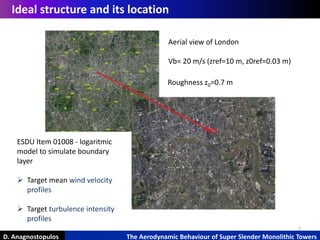
Aerial view of London
Vb= 20 m/s (zref=10 m, z0ref=0.03 m)
ESDU Item 01008 - logaritmic
model to simulate boundary
layer
 Target mean wind velocity
profiles
 Target turbulence intensity
profiles
Roughness z0=0.7 m
8
D. Anagnostopulos The Aerodynamic Behaviour of Super Slender Monolithic Towers
Ideal structure and its location
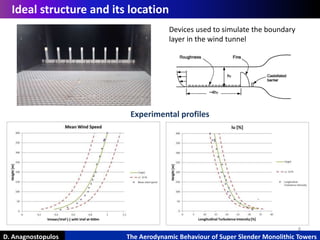
Devices used to simulate the boundary
layer in the wind tunnel
Experimental profiles
9
D. Anagnostopulos The Aerodynamic Behaviour of Super Slender Monolithic Towers
Design of the aeroelastic model
Scaling parameters
Froude Number
Cauchy Number
Reynolds Number
Density parameter
Damping Ratio
Quantity Scaling Factor
Length 𝑓𝐿=𝐿 𝑚/𝐿 𝑝=1:400
Air density 𝑓∆=1:1
Mass 𝑓∆x𝑓𝐿
3
=1:4003
Structural Damping Ratio f=1:1
Fundamental Frequencies 𝑓𝑇= 𝑓𝑚/𝑓𝑝
Wind Velocity 𝑓𝑉= 𝑓𝑇x𝑓𝐿
Time 𝑓𝑡=1/𝑓𝑇
Force 𝑓𝐹= 𝑓𝛥x𝑓𝑉
2
x𝑓𝐿
2
Bending Moment 𝑓 𝑀= 𝑓𝛥x𝑓𝑉
2
x𝑓𝐿
3
Acceleration 𝑓𝐴=𝑓𝐿/𝑓𝑡
2
Full Scale Properties Model Scale Properties
B [m] 20.0 B [m] 0.05
r [m] 2.0 r [m] 0.01
Floor Area [m2] 396.6 Floor Area [m2] 0.002
Height of building [m] 400.0 Height of building [m] 1.00
Volume [m3] 158626.5 Volume [m3] 0.002
Density [Kg/m3] 250.0 Density [Kg/m3] 250.0
Mass x unit height[Kg/m] 99141.6 Mass x unit height[Kg/m] 0.6
Similitudine requirements
 Approach used only for very important
structures
 Most reliable approach to predict
building’s dynamic response to wind
action
 Simulates: mass, stiffness, damping of
actual structure
 Flexes in response to the wind as the
real structure
10
D. Anagnostopulos The Aerodynamic Behaviour of Super Slender Monolithic Towers
Design of the aeroelastic model
Construction of the
tapered brass spine
 Brass Spine: internal structural part reproduces the stiffness properties and part of the mass
 Outer Shell: reproduces the exterior geometry and part of the mass
Aeroelastic model composed by:
11
D. Anagnostopulos The Aerodynamic Behaviour of Super Slender Monolithic Towers
Design of the aeroelastic model
TABLE: Modal Periods And Frequencies
OutputCase StepType StepNum Period SAPFrequency
Text Text Unitless Sec Cyc/sec
MODAL Mode 1 0.09 11.09
MODAL Mode 2 0.07 14.88
MODAL Mode 3 0.03 29.98
MODAL Mode 4 0.03 39.66
MODAL Mode 5 0.02 47.60
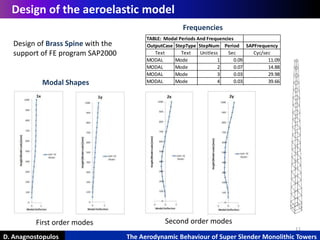
Design of Brass Spine with the
support of FE program SAP2000
Modal Shapes
Frequencies
First order modes Second order modes
12
D. Anagnostopulos The Aerodynamic Behaviour of Super Slender Monolithic Towers
Design of the aeroelastic model
Construction
Outer Shell
Complete aeroelastic model
Density SLS thikness Vtot shell Mass shell
[kg/m3] [m] [m3] [kg]
900 0.002 0.0004 0.330
 Derived by selective laser sintering
 Formed by 10 vertical segments
 1mm gap in between the segments
Instrumentation
Accelerometers  2 at the top
 2 at the antinode
13
D. Anagnostopulos The Aerodynamic Behaviour of Super Slender Monolithic Towers
Design of the static model
2
0,5ρ
refP P
cp
v


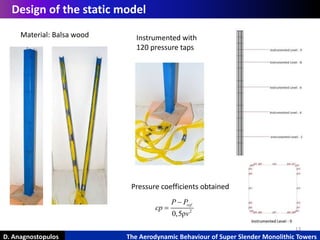
Material: Balsa wood Instrumented with
120 pressure taps
Pressure coefficients obtained
14
D. Anagnostopulos The Aerodynamic Behaviour of Super Slender Monolithic Towers
Setup of aeroelastic tests
Calibration
Mode shapes
check
Frequency check
SAP Model WT Model
Mode Direction Frequency [Hz] Frequency [Hz]
1 X-Along 11.1 12.4
1 Y-Cross 14.9 13.8
2 X-Along 30.0 28.7
2 Y-Cross 39.7 44.0
𝑛2𝑜𝑟𝑑𝑒𝑟𝑊𝑇
𝑛1𝑜𝑟𝑑𝑒𝑟𝑊𝑇
= 3.3
15
D. Anagnostopulos The Aerodynamic Behaviour of Super Slender Monolithic Towers
Setup of aeroelastic tests
Damping check
ξ 𝑠 =
𝐿𝑜𝑔𝐷𝑒𝑐
2𝜋
Tecniques to augment damping:
good results with tape
Log Dec % Critical
Mode 1x 0.04 ≈ 0.63
Mode 1y 0.04 ≈ 0.58
Mode 2x 0.03 ≈ 0.45
Mode 2y 0.03 ≈ 0.49
“String burn” technique to determine
the logarithmic decrement in wind-off
conditions
16
D. Anagnostopulos The Aerodynamic Behaviour of Super Slender Monolithic Towers
Aeroelastic and pressure tests
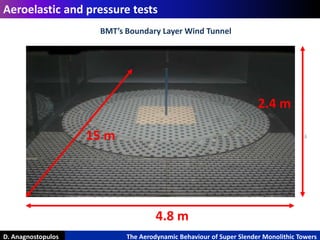
BMT’s Boundary Layer Wind Tunnel
4.8 m
2.4 m
15 m
17
D. Anagnostopulos The Aerodynamic Behaviour of Super Slender Monolithic Towers
Aeroelastic and pressure tests
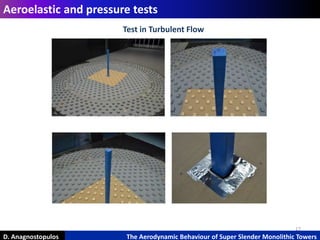
Test in Turbulent Flow
18
Aeroelastic and pressure tests
D. Anagnostopulos The Aerodynamic Behaviour of Super Slender Monolithic Towers
Summarizing
Aeroelastic Test
 Turbulent Flow: Range of wind velocities (model scale) 3-20 m/s with 0.25 m/s step crosswind;
Sample time 1 min for each run
 Smooth Flow: Range of wind velocities (model scale) 3-20 m/s with 0.5 m/s step crosswind; Sample
time 1 min for each run
 Turbulent Flow with adjuncted damping: Range of wind velocities (model scale) 3-20 m/s with 0.5
m/s step crosswind; Sample time 1 min for each run
Approximately 12 hours of acquisition in the wind tunnel
Pressure Test
 Turbulent Flow: Run at a velocy (model scale) 17.5 m/s with angle of attacks 0°, 90°, 180°, 270°.
Approximately 1 hour of acquisition in the wind tunnel
Test in Smooth Flow
19
D. Anagnostopulos The Aerodynamic Behaviour of Super Slender Monolithic Towers
Pressure data analysis
Pressure
coefficients,
mean values
D. Anagnostopulos The Aerodynamic Behaviour of Super Slender Monolithic Towers
Pressure data analysis
The crosswind correlation
becomes very weak at a distance
equal to 120 m (i.e. 6 times the
cross-section side), similarly to
classic formulation in the
technical literature (e.g., the
harmonic method in EC1/CNR)
z Correl coeff Correl coeff
[m] cross along
340 1.00 1.00
300 0.64 0.73
220 0.12 0.46
140 0.01 0.33
,
,
( )i j
i j
i j
Cpp

 

,
1
1
( ) ( )( )
n
i j hi hi hj hj
h
Cpp cp mcp cp mcp
n 
  
21
D. Anagnostopulos The Aerodynamic Behaviour of Super Slender Monolithic Towers
Structural response analysis
𝑆𝑐𝑖 =
4𝜋𝑚 𝑒,𝑖ξ 𝑖
𝜌𝐵2
m ξ ρ B Sc,i
[Kg/m] [-] [Kg/m3] m [-]
mode 1y 99141 0.0058 1.25 20 14
mode 2y 99141 0.0049 1.25 20 12
Scruton Number
CNR
Low structural frequencies lead to resonance for both first and second order mode of vibration
Critical velocities migrate along the axis of the structure:
 First order mode excited by vortex shedding for low wind speeds, at the top
 Second order mode excited by higher velocities and has to be analysed for more critical
positions with regards to vortex shedding
Low values of Scruton Number show that the structure
is sensible to vibrations induced by vortex shedding
D. Anagnostopulos The Aerodynamic Behaviour of Super Slender Monolithic Towers
Structural response analysis
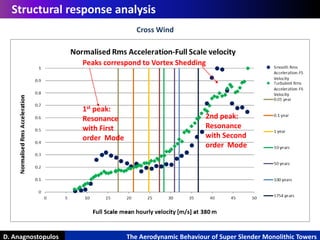
Cross Wind
1st peak:
Resonance
with First
order Mode
2nd peak:
Resonance
with Second
order Mode
Peaks correspond to Vortex Shedding
23
D. Anagnostopulos The Aerodynamic Behaviour of Super Slender Monolithic Towers
Structural response analysis
Videos in Turbulent Flow
Left Run at a Velocity (full
scale) of 16 m/s
Right Run at a Velocity
(full scale) of 42 m/s
shows there is vortex
shedding also in the along
wind direction
Data have been filtered to highlight the contribution of different modes
wt flowwt flow
For velocities higher than 30 m/s the contribution of second order mode is dominant
24
D. Anagnostopulos The Aerodynamic Behaviour of Super Slender Monolithic Towers
Structural response analysis
Values of peak factor < 3 indicates that
vortex shedding is occurring; here the
response is harmonic (deterministic)
Typical peak factor values for tall
buildings around 3-4
25
D. Anagnostopulos The Aerodynamic Behaviour of Super Slender Monolithic Towers
Preliminary conclusions and prospects of the work
Utility of the static pressure test
 Qualitative behaviour of the section
 Calculation of correlation coefficient
Utility of dynamic aeroelastic test
 Very interesting experimental results that highlight the importance of the secod order
mode of vibration for the design of the structure have been obtained, in particular for
the turbulent flow
 Some aspects need to be analyzed more in depth, for example the possible coupling
alongwind-crosswind and the total damping (for the moment, has been obtained with the
random decrement tecnique)
Not all the obtained data have been processed and some obtained results need to be
interpreted more in depth
At the present moment there is no specific scientific literature on this subject
Prospects of this work
It seems very interesting to:
 investigate the behaviour at the antinode of the 2nd order mode
 compare experimental results with the theory of slender elements (3D gust effect factor)

Msc thesis Anagnostopulos Danai Iris

  • 1.
    The Aerodynamic Behaviourof Super Slender Monolithic Towers Danai Iris Anagnostopulos S. Cammelli, BMT Fluid MechanicsG. Piccardo, Università di Genova 31/03/2016
  • 2.
    Introduction D. Anagnostopulos TheAerodynamic Behaviour of Super Slender Monolithic Towers Super slender towers 432 Park Avenue in New York 111 West 57th Street in New York  Impressively high ratio between height and width  More and more popular among the residential real estate market  Lighter, flexible, less structural damping: intrinsic vulnerability to wind action Slenderness ratio 15:1 Slenderness ratio 24:1
  • 3.
    3 Introduction D. Anagnostopulos TheAerodynamic Behaviour of Super Slender Monolithic Towers A tall building is like a swing  Resonant condition: Critical wind speed 𝑣𝑐𝑟 for which 𝑓𝑠 =𝑓𝑏,𝑖  Low fundamental frequencies 𝑓𝑏,𝑖 thus require lower critical wind speed for resonance  Possible vortex shedding excitation on: • First order mode of vibration • Second order mode of vibration The importance of vortex shedding , , b im s cr i f BSt v f v B St     wt flow
  • 4.
    4 Introduction D. Anagnostopulos TheAerodynamic Behaviour of Super Slender Monolithic Towers  Coherent shedding of vortices excites building into motion  Turbulence is beneficial: contributes to disrupt coherent shedding of vortices  Low levels of turbulence near very tall buildings  The solution: techniques to frustrate coherent shedding • Variation of cross section with height • Softening sharp corners • Create openings in building • Add spoilers, spiral bands The effect of turbulence in vortex-induced excitation Burj Khalifa in Dubai
  • 5.
    5 D. Anagnostopulos TheAerodynamic Behaviour of Super Slender Monolithic Towers Aim of the work Ideal structure and its location Pressure data analysis The design of aeroelastic and pressure models Structural response analysis Setup of aeroelastic tests Outline of this presentation Investigate the importance of vortex shedding excitation in supertall slender monolithic towers at various mean wind velocities associated with different return periods Wind tunnel tests • on scaled pressure model: static • on scaled aeroelastic model: able to reproduce the main dynamic characteristics of the structure Preliminary conclusions and prospects of this work
  • 6.
    6 D. Anagnostopulos TheAerodynamic Behaviour of Super Slender Monolithic Towers Ideal structure and its location Structural Properties Full Scale Properties B [m] 20.00 B [m] 20.00 r [m] 2.00 Floor Area [m2] 396.57 Height of building [m] 400.00 Volume [m3] 158626.55 Density [Kg/m3] 250.00 Mass x unit height[Kg/m] 99141.59 Frequency Frequency 1st order mode 2nd order mode (Hz) (Hz) 0.08 0.24 𝑛2𝑜𝑟𝑑𝑒𝑟 𝑛1𝑜𝑟𝑑𝑒𝑟 ≈ 3.0 Dynamic Properties Slenderness ratio 20:1
  • 7.
    7 D. Anagnostopulos TheAerodynamic Behaviour of Super Slender Monolithic Towers Ideal structure and its location Aerial view of London Vb= 20 m/s (zref=10 m, z0ref=0.03 m) ESDU Item 01008 - logaritmic model to simulate boundary layer  Target mean wind velocity profiles  Target turbulence intensity profiles Roughness z0=0.7 m
  • 8.
    8 D. Anagnostopulos TheAerodynamic Behaviour of Super Slender Monolithic Towers Ideal structure and its location Devices used to simulate the boundary layer in the wind tunnel Experimental profiles
  • 9.
    9 D. Anagnostopulos TheAerodynamic Behaviour of Super Slender Monolithic Towers Design of the aeroelastic model Scaling parameters Froude Number Cauchy Number Reynolds Number Density parameter Damping Ratio Quantity Scaling Factor Length 𝑓𝐿=𝐿 𝑚/𝐿 𝑝=1:400 Air density 𝑓∆=1:1 Mass 𝑓∆x𝑓𝐿 3 =1:4003 Structural Damping Ratio f=1:1 Fundamental Frequencies 𝑓𝑇= 𝑓𝑚/𝑓𝑝 Wind Velocity 𝑓𝑉= 𝑓𝑇x𝑓𝐿 Time 𝑓𝑡=1/𝑓𝑇 Force 𝑓𝐹= 𝑓𝛥x𝑓𝑉 2 x𝑓𝐿 2 Bending Moment 𝑓 𝑀= 𝑓𝛥x𝑓𝑉 2 x𝑓𝐿 3 Acceleration 𝑓𝐴=𝑓𝐿/𝑓𝑡 2 Full Scale Properties Model Scale Properties B [m] 20.0 B [m] 0.05 B [m] 20.0 B [m] 0.05 r [m] 2.0 r [m] 0.01 Floor Area [m2] 396.6 Floor Area [m2] 0.002 Height of building [m] 400.0 Height of building [m] 1.00 Volume [m3] 158626.5 Volume [m3] 0.002 Density [Kg/m3] 250.0 Density [Kg/m3] 250.0 Mass x unit height[Kg/m] 99141.6 Mass x unit height[Kg/m] 0.6 Similitudine requirements  Approach used only for very important structures  Most reliable approach to predict building’s dynamic response to wind action  Simulates: mass, stiffness, damping of actual structure  Flexes in response to the wind as the real structure
  • 10.
    10 D. Anagnostopulos TheAerodynamic Behaviour of Super Slender Monolithic Towers Design of the aeroelastic model Construction of the tapered brass spine  Brass Spine: internal structural part reproduces the stiffness properties and part of the mass  Outer Shell: reproduces the exterior geometry and part of the mass Aeroelastic model composed by:
  • 11.
    11 D. Anagnostopulos TheAerodynamic Behaviour of Super Slender Monolithic Towers Design of the aeroelastic model TABLE: Modal Periods And Frequencies OutputCase StepType StepNum Period SAPFrequency Text Text Unitless Sec Cyc/sec MODAL Mode 1 0.09 11.09 MODAL Mode 2 0.07 14.88 MODAL Mode 3 0.03 29.98 MODAL Mode 4 0.03 39.66 MODAL Mode 5 0.02 47.60 Design of Brass Spine with the support of FE program SAP2000 Modal Shapes Frequencies First order modes Second order modes
  • 12.
    12 D. Anagnostopulos TheAerodynamic Behaviour of Super Slender Monolithic Towers Design of the aeroelastic model Construction Outer Shell Complete aeroelastic model Density SLS thikness Vtot shell Mass shell [kg/m3] [m] [m3] [kg] 900 0.002 0.0004 0.330  Derived by selective laser sintering  Formed by 10 vertical segments  1mm gap in between the segments Instrumentation Accelerometers  2 at the top  2 at the antinode
  • 13.
    13 D. Anagnostopulos TheAerodynamic Behaviour of Super Slender Monolithic Towers Design of the static model 2 0,5ρ refP P cp v   Material: Balsa wood Instrumented with 120 pressure taps Pressure coefficients obtained
  • 14.
    14 D. Anagnostopulos TheAerodynamic Behaviour of Super Slender Monolithic Towers Setup of aeroelastic tests Calibration Mode shapes check Frequency check SAP Model WT Model Mode Direction Frequency [Hz] Frequency [Hz] 1 X-Along 11.1 12.4 1 Y-Cross 14.9 13.8 2 X-Along 30.0 28.7 2 Y-Cross 39.7 44.0 𝑛2𝑜𝑟𝑑𝑒𝑟𝑊𝑇 𝑛1𝑜𝑟𝑑𝑒𝑟𝑊𝑇 = 3.3
  • 15.
    15 D. Anagnostopulos TheAerodynamic Behaviour of Super Slender Monolithic Towers Setup of aeroelastic tests Damping check ξ 𝑠 = 𝐿𝑜𝑔𝐷𝑒𝑐 2𝜋 Tecniques to augment damping: good results with tape Log Dec % Critical Mode 1x 0.04 ≈ 0.63 Mode 1y 0.04 ≈ 0.58 Mode 2x 0.03 ≈ 0.45 Mode 2y 0.03 ≈ 0.49 “String burn” technique to determine the logarithmic decrement in wind-off conditions
  • 16.
    16 D. Anagnostopulos TheAerodynamic Behaviour of Super Slender Monolithic Towers Aeroelastic and pressure tests BMT’s Boundary Layer Wind Tunnel 4.8 m 2.4 m 15 m
  • 17.
    17 D. Anagnostopulos TheAerodynamic Behaviour of Super Slender Monolithic Towers Aeroelastic and pressure tests Test in Turbulent Flow
  • 18.
    18 Aeroelastic and pressuretests D. Anagnostopulos The Aerodynamic Behaviour of Super Slender Monolithic Towers Summarizing Aeroelastic Test  Turbulent Flow: Range of wind velocities (model scale) 3-20 m/s with 0.25 m/s step crosswind; Sample time 1 min for each run  Smooth Flow: Range of wind velocities (model scale) 3-20 m/s with 0.5 m/s step crosswind; Sample time 1 min for each run  Turbulent Flow with adjuncted damping: Range of wind velocities (model scale) 3-20 m/s with 0.5 m/s step crosswind; Sample time 1 min for each run Approximately 12 hours of acquisition in the wind tunnel Pressure Test  Turbulent Flow: Run at a velocy (model scale) 17.5 m/s with angle of attacks 0°, 90°, 180°, 270°. Approximately 1 hour of acquisition in the wind tunnel Test in Smooth Flow
  • 19.
    19 D. Anagnostopulos TheAerodynamic Behaviour of Super Slender Monolithic Towers Pressure data analysis Pressure coefficients, mean values
  • 20.
    D. Anagnostopulos TheAerodynamic Behaviour of Super Slender Monolithic Towers Pressure data analysis The crosswind correlation becomes very weak at a distance equal to 120 m (i.e. 6 times the cross-section side), similarly to classic formulation in the technical literature (e.g., the harmonic method in EC1/CNR) z Correl coeff Correl coeff [m] cross along 340 1.00 1.00 300 0.64 0.73 220 0.12 0.46 140 0.01 0.33 , , ( )i j i j i j Cpp     , 1 1 ( ) ( )( ) n i j hi hi hj hj h Cpp cp mcp cp mcp n    
  • 21.
    21 D. Anagnostopulos TheAerodynamic Behaviour of Super Slender Monolithic Towers Structural response analysis 𝑆𝑐𝑖 = 4𝜋𝑚 𝑒,𝑖ξ 𝑖 𝜌𝐵2 m ξ ρ B Sc,i [Kg/m] [-] [Kg/m3] m [-] mode 1y 99141 0.0058 1.25 20 14 mode 2y 99141 0.0049 1.25 20 12 Scruton Number CNR Low structural frequencies lead to resonance for both first and second order mode of vibration Critical velocities migrate along the axis of the structure:  First order mode excited by vortex shedding for low wind speeds, at the top  Second order mode excited by higher velocities and has to be analysed for more critical positions with regards to vortex shedding Low values of Scruton Number show that the structure is sensible to vibrations induced by vortex shedding
  • 22.
    D. Anagnostopulos TheAerodynamic Behaviour of Super Slender Monolithic Towers Structural response analysis Cross Wind 1st peak: Resonance with First order Mode 2nd peak: Resonance with Second order Mode Peaks correspond to Vortex Shedding
  • 23.
    23 D. Anagnostopulos TheAerodynamic Behaviour of Super Slender Monolithic Towers Structural response analysis Videos in Turbulent Flow Left Run at a Velocity (full scale) of 16 m/s Right Run at a Velocity (full scale) of 42 m/s shows there is vortex shedding also in the along wind direction Data have been filtered to highlight the contribution of different modes wt flowwt flow For velocities higher than 30 m/s the contribution of second order mode is dominant
  • 24.
    24 D. Anagnostopulos TheAerodynamic Behaviour of Super Slender Monolithic Towers Structural response analysis Values of peak factor < 3 indicates that vortex shedding is occurring; here the response is harmonic (deterministic) Typical peak factor values for tall buildings around 3-4
  • 25.
    25 D. Anagnostopulos TheAerodynamic Behaviour of Super Slender Monolithic Towers Preliminary conclusions and prospects of the work Utility of the static pressure test  Qualitative behaviour of the section  Calculation of correlation coefficient Utility of dynamic aeroelastic test  Very interesting experimental results that highlight the importance of the secod order mode of vibration for the design of the structure have been obtained, in particular for the turbulent flow  Some aspects need to be analyzed more in depth, for example the possible coupling alongwind-crosswind and the total damping (for the moment, has been obtained with the random decrement tecnique) Not all the obtained data have been processed and some obtained results need to be interpreted more in depth At the present moment there is no specific scientific literature on this subject Prospects of this work It seems very interesting to:  investigate the behaviour at the antinode of the 2nd order mode  compare experimental results with the theory of slender elements (3D gust effect factor)