JSON-LD and SHACL
for Knowledge Graphs
Dr. Jans Aasman
(allegrograph.com)
Contents
• Knowledge Graphs are getting popular very fast, are you
building a Knowledge Graph already?
• JSON-LD will help you add and delete objects to a
Knowledge Graph as easy as MongoDB
• SHACL will help you validate your data in the Knowledge
Graph.
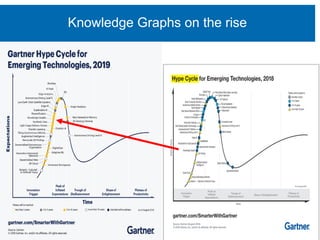
Knowledge Graphs on the rise
• Line one
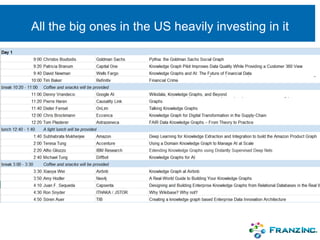
All the big ones in the US heavily investing in it
• Good luck trying to find a definition on the web that is not ideology or
vendor based or very application specific
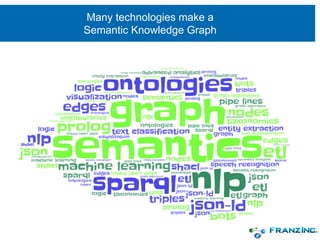
Many technologies make a
Semantic Knowledge Graph
Documents: JSON, JSON-LD Graphs: RDF, Quads, Properties
Storage: Triple Attributes, Security Filters, Compression, Indexing, Full-text
Transactions: “Real” ACID, 2 Phase Commit
Management: Security, Multi-Master Replication, Backup/Restore, Warm Failover
Stored Procs:
JavaScript
Lisp
Prolog
SPARQL
Magic Predicates
Reasoning:
RDFS++
OWL2-RL
Prolog
Probabilistic
NLP:
Taxonomies
Entity Extract
Text Classify
Sentiment
Machine
Learning
ETL:
RDBMS
CSV
TEXT
NoSQL
Events:
Geospatial
Temporal
Social
REST GUI: GRUFF/AGWebView
Java Python Lisp
Built-In Integrations
Cloud:
Amazon AWS
Microsoft Azure
Data Science:
Anaconda
R Studio
Knowledge:
Linked Open Data
Editors:
Ontology, Taxonomy
NoSQL:
Cloudera, MongoDB,
Solr
Containers:
Docker, VMWare
Massively Parallel - Federation and Sharding
OSS Clients
SPARQL Prolog
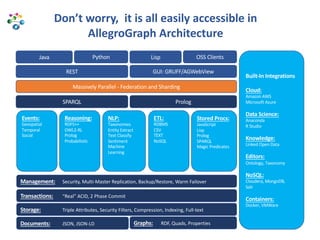
Don’t worry, it is all easily accessible in
AllegroGraph Architecture
Successful Knowledge Graphs built on
• SKOS Taxonomies & OWL Ontologies
• RDF based Semantic Graph Technologies:
• Based on the uniqueness principle: one Thing, one URL
• If you don’t have that, you don’t have anything
• Property graphs destined to reinvent semantics
• But:
• Your User Experience and Application developers don’t want to learn
that entire stack
Challenge # 1 for UI and application developers:
How do you make it easy to
• Add data to a knowledge graph
• Retrieve data from a knowledge graph
• Validate your data
Solution:
• Knowledge Graphs are getting popular very fast, are you
building a Knowledge Graph already?
• JSON-LD will help you add, retrieve and delete objects to a
Knowledge Graph as easy as MongoDB
• SHACL will help you validate your data in the Knowledge
Graph.
JSON Won
• Messaging:
• the lingua franca for messaging and data exchange
• Configuration:
• JSON is replacing XML for configuration of nearly
anything
• Document and key/value store:
• JSON is the main data format stored in Document Stores
(Couchbase, Mongo, etc…)
JSON – the good
• Simple standard:
• Json.org spec is 5 pages, XML spec on W3C = 60 pages J
• only a few datatypes and with arrays!
• you can make your own complex data types if you want
• Easy to read and parse by humans and machines
• Easy to store in document stores
• Easy to program: support in every programming language
JSON (and JSON stores) – the bad
• No standards Schema (but close!)
• How do I know that the data I received is good, how do I know that
the data I’m going to send to my document store is good?
• No Semantics for attributes
• What does that attribute mean?
• Not set up for linking data
• How do I express linkage between JSON objects?
• No joins or graph search in document stores
• There simply is no concept of a relations between objects
• Client side joins or awkward procedures in javascript in the DB
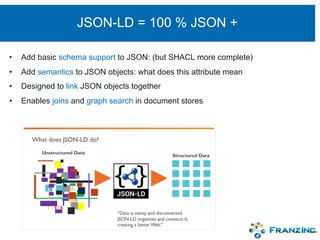
JSON-LD = 100 % JSON +
• Add basic schema support to JSON: (but SHACL more complete)
• Add semantics to JSON objects: what does this attribute mean
• Designed to link JSON objects together
• Enables joins and graph search in document stores
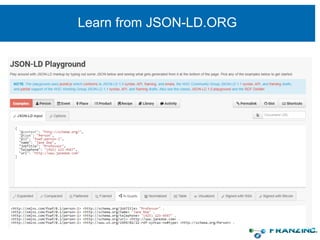
Learn from JSON-LD.ORG
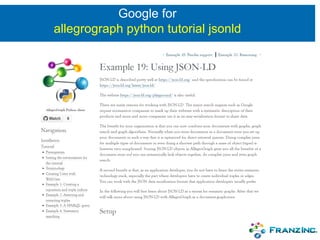
Google for
allegrograph python tutorial jsonld
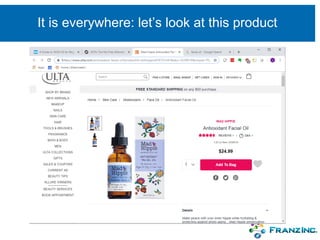
It is everywhere: let’s look at this product
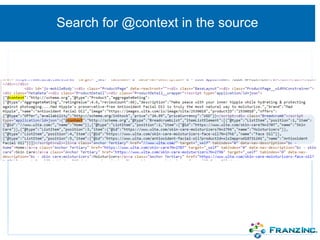
Search for @context in the source
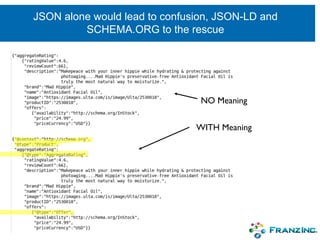
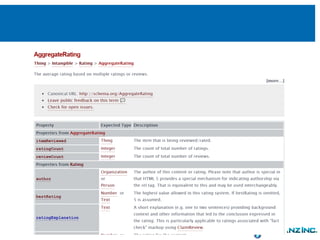
JSON alone would lead to confusion, JSON-LD and
SCHEMA.ORG to the rescue
NO Meaning
WITH Meaning
Demo JSON-LD in Python
• Based on crunch base data from early 2000 till 2014
• Core objects: Investments, acquisitions, investors, companies
• For developers: how can you implement basic CRUD with AllegroGraph
JSONLD
• You can add and retrieve Python dictionaries directly
• Like many other document databases
• Objects are indexed with triples but can also be stored as blobs
• You can retrieve parts of objects in a SPARQL queries
• And you can retrieve as dictionaries.
And now SHACL
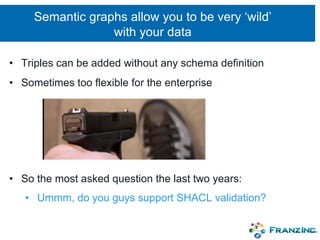
Semantic graphs allow you to be very ‘wild’
with your data
• Triples can be added without any schema definition
• Sometimes too flexible for the enterprise
• So the most asked question the last two years:
• Ummm, do you guys support SHACL validation?
SHACL seems to be replacing OWL
• Easier to read
• Less complicated
• OWL can still be derived automatically from SHACL
• Great tutorials on the web.
title
• Line one
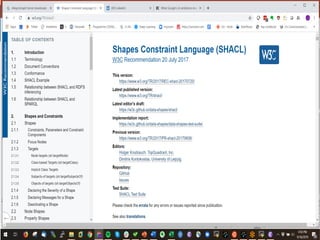
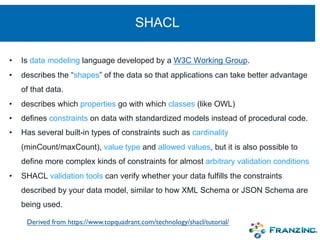
SHACL
• Is data modeling language developed by a W3C Working Group.
• describes the “shapes” of the data so that applications can take better advantage
of that data.
• describes which properties go with which classes (like OWL)
• defines constraints on data with standardized models instead of procedural code.
• Has several built-in types of constraints such as cardinality
(minCount/maxCount), value type and allowed values, but it is also possible to
define more complex kinds of constraints for almost arbitrary validation conditions
• SHACL validation tools can verify whether your data fulfills the constraints
described by your data model, similar to how XML Schema or JSON Schema are
being used.
Derived from https://www.topquadrant.com/technology/shacl/tutorial/
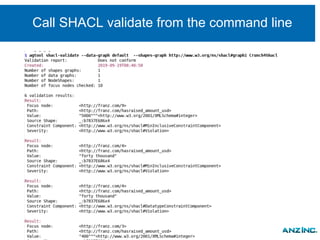
Call SHACL validate from the command line
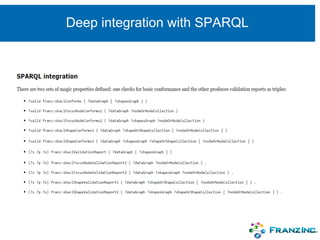
Deep integration with SPARQL
Conclusion: JSON-LD and SHACL
for Knowledge Graphs
• Make life easier for User Experience and Application
Developers that need to work with Knowledge Graphs.
• JSON-LD hides complexity of semantics and graphs
• SHACL easy way to validate new data.
Thank you

JSON-LD and SHACL for Knowledge Graphs

  • 1.
    JSON-LD and SHACL forKnowledge Graphs Dr. Jans Aasman (allegrograph.com)
  • 2.
    Contents • Knowledge Graphsare getting popular very fast, are you building a Knowledge Graph already? • JSON-LD will help you add and delete objects to a Knowledge Graph as easy as MongoDB • SHACL will help you validate your data in the Knowledge Graph.
  • 3.
    Knowledge Graphs onthe rise • Line one
  • 4.
    All the bigones in the US heavily investing in it • Good luck trying to find a definition on the web that is not ideology or vendor based or very application specific
  • 5.
    Many technologies makea Semantic Knowledge Graph
  • 6.
    Documents: JSON, JSON-LDGraphs: RDF, Quads, Properties Storage: Triple Attributes, Security Filters, Compression, Indexing, Full-text Transactions: “Real” ACID, 2 Phase Commit Management: Security, Multi-Master Replication, Backup/Restore, Warm Failover Stored Procs: JavaScript Lisp Prolog SPARQL Magic Predicates Reasoning: RDFS++ OWL2-RL Prolog Probabilistic NLP: Taxonomies Entity Extract Text Classify Sentiment Machine Learning ETL: RDBMS CSV TEXT NoSQL Events: Geospatial Temporal Social REST GUI: GRUFF/AGWebView Java Python Lisp Built-In Integrations Cloud: Amazon AWS Microsoft Azure Data Science: Anaconda R Studio Knowledge: Linked Open Data Editors: Ontology, Taxonomy NoSQL: Cloudera, MongoDB, Solr Containers: Docker, VMWare Massively Parallel - Federation and Sharding OSS Clients SPARQL Prolog Don’t worry, it is all easily accessible in AllegroGraph Architecture
  • 7.
    Successful Knowledge Graphsbuilt on • SKOS Taxonomies & OWL Ontologies • RDF based Semantic Graph Technologies: • Based on the uniqueness principle: one Thing, one URL • If you don’t have that, you don’t have anything • Property graphs destined to reinvent semantics • But: • Your User Experience and Application developers don’t want to learn that entire stack
  • 8.
    Challenge # 1for UI and application developers: How do you make it easy to • Add data to a knowledge graph • Retrieve data from a knowledge graph • Validate your data
  • 9.
    Solution: • Knowledge Graphsare getting popular very fast, are you building a Knowledge Graph already? • JSON-LD will help you add, retrieve and delete objects to a Knowledge Graph as easy as MongoDB • SHACL will help you validate your data in the Knowledge Graph.
  • 10.
    JSON Won • Messaging: •the lingua franca for messaging and data exchange • Configuration: • JSON is replacing XML for configuration of nearly anything • Document and key/value store: • JSON is the main data format stored in Document Stores (Couchbase, Mongo, etc…)
  • 11.
    JSON – thegood • Simple standard: • Json.org spec is 5 pages, XML spec on W3C = 60 pages J • only a few datatypes and with arrays! • you can make your own complex data types if you want • Easy to read and parse by humans and machines • Easy to store in document stores • Easy to program: support in every programming language
  • 12.
    JSON (and JSONstores) – the bad • No standards Schema (but close!) • How do I know that the data I received is good, how do I know that the data I’m going to send to my document store is good? • No Semantics for attributes • What does that attribute mean? • Not set up for linking data • How do I express linkage between JSON objects? • No joins or graph search in document stores • There simply is no concept of a relations between objects • Client side joins or awkward procedures in javascript in the DB
  • 13.
    JSON-LD = 100% JSON + • Add basic schema support to JSON: (but SHACL more complete) • Add semantics to JSON objects: what does this attribute mean • Designed to link JSON objects together • Enables joins and graph search in document stores
  • 14.
  • 15.
  • 16.
    It is everywhere:let’s look at this product
  • 17.
    Search for @contextin the source
  • 18.
    JSON alone wouldlead to confusion, JSON-LD and SCHEMA.ORG to the rescue NO Meaning WITH Meaning
  • 20.
    Demo JSON-LD inPython • Based on crunch base data from early 2000 till 2014 • Core objects: Investments, acquisitions, investors, companies • For developers: how can you implement basic CRUD with AllegroGraph JSONLD • You can add and retrieve Python dictionaries directly • Like many other document databases • Objects are indexed with triples but can also be stored as blobs • You can retrieve parts of objects in a SPARQL queries • And you can retrieve as dictionaries.
  • 21.
  • 22.
    Semantic graphs allowyou to be very ‘wild’ with your data • Triples can be added without any schema definition • Sometimes too flexible for the enterprise • So the most asked question the last two years: • Ummm, do you guys support SHACL validation?
  • 23.
    SHACL seems tobe replacing OWL • Easier to read • Less complicated • OWL can still be derived automatically from SHACL • Great tutorials on the web.
  • 24.
  • 25.
    SHACL • Is datamodeling language developed by a W3C Working Group. • describes the “shapes” of the data so that applications can take better advantage of that data. • describes which properties go with which classes (like OWL) • defines constraints on data with standardized models instead of procedural code. • Has several built-in types of constraints such as cardinality (minCount/maxCount), value type and allowed values, but it is also possible to define more complex kinds of constraints for almost arbitrary validation conditions • SHACL validation tools can verify whether your data fulfills the constraints described by your data model, similar to how XML Schema or JSON Schema are being used. Derived from https://www.topquadrant.com/technology/shacl/tutorial/
  • 26.
    Call SHACL validatefrom the command line
  • 27.
  • 28.
    Conclusion: JSON-LD andSHACL for Knowledge Graphs • Make life easier for User Experience and Application Developers that need to work with Knowledge Graphs. • JSON-LD hides complexity of semantics and graphs • SHACL easy way to validate new data.
  • 29.