Summer Graduate Teaching Scholars
May 15 and 17, 2013
Practical 3: Learning Outcomes
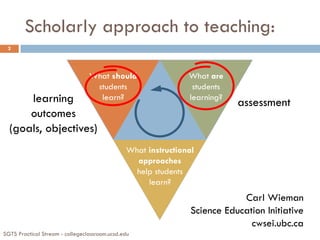
Scholarly approach to teaching:
SGTS Practical Stream - collegeclassroom.ucsd.edu
2
Carl Wieman
Science Education Initiative
cwsei.ubc.ca
What should
students
learn?
What are
students
learning?
What instructional
approaches
help students
learn?
learning
outcomes
(goals, objectives)
assessment
Learning outcomes, recall,…
SGTS Practical Stream - collegeclassroom.ucsd.edu
3
 are statements that complete the sentence, “By this
end of this lesson/unit/course, you will be able to…”
 begins with an action verb, typically chosen by the
cognitive Bloom’s Level of the outcome (remember,
comprehend, apply, analyze, evaluate, create)
 clarify to the students and to the instructors the
what it means to “understand” the concept
 guide instructor’s choice of materials, activities,
assessment, etc.: Does it support the LO? Yes: use it.
No: find something else.
Topic-level and Course-level LOs
SGTS Practical Stream - collegeclassroom.ucsd.edu
4
You likely have some “big picture” goals for your course
that can’t be assessed by a single exam question
“gain a quantitative perspective on the scale, age and
diversity of our Solar System”
“develop evidence-based arguments to defend a position”
A complete set of LOs might have
SGTS Practical Stream - collegeclassroom.ucsd.edu
5
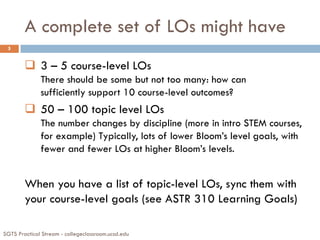
 3 – 5 course-level LOs
There should be some but not too many: how can
sufficiently support 10 course-level outcomes?
 50 – 100 topic level LOs
The number changes by discipline (more in intro STEM courses,
for example) Typically, lots of lower Bloom’s level goals, with
fewer and fewer LOs at higher Bloom’s levels.
When you have a list of topic-level LOs, sync them with
your course-level goals (see ASTR 310 Learning Goals)
1. “Back-engineer” LOs from exams
SGTS Practical Stream - collegeclassroom.ucsd.edu
6
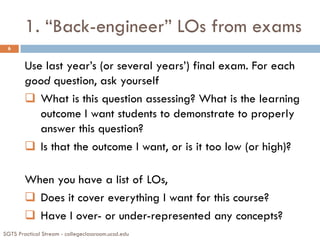
Use last year’s (or several years’) final exam. For each
good question, ask yourself
 What is this question assessing? What is the learning
outcome I want students to demonstrate to properly
answer this question?
 Is that the outcome I want, or is it too low (or high)?
When you have a list of LOs,
 Does it cover everything I want for this course?
 Have I over- or under-represented any concepts?
2. Draft LOs from course outline
SGTS Practical Stream - collegeclassroom.ucsd.edu
7
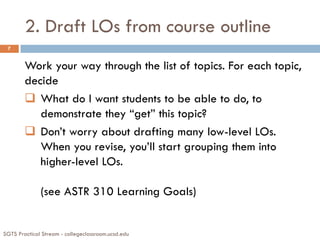
Work your way through the list of topics. For each topic,
decide
 What do I want students to be able to do, to
demonstrate they “get” this topic?
 Don’t worry about drafting many low-level LOs.
When you revise, you’ll start grouping them into
higher-level LOs.
(see ASTR 310 Learning Goals)
Deciding on the level of a LO
SGTS Practical Stream - collegeclassroom.ucsd.edu
8
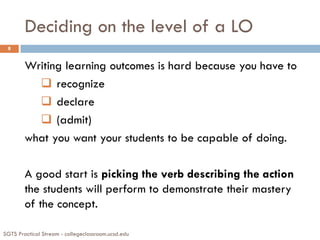
Writing learning outcomes is hard because you have to
 recognize
 declare
 (admit)
what you want your students to be capable of doing.
A good start is picking the verb describing the action
the students will perform to demonstrate their mastery
of the concept.
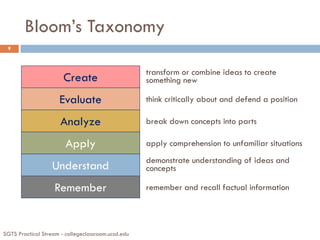
Bloom’s Taxonomy
SGTS Practical Stream - collegeclassroom.ucsd.edu
9
Remember
Understand
Apply
Analyze
Evaluate
Create
think critically about and defend a position
transform or combine ideas to create
something new
break down concepts into parts
apply comprehension to unfamiliar situations
demonstrate understanding of ideas and
concepts
remember and recall factual information
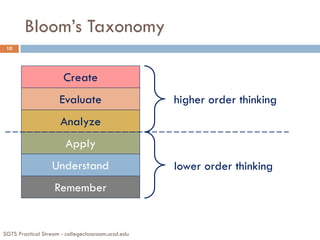
Bloom’s Taxonomy
SGTS Practical Stream - collegeclassroom.ucsd.edu
10
Remember
Understand
Apply
Analyze
Evaluate
Create
higher order thinking
lower order thinking
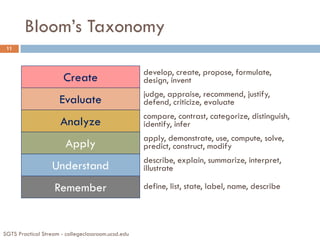
Bloom’s Taxonomy
SGTS Practical Stream - collegeclassroom.ucsd.edu
11
Remember
Understand
Apply
Analyze
Evaluate
Create
develop, create, propose, formulate,
design, invent
judge, appraise, recommend, justify,
defend, criticize, evaluate
compare, contrast, categorize, distinguish,
identify, infer
apply, demonstrate, use, compute, solve,
predict, construct, modify
describe, explain, summarize, interpret,
illustrate
define, list, state, label, name, describe
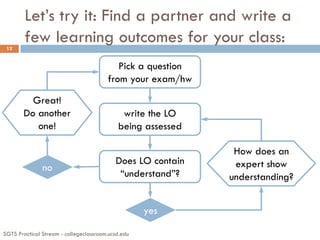
Let’s try it: Find a partner and write a
few learning outcomes for your class:
SGTS Practical Stream - collegeclassroom.ucsd.edu
12
Pick a question
from your exam/hw
write the LO
being assessed
Does LO contain
“understand”?
yes
Great!
Do another
one!
How does an
expert show
understanding?
no
Share your LOs with your students
SGTS Practical Stream - collegeclassroom.ucsd.edu
13
 After you’ve gone to the trouble of creating learning
outcomes, share them with your students
 (good) publish them as a document along side your
syllabus
 (better) include relevant learning goals in your lecture
slides at the beginning of each day/topic
 Rather than always reading them aloud, take the time to
remind students what they are and how to use them. The
LOs will be there when they study.
 Don’t worry about “spoon-feeding” them – so what if
students do exactly what you feel demonstrates
understanding?
Bloom’s Taxonomy of the Cognitive Domain
(Levels of Learning) [Wieman, 2007]
14
6. Synthesis: transform and combine ideas to create something new
develop, create, propose, formulate, design, invent
5. Evaluation: think critically about and defend a position
judge, appraise, recommend, justify, defend, criticize, evaluate
4. Analysis: break down concepts into parts
compare, contrast, categorize, distinguish, identify, infer
3. Application: apply comprehension to unfamiliar situations
apply, demonstrate, use, compute, solve, predict, construct, modify
2. Comprehension: demonstrate understanding of ideas, concepts
describe, explain, summarize, interpret, illustrate
1. Factual Knowledge: remember and recall factual knowledge
define, list, state, label, name, describe
SGTS Practical Stream - collegeclassroom.ucsd.edu

SGTS Practical 3 - Learning Outcomes

  • 1.
    Summer Graduate TeachingScholars May 15 and 17, 2013 Practical 3: Learning Outcomes
  • 2.
    Scholarly approach toteaching: SGTS Practical Stream - collegeclassroom.ucsd.edu 2 Carl Wieman Science Education Initiative cwsei.ubc.ca What should students learn? What are students learning? What instructional approaches help students learn? learning outcomes (goals, objectives) assessment
  • 3.
    Learning outcomes, recall,… SGTSPractical Stream - collegeclassroom.ucsd.edu 3  are statements that complete the sentence, “By this end of this lesson/unit/course, you will be able to…”  begins with an action verb, typically chosen by the cognitive Bloom’s Level of the outcome (remember, comprehend, apply, analyze, evaluate, create)  clarify to the students and to the instructors the what it means to “understand” the concept  guide instructor’s choice of materials, activities, assessment, etc.: Does it support the LO? Yes: use it. No: find something else.
  • 4.
    Topic-level and Course-levelLOs SGTS Practical Stream - collegeclassroom.ucsd.edu 4 You likely have some “big picture” goals for your course that can’t be assessed by a single exam question “gain a quantitative perspective on the scale, age and diversity of our Solar System” “develop evidence-based arguments to defend a position”
  • 5.
    A complete setof LOs might have SGTS Practical Stream - collegeclassroom.ucsd.edu 5  3 – 5 course-level LOs There should be some but not too many: how can sufficiently support 10 course-level outcomes?  50 – 100 topic level LOs The number changes by discipline (more in intro STEM courses, for example) Typically, lots of lower Bloom’s level goals, with fewer and fewer LOs at higher Bloom’s levels. When you have a list of topic-level LOs, sync them with your course-level goals (see ASTR 310 Learning Goals)
  • 6.
    1. “Back-engineer” LOsfrom exams SGTS Practical Stream - collegeclassroom.ucsd.edu 6 Use last year’s (or several years’) final exam. For each good question, ask yourself  What is this question assessing? What is the learning outcome I want students to demonstrate to properly answer this question?  Is that the outcome I want, or is it too low (or high)? When you have a list of LOs,  Does it cover everything I want for this course?  Have I over- or under-represented any concepts?
  • 7.
    2. Draft LOsfrom course outline SGTS Practical Stream - collegeclassroom.ucsd.edu 7 Work your way through the list of topics. For each topic, decide  What do I want students to be able to do, to demonstrate they “get” this topic?  Don’t worry about drafting many low-level LOs. When you revise, you’ll start grouping them into higher-level LOs. (see ASTR 310 Learning Goals)
  • 8.
    Deciding on thelevel of a LO SGTS Practical Stream - collegeclassroom.ucsd.edu 8 Writing learning outcomes is hard because you have to  recognize  declare  (admit) what you want your students to be capable of doing. A good start is picking the verb describing the action the students will perform to demonstrate their mastery of the concept.
  • 9.
    Bloom’s Taxonomy SGTS PracticalStream - collegeclassroom.ucsd.edu 9 Remember Understand Apply Analyze Evaluate Create think critically about and defend a position transform or combine ideas to create something new break down concepts into parts apply comprehension to unfamiliar situations demonstrate understanding of ideas and concepts remember and recall factual information
  • 10.
    Bloom’s Taxonomy SGTS PracticalStream - collegeclassroom.ucsd.edu 10 Remember Understand Apply Analyze Evaluate Create higher order thinking lower order thinking
  • 11.
    Bloom’s Taxonomy SGTS PracticalStream - collegeclassroom.ucsd.edu 11 Remember Understand Apply Analyze Evaluate Create develop, create, propose, formulate, design, invent judge, appraise, recommend, justify, defend, criticize, evaluate compare, contrast, categorize, distinguish, identify, infer apply, demonstrate, use, compute, solve, predict, construct, modify describe, explain, summarize, interpret, illustrate define, list, state, label, name, describe
  • 12.
    Let’s try it:Find a partner and write a few learning outcomes for your class: SGTS Practical Stream - collegeclassroom.ucsd.edu 12 Pick a question from your exam/hw write the LO being assessed Does LO contain “understand”? yes Great! Do another one! How does an expert show understanding? no
  • 13.
    Share your LOswith your students SGTS Practical Stream - collegeclassroom.ucsd.edu 13  After you’ve gone to the trouble of creating learning outcomes, share them with your students  (good) publish them as a document along side your syllabus  (better) include relevant learning goals in your lecture slides at the beginning of each day/topic  Rather than always reading them aloud, take the time to remind students what they are and how to use them. The LOs will be there when they study.  Don’t worry about “spoon-feeding” them – so what if students do exactly what you feel demonstrates understanding?
  • 14.
    Bloom’s Taxonomy ofthe Cognitive Domain (Levels of Learning) [Wieman, 2007] 14 6. Synthesis: transform and combine ideas to create something new develop, create, propose, formulate, design, invent 5. Evaluation: think critically about and defend a position judge, appraise, recommend, justify, defend, criticize, evaluate 4. Analysis: break down concepts into parts compare, contrast, categorize, distinguish, identify, infer 3. Application: apply comprehension to unfamiliar situations apply, demonstrate, use, compute, solve, predict, construct, modify 2. Comprehension: demonstrate understanding of ideas, concepts describe, explain, summarize, interpret, illustrate 1. Factual Knowledge: remember and recall factual knowledge define, list, state, label, name, describe SGTS Practical Stream - collegeclassroom.ucsd.edu