

Summer GraduateTeaching Scholars
Preparing toTeach 1:
Student-facing Syllabus
May 12 and 13, 2016
1sgts.ucsd.edu
Name
Course Dept/School
Summer I or II # students
Peter Newbury
Preparing to Teach Workshops
sgts.ucsd.edu 2
The aim of these workshops is to give you a well-
supported head start on many of the things you
should do to prepare for your classes, like
 creating a syllabus
 working out an assessment scheme
 drafting learning outcomes
 choose active learning strategies
 identify something you want to learn about
your students and design a way to figure it out
 and more…
How are you feeling?
sgts.ucsd.edu 3
Who are you?
sgts.ucsd.edu 4
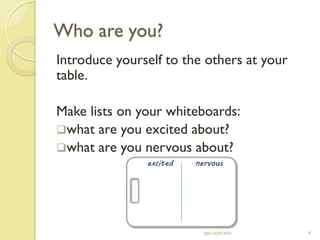
Introduce yourself to the others at your
table.
Make lists on your whiteboards:
what are you excited about?
what are you nervous about?
excited nervous
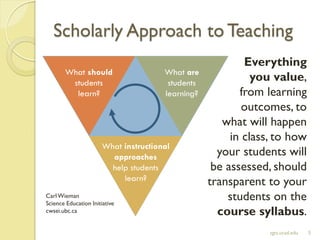
Scholarly Approach to Teaching
sgts.ucsd.edu 5
What should
students
learn?
What are
students
learning?
What instructional
approaches
help students
learn?
Everything
you value,
from learning
outcomes, to
what will happen
in class, to how
your students will
be assessed, should
transparent to your
students on the
course syllabus.
CarlWieman
Science Education Initiative
cwsei.ubc.ca
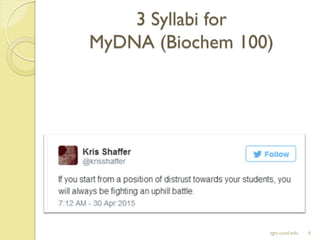
3 Syllabi for
MyDNA (Biochem 100)
sgts.ucsd.edu 6
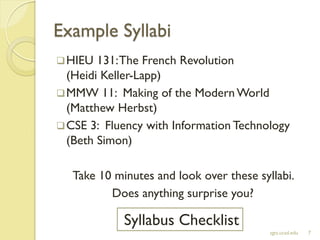
Example Syllabi
HIEU 131:The French Revolution
(Heidi Keller-Lapp)
MMW 11: Making of the Modern World
(Matthew Herbst)
CSE 3: Fluency with Information Technology
(Beth Simon)
Take 10 minutes and look over these syllabi.
Does anything surprise you?
7sgts.ucsd.edu
Syllabus Checklist
Course Description
Take __ minutes to draft/revise your
course description.
Later, you’ll share it with a peer, get
feedback, and give them feedback on theirs.
sgts.ucsd.edu 8
Resources (like today’s syllabi)
Printed
Online
Both
sgts.ucsd.edu 9
Next week: Learning outcomes
Watch the blog
sgts.ucsd.edu
for details about what you should do to
prepare for next week’s meeting.
sgts.ucsd.edu 10
sgts.ucsd.edu 11
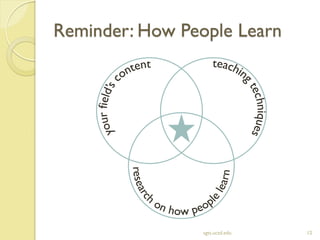
Reminder: How People Learn
sgts.ucsd.edu 12
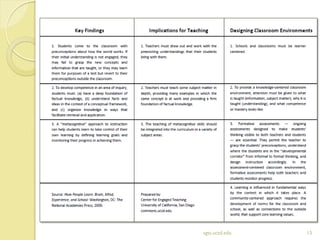
How People Learn: Key Findings
1. Students come to the classroom with preconceptions about how
the world works. If their initial understanding is not engaged, they
may fail to grasp the new concepts and information that are
taught, or they may learn them for purposes of a test but revert
to their preconceptions outside the classroom.
2. To develop competence in an area of inquiry, students must: (a)
have a deep foundation of factual knowledge, (b) understand facts
and ideas in the context of a conceptual framework, and (c)
organize knowledge in ways that facilitate retrieval and
application.
3. A “metacognitive” approach to instruction can help students
learn to take control of their own learning by defining learning
goals and monitoring their progress in achieving them.
sgts.ucsd.edu 13
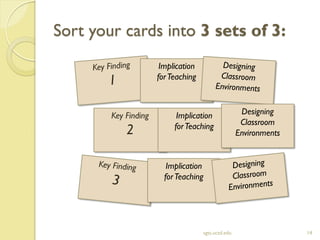
Sort your cards into 3 sets of 3:
sgts.ucsd.edu 14
Key Finding
2
Implication
forTeaching
Implication
forTeaching
Implication
forTeaching
Designing
Classroom
Environments
sgts.ucsd.edu 15
More than anything else, the best teachers try to
create a natural critical learning environment:
sgts.ucsd.edu 16
(Bain, p. 99)
More than anything else, the best teachers try to
create a natural critical learning environment:
sgts.ucsd.edu 17
natural because students encounter skills, habits,
attitudes, and information they are trying to learn
embedded in questions and tasks they find
fascinating – authentic tasks that arouse curiosity
and become intrinsically interesting,
(Bain, p. 99)
More than anything else, the best teachers try to
create a natural critical learning environment:
sgts.ucsd.edu 18
natural because students encounter skills, habits,
attitudes, and information they are trying to learn
embedded in questions and tasks they find
fascinating – authentic tasks that arouse curiosity
and become intrinsically interesting,
critical because students learn to think critically,
to reason from evidence, to examine the quality of
their reasoning using a variety of intellectual
standards, to make improvements while thinking,
and to ask probing and insightful questions about
the thinking of other people. (Bain, p. 99)
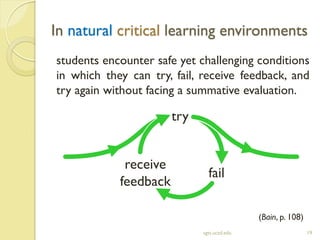
In natural critical learning environments
sgts.ucsd.edu 19
students encounter safe yet challenging conditions
in which they can try, fail, receive feedback, and
try again without facing a summative evaluation.
fail
receive
feedback
(Bain, p. 108)
try

Preparing to Teach 1: A Student-facing Syllabus

  • 1.
    Summer GraduateTeaching Scholars PreparingtoTeach 1: Student-facing Syllabus May 12 and 13, 2016 1sgts.ucsd.edu Name Course Dept/School Summer I or II # students Peter Newbury
  • 2.
    Preparing to TeachWorkshops sgts.ucsd.edu 2 The aim of these workshops is to give you a well- supported head start on many of the things you should do to prepare for your classes, like  creating a syllabus  working out an assessment scheme  drafting learning outcomes  choose active learning strategies  identify something you want to learn about your students and design a way to figure it out  and more…
  • 3.
    How are youfeeling? sgts.ucsd.edu 3
  • 4.
    Who are you? sgts.ucsd.edu4 Introduce yourself to the others at your table. Make lists on your whiteboards: what are you excited about? what are you nervous about? excited nervous
  • 5.
    Scholarly Approach toTeaching sgts.ucsd.edu 5 What should students learn? What are students learning? What instructional approaches help students learn? Everything you value, from learning outcomes, to what will happen in class, to how your students will be assessed, should transparent to your students on the course syllabus. CarlWieman Science Education Initiative cwsei.ubc.ca
  • 6.
    3 Syllabi for MyDNA(Biochem 100) sgts.ucsd.edu 6
  • 7.
    Example Syllabi HIEU 131:TheFrench Revolution (Heidi Keller-Lapp) MMW 11: Making of the Modern World (Matthew Herbst) CSE 3: Fluency with Information Technology (Beth Simon) Take 10 minutes and look over these syllabi. Does anything surprise you? 7sgts.ucsd.edu Syllabus Checklist
  • 8.
    Course Description Take __minutes to draft/revise your course description. Later, you’ll share it with a peer, get feedback, and give them feedback on theirs. sgts.ucsd.edu 8
  • 9.
    Resources (like today’ssyllabi) Printed Online Both sgts.ucsd.edu 9
  • 10.
    Next week: Learningoutcomes Watch the blog sgts.ucsd.edu for details about what you should do to prepare for next week’s meeting. sgts.ucsd.edu 10
  • 11.
  • 12.
    Reminder: How PeopleLearn sgts.ucsd.edu 12
  • 13.
    How People Learn:Key Findings 1. Students come to the classroom with preconceptions about how the world works. If their initial understanding is not engaged, they may fail to grasp the new concepts and information that are taught, or they may learn them for purposes of a test but revert to their preconceptions outside the classroom. 2. To develop competence in an area of inquiry, students must: (a) have a deep foundation of factual knowledge, (b) understand facts and ideas in the context of a conceptual framework, and (c) organize knowledge in ways that facilitate retrieval and application. 3. A “metacognitive” approach to instruction can help students learn to take control of their own learning by defining learning goals and monitoring their progress in achieving them. sgts.ucsd.edu 13
  • 14.
    Sort your cardsinto 3 sets of 3: sgts.ucsd.edu 14 Key Finding 2 Implication forTeaching Implication forTeaching Implication forTeaching Designing Classroom Environments
  • 15.
  • 16.
    More than anythingelse, the best teachers try to create a natural critical learning environment: sgts.ucsd.edu 16 (Bain, p. 99)
  • 17.
    More than anythingelse, the best teachers try to create a natural critical learning environment: sgts.ucsd.edu 17 natural because students encounter skills, habits, attitudes, and information they are trying to learn embedded in questions and tasks they find fascinating – authentic tasks that arouse curiosity and become intrinsically interesting, (Bain, p. 99)
  • 18.
    More than anythingelse, the best teachers try to create a natural critical learning environment: sgts.ucsd.edu 18 natural because students encounter skills, habits, attitudes, and information they are trying to learn embedded in questions and tasks they find fascinating – authentic tasks that arouse curiosity and become intrinsically interesting, critical because students learn to think critically, to reason from evidence, to examine the quality of their reasoning using a variety of intellectual standards, to make improvements while thinking, and to ask probing and insightful questions about the thinking of other people. (Bain, p. 99)
  • 19.
    In natural criticallearning environments sgts.ucsd.edu 19 students encounter safe yet challenging conditions in which they can try, fail, receive feedback, and try again without facing a summative evaluation. fail receive feedback (Bain, p. 108) try