1
Introduction to Credit Derivatives
Introduction to
Credit Derivatives01
Introduction to Credit Derivatives
Credit Risk and Credit Derivatives
Market for Credit Derivatives
Credit Derivative Products
2
Introduction to Credit Derivatives
 Credit risk is the risk of a financial loss due to a reduction in
credit quality of a borrower/debtor/obligator.
 Default risk is the risk that an borrower/obligator does not repay
part or his entire financial obligation.
o If default occurs, the creditor will only receive the amount recovered
from the debtor called recovery value.
 Credit deterioration risk is the risk that the credit quality of the
borrower/debtor might decrease.
 Default risk can be viewed as a subcategory of credit
deterioration risk since default occurs for large credit
deterioration
Credit Risk
3
Introduction to Credit Derivatives
 Credit derivatives are financial instruments designed to transfer
credit risk from one counterparty to another
 Credit derivatives allow an investor to reduce or eliminate credit
risk or to assume it expecting to profit from it.
 Credit derivatives are financial instruments whose value is
derived from the credit quality of an underlying obligation which
is usually a bond or a loan.
Credit Derivatives
4
Introduction to Credit Derivatives
o Bankruptcy
 It is widely drafted so as to be triggered by a variety of events
associated with bankruptcy or insolvency proceedings
o Failure to Pay
 Failure to Pay is defined to be a failure of the reference entity to
make, when and where due, any payments under one or more
obligations.
o Restructuring
 Restructuring covers events as a result of which the terms, as
agreed by the reference entity or governmental authority and the
holders of the relevant obligation, governing the relevant obligation
have become less favorable to the holders that they would otherwise
have been.
 Other events
Credit Events
5
Introduction to Credit Derivatives
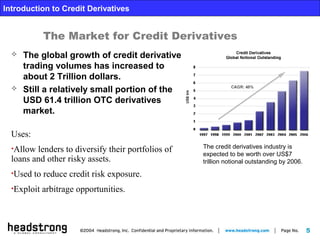
The Market for Credit Derivatives
 The global growth of credit derivative
trading volumes has increased to
about 2 Trillion dollars.
 Still a relatively small portion of the
USD 61.4 trillion OTC derivatives
market.
The credit derivatives industry is
expected to be worth over US$7
trillion notional outstanding by 2006.
Uses:
•Allow lenders to diversify their portfolios of
loans and other risky assets.
•Used to reduce credit risk exposure.
•Exploit arbitrage opportunities.
6
Introduction to Credit Derivatives
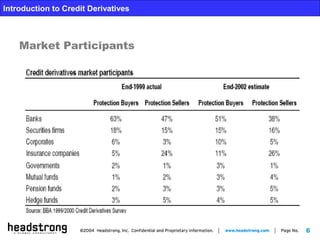
Market Participants
7
Introduction to Credit Derivatives
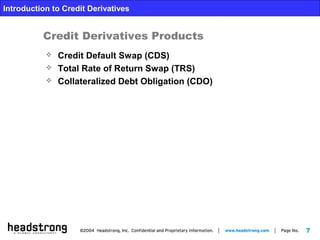
 Credit Default Swap (CDS)
 Total Rate of Return Swap (TRS)
 Collateralized Debt Obligation (CDO)
Credit Derivatives Products
8
Introduction to Credit Derivatives
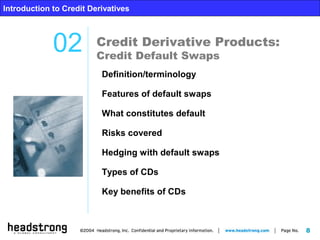
Credit Derivative Products:
Credit Default Swaps
02
Introduction to Credit Derivatives
Definition/terminology
Features of default swaps
What constitutes default
Risks covered
Hedging with default swaps
Types of CDs
Key benefits of CDs
9
Introduction to Credit Derivatives
Credit Default Swaps (CDS)
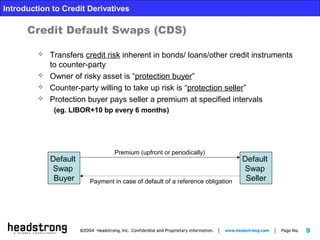
 Transfers credit risk inherent in bonds/ loans/other credit instruments
to counter-party
 Owner of risky asset is “protection buyer”
 Counter-party willing to take up risk is “protection seller”
 Protection buyer pays seller a premium at specified intervals
(eg. LIBOR+10 bp every 6 months)
Default
Swap
Buyer
Default
Swap
Seller
Premium (upfront or periodically)
Payment in case of default of a reference obligation
10
Introduction to Credit Derivatives
Credit Default Swaps (CDS)
 Upon occurrence of a Credit Event, protection seller pays the
buyer the amount of the loss.
o Cash settlement – seller pays buyer difference between par
amount and current asset value
o Physical settlement – buyer hands over impaired asset to seller
and gets par value in return
 The default swap premium is often called the default swap
spread
11
Introduction to Credit Derivatives
Credit Default Swaps (CDS)
 Key parameters in CDS Transaction
o Defining the default event
o Determination of Premium or Default Protection Fee
o The reference Obligation, its notional amount
o Maturity of the swap
o Determination of Reference Asset, its notional amount
o Determination of default payment
o Type of settlement
• Physical
• Cash
12
Introduction to Credit Derivatives
Credit Default Swaps (CDS)
 Motivation of Protection Buyer
o Risk reduction
o Reducing Regulatory Capital
13
Introduction to Credit Derivatives
Credit Default Swaps (CDS)
 Motivation of Protection Seller
o Access to new assets
o Extreme leverage advantage
14
Introduction to Credit Derivatives
Applications of Credit Derivatives
 Regulatory Capital Relief
o Large commercial banks account for the most common application of
credit default options: reducing regulatory capital.
o Regulatory capital is the percentage of equity capital that a bank must
maintain in relation to its assets (e.g. loans), typically 8%.
o Equity is relatively expensive to fund.
o With the protection afforded by an instrument such as the credit default
option, only 20% of the recommended 8% holding is required.
15
Introduction to Credit Derivatives
Applications: Buying Bonds Synthetically
 Buying Bonds Synthetically
o Some institutional investors sell credit default options in order to
assume the risk and return of a bond without owning the asset outright,
an application known as buying the bond "synthetically.“
o Investor sells a credit default swap on $1 million face of 5-year BBB-
rated bonds.
o The investor assumes the risk of default, similar to the risk assumed by
the actual bondholder, and receives payments in return, also similar to
those received by the bondholder.
16
Introduction to Credit Derivatives
Application: Diversifying Loan Portfolios
 If a bank's loan portfolio is over-concentrated in a given industry, credit
default options can help diversify the portfolio without sacrificing existing
loan relationships.
 Texas bank is heavily exposed to the energy sector during a period of oil
price volatility
 The bank would like to diversify its portfolio
 solution is for the bank to buy default options on the oil loans and sell
default options on loans with a low correlation to the energy sector
17
Introduction to Credit Derivatives
Basket Default Options
 Basket Default Options
o The buyer of a basket default option exchanges a premium for default
protection on a group of equally rated bonds or loans, most commonly
on a "first-to-default" basis.
o If one asset in the basket defaults, the buyer receives a loss payment
and the option terminates
o This allows the investor to protect several different assets for typically
less than the price of protecting each asset individually.
o Variations on the first-to-default structure include the "nth-to-default"
option and the "portfolio default swap."
o High asset correlation lowers the likelihood of a default payment since
the conditions under which default may occur are restricted to roughly a
single asset.
o Low asset correlation increases the likelihood of default payment since
these conditions widen to include several different assets.
18
Introduction to Credit Derivatives
Credit Derivative Products:
Total Rate of Return Swaps(TRORs)
03
Introduction to Credit Derivatives
Definition/Terminology
Difference between TROR and CDS
19
Introduction to Credit Derivatives
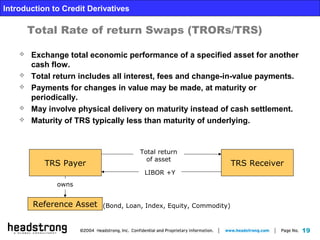
Total Rate of return Swaps (TRORs/TRS)
 Exchange total economic performance of a specified asset for another
cash flow.
 Total return includes all interest, fees and change-in-value payments.
 Payments for changes in value may be made, at maturity or
periodically.
 May involve physical delivery on maturity instead of cash settlement.
 Maturity of TRS typically less than maturity of underlying.
TRS Payer
Reference Asset
owns
Total return
of asset
TRS Receiver
LIBOR +Y
(Bond, Loan, Index, Equity, Commodity)
20
Introduction to Credit Derivatives
Total Rate of return Swaps (TRORs/TRS)
Effect of events
 Rating downgrade -> leads to drop in value of asset -> this drop is
made good by receiver to payer
 Rating upgrade -> leads to rise in value of asset -> this rise is
transferred by payer to receiver
 Asset defaults -> asset holder faces loss -> this loss made good by
receiver
TRS compared to CDS
 CDS transfers only Credit risk,
 TRS transfers both Credit and Price risk.
21
Introduction to Credit Derivatives
Total Rate of return Swaps (TRS) –
Motivation of Receiver
 Create new assets with custom maturities
 Access to asset class not normally available
 Exposure to underlying without upfront acquisition cost- Extreme
leverage advantage
 Off-balance sheet exposure to desired asset class
 Off-balance sheet exposure leading to higher ROA
 Fill credit gaps in portfolio or access entire asset class by receiving
total returns on an Index
22
Introduction to Credit Derivatives
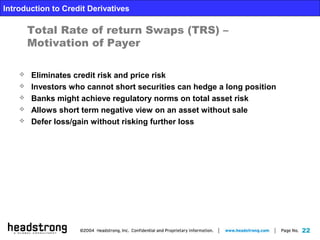
Total Rate of return Swaps (TRS) –
Motivation of Payer
 Eliminates credit risk and price risk
 Investors who cannot short securities can hedge a long position
 Banks might achieve regulatory norms on total asset risk
 Allows short term negative view on an asset without sale
 Defer loss/gain without risking further loss
23
Introduction to Credit Derivatives
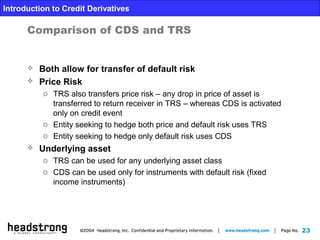
Comparison of CDS and TRS
 Both allow for transfer of default risk
 Price Risk
o TRS also transfers price risk – any drop in price of asset is
transferred to return receiver in TRS – whereas CDS is activated
only on credit event
o Entity seeking to hedge both price and default risk uses TRS
o Entity seeking to hedge only default risk uses CDS
 Underlying asset
o TRS can be used for any underlying asset class
o CDS can be used only for instruments with default risk (fixed
income instruments)
24
Introduction to Credit Derivatives
Credit Derivative Products:
Credit Spread Products
04
Introduction to Credit Derivatives
Credit Spread Options
Credit Spread Forwards
Credit Spread Swaps
25
Introduction to Credit Derivatives
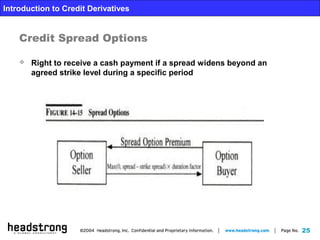
Credit Spread Options
 Right to receive a cash payment if a spread widens beyond an
agreed strike level during a specific period
26
Introduction to Credit Derivatives
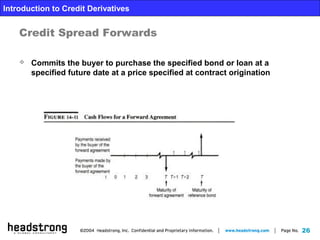
Credit Spread Forwards
 Commits the buyer to purchase the specified bond or loan at a
specified future date at a price specified at contract origination
27
Introduction to Credit Derivatives
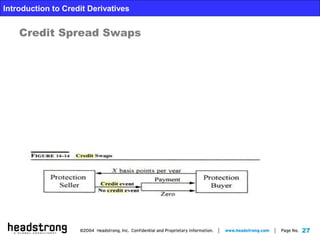
Credit Spread Swaps
28
Introduction to Credit Derivatives
Synthetic Structures:
Synthetic Collateralized Debt
Obligations (CDOs)
05
Introduction to Credit Derivatives
01 Cash CDO
02 Synthetic CDO
03 Motivation for CDOs
04 CDO Squared Structures
29
Introduction to Credit Derivatives
Collateralized Debt Obligation (CDO)
Asset Securitization
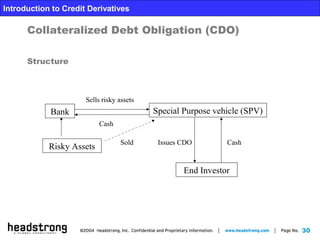
 A Bank owns some risky assets that it wants to sell.
 It creates a separate Special Purpose Vehicle (SPV) legal entity
 Offers to sell the assets to SPV in exchange for cash
 SPV offers to issue a note, or set of notes, to investors, promising to
collateralize the notes with the payments from the assets.
 Bank works with the rating agencies, lawyers, accountants, and
investors to define the collateral pool and the structure of the notes.
 The SPV sells the structured notes to the investors, and uses the cash
to buy the assets from the bank.
 Payments are made to the CDO Bond holders based on the cash flows
that come in from the underlying risky assets
 Bond Investors take on risk and return from the underlying assets
 Bank sold the assets, and got cashed out upon the sale of the bonds
 Bank uses the money to make new loans, and starts the process again
30
Introduction to Credit Derivatives
Collateralized Debt Obligation (CDO)
Structure
Bank Special Purpose vehicle (SPV)
End Investor
Sells risky assets
Cash
CashIssues CDO
Risky Assets
Sold
31
Introduction to Credit Derivatives
Collateralized Debt Obligation (CDO)
 The CDO notes/bonds that are offered to investors reflect
various combinations of yields, maturities, credit quality,
payment priorities, etc.
 The individual notes offered to investors are called
“tranches”, French for “slices”.
 Some of the tranches are more senior, or junior, in terms of
their priority of receiving cash flows.
 The tranches are structured to appeal to different investors
with different risk and return appetites.
32
Introduction to Credit Derivatives
Collateralized Debt Obligation (CDO)
Synthetic CDO
 In the previous structure, where the bank who owns the
assets and sells them to the Special Purpose Vehicle, we
call that a Cash CDO.
 Banks also use Credit Default Swaps, whereby a credit
default swap, reflecting the risk premium associated with
the risk of the risky pool of assets, is combined with an
investment in riskless assets, say US Treasuries, and the
two sets of assets combine to provide the cash flow to the
CDO investors.
33
Introduction to Credit Derivatives
Collateralized Debt Obligation (CDO)
CDO Squared
 Notes or Bonds that are themselves CDO’s can be used as
loans which are then pooled with other CDO tranches, to
create a new tranche in a new offering.
 Doing so creates a CDO of a CDO,
 This is called a CDO Squared.
 And this process can be repeated, over and over.

Sg credit derivatives overview

  • 1.
    1 Introduction to CreditDerivatives Introduction to Credit Derivatives01 Introduction to Credit Derivatives Credit Risk and Credit Derivatives Market for Credit Derivatives Credit Derivative Products
  • 2.
    2 Introduction to CreditDerivatives  Credit risk is the risk of a financial loss due to a reduction in credit quality of a borrower/debtor/obligator.  Default risk is the risk that an borrower/obligator does not repay part or his entire financial obligation. o If default occurs, the creditor will only receive the amount recovered from the debtor called recovery value.  Credit deterioration risk is the risk that the credit quality of the borrower/debtor might decrease.  Default risk can be viewed as a subcategory of credit deterioration risk since default occurs for large credit deterioration Credit Risk
  • 3.
    3 Introduction to CreditDerivatives  Credit derivatives are financial instruments designed to transfer credit risk from one counterparty to another  Credit derivatives allow an investor to reduce or eliminate credit risk or to assume it expecting to profit from it.  Credit derivatives are financial instruments whose value is derived from the credit quality of an underlying obligation which is usually a bond or a loan. Credit Derivatives
  • 4.
    4 Introduction to CreditDerivatives o Bankruptcy  It is widely drafted so as to be triggered by a variety of events associated with bankruptcy or insolvency proceedings o Failure to Pay  Failure to Pay is defined to be a failure of the reference entity to make, when and where due, any payments under one or more obligations. o Restructuring  Restructuring covers events as a result of which the terms, as agreed by the reference entity or governmental authority and the holders of the relevant obligation, governing the relevant obligation have become less favorable to the holders that they would otherwise have been.  Other events Credit Events
  • 5.
    5 Introduction to CreditDerivatives The Market for Credit Derivatives  The global growth of credit derivative trading volumes has increased to about 2 Trillion dollars.  Still a relatively small portion of the USD 61.4 trillion OTC derivatives market. The credit derivatives industry is expected to be worth over US$7 trillion notional outstanding by 2006. Uses: •Allow lenders to diversify their portfolios of loans and other risky assets. •Used to reduce credit risk exposure. •Exploit arbitrage opportunities.
  • 6.
    6 Introduction to CreditDerivatives Market Participants
  • 7.
    7 Introduction to CreditDerivatives  Credit Default Swap (CDS)  Total Rate of Return Swap (TRS)  Collateralized Debt Obligation (CDO) Credit Derivatives Products
  • 8.
    8 Introduction to CreditDerivatives Credit Derivative Products: Credit Default Swaps 02 Introduction to Credit Derivatives Definition/terminology Features of default swaps What constitutes default Risks covered Hedging with default swaps Types of CDs Key benefits of CDs
  • 9.
    9 Introduction to CreditDerivatives Credit Default Swaps (CDS)  Transfers credit risk inherent in bonds/ loans/other credit instruments to counter-party  Owner of risky asset is “protection buyer”  Counter-party willing to take up risk is “protection seller”  Protection buyer pays seller a premium at specified intervals (eg. LIBOR+10 bp every 6 months) Default Swap Buyer Default Swap Seller Premium (upfront or periodically) Payment in case of default of a reference obligation
  • 10.
    10 Introduction to CreditDerivatives Credit Default Swaps (CDS)  Upon occurrence of a Credit Event, protection seller pays the buyer the amount of the loss. o Cash settlement – seller pays buyer difference between par amount and current asset value o Physical settlement – buyer hands over impaired asset to seller and gets par value in return  The default swap premium is often called the default swap spread
  • 11.
    11 Introduction to CreditDerivatives Credit Default Swaps (CDS)  Key parameters in CDS Transaction o Defining the default event o Determination of Premium or Default Protection Fee o The reference Obligation, its notional amount o Maturity of the swap o Determination of Reference Asset, its notional amount o Determination of default payment o Type of settlement • Physical • Cash
  • 12.
    12 Introduction to CreditDerivatives Credit Default Swaps (CDS)  Motivation of Protection Buyer o Risk reduction o Reducing Regulatory Capital
  • 13.
    13 Introduction to CreditDerivatives Credit Default Swaps (CDS)  Motivation of Protection Seller o Access to new assets o Extreme leverage advantage
  • 14.
    14 Introduction to CreditDerivatives Applications of Credit Derivatives  Regulatory Capital Relief o Large commercial banks account for the most common application of credit default options: reducing regulatory capital. o Regulatory capital is the percentage of equity capital that a bank must maintain in relation to its assets (e.g. loans), typically 8%. o Equity is relatively expensive to fund. o With the protection afforded by an instrument such as the credit default option, only 20% of the recommended 8% holding is required.
  • 15.
    15 Introduction to CreditDerivatives Applications: Buying Bonds Synthetically  Buying Bonds Synthetically o Some institutional investors sell credit default options in order to assume the risk and return of a bond without owning the asset outright, an application known as buying the bond "synthetically.“ o Investor sells a credit default swap on $1 million face of 5-year BBB- rated bonds. o The investor assumes the risk of default, similar to the risk assumed by the actual bondholder, and receives payments in return, also similar to those received by the bondholder.
  • 16.
    16 Introduction to CreditDerivatives Application: Diversifying Loan Portfolios  If a bank's loan portfolio is over-concentrated in a given industry, credit default options can help diversify the portfolio without sacrificing existing loan relationships.  Texas bank is heavily exposed to the energy sector during a period of oil price volatility  The bank would like to diversify its portfolio  solution is for the bank to buy default options on the oil loans and sell default options on loans with a low correlation to the energy sector
  • 17.
    17 Introduction to CreditDerivatives Basket Default Options  Basket Default Options o The buyer of a basket default option exchanges a premium for default protection on a group of equally rated bonds or loans, most commonly on a "first-to-default" basis. o If one asset in the basket defaults, the buyer receives a loss payment and the option terminates o This allows the investor to protect several different assets for typically less than the price of protecting each asset individually. o Variations on the first-to-default structure include the "nth-to-default" option and the "portfolio default swap." o High asset correlation lowers the likelihood of a default payment since the conditions under which default may occur are restricted to roughly a single asset. o Low asset correlation increases the likelihood of default payment since these conditions widen to include several different assets.
  • 18.
    18 Introduction to CreditDerivatives Credit Derivative Products: Total Rate of Return Swaps(TRORs) 03 Introduction to Credit Derivatives Definition/Terminology Difference between TROR and CDS
  • 19.
    19 Introduction to CreditDerivatives Total Rate of return Swaps (TRORs/TRS)  Exchange total economic performance of a specified asset for another cash flow.  Total return includes all interest, fees and change-in-value payments.  Payments for changes in value may be made, at maturity or periodically.  May involve physical delivery on maturity instead of cash settlement.  Maturity of TRS typically less than maturity of underlying. TRS Payer Reference Asset owns Total return of asset TRS Receiver LIBOR +Y (Bond, Loan, Index, Equity, Commodity)
  • 20.
    20 Introduction to CreditDerivatives Total Rate of return Swaps (TRORs/TRS) Effect of events  Rating downgrade -> leads to drop in value of asset -> this drop is made good by receiver to payer  Rating upgrade -> leads to rise in value of asset -> this rise is transferred by payer to receiver  Asset defaults -> asset holder faces loss -> this loss made good by receiver TRS compared to CDS  CDS transfers only Credit risk,  TRS transfers both Credit and Price risk.
  • 21.
    21 Introduction to CreditDerivatives Total Rate of return Swaps (TRS) – Motivation of Receiver  Create new assets with custom maturities  Access to asset class not normally available  Exposure to underlying without upfront acquisition cost- Extreme leverage advantage  Off-balance sheet exposure to desired asset class  Off-balance sheet exposure leading to higher ROA  Fill credit gaps in portfolio or access entire asset class by receiving total returns on an Index
  • 22.
    22 Introduction to CreditDerivatives Total Rate of return Swaps (TRS) – Motivation of Payer  Eliminates credit risk and price risk  Investors who cannot short securities can hedge a long position  Banks might achieve regulatory norms on total asset risk  Allows short term negative view on an asset without sale  Defer loss/gain without risking further loss
  • 23.
    23 Introduction to CreditDerivatives Comparison of CDS and TRS  Both allow for transfer of default risk  Price Risk o TRS also transfers price risk – any drop in price of asset is transferred to return receiver in TRS – whereas CDS is activated only on credit event o Entity seeking to hedge both price and default risk uses TRS o Entity seeking to hedge only default risk uses CDS  Underlying asset o TRS can be used for any underlying asset class o CDS can be used only for instruments with default risk (fixed income instruments)
  • 24.
    24 Introduction to CreditDerivatives Credit Derivative Products: Credit Spread Products 04 Introduction to Credit Derivatives Credit Spread Options Credit Spread Forwards Credit Spread Swaps
  • 25.
    25 Introduction to CreditDerivatives Credit Spread Options  Right to receive a cash payment if a spread widens beyond an agreed strike level during a specific period
  • 26.
    26 Introduction to CreditDerivatives Credit Spread Forwards  Commits the buyer to purchase the specified bond or loan at a specified future date at a price specified at contract origination
  • 27.
    27 Introduction to CreditDerivatives Credit Spread Swaps
  • 28.
    28 Introduction to CreditDerivatives Synthetic Structures: Synthetic Collateralized Debt Obligations (CDOs) 05 Introduction to Credit Derivatives 01 Cash CDO 02 Synthetic CDO 03 Motivation for CDOs 04 CDO Squared Structures
  • 29.
    29 Introduction to CreditDerivatives Collateralized Debt Obligation (CDO) Asset Securitization  A Bank owns some risky assets that it wants to sell.  It creates a separate Special Purpose Vehicle (SPV) legal entity  Offers to sell the assets to SPV in exchange for cash  SPV offers to issue a note, or set of notes, to investors, promising to collateralize the notes with the payments from the assets.  Bank works with the rating agencies, lawyers, accountants, and investors to define the collateral pool and the structure of the notes.  The SPV sells the structured notes to the investors, and uses the cash to buy the assets from the bank.  Payments are made to the CDO Bond holders based on the cash flows that come in from the underlying risky assets  Bond Investors take on risk and return from the underlying assets  Bank sold the assets, and got cashed out upon the sale of the bonds  Bank uses the money to make new loans, and starts the process again
  • 30.
    30 Introduction to CreditDerivatives Collateralized Debt Obligation (CDO) Structure Bank Special Purpose vehicle (SPV) End Investor Sells risky assets Cash CashIssues CDO Risky Assets Sold
  • 31.
    31 Introduction to CreditDerivatives Collateralized Debt Obligation (CDO)  The CDO notes/bonds that are offered to investors reflect various combinations of yields, maturities, credit quality, payment priorities, etc.  The individual notes offered to investors are called “tranches”, French for “slices”.  Some of the tranches are more senior, or junior, in terms of their priority of receiving cash flows.  The tranches are structured to appeal to different investors with different risk and return appetites.
  • 32.
    32 Introduction to CreditDerivatives Collateralized Debt Obligation (CDO) Synthetic CDO  In the previous structure, where the bank who owns the assets and sells them to the Special Purpose Vehicle, we call that a Cash CDO.  Banks also use Credit Default Swaps, whereby a credit default swap, reflecting the risk premium associated with the risk of the risky pool of assets, is combined with an investment in riskless assets, say US Treasuries, and the two sets of assets combine to provide the cash flow to the CDO investors.
  • 33.
    33 Introduction to CreditDerivatives Collateralized Debt Obligation (CDO) CDO Squared  Notes or Bonds that are themselves CDO’s can be used as loans which are then pooled with other CDO tranches, to create a new tranche in a new offering.  Doing so creates a CDO of a CDO,  This is called a CDO Squared.  And this process can be repeated, over and over.