SEGUINE FORM BOARD TEST
Presenter Chair person
D Kranthi Ms. Bhawna Sharma
MPhil Trainee Clinical Psychologist
Intelligence
The global capacity of a person to act, purposefully, to think rationally and to deal
effectively with his/her environment- David Wischsler.
G Factor Of Intelligence
The g factor is considered to represent an individual's overall intellectual ability. It is a
theoretical construct that underlies various specific abilities (like verbal ability,
mathematical reasoning, spatial reasoning, etc.).
Seguin Form Board Test (SFBT)
SFBT primarily used to assess intelligence in children, particularly those with speech,
hearing, or educational disadvantages. Its designs aimed at evaluating visuo-motor
skills, cognitive abilities, and perceptual skills.
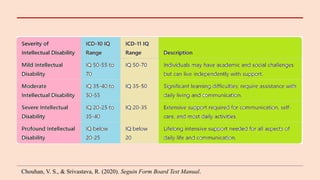
Chouhan, V. S., & Srivastava, R. (2020). Seguin Form Board Test Manual.
HISTORY
• Developed by Seguine From Board Test in 1856. It is based on the singe factor
theory of intelligence.
• Indian adaptation was by J Bharatraj.
• Ideal foe Non-Verbal children particularly in small 3 to 11 of age and adults with
intellectual disability.
• Western norms were given by RB Cattell.
• Indian Norms by SK Goel& J Bharat Raj.
Shukla, R. (2004). The evolution of intelligence tests: Contributions of Edouard Séguin. History of Psychological Sciences, 18(4), 245-
260.
Form
 The measurement of spatial visualization or visual spatial ability involving
manipulation of 2Dand 3D objects or figures may involve use of form boards, paper
folding tasks, manipulation of cubes, reversal of needles on clocks , maze route.
 The board had a mix of primary, secondary and territory forms with handles to place
or retrieve them.
 Goddard brought the board to its present size, removes the handles and complex
forms.
 Edwin B Twittmyer adopted Goddard's arrangement and size of forms, but revised
the order, made the recesses shallow, used hard wood and gave the overall
appearance which we can see today.
Misra, A., & Agarwal, P. (2018). Predictive validity of the Seguin Form Board Test: Longitudinal studies in early childhood
development. Psychological Studies, 63(3), 219-230.
Reliability, Validity, and Norms
Reliability: Studies indicate that the test has a reliability coefficient of approximately
0.9, demonstrating strong consistency in results.
Validity: The SFBT has shown good concurrent and predictive validity, correlating
well with other established intelligence tests.
Norms: Normative data for the SFBT has been established, allowing for comparison
of individual scores against a standardized population.
Chouhan, V. S., & Srivastava, R. (2020). Seguin Form Board Test Manual.
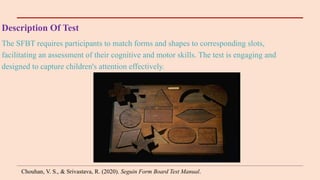
Description Of Test
The SFBT requires participants to match forms and shapes to corresponding slots,
facilitating an assessment of their cognitive and motor skills. The test is engaging and
designed to capture children's attention effectively.
Chouhan, V. S., & Srivastava, R. (2020). Seguin Form Board Test Manual.
Description Of Test
Age Range
Children (around ages 3 to 10 years): The test is often used with young children to
assess basic motor skills, problem-solving, and cognitive flexibility.
Adolescents and Adults (up to age 18 or older): population with developmental
disabilities, intellectual impairments, or in clinical settings where cognitive and motor
skills need to be assessed.
Chouhan, V. S., & Srivastava, R. (2020). Seguin Form Board Test Manual.
Procedures and Administration
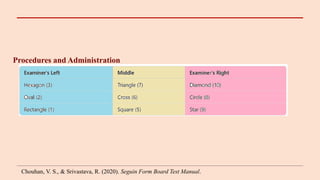
Tool Kit: The form board consisting of 10 different geometric shaped wooden blocks.
Task of the subject: The child is expected to fit the differently shaped blocks into their
respective slots on the form board.
Task of Examiner: Should note down the time in seconds for every trial and the total
seconds of all three trials without child's knowledge.
The board's position: Start is towards the examiner.
Time( in seconds)noted without child's knowledge.
Ques/Prompted: Speed is stressed at the start of the test, with no further between cues or
assistance being provided to the child.
Chouhan, V. S., & Srivastava, R. (2020). Seguin Form Board Test Manual.
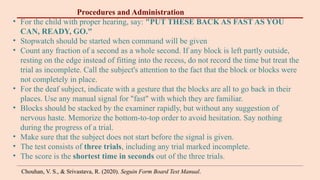
Procedures and Administration
• For the child with proper hearing, say: "PUT THESE BACK AS FAST AS YOU
CAN, READY, GO."
• Stopwatch should be started when command will be given
• Count any fraction of a second as a whole second. If any block is left partly outside,
resting on the edge instead of fitting into the recess, do not record the time but treat the
trial as incomplete. Call the subject's attention to the fact that the block or blocks were
not completely in place.
• For the deaf subject, indicate with a gesture that the blocks are all to go back in their
places. Use any manual signal for "fast" with which they are familiar.
• Blocks should be stacked by the examiner rapidly, but without any suggestion of
nervous haste. Memorize the bottom-to-top order to avoid hesitation. Say nothing
during the progress of a trial.
• Make sure that the subject does not start before the signal is given.
• The test consists of three trials, including any trial marked incomplete.
• The score is the shortest time in seconds out of the three trials.
Chouhan, V. S., & Srivastava, R. (2020). Seguin Form Board Test Manual.
Procedures and Administration
Chouhan, V. S., & Srivastava, R. (2020). Seguin Form Board Test Manual.
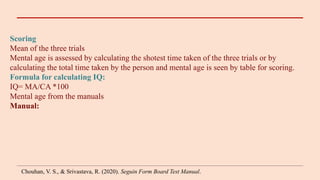
Scoring
Mean of the three trials
Mental age is assessed by calculating the shotest time taken of the three trials or by
calculating the total time taken by the person and mental age is seen by table for scoring.
Formula for calculating IQ:
IQ= MA/CA *100
Mental age from the manuals
Manual:
Chouhan, V. S., & Srivastava, R. (2020). Seguin Form Board Test Manual.
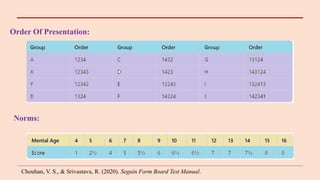
Order Of Presentation:
Chouhan, V. S., & Srivastava, R. (2020). Seguin Form Board Test Manual.
Norms:
Chouhan, V. S., & Srivastava, R. (2020). Seguin Form Board Test Manual.
THANK YOU

SFBT ASSESSMENT FOR INTELLIGENCE AND VISUO MOTOR FUNCTION

  • 1.
    SEGUINE FORM BOARDTEST Presenter Chair person D Kranthi Ms. Bhawna Sharma MPhil Trainee Clinical Psychologist
  • 2.
    Intelligence The global capacityof a person to act, purposefully, to think rationally and to deal effectively with his/her environment- David Wischsler. G Factor Of Intelligence The g factor is considered to represent an individual's overall intellectual ability. It is a theoretical construct that underlies various specific abilities (like verbal ability, mathematical reasoning, spatial reasoning, etc.). Seguin Form Board Test (SFBT) SFBT primarily used to assess intelligence in children, particularly those with speech, hearing, or educational disadvantages. Its designs aimed at evaluating visuo-motor skills, cognitive abilities, and perceptual skills. Chouhan, V. S., & Srivastava, R. (2020). Seguin Form Board Test Manual.
  • 3.
    HISTORY • Developed bySeguine From Board Test in 1856. It is based on the singe factor theory of intelligence. • Indian adaptation was by J Bharatraj. • Ideal foe Non-Verbal children particularly in small 3 to 11 of age and adults with intellectual disability. • Western norms were given by RB Cattell. • Indian Norms by SK Goel& J Bharat Raj. Shukla, R. (2004). The evolution of intelligence tests: Contributions of Edouard Séguin. History of Psychological Sciences, 18(4), 245- 260.
  • 4.
    Form  The measurementof spatial visualization or visual spatial ability involving manipulation of 2Dand 3D objects or figures may involve use of form boards, paper folding tasks, manipulation of cubes, reversal of needles on clocks , maze route.  The board had a mix of primary, secondary and territory forms with handles to place or retrieve them.  Goddard brought the board to its present size, removes the handles and complex forms.  Edwin B Twittmyer adopted Goddard's arrangement and size of forms, but revised the order, made the recesses shallow, used hard wood and gave the overall appearance which we can see today. Misra, A., & Agarwal, P. (2018). Predictive validity of the Seguin Form Board Test: Longitudinal studies in early childhood development. Psychological Studies, 63(3), 219-230.
  • 5.
    Reliability, Validity, andNorms Reliability: Studies indicate that the test has a reliability coefficient of approximately 0.9, demonstrating strong consistency in results. Validity: The SFBT has shown good concurrent and predictive validity, correlating well with other established intelligence tests. Norms: Normative data for the SFBT has been established, allowing for comparison of individual scores against a standardized population. Chouhan, V. S., & Srivastava, R. (2020). Seguin Form Board Test Manual.
  • 6.
    Description Of Test TheSFBT requires participants to match forms and shapes to corresponding slots, facilitating an assessment of their cognitive and motor skills. The test is engaging and designed to capture children's attention effectively. Chouhan, V. S., & Srivastava, R. (2020). Seguin Form Board Test Manual.
  • 7.
    Description Of Test AgeRange Children (around ages 3 to 10 years): The test is often used with young children to assess basic motor skills, problem-solving, and cognitive flexibility. Adolescents and Adults (up to age 18 or older): population with developmental disabilities, intellectual impairments, or in clinical settings where cognitive and motor skills need to be assessed. Chouhan, V. S., & Srivastava, R. (2020). Seguin Form Board Test Manual.
  • 8.
    Procedures and Administration ToolKit: The form board consisting of 10 different geometric shaped wooden blocks. Task of the subject: The child is expected to fit the differently shaped blocks into their respective slots on the form board. Task of Examiner: Should note down the time in seconds for every trial and the total seconds of all three trials without child's knowledge. The board's position: Start is towards the examiner. Time( in seconds)noted without child's knowledge. Ques/Prompted: Speed is stressed at the start of the test, with no further between cues or assistance being provided to the child. Chouhan, V. S., & Srivastava, R. (2020). Seguin Form Board Test Manual.
  • 9.
    Procedures and Administration •For the child with proper hearing, say: "PUT THESE BACK AS FAST AS YOU CAN, READY, GO." • Stopwatch should be started when command will be given • Count any fraction of a second as a whole second. If any block is left partly outside, resting on the edge instead of fitting into the recess, do not record the time but treat the trial as incomplete. Call the subject's attention to the fact that the block or blocks were not completely in place. • For the deaf subject, indicate with a gesture that the blocks are all to go back in their places. Use any manual signal for "fast" with which they are familiar. • Blocks should be stacked by the examiner rapidly, but without any suggestion of nervous haste. Memorize the bottom-to-top order to avoid hesitation. Say nothing during the progress of a trial. • Make sure that the subject does not start before the signal is given. • The test consists of three trials, including any trial marked incomplete. • The score is the shortest time in seconds out of the three trials. Chouhan, V. S., & Srivastava, R. (2020). Seguin Form Board Test Manual.
  • 10.
    Procedures and Administration Chouhan,V. S., & Srivastava, R. (2020). Seguin Form Board Test Manual.
  • 11.
    Scoring Mean of thethree trials Mental age is assessed by calculating the shotest time taken of the three trials or by calculating the total time taken by the person and mental age is seen by table for scoring. Formula for calculating IQ: IQ= MA/CA *100 Mental age from the manuals Manual: Chouhan, V. S., & Srivastava, R. (2020). Seguin Form Board Test Manual.
  • 12.
    Order Of Presentation: Chouhan,V. S., & Srivastava, R. (2020). Seguin Form Board Test Manual. Norms:
  • 13.
    Chouhan, V. S.,& Srivastava, R. (2020). Seguin Form Board Test Manual.
  • 15.