Khan, Asadullah
Course: MME 9620
“Nanomaterials and Nanotechnology”
Professor: Dr. XA Sun
Introduction
Hazards of Nanomaterials
Nanosafety
Conclusion
References
2
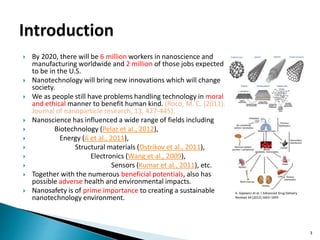
 By 2020, there will be 6 million workers in nanoscience and
manufacturing worldwide and 2 million of those jobs expected
to be in the U.S.
 Nanotechnology will bring new innovations which will change
society.
 We as people still have problems handling technology in moral
and ethical manner to benefit human kind. (Roco, M. C. (2011).
Journal of nanoparticle research, 13, 427‐445).
 Nanoscience has influenced a wide range of fields including
 Biotechnology (Pelaz et al., 2012),
 Energy (Ji et al., 2011),
 Structural materials (Ostrikov et al., 2011),
 Electronics (Wang et al., 2009),
 Sensors (Kumar et al., 2011), etc.
 Together with the numerous beneficial potentials, also has
possible adverse health and environmental impacts.
 Nanosafety is of prime importance to creating a sustainable
nanotechnology environment.
3
A. Gajewicz et al. / Advanced Drug Delivery
Reviews 64 (2012) 1663–1693
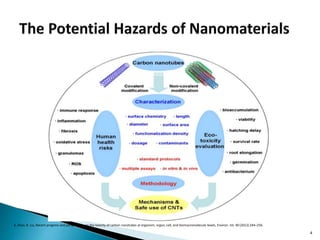
4
X. Zhao, R. Liu, Recent progress and perspectives on the toxicity of carbon nanotubes at organism, organ, cell, and biomacromolecule levels, Environ. Int. 40 (2012) 244–256.
 There are some unknowns about
nanoparticles in terms of their
characterization
 There is no or little research to
determine if different size
nanoparticles have the same
properties
 This may proposed a problem if
scientists do not know if different size
nanoparticles have different
reactions to the human body
5
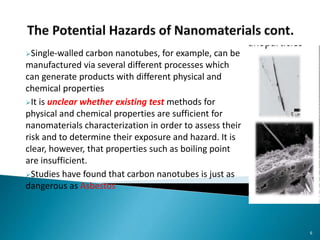
Single‐walled carbon nanotubes, for example, can be
manufactured via several different processes which
can generate products with different physical and
chemical properties
It is unclear whether existing test methods for
physical and chemical properties are sufficient for
nanomaterials characterization in order to assess their
risk and to determine their exposure and hazard. It is
clear, however, that properties such as boiling point
are insufficient.
Studies have found that carbon nanotubes is just as
dangerous as Asbestos
6
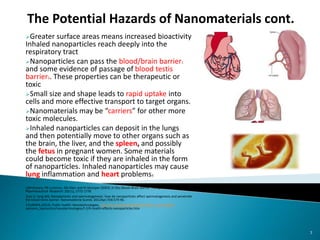
Greater surface areas means increased bioactivity
Inhaled nanoparticles reach deeply into the
respiratory tract
Nanoparticles can pass the blood/brain barrier1
and some evidence of passage of blood testis
barrier2. These properties can be therapeutic or
toxic
Small size and shape leads to rapid uptake into
cells and more effective transport to target organs.
Nanomaterials may be “carriers” for other more
toxic molecules.
Inhaled nanoparticles can deposit in the lungs
and then potentially move to other organs such as
the brain, the liver, and the spleen, and possibly
the fetus in pregnant women. Some materials
could become toxic if they are inhaled in the form
of nanoparticles. Inhaled nanoparticles may cause
lung inflammation and heart problems3
1JM Koziara, PR Lockman, DD Allen and RJ Mumper (2003). In Situ Blood–Brain Barrier Transport of Nanoparticles.
Pharmaceutical Research: 20(11), 1772-1778
2Lan Z, Yang WX. Nanoparticles and spermatogenesis: how do nanoparticles affect spermatogenesis and penetrate
the blood-testis barrier. Nanomedicine (Lond). 2012Apr;7(4):579-96.
3 EUROPA (2013). Public health: Nanotechnologies. http://ec.europa.eu/health/scientific_committees/
opinions_layman/en/nanotechnologies/l‐2/6‐health‐effects‐nanoparticles.htm
7
The Potential Hazards of Nanomaterials cont.
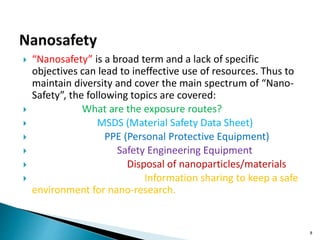
 “Nanosafety” is a broad term and a lack of specific
objectives can lead to ineffective use of resources. Thus to
maintain diversity and cover the main spectrum of “Nano-
Safety”, the following topics are covered:
 What are the exposure routes?
 MSDS (Material Safety Data Sheet)
 PPE (Personal Protective Equipment)
 Safety Engineering Equipment
 Disposal of nanoparticles/materials
 Information sharing to keep a safe
environment for nano-research.
8
9
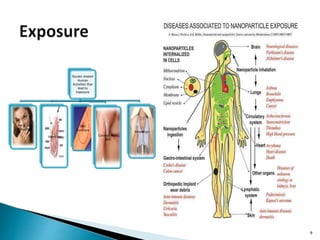
Routes related
Human
Activities that
lead to
Exposure
Hand to
Mouth
Ingestion
Skin
Puncture
Contact With
Skin
Inhalation
10
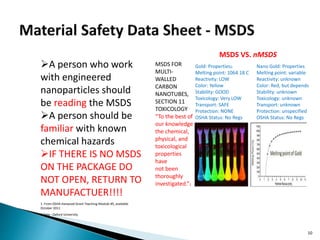
A person who work
with engineered
nanoparticles should
be reading the MSDS
A person should be
familiar with known
chemical hazards
IF THERE IS NO MSDS
ON THE PACKAGE DO
NOT OPEN, RETURN TO
MANUFACTUER!!!!
MSDS FOR
MULTI-
WALLED
CARBON
NANOTUBES,
SECTION 11
TOXICOLOGY
“To the best of
our knowledge
the chemical,
physical, and
toxicological
properties
have
not been
thoroughly
investigated.”1
1. From OSHA Harwood Grant Teaching Module #5, available
October 2011
Gold: Properties2
Melting point: 1064.18 C
Reactivity: LOW
Color: Yellow
Stability: GOOD
Toxicology: Very LOW
Transport: SAFE
Protection: NONE
OSHA Status: No Regs
Nano Gold: Properties
Melting point: variable
Reactivity: unknown
Color: Red, but depends
Stability: unknown
Toxicology: unknown
Transport: unknown
Protection: unspecified
OSHA Status: No Regs
MSDS VS. nMSDS
2 Data - Oxford University
11
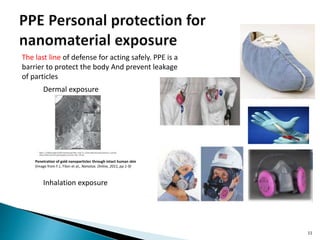
Dermal exposure
Inhalation exposure
The last line of defense for acting safely. PPE is a
barrier to protect the body And prevent leakage
of particles
Penetration of gold nanoparticles through intact human skin
(Image from F.L. Filon et al., Nanotox. Online, 2011, pp.1-9)
12
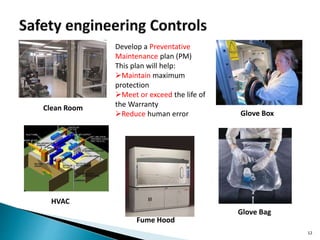
Fume Hood
Glove Box
Glove Bag
Clean Room
HVAC
Develop a Preventative
Maintenance plan (PM)
This plan will help:
Maintain maximum
protection
Meet or exceed the life of
the Warranty
Reduce human error
13
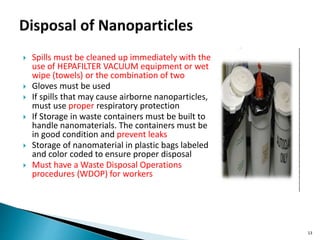
 Spills must be cleaned up immediately with the
use of HEPAFILTER VACUUM equipment or wet
wipe (towels) or the combination of two
 Gloves must be used
 If spills that may cause airborne nanoparticles,
must use proper respiratory protection
 If Storage in waste containers must be built to
handle nanomaterials. The containers must be
in good condition and prevent leaks
 Storage of nanomaterial in plastic bags labeled
and color coded to ensure proper disposal
 Must have a Waste Disposal Operations
procedures (WDOP) for workers
 The Occupational Safety & Health Administration (OSHA) requires a respiratory program in workplaces
 The standard requires that National Institute of Occupational Health and Safety (NIOSH)-approved
particulate respirators be selected based on an expert knowledgeable of the limitations of respirators and
workplaces (Shaffer and Rengasamy, 2009).
 NIOSH recommends the use of NIOSH respirator selection logic (RSL) (NIOSH, February 26, 2013).
 NIOSH-approved respirators have been shown to provide expected levels of protection when properly
used.
 A recent study (Rengasamy et al., 2009) showed that respirators effectively capture smaller size
nanoparticles as predicted by the single fiber theory. Particle penetration, however, exceeded NIOSH
allowable penetration levels when number-based methods were employed as opposed to the
photometric methods (Rengasamy et al., 2009 and Rengasamy et al., 2011).
 Particles below 200 nm size showed a decrease in leakage through face seal area of respirators. However,
the high mobility of nanoparticles indicated otherwise, and the results obtained from mannequin studies
showed a twofold higher concentration of nanoparticles than larger size particles inside the breathing
zone (Rengasamy and Eimer, 2012).
 It was also observed that among the particles that enter inside the respirator, a higher concentration of
nanoparticles inside the respirator can be expected in workplaces producing high concentration of
nanoparticles (Rengasamy and Eimer, 2012).
 The use of nitrile gloves provides sufficient protection against nanoparticles produced in many laboratory
operations. Only a few studies have reported the penetration of nanomaterials through protective
clothing and gloves (Faccini et al., 2012 and Gao et al., 2011).
 Some studies also showed no significant penetration of smaller size particles such as a bacteriophage
through nitrile gloves (Edlich et al., 1999).
 The use of nitrile gloves provides sufficient protection against nanoparticles produced in many laboratory
operations. Only a few studies have reported the penetration of nanomaterials through protective
clothing and gloves (Faccini et al., 2012 and Gao et al., 2011). Some studies also showed no significant
penetration of smaller size particles such as a bacteriophage through nitrile gloves (Edlich et al., 1999).
14
 The fast growth of the nanotechnology industry presents
potential challenges with the use of Personal Protective
Equipment (PPE). Nanomaterial-producing industries and
users should be aware of the health and environmental
effects of engineered nanomaterials. The use of appropriate
PPE to reduce worker exposure to harmful nanomaterials is
important. This could be achieved by industries collaborating
with research institutions, although not many industries are
interested in working with researchers to reduce
nanomaterial exposures. In the case of respirators, the
selection process becomes difficult with limited information
on the toxicity, a lack of available occupational exposure
limits (OELs) for most nanomaterials, and limited exposure
measurements in the workplace (van Broekhuizen, 2011).
 Portable high precision instruments for workplace
measurements are not readily available in the market.
Another challenge is the availability of PPE standards and
recommendation/guidance documents. Government
agencies have only developed limited or no regulations for
the use of PPE (e.g. gloves and protective clothing) for
nanomaterials
15
 The effectiveness of existing PPE needs to be evaluated for a variety of
nanoparticle workplace exposures. Currently available PPE may be
sufficient for protection against nanomaterials in many cases, but a
thorough evaluation of PPE for nanomaterials is required to ascertain
their effectiveness in a variety of settings. This evaluation of PPE for
nanomaterials requires sensitive equipment and methodologies capable
of identifying potential differences.
 Another area that requires attention is whether employees are being
properly trained on PPE use. PPE may offer only limited/no protection
against nanomaterials when not used properly. There is also a growing
need for PPE standards and guidance documents. In the case of
respirators, multiple standards are available, which are confusing to
employers and employees. No clear guidance or standard is available for
glove and protective clothing. Effort is needed to develop consensus
standards and guidance documents for PPE use in nanomaterial
workplaces.
16
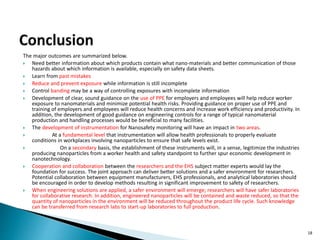
 Given the limited information about the health risks associated with
occupational exposure to engineered nanoparticles, engineering
controls should be used to minimize worker exposure. The proper
design and use of engineering controls can help reduce nanoparticle
exposure in most workplaces. In general, control techniques such as
source enclosure (i.e., isolating the generation source from the
worker) and local exhaust ventilation systems should be effective for
capturing airborne nanoparticles. For example, in some studies
laboratory fume hoods have been shown to effectively control
exposure when working with nanomaterials (Tsai et al., 2009a and Tsai
et al., 2009b).
 However, other studies have shown that conventional constant air
volume fume hoods may allow the release of nanomaterials during
standard handling procedures (Tsai et al., 2010 and Yeganeh et al.,
2008).
 Proper evaluation of the effectiveness of engineering controls for
common nanomaterial tasks/processes should be conducted.
17
The major outcomes are summarized below.
 Need better information about which products contain what nano-materials and better communication of those
hazards about which information is available, especially on safety data sheets.
 Learn from past mistakes
 Reduce and prevent exposure while information is still incomplete
 Control banding may be a way of controlling exposures with incomplete information
 Development of clear, sound guidance on the use of PPE for employers and employees will help reduce worker
exposure to nanomaterials and minimize potential health risks. Providing guidance on proper use of PPE and
training of employers and employees will reduce health concerns and increase work efficiency and productivity. In
addition, the development of good guidance on engineering controls for a range of typical nanomaterial
production and handling processes would be beneficial to many facilities.
 The development of instrumentation for Nanosafety monitoring will have an impact in two areas.
 At a fundamental level that instrumentation will allow health professionals to properly evaluate
conditions in workplaces involving nanoparticles to ensure that safe levels exist.
 On a secondary basis, the establishment of these instruments will, in a sense, legitimize the industries
producing nanoparticles from a worker health and safety standpoint to further spur economic development in
nanotechnology.
 Cooperation and collaboration between the researchers and the EHS subject matter experts would lay the
foundation for success. The joint approach can deliver better solutions and a safer environment for researchers.
Potential collaboration between equipment manufacturers, EHS professionals, and analytical laboratories should
be encouraged in order to develop methods resulting in significant improvement to safety of researchers.
 When engineering solutions are applied, a safer environment will emerge; researchers will have safer laboratories
for collaborative research. In addition, engineered nanoparticles will be contained and waste reduced, so that the
quantity of nanoparticles in the environment will be reduced throughout the product life cycle. Such knowledge
can be transferred from research labs to start-up laboratories to full production.
18
19
20
 Bottom Line "The Next Big
Thing Is Really Small”
21
 Nano Portal
 http://nanoportal.gc.ca/default.asp?lang=En&n=04C44A10-1
 National Institute of Environmental Health and Safety
 http://www.niehs.nih.gov/health/topics/agents/sya-nano/
 CAUT Health and Safety Fact Sheet
 http://www.caut.ca/docs/default-source/health-safety-fact-sheets/animal-hazards.pdf?sfvrsn=8
 Florida State University – Laboratory Safety
 http://www.safety.fsu.edu/lab-nano.html
 University of Dayton – Environmental Health and Safety/Risk Management – Nanotechnology Safety
 http://campus.udayton.edu/~UDCampusPlanning/EHSRM/index.php?option=com_content&view=article&id=18&Itemid=205
 National Institutes of Health Office of Research Services Division of Occupational Health and Safety
 http://www.ors.od.nih.gov/sr/dohs/Documents/Nanotechnology%20Safety%20and%20Health%20Program.pdf
 National Collaborating Center for Environmental Health - Nanotechnology: A Review of Exposure, Health Risks and Recent Regulatory Developments
 http://www.ncceh.ca/sites/default/files/Nanotechnology_Review_Aug_2011.pdf
 Scientific Committee on Emerging and Newly Identified Health Risks - Risk Assessment of Products of Nanotechnologies
 http://ec.europa.eu/health/ph_risk/committees/04_scenihr/docs/scenihr_o_023.pdf
 European Commission - Guidance on the protection of the health and safety of workers from the potential risks related to nanomaterials at work
 https://osha.europa.eu/en/news/eu-safe-use-of-nanomaterials-commission-publishes-guidance-for-employers-and-workers
 Safe Work Australia – Safety Hazards of Engineered Nanomaterials Information Sheet
 http://www.safeworkaustralia.gov.au/sites/SWA/about/Publications/Documents/762/Safety-hazards-engineered-nanomaterials.pdf
 Additional Reference:
 Good Nano Guide
 http://goodnanoguide.org
 National Institute for Occupational Safety and Health (NIOSH) – Nanotechnology
 www.cdc.gov/niosh/topics/nanotech
 National Institute of Occupation Safety and Health’s Approaches to Safe Nanotechnology: An information exchange with NIOSH (March 2009)
 www.cdc.gov/niosh/docs/2009-125/
 National Nanotechnology Initiative
 www.nano.gov
22
Thank you!
Questions…
23

Nanotechnology – safety concerns

  • 1.
    Khan, Asadullah Course: MME9620 “Nanomaterials and Nanotechnology” Professor: Dr. XA Sun
  • 2.
  • 3.
     By 2020,there will be 6 million workers in nanoscience and manufacturing worldwide and 2 million of those jobs expected to be in the U.S.  Nanotechnology will bring new innovations which will change society.  We as people still have problems handling technology in moral and ethical manner to benefit human kind. (Roco, M. C. (2011). Journal of nanoparticle research, 13, 427‐445).  Nanoscience has influenced a wide range of fields including  Biotechnology (Pelaz et al., 2012),  Energy (Ji et al., 2011),  Structural materials (Ostrikov et al., 2011),  Electronics (Wang et al., 2009),  Sensors (Kumar et al., 2011), etc.  Together with the numerous beneficial potentials, also has possible adverse health and environmental impacts.  Nanosafety is of prime importance to creating a sustainable nanotechnology environment. 3 A. Gajewicz et al. / Advanced Drug Delivery Reviews 64 (2012) 1663–1693
  • 4.
    4 X. Zhao, R.Liu, Recent progress and perspectives on the toxicity of carbon nanotubes at organism, organ, cell, and biomacromolecule levels, Environ. Int. 40 (2012) 244–256.
  • 5.
     There aresome unknowns about nanoparticles in terms of their characterization  There is no or little research to determine if different size nanoparticles have the same properties  This may proposed a problem if scientists do not know if different size nanoparticles have different reactions to the human body 5
  • 6.
    Single‐walled carbon nanotubes,for example, can be manufactured via several different processes which can generate products with different physical and chemical properties It is unclear whether existing test methods for physical and chemical properties are sufficient for nanomaterials characterization in order to assess their risk and to determine their exposure and hazard. It is clear, however, that properties such as boiling point are insufficient. Studies have found that carbon nanotubes is just as dangerous as Asbestos 6
  • 7.
    Greater surface areasmeans increased bioactivity Inhaled nanoparticles reach deeply into the respiratory tract Nanoparticles can pass the blood/brain barrier1 and some evidence of passage of blood testis barrier2. These properties can be therapeutic or toxic Small size and shape leads to rapid uptake into cells and more effective transport to target organs. Nanomaterials may be “carriers” for other more toxic molecules. Inhaled nanoparticles can deposit in the lungs and then potentially move to other organs such as the brain, the liver, and the spleen, and possibly the fetus in pregnant women. Some materials could become toxic if they are inhaled in the form of nanoparticles. Inhaled nanoparticles may cause lung inflammation and heart problems3 1JM Koziara, PR Lockman, DD Allen and RJ Mumper (2003). In Situ Blood–Brain Barrier Transport of Nanoparticles. Pharmaceutical Research: 20(11), 1772-1778 2Lan Z, Yang WX. Nanoparticles and spermatogenesis: how do nanoparticles affect spermatogenesis and penetrate the blood-testis barrier. Nanomedicine (Lond). 2012Apr;7(4):579-96. 3 EUROPA (2013). Public health: Nanotechnologies. http://ec.europa.eu/health/scientific_committees/ opinions_layman/en/nanotechnologies/l‐2/6‐health‐effects‐nanoparticles.htm 7 The Potential Hazards of Nanomaterials cont.
  • 8.
     “Nanosafety” isa broad term and a lack of specific objectives can lead to ineffective use of resources. Thus to maintain diversity and cover the main spectrum of “Nano- Safety”, the following topics are covered:  What are the exposure routes?  MSDS (Material Safety Data Sheet)  PPE (Personal Protective Equipment)  Safety Engineering Equipment  Disposal of nanoparticles/materials  Information sharing to keep a safe environment for nano-research. 8
  • 9.
    9 Routes related Human Activities that leadto Exposure Hand to Mouth Ingestion Skin Puncture Contact With Skin Inhalation
  • 10.
    10 A person whowork with engineered nanoparticles should be reading the MSDS A person should be familiar with known chemical hazards IF THERE IS NO MSDS ON THE PACKAGE DO NOT OPEN, RETURN TO MANUFACTUER!!!! MSDS FOR MULTI- WALLED CARBON NANOTUBES, SECTION 11 TOXICOLOGY “To the best of our knowledge the chemical, physical, and toxicological properties have not been thoroughly investigated.”1 1. From OSHA Harwood Grant Teaching Module #5, available October 2011 Gold: Properties2 Melting point: 1064.18 C Reactivity: LOW Color: Yellow Stability: GOOD Toxicology: Very LOW Transport: SAFE Protection: NONE OSHA Status: No Regs Nano Gold: Properties Melting point: variable Reactivity: unknown Color: Red, but depends Stability: unknown Toxicology: unknown Transport: unknown Protection: unspecified OSHA Status: No Regs MSDS VS. nMSDS 2 Data - Oxford University
  • 11.
    11 Dermal exposure Inhalation exposure Thelast line of defense for acting safely. PPE is a barrier to protect the body And prevent leakage of particles Penetration of gold nanoparticles through intact human skin (Image from F.L. Filon et al., Nanotox. Online, 2011, pp.1-9)
  • 12.
    12 Fume Hood Glove Box GloveBag Clean Room HVAC Develop a Preventative Maintenance plan (PM) This plan will help: Maintain maximum protection Meet or exceed the life of the Warranty Reduce human error
  • 13.
    13  Spills mustbe cleaned up immediately with the use of HEPAFILTER VACUUM equipment or wet wipe (towels) or the combination of two  Gloves must be used  If spills that may cause airborne nanoparticles, must use proper respiratory protection  If Storage in waste containers must be built to handle nanomaterials. The containers must be in good condition and prevent leaks  Storage of nanomaterial in plastic bags labeled and color coded to ensure proper disposal  Must have a Waste Disposal Operations procedures (WDOP) for workers
  • 14.
     The OccupationalSafety & Health Administration (OSHA) requires a respiratory program in workplaces  The standard requires that National Institute of Occupational Health and Safety (NIOSH)-approved particulate respirators be selected based on an expert knowledgeable of the limitations of respirators and workplaces (Shaffer and Rengasamy, 2009).  NIOSH recommends the use of NIOSH respirator selection logic (RSL) (NIOSH, February 26, 2013).  NIOSH-approved respirators have been shown to provide expected levels of protection when properly used.  A recent study (Rengasamy et al., 2009) showed that respirators effectively capture smaller size nanoparticles as predicted by the single fiber theory. Particle penetration, however, exceeded NIOSH allowable penetration levels when number-based methods were employed as opposed to the photometric methods (Rengasamy et al., 2009 and Rengasamy et al., 2011).  Particles below 200 nm size showed a decrease in leakage through face seal area of respirators. However, the high mobility of nanoparticles indicated otherwise, and the results obtained from mannequin studies showed a twofold higher concentration of nanoparticles than larger size particles inside the breathing zone (Rengasamy and Eimer, 2012).  It was also observed that among the particles that enter inside the respirator, a higher concentration of nanoparticles inside the respirator can be expected in workplaces producing high concentration of nanoparticles (Rengasamy and Eimer, 2012).  The use of nitrile gloves provides sufficient protection against nanoparticles produced in many laboratory operations. Only a few studies have reported the penetration of nanomaterials through protective clothing and gloves (Faccini et al., 2012 and Gao et al., 2011).  Some studies also showed no significant penetration of smaller size particles such as a bacteriophage through nitrile gloves (Edlich et al., 1999).  The use of nitrile gloves provides sufficient protection against nanoparticles produced in many laboratory operations. Only a few studies have reported the penetration of nanomaterials through protective clothing and gloves (Faccini et al., 2012 and Gao et al., 2011). Some studies also showed no significant penetration of smaller size particles such as a bacteriophage through nitrile gloves (Edlich et al., 1999). 14
  • 15.
     The fastgrowth of the nanotechnology industry presents potential challenges with the use of Personal Protective Equipment (PPE). Nanomaterial-producing industries and users should be aware of the health and environmental effects of engineered nanomaterials. The use of appropriate PPE to reduce worker exposure to harmful nanomaterials is important. This could be achieved by industries collaborating with research institutions, although not many industries are interested in working with researchers to reduce nanomaterial exposures. In the case of respirators, the selection process becomes difficult with limited information on the toxicity, a lack of available occupational exposure limits (OELs) for most nanomaterials, and limited exposure measurements in the workplace (van Broekhuizen, 2011).  Portable high precision instruments for workplace measurements are not readily available in the market. Another challenge is the availability of PPE standards and recommendation/guidance documents. Government agencies have only developed limited or no regulations for the use of PPE (e.g. gloves and protective clothing) for nanomaterials 15
  • 16.
     The effectivenessof existing PPE needs to be evaluated for a variety of nanoparticle workplace exposures. Currently available PPE may be sufficient for protection against nanomaterials in many cases, but a thorough evaluation of PPE for nanomaterials is required to ascertain their effectiveness in a variety of settings. This evaluation of PPE for nanomaterials requires sensitive equipment and methodologies capable of identifying potential differences.  Another area that requires attention is whether employees are being properly trained on PPE use. PPE may offer only limited/no protection against nanomaterials when not used properly. There is also a growing need for PPE standards and guidance documents. In the case of respirators, multiple standards are available, which are confusing to employers and employees. No clear guidance or standard is available for glove and protective clothing. Effort is needed to develop consensus standards and guidance documents for PPE use in nanomaterial workplaces. 16
  • 17.
     Given thelimited information about the health risks associated with occupational exposure to engineered nanoparticles, engineering controls should be used to minimize worker exposure. The proper design and use of engineering controls can help reduce nanoparticle exposure in most workplaces. In general, control techniques such as source enclosure (i.e., isolating the generation source from the worker) and local exhaust ventilation systems should be effective for capturing airborne nanoparticles. For example, in some studies laboratory fume hoods have been shown to effectively control exposure when working with nanomaterials (Tsai et al., 2009a and Tsai et al., 2009b).  However, other studies have shown that conventional constant air volume fume hoods may allow the release of nanomaterials during standard handling procedures (Tsai et al., 2010 and Yeganeh et al., 2008).  Proper evaluation of the effectiveness of engineering controls for common nanomaterial tasks/processes should be conducted. 17
  • 18.
    The major outcomesare summarized below.  Need better information about which products contain what nano-materials and better communication of those hazards about which information is available, especially on safety data sheets.  Learn from past mistakes  Reduce and prevent exposure while information is still incomplete  Control banding may be a way of controlling exposures with incomplete information  Development of clear, sound guidance on the use of PPE for employers and employees will help reduce worker exposure to nanomaterials and minimize potential health risks. Providing guidance on proper use of PPE and training of employers and employees will reduce health concerns and increase work efficiency and productivity. In addition, the development of good guidance on engineering controls for a range of typical nanomaterial production and handling processes would be beneficial to many facilities.  The development of instrumentation for Nanosafety monitoring will have an impact in two areas.  At a fundamental level that instrumentation will allow health professionals to properly evaluate conditions in workplaces involving nanoparticles to ensure that safe levels exist.  On a secondary basis, the establishment of these instruments will, in a sense, legitimize the industries producing nanoparticles from a worker health and safety standpoint to further spur economic development in nanotechnology.  Cooperation and collaboration between the researchers and the EHS subject matter experts would lay the foundation for success. The joint approach can deliver better solutions and a safer environment for researchers. Potential collaboration between equipment manufacturers, EHS professionals, and analytical laboratories should be encouraged in order to develop methods resulting in significant improvement to safety of researchers.  When engineering solutions are applied, a safer environment will emerge; researchers will have safer laboratories for collaborative research. In addition, engineered nanoparticles will be contained and waste reduced, so that the quantity of nanoparticles in the environment will be reduced throughout the product life cycle. Such knowledge can be transferred from research labs to start-up laboratories to full production. 18
  • 19.
  • 20.
  • 21.
     Bottom Line"The Next Big Thing Is Really Small” 21
  • 22.
     Nano Portal http://nanoportal.gc.ca/default.asp?lang=En&n=04C44A10-1  National Institute of Environmental Health and Safety  http://www.niehs.nih.gov/health/topics/agents/sya-nano/  CAUT Health and Safety Fact Sheet  http://www.caut.ca/docs/default-source/health-safety-fact-sheets/animal-hazards.pdf?sfvrsn=8  Florida State University – Laboratory Safety  http://www.safety.fsu.edu/lab-nano.html  University of Dayton – Environmental Health and Safety/Risk Management – Nanotechnology Safety  http://campus.udayton.edu/~UDCampusPlanning/EHSRM/index.php?option=com_content&view=article&id=18&Itemid=205  National Institutes of Health Office of Research Services Division of Occupational Health and Safety  http://www.ors.od.nih.gov/sr/dohs/Documents/Nanotechnology%20Safety%20and%20Health%20Program.pdf  National Collaborating Center for Environmental Health - Nanotechnology: A Review of Exposure, Health Risks and Recent Regulatory Developments  http://www.ncceh.ca/sites/default/files/Nanotechnology_Review_Aug_2011.pdf  Scientific Committee on Emerging and Newly Identified Health Risks - Risk Assessment of Products of Nanotechnologies  http://ec.europa.eu/health/ph_risk/committees/04_scenihr/docs/scenihr_o_023.pdf  European Commission - Guidance on the protection of the health and safety of workers from the potential risks related to nanomaterials at work  https://osha.europa.eu/en/news/eu-safe-use-of-nanomaterials-commission-publishes-guidance-for-employers-and-workers  Safe Work Australia – Safety Hazards of Engineered Nanomaterials Information Sheet  http://www.safeworkaustralia.gov.au/sites/SWA/about/Publications/Documents/762/Safety-hazards-engineered-nanomaterials.pdf  Additional Reference:  Good Nano Guide  http://goodnanoguide.org  National Institute for Occupational Safety and Health (NIOSH) – Nanotechnology  www.cdc.gov/niosh/topics/nanotech  National Institute of Occupation Safety and Health’s Approaches to Safe Nanotechnology: An information exchange with NIOSH (March 2009)  www.cdc.gov/niosh/docs/2009-125/  National Nanotechnology Initiative  www.nano.gov 22
  • 23.