1
Laboratory Safety and Hazards
Dr. E. A Tagoe
2022
2
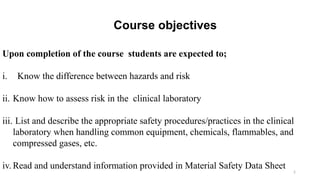
Course objectives
Upon completion of the course students are expected to;
i. Know the difference between hazards and risk
ii. Know how to assess risk in the clinical laboratory
iii. List and describe the appropriate safety procedures/practices in the clinical
laboratory when handling common equipment, chemicals, flammables, and
compressed gases, etc.
iv. Read and understand information provided in Material Safety Data Sheet
3
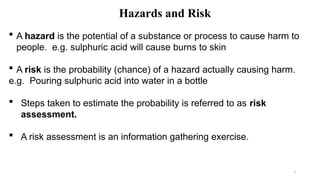
Hazards and Risk
 A hazard is the potential of a substance or process to cause harm to
people. e.g. sulphuric acid will cause burns to skin
 A risk is the probability (chance) of a hazard actually causing harm.
e.g. Pouring sulphuric acid into water in a bottle
 Steps taken to estimate the probability is referred to as risk
assessment.
 A risk assessment is an information gathering exercise.
4
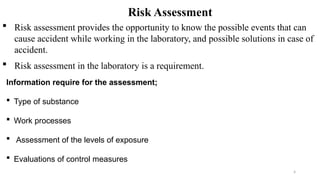
Risk Assessment
 Risk assessment provides the opportunity to know the possible events that can
cause accident while working in the laboratory, and possible solutions in case of
accident.
 Risk assessment in the laboratory is a requirement.
Information require for the assessment;
 Type of substance
 Work processes
 Assessment of the levels of exposure
 Evaluations of control measures
5
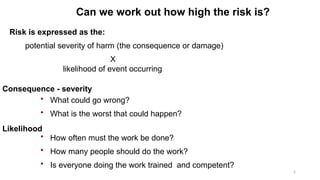
Risk is expressed as the:
potential severity of harm (the consequence or damage)
X
likelihood of event occurring
Can we work out how high the risk is?
• What could go wrong?
• What is the worst that could happen?
Consequence - severity
Likelihood
• How often must the work be done?
• How many people should do the work?
• Is everyone doing the work trained and competent?
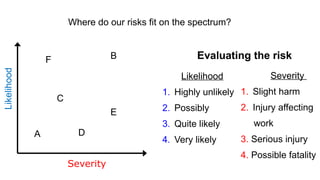
Where do our risks fit on the spectrum?
Likelihood
Severity
A
B
C
D
E
F
Likelihood
1. Highly unlikely
2. Possibly
3. Quite likely
4. Very likely
Severity
1. Slight harm
2. Injury affecting
work
3. Serious injury
4. Possible fatality
Evaluating the risk
7
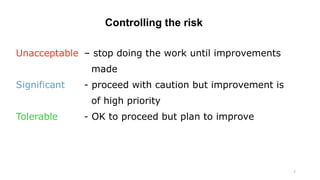
Controlling the risk
Unacceptable – stop doing the work until improvements
made
Significant - proceed with caution but improvement is
of high priority
Tolerable - OK to proceed but plan to improve
8
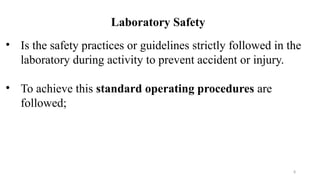
Laboratory Safety
• Is the safety practices or guidelines strictly followed in the
laboratory during activity to prevent accident or injury.
• To achieve this standard operating procedures are
followed;
9
 General Personal Safety: - Dos and Don'ts in the Laboratory which keep
researchers/workers from danger.
i. Avoid eating and drinking in the laboratory to prevent ingestion of toxic/cells
materials into your body.
ii. Do not store food or drink in the fridges or deep freezers in the laboratory to
avoid contamination.
iii. Secure long hair, ties, long sleeves and other materials that can possibly get
contaminated.
10
iv. Avoid introducing objects such as pens and pencils into the mouth.
v. Put on protective clothing (laboratory coat, laboratory footwear and gloves).
vi. Handle all biological samples / materials as potential hazardous substances.
vii. Regular hand washing is highly recommended
11
i. Wear eye goggles when working with ultra-violet radiation (light), body fluid,
caustic reagents and/or solvents, or concentrated acids and bases.
ii. Wearing contact lenses in the laboratory is discouraged.
iii. Avoid rubbing your eye when working in the laboratory
 Eye Safety : necessary steps taken to protect the eye
12
 Safe handling of Biologically Hazardous Material
i. Handle all patients samples as potentially hazards
ii. Wear protective clothing (glove, lab coat, etc) before handling patient
sample
iii. Wash hands immediately after the gloves are removed
iv. Avoid spillage and if it occurs accidentally, disinfect the working area
v. Wash hands after work and protective clothing should be
removed prior to leaving the lab.
vi. Biohazards must be appropriately discarded (in Biohazard bag for
autoclave or other approved method).
13
• Sharps
• Chemical and gas hazards
• Fire
• Breakage of glassware
• Spillages
• Pressure equipment & gas cylinders
• Extremes of heat & cold
• Biological hazards
• Radiation, etc
General hazards in a laboratory
14
Proper handling of sharp objects
i. Contaminated needles and other sharps are never broken, bent, recapped or
re-sheathed by hand.
ii. Used needles are removed from syringes and separately disposed.
iii. Needles and sharps are disposed of in impervious containers
located near the point of use.
iv. Sharp objects must be stored in a protective case.
15
Chemicals and Gas Safety
i. Corrosive materials
ii. Toxic or poisonous materials
 Types of material
16
 Safety Practices
i. Avoid dangerous splashing
ii. Toxic materials should be labeled with special tape when stored in separate
containers.
iii. Toxic chemical must be prepared in the hood.
iv. Acids and alkali should be carried by means of special protective carriers when
transporting.
v. In case of spillage, clean all exposed surfaces, and avoid body contact.
Accidental body contact must be washed and reported to supervisor.
Chemical and Gas
17
Flammable compounds
i. All flammable reagents should be kept in the flammable storage facilities (closet
or refrigerator) at all times when not in use.
ii. Any solutions compounded from these reagents should be labeled as flammable.
iii. Flammable substances should be handled in areas free of ignition sources.
iv. Flammable substances should never be heated using an open flame.
v. Ventilation is one of the most effective ways to prevent accumulation of
explosive levels of flammable vapors.
iv. Flammable compounds should be placed in proper receptacle for disposal.
18
Compressed Gases
i. The storage of all compressed gases shall be in designed containers.
ii. In the laboratory, gas containers are to be limited to the number of containers in
use at any time.
iii. Containers shall be securely strapped, chained or secured in a cylinder stand
so they cannot fall.
iv. Oxidizing gases should be separated from flammable gasses.
19
Fire Safety
i. Know where all fire exits, fire extinguishers and fire alarms are
located.
ii. Know how to properly operate appropriate fire alarms and fire safety
equipment
20
i. Raise an alarm (Activate the fire pull station)
ii. Rescue those in danger (if possible)
iii. Contain the fire by closing all doors and windows (if possible)
iv. Extinguish the fire (if possible)
v. Do not re-enter a room that has already been closed
vi. Evacuate, be at the assembly point
Fire Safety Practices
21
Electrical Safety
i. The use of extension cords in the laboratory (if needed) must be
done under supervision.
ii. All equipment must be properly grounded.
iii. Never operate electrical equipment with fluid spillage or with wet
hands.
iv. Never use plugs with exposed or frayed wires.
v. If there are sparks or smoke or any unusual event, shut down the
instrument and notify the manager or safety officer.
22
vi. Electrical equipment that is not working properly should not be
used.
vii. If a person is shocked by electricity, shut off the current or break
contact with the live wire immediately. Do not touch the victim while
he is in contact with the source of current unless you are completely
insulated against shock.
viii. If the victim is unconscious, call emergency number and request
assistance.
Electrical Safety
23
i. Cracked or chipped glassware should not be used.
ii. Centrifuges should not be used without the covers completely
closed.
iii. Operational manual should be followed when operating equipment
iii. When removing tops from evacuated test tubes, care must be taken
to prevent aerosol formation.
General Procedures and Equipment
24
In Case of Accidents
1. Accidental Needle Stick
i. Bleed wound
ii. Wash wound thoroughly with soap
iii. Notify the supervisor of the incident
iv. May need to get blood tested for infectious pathogens (if suspected)
25
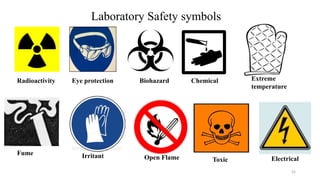
Laboratory Safety symbols
Radioactivity Eye protection Biohazard Chemical
Electrical
Extreme
temperature
Fume Irritant Open Flame Toxic
26
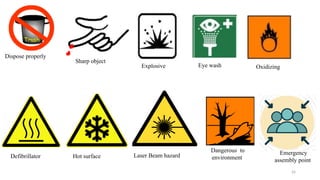
Dispose properly
Sharp object
Explosive Eye wash Oxidizing
Defibrillator Hot surface Laser Beam hazard
Dangerous to
environment
Emergency
assembly point
27
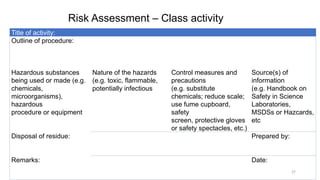
Title of activity:
Outline of procedure:
Hazardous substances
being used or made (e.g.
chemicals,
microorganisms),
hazardous
procedure or equipment
Nature of the hazards
(e.g. toxic, flammable,
potentially infectious
Control measures and
precautions
(e.g. substitute
chemicals; reduce scale;
use fume cupboard,
safety
screen, protective gloves
or safety spectacles, etc.)
Source(s) of
information
(e.g. Handbook on
Safety in Science
Laboratories,
MSDSs or Hazcards,
etc
Disposal of residue: Prepared by:
Remarks: Date:
Risk Assessment – Class activity

laboratory safety, precautions and hazards

  • 1.
    1 Laboratory Safety andHazards Dr. E. A Tagoe 2022
  • 2.
    2 Course objectives Upon completionof the course students are expected to; i. Know the difference between hazards and risk ii. Know how to assess risk in the clinical laboratory iii. List and describe the appropriate safety procedures/practices in the clinical laboratory when handling common equipment, chemicals, flammables, and compressed gases, etc. iv. Read and understand information provided in Material Safety Data Sheet
  • 3.
    3 Hazards and Risk A hazard is the potential of a substance or process to cause harm to people. e.g. sulphuric acid will cause burns to skin  A risk is the probability (chance) of a hazard actually causing harm. e.g. Pouring sulphuric acid into water in a bottle  Steps taken to estimate the probability is referred to as risk assessment.  A risk assessment is an information gathering exercise.
  • 4.
    4 Risk Assessment  Riskassessment provides the opportunity to know the possible events that can cause accident while working in the laboratory, and possible solutions in case of accident.  Risk assessment in the laboratory is a requirement. Information require for the assessment;  Type of substance  Work processes  Assessment of the levels of exposure  Evaluations of control measures
  • 5.
    5 Risk is expressedas the: potential severity of harm (the consequence or damage) X likelihood of event occurring Can we work out how high the risk is? • What could go wrong? • What is the worst that could happen? Consequence - severity Likelihood • How often must the work be done? • How many people should do the work? • Is everyone doing the work trained and competent?
  • 6.
    Where do ourrisks fit on the spectrum? Likelihood Severity A B C D E F Likelihood 1. Highly unlikely 2. Possibly 3. Quite likely 4. Very likely Severity 1. Slight harm 2. Injury affecting work 3. Serious injury 4. Possible fatality Evaluating the risk
  • 7.
    7 Controlling the risk Unacceptable– stop doing the work until improvements made Significant - proceed with caution but improvement is of high priority Tolerable - OK to proceed but plan to improve
  • 8.
    8 Laboratory Safety • Isthe safety practices or guidelines strictly followed in the laboratory during activity to prevent accident or injury. • To achieve this standard operating procedures are followed;
  • 9.
    9  General PersonalSafety: - Dos and Don'ts in the Laboratory which keep researchers/workers from danger. i. Avoid eating and drinking in the laboratory to prevent ingestion of toxic/cells materials into your body. ii. Do not store food or drink in the fridges or deep freezers in the laboratory to avoid contamination. iii. Secure long hair, ties, long sleeves and other materials that can possibly get contaminated.
  • 10.
    10 iv. Avoid introducingobjects such as pens and pencils into the mouth. v. Put on protective clothing (laboratory coat, laboratory footwear and gloves). vi. Handle all biological samples / materials as potential hazardous substances. vii. Regular hand washing is highly recommended
  • 11.
    11 i. Wear eyegoggles when working with ultra-violet radiation (light), body fluid, caustic reagents and/or solvents, or concentrated acids and bases. ii. Wearing contact lenses in the laboratory is discouraged. iii. Avoid rubbing your eye when working in the laboratory  Eye Safety : necessary steps taken to protect the eye
  • 12.
    12  Safe handlingof Biologically Hazardous Material i. Handle all patients samples as potentially hazards ii. Wear protective clothing (glove, lab coat, etc) before handling patient sample iii. Wash hands immediately after the gloves are removed iv. Avoid spillage and if it occurs accidentally, disinfect the working area v. Wash hands after work and protective clothing should be removed prior to leaving the lab. vi. Biohazards must be appropriately discarded (in Biohazard bag for autoclave or other approved method).
  • 13.
    13 • Sharps • Chemicaland gas hazards • Fire • Breakage of glassware • Spillages • Pressure equipment & gas cylinders • Extremes of heat & cold • Biological hazards • Radiation, etc General hazards in a laboratory
  • 14.
    14 Proper handling ofsharp objects i. Contaminated needles and other sharps are never broken, bent, recapped or re-sheathed by hand. ii. Used needles are removed from syringes and separately disposed. iii. Needles and sharps are disposed of in impervious containers located near the point of use. iv. Sharp objects must be stored in a protective case.
  • 15.
    15 Chemicals and GasSafety i. Corrosive materials ii. Toxic or poisonous materials  Types of material
  • 16.
    16  Safety Practices i.Avoid dangerous splashing ii. Toxic materials should be labeled with special tape when stored in separate containers. iii. Toxic chemical must be prepared in the hood. iv. Acids and alkali should be carried by means of special protective carriers when transporting. v. In case of spillage, clean all exposed surfaces, and avoid body contact. Accidental body contact must be washed and reported to supervisor. Chemical and Gas
  • 17.
    17 Flammable compounds i. Allflammable reagents should be kept in the flammable storage facilities (closet or refrigerator) at all times when not in use. ii. Any solutions compounded from these reagents should be labeled as flammable. iii. Flammable substances should be handled in areas free of ignition sources. iv. Flammable substances should never be heated using an open flame. v. Ventilation is one of the most effective ways to prevent accumulation of explosive levels of flammable vapors. iv. Flammable compounds should be placed in proper receptacle for disposal.
  • 18.
    18 Compressed Gases i. Thestorage of all compressed gases shall be in designed containers. ii. In the laboratory, gas containers are to be limited to the number of containers in use at any time. iii. Containers shall be securely strapped, chained or secured in a cylinder stand so they cannot fall. iv. Oxidizing gases should be separated from flammable gasses.
  • 19.
    19 Fire Safety i. Knowwhere all fire exits, fire extinguishers and fire alarms are located. ii. Know how to properly operate appropriate fire alarms and fire safety equipment
  • 20.
    20 i. Raise analarm (Activate the fire pull station) ii. Rescue those in danger (if possible) iii. Contain the fire by closing all doors and windows (if possible) iv. Extinguish the fire (if possible) v. Do not re-enter a room that has already been closed vi. Evacuate, be at the assembly point Fire Safety Practices
  • 21.
    21 Electrical Safety i. Theuse of extension cords in the laboratory (if needed) must be done under supervision. ii. All equipment must be properly grounded. iii. Never operate electrical equipment with fluid spillage or with wet hands. iv. Never use plugs with exposed or frayed wires. v. If there are sparks or smoke or any unusual event, shut down the instrument and notify the manager or safety officer.
  • 22.
    22 vi. Electrical equipmentthat is not working properly should not be used. vii. If a person is shocked by electricity, shut off the current or break contact with the live wire immediately. Do not touch the victim while he is in contact with the source of current unless you are completely insulated against shock. viii. If the victim is unconscious, call emergency number and request assistance. Electrical Safety
  • 23.
    23 i. Cracked orchipped glassware should not be used. ii. Centrifuges should not be used without the covers completely closed. iii. Operational manual should be followed when operating equipment iii. When removing tops from evacuated test tubes, care must be taken to prevent aerosol formation. General Procedures and Equipment
  • 24.
    24 In Case ofAccidents 1. Accidental Needle Stick i. Bleed wound ii. Wash wound thoroughly with soap iii. Notify the supervisor of the incident iv. May need to get blood tested for infectious pathogens (if suspected)
  • 25.
    25 Laboratory Safety symbols RadioactivityEye protection Biohazard Chemical Electrical Extreme temperature Fume Irritant Open Flame Toxic
  • 26.
    26 Dispose properly Sharp object ExplosiveEye wash Oxidizing Defibrillator Hot surface Laser Beam hazard Dangerous to environment Emergency assembly point
  • 27.
    27 Title of activity: Outlineof procedure: Hazardous substances being used or made (e.g. chemicals, microorganisms), hazardous procedure or equipment Nature of the hazards (e.g. toxic, flammable, potentially infectious Control measures and precautions (e.g. substitute chemicals; reduce scale; use fume cupboard, safety screen, protective gloves or safety spectacles, etc.) Source(s) of information (e.g. Handbook on Safety in Science Laboratories, MSDSs or Hazcards, etc Disposal of residue: Prepared by: Remarks: Date: Risk Assessment – Class activity