FOUR
BASIC
CONCEPTS
GE 103
JUAN MIGUEL I. TANGKEKO
Four Basic
Concepts
SETS AND ITS BASIC
OPERATIONS
RELATIONS
FUNCTIONS
BINARY OPERATIONS
Sets and its
basic
operations
Four Basic Concepts
LESSON 1
DEFINITION
In Math, sets are a collection of well-
defined objects or elements. A set is
represented by a capital letter symbol and
the number of elements in the finite set is
represented as the cardinal number of a
set in a curly bracket {…}.
EXAMPLES
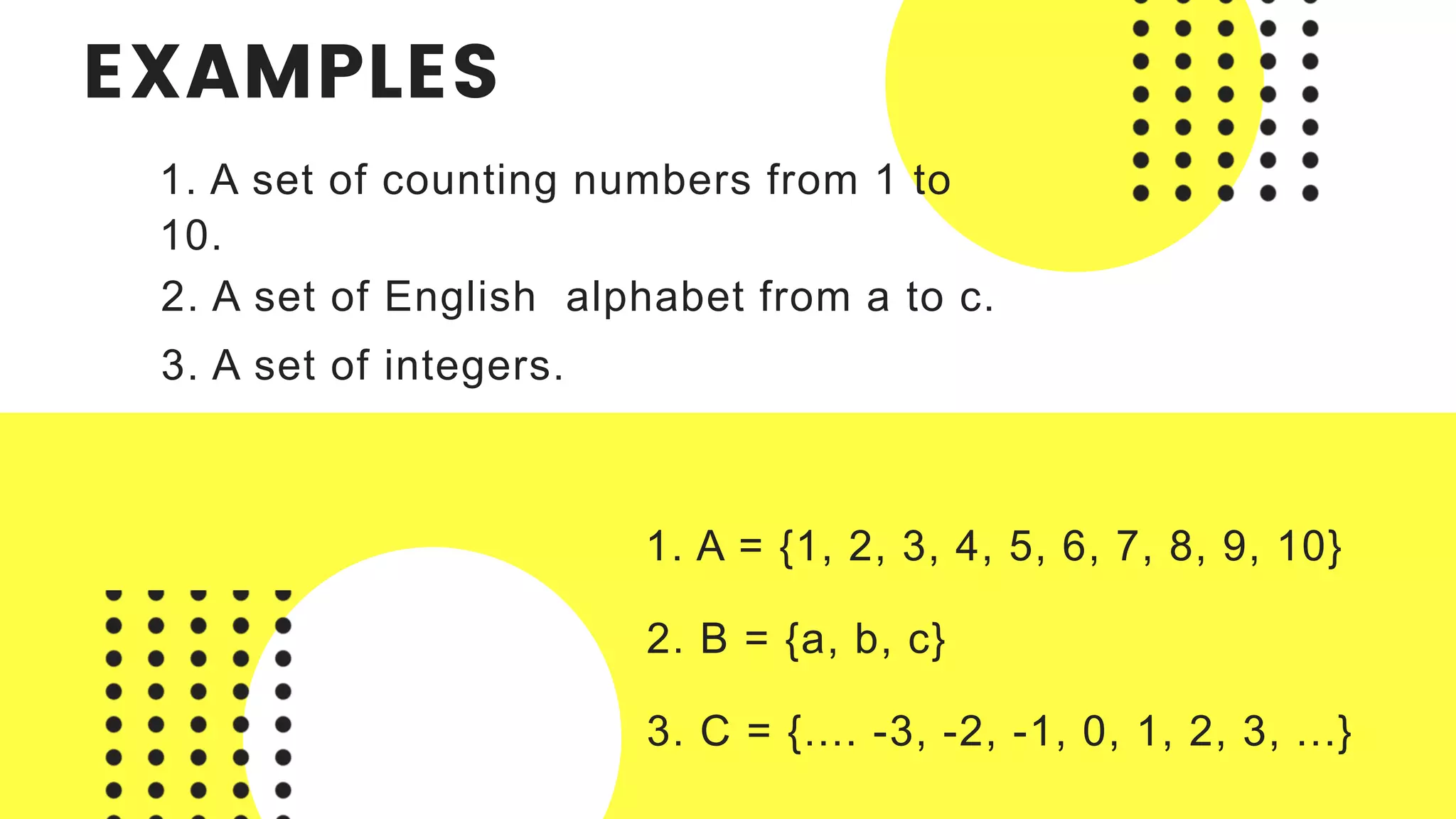
1. A set of counting numbers from 1 to
10.
2. A set of English alphabet from a to c.
3. A set of integers.
1. A = {1, 2, 3, 4, 5, 6, 7, 8, 9, 10}
2. B = {a, b, c}
3. C = {.... -3, -2, -1, 0, 1, 2, 3, ...}
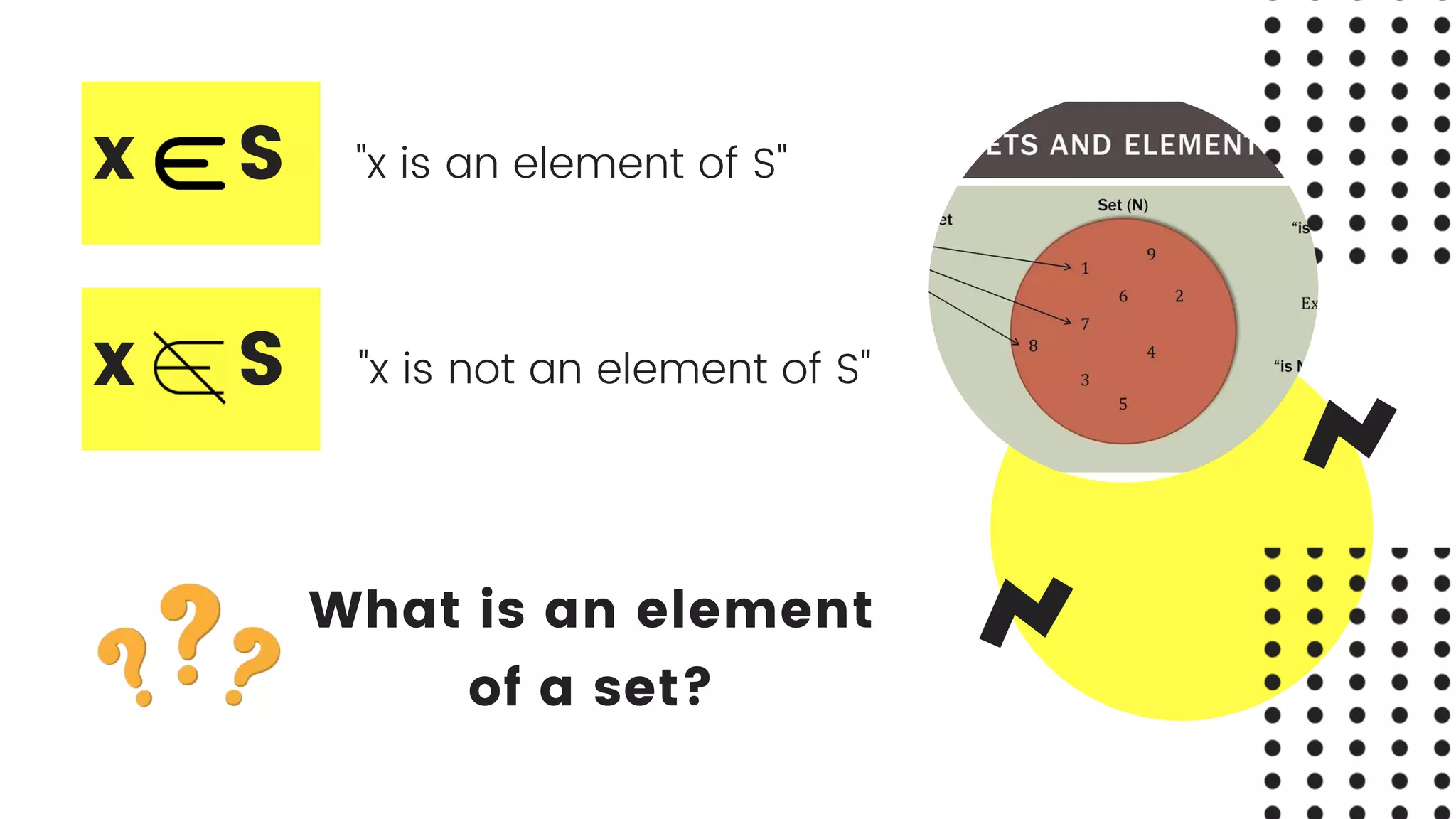
x S
x S
"x is an element of S"
"x is not an element of S"
What is an element
of a set?
The language of Sets
The notation means that
an item belongs to a set.
1 A 3 A 6 A
Pertains to each member of
the set.
Illustration
Say A = {1, 2, 3, 4, 5}
5 A
ELEMENT
OF A SET
Terminologies of Sets
Unit set is a set that contains
only one element.
UNIT SET
Illustration
A = {1} B= {c} C= {banana}
Terminologies of Sets
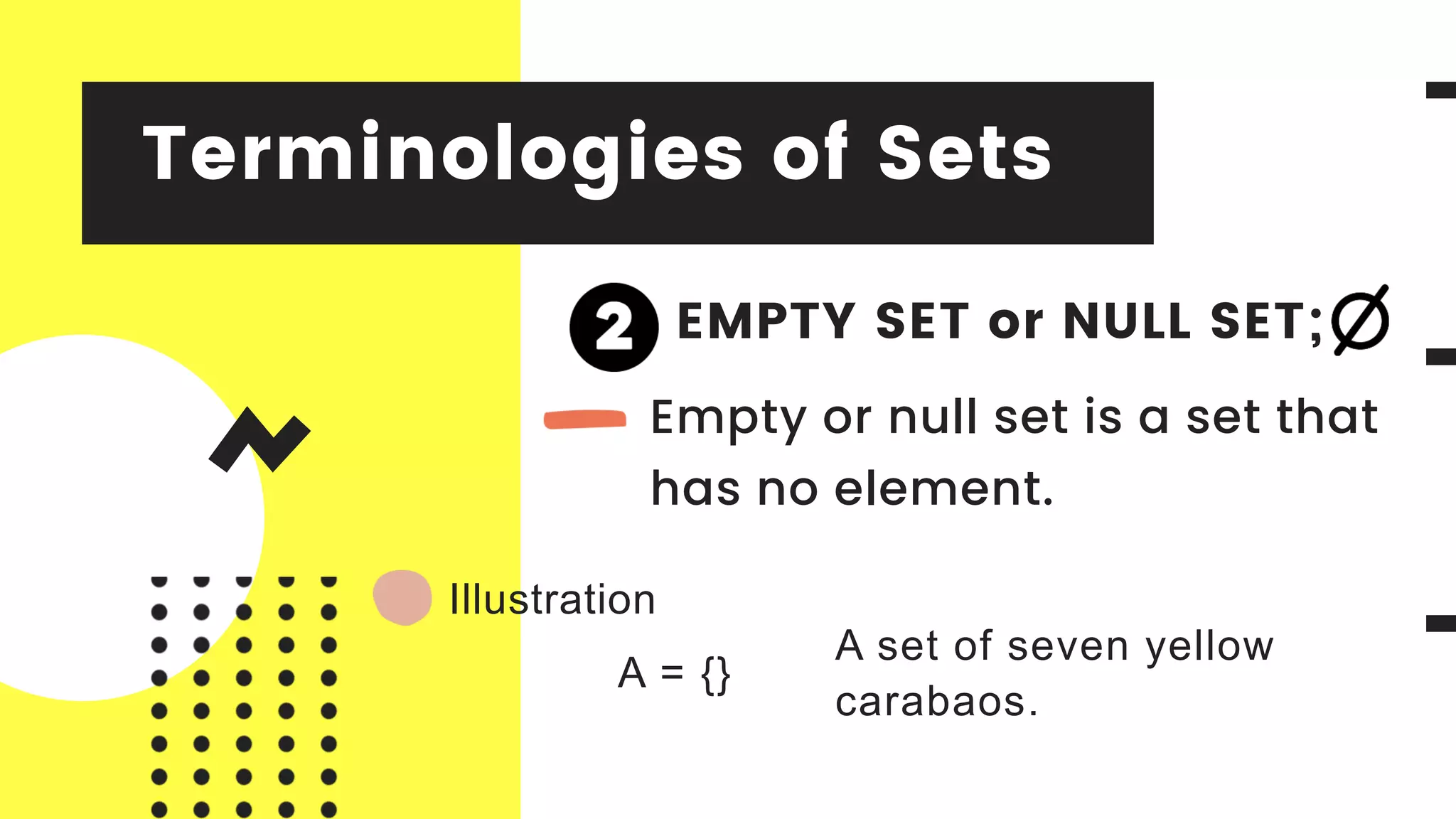
Empty or null set is a set that
has no element.
EMPTY SET or NULL SET;
Illustration
A = {}
A set of seven yellow
carabaos.
Terminologies of Sets
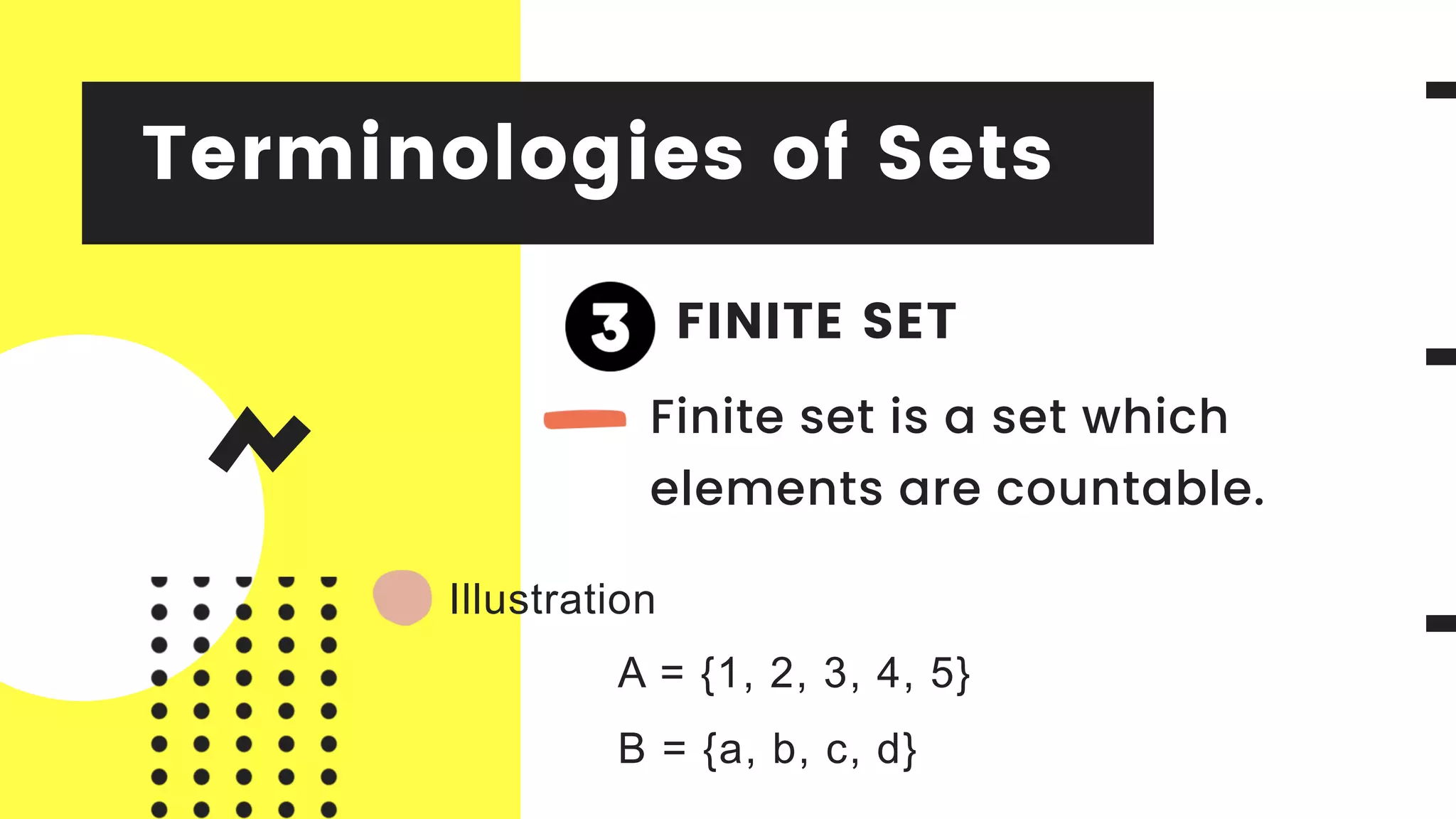
Finite set is a set which
elements are countable.
FINITE SET
Illustration
A = {1, 2, 3, 4, 5}
B = {a, b, c, d}
Terminologies of Sets
Infinite set is a set which
elements are not countable or
has no end.
INFINITE SET
Illustration
Set of counting numbers
A = {.... -3, -2, -1, 0, 1, 2, 3, ...}
Terminologies of Sets
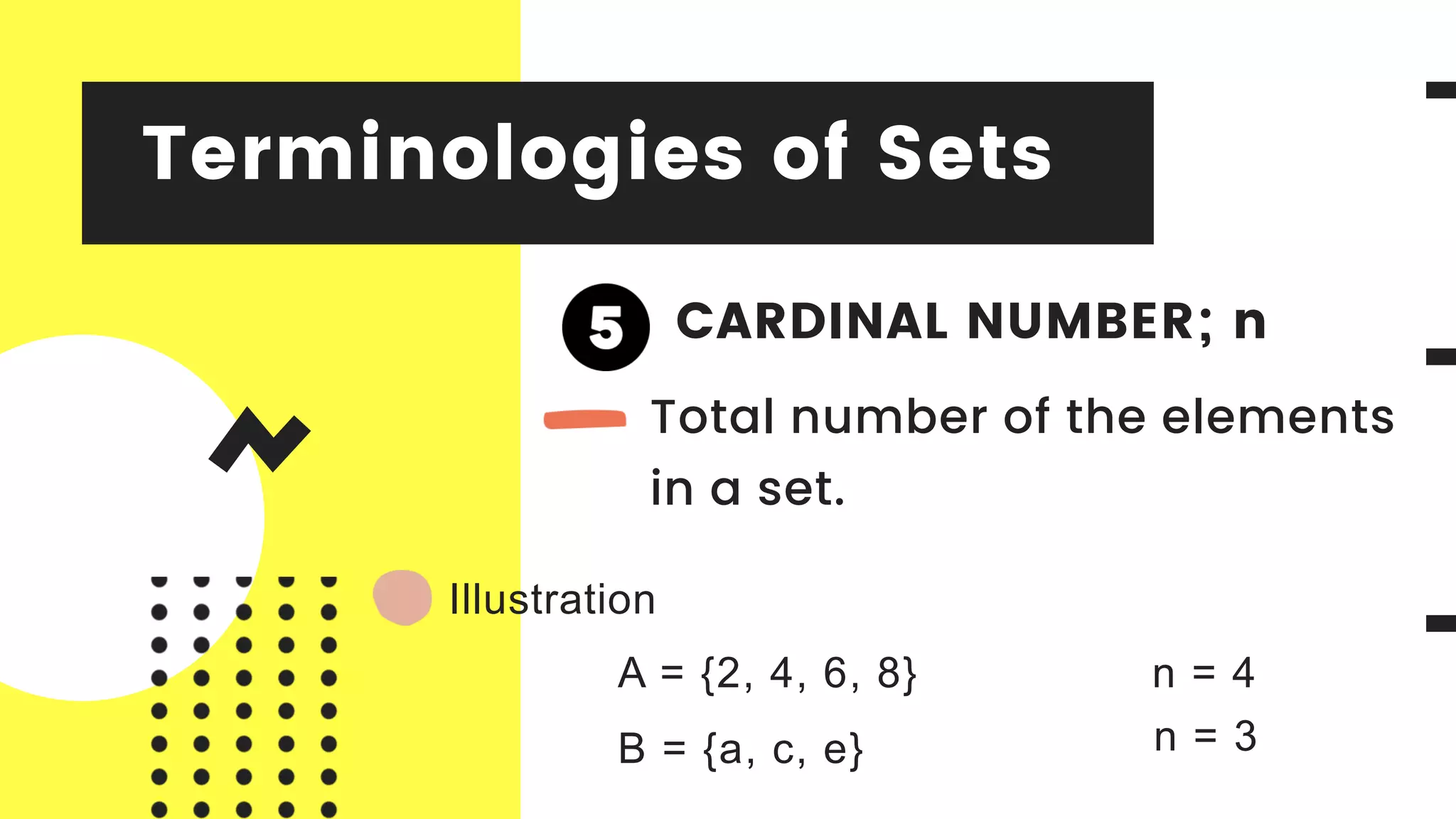
Total number of the elements
in a set.
CARDINAL NUMBER; n
Illustration
A = {2, 4, 6, 8}
B = {a, c, e}
n = 4
n = 3
Two sets are said to be equal iff the
have equal number of cardinality and
the elements are identical.
EQUAL SET
Illustration
A = {1, 2, 3, 4, 5}
B = {3, 5, 2, 1, 4}
A and B are
equal sets
Terminologies of Sets
Two sets are said to be equivalent if the
Sets have the exact number of elements.
There is a 1-1 correspondence.
EQUIVALENT SET
Illustration
A = {1, 2, 3, 4, 5}
B = {a, b, c, d, e}
A and B are
equivalent
sets
Terminologies of Sets
Universal set is the set of all
elements under discussion
UNIVERSAL SET; U
Illustration
A set of an English alphabet
U = {a, b, c, d, ...z}
Terminologies of Sets
Two sets, say A and B, are said to
be joint iff they have common
element/s.
JOINT SETS
Illustration
A = {1, 2, 3}
B = {2, 4, 6}
A and B are joint sets since
they have a common element,
2.
Terminologies of Sets
Two sets, say A and B, are said to be
disjoint iff they are mutually exclusive
or they don't have common element/s.
DISJOINT SETS
Illustration
A = {1, 2, 3}
B = {4, 6, 8}
A and B are disjoint sets since
they don't have a common
element.
Terminologies of Sets
TWO WAYS OF DESCRIBING A SET
It is done by listing or tabulating the
elements of the set.
ROSTER or TABULAR
METHOD
Illustration
A = {2, 4, 6}
B = {a, b, d, e, h, i}
C = {blue, red, yellow}
It is done by stating or describing the
common characteristics of the elements of
the set. We use the notation A = {x l x ...}
RULE or SET-BUILDER
METHOD
Illustration
A = {x l x is a counting number from 1 to 5}
B = {x l x English alphabet}
TWO WAYS OF DESCRIBING A SET
EXAMPLES
A subset, A B, means
that every element of A is
also an element of B.
If x A then, x B
SUBSETS
In particular, every set is a
subset of itself. A A
SUBSETS A subset is called a proper subset,
A is a proper subset of B, if there is
at least one element of B that is
not in A.
A B
A = {1, 3, 5, 7}
Illustration
B = {1, 3, 5, 7, 9, 11}
every element of A is an element of B
there is at least 1 element in B that is
not an element of A
The empty or null set, {} or , is a
subset of every set.
How many subsets are there in the set
Illustration
A = {1, 2, 3}
The number of subsets of a given
set is given by , n is the number
of elements of the given set.
2
n
List down all the subsets of A.
SUBSETS
Solution:
{1}
2
n
List of subsets:
Number of elements = 3
= 2
3
= 8
A has 8 subsets.
With one element
{2} {3}
With two elements
{1, 2} {1, 3} {2, 3}
With three elements
{1, 2, 3}
With no
element
{} or
SUBSETS
ORDERED PAIR
"b"
Given elements a and b, the symbol (a, b) denotes the
ordered pair consisting of a and b together.
"a" first element second element
two ordered pairs (a, b) and (c, d) are equal iff
a = c and b = d
ORDERED PAIR
(a, b) = (c, d)
Symbolically,
means that a = c and b = d
Illustration
If (a, b) = (3, 2)
then a = 3 and b = 2
Find x and y if (4x + 3, y) = (3x + 5, -2)
4x + 3 = 3x + 5 y = -2
4x - 3x = 5 - 3
x = 2
OPERATION ON SETS
A B
UNION OF SETS
The union of sets A and B, denoted by
is defined as
A B = {x l x A or x B}
Illustration
If A = {1, 2, 3} and B = {4, 5}, then
A B = {1, 2, 3, 4, 5}
If A = {1, 2, 3} and B = {1, 2, 4, 5}, then
A B = {1, 2, 3, 4, 5}
A B
UNION OF SETS
Illustration
OPERATION ON SETS
The intersection of sets A and B,
denoted by
A B = {x l x A and x B}
A B = {1, 2} A B = {} or
A B
INTERSECTION OF SETS
is defined as
Illustration
If A = {1, 2, 3} and B = {4, 5}, then
If A = {1, 2, 3} and B = {1, 2, 4, 5}, then
OPERATION ON SETS
A B
INTERSECTION OF SETS
Illustration
OPERATION ON SETS
The difference of sets A and B,
denoted by
A - B = {x l x A and x B}
A - B = {3} A - B = {1, 2, 3}
A - B
DIFFERENCE OF SETS
is defined as
Illustration
If A = {1, 2, 3} and B = {4, 5}, then
If A = {1, 2, 3} and B = {1, 2, 4, 5}, then
OPERATION ON SETS
A - B
DIFFERENCE OF SETS
Illustration
OPERATION ON SETS
For set A, the difference U - A, where U is the
universal set is called the complement of A,
denoted by . Thus it is the set of
everything that is not in A.
A
COMPLEMENT OF SETS
Illustration
Let U = {a, e, i, o u} and A = {a, e}, then
c
or A'
Ac
= {i, o, u}
OPERATION ON SETS
COMPLEMENT OF SETS
Illustration
A
c
OPERATION ON SETS
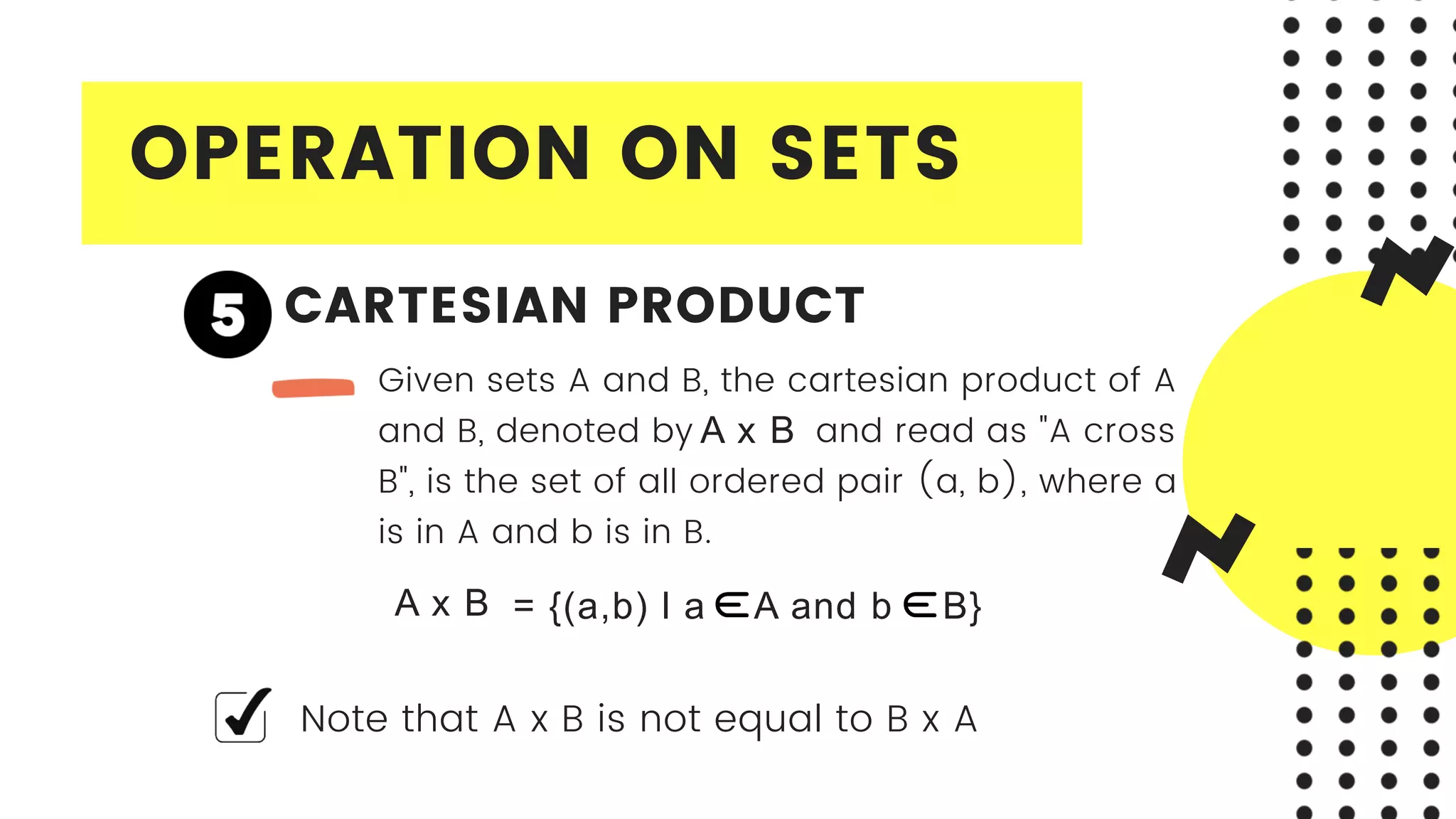
Given sets A and B, the cartesian product of A
and B, denoted by and read as "A cross
B", is the set of all ordered pair (a, b), where a
is in A and b is in B.
A x B
CARTESIAN PRODUCT
= {(a,b) l a A and b B}
A x B
Note that A x B is not equal to B x A
OPERATION ON SETS
CARTESIAN PRODUCT, cont'd
A x B = {(1, a), (1, b), (2, a), (2, b)}
Illustration
If A = {1, 2, } and B = {a, b}, what is A x B?
what is B x A?
B x A = {(a, 1), (a, 2), (b, 1), (b, 2)}
OPERATION ON SETS
Thank
you!
GE 103
JASMINE T. BELEN

SETS-AND-SUBSETS.pptx

  • 1.
  • 2.
    Four Basic Concepts SETS ANDITS BASIC OPERATIONS RELATIONS FUNCTIONS BINARY OPERATIONS
  • 3.
    Sets and its basic operations FourBasic Concepts LESSON 1
  • 4.
    DEFINITION In Math, setsare a collection of well- defined objects or elements. A set is represented by a capital letter symbol and the number of elements in the finite set is represented as the cardinal number of a set in a curly bracket {…}.
  • 5.
    EXAMPLES 1. A setof counting numbers from 1 to 10. 2. A set of English alphabet from a to c. 3. A set of integers. 1. A = {1, 2, 3, 4, 5, 6, 7, 8, 9, 10} 2. B = {a, b, c} 3. C = {.... -3, -2, -1, 0, 1, 2, 3, ...}
  • 6.
    x S x S "xis an element of S" "x is not an element of S" What is an element of a set?
  • 7.
    The language ofSets The notation means that an item belongs to a set. 1 A 3 A 6 A Pertains to each member of the set. Illustration Say A = {1, 2, 3, 4, 5} 5 A ELEMENT OF A SET
  • 8.
    Terminologies of Sets Unitset is a set that contains only one element. UNIT SET Illustration A = {1} B= {c} C= {banana}
  • 9.
    Terminologies of Sets Emptyor null set is a set that has no element. EMPTY SET or NULL SET; Illustration A = {} A set of seven yellow carabaos.
  • 10.
    Terminologies of Sets Finiteset is a set which elements are countable. FINITE SET Illustration A = {1, 2, 3, 4, 5} B = {a, b, c, d}
  • 11.
    Terminologies of Sets Infiniteset is a set which elements are not countable or has no end. INFINITE SET Illustration Set of counting numbers A = {.... -3, -2, -1, 0, 1, 2, 3, ...}
  • 12.
    Terminologies of Sets Totalnumber of the elements in a set. CARDINAL NUMBER; n Illustration A = {2, 4, 6, 8} B = {a, c, e} n = 4 n = 3
  • 13.
    Two sets aresaid to be equal iff the have equal number of cardinality and the elements are identical. EQUAL SET Illustration A = {1, 2, 3, 4, 5} B = {3, 5, 2, 1, 4} A and B are equal sets Terminologies of Sets
  • 14.
    Two sets aresaid to be equivalent if the Sets have the exact number of elements. There is a 1-1 correspondence. EQUIVALENT SET Illustration A = {1, 2, 3, 4, 5} B = {a, b, c, d, e} A and B are equivalent sets Terminologies of Sets
  • 15.
    Universal set isthe set of all elements under discussion UNIVERSAL SET; U Illustration A set of an English alphabet U = {a, b, c, d, ...z} Terminologies of Sets
  • 16.
    Two sets, sayA and B, are said to be joint iff they have common element/s. JOINT SETS Illustration A = {1, 2, 3} B = {2, 4, 6} A and B are joint sets since they have a common element, 2. Terminologies of Sets
  • 17.
    Two sets, sayA and B, are said to be disjoint iff they are mutually exclusive or they don't have common element/s. DISJOINT SETS Illustration A = {1, 2, 3} B = {4, 6, 8} A and B are disjoint sets since they don't have a common element. Terminologies of Sets
  • 18.
    TWO WAYS OFDESCRIBING A SET It is done by listing or tabulating the elements of the set. ROSTER or TABULAR METHOD Illustration A = {2, 4, 6} B = {a, b, d, e, h, i} C = {blue, red, yellow}
  • 19.
    It is doneby stating or describing the common characteristics of the elements of the set. We use the notation A = {x l x ...} RULE or SET-BUILDER METHOD Illustration A = {x l x is a counting number from 1 to 5} B = {x l x English alphabet} TWO WAYS OF DESCRIBING A SET
  • 20.
  • 21.
    A subset, AB, means that every element of A is also an element of B. If x A then, x B SUBSETS In particular, every set is a subset of itself. A A
  • 22.
    SUBSETS A subsetis called a proper subset, A is a proper subset of B, if there is at least one element of B that is not in A. A B A = {1, 3, 5, 7} Illustration B = {1, 3, 5, 7, 9, 11} every element of A is an element of B there is at least 1 element in B that is not an element of A
  • 23.
    The empty ornull set, {} or , is a subset of every set. How many subsets are there in the set Illustration A = {1, 2, 3} The number of subsets of a given set is given by , n is the number of elements of the given set. 2 n List down all the subsets of A. SUBSETS
  • 24.
    Solution: {1} 2 n List of subsets: Numberof elements = 3 = 2 3 = 8 A has 8 subsets. With one element {2} {3} With two elements {1, 2} {1, 3} {2, 3} With three elements {1, 2, 3} With no element {} or SUBSETS
  • 25.
    ORDERED PAIR "b" Given elementsa and b, the symbol (a, b) denotes the ordered pair consisting of a and b together. "a" first element second element two ordered pairs (a, b) and (c, d) are equal iff a = c and b = d
  • 26.
    ORDERED PAIR (a, b)= (c, d) Symbolically, means that a = c and b = d Illustration If (a, b) = (3, 2) then a = 3 and b = 2 Find x and y if (4x + 3, y) = (3x + 5, -2) 4x + 3 = 3x + 5 y = -2 4x - 3x = 5 - 3 x = 2
  • 27.
    OPERATION ON SETS AB UNION OF SETS The union of sets A and B, denoted by is defined as A B = {x l x A or x B} Illustration If A = {1, 2, 3} and B = {4, 5}, then A B = {1, 2, 3, 4, 5} If A = {1, 2, 3} and B = {1, 2, 4, 5}, then A B = {1, 2, 3, 4, 5}
  • 28.
    A B UNION OFSETS Illustration OPERATION ON SETS
  • 29.
    The intersection ofsets A and B, denoted by A B = {x l x A and x B} A B = {1, 2} A B = {} or A B INTERSECTION OF SETS is defined as Illustration If A = {1, 2, 3} and B = {4, 5}, then If A = {1, 2, 3} and B = {1, 2, 4, 5}, then OPERATION ON SETS
  • 30.
    A B INTERSECTION OFSETS Illustration OPERATION ON SETS
  • 31.
    The difference ofsets A and B, denoted by A - B = {x l x A and x B} A - B = {3} A - B = {1, 2, 3} A - B DIFFERENCE OF SETS is defined as Illustration If A = {1, 2, 3} and B = {4, 5}, then If A = {1, 2, 3} and B = {1, 2, 4, 5}, then OPERATION ON SETS
  • 32.
    A - B DIFFERENCEOF SETS Illustration OPERATION ON SETS
  • 33.
    For set A,the difference U - A, where U is the universal set is called the complement of A, denoted by . Thus it is the set of everything that is not in A. A COMPLEMENT OF SETS Illustration Let U = {a, e, i, o u} and A = {a, e}, then c or A' Ac = {i, o, u} OPERATION ON SETS
  • 34.
  • 35.
    Given sets Aand B, the cartesian product of A and B, denoted by and read as "A cross B", is the set of all ordered pair (a, b), where a is in A and b is in B. A x B CARTESIAN PRODUCT = {(a,b) l a A and b B} A x B Note that A x B is not equal to B x A OPERATION ON SETS
  • 36.
    CARTESIAN PRODUCT, cont'd Ax B = {(1, a), (1, b), (2, a), (2, b)} Illustration If A = {1, 2, } and B = {a, b}, what is A x B? what is B x A? B x A = {(a, 1), (a, 2), (b, 1), (b, 2)} OPERATION ON SETS
  • 37.