SET THEORY
NISHITA KALYANI
SET
• A set is collection of well-defined objects.
• Each of the objects in the set is called an element of the set.
• Elements of a set are usually denoted by lower case letter (a, b, c …).
• While sets are denoted by capital letters (A, B, C …).
• The symbol ‘∈ (is belongs to)’ indicates the membership in a set. While the
symbol ‘∉ (is not belongs to)’ is used to indicate that an element is not in the
set.
• For example, if A = {1, 2, 3, a, b} then we can write that a ∈ A, 1 ∈ A but 4 ∉ A.
REPRESENTATION
Listing method :
• In listing method, all the elements of a set are listed, the elements are being separated by
commas and are enclosed within braces { }.
• For example, the set of all natural numbers less than 6 is described in listing method as :
{1, 2, 3, 4, 5}.
Property method :
• In property method, all the elements of a set possess a single common property which is not
possessed by any element outside the set.
• For example, the set of all natural number between 0 & 6 described in property method as:
{𝑥; 𝑥 𝑖𝑠 𝑎 𝑛𝑎𝑡𝑢𝑟𝑎𝑙 𝑛𝑢𝑚𝑏𝑒𝑟 & 0 < 𝑥 < 6}
SPECIAL SETS
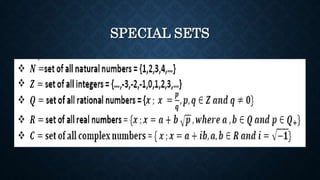
• Subsets : Let A and B be two sets. If each elements of set A is an element of
set B then A is called subset of set B and it is denoted by 𝐴 ⊂ 𝐵
• Empty set (null set) does not contain any element and It is denoted as { } or
𝛟.
• A set which contain at least one element is called Non-empty set.
• A set which contain exactly one element is called Singleton set.
• A set which contain finite number of elements is called finite set.
SOME DEFINATIONS
SOME DEFINITIONS
• A set which contain infinite number of elements is called infinite set.
• Two set A and B are said to be equal if they have the same elements
and we write A=B. Otherwise, the sets are said to be unequal, and we
write A≠B.
• There always happens to be a set that contains all set under
consideration i.e., it is a super set of each of the given sets. Such a set
is called the universal set and is denoted by U.
• Remark: if A is a subset of B, then B is a superset of A.
OPERATIONS ON SET
• Union
Union of the sets A and B, denoted by A ∪ B, is the
set of distinct elements that belong to set A or set
B, or both.
• Intersection
The intersection of the sets A and B, denoted by A
∩ B, is the set of elements that belong to both A
and B i.e. set of the common elements in A and B.
OPERATIONS ON SET
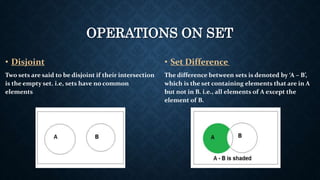
• Disjoint
Two sets are said to be disjoint if their intersection
is the empty set. i.e, sets have no common
elements.
• Set Difference
The difference between sets is denoted by ‘A – B’,
which is the set containing elements that are in A
but not in B. i.e., all elements of A except the
element of B.
OPERATIONS ON SET
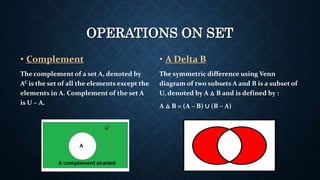
• Complement
The complement of a set A, denoted by
AC is the set of all the elements except the
elements in A. Complement of the set A
is U – A.
• A Delta B
The symmetric difference using Venn
diagram of two subsets A and B is a subset of
U, denoted by A △ B and is defined by :
A △ B = (A – B) ∪ (B – A)
SIZE OF SET
• Size of a set can be finite or infinite.
• For example:
Finite set: Set of natural numbers less than 100.
Infinite set: Set of real numbers.
• Size of the set S is known as Cardinality number, denoted as |S|.
• Example: Let A be a set of odd positive integers less than 10.
Solution : A = {1,3,5,7,9}, Cardinality of the set is 5, i.e.,|A| = 5.
• Note: Cardinality of a null set is 0.
POWER SET
• The power set is the set all possible subset of the set S.
Denoted by P(S).
• Example : What is the power set of {0,1,2}?
Solution : All possible subsets
{∅}, {0}, {1}, {2}, {0,1}, {0,2}, {1,2}, {0,1,2}.
• Note: Empty set and set itself is also the member of this set of subsets.
• Cardinality of power set is 2^n, where n is the number of elements in a set.
CARTESIAN PRODUCT
• Let A and B be two sets. Cartesian product of A and B is denoted by A × B, is
the set of all ordered pairs (a,b), where a belong to A and b belong to B.
A × B = {(a, b) | a ∈ A ∧ b ∈ B}.
• Example 1. What is Cartesian product of A = {1,2} and B = {p, q, r}.
Solution : A × B ={(1, p), (1, q), (1, r), (2, p), (2, q), (2, r) };
EXAMPLE
A survey asks 200 people “What beverage do you drink in the morning”,
and offers choices:
• Tea only
• Coffee only
• Both coffee and tea
Suppose 20 report tea only, 80 report coffee only, 40 report both. How
many people drink tea in the morning? How many people drink
neither tea or coffee?
SOLUTION
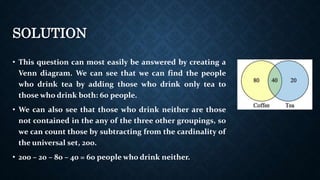
• This question can most easily be answered by creating a
Venn diagram. We can see that we can find the people
who drink tea by adding those who drink only tea to
those who drink both: 60 people.
• We can also see that those who drink neither are those
not contained in the any of the three other groupings, so
we can count those by subtracting from the cardinality of
the universal set, 200.
• 200 – 20 – 80 – 40 = 60 people who drink neither.

Set Theory

  • 1.
  • 2.
    SET • A setis collection of well-defined objects. • Each of the objects in the set is called an element of the set. • Elements of a set are usually denoted by lower case letter (a, b, c …). • While sets are denoted by capital letters (A, B, C …). • The symbol ‘∈ (is belongs to)’ indicates the membership in a set. While the symbol ‘∉ (is not belongs to)’ is used to indicate that an element is not in the set. • For example, if A = {1, 2, 3, a, b} then we can write that a ∈ A, 1 ∈ A but 4 ∉ A.
  • 3.
    REPRESENTATION Listing method : •In listing method, all the elements of a set are listed, the elements are being separated by commas and are enclosed within braces { }. • For example, the set of all natural numbers less than 6 is described in listing method as : {1, 2, 3, 4, 5}. Property method : • In property method, all the elements of a set possess a single common property which is not possessed by any element outside the set. • For example, the set of all natural number between 0 & 6 described in property method as: {𝑥; 𝑥 𝑖𝑠 𝑎 𝑛𝑎𝑡𝑢𝑟𝑎𝑙 𝑛𝑢𝑚𝑏𝑒𝑟 & 0 < 𝑥 < 6}
  • 4.
  • 5.
    • Subsets :Let A and B be two sets. If each elements of set A is an element of set B then A is called subset of set B and it is denoted by 𝐴 ⊂ 𝐵 • Empty set (null set) does not contain any element and It is denoted as { } or 𝛟. • A set which contain at least one element is called Non-empty set. • A set which contain exactly one element is called Singleton set. • A set which contain finite number of elements is called finite set. SOME DEFINATIONS
  • 6.
    SOME DEFINITIONS • Aset which contain infinite number of elements is called infinite set. • Two set A and B are said to be equal if they have the same elements and we write A=B. Otherwise, the sets are said to be unequal, and we write A≠B. • There always happens to be a set that contains all set under consideration i.e., it is a super set of each of the given sets. Such a set is called the universal set and is denoted by U. • Remark: if A is a subset of B, then B is a superset of A.
  • 7.
    OPERATIONS ON SET •Union Union of the sets A and B, denoted by A ∪ B, is the set of distinct elements that belong to set A or set B, or both. • Intersection The intersection of the sets A and B, denoted by A ∩ B, is the set of elements that belong to both A and B i.e. set of the common elements in A and B.
  • 8.
    OPERATIONS ON SET •Disjoint Two sets are said to be disjoint if their intersection is the empty set. i.e, sets have no common elements. • Set Difference The difference between sets is denoted by ‘A – B’, which is the set containing elements that are in A but not in B. i.e., all elements of A except the element of B.
  • 9.
    OPERATIONS ON SET •Complement The complement of a set A, denoted by AC is the set of all the elements except the elements in A. Complement of the set A is U – A. • A Delta B The symmetric difference using Venn diagram of two subsets A and B is a subset of U, denoted by A △ B and is defined by : A △ B = (A – B) ∪ (B – A)
  • 10.
    SIZE OF SET •Size of a set can be finite or infinite. • For example: Finite set: Set of natural numbers less than 100. Infinite set: Set of real numbers. • Size of the set S is known as Cardinality number, denoted as |S|. • Example: Let A be a set of odd positive integers less than 10. Solution : A = {1,3,5,7,9}, Cardinality of the set is 5, i.e.,|A| = 5. • Note: Cardinality of a null set is 0.
  • 11.
    POWER SET • Thepower set is the set all possible subset of the set S. Denoted by P(S). • Example : What is the power set of {0,1,2}? Solution : All possible subsets {∅}, {0}, {1}, {2}, {0,1}, {0,2}, {1,2}, {0,1,2}. • Note: Empty set and set itself is also the member of this set of subsets. • Cardinality of power set is 2^n, where n is the number of elements in a set.
  • 12.
    CARTESIAN PRODUCT • LetA and B be two sets. Cartesian product of A and B is denoted by A × B, is the set of all ordered pairs (a,b), where a belong to A and b belong to B. A × B = {(a, b) | a ∈ A ∧ b ∈ B}. • Example 1. What is Cartesian product of A = {1,2} and B = {p, q, r}. Solution : A × B ={(1, p), (1, q), (1, r), (2, p), (2, q), (2, r) };
  • 13.
    EXAMPLE A survey asks200 people “What beverage do you drink in the morning”, and offers choices: • Tea only • Coffee only • Both coffee and tea Suppose 20 report tea only, 80 report coffee only, 40 report both. How many people drink tea in the morning? How many people drink neither tea or coffee?
  • 14.
    SOLUTION • This questioncan most easily be answered by creating a Venn diagram. We can see that we can find the people who drink tea by adding those who drink only tea to those who drink both: 60 people. • We can also see that those who drink neither are those not contained in the any of the three other groupings, so we can count those by subtracting from the cardinality of the universal set, 200. • 200 – 20 – 80 – 40 = 60 people who drink neither.