Introduction
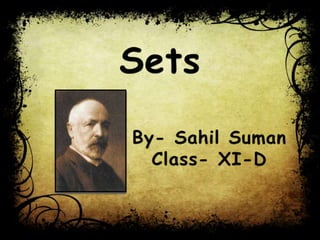
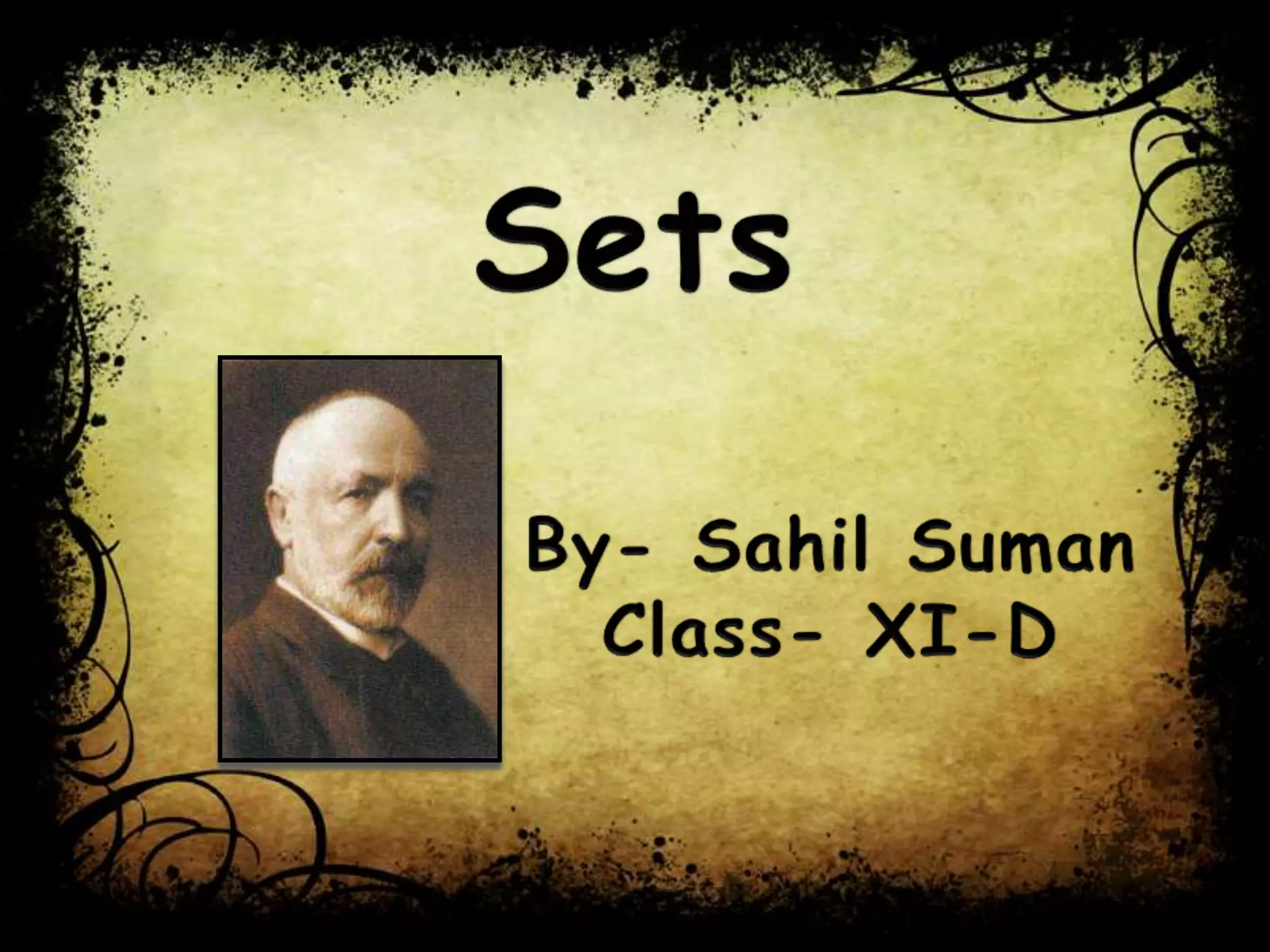
• The theory of sets was developed
by German mathematician George
Cantor.
• A set is a collection of objects.
• Objects in the collection are called
elements of the set.
• They are named by capital English
alphabet.
Representation Of
Sets• Roster form and Set Builder form
• Roster Form- when the elements are
written inside the set It is defined as
a set by actually listing its elements,
for example, the elements in the set A
of letters of the English alphabet can
be listed as A={a,b,c,……….,z} separated
by comas.
• Set Builder Form- when we write a
set in a straight form using
underlying relations that binds
them.
• Example- {x | x < 6 and x is a
counting number} in the set of all
counting numbers less than 6. Note
this is the same set as {1,2,3,4,5}.
Types Of Sets
• Empty Sets
• Finite Sets
• Infinite Sets
• Equal Sets
• Subsets
• Power Sets
• Universal Sets
Empty Sets
• A set that contains no members is
called the empty set or null set .
• For example, the set of the months
of a year that have fewer than 15
days has no member .Therefore ,it
is the empty set. The empty set is
written as { } or .
Finite Sets
• A set is finite if it consists of a
definite number of different
elements ,i.e., if in counting the
different members of the set, the
counting process can come to an end.
• For example, if W be the set of
people living in a town, then W is
finite.
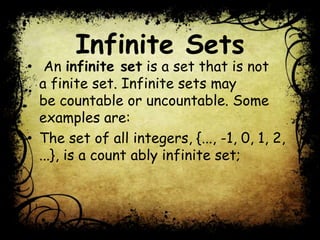
Infinite Sets
• An infinite set is a set that is not
a finite set. Infinite sets may
be countable or uncountable. Some
examples are:
• The set of all integers, {..., -1, 0, 1, 2,
...}, is a count ably infinite set;
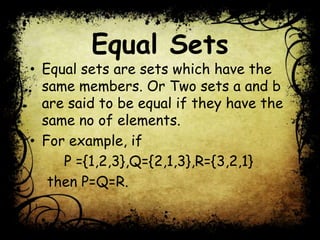
Equal Sets
• Equal sets are sets which have the
same members. Or Two sets a and b
are said to be equal if they have the
same no of elements.
• For example, if
P ={1,2,3},Q={2,1,3},R={3,2,1}
then P=Q=R.
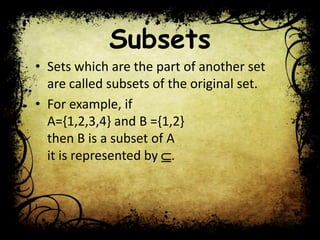
Subsets
• Sets which are the part of another set
are called subsets of the original set.
• For example, if
A={1,2,3,4} and B ={1,2}
then B is a subset of A
it is represented by .
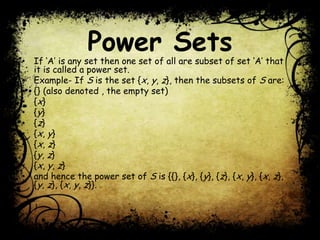
Power Sets• If ‘A’ is any set then one set of all are subset of set ‘A’ that
it is called a power set.
• Example- If S is the set {x, y, z}, then the subsets of S are:
• {} (also denoted , the empty set)
• {x}
• {y}
• {z}
• {x, y}
• {x, z}
• {y, z}
• {x, y, z}
• and hence the power set of S is {{}, {x}, {y}, {z}, {x, y}, {x, z},
{y, z}, {x, y, z}}.
Universal Sets
• A universal set is a set which contains all
objects, including itself. Or
• In a group of sets if all the sets are the
subset of a particular bigger set then that
bigger set then that bigger set is called the
universal set.
• Example- A={12345678}
B={1357}
C={2468}
D={2367}
Here A is universal set and is
denoted by
Operation Of Sets
• Union of sets
• Intersection of sets
• Compliments of sets
Union
• The union of two sets would be
wrote as A U B, which is the set of
elements that are members of A or
B, or both too.
• Using set-builder notation,
A U B = {x : x is a member of A or
X is a member of B}
Intersection
• Intersection are written as A ∩ B,
is the set of elements that are in A
and B.
• Using set-builder notation, it would
look like:
A ∩ B = {x : x is a member of A and
x is a member of B}.
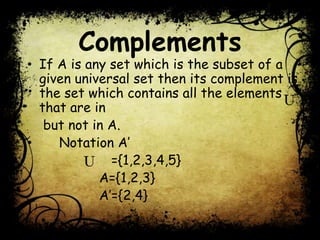
Complements
• If A is any set which is the subset of a
given universal set then its complement is
the set which contains all the elements
that are in
but not in A.
• Notation A’
={1,2,3,4,5}
A={1,2,3}
A’={2,4}
Some Other Sets
• Disjoint – If A ∩ B = 0, then A and B
are disjoint.
• Difference: B – A; all the elements in B
but not in A
• Equivalent sets – two sets are
equivalent if n(A) = n(B).
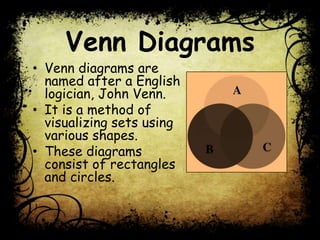
Venn Diagrams
• Venn diagrams are
named after a English
logician, John Venn.
• It is a method of
visualizing sets using
various shapes.
• These diagrams
consist of rectangles
and circles.
Dxc

Dxc

  • 2.
    Introduction • The theoryof sets was developed by German mathematician George Cantor. • A set is a collection of objects. • Objects in the collection are called elements of the set. • They are named by capital English alphabet.
  • 3.
    Representation Of Sets• Rosterform and Set Builder form • Roster Form- when the elements are written inside the set It is defined as a set by actually listing its elements, for example, the elements in the set A of letters of the English alphabet can be listed as A={a,b,c,……….,z} separated by comas.
  • 4.
    • Set BuilderForm- when we write a set in a straight form using underlying relations that binds them. • Example- {x | x < 6 and x is a counting number} in the set of all counting numbers less than 6. Note this is the same set as {1,2,3,4,5}.
  • 5.
    Types Of Sets •Empty Sets • Finite Sets • Infinite Sets • Equal Sets • Subsets • Power Sets • Universal Sets
  • 6.
    Empty Sets • Aset that contains no members is called the empty set or null set . • For example, the set of the months of a year that have fewer than 15 days has no member .Therefore ,it is the empty set. The empty set is written as { } or .
  • 7.
    Finite Sets • Aset is finite if it consists of a definite number of different elements ,i.e., if in counting the different members of the set, the counting process can come to an end. • For example, if W be the set of people living in a town, then W is finite.
  • 8.
    Infinite Sets • Aninfinite set is a set that is not a finite set. Infinite sets may be countable or uncountable. Some examples are: • The set of all integers, {..., -1, 0, 1, 2, ...}, is a count ably infinite set;
  • 9.
    Equal Sets • Equalsets are sets which have the same members. Or Two sets a and b are said to be equal if they have the same no of elements. • For example, if P ={1,2,3},Q={2,1,3},R={3,2,1} then P=Q=R.
  • 10.
    Subsets • Sets whichare the part of another set are called subsets of the original set. • For example, if A={1,2,3,4} and B ={1,2} then B is a subset of A it is represented by .
  • 11.
    Power Sets• If‘A’ is any set then one set of all are subset of set ‘A’ that it is called a power set. • Example- If S is the set {x, y, z}, then the subsets of S are: • {} (also denoted , the empty set) • {x} • {y} • {z} • {x, y} • {x, z} • {y, z} • {x, y, z} • and hence the power set of S is {{}, {x}, {y}, {z}, {x, y}, {x, z}, {y, z}, {x, y, z}}.
  • 12.
    Universal Sets • Auniversal set is a set which contains all objects, including itself. Or • In a group of sets if all the sets are the subset of a particular bigger set then that bigger set then that bigger set is called the universal set. • Example- A={12345678} B={1357} C={2468} D={2367} Here A is universal set and is denoted by
  • 13.
    Operation Of Sets •Union of sets • Intersection of sets • Compliments of sets
  • 14.
    Union • The unionof two sets would be wrote as A U B, which is the set of elements that are members of A or B, or both too. • Using set-builder notation, A U B = {x : x is a member of A or X is a member of B}
  • 15.
    Intersection • Intersection arewritten as A ∩ B, is the set of elements that are in A and B. • Using set-builder notation, it would look like: A ∩ B = {x : x is a member of A and x is a member of B}.
  • 16.
    Complements • If Ais any set which is the subset of a given universal set then its complement is the set which contains all the elements that are in but not in A. • Notation A’ ={1,2,3,4,5} A={1,2,3} A’={2,4}
  • 17.
    Some Other Sets •Disjoint – If A ∩ B = 0, then A and B are disjoint. • Difference: B – A; all the elements in B but not in A • Equivalent sets – two sets are equivalent if n(A) = n(B).
  • 18.
    Venn Diagrams • Venndiagrams are named after a English logician, John Venn. • It is a method of visualizing sets using various shapes. • These diagrams consist of rectangles and circles.