This document provides an overview of set theory concepts including:
1. It defines what a set is and introduces some key terms like members, elements, and operations between sets.
2. It outlines several ways to represent sets including using rosters/lists and describing characteristic properties.
3. It discusses set notation where sets are denoted by capital letters and explains membership.
4. It describes different types of sets such as finite, infinite, null, singleton, and disjoint sets.
SET THEORY CONTENTS
•1. Meaning and definition.
2. Representation of a set.
3. Set notation.
4. Types and kinds of set.
5. Sub-set and Universal set.
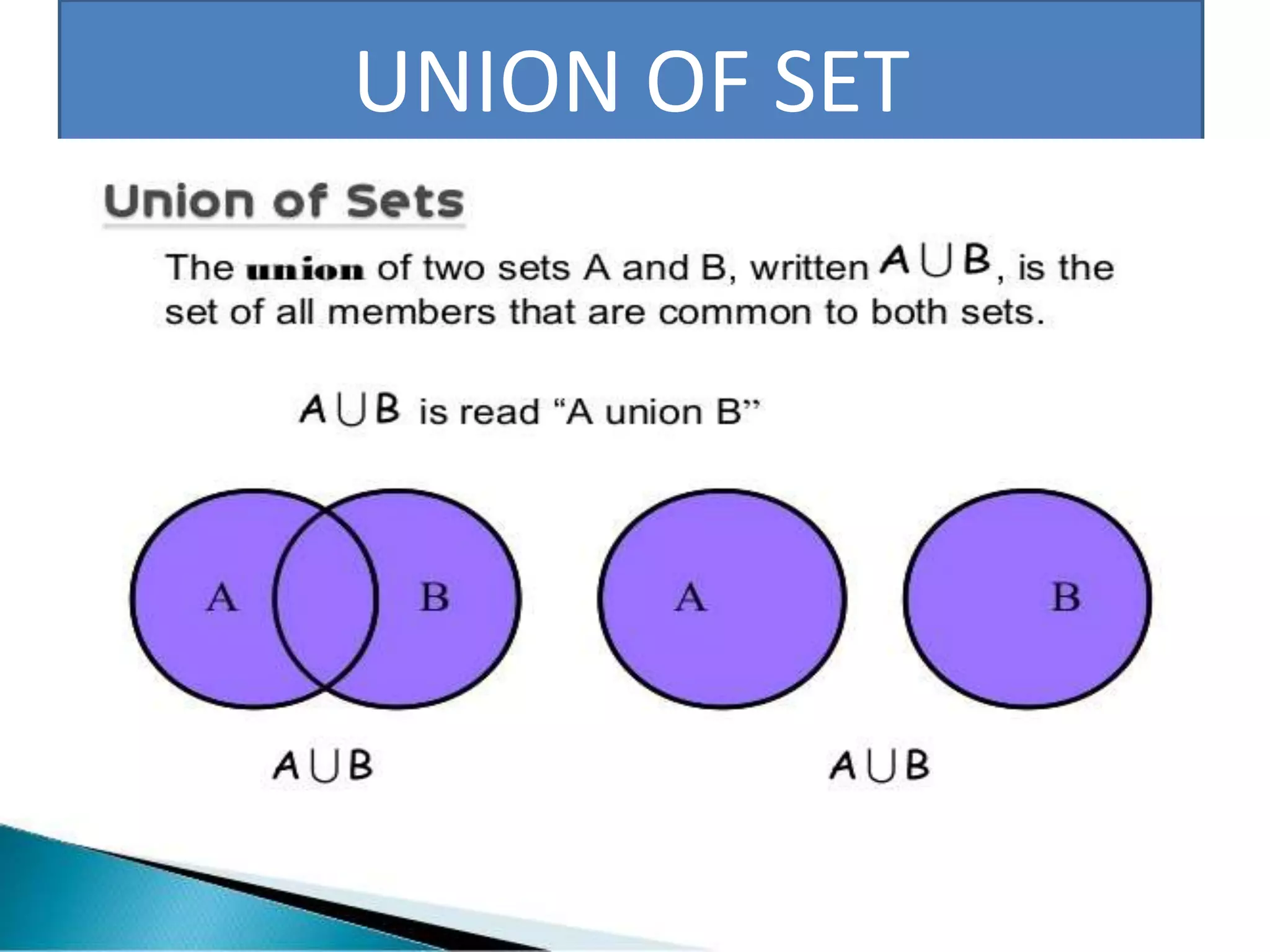
6.Union OF SET
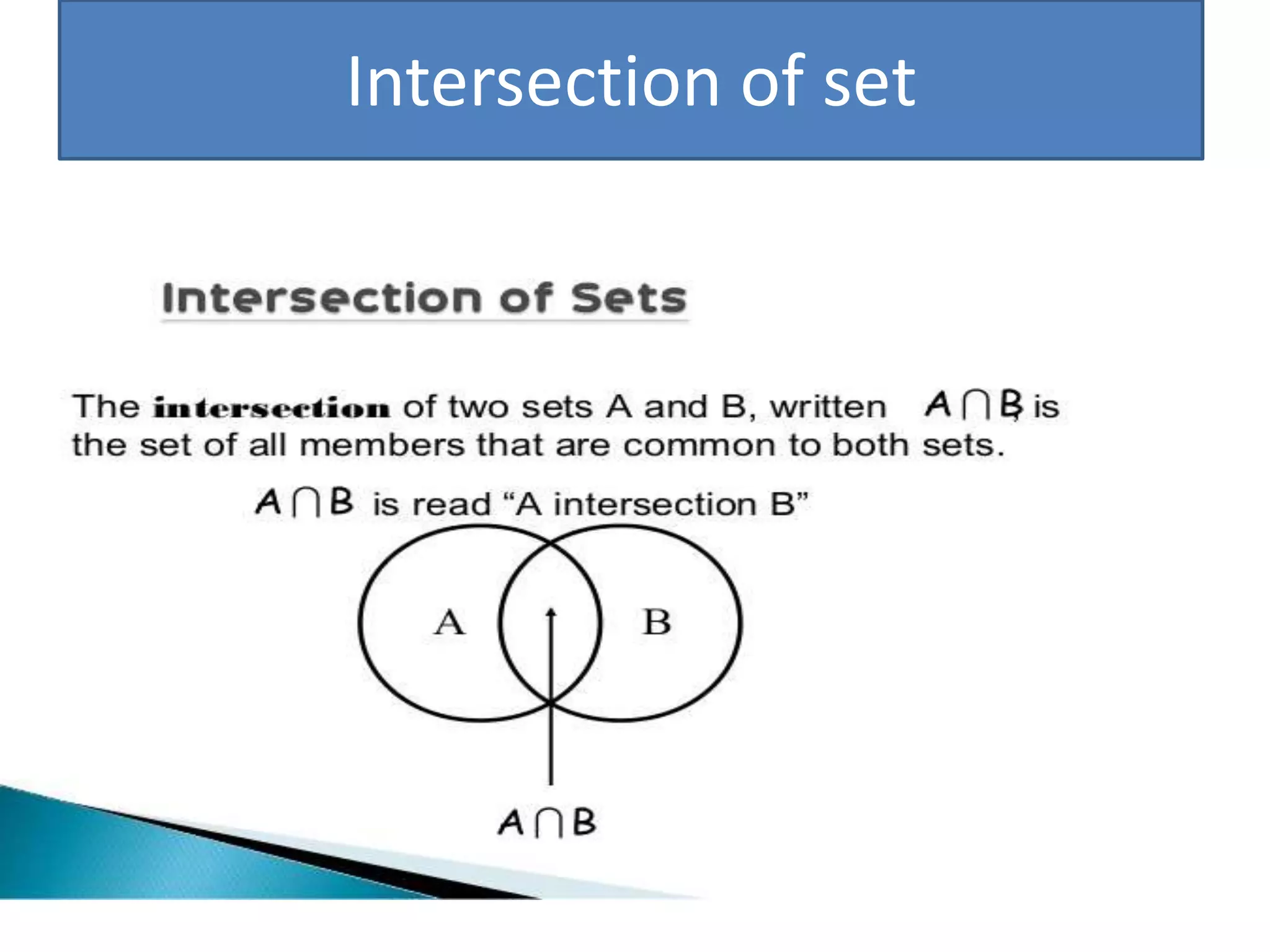
7. Intersection of set.
8. DE-MORGAN’S LAW.
3.
MEANING AND DEFINITATION
•The concept of set was introduce in the end of
19th century by German mathematician
GEORGE CANTER (1845-1918)
• A set a structure ,representing an unordered
collection (group , plurality) of zero or more
distinct(different) objects.
• The objects that makes up a set is called
member or objects of the set.
• Set theory deals with operations between
,relations among ,and statements about sets.
4.
REORESENTATION OF SET
Aset can be represented by two method
(1). Tabular or Roster method = Under this method
,the element of a set are enumerated or listed
within parentheses ( ), , , separated by
commas (,) .
(2). Builder method = Under this method , the
element are indicated by description of their
characteristics or properties .( x: x is a element of
a set )
5.
SET NOTATION
• Normallyset are denoted by capital letters of
English alphabet like A,B,C,D,…..X,M ,Z
.Example A=( 1,2,3,4,5,6).
• If X is an element of a set A ,it is written as X is
not equal to A and read as ‘X’ does not
belongs to ‘A’ or ‘x’ is not an element of ‘A’ or
‘x’ is not in A. Example A= (1,2,3,4,) then 3 is
= A But 2 is not = to a.
6.
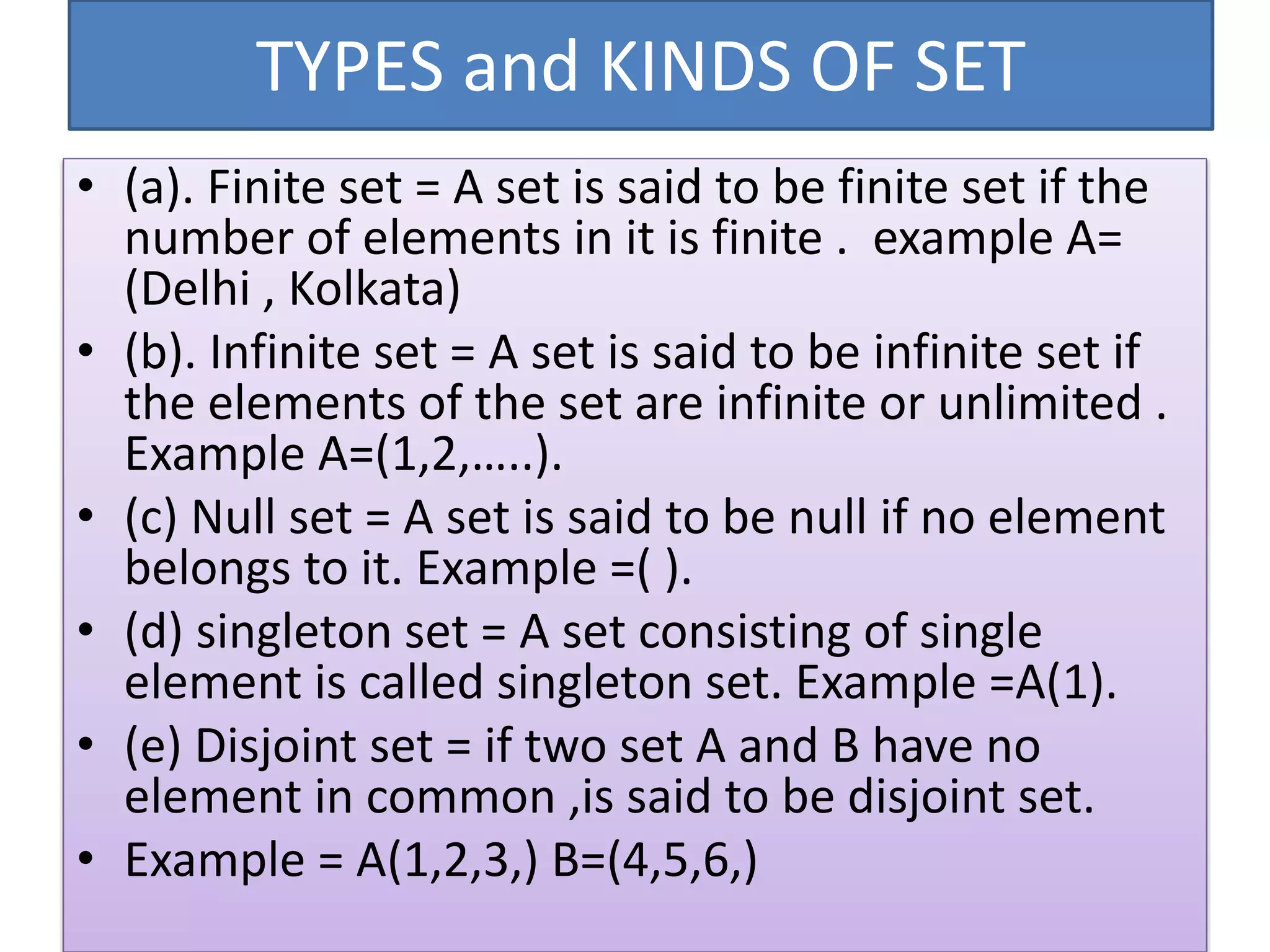
TYPES and KINDSOF SET
• (a). Finite set = A set is said to be finite set if the
number of elements in it is finite . example A=
(Delhi , Kolkata)
• (b). Infinite set = A set is said to be infinite set if
the elements of the set are infinite or unlimited .
Example A=(1,2,…..).
• (c) Null set = A set is said to be null if no element
belongs to it. Example =( ).
• (d) singleton set = A set consisting of single
element is called singleton set. Example =A(1).
• (e) Disjoint set = if two set A and B have no
element in common ,is said to be disjoint set.
• Example = A(1,2,3,) B=(4,5,6,)
7.
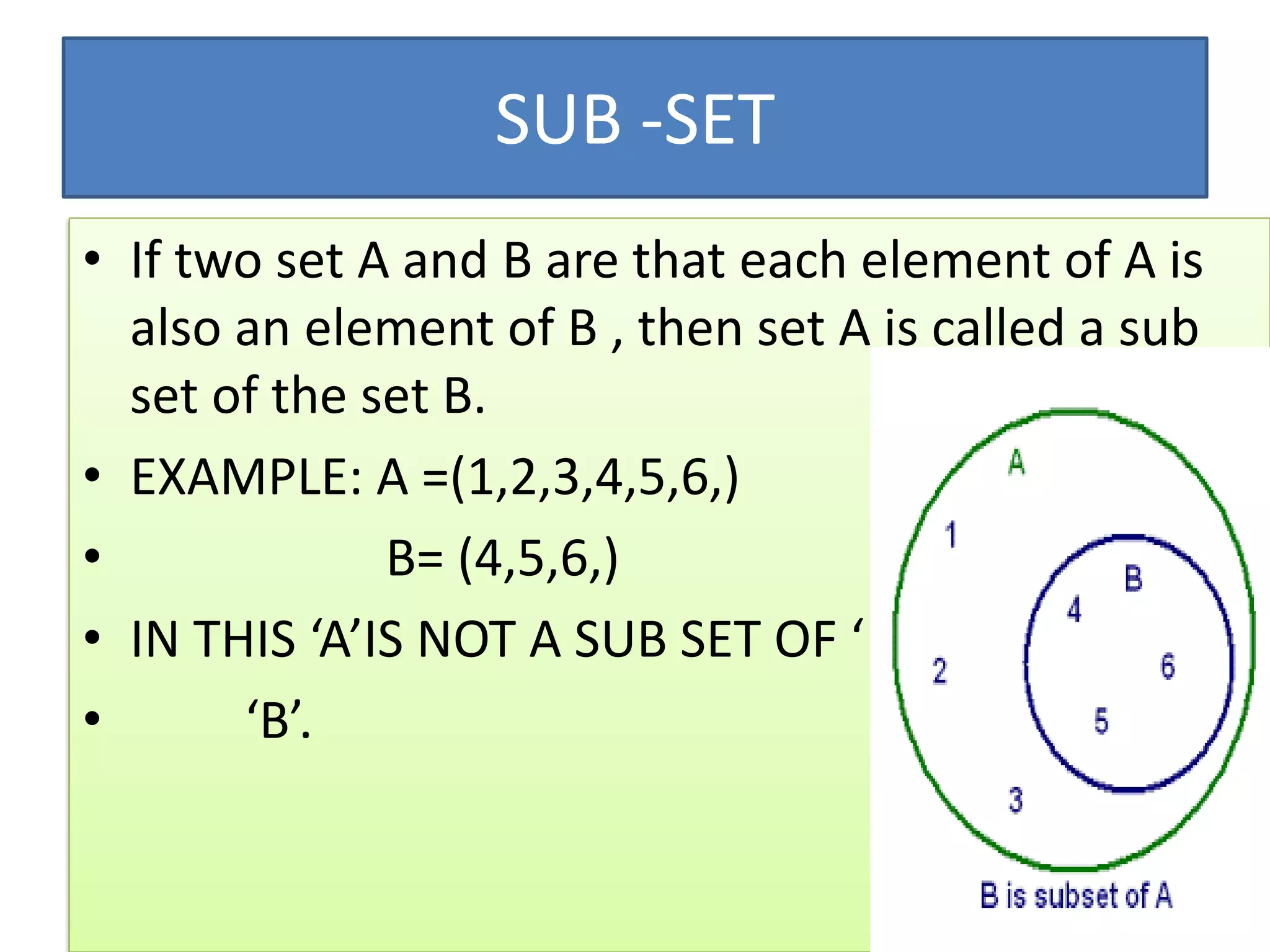
SUB -SET
• Iftwo set A and B are that each element of A is
also an element of B , then set A is called a sub
set of the set B.
• EXAMPLE: A =(1,2,3,4,5,6,)
• B= (4,5,6,)
• IN THIS ‘A’IS NOT A SUB SET OF ‘
• ‘B’.
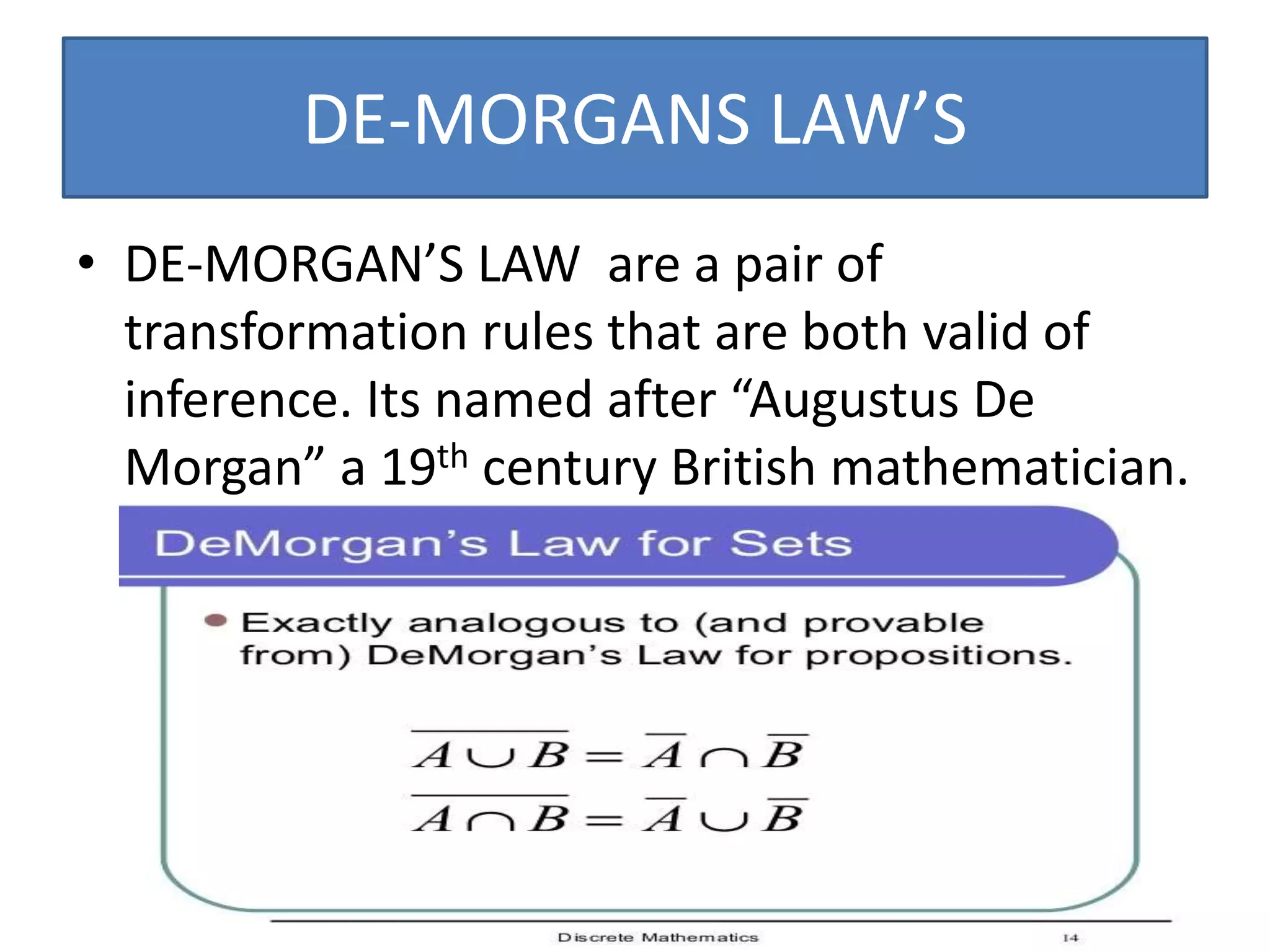
DE-MORGANS LAW’S
• DE-MORGAN’SLAW are a pair of
transformation rules that are both valid of
inference. Its named after “Augustus De
Morgan” a 19th century British mathematician.