Negotiation
    GSCM 506-01


Ethics in Negotiations
      Chapter 9


        10 October 2012
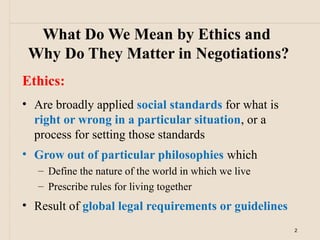
What Do We Mean by Ethics and
 Why Do They Matter in Negotiations?
Ethics:
• Are broadly applied social standards for what is
  right or wrong in a particular situation, or a
  process for setting those standards
• Grow out of particular philosophies which
   – Define the nature of the world in which we live
   – Prescribe rules for living together
• Result of global legal requirements or guidelines
                                                       2
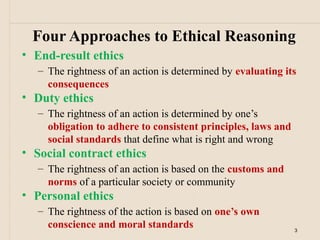
Four Approaches to Ethical Reasoning
• End-result ethics
   – The rightness of an action is determined by evaluating its
     consequences
• Duty ethics
   – The rightness of an action is determined by one’s
     obligation to adhere to consistent principles, laws and
     social standards that define what is right and wrong
• Social contract ethics
   – The rightness of an action is based on the customs and
     norms of a particular society or community
• Personal ethics
   – The rightness of the action is based on one’s own
     conscience and moral standards                            3
Examples of Ethical Conduct
        that Arise in Negotiation
• Using ethically ambiguous tactics: It’s
  (mostly) all about the truth

• Deception by omission versus commission
  – Omission – failing to disclose information that
    would benefit the other
  – Commission – actually lying about the common-
    value issue

                                                      4
Rationalizations for Unethical Conduct
• The tactic was unavoidable
• The tactic was harmless
• The tactic will help to avoid negative consequences
• The tactic will produce good consequences
• “They had it coming,” or “They deserve it,”
• “They were going to do it anyway, so I’ll do it first”
• “They started it”
• The tactic is fair or appropriate to the situation   5
How Can Negotiators Deal With the
    Other Party’s Use of Deception?
• Ask probing questions
• Phrase questions in different ways
• Test the other party
• “Call” the tactic
• Ignore the tactic
• Discuss what you see and offer to help the other
  party change to more honest behaviors
• Respond in kind
                                                     6
Ethical Standards to Follow in Negotiations
1. Ethical Perceptions        8. Governing Laws

2. Responsibilities to the    9. Small,
   Employer                      Disadvantaged, and
                                 Minority Owned
3. Conflict of Interest          Businesses

4. Gratuities                 10.Personal Purchases
                                 for Employees
5. Confidential Information
                              11.Responsibilities to
6. Treatment of Suppliers        the Profession

7. Reciprocity                12.Global Supply
                                 Management
                                                       7
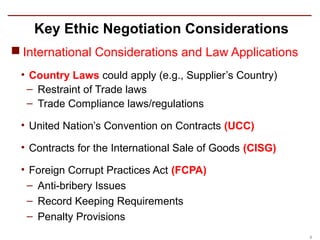
Key Ethic Negotiation Considerations
 International Considerations and Law Applications
 • Country Laws could apply (e.g., Supplier’s Country)
  – Restraint of Trade laws
  – Trade Compliance laws/regulations

 • United Nation’s Convention on Contracts (UCC)

 • Contracts for the International Sale of Goods (CISG)

 • Foreign Corrupt Practices Act (FCPA)
  – Anti-bribery Issues
  – Record Keeping Requirements
  – Penalty Provisions
                                                          8
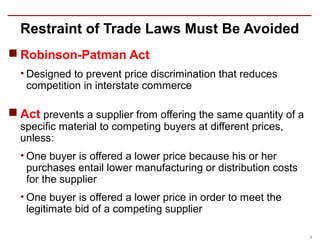
Restraint of Trade Laws Must Be Avoided
 Robinson-Patman Act
  • Designed to prevent price discrimination that reduces
    competition in interstate commerce

 Act prevents a supplier from offering the same quantity of a
  specific material to competing buyers at different prices,
  unless:
  • One buyer is offered a lower price because his or her
    purchases entail lower manufacturing or distribution costs
    for the supplier
  • One buyer is offered a lower price in order to meet the
    legitimate bid of a competing supplier

                                                                 9
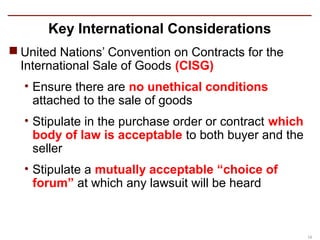
Key International Considerations
 United Nations’ Convention on Contracts for the
  International Sale of Goods (CISG)
  • Ensure there are no unethical conditions
    attached to the sale of goods
  • Stipulate in the purchase order or contract which
    body of law is acceptable to both buyer and the
    seller
  • Stipulate a mutually acceptable “choice of
    forum” at which any lawsuit will be heard


                                                        10
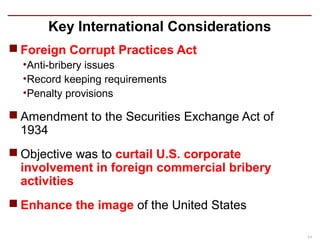
Key International Considerations
 Foreign Corrupt Practices Act
  •Anti-bribery issues
  •Record keeping requirements
  •Penalty provisions

 Amendment to the Securities Exchange Act of
  1934
 Objective was to curtail U.S. corporate
  involvement in foreign commercial bribery
  activities
 Enhance the image of the United States

                                                11
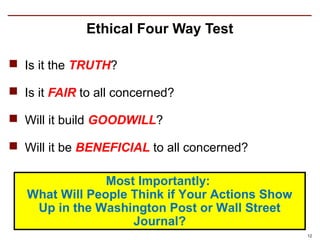
Ethical Four Way Test

 Is it the TRUTH?

 Is it FAIR to all concerned?

 Will it build GOODWILL?

 Will it be BENEFICIAL to all concerned?

                Most Importantly:
   What Will People Think if Your Actions Show
    Up in the Washington Post or Wall Street
                    Journal?
                                                 12
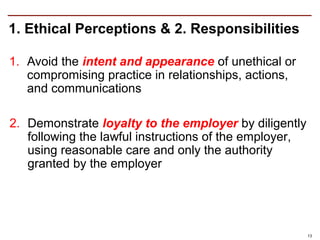
1. Ethical Perceptions & 2. Responsibilities

1. Avoid the intent and appearance of unethical or
   compromising practice in relationships, actions,
   and communications

2. Demonstrate loyalty to the employer by diligently
   following the lawful instructions of the employer,
   using reasonable care and only the authority
   granted by the employer


                                                        13
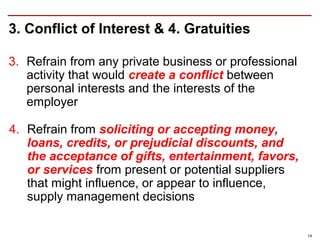
3. Conflict of Interest & 4. Gratuities

3. Refrain from any private business or professional
   activity that would create a conflict between
   personal interests and the interests of the
   employer

4. Refrain from soliciting or accepting money,
   loans, credits, or prejudicial discounts, and
   the acceptance of gifts, entertainment, favors,
   or services from present or potential suppliers
   that might influence, or appear to influence,
   supply management decisions

                                                       14
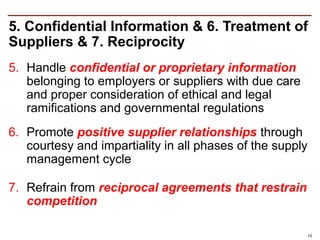
5. Confidential Information & 6. Treatment of
Suppliers & 7. Reciprocity
5. Handle confidential or proprietary information
   belonging to employers or suppliers with due care
   and proper consideration of ethical and legal
   ramifications and governmental regulations
6. Promote positive supplier relationships through
   courtesy and impartiality in all phases of the supply
   management cycle

7. Refrain from reciprocal agreements that restrain
   competition

                                                       15
8. Governing Laws & 9. Small, Disadvantaged,
and Minority Owned Businesses
8. Know and obey the letter and spirit of laws
   governing the supply management function, and
   remain alert to the legal ramifications of supply
   management decisions

9. Encourage all segments of society to participate
   by providing access for small, disadvantaged, and
   minority-owned businesses


                                                       16
10. Personal Purchases for Employees &
11. Responsibilities to the Profession

10.Discourage supply management’s involvement in
   employer-sponsored programs of personal
   purchases that are not business related

11.Enhance the proficiency and stature of the supply
   management profession by acquiring and
   maintaining current technical knowledge and the
   highest standards of ethical behavior


                                                   17
12. Global Supply Management

12. Conduct international supply management in
    accordance with:
   • the laws, customs, and practices of foreign
     countries,
   • consistent with your country’s laws,
   • your organization’s policies,
   • and these Ethical Standards and Guidelines


                                                   18

Session13 chap 9 ethics in negotiation enhanced 03 oct12

  • 1.
    Negotiation GSCM 506-01 Ethics in Negotiations Chapter 9 10 October 2012
  • 2.
    What Do WeMean by Ethics and Why Do They Matter in Negotiations? Ethics: • Are broadly applied social standards for what is right or wrong in a particular situation, or a process for setting those standards • Grow out of particular philosophies which – Define the nature of the world in which we live – Prescribe rules for living together • Result of global legal requirements or guidelines 2
  • 3.
    Four Approaches toEthical Reasoning • End-result ethics – The rightness of an action is determined by evaluating its consequences • Duty ethics – The rightness of an action is determined by one’s obligation to adhere to consistent principles, laws and social standards that define what is right and wrong • Social contract ethics – The rightness of an action is based on the customs and norms of a particular society or community • Personal ethics – The rightness of the action is based on one’s own conscience and moral standards 3
  • 4.
    Examples of EthicalConduct that Arise in Negotiation • Using ethically ambiguous tactics: It’s (mostly) all about the truth • Deception by omission versus commission – Omission – failing to disclose information that would benefit the other – Commission – actually lying about the common- value issue 4
  • 5.
    Rationalizations for UnethicalConduct • The tactic was unavoidable • The tactic was harmless • The tactic will help to avoid negative consequences • The tactic will produce good consequences • “They had it coming,” or “They deserve it,” • “They were going to do it anyway, so I’ll do it first” • “They started it” • The tactic is fair or appropriate to the situation 5
  • 6.
    How Can NegotiatorsDeal With the Other Party’s Use of Deception? • Ask probing questions • Phrase questions in different ways • Test the other party • “Call” the tactic • Ignore the tactic • Discuss what you see and offer to help the other party change to more honest behaviors • Respond in kind 6
  • 7.
    Ethical Standards toFollow in Negotiations 1. Ethical Perceptions 8. Governing Laws 2. Responsibilities to the 9. Small, Employer Disadvantaged, and Minority Owned 3. Conflict of Interest Businesses 4. Gratuities 10.Personal Purchases for Employees 5. Confidential Information 11.Responsibilities to 6. Treatment of Suppliers the Profession 7. Reciprocity 12.Global Supply Management 7
  • 8.
    Key Ethic NegotiationConsiderations  International Considerations and Law Applications • Country Laws could apply (e.g., Supplier’s Country) – Restraint of Trade laws – Trade Compliance laws/regulations • United Nation’s Convention on Contracts (UCC) • Contracts for the International Sale of Goods (CISG) • Foreign Corrupt Practices Act (FCPA) – Anti-bribery Issues – Record Keeping Requirements – Penalty Provisions 8
  • 9.
    Restraint of TradeLaws Must Be Avoided  Robinson-Patman Act • Designed to prevent price discrimination that reduces competition in interstate commerce  Act prevents a supplier from offering the same quantity of a specific material to competing buyers at different prices, unless: • One buyer is offered a lower price because his or her purchases entail lower manufacturing or distribution costs for the supplier • One buyer is offered a lower price in order to meet the legitimate bid of a competing supplier 9
  • 10.
    Key International Considerations United Nations’ Convention on Contracts for the International Sale of Goods (CISG) • Ensure there are no unethical conditions attached to the sale of goods • Stipulate in the purchase order or contract which body of law is acceptable to both buyer and the seller • Stipulate a mutually acceptable “choice of forum” at which any lawsuit will be heard 10
  • 11.
    Key International Considerations Foreign Corrupt Practices Act •Anti-bribery issues •Record keeping requirements •Penalty provisions  Amendment to the Securities Exchange Act of 1934  Objective was to curtail U.S. corporate involvement in foreign commercial bribery activities  Enhance the image of the United States 11
  • 12.
    Ethical Four WayTest  Is it the TRUTH?  Is it FAIR to all concerned?  Will it build GOODWILL?  Will it be BENEFICIAL to all concerned? Most Importantly: What Will People Think if Your Actions Show Up in the Washington Post or Wall Street Journal? 12
  • 13.
    1. Ethical Perceptions& 2. Responsibilities 1. Avoid the intent and appearance of unethical or compromising practice in relationships, actions, and communications 2. Demonstrate loyalty to the employer by diligently following the lawful instructions of the employer, using reasonable care and only the authority granted by the employer 13
  • 14.
    3. Conflict ofInterest & 4. Gratuities 3. Refrain from any private business or professional activity that would create a conflict between personal interests and the interests of the employer 4. Refrain from soliciting or accepting money, loans, credits, or prejudicial discounts, and the acceptance of gifts, entertainment, favors, or services from present or potential suppliers that might influence, or appear to influence, supply management decisions 14
  • 15.
    5. Confidential Information& 6. Treatment of Suppliers & 7. Reciprocity 5. Handle confidential or proprietary information belonging to employers or suppliers with due care and proper consideration of ethical and legal ramifications and governmental regulations 6. Promote positive supplier relationships through courtesy and impartiality in all phases of the supply management cycle 7. Refrain from reciprocal agreements that restrain competition 15
  • 16.
    8. Governing Laws& 9. Small, Disadvantaged, and Minority Owned Businesses 8. Know and obey the letter and spirit of laws governing the supply management function, and remain alert to the legal ramifications of supply management decisions 9. Encourage all segments of society to participate by providing access for small, disadvantaged, and minority-owned businesses 16
  • 17.
    10. Personal Purchasesfor Employees & 11. Responsibilities to the Profession 10.Discourage supply management’s involvement in employer-sponsored programs of personal purchases that are not business related 11.Enhance the proficiency and stature of the supply management profession by acquiring and maintaining current technical knowledge and the highest standards of ethical behavior 17
  • 18.
    12. Global SupplyManagement 12. Conduct international supply management in accordance with: • the laws, customs, and practices of foreign countries, • consistent with your country’s laws, • your organization’s policies, • and these Ethical Standards and Guidelines 18